
- A cash home buyer buys your Connecticut house without a mortgage, usually as-is, and can close in about one to three weeks. It is one of several ways to sell; our guide on how to sell a house in Connecticut covers them all.
- The offer is a formula: the after-repair value, minus repairs, minus the buyer’s resale costs, minus holding and financing costs, minus a profit margin. A buyer who cannot show you that math is guessing, or hiding something.
- Cash offers are below retail. On a house that needs moderate work, the formula lands at roughly 55% to 70% of the after-repair value (our estimate, not survey data). Nobody publishes reliable statewide figures; be wary of anyone who quotes one.
- Connecticut now regulates wholesalers. Since July 1, 2026, anyone who signs a contract to buy your house and then sells that contract to someone else must be registered with the Department of Consumer Protection, give you a state disclosure report, and let you cancel within three business days (CGS 20-329aaa to 20-329hhh).
- You still pay Connecticut seller costs: the conveyance tax (1% to 1.25% on most homes) and your own attorney, unless the buyer agrees in writing to cover them.
- Listing usually nets more for a house that is in decent shape, can be financed by a buyer’s bank, and has time to sell. A cash sale wins on condition, speed and certainty, not on price.
What is a cash home buyer in Connecticut?
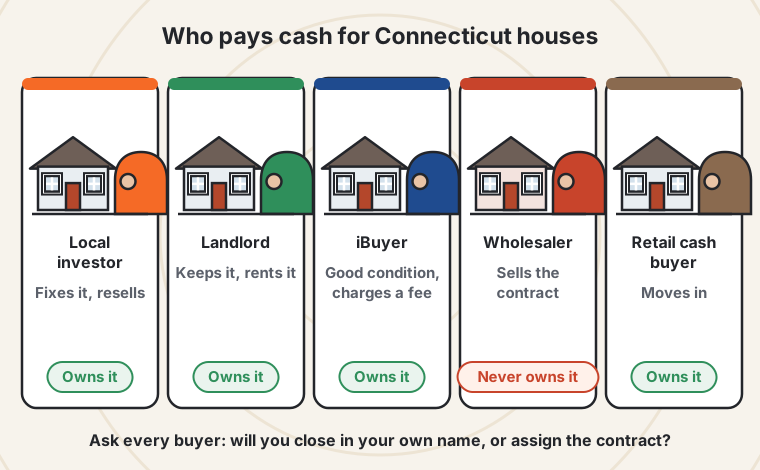
A cash home buyer in Connecticut is a person or company that buys houses without a mortgage loan, usually as-is, and closes on the seller’s schedule through Connecticut attorneys. Most are local investors who renovate and resell or rent the house. Others are wholesalers who sell your contract to another investor, national franchises, iBuyers, and ordinary buyers who simply have the money.
“Cash” means the buyer does not need a bank’s approval to close. The money may come from the buyer’s own account, a business line of credit or a private lender, but none of it depends on a mortgage underwriter, a bank appraisal or a loan commitment. That is what makes a cash sale faster and more certain than a financed one.
When people search for “cash home buyers,” they almost always mean the second group: companies and investors who advertise “we buy houses” and make offers on houses in any condition. Those buyers are in business to make a profit on the house after they buy it, which is why their offers are below what the same house would sell for after a renovation. This guide explains how that gap is calculated, when it is worth paying, and when it is not.
Who is behind the signs and the postcards
- Local investors. Small Connecticut companies or individuals who buy a few to a few dozen houses a year, renovate them and resell them (a “flip”), or keep them as rentals. They close in their own name or their company’s name.
- Landlords and buy-and-hold investors. They buy to rent. Multi-family houses in cities like Hartford, New Haven, Bridgeport and Waterbury draw many of them. They often pay more for a house that already has good tenants and less for one that needs a full renovation.
- Wholesalers. They sign a contract to buy your house and then sell (“assign”) that contract to another investor for a fee, without ever owning the house. Connecticut now requires them to register with the state. See the wholesaler section.
- Franchises and national brands. Large “we buy houses” brands run by local franchise owners, and national companies that buy online. Some buy; some pass leads on to local investors.
- iBuyers. Technology companies that make computer-generated offers on houses in good condition and charge a service fee. Their coverage is concentrated in specific metro areas, so check whether any of them actually makes offers at your Connecticut address.
- Ordinary buyers who pay cash. Downsizers, relocating families and second-home buyers who pay without a mortgage. They usually buy through agents on the open market at market prices, and they rarely buy houses that need major work.
What national “cash buyer” pages get wrong about Connecticut
Most pages that rank for this topic are directories or sales funnels from national companies. They miss the Connecticut parts:
| What national pages say | What is true in Connecticut |
|---|---|
| “The cash buyer pays all closing costs.” | The seller owes the Connecticut conveyance tax by law (CGS 12-494): 0.75% state plus 0.25% or 0.50% town on most homes. A buyer can agree to reimburse it, but only the contract decides that. |
| “Close with a title or escrow company.” | Connecticut closings are run by attorneys, and in practice each side has its own. Your deposit should sit in an attorney’s clients’ funds account, not with the buyer. |
| “Wholesalers are unregulated.” | Since July 1, 2026, wholesalers must register with the Department of Consumer Protection, give you a state disclosure report, and let you cancel within three business days (CGS 20-329aaa to 20-329hhh). |
| “Sell as-is and skip the disclosures.” | As-is changes who repairs, not what you disclose. The Property Condition Disclosure Report still applies (or a $500 credit, CGS 20-327c), and the wholesaler law makes you hand that report to a wholesaler before signing. |
| “Investors pay 70% of value.” | The “70% rule” is an investor rule of thumb, not a law or a statistic. Connecticut offers move with repairs, the town’s mill rate, the conveyance tax on the resale and the buyer’s financing. |
| Directory lists “Connecticut cash buyers.” | Several directory listings for Connecticut show New York, Massachusetts or Texas addresses. A buyer who has never closed in your town cannot price your town. |
How does selling to a cash home buyer work in Connecticut?
Selling to a cash home buyer in Connecticut works in six steps: you contact the buyer, they see the house in person or by photos, they give you a written offer, both attorneys handle a purchase contract, the buyer’s attorney searches the title while yours orders your mortgage payoff, and you sign at a closing run by the attorneys. With a clean title, that usually takes one to three weeks.
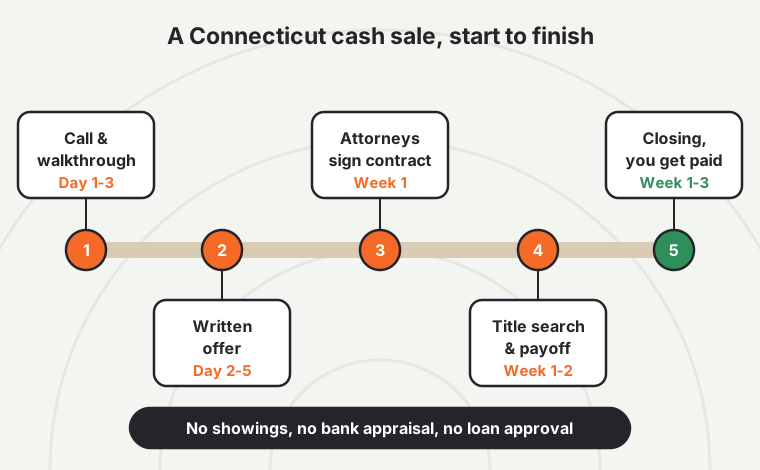
The difference from a normal sale is what is missing. There is no listing, no showings, no buyer’s mortgage commitment and no bank appraisal. Inspections are usually a single walkthrough, and the price already accounts for the condition. What stays the same is everything Connecticut law and title insurance require.
- First contact. You call or fill in a form. A serious buyer asks about the house, the mortgage balance, who is on the deed, and your timing.
- Walkthrough or photos. Most local buyers want to see the basement, roof, heating system, electrical panel and water heater. Some will make an offer from photos and confirm it at a walkthrough.
- Written offer. Price, deposit, closing date, what the buyer pays and what you pay, and any contingencies. Get it in writing before you decide anything.
- Contract. In Connecticut the attorneys draft or review the purchase contract. Your attorney checks the deposit, the closing date, who pays the conveyance tax, the inspection terms and whether the buyer can assign the contract.
- Title and payoff. The buyer’s attorney searches the land records at your town clerk; your attorney requests your mortgage payoff and clears liens, open permits or unreleased old mortgages.
- Closing. You sign the deed, the conveyance tax return (Form OP-236) and the smoke and carbon monoxide affidavit (or give a $250 credit, CGS 29-453). Your attorney pays off your mortgage and sends you the rest.
Timing is set by the title work, the town’s municipal searches, your lender’s payoff letter and the attorneys’ schedules, not by the buyer’s bank. Our guide to how long it takes to sell a house in Connecticut compares this clock with a listing, and the Connecticut closing process for sellers explains each document you will sign.
Connecticut real estate closings are conducted by attorneys (CGS 51-88a). A cash buyer who suggests closing without attorneys, or asks you to sign a deed “now” and close later, is a buyer to walk away from. Hire your own Connecticut real estate attorney even when the buyer offers to “handle everything.”
How do cash home buyers calculate their offer?
Cash home buyers calculate their offer by starting from the after-repair value, the price the house should sell for once it is fixed, and subtracting the repairs, the costs to resell (commission, Connecticut conveyance tax, attorney), the costs of holding and financing the house while it is renovated, and a profit margin. What is left is the most they can pay you and still make the deal work.
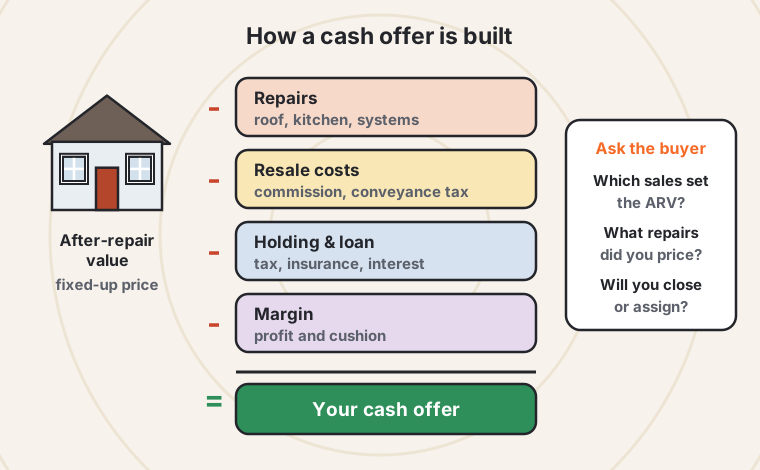
| Piece of the formula | What it is | Connecticut detail that moves it |
|---|---|---|
| After-repair value (ARV) | What the house should sell for, fully fixed, based on recent renovated sales nearby | Town and street matter more than the state average. A buyer who uses a statewide figure is not pricing your house. |
| Repairs | Everything needed to make the house sell at the ARV: roof, kitchen, baths, mechanicals, paint, floors, permits | Older housing stock (most single-family homes in New Haven, New Britain and Hartford-area cities were built before 1960), oil tanks, septic, lead paint, and crumbling foundations in north-central and eastern Connecticut. |
| Resale costs | Commission, the seller’s conveyance tax, attorney, buyer concessions on the resale | The investor pays the conveyance tax again when they resell: 1.25% total in the 16 cities with a 0.50% town rate, 1% in most other towns. |
| Holding and financing | Property tax, insurance, utilities, loan interest and points for the months of renovation and resale, plus the investor’s own closing costs | Mill rates run from about 25 to about 70 in the towns we cover, so the same house costs very different amounts to hold (see the town table). |
| Margin | The buyer’s profit and cushion for surprises | Bigger for houses with unknowns: foundation, oil tank, structural or permit problems, tenants. |
After-repair value: the number everything hangs on
The ARV is not your Zillow estimate or your town’s assessed value. It is what a buyer with a mortgage would pay for your house after it is renovated, based on renovated houses that actually sold nearby in the last few months. If the buyer’s ARV is too low, every offer they make will be too low, even if the rest of the math is honest. Ask which sales they used. You can check them yourself on Zillow, Redfin or the state’s real estate sales data on data.ct.gov.
Repairs: the most argued-over line
Investors price repairs at contractor rates plus a cushion, and they price everything a retail buyer’s inspector or lender would flag. That is why a list that looks like “$15,000 of work” to an owner can become $40,000 in an offer: the roof, a 1970s electrical panel, an old oil tank, a failing septic, lead paint on old windows, a kitchen that photographs badly. Our guide to what to fix before selling a house in Connecticut has typical Connecticut repair costs, and the oil tank, septic, well and radon guide covers the systems that most often surprise owners.
Resale costs: the Connecticut taxes the investor pays again
When the investor resells, they pay what any seller pays: commission, an attorney, often a credit toward the buyer’s closing costs, and the conveyance tax. On a $330,000 resale in a city with the 0.50% town rate, the conveyance tax alone is $4,125. The Connecticut conveyance tax guide lists every town’s rate.
Holding and financing: why time costs money
A renovation and resale often takes four to nine months (est.). Every month the investor pays your town’s property tax, insurance on a vacant house, heat and utilities, and interest on whatever they borrowed. Many local investors use short-term private or “hard money” loans that cost more than a home mortgage, plus upfront points (est.). That is why an offer on the same house can differ between a high-mill-rate city and a low-mill-rate suburb.
Margin: the line nobody likes to talk about
The margin is the investor’s pay for the risk, the work and the money tied up. A buyer who claims to make no profit is not telling you the truth. A fair margin is smaller on a simple cosmetic job and bigger on a house with unknowns, because one hidden problem can erase it. You cannot see the margin directly, but if the other four numbers are realistic, what is left is the margin.
Many investors start from a rule of thumb: offer about 70% of the after-repair value minus repairs. Clever, a brokerage that runs a cash-offer marketplace, says cash investors pay about 67.5% of after-repair value. Both are shortcuts, not data. The rule ignores your town’s mill rate, the conveyance tax and how long the work takes. Use it to sanity-check an offer, never to set your price.
What would a cash buyer offer on a $330,000 Connecticut house? A worked example
A cash buyer would offer roughly $196,000 on a house worth $330,000 after repairs, in this illustrative example of a 1960s ranch in Bristol that needs $45,000 of work. The buyer subtracts the repairs, about $21,800 to resell, about $27,300 to buy, hold and finance the house for six months, and a 12% margin. The numbers are an illustration of the method, not a quote or a real deal.
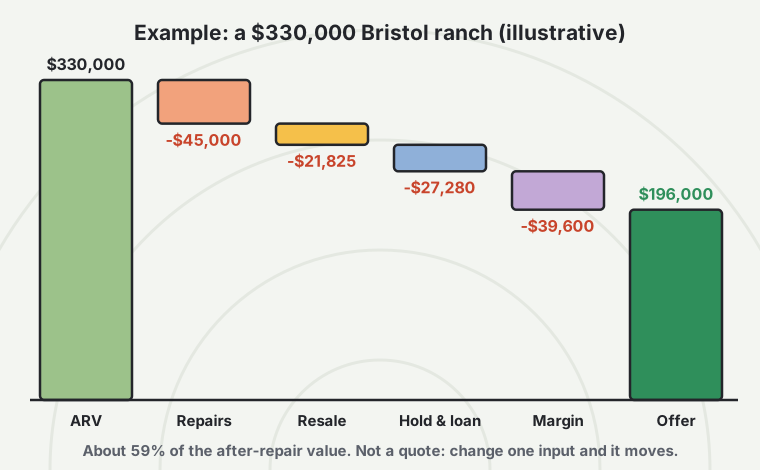
Bristol is a useful example because its numbers are typical of many Connecticut towns: a median single-family sale price of $330,000 from October 2024 to September 2025, a fiscal 2027 mill rate of 35.3, and the 0.50% town conveyance rate. Assume the house needs a roof, a kitchen, two bathrooms, paint and floors.
| Line | Amount (illustrative) | How it was figured |
|---|---|---|
| After-repair value | $330,000 | Bristol’s median single-family sale price, used as the renovated value |
| Repairs | −$45,000 | Roof about $12,000, kitchen $18,000, two baths $8,000, paint and floors $7,000 (est.) |
| Commission on the resale (5%) | −$16,500 | Both agents on the resale (est.) |
| Conveyance tax on the resale (1.25%) | −$4,125 | 0.75% state + 0.50% Bristol (CGS 12-494) |
| Attorney on the resale | −$1,200 | (est.) |
| Investor’s purchase closing costs | −$2,500 | Attorney and title insurance (est.) |
| Property tax, 6 months | −$4,080 | $680 a month on a $330,000 house at 70% assessment and 35.3 mills |
| Insurance and utilities, 6 months | −$2,700 | $200 + $250 a month (est.) |
| Loan interest, 6 months | −$13,200 | 11% a year on $240,000 borrowed for purchase and repairs (est.) |
| Loan points | −$4,800 | 2 points on $240,000 (est.) |
| Margin (12% of ARV) | −$39,600 | Profit and cushion (est.) |
| Maximum offer | $196,295, rounded to $196,000 | About 59% of the after-repair value |
Change one input and the offer moves. If the house needs only $15,000 of cosmetic work and can be resold in three months, the same formula gives an offer near $250,000 (about 76% of ARV). If the foundation is failing and the work runs past $100,000, the offer can drop below half of ARV, and some buyers will not make one at all.
The rule of thumb gives a similar answer here: 70% of $330,000 is $231,000, minus $45,000 of repairs is $186,000. The full formula came out $10,000 higher because Bristol’s mill rate and the six-month timeline are moderate. In a city with a mill rate near 70, or with a slower resale, it would come out lower.
How much do cash buyers pay compared with listing your house?
Cash buyers pay less than listing your house would bring, and how much less depends almost entirely on the house’s condition. In our estimate from the offer formula, a house needing light cosmetic work draws cash offers of about 70% to 80% of its after-repair value, moderate work 55% to 70%, and heavy or structural work 35% to 55%. No public data source tracks actual cash offers in Connecticut.
| Condition of the house | Typical repairs (est.) | Cash offer as % of after-repair value (est.) | Who usually buys |
|---|---|---|---|
| Dated but sound: paint, carpet, fixtures | Under $20,000 | About 70% to 80% | Flippers, landlords, iBuyers (where they operate), also many retail buyers |
| Needs a kitchen, baths, roof or mechanicals | $30,000 to $60,000 | About 55% to 70% | Local investors, landlords |
| Major: structural, foundation, fire or water damage, full gut | $80,000 and up | About 35% to 55% | Experienced local investors only |
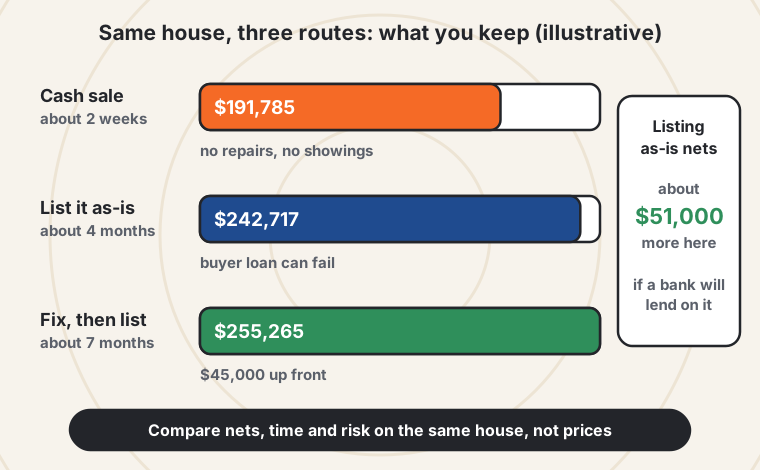
Two things matter more than any percentage. First, the comparison that counts is not the cash offer against your hoped-for list price, but your net from each route on the same house, after commissions, repairs, carrying costs and the risk of a failed deal. Second, an as-is listing is a real option for many houses: plenty of Connecticut buyers will take a dated house with a mortgage if it passes their lender’s appraisal.
The same Bristol house, three ways (illustrative)
Sell for cash
$191,785net after about 2 weeks
- $196,000 offer
- −$2,450 conveyance tax (1.25%)
- −$1,200 attorney (est.)
- −$565 two weeks of carrying (est.)
- No repairs, showings or commission
List it as-is
$242,717net after about 4 months
- $265,000 price (illustrative)
- −$13,250 commission (5%, est.)
- −$3,313 conveyance tax
- −$1,200 attorney (est.)
- −$4,520 four months of carrying (est.)
- Risk: the buyer’s appraisal or financing fails
Fix it, then list
$255,265net after about 7 months
- $330,000 price
- −$45,000 repairs you pay up front
- −$16,500 commission (5%, est.)
- −$4,125 conveyance tax
- −$1,200 attorney (est.)
- −$7,910 seven months of carrying (est.)
- Risk: cost overruns and delays
On this house, listing as-is nets about $51,000 more than the cash sale, and fixing and listing about $63,500 more, before you count your time, the cash you need up front, and what happens if a deal falls apart. That is the honest picture for a house a bank will lend on. The picture flips when a retail buyer’s lender will not finance the house, when the repairs are open-ended, or when you cannot wait four to seven months. The next sections say when.
Carrying is $1,130 a month in this example: $680 property tax, $200 insurance and $250 utilities (est.). Property tax proration and your mortgage payoff are the same in every route and are left out. Run your own numbers in the calculator.
How much would you walk away with?
Slide the numbers to match your house. It works in your browser; nothing is saved or sent.
Estimates for planning. Conveyance tax per CGS 12-494 (state 0.75% up to $800,000, 1.25% to $2.5M, 2.25% above, plus the town rate). Seller attorney about $1,200 to $1,500; flat-fee MLS about $400; listings include three months of taxes, insurance and utilities, a cash sale about two weeks. Your attorney gives you the final numbers.
iBuyers: the fee is the discount
iBuyers price differently from local investors. They make offers close to market value on houses in good condition, then subtract a service fee and a repair credit. Opendoor, the largest, says its fee “varies by market and property” and does not publish a fixed percentage; its own illustrative example uses a $17,500 fee on a $350,000 house, which is 5%. Repair credits come on top. iBuyers do not buy every house or every market, so the first question is whether any iBuyer makes offers at your Connecticut address at all.
Be careful with any cash offer far above what the formula allows. A common pattern is a high number to win the contract, followed by a long inspection period and a lower price two weeks before closing, after you have stopped talking to other buyers. A short inspection period and a deposit with your attorney are your protection. Our guide to comparing offers shows how to read the terms, not only the price.
What is the difference between iBuyers, local investors and wholesalers?
The difference between iBuyers, local investors and wholesalers is who ends up owning your house and how they make money. An iBuyer buys houses in good condition with an algorithm and charges a fee. A local investor buys the house itself, in any condition, and profits from renovating, reselling or renting it. A wholesaler signs a contract with you and sells that contract to another investor for an assignment fee, without ever owning the house.
| iBuyer | Local investor | Wholesaler | Retail cash buyer | |
|---|---|---|---|---|
| Who closes on your house | The iBuyer | The investor or their company | Usually someone else | The buyer |
| Houses they buy | Newer, good condition, in their markets | Any condition | Any condition, if they can find an end buyer | Move-in ready, through agents |
| How they price | Near market value minus a service fee and repairs | The offer formula | The end buyer’s formula minus the wholesaler’s fee | Market value |
| How they make money | Fee plus resale | Renovate and resell, or rent | Assignment fee or resale spread | They live in it |
| Typical time to close | A few weeks | 1 to 3 weeks | Often 30 to 90 days (capped at 90 by statute) | 30 to 45 days via an agent (often faster with cash) |
| Connecticut rules | Ordinary buyer | Ordinary buyer | Registration, disclosure report, 3-day cancel, 90-day cap | Ordinary buyer |
| Best for | A tidy house in a market they serve | A house that needs work, or a seller who needs certainty | Rarely the best choice for the seller; sometimes the only one who answers | A ready house with time to list |
Local investors
A local investor who closes in their own name is the simplest kind of cash buyer to deal with. The person who walks your house is the person who buys it, and their offer can be checked against the formula. The best ones can show you deeds they have recorded in your county’s towns, name the Connecticut attorney they close with, and explain their repair estimate line by line. Our posts on selling a house to an investor and whether an investor will pay close to asking price go deeper.
Landlords and buy-and-hold investors
A buy-and-hold investor prices from rent, not resale. On a two- or three-family house with paying tenants, that can mean a better offer than a flipper would make, because the investor does not need to renovate or resell. On a vacant house that needs a full renovation, their offer looks much like a flipper’s. If your house has tenants, see the landlord’s guide to selling a rental with tenants in Connecticut.
iBuyers
iBuyers make instant offers from data, inspect the house, and subtract a fee and repair costs. They suit a newer, tidy house in a market they cover and an owner who values a fixed closing date. They rarely buy multi-family houses, houses with major defects, or rural properties with wells and septic systems. If you get an iBuyer offer, compare its net, after the fee and repair credit, with what a listing agent says the house would net.
Franchises and national brands
Many “we buy houses” signs belong to franchises or national lead-generation companies. A local franchise owner may buy the house; a lead company may sell your name to investors. Neither is a problem in itself. Ask the person on the phone who will sign the contract and whose name will be on the deed.
What is a wholesaler, and how does Connecticut’s 2026 wholesaler law protect you?
A wholesaler is someone who signs a contract to buy your house and then sells, or “assigns,” that contract to another buyer for a fee, without ever owning the house. Since July 1, 2026, Connecticut requires every real estate wholesaler to register with the Department of Consumer Protection, give you a state disclosure report before you sign, let you cancel within three business days, and close within 90 days.
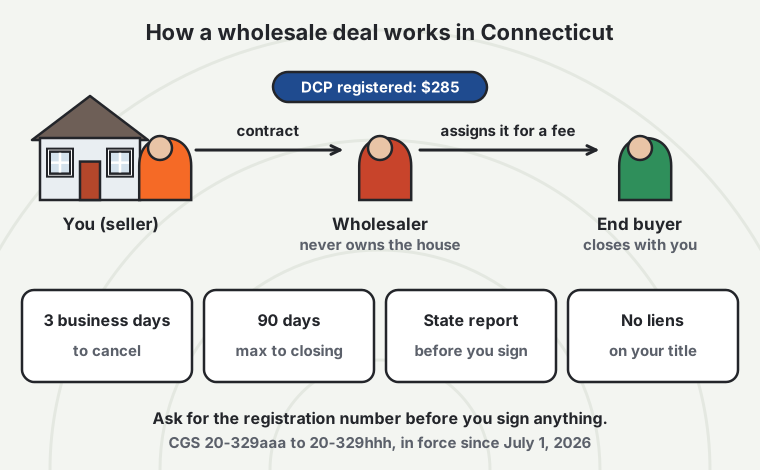
Wholesaling works like this. You sign a purchase contract with the wholesaler. The contract usually names the buyer as the wholesaler “and/or assigns,” which lets them transfer it. The wholesaler then markets your house, or your contract, to investors. When they find one, they assign the contract for a fee, and the investor closes with you at the contract price. Your price does not change; the wholesaler’s fee is paid by the investor, out of the gap between your price and what the investor would have paid you directly.
That gap is the issue. Every dollar of assignment fee is a dollar the end buyer could have paid you. A wholesaler may also tie up your house for weeks while they look for an end buyer, and if they find none, the deal can fall apart. Connecticut’s Department of Consumer Protection put it plainly when it announced the new rules: sellers often do not know they are working with a wholesaler.
What Connecticut’s wholesaler law requires
| Rule | What it means for you | Statute |
|---|---|---|
| Registration | No one may act as a real estate wholesaler in Connecticut without a DCP registration (from July 1, 2026). The fee is $285 for up to two years. Ask for the registration number; it goes on the disclosure report. | CGS 20-329bbb |
| Disclosure report | Before you sign, the wholesaler must give you DCP’s Wholesale Disclosure Report (required from October 1, 2026). Both of you sign it. | CGS 20-329eee |
| Three-business-day cancellation | You may cancel within three business days of signing, for any reason, with no penalty except returning any deposit they paid you. | CGS 20-329ccc(a) |
| 90-day closing cap | The closing date may not be more than 90 days after everyone signs. Extensions must be in writing and signed by you; otherwise the contract ends automatically. | CGS 20-329ccc(b) |
| Notice to the end buyer | Before assigning, the wholesaler must tell the end buyer in writing that they hold only a future interest, not title, and pass on your property condition report. | CGS 20-329ccc(c) |
| Your disclosure duty | You give the wholesaler your Property Condition Disclosure Report and any federal lead paint disclosure before signing. | CGS 20-329ddd |
| No liens on your title | No one may record a wholesale contract or notice on the land records to cloud your title, and a wholesaler may not file a purchaser’s lien. Town clerks may refuse such filings. | CGS 20-329fff |
| Enforcement | A violation is an unfair or deceptive trade practice under the Connecticut Unfair Trade Practices Act. | CGS 20-329hhh |
What the state’s disclosure report tells you
The DCP report has eleven numbered points. In plain English: the wholesaler may not be the one who buys your house; they may market it while under contract; they expect to profit or earn an assignment fee; your contract may let them accept or reject offers without asking you; your town’s assessed value is not market value and can be much lower; you may check your house’s value and negotiate the price; you may have an attorney or appraiser review the deal; you may cancel within three business days; a licensed agent acting as a wholesaler must say whom they represent; you still owe the state and federal disclosures; and the closing must be within 90 days unless you agree in writing to extend.
Point 5 of the state’s report exists for a reason: some sellers are told their house is “worth” its assessed value. In Connecticut, assessments are set at 70% of market value as of the town’s last revaluation (CGS 12-62a), so an offer “at assessment” can be far below market. Always compare an offer with recent sales, not with your tax bill.
Is a wholesaler ever the right choice?
Sometimes, yes. A wholesaler with a deep list of investors can find a buyer for a house that no single local investor wants, such as a badly damaged house in a small town. But if a local investor will buy the house directly, you usually get a better price and a faster, more certain closing by dealing with the investor. If you do sign with a wholesaler, keep the contract short, make the deposit meaningful, and have your attorney read it during the three business days. Our posts on what to expect when selling to a wholesaler and common misconceptions about wholesalers add detail.
One open question for your attorney: an investor who actually buys your house and resells it, even the same day (a “double closing”), takes title, so the deal may fall outside the wholesaler definition. Either way, ask whether your buyer intends to close or to assign.
What do you pay when you sell your house for cash in Connecticut?
When you sell your house for cash in Connecticut, you still pay the seller’s conveyance tax (1% to 1.25% of the price in most towns), your own attorney, your mortgage payoff, any liens, and your share of prorated property taxes, unless the buyer agrees in the contract to cover some of them. You skip the commission, repairs, staging, months of carrying costs and buyer credits.
| Cost | Listing with an agent | Cash sale |
|---|---|---|
| Commission | Often 4.5% to 6% total (est., negotiable) | None |
| Repairs and prep | What buyers and lenders require | None; the price reflects condition |
| Buyer credits after inspection | Common | Rare |
| State conveyance tax | 0.75% to $800,000; 1.25% from $800,000 to $2.5 million; 2.25% above | Same (seller’s, unless the buyer agrees to pay) |
| Town conveyance tax | 0.25%; 0.50% in 16 cities; Stamford 0.35% to $1 million | Same |
| Seller’s attorney | About $1,000 to $1,500 (est.) | Same; some buyers contribute |
| Property tax proration | Usually a credit to the buyer (taxes paid in arrears) | Same |
| Oil left in the tank | Buyer reimburses you (custom) | Same, if the contract says so |
| Disclosure report | Required, or a $500 credit (CGS 20-327c) | Same |
| Smoke and CO affidavit | Required, or a $250 credit (CGS 29-453) | Same |
| Carrying costs while you wait | Months of tax, insurance, utilities, mortgage | Usually two to three weeks |
Two Connecticut points surprise owners. The conveyance tax is the seller’s by law, so “we pay all closing costs” means nothing until the contract says who pays the conveyance tax and your attorney. And because Connecticut towns bill property tax in arrears, your closing statement usually shows a charge for taxes you have not paid yet, not a refund. The full list is in our guide to the cost to sell a house in Connecticut.
Taxes after the sale do not change because the buyer paid cash. If the house was your main home for two of the last five years, up to $250,000 of gain ($500,000 for a married couple filing jointly) is excluded from federal tax (IRS Publication 523). Connecticut taxes any remaining gain as income. See taxes when selling a house in Connecticut.
When does a cash sale beat listing your Connecticut house?
A cash sale beats listing your Connecticut house when the house cannot easily be financed by a retail buyer’s bank, when the repairs are large or unknown, when you need to close by a fixed date, or when a listing would bring risks you cannot carry: probate, foreclosure, tenants, an out-of-state owner, or a house you cannot afford to keep. In those cases the higher list price often never reaches your pocket.
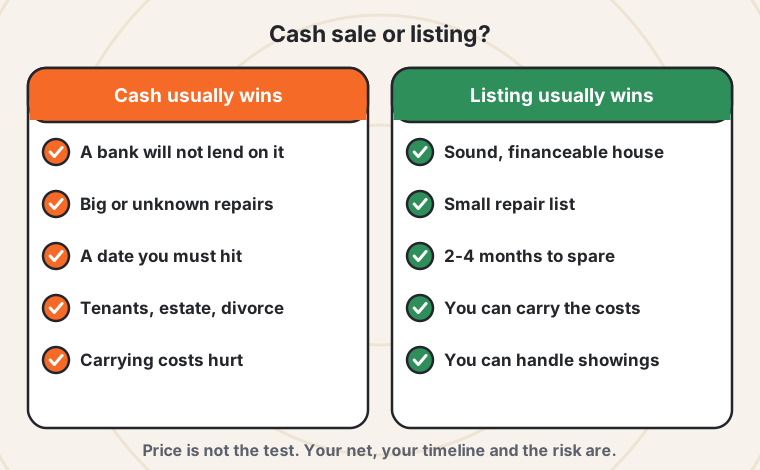
- The house will not pass a lender’s appraisal. No working kitchen or bath, a failing roof, active leaks, no heat, structural or foundation damage, or a failed septic. Retail buyers with FHA, VA or many conventional loans cannot close on it as-is, so your real market is cash buyers anyway.
- The repairs are open-ended. Crumbling concrete, an underground oil tank, a fire, or years of deferred maintenance. See our guides to selling a house with a crumbling foundation and selling a house as-is in Connecticut.
- A date controls the sale. A foreclosure Law Day, a job start, a divorce decree, a probate deadline. Our Connecticut foreclosure guide explains Law Day and mediation, and the relocation guide covers moving on a deadline.
- Carrying the house is draining you. Each month of tax, insurance, heat and mortgage on an empty house comes out of your eventual price.
- Tenants, family or an estate complicate showings. A tenant who will not cooperate, heirs who disagree, or a house full of a parent’s belongings. See selling an inherited house in Connecticut.
- You value certainty over the last dollar. No showings, no inspection renegotiation, no buyer’s loan to fail in week five.
If you are not sure which side you are on, this two-minute check weighs your answers.
Is a cash sale right for you, or should you list?
Seven quick questions. There is no wrong answer, and we will tell you honestly if listing would leave you more.
- Does the house need repairs you would rather not pay for or manage?
- Do you need to close by a certain date, or within the next month or two?
- Would showings be hard: tenants, belongings, privacy, or you live out of state?
- Is there a complication: an estate or probate, a divorce, foreclosure, liens or back taxes?
- Could you comfortably cover the mortgage, taxes and utilities for three or more months?
- Is getting the highest possible price more important to you than speed and certainty?
- Would a buyer's bank lend on the house as it is (no major roof, foundation, oil tank or code issues)?
When is listing, or another route, better than a cash sale?
Listing is better than a cash sale when your Connecticut house is in decent condition, a buyer’s bank will lend on it, you can wait two to four months, and you can keep paying for it while it sells. Other routes can also beat cash: a loan modification or foreclosure mediation if you want to keep the house, a short sale if you owe more than it is worth, or renting it out if the numbers work.
- A sound house in a normal market. If the house needs paint and a deep clean, the formula’s margin and resale costs are money you can keep by listing. In our illustration, listing as-is netted about $51,000 more.
- A small repair list you can fund. A few thousand dollars of the right fixes can move a house from “investor only” to “any buyer.” See 13 low-cost fixes.
- You want to keep the house. If you are behind on payments, Connecticut’s foreclosure mediation program and a loan modification may save the house; selling should not be the first move if keeping it is possible.
- You owe more than it is worth. A cash buyer cannot pay off a mortgage the price does not cover. A short sale, approved by your lender, may be the route; read short sale vs foreclosure.
- You are a capable seller with time. Selling by owner with a flat-fee listing can save most of a commission; see how to sell a house without an agent in Connecticut.
- A rental that still pays. If the property cash-flows and you can manage it, keeping it may beat any sale.

I buy houses for cash, and I still tell a lot of owners to list. If your house is clean, the roof and furnace are fine, and you are not on a deadline, an agent will usually put more money in your pocket than I can. Where I earn my price is the house that needs real work, the owner who needs a date, or the sale that has too many moving parts for a 30-day mortgage. Get the listing number too, and compare the nets side by side.
The full head-to-head comparison is on our cash buyer vs. realtor in Connecticut page.
How do you check that a cash home buyer is legitimate?
You check that a cash home buyer is legitimate by verifying the company with the Connecticut Secretary of the State, asking for proof of funds, insisting on a Connecticut attorney closing, refusing any upfront fee, reading the contract for assignment language, checking independent reviews and recorded deeds, and walking away from pressure. Since July 2026, also ask whether they are a registered wholesaler.
We cover each check in detail in our separate guide, how to check a cash home buyer in Connecticut. The short version:
- The company is registered with the Connecticut Secretary of the State and has a real Connecticut presence
- They show proof of funds for your price (a bank statement or lender letter)
- Both sides have their own Connecticut real estate attorney, and the deposit goes into an attorney’s account
- You pay no fee to receive or accept an offer
- You know whether the contract can be assigned (“and/or assigns”), and if so, the buyer is a DCP-registered wholesaler who gave you the Wholesale Disclosure Report
- You found reviews on sites the buyer does not control
- You found deeds they have recorded in Connecticut towns
- Nobody pushed you to sign the same day
The older post “We buy houses” companies: are they credible? covers the same ground with Hartford examples.
How to sell your house for cash in Connecticut: step by step
To sell your house for cash in Connecticut, get a listing estimate first, gather your mortgage payoff and deed, contact two or three local cash buyers, compare written offers by net and terms, check the buyer, have your own attorney review the contract, complete the required disclosures, and close with both attorneys. Most of these steps take days, not weeks.
Know your listing number first
Ask one or two agents what the house would sell for as-is and after basic fixes, and what they would net you. Check recent sales on data.ct.gov, Zillow or Redfin. Without that number, no cash offer can be judged.
Gather what you owe and what you own
Get a mortgage payoff estimate and any home equity line balance. Look up your deed at the town clerk to confirm who must sign. If an owner has died, the executor sells, often with probate court approval.
Contact two or three local buyers
Choose buyers who close in their own name in Connecticut. Give each the same information and the same access, so the offers are comparable.
Ask each buyer to show their math
Ask for the after-repair value, the comparable sales they used and their repair estimate. A buyer who will not explain the number is asking you to trust it blindly.
Compare written offers by net, terms and certainty
Look at the price, who pays the conveyance tax and attorneys, the deposit, the inspection period, the closing date and whether the contract can be assigned. A slightly lower offer with no inspection contingency and a firm date can be worth more.
Check the buyer
Run the checks in the vetting section: state registration, proof of funds, recorded deeds, reviews and, if they may assign, their DCP wholesaler registration.
Hire your own Connecticut attorney
Your attorney reviews the contract before you sign, holds or verifies the deposit, orders your payoff, clears title problems and prepares the deed and conveyance tax return.
Complete the disclosures
Fill in the Residential Property Condition Report (or give the $500 credit), the lead paint disclosure for homes built before 1978, and prepare the smoke and carbon monoxide affidavit. Selling as-is does not remove them; see the property condition disclosure guide.
Plan the move-out
Agree in the contract what you may leave behind. Many cash buyers take the house with furniture and belongings; get that in writing.
Close and get paid
Sign the deed, Form OP-236 and the affidavits. Your attorney pays off your mortgage and liens, and wires or checks you the balance, usually the same day or the next business day.
Your cash sale checklist for Connecticut
This cash sale checklist covers everything a Connecticut seller should do before signing with a cash buyer, in order: the numbers to know, the offers to collect, the contract terms to check and the paperwork for the closing. Tick the items off as you go; your progress is saved on this device.
- Get an as-is listing estimate and a net figure from an agent
- Pull 3 to 6 recent renovated sales near you (your own after-repair value)
- Get a mortgage and home equity payoff estimate
- Confirm everyone on the deed can and will sign
- Collect two or three written cash offers
- Ask each buyer for their after-repair value and repair estimate
- Check who pays the conveyance tax and attorneys in each offer
- Check the inspection period and deposit amount
- Ask whether the buyer will close or assign the contract
- If they may assign: DCP wholesaler registration number and the signed Wholesale Disclosure Report
- Verify proof of funds and the buyer’s company registration
- Hire your own Connecticut real estate attorney
- Complete the Property Condition Disclosure Report and lead paint disclosure
- Agree in writing on what you may leave in the house
- Test smoke and CO alarms for the closing affidavit
- Schedule final water, sewer and oil readings
How does a cash sale work with foreclosure, probate, tenants or divorce?
A cash sale works with foreclosure, probate, tenants or divorce in Connecticut, but each adds its own rules: a foreclosure sale must close before Law Day, a probate sale needs the executor and often court approval, tenants keep their lease rights after the sale, and a divorce sale needs both spouses or a court order. Cash buyers are often chosen in these cases because their closing date is reliable.
| Situation | What changes in a cash sale | Full guide |
|---|---|---|
| Foreclosure | The sale must close, and pay off the lender, before Law Day. Equity above the debt is yours. Ask the court about mediation before you decide to sell. | Foreclosure in Connecticut, selling in foreclosure |
| Inherited house or probate | The executor or administrator signs; the probate court may need to approve the sale; the estate’s probate fee and taxes come into play. | Selling an inherited house, inherited a house: what to do |
| Tenants | The lease survives the sale; security deposits transfer to the buyer; ending a tenancy follows Connecticut’s notice to quit and summary process rules. | Landlord’s guide to selling with tenants |
| Divorce | Both spouses sign, or the court orders the sale; Connecticut’s automatic orders limit what either spouse may do with the house while the case is pending. | Selling a house during a divorce |
| Relocation | A cash sale lets you set the closing date around your move; signing can be done from out of state with a Connecticut attorney. | Relocating and selling |
| Crumbling foundation | Many retail buyers cannot finance the house; disclosure duties remain; some cash buyers decline these houses. | Crumbling foundations |
See your cash offer before you decide anything
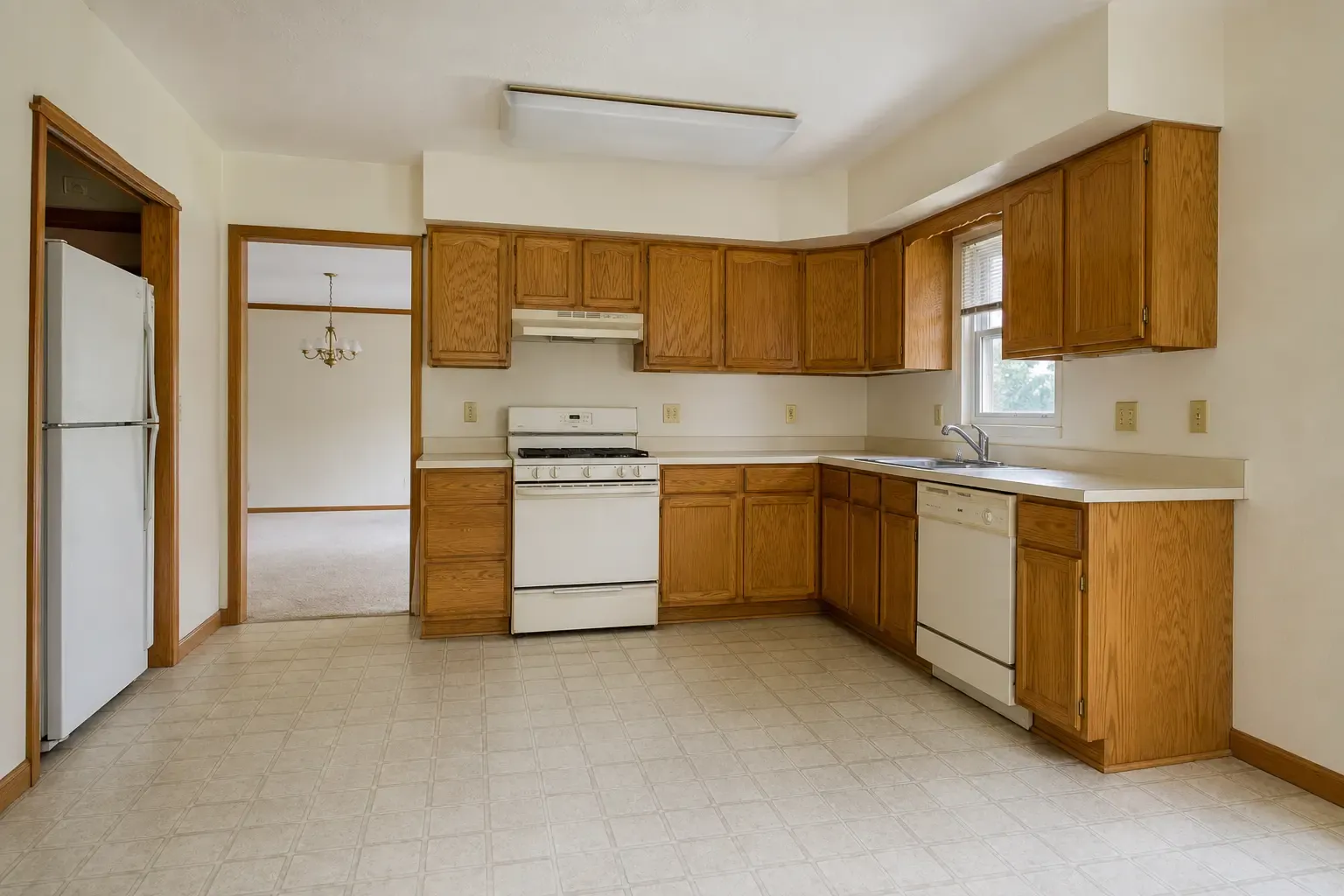
Want your offer faster, or rather not talk to anyone yet? Send a few photos of the house and the address. We price the repairs we see against recent sales near you and show you the math behind the number, so you can compare it with a listing.
 CabinetsFlooring
 Tub & tile
 Floors
 Roof
We may bring in a partner buyer to close. Your price and terms don't change.
What changes a cash offer from town to town in Connecticut?
What changes a cash offer from town to town in Connecticut is the local after-repair value, the age of the housing, the mill rate that sets holding costs, and the conveyance tax the buyer pays on the resale. A house in a city with a high mill rate and a 0.50% town conveyance tax costs a buyer more to hold and resell than the same house in a low-tax suburb.
| Town | Homes sold | Median sale price | Mill rate (FY2027) | Property tax a month on a median single-family (est.) | Total conveyance tax | Median year built |
|---|---|---|---|---|---|---|
| Bridgeport | 1,166 | $374,500 | 27.95 | $620 | 1.25% | 1949 |
| Bristol | 882 | $317,500 | 35.30 | $680 | 1.25% | 1962 |
| Danbury | 959 | $443,000 | 25.23 | $700 | 1.00% | 1972 |
| East Hartford | 614 | $282,750 | 47.24 | $780 | 1.25% | n/a |
| Enfield | 659 | $310,000 | 33.11 | $600 | 1.00% | 1960 |
| Hamden | 810 | $339,950 | 53.67 | $1,110 | 1.25% | 1952 |
| Hartford | 825 | $290,000 | 69.95 | $1,060 | 1.25% | n/a |
| Manchester | 724 | $315,000 | 41.00 | $770 | 1.00% | 1953 |
| Meriden | 749 | $300,000 | 29.99 | $550 | 1.25% | n/a |
| Naugatuck | 470 | $330,000 | 40.44 | $810 | 1.00% | 1969 |
| New Britain | 768 | $300,000 | 39.18 | $650 | 1.25% | 1953 |
| New Haven | 1,022 | $350,000 | 39.96 | $770 | 1.25% | 1930 |
| Norwich | 712 | $261,000 | 34.15 | $540 | 1.25% | 1953 |
| Stamford | 1,493 | $699,000 | 28.47 | $1,490 | 1.10% (to $800,000) | 1956 |
| Waterbury | 1,305 | $270,000 | 43.34 | $710 | 1.25% | 1955 |
| West Hartford | 831 | $485,100 | 46.77 | $1,420 | 1.00% | 1951 |
Read the table the way a cash buyer does. Hartford and Hamden have the highest monthly holding costs on a typical house here, so a six-month renovation costs a buyer more there. New Haven’s housing is the oldest in the table (a median year built of 1930), which usually means more repairs per house. Danbury and Enfield have the standard 1% conveyance tax, so the resale costs a little less. None of this is a price for your house; it is why two similar houses in different towns can draw different offers.
What mistakes do Connecticut owners make with cash home buyers?
The mistakes Connecticut owners make with cash home buyers are accepting the first offer without a listing estimate, comparing cash offers by price instead of net and terms, signing a contract that can be assigned without knowing it, agreeing to long inspection periods, skipping their own attorney, and judging an offer against assessed value instead of recent sales.
- No listing number. You cannot judge a discount if you do not know the starting price.
- One offer only. Two or three written offers from local buyers show you the real range.
- Price over terms. A high number with a 30-day inspection period and a $500 deposit is a weak offer.
- Not asking “will you close or assign?” If the answer is assign, the state’s wholesaler rules apply, and you should know before you sign.
- Using the assessed value. Connecticut assessments are 70% of market value at the last revaluation; they are not a price.
- Letting the buyer’s attorney represent you. Hire your own; it costs about $1,000 to $1,500 (est.).
- Forgetting the conveyance tax. “No closing costs” rarely includes the tax the law puts on the seller.
- Waiting too long. In a foreclosure or a vacant-house situation, every month you wait comes out of your equity.
Questions Connecticut owners ask about cash home buyers
How much do cash home buyers pay in Connecticut?
Cash home buyers in Connecticut pay the after-repair value minus repairs, resale costs, holding costs and a margin. In our estimate from that formula, that is about 70% to 80% of after-repair value for a house needing light work, 55% to 70% for moderate work, and 35% to 55% for major work. No public source tracks actual offers.
Is it a good idea to sell my house for cash?
Selling your house for cash is a good idea when the house needs major work, cannot easily be financed, or must sell by a fixed date. It is usually not the best idea for a house in good condition when you have two to four months to list, because listing typically nets more.
How fast can a cash buyer close in Connecticut?
A cash buyer can usually close in Connecticut in one to three weeks, sometimes faster. The clock is set by the title search, the town’s municipal searches, your mortgage payoff and the attorneys’ schedules. Probate or title problems add time.
Do I need an attorney to sell my house for cash in Connecticut?
Yes, you should have your own attorney to sell your house for cash in Connecticut. Connecticut closings are run by attorneys, and your attorney reviews the contract, holds or checks the deposit, pays off your mortgage and prepares the deed and conveyance tax return.
Who pays closing costs in a cash sale?
In a cash sale in Connecticut, the seller pays the conveyance tax and their own attorney, and the buyer pays their attorney and title insurance, unless the contract says otherwise. Many cash buyers offer to pay some seller costs; get it in writing.
Do I have to fill out the disclosure report if I sell as-is for cash?
Yes, you generally still owe the Residential Property Condition Report when you sell as-is for cash in Connecticut, or a $500 credit to the buyer if you do not deliver it (CGS 20-327c). Selling to a wholesaler, you must hand them the report before signing.
What is an assignment of contract?
An assignment of contract is when the buyer named in your purchase contract transfers their right to buy your house to someone else, usually for a fee. In Connecticut, anyone who does this as a wholesaler must be registered with the Department of Consumer Protection.
Can I cancel a contract with a wholesaler in Connecticut?
Yes, you can cancel a contract with a real estate wholesaler in Connecticut within three business days of signing, for any reason and without penalty, except returning any deposit they paid you (CGS 20-329ccc). After that, the contract’s own terms apply.
How do I know if a cash buyer is a wholesaler?
To know if a cash buyer is a wholesaler, ask directly whether they will close in their own name or assign the contract, look for “and/or assigns” in the contract, and ask for their DCP wholesaler registration number. A wholesaler must give you the state’s Wholesale Disclosure Report before you sign.
Are iBuyers available in Connecticut?
iBuyer availability in Connecticut is limited and changes over time; iBuyers concentrate on specific metro areas and newer houses. Enter your address on each company’s site to see whether it makes an offer. Compare the net after its service fee and repair credit.
Will a cash buyer pay close to asking price?
A cash buyer will rarely pay close to asking price for a house that needs work, because they must cover repairs, resale costs and holding costs. A house in good condition may draw an offer closer to market value from an iBuyer or a retail cash buyer, but listing usually brings more.
Can I sell my house for cash if I still have a mortgage?
Yes, you can sell your house for cash with a mortgage. Your attorney orders a payoff statement and pays the lender from the sale proceeds at closing. If the price is lower than what you owe, you need the lender’s approval for a short sale or must bring money to closing.
Can I sell a house with tenants to a cash buyer?
Yes, you can sell a house with tenants to a cash buyer in Connecticut. The lease and the tenant’s rights continue under the new owner, and the security deposit and interest transfer with the house. Many investors buy occupied houses.
Do cash buyers charge fees?
Legitimate cash buyers do not charge you a fee to make or accept an offer. Their profit comes from the price. Any request for an application, inspection or “processing” fee is a red flag.
Should I accept a cash offer based on my assessed value?
You should not accept a cash offer just because it matches your assessed value. Connecticut assessments are 70% of market value as of the town’s last revaluation, so an offer “at assessment” can be well below what the house would sell for.
What happens to the deposit in a cash sale?
In a Connecticut cash sale, the buyer’s deposit is usually held in an attorney’s clients’ funds account until closing, then credited toward the price. If the buyer defaults, what happens to it depends on the contract; have your attorney review that clause.
Do I pay taxes when I sell my house for cash?
You pay the same taxes when you sell your house for cash as in any sale: the Connecticut conveyance tax at closing, and income tax on any gain above the home-sale exclusion of $250,000 single or $500,000 married filing jointly, if you qualify (IRS Publication 523).
Can I leave furniture and belongings behind?
Many cash buyers let you leave furniture and belongings behind, but only if the contract says so. Agree in writing on what can stay so there is no dispute at the final walkthrough.
How many cash offers should I get?
You should get two or three written cash offers from local buyers who close in their own name. More than that rarely improves the price, and fewer leaves you without a comparison.
Is a cash offer from a company better than one from an individual?
A cash offer from a company is not automatically better than one from an individual. What matters is proof of funds, a track record of Connecticut closings, a short inspection period, a real deposit, and whether they will close or assign the contract.
Related Connecticut guides
Decide your route
Offers and money
Sources
- Connecticut General Statutes chapter 392a, §§ 20-329aaa to 20-329hhh (real estate wholesalers: registration, cancellation, 90-day cap, disclosure report, recording ban, CUTPA), 2026 Supplement, added by Public Act 25-168.
- Department of Consumer Protection, Real Estate Wholesaling, the Wholesale Disclosure Report (revised 06/2026) and the June 2026 DCP announcement (registration from July 1, 2026; $285 fee).
- CGS § 12-494 (real estate conveyance tax) and OLR Report 2020-R-0020 (rates and eligible municipalities).
- CGS § 12-62a (assessments at 70% of market value).
- CGS §§ 20-327b and 20-327c (property condition disclosure; $500 credit).
- CGS § 29-453 (smoke and carbon monoxide affidavit; $250 credit).
- CGS § 51-88a (practice of law; Connecticut attorney closings).
- EPA and HUD Lead-Based Paint Disclosure Rule (homes built before 1978).
- IRS Publication 523, Selling Your Home (home sale exclusion).
- Opendoor, How does Opendoor make money? (service fee varies; illustrative $17,500 fee on $350,000).
- Clever Real Estate, cash home buyers in Connecticut (its 67.5% of after-repair value figure; Clever’s own estimate).
- Town sales, median prices, fiscal 2027 mill rates and 2025 parcel data: Connecticut Office of Policy and Management, published on data.ct.gov.
See the house together.
Pick a time that works.
Choose a time for us to walk through the property with you, or ask for a quick call first. We confirm every request personally.
Tuesday, January 13
No open times in the next few weeks. Please call us.
We will confirm by email. Nothing is booked until we do.
View my request
Who wrote this
Jerryll Noorden
Jerryll has bought and sold Connecticut houses since 2016 and has sat at more closing tables than he can count, on both sides. Before real estate he was a robotics scientist at NASA, IHMC and IIT. He wrote this guide because the national sites that rank for it skip the Connecticut rules that cost sellers money. When listing or selling it yourself would get you more than a cash offer, he says so.
This guide explains Connecticut rules in plain English. It is not legal or tax advice. Laws change; for your sale, talk to a Connecticut real estate attorney and a tax professional.
