
- Almost every Connecticut seller of a 1-4 unit home or condo must give the buyer the Residential Property Condition Report before the buyer signs anything (CGS 20-327b). That applies with or without an agent, and to as-is sales.
- Skipping the report costs a $500 credit to the buyer at closing (CGS 20-327c). Paying the credit does not excuse you from disclosing serious defects you know about.
- You answer from what you actually know. You do not have to inspect or test, and “UNK” (unknown) is an honest answer. But you must attach reports you have, such as a radon test, a well test or a tank removal letter.
- The form changed on July 1, 2025. Public Act 25-33 added a “Flood Risk Awareness” section (questions 60 to 65) and a flood insurance statement. The current form is marked “Revised 07/2025” and has 65 questions.
- The separate Residential Foundation Condition Report is narrower than most people think. It applies only to homes acquired through foreclosure or by a town, in the crumbling-foundation towns on the CRCOG list. Everyone else answers the foundation questions on the main form.
- Some transfers are exempt, including sales by executors, administrators, trustees and conservators, and transfers between co-owners or to close family for no money.
What is the Connecticut Property Condition Disclosure Report?
The Connecticut Property Condition Disclosure Report is the state form, officially the Residential Property Condition Report, in which a seller tells the buyer what they know about the home’s condition: the heating, water, septic, roof, foundation, radon, lead, flood history and more. State law (CGS 20-327b) requires it for most sales of 1-4 unit homes and condos, and it must reach the buyer before they sign a binder or contract.
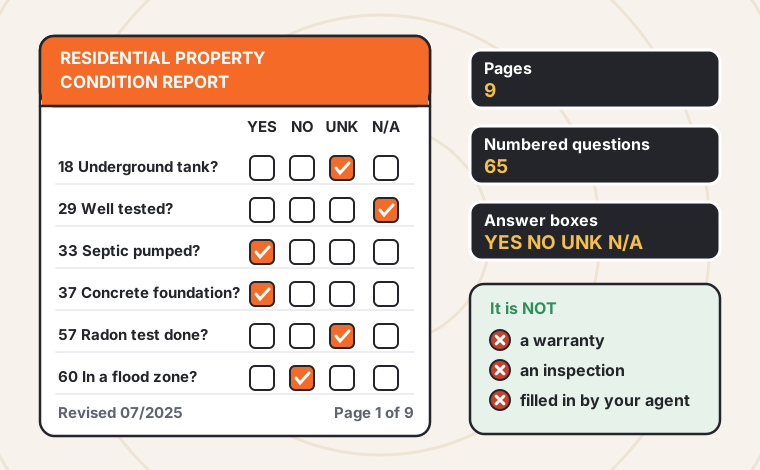
The law behind it is the Uniform Property Condition Disclosure Act, in effect since January 1, 1996. The Department of Consumer Protection (DCP) publishes the form. The current version is nine pages, has 65 numbered questions, and carries the footer “Revised 07/2025”. Each question has four boxes: YES, NO, UNK (unknown) and N/A (not applicable).
It is one step in a bigger process. If you are early in the sale, our guide on how to sell a house in Connecticut shows where the report fits next to pricing, the attorney and the closing. This page goes deep on the report itself: who must fill it in, how to answer each section, what changed in 2025, and what happens if you skip it.
Three things the report is not
- It is not a warranty. The form itself says your answers “shall not constitute a warranty to the buyer”, and CGS 20-327d says the law creates no new implied or express warranties.
- It is not an inspection. You do not have to hire anyone or test anything to fill it in (CGS 20-327d). The form tells buyers to get their own home inspection.
- It is not something your agent can fill in for you. The form says in bold that your real estate licensee cannot complete it on your behalf. Your agent or attorney can explain a question; the answers must be yours.
Who has to fill out the property condition report in Connecticut?
Anyone who sells, exchanges or leases with an option to buy a Connecticut home of one to four dwelling units, including a condo or co-op unit, has to fill out the property condition report, whether or not a real estate agent is involved. The only sellers who do not are those whose transfer falls into one of nine exemptions in CGS 20-327b(b), such as executors, co-owners and foreclosing lenders.
That covers by-owner sales too. If you are selling without an agent, the report is still yours to deliver (see our guide to selling by owner in Connecticut). It also covers as-is sales and sales to cash buyers. There is no “as-is” exemption in the statute.
The nine exempt transfers
| Exempt transfer (CGS 20-327b(b)) | What it means in practice |
|---|---|
| 1. From co-owners solely to one or more of the co-owners | A sibling buying out a sibling who is also on the deed; a spouse taking over the other spouse’s share. |
| 2. To a spouse, parent, brother, sister, child, grandparent or grandchild, where no money is paid | A gift deed to your daughter. If she pays you, the exemption does not apply. |
| 3. Newly built homes that carry the builder’s implied warranty (chapter 827) | First sale of a new house by the builder. |
| 4. Transfers by executors, administrators, trustees or conservators | Selling a parent’s house as executor of the estate, or as trustee of a trust. |
| 5. Transfers by the federal government or federally chartered agencies | A HUD home sale. |
| 6. Transfers by the State of Connecticut | State-owned property. |
| 7. Transfers by a town or other political subdivision (except the foundation report, see below) | A town selling a tax-taken house. |
| 8. Property under a contract or option signed before January 1, 1996 | Rare today. |
| 9. Property acquired by strict foreclosure, foreclosure by sale or deed in lieu (except the foundation report) | A bank selling a house it took back. |
An executor or administrator selling an inherited house does not have to complete the report. Many still do, or answer “UNK” honestly, because buyers and their attorneys ask for it. Exempt from the form does not mean free to hide a problem you know about. If you are handling an estate, see our guide to selling an inherited house in Connecticut.
What the report does not cover
The law applies only to “residential real property consisting of not less than one nor more than four dwelling units” (CGS 20-327b(c)). A five-unit building, commercial property and vacant land are outside it. Those sales are still subject to ordinary law on fraud and misrepresentation.
When must a Connecticut seller give the buyer the disclosure report?
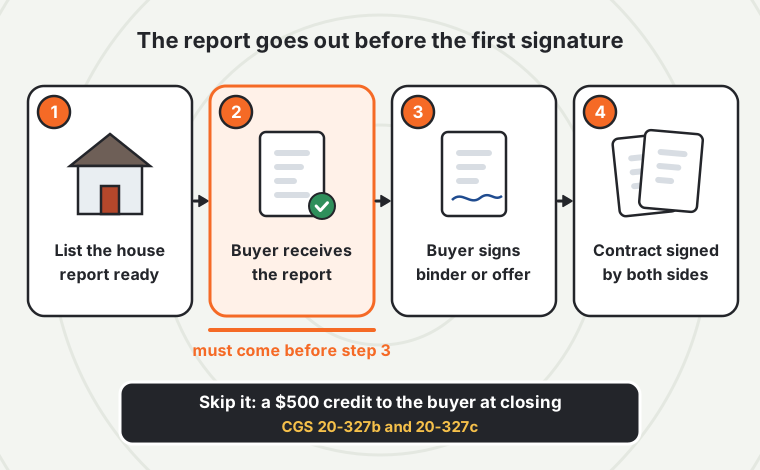
A Connecticut seller must give the buyer the disclosure report before the buyer signs any binder, contract to purchase, option, or lease with a purchase option. In practice it goes out with the listing, so it is ready when an offer comes in. A copy with the buyer’s written receipt is attached to the offer or binder, and a copy signed by both buyer and seller is attached to the purchase agreement (CGS 20-327b(a)).
Two timing points trip people up:
- “Before the buyer signs” means before the first signed paper. In Connecticut many buyers sign a binder or offer form before the attorneys draft the full contract. The report is due before that first signature.
- New form versions apply to new listings 30 days after DCP posts them (CGS 20-327b(f)). If you listed in spring 2025 on the old form, your attorney may still ask you to complete the current one. When in doubt, use the version on the DCP site the day you list.
Get the form from the DCP’s real estate consumer page, not from an old printout or a website copy. Our list of documents you need to sell a house in Connecticut shows what else to gather at the same time.
What changed on the Connecticut disclosure form in 2025?
What changed on the Connecticut disclosure form in 2025 is a new “Flood Risk Awareness” section. Public Act 25-33, effective July 1, 2025, added six questions on FEMA flood zones, past flood disaster aid, flood insurance, elevation certificates, flood claims and water penetration, plus a statement on flood insurance and flood maps. The form is now “Revised 07/2025” and runs to 65 questions.
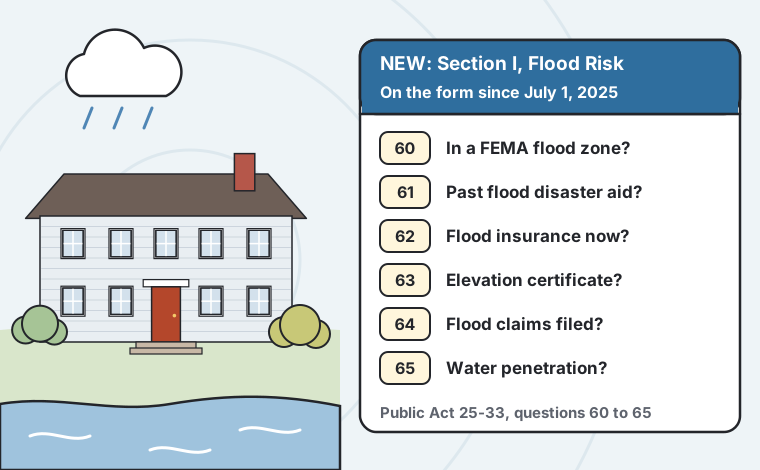
The change came in Public Act 25-33, a large environment and climate bill (Substitute Senate Bill 9), sections 3 and 4. The legislature’s Office of Legislative Research summarized it in its 2025 housing report: sellers now answer questions on “floodplain designations, prior disaster assistance for flood damage, flood insurance policies and claims, and water penetration.”
The six new flood questions
| # | Question (paraphrased) | How to answer it well |
|---|---|---|
| 60 | Is the property in a FEMA-designated floodplain? Which zone? | Look up the address on FEMA’s flood map service center before you answer. Many inland Connecticut homes near rivers and brooks are in a zone. |
| 61 | Have you, or (to your knowledge) a previous owner, received FEMA, SBA or other federal or state disaster aid for flood damage? | This one matters: past federal aid can require future owners to keep flood insurance. |
| 62 | Is there a current flood insurance policy? | Yes or no; a buyer may be able to assume an NFIP policy. |
| 63 | Is a FEMA elevation certificate available? | If you have one, attach it. It can lower the buyer’s premium. |
| 64 | Have you ever filed a flood damage claim? | Your own claims history. |
| 65 | Has any structure had water penetration or damage from seepage or a natural flood? | This overlaps with basement dampness (question 39). Answer both consistently. |
The form also gained a statement, item (I) in the “Important Information” section, explaining that federal law requires flood insurance on homes with a federally backed mortgage in a Special Flood Hazard Area, that a prior disaster-aid flood insurance requirement “affixes to the property and applies to all future owners”, and that “a property does not have to be near water or in a flood zone to flood.”
Two more flood rules from the same act, effective July 1, 2026
Public Act 25-33 also requires (section 2) mortgage lenders to give borrowers a signed written notice, at least ten days before closing, that standard homeowners policies do not cover flood. Section 1 requires insurers to give a similar notice with homeowners and renters policies. Neither is the seller’s job, but expect buyers to ask more flood questions than they used to.
What did not change in 2025
You may read that 2025 legislation also rewrote the crumbling-foundation disclosure. We checked. The foundation questions on the main form (37 to 43) and the separate Residential Foundation Condition Report come from Public Act 19-192, and the foundation report was simply reissued with a 07/2025 revision date. A 2025 real estate bill, Substitute House Bill 7078, dealt with squatters, agent education and wholesaling, not disclosures, and it died in the Appropriations Committee in May 2025. It did not become law.
What does each section of the Connecticut disclosure report ask?
Each section of the Connecticut disclosure report asks about one part of the property: A, the seller and address; B, general and legal information such as easements, flood and wetlands; C, leased equipment; D, mechanical systems and oil tanks; E, water; F, sewage; G, asbestos and lead; H, the building, foundation, roof and radon; and I, flood risk. Then come the important-information statements and both certifications.
| Section | Questions | What it covers | Where sellers slip |
|---|---|---|---|
| A. Subject property | 1-2 | Your name(s) and the address | List every owner on the deed. |
| B. General information | 3-14 | Year built, how long you lived there, encroachments, easements, flood hazard or wetlands, registered dams, expected municipal assessments (sewer, water mains, sidewalks), historic or village district, special tax district, land-use restrictions, common interest community fees, hazardous-substance actions or liens | Forgetting a shared driveway or a neighbor’s fence over the line; not mentioning a planned sewer assessment the town has discussed. |
| C. Leased equipment | 15 | Leased propane tank, water heater, alarm, solar, water treatment and so on | Leased solar panels and propane tanks. The buyer must take over or replace them. |
| D. Mechanical and utility systems | 16-26 | Fuel type and heating problems, water heater age, underground storage tanks (now and removed), A/C, plumbing, electrical, security system, smoke and CO detectors, sprinklers | Saying “no” to an underground tank you are not sure about. If you do not know, say UNK. |
| E. Water system | 27-30 | Public or well; water charges; well testing; water quality, quantity, recovery and pressure | Not attaching a well test you have. |
| F. Sewage disposal | 31-33 | Public sewer or septic/cesspool; sewer charges; service company, last pumping, problems | Leaving the pumping date blank when a receipt is in the drawer. |
| G. Asbestos and lead | 34-36 | Asbestos insulation or materials, lead paint, lead plumbing | Answering NO for a 1950s house when the honest answer is UNK. |
| H. Building, structure, improvements | 37-59 | Concrete foundation, settling, water seepage, sump pump, foundation testing and repairs, pyrrhotite, roof type, age and leaks, siding, chimney, deck, driveway, drainage, interior damage, fire, pests, rot, insulation, radon tests and radon systems | Not attaching the radon test or the foundation report that question 41 asks for. |
| I. Flood risk awareness | 60-65 | FEMA zone, disaster aid, flood insurance, elevation certificate, claims, water penetration | New since July 2025; check FEMA’s map before answering. |
Section D: underground oil tanks (questions 18 to 20)
Connecticut asks more about oil tanks than most states. Question 18 asks whether there is an underground storage tank now, its age and location. Question 19 asks about known problems. Question 20 asks whether there has ever been one during your ownership, whether it was removed, when, by whom, and asks you to attach the removal paperwork. If you had a tank pulled, find the contractor’s letter and any soil test; buyers and their lenders want it. Our guide to oil tanks, septic, wells and radon covers what that paperwork should show.
Section D: smoke and CO detectors (question 25)
Question 25 asks whether there are carbon monoxide or smoke detectors, how many, and whether there have been problems. It is separate from the smoke and carbon monoxide affidavit you sign at closing under CGS 29-453 (or credit the buyer $250). Make sure both tell the same story.
Section E: wells (questions 27 to 30)
If you have a private well, question 29 asks whether it has been tested for contaminants or volatile organic compounds, and asks you to attach the report or name the lab and describe the results. Separately, CGS 19a-37(d) requires a well owner to tell the buyer, before the sale, that educational material on private well testing is on the Department of Public Health website. A line in the contract or a printed DPH fact sheet handed to the buyer satisfies it.
Section F: septic (questions 31 to 33)
For a septic system or cesspool the form asks for the service company, the date it was last pumped and how often you pumped it, and any problems. Pull your pumping receipts before you list. A system pumped on schedule with records is an easier sale.
Section G: asbestos and lead (questions 34 to 36)
These ask whether asbestos materials, lead paint and lead plumbing are present, and where. For a house built before 1978 you will also give the separate federal lead disclosure (see below). If you have never tested, “UNK” is usually the honest answer for lead paint in an older house; “NO” is a statement of fact you should be able to back up.
Section H: the foundation questions (37 to 43)
Since 2017 and 2019, the main form asks every seller in the state, not only in the crumbling-foundation towns, whether the foundation is concrete (37), about settling (38), seepage (39), sump pumps (40), any testing or inspection by a licensed professional (41, attach the report), any foundation repairs (42, attach the report) and any knowledge of pyrrhotite (43). If you are in the north-central or eastern part of the state, read our guide to selling a house with a crumbling foundation in Connecticut before you answer these.
Section H: roof, structure and pests (questions 44 to 56)
Roof type and age, roof leaks, siding, chimney and stoves, decks (and whether the wood is treated), driveway, drainage, interior floor, wall and ceiling problems, fire or smoke damage, termites and other pests, rot and water damage, and insulation. A roof leak you fixed two years ago with a receipt is worth disclosing with the fix; it reassures more than it scares.
Section H: radon (questions 57 to 59)
Question 57 asks whether a radon test has been performed and asks you to attach it. Question 58 asks whether a radon control system is in place now, and question 59 whether one has been in place in the previous 12 months. That last question exists so a buyer learns about a system you removed or switched off before listing.
What does “to the best of your knowledge” mean on the Connecticut disclosure?
“To the best of your knowledge” on the Connecticut disclosure means you answer from what you actually know, not from what you could have found out. CGS 20-327e says your answers extend only to your “actual knowledge” and no constructive knowledge is imputed to you, and CGS 20-327d says you do not have to inspect or test. But a false answer about something you did know can still lead to a lawsuit.
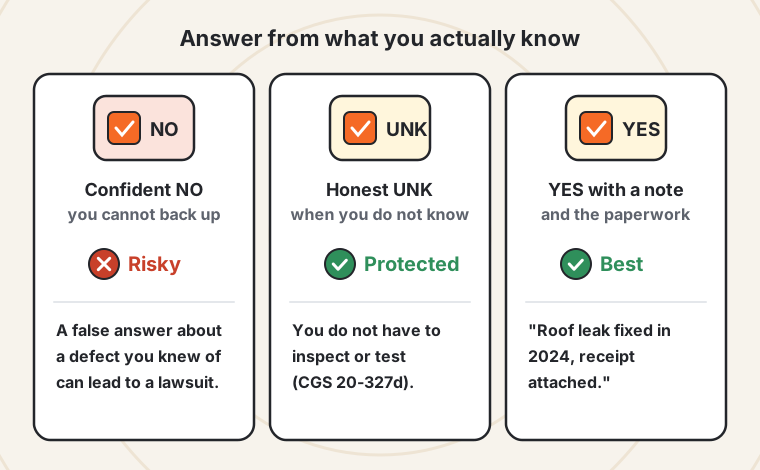
Connecticut’s appellate courts have read the law that way. In one case the Appellate Court described the report as a way to “diminish the risk of litigation” by making seller and buyer talk, not a warranty about conditions the seller did not know. In a later case it held that a seller’s negligent misrepresentation on the report about a defect the seller actually knew of is actionable. Put simply: honest “UNK” answers protect you; confident wrong answers do not.
How to use UNK and N/A
- UNK (unknown) when you truly do not know: the age of a roof you did not install, whether there is lead paint under the layers, whether a past owner had a tank.
- N/A (not applicable) when the question does not apply: septic questions on a house with public sewer.
- Explain when in doubt. “Previous owner told us the roof was replaced around 2010; we have no paperwork” is better than a bare YES or NO.
- Attach what you have. The form asks for radon, well, foundation and tank documents. Attaching them shows good faith.
Some owners avoid tests so they can answer “UNK”. The law does not require you to test, but buyers in Connecticut will test radon, wells, septic and sometimes foundations during their inspection anyway. If you have reason to suspect a problem, it is usually cheaper to know first and price it in than to have a buyer find it two weeks before closing.
What do you not have to disclose when selling a house in Connecticut?
When selling a house in Connecticut you do not have to disclose “nonmaterial facts”: that someone who lived there had a reportable disease, or that the house was the site of a death or a suspected felony (CGS 20-329cc and 20-329dd). You also do not have to research things you do not know, or list nearby hazardous waste sites if you give the buyer the notice described in CGS 20-327f.
Deaths, crimes and illness
Connecticut defines a “nonmaterial fact” to include that an occupant had a disease on the state’s reportable list, or that the property was suspected to be the site of a death or felony. Not disclosing one gives the buyer no claim (CGS 20-329dd). One exception: if a buyer making a genuine offer tells you in writing that a suspected homicide, other felony or suicide at the property matters to their decision, you, through your agent, must answer in writing or have the agent tell them in writing that you decline (CGS 20-329ee).
Neighborhood environmental and hunting notices
- Hazardous waste facilities. If you give the buyer written notice, before or when the contract is signed, that the lists of hazardous waste facilities kept under CGS 22a-134f are available, you have satisfied any duty to disclose them (CGS 20-327f). The same applies to environmental information from the EPA and other federal sources about properties other than yours.
- Hunting and shooting. A written notice that the town clerk may have a list of local properties where hunting or shooting sports regularly take place satisfies that duty (CGS 20-327g).
Your attorney usually puts both notices in the contract.
Problems you already fixed
The form asks about “problems”, and several questions ask directly about past items: removed oil tanks (20), foundation repairs (42), radon systems in the last 12 months (59), flood claims and aid (61, 64). For everything else, a fixed problem with paperwork is best disclosed with the fix: “Roof leak at the chimney, flashing replaced by a licensed contractor in 2024, receipt attached.” Buyers trust a house with a paper trail.
What is the $500 credit, and can you pay it instead of filling out the report?
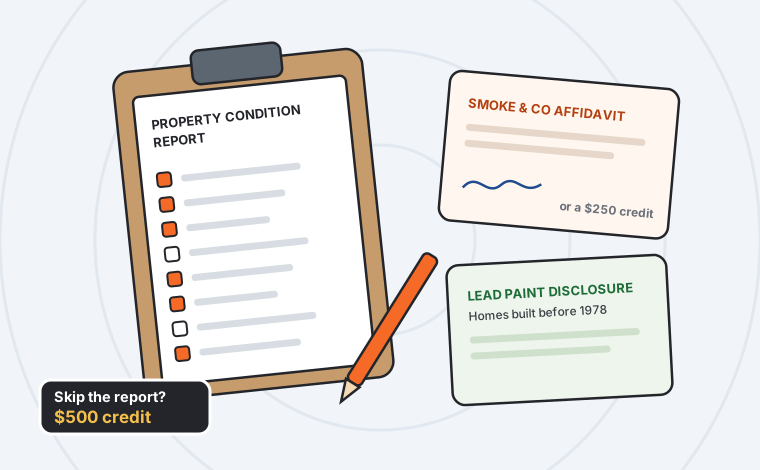
The $500 credit is what a Connecticut seller must credit the buyer at closing if the seller does not deliver the required disclosure report (CGS 20-327c). You can legally choose to pay it instead of filling out the report, but since January 1, 2020 paying it does not excuse you from disclosing a defect you know about that significantly impairs the home’s value, the occupants’ health or safety, or the home’s useful life.
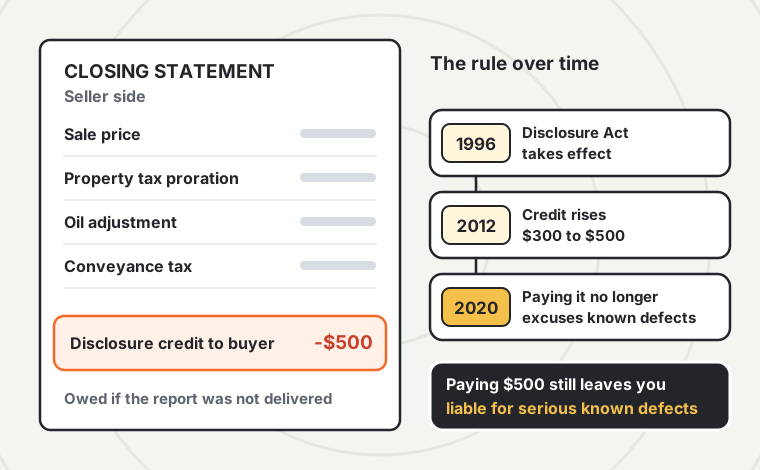
Every purchase agreement for a home that needs the report must include the credit clause. The amount was $300 until Public Act 12-122 raised it to $500 on July 1, 2012. Public Act 19-192 then added the rule that makes “just pay the $500” a weak strategy: a seller who pays the credit must still disclose a defect that is covered by the report, within the seller’s actual knowledge, and that significantly impairs value, health or safety, or useful life. A buyer can sue for actual damages if you do not (CGS 20-327c(b) and (c)).
Fill in the report
$0plus an hour or two of your time
- Buyers and their attorneys expect it
- Your honest answers are on record
- Fewer surprises at inspection
Pay the credit
$500credited to the buyer at closing
- Still must disclose serious known defects
- Makes buyers wonder what you are hiding
- No real legal protection gained
Our advice
Fill it inhonestly, with UNK where you do not know.
- Attach the reports you have.
The credit appears on the closing statement alongside the property tax proration and the oil adjustment. Our guide to seller closing costs in Connecticut walks through the rest of that statement.
What other disclosures does a Connecticut seller have to make?
Besides the property condition report, a Connecticut seller usually has to give the federal lead paint disclosure for homes built before 1978, sign the smoke and carbon monoxide affidavit at closing (or credit the buyer $250), give the private well testing notice if there is a well, and attach the state’s fair housing disclosure form at closing. Homes in the crumbling-foundation towns acquired through foreclosure or a deed in lieu, or sold by a town, also need the Residential Foundation Condition Report.
| Disclosure | Who it applies to | When | If you skip it |
|---|---|---|---|
| Residential Property Condition Report (CGS 20-327b) | Most sellers of 1-4 unit homes and condos | Before the buyer signs a binder or contract | $500 credit; still liable for serious known defects |
| Lead-based paint disclosure and EPA pamphlet (federal) | Homes built before 1978 | Before the contract; buyer gets up to 10 days to test unless waived | Federal penalties and damages |
| Smoke and carbon monoxide affidavit (CGS 29-453) | One- and two-family homes and condo units | At closing | $250 credit to the buyer |
| Private well testing notice (CGS 19a-37(d)) | Properties with a private or semipublic well | Before the sale | Does not void the sale; written notice fully satisfies the duty |
| Fair housing disclosure form (CGS 20-327h) | Sellers of residential property | Signed by the buyer, attached at closing | Does not void the contract |
| Residential Foundation Condition Report (CGS 20-327b(g)-(h)) | Homes in CRCOG-listed towns acquired by foreclosure, deed in lieu or a town | Before the buyer signs | $500 credit |
| Hazardous waste and hunting notices (CGS 20-327f, 20-327g) | Optional notices | Before or at contract | Giving them satisfies the duty |
Lead paint disclosure for homes built before 1978
Federal law (the Residential Lead-Based Paint Hazard Reduction Act, enforced by EPA and HUD) applies on top of Connecticut’s report. For a home built before 1978 you must disclose any known lead-based paint or hazards, hand over any lead reports you have, give the buyer the EPA pamphlet “Protect Your Family From Lead in Your Home”, include the lead warning statement in the contract, and give the buyer up to 10 days to arrange a lead inspection or risk assessment unless they waive it in writing. Keep the signed form for three years. Much of Connecticut’s housing qualifies: in New Haven the median single-family home on our New Haven page was built around 1930, and in New Britain and West Hartford roughly four in five were built before 1960.
The smoke and carbon monoxide affidavit
At closing on a one- or two-family home or condo unit you sign an affidavit about the smoke and carbon monoxide detection equipment (CGS 29-453). If you do not, you credit the buyer $250. It is cheap to get right: working alarms on every level and near bedrooms, and CO alarms if the house has fuel-burning appliances or an attached garage. Your attorney will have the form.
Who has to fill out the Residential Foundation Condition Report?
The Residential Foundation Condition Report has to be filled out only for homes in a town the Capitol Region Council of Governments (CRCOG) lists as affected or potentially affected by crumbling foundations, and only when the seller acquired the home through strict foreclosure, foreclosure by sale, a deed in lieu of foreclosure, or is a town or other political subdivision. Ordinary homeowners in those towns answer the foundation questions on the main report instead.
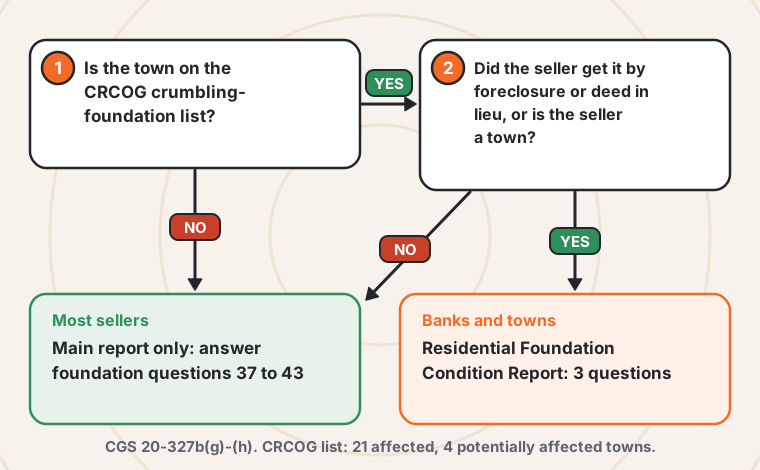
This is the most misunderstood part of the Connecticut disclosure rules, including in some real estate guides. The statute is CGS 20-327b(g) and (h), added by Public Act 19-192, and the DCP form’s first paragraph says the same thing. Those sellers, mostly banks and towns, are otherwise exempt from the main report, so the legislature made them disclose what they know about the foundation on a short three-question form: knowledge of pyrrhotite, known damage or deterioration, and known repairs or remediation. Missing it triggers the same $500 credit.
If you are an individual homeowner in Vernon, Manchester, South Windsor or Enfield, you fill in questions 37 to 43 on the main report, which ask the same things and more. The CRCOG map, last updated September 28, 2023, lists 21 affected and 4 potentially affected towns; our crumbling foundation guide lists them all.
How do you fill out the Connecticut property condition report, step by step?
To fill out the Connecticut property condition report, download the current DCP form, gather your records first (tank, septic, well, radon, roof, foundation and repair paperwork), answer every question with YES, NO, UNK or N/A, explain each YES, attach the reports the form asks for, initial every page, sign and date, and have your attorney or agent deliver it before the buyer signs anything.
Download the current form
Get the Residential Property Condition Report from the Department of Consumer Protection’s real estate consumer page. Check the footer: it should say “Revised 07/2025” or later.
Gather your records before you start
Septic pumping receipts, oil tank removal letters and soil tests, well water tests, radon tests, roof and window invoices, foundation inspection or core-test reports, permits for work you did, flood insurance and any elevation certificate, HOA documents for a condo.
Look up your flood zone
Use FEMA’s Flood Map Service Center for question 60. Do not guess.
Answer every question
All 65. Leaving one blank is not the same as UNK. Use UNK when you do not know and N/A when it does not apply.
Explain every YES
Short, factual, dated: what happened, when, what was done, who did it. Attach extra pages with the address, your name and the date if you need room.
Attach the reports the form asks for
Questions 20 (tank removal), 29 (well test), 41 and 42 (foundation testing and repairs) and 57 (radon) all ask for documents.
Read it as the buyer would
Do your answers match each other and the listing? A “no seepage” answer next to a listing photo of a dehumidifier and water stains invites questions.
Initial each page, sign and date
Every owner signs. Keep a copy.
Deliver it before any signature
Your attorney or agent gives it to the buyer, gets their signed receipt, and attaches it to the offer and the contract.
Records to pull before you list
- Deed and the names of every owner
- Oil tank: location, age, removal letter, soil (ETPH) test
- Septic: service company, last pumping date, inspection reports
- Well: most recent water test and the lab name
- Radon: test results; mitigation system invoice
- Roof: age, invoice, warranty
- Foundation: any engineer’s visual inspection or core test
- Permits and certificates of occupancy for additions and finished basements
- Flood: FEMA zone, insurance declarations page, elevation certificate
- Leases for solar panels, propane tank, water heater or alarm
- Condo or HOA dues and any special assessment
- Lead: any lead inspection or abatement report (homes built before 1978)
What if you discover a problem after you give the buyer the report?
If you discover a problem after you give the buyer the Connecticut disclosure report, tell your attorney right away and put it in writing to the buyer. The statute does not spell out an update procedure, but a defect you learn about before closing is now within your actual knowledge, and staying quiet about something that significantly impairs value or safety is exactly what CGS 20-327c(b) allows a buyer to sue over.
The same goes for anything the buyer’s inspection turns up. Once you have read the inspection report, you know what it says. If the deal falls through and you relist, update your report before the next buyer signs.
Do you still need the disclosure report if you sell as-is or for cash?
Yes, you still need the disclosure report in Connecticut if you sell as-is or to a cash buyer. The law has no as-is or cash exemption: the report applies to all sales of 1-4 unit homes “with or without” an agent, and an as-is clause only means you will not make repairs. It does not let you hide known defects.
What a cash or as-is sale changes is how much the answers matter to the deal. A buyer who is pricing in the repairs anyway, with no lender to satisfy, is less likely to walk away over a YES on the roof or a tank. That is why owners with problem houses often find an as-is sale less stressful, even though the price is lower. If you want to see how the numbers compare, our cash buyer vs. realtor comparison shows the trade-off honestly, and our guide on what to fix before selling a house in Connecticut helps you decide whether to repair first.

When we buy a house, a filled-in disclosure report with an honest list of problems never scares us off. What slows a deal down is a report that says “no problems” next to a basement that clearly has some. Write it the way you would want it written if you were the buyer. If a question makes you nervous, call your attorney before you answer it, not after.
Selling a house with problems on the report?
Send a few photos and the address. We will price the repairs we see and give you a cash number you can compare with listing it, no visit needed to start.
Get your cash offer
without anyone coming over.
Want your offer faster, or rather not talk to anyone yet? Send a few phone photos of each room. We price the repairs from them, line by line, and send your cash offer back, so you see a real number before you ever meet us or pick up the phone.
 CabinetsFlooring
 Tub & tile
 Floors
 Roof
We may bring in a partner buyer to close. Your price and terms don't change.
Questions about the Connecticut property condition disclosure
Is a seller’s disclosure required in Connecticut?
Yes, a seller’s disclosure is required in Connecticut for most sales of one- to four-unit homes and condos. The seller must give the Residential Property Condition Report before the buyer signs a binder or contract (CGS 20-327b), or credit the buyer $500 at closing (CGS 20-327c).
Where do I get the Connecticut property condition disclosure form?
You get the Connecticut property condition disclosure form from the Department of Consumer Protection’s real estate consumer page on portal.ct.gov. Use the current version, marked “Revised 07/2025”, not an old copy from a previous sale.
Can I just pay the $500 instead of filling out the disclosure?
You can pay the $500 instead of filling out the disclosure in Connecticut, but it rarely helps. Since 2020, a seller who pays the credit must still disclose known defects that significantly impair the home’s value, health and safety, or useful life, and a buyer can sue for damages if they do not.
Do I have to disclose a problem I fixed?
You should disclose a problem you fixed when the form asks about it, and several questions do: removed oil tanks, foundation repairs, radon systems in the last 12 months, flood claims and aid. For other items, disclosing the fix with a receipt is usually the safest and most reassuring answer.
Does an executor have to fill out the disclosure report in Connecticut?
No, an executor does not have to fill out the disclosure report in Connecticut. Transfers by executors, administrators, trustees and conservators are exempt under CGS 20-327b(b). Many executors still provide what they know, because buyers ask for it.
Do I have to disclose a death in the house in Connecticut?
No, you do not have to disclose a death in the house in Connecticut. It is a “nonmaterial fact” under CGS 20-329dd. If a buyer making a genuine offer asks in writing about a suspected homicide, felony or suicide, you must answer in writing or have your agent say in writing that you decline.
What changed on the Connecticut disclosure form in 2025?
What changed on the Connecticut disclosure form in 2025 is a new Flood Risk Awareness section with six questions (60 to 65) and a flood insurance statement, added by Public Act 25-33 effective July 1, 2025. The form is now marked “Revised 07/2025”.
Do I need the Residential Foundation Condition Report?
You need the Residential Foundation Condition Report only if your home is in a CRCOG-listed crumbling-foundation town and you acquired it through foreclosure, a deed in lieu, or as a town. Other sellers answer the foundation questions (37 to 43) on the main report.
Is the Connecticut disclosure report a warranty?
No, the Connecticut disclosure report is not a warranty. The form and CGS 20-327d say so. Your answers cover only your actual knowledge (CGS 20-327e), but a false answer about something you knew can still support a claim.
Do I have to get inspections before filling out the report?
No, you do not have to get inspections before filling out the report. CGS 20-327d says the law does not require the seller to secure inspections or tests. Answer from what you know and use “UNK” where you do not know.
Does the disclosure apply to a condo?
Yes, the disclosure applies to a condo or co-op unit in Connecticut. The law covers one- to four-unit residential property “including cooperatives and condominiums”. Question 13 asks about the common interest community and its fees.
Does the disclosure apply to a five-unit building?
No, the disclosure report does not apply to a five-unit building. The statute covers one to four dwelling units. Larger buildings, commercial property and land are outside it, although ordinary misrepresentation law still applies.
Can my real estate agent fill out the disclosure for me?
No, your real estate agent cannot fill out the disclosure for you. The form states that your real estate licensee cannot complete it on your behalf. Your agent or attorney can explain questions, but the answers must be yours.
When does the buyer have to receive the disclosure?
The buyer has to receive the disclosure before signing any binder, contract to purchase, option or lease with a purchase option. A copy with the buyer’s receipt is attached to the offer, and a copy signed by both sides is attached to the purchase agreement.
Do I need to disclose radon in Connecticut?
You need to disclose radon test results you have in Connecticut. Question 57 asks whether a test was done and asks you to attach the report, and questions 58 and 59 ask about a radon system now or in the previous 12 months. Connecticut does not require you to test.
Do I have to disclose an old underground oil tank?
Yes, you have to disclose an old underground oil tank you know about. Questions 18 to 20 ask about current tanks, known problems and any tank removed during your ownership, including who removed it and when, with the removal paperwork attached.
Does selling as-is mean I skip the disclosure?
No, selling as-is does not mean you skip the disclosure in Connecticut. There is no as-is exemption. As-is means you will not make repairs; you still disclose what you know.
What disclosures are needed for a house with a well?
For a house with a well, you answer the water questions on the report (27 to 30), attach any well test, and give the buyer written notice that private well testing information is on the Department of Public Health website (CGS 19a-37(d)).
Related Connecticut guides
Before you list
Common disclosure issues
The disclosure report is one piece of the sale. For the full picture, from pricing to closing day, start with our guide on how to sell a house in Connecticut.
Sources
- Connecticut General Statutes, chapter 392: § 20-327b (condition reports, exemptions, foundation report), § 20-327c ($500 credit; disclosure of serious known defects), §§ 20-327d to 20-327h, §§ 20-329cc to 20-329ee (nonmaterial facts). Checked October 2026.
- Department of Consumer Protection, Real Estate Information for Consumers and the Residential Property Condition Report and Residential Foundation Condition Report (Revised 07/2025).
- Public Act 25-33 (flood risk awareness section, §§ 3-4, effective July 1, 2025; lender and insurer flood notices, §§ 1-2, effective July 1, 2026) and OLR Report 2025-R-0113, 2025 Acts Affecting Housing and Real Estate.
- 2025 Substitute House Bill 7078, bill status (failed in the Appropriations Committee, May 5, 2025).
- Public Act 12-122 (credit raised to $500).
- CGS § 29-453 (smoke and carbon monoxide affidavit; $250 credit).
- CGS § 19a-37(d) (private well testing notice at sale).
- EPA and HUD Lead-Based Paint Disclosure Rule (homes built before 1978).
- Capitol Region Council of Governments, Crumbling Foundations (towns affected for real estate transactions under § 20-327b; map updated September 28, 2023).
- FEMA Flood Map Service Center.
- Town housing age: Connecticut OPM and 2025 parcel CAMA data on data.ct.gov, as shown on our town pages.
See the house together.
Pick a time that works.
Choose a time for us to walk through the property with you, or ask for a quick call first. We confirm every request personally.
Tuesday, January 13
No open times in the next few weeks. Please call us.
We will confirm by email. Nothing is booked until we do.
View my request
Who wrote this
Jerryll Noorden
Jerryll has bought and sold Connecticut houses since 2016 and has sat at more closing tables than he can count, on both sides. Before real estate he was a robotics scientist at NASA, IHMC and IIT. He wrote this guide because the national sites that rank for it skip the Connecticut rules that cost sellers money. When listing or selling it yourself would get you more than a cash offer, he says so.
This guide explains Connecticut rules in plain English. It is not legal or tax advice. Laws change; for your sale, talk to a Connecticut real estate attorney and a tax professional.
