
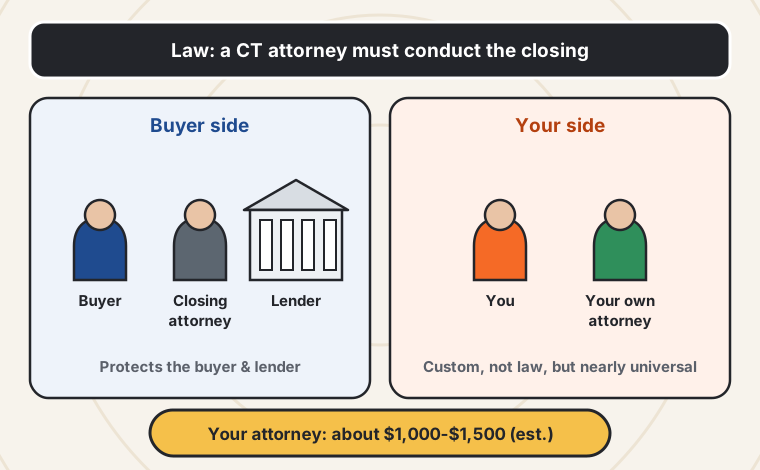
- It is the law that an attorney conducts the closing. Since October 1, 2019, only a Connecticut-admitted attorney in good standing may conduct a real estate closing in Connecticut, including a cash sale (CGS 51-88a, Public Act 19-88).
- It is custom, not law, that you hire your own. The law does not force a seller to have a separate attorney. Almost every Connecticut seller does, because the closing attorney usually works for the buyer or the lender.
- From signed contract to closing usually takes 30 to 45 days with a mortgage buyer, and about two weeks with cash (est.).
- Your attorney’s main jobs: the contract, your mortgage payoff and release, title problems, the deed, the conveyance tax return (OP-236) and your settlement statement.
- Your jobs: the property condition report before the contract, working smoke and CO detectors for the closing affidavit, a clean and empty house for the walkthrough, and your keys.
- You do not have to be in the room. Many sellers sign ahead with a notary or use a recorded power of attorney.
Do you need an attorney to sell a house in Connecticut?
You need an attorney involved to sell a house in Connecticut, because state law says only a Connecticut-admitted attorney in good standing may conduct a real estate closing (CGS 51-88a). The law does not require you, the seller, to hire your own attorney; the closing attorney is often the buyer’s or the lender’s. In practice nearly every Connecticut seller has their own attorney, and you should too.
This is one of the questions where national advice gets Connecticut wrong, and where the honest answer has two parts: what the law says, and what everyone does. If you are just starting out, our guide to how to sell a house in Connecticut puts the closing in context with pricing, repairs and the different ways to sell.
What the law actually says
The statute is short. Since October 1, 2019, “no person shall conduct a real estate closing” unless that person is admitted as an attorney in Connecticut and is not disqualified by resignation, disbarment, inactive status or suspension. A “real estate closing” includes any transaction in which consideration is paid to change the ownership of real property in Connecticut, and most mortgage loan closings (CGS 51-88a(a)). Doing it without being a Connecticut attorney is the unauthorized practice of law, which is generally a class D felony, or a class C misdemeanor for a lawyer admitted elsewhere (CGS 51-88).
The legislature’s Office of Legislative Research says the 2019 law was passed partly in response to “witness-only” or “notary-only” closings, where someone only notarized signatures and nobody was actively handling the transaction. Bills to limit or repeal it were proposed in 2021 and did not pass.
The law requires that a Connecticut attorney conduct the closing (CGS 51-88a). Custom, not law, is that the buyer and the seller each have their own attorney. National articles that say “Connecticut requires both parties to have an attorney” overstate it; articles that say “you don’t need an attorney in Connecticut” are out of date since 2019.
Why you still want your own attorney
- The closing attorney is not on your side. In a sale with a mortgage, the attorney running the closing is usually the buyer’s attorney, often also acting for the lender. Their job is to protect the buyer and the lender. A lawyer generally cannot represent both sides when their interests conflict.
- Someone has to clear your title. Old mortgages that were paid but never released, liens, an estate that was never probated, a name mismatch on the deed: these are the seller’s problems to fix.
- Someone has to get your mortgage paid off and released. Your attorney orders the payoff, pays it from your proceeds and follows up until the release is on the land records.
- Someone has to prepare your documents. The deed, the conveyance tax return and the seller affidavits are the seller’s side of the closing.
- The cost is small next to the risk. A straightforward sale usually costs about $1,000 to $1,500 in seller’s attorney fees (est.), on a transaction worth hundreds of thousands.
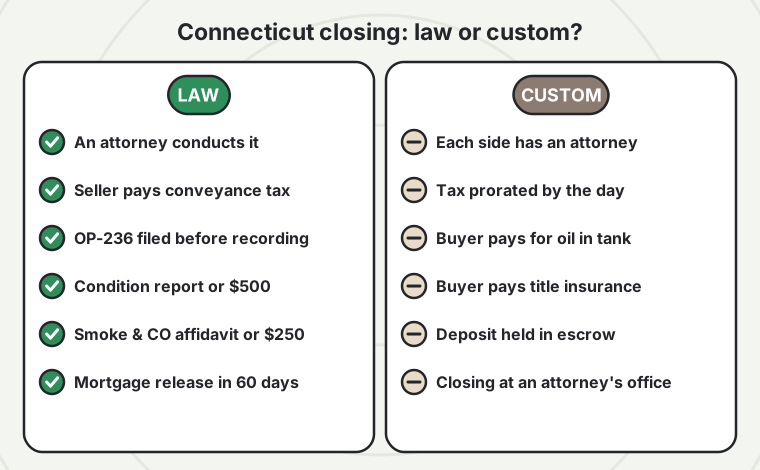
What parts of a Connecticut closing are law, and what parts are custom?
The parts of a Connecticut closing set by law are the attorney conducting the closing, the seller paying the conveyance tax and filing the return before the deed is recorded, recording the deed, the property condition report and smoke and CO affidavit (or their credits), the federal lead paint disclosure, and the lender’s duty to release your mortgage. Separate attorneys for each side, the property tax proration method, the oil adjustment, who pays title insurance and the deposit amounts are custom.
| Part of the sale | Law or custom | Source or note |
|---|---|---|
| A Connecticut attorney conducts the closing | Law | CGS 51-88a (PA 19-88), effective October 1, 2019 |
| Buyer and seller each have their own attorney | Custom | Not required by statute; nearly universal in practice |
| Seller pays the conveyance tax when the deed is recorded | Law | CGS 12-495 |
| Conveyance tax return (OP-236) filed and tax paid before recording | Law | CGS 12-497 |
| Deed recorded in the town where the land lies | Law | An unrecorded deed does not hold the land against anyone but the seller and heirs (CGS 47-10) |
| Power of attorney recorded with the deed | Law | CGS 47-10, unless already recorded and referenced |
| Residential Property Condition Report before the buyer signs, or a $500 credit | Law | CGS 20-327b and 20-327c |
| Smoke and carbon monoxide affidavit at closing, or a $250 credit | Law | CGS 29-453 |
| Lead paint disclosure and pamphlet for homes built before 1978 | Law (federal) | EPA/HUD disclosure rule |
| Condo resale certificate delivered to the buyer | Law | CGS 47-270 |
| Lender releases your mortgage after payoff | Law | Within 60 days of a written request, or $200 a week in damages up to $5,000 (CGS 49-8); an attorney can record an affidavit if the lender does not (CGS 49-8a) |
| Form 1099-S reported to the IRS | Law (federal) | Filed by the person responsible for closing; most main-home sales of $250,000 or less ($500,000 married) can be exempted with a seller certification |
| FIRPTA withholding if the seller is a foreign person | Law (federal) | 15% of the amount realized unless an exception applies (IRS) |
| Property tax prorated by the day; seller usually credits the buyer | Custom | Towns bill in arrears; method follows the town’s billing cycle |
| Buyer reimburses seller for heating oil in the tank | Custom | Set in the contract |
| Buyer pays title search and title insurance | Custom | Negotiable |
| Deposit: a small amount with the offer, more at contract, held in an attorney’s escrow account | Custom | Amounts and timing are set in the contract |
| Closing at an attorney’s office; seller may sign ahead | Custom | Arranged by the attorneys |
How long does the closing process take in Connecticut?
The closing process in Connecticut usually takes 30 to 45 days from a signed contract to closing when the buyer has a mortgage, and about two weeks, or whatever date you choose, when the buyer pays cash (est.). The mortgage commitment date in the contract is usually what sets the pace, because the lender’s appraisal and underwriting take the most time.
Typical shapes, not promises (est.). Estates, short sales, title problems and divorces add time. Our guide to how long it takes to sell a house in Connecticut covers the time before the contract too.
What are the steps of a Connecticut closing for a seller?
The steps of a Connecticut closing for a seller are: hire your attorney, deliver the disclosures, accept an offer, sign the contract and take the deposit, handle the inspection, wait for the buyer’s mortgage commitment and title search, let your attorney order the payoff and prepare the deed and tax return, review the settlement statement, prepare the house for the walkthrough, sign at closing, and receive your proceeds after the deed is recorded.
Hire your Connecticut attorney before you sign anything
Ideally before you list, and certainly before you accept an offer. Get a flat fee in writing. If you do not know one, the Connecticut Bar Association runs a lawyer referral service. Give your attorney your deed, your mortgage statement and any HOA details.
Give the buyer the disclosures before the contract
The Residential Property Condition Report has to reach the buyer before they sign a binder, contract or lease-option, or you credit $500 at closing. Add the lead paint disclosure for a pre-1978 house; in crumbling-foundation towns, answer the report’s foundation questions carefully. Condo sellers order the resale certificate from the association, which has ten business days to provide it (CGS 47-270).
Accept an offer, then sign the contract
In Connecticut the offer or binder is usually followed by a full purchase and sale agreement that the attorneys draft or review. It sets the price, deposit, mortgage contingency date, inspection period, closing date, the oil and tax adjustments and what stays with the house.
The deposit goes into escrow
The buyer’s deposit is usually held in an attorney’s or broker’s escrow account until closing. The contract says when it becomes non-refundable.
The buyer’s inspections
Usually in the first week or two. Expect a request for repairs or a credit. In Connecticut the usual topics are the oil tank, septic, well water, radon, the electrical panel and, in some towns, the foundation. Negotiate a credit rather than doing rushed repairs if you can.
Appraisal and mortgage commitment
The lender orders an appraisal and underwrites the loan. The buyer must get a written commitment by the date in the contract or cancel. A low appraisal is the most common reason for a second negotiation.
Title search and municipal searches
The buyer’s attorney searches the town land records, usually back decades, and checks for unpaid taxes, sewer and water charges, liens and open permits. Anything that clouds title comes back to your attorney to fix.
Your attorney orders the payoff and prepares your documents
A written payoff statement from each lender, the deed (usually a warranty deed), the conveyance tax return (OP-236), and the seller’s affidavits. Your attorney also gathers what you need to sign for the 1099-S and, if relevant, the FIRPTA certification.
Review the settlement statement
A day or two before closing you get the draft: price, credits, conveyance tax, prorated property tax, oil adjustment, payoffs, fees and your net. Read every line and ask about anything you do not recognize.
Final readings and the walkthrough
Arrange final water and sewer readings and an oil reading. The buyer walks through the house, usually within 24 hours of closing. Leave it empty (unless the contract says otherwise), clean and with everything that was included.
Closing day
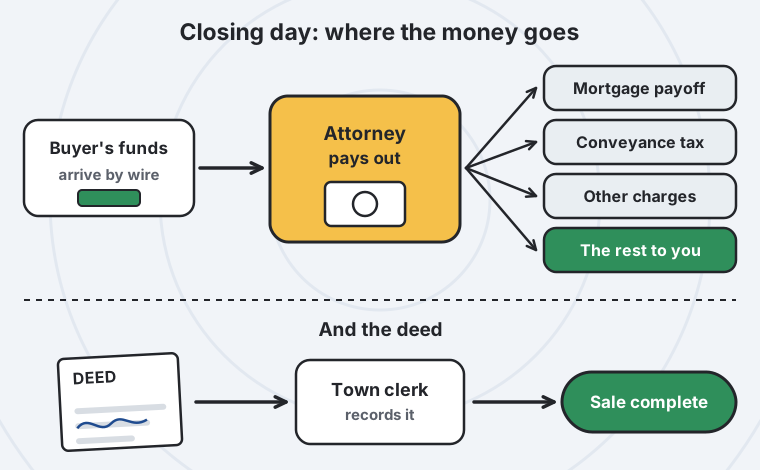
You sign the deed, the conveyance tax return, the smoke and CO affidavit and the seller affidavits. The buyer’s funds arrive by wire. The deed and the conveyance tax go to the town clerk for recording.
Money and the mortgage release
Your attorney pays your mortgage, the conveyance tax and the other charges, and sends you the rest, usually by wire. The lender has 60 days from a written request to deliver the release; if it does not, an attorney can record an affidavit of payment (CGS 49-8 and 49-8a).
What does a seller’s attorney do in Connecticut?
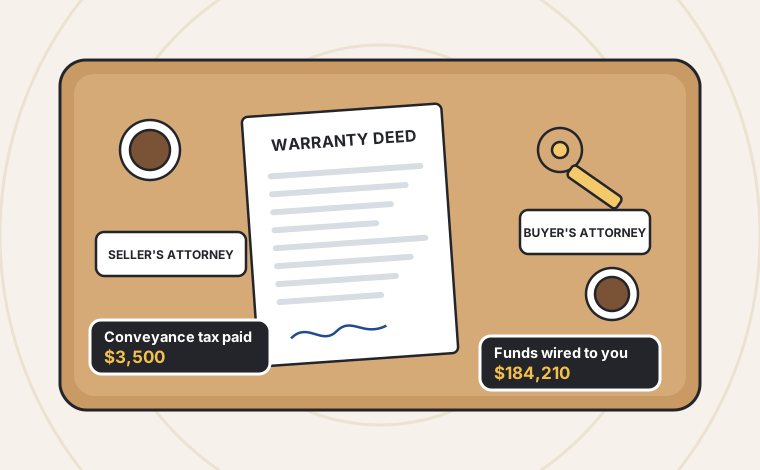
A seller’s attorney in Connecticut reviews or drafts the contract, orders your mortgage payoffs, clears title problems, prepares the deed, the conveyance tax return and the seller affidavits, checks the settlement statement, holds and disburses your money, and makes sure your mortgage is released after closing. Here is who does what.
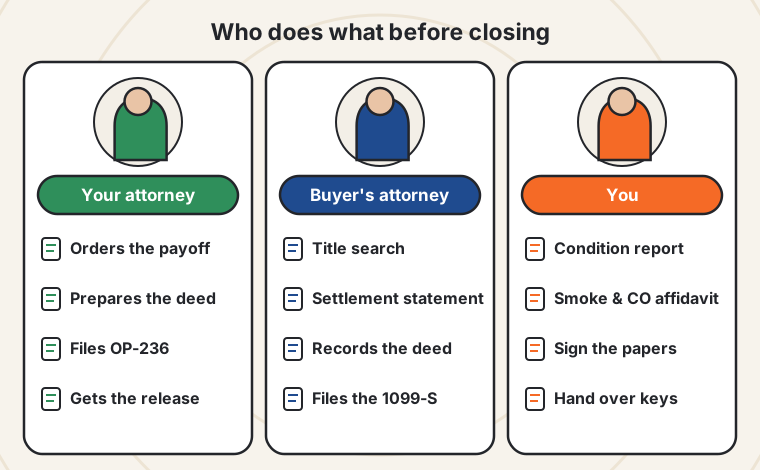
| Task | Seller’s attorney | Buyer’s or closing attorney | You |
|---|---|---|---|
| Purchase contract | Drafts or reviews | Drafts or reviews | Signs |
| Disclosures (condition report, lead, foundation) | Advises | Receives | Completes and delivers |
| Title search and municipal lien searches | Fixes what is found | Orders and reviews | Provides documents |
| Mortgage payoff statements | Orders | Reviews | Signs authorization |
| Deed | Prepares | Reviews | Signs |
| Conveyance tax return (OP-236) | Prepares and files | Reviews | Signs (or attorney signs) |
| Smoke and CO affidavit | Prepares | Receives | Signs |
| Settlement statement | Reviews your side | Prepares (usually) | Approves |
| Recording deed and mortgage | Records | ||
| Paying off your loan and getting the release | Pays and follows up | ||
| Form 1099-S | Collects your information | Files (usually, as the person responsible for closing) | Gives SSN and any certification |
What your attorney needs from you
Tick these off as you gather them; your progress is saved on this device.
- A copy of your deed (from the town clerk if you do not have it)
- Your latest mortgage statement(s) and any home equity line, with account numbers
- Social Security numbers of all sellers (for OP-236 and the 1099-S)
- Your forwarding address after the sale
- The completed property condition report and any foundation or lead disclosures
- Your latest property tax bill and any sewer or water bills
- HOA or condo association contact, and the resale certificate
- Permits and records for work you did (roof, additions, oil tank removal, septic)
- Survey, if you have one
- Death certificate, probate certificate, divorce decree, trust or LLC papers, or power of attorney, if anyone on title cannot sign for themselves
- Wiring instructions for your proceeds, confirmed by phone
The full list, with where to get each document, is in the documents you need to sell a house in Connecticut.
How much does a real estate attorney cost for a seller in Connecticut?
A real estate attorney for a seller in Connecticut usually costs about $1,000 to $1,500 for a straightforward sale (est.), almost always as a flat fee. Expect more for a by-owner sale where the attorney drafts the contract, an estate or trust sale, a short sale, a divorce sale, or a title problem that takes extra work.
| Situation | Typical seller attorney fee (est.) | Why it differs |
|---|---|---|
| Simple sale with agents on both sides | $1,000 to $1,500 | Standard documents, one payoff |
| By-owner sale | Somewhat higher | The attorney drafts the contract and does work an agent would coordinate |
| Estate or probate sale | Higher | Fiduciary deed, probate court authority, estate tax lien release |
| Short sale | Higher | Lender approval, payoff negotiation, tight deadlines |
| Title problems (unreleased mortgages, liens, boundary issues) | Extra | Research and curative documents |
The attorney fee is part of your overall selling cost. Our guide to the cost to sell a house in Connecticut puts it next to commissions, the conveyance tax and property tax prorations, with a calculator.
What happens on closing day in Connecticut?
On closing day in Connecticut, the seller signs the deed, the conveyance tax return, the smoke and carbon monoxide affidavit and the seller affidavits, the buyer’s money arrives by wire, the attorney pays off your mortgage, the conveyance tax and other charges, and you receive the rest. The deed is then recorded at the town clerk’s office.
What you sign
- The deed. Usually a warranty deed, which promises the buyer good title. Executors and trustees use a fiduciary deed; some transfers use a quitclaim deed.
- Form OP-236, the conveyance tax return (you or your attorney sign).
- The smoke and carbon monoxide affidavit for one- and two-family homes and condo units, or you credit $250.
- Seller affidavits the title insurer asks for, such as that no one has done unpaid work on the house recently and there are no unrecorded agreements.
- The settlement statement approving the numbers.
- Tax forms: the 1099-S information or certification, and a FIRPTA non-foreign certification (or the withholding paperwork if you are a foreign person).
Do you have to attend?
No. Many Connecticut sellers sign their documents in advance in front of a notary, at their attorney’s office or wherever they live, and the attorneys complete the closing without them. You can also sign through a power of attorney; under CGS 47-10 the power of attorney is recorded with the deed. If you live out of state, tell your attorney at the start so they can plan the signing.
Bring
- A government photo ID
- All keys, garage openers, codes
- Your final oil reading or receipt
- Confirmed wiring instructions for your proceeds
Criminals target real estate closings with fake emails that “update” wiring instructions. Never send money or change where your proceeds go based on an email. Call your attorney at a number you already know and confirm by voice.
How is the closing different for an estate, a divorce, a short sale or a cash sale?
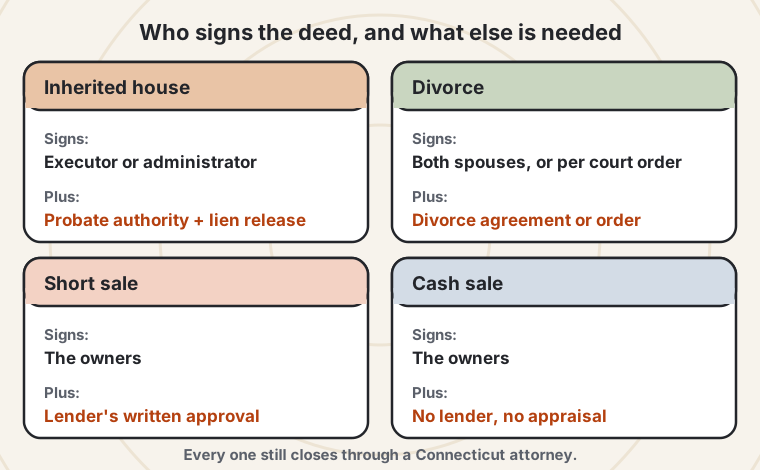
The Connecticut closing is different for an estate, a divorce, a short sale or a cash sale mainly in who signs and what extra paperwork the attorneys need: probate authority and an estate tax lien release for an estate, both spouses or a court order for a divorce, the lender’s written approval for a short sale, and no lender or appraisal at all for a cash sale.
| Situation | Who signs the deed | Extra paperwork | Time effect |
|---|---|---|---|
| Inherited house in probate | The executor or administrator (fiduciary deed) | Probate certificate of appointment; Probate Court authority to sell where required (CGS 45a-164); release of the Connecticut estate tax lien | Court hearing can add weeks |
| Divorce | Both spouses on title, or as ordered by the court | Divorce agreement or court order; a deed under a decree is exempt from conveyance tax (CGS 12-498) | Depends on cooperation |
| Short sale | The owners | The lender’s written short sale approval; conveyance tax exemption for a principal residence (CGS 12-498(a)(20)) | Lender approval often takes the longest |
| Foreclosure pending | The owners | Payoff or approval from the foreclosing lender; must close before your Law Day | Deadline-driven |
| Cash sale | The owners | No lender, no appraisal; a Connecticut attorney still conducts the closing (CGS 51-88a) | About two weeks or your chosen date (est.) |
| Seller is an LLC or trust | The authorized manager or trustee | Authority documents; OP-236 Schedule A listing members or beneficiaries | Minor |
How does the closing work if you sell without a realtor?
If you sell without a realtor in Connecticut, the closing works the same way, but your attorney does more: they draft or review the contract from the start, track the inspection and mortgage deadlines an agent would usually watch, and coordinate directly with the buyer’s attorney and lender. Hire the attorney before you accept an offer.
Without an agent, your attorney is your only professional on the deal. That makes the attorney’s fee the best money you spend. Our guide to selling a house without a realtor in Connecticut has the full by-owner process, including how to screen offers and verify the buyer’s financing.

Closings in Connecticut rarely fall apart at the table. They fall apart in the weeks before: a payoff that was ordered late, an old mortgage from a refinance years ago that was never released, a parent’s name still on the deed. Give your attorney your deed and mortgage statements the week you list, and ask them to look at title early. Those fixes take days when you start early and weeks when you start late.
What delays a closing in Connecticut?
The things that delay a closing in Connecticut are a late mortgage commitment or a low appraisal, title problems such as unreleased old mortgages or liens, a missing signature from a co-owner or an estate, open building permits or unpaid municipal charges, repair disputes after the inspection, and lender approval in a short sale.
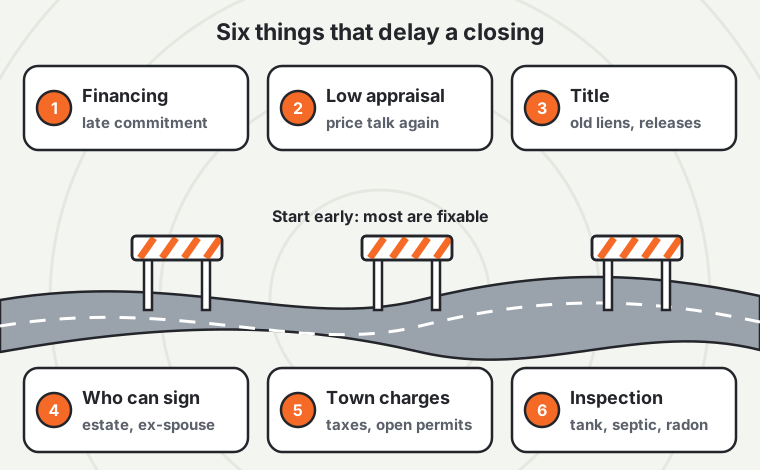
- Financing. The buyer’s commitment comes late or not at all. Verify the buyer’s pre-approval before you accept.
- A low appraisal. The buyer asks for a lower price. Price from recent sales to reduce the risk.
- Title. A mortgage paid off in a refinance but never released, a mechanic’s lien, a judgment lien. Your attorney can usually cure these, given time.
- Who can sign. A deceased owner, a divorced spouse still on title, an heir out of state. See selling a house during probate in Connecticut.
- Municipal issues. Unpaid taxes or sewer charges, open permits for old work. Check with your town early. Liens and tax problems are covered in selling a house with liens or tax problems.
- Inspection disputes. Oil tanks, septic, radon, foundations. Decide in advance what you will credit.
What changes if you sell to a cash buyer?
If you sell to a cash buyer in Connecticut, there is no mortgage contingency, no lender appraisal and usually no inspection negotiation, so the closing can happen in about two weeks or on the date you choose (est.). The legal steps stay the same: a Connecticut attorney conducts the closing, you sign a deed and the conveyance tax return, and your attorney pays off your mortgage and sends you the rest.
We are cash buyers, so take this with that in mind. A cash sale is not the right answer for every house. If yours is in good shape and you have a few months, listing it will usually net you more, and we will tell you so. A cash sale earns its place when the house needs work a lender will not finance, when there is a deadline (a Law Day, a probate timeline, a move), or when you simply do not want showings, repairs and a 45-day contingency period.
If you want to compare, here is how it works with us. You talk to me, Jerryll Noorden, directly at (203) 529-4712. You can start small: send the address and a few photos for a ballpark. We never charge fees, we close through Connecticut attorneys like any other sale, you are welcome to have your own attorney review everything, and our offers do not expire while you think about it. Whatever state the house is in, we have seen worse.
Get your cash offer
without anyone coming over.
Want your offer faster, or rather not talk to anyone yet? Send a few phone photos of each room. We price the repairs from them, line by line, and send your cash offer back, so you see a real number before you ever meet us or pick up the phone.
 CabinetsFlooring
 Tub & tile
 Floors
 Roof
We may bring in a partner buyer to close. Your price and terms don't change.
Questions Connecticut sellers ask about closing and attorneys
Is Connecticut an attorney closing state?
Yes, Connecticut is an attorney closing state. Since October 1, 2019, only a Connecticut-admitted attorney in good standing may conduct a real estate closing, including sales and most mortgage loan closings (CGS 51-88a).
Does the seller need a lawyer in Connecticut?
The seller does not strictly need their own lawyer under Connecticut law, which only requires that a Connecticut attorney conduct the closing. In practice nearly every Connecticut seller hires one, because the closing attorney usually represents the buyer or the lender.
Can the buyer’s attorney represent me too?
Usually the buyer’s attorney cannot also represent you, because buyers and sellers have conflicting interests in a sale. The buyer’s attorney protects the buyer and often the lender. Hire your own attorney for the seller’s side.
How much does a closing attorney cost for a seller in Connecticut?
A closing attorney for a seller in Connecticut usually costs about $1,000 to $1,500 for a straightforward sale (est.), as a flat fee. Estate, short sale, divorce and by-owner sales usually cost more.
How long does closing take in Connecticut?
Closing in Connecticut usually takes 30 to 45 days from a signed contract with a mortgage buyer, and about two weeks with a cash buyer (est.). The closing meeting itself typically takes about an hour (est.).
Do I have to be at the closing to sell my house?
No, you do not have to be at the closing to sell your house in Connecticut. You can sign the deed and other documents in advance before a notary, or use a power of attorney, which is recorded with the deed (CGS 47-10). Your attorney arranges it.
When do I get paid after closing in Connecticut?
You usually get paid on the day of closing or the next business day in Connecticut, by wire or check from your attorney’s trust account, once the buyer’s funds have arrived and the documents are signed.
What does the seller sign at closing?
At a Connecticut closing the seller signs the deed, the conveyance tax return (Form OP-236), the smoke and carbon monoxide affidavit, the seller’s title affidavits, the settlement statement, and the 1099-S and FIRPTA paperwork.
Who holds the deposit in Connecticut?
The deposit in a Connecticut sale is usually held in an attorney’s or real estate broker’s escrow account until closing, as the contract states. It is credited to the buyer at closing.
Is there an attorney review period in Connecticut?
There is no statewide attorney review period set by statute in Connecticut. In practice an accepted offer is followed by a contract the attorneys draft or review, and some offer forms include their own review or contract deadline. Read yours with your attorney.
Do cash sales need an attorney in Connecticut?
Yes, cash sales need an attorney in Connecticut. CGS 51-88a covers any transaction in which consideration is paid to change ownership of real property, so a Connecticut attorney must conduct a cash closing too.
What if my lender does not release my mortgage after closing?
If your lender does not release your mortgage after closing, Connecticut law requires a release within 60 days of a written request and allows damages of $200 a week up to $5,000 (CGS 49-8). An attorney can also record an affidavit of payment after 60 days (CGS 49-8a).
Who files the conveyance tax return?
The seller’s attorney usually files the conveyance tax return, Form OP-236, often electronically through the state’s myCTREC system. The seller, the seller’s attorney or an authorized agent signs it, and it must be filed before the deed is recorded (CGS 12-497).
Can a title company close my sale in Connecticut?
A title company cannot conduct your closing in Connecticut unless the person conducting it is a Connecticut-admitted attorney (CGS 51-88a). Title insurers do issue the policies, usually through Connecticut attorneys acting as their agents.
What happens if the buyer backs out before closing?
If the buyer backs out before closing, it depends on the contract. A buyer who cancels within a contingency (mortgage, inspection) usually gets the deposit back; a buyer who breaches may forfeit it. Your attorney reads the dates and the default clause.
How do I find a real estate attorney in Connecticut?
To find a real estate attorney in Connecticut, ask friends, your agent or lender for names, or use the Connecticut Bar Association’s lawyer referral service. Ask about real estate experience, the flat fee and what it includes.
Related Connecticut guides
Before closing
Money at closing
We buy across the state, including Hartford, New Haven, Waterbury, West Hartford, Milford and Danbury. For the whole selling process in one place, see how to sell a house in Connecticut.
Plain-English information about Connecticut law, not legal advice. Talk to a Connecticut attorney about your sale.
Sources
- CGS § 51-88 and § 51-88a (unauthorized practice of law; real estate closings conducted only by Connecticut attorneys).
- OLR Report 2021-R-0222, Attorneys at Real Estate Closings in Connecticut (PA 19-88, witness-only closings, 2021 repeal attempts).
- CGS §§ 12-494, 12-495, 12-497, 12-498 (conveyance tax, payment, return, exemptions).
- CGS § 47-10 (recording conveyances and powers of attorney).
- CGS § 49-8 and § 49-8a (mortgage releases; attorney affidavit of payment).
- CGS § 47-270 (condo resale certificate).
- CGS § 20-327b and § 20-327c (property condition report; $500 credit) and CGS § 29-453 (smoke and CO affidavit; $250 credit).
- EPA and HUD lead-based paint disclosure rule.
- IRS Instructions for Form 1099-S (who files; principal residence exception) and IRS FIRPTA withholding.
- Connecticut Bar Association Lawyer Referral Service.
See the house together.
Pick a time that works.
Choose a time for us to walk through the property with you, or ask for a quick call first. We confirm every request personally.
Tuesday, January 13
No open times in the next few weeks. Please call us.
We will confirm by email. Nothing is booked until we do.
View my request
Who wrote this
Jerryll Noorden
Jerryll has bought and sold Connecticut houses since 2016 and has sat at more closing tables than he can count, on both sides. Before real estate he was a robotics scientist at NASA, IHMC and IIT. He wrote this guide because the national sites that rank for it skip the Connecticut rules that cost sellers money. When listing or selling it yourself would get you more than a cash offer, he says so.
This guide explains Connecticut rules in plain English. It is not legal or tax advice. Laws change; for your sale, talk to a Connecticut real estate attorney and a tax professional.
