
- Selling a house as-is in Connecticut is legal and common. “As-is” is a term in your purchase contract: you will not make repairs or give repair credits. It is one route in how to sell a house in Connecticut, not a separate legal process.
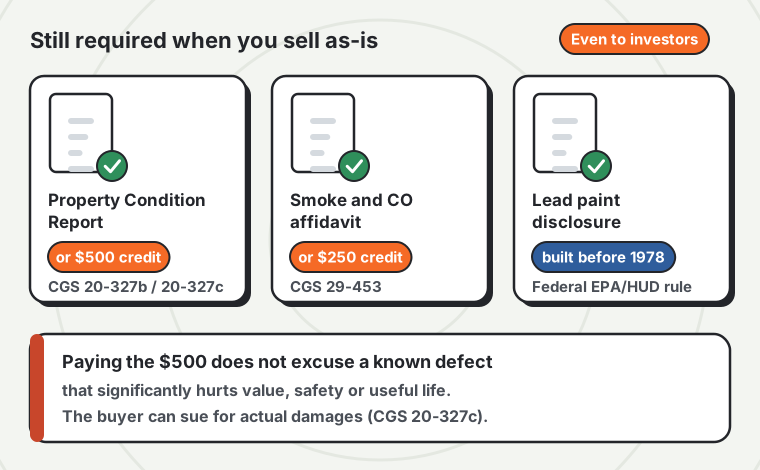
- As-is does not switch off disclosure. You still owe the Property Condition Disclosure Report (or a $500 credit, CGS 20-327c), the smoke and carbon monoxide affidavit (or a $250 credit, CGS 29-453) and the federal lead paint disclosure for homes built before 1978.
- Paying the $500 credit does not protect you from a lawsuit over a defect you knew about that significantly hurts the value, safety or useful life of the house (CGS 20-327c(b)-(c)).
- Who can buy depends on condition. FHA and VA loans have minimum property standards; houses with structural, safety or heating problems often end up with conventional, renovation-loan or cash buyers.
- Investors price as-is houses with one formula: after-repair value, minus repairs, minus their buying, holding and resale costs, minus profit. Know the numbers before you take an offer.
- As-is to a cash buyer is not always the best deal. If a buyer can still get a loan, listing as-is with an agent usually nets more. If you have an open crumbling-foundation claim, the state’s CFSIC program can be worth far more than a discount.
What does selling a house “as-is” mean in Connecticut?
Selling a house “as-is” in Connecticut means the contract says you will sell the house in its current condition, without making repairs or giving credits for what an inspection finds. It is a contract clause, not a legal status. It does not cancel the state’s disclosure report, the smoke and carbon monoxide affidavit, the lead paint rule, or your liability for hiding a known defect.
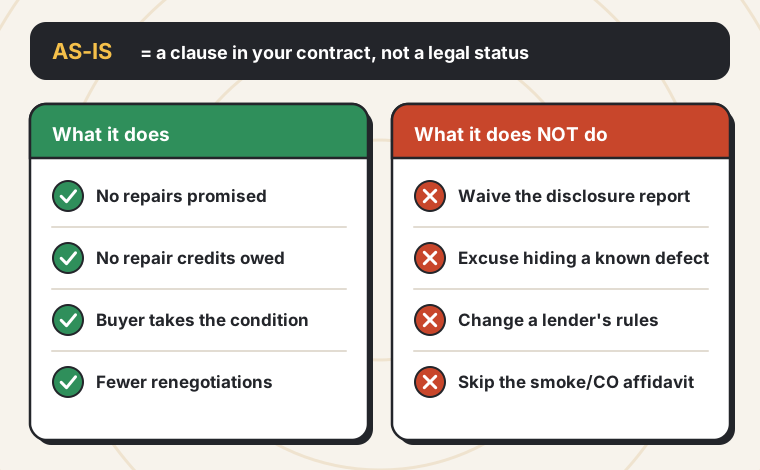
The phrase sounds more powerful than it is. In Connecticut, the house is sold through a written contract that the attorneys draft or review. “As-is” is simply language in that contract. The buyer agrees to take the property in the condition it is in on the day of the contract (the contract usually adds “reasonable wear and tear excepted” up to closing), and the seller is not obligated to fix anything the buyer’s inspector finds.
Three things are true of almost every as-is sale in Connecticut:
- The buyer can usually still inspect. Most as-is contracts keep an inspection contingency. What changes is the remedy: the buyer can accept the house or walk away inside the inspection period, but cannot demand repairs. Some buyers waive the inspection entirely, which is common with experienced cash buyers.
- The buyer’s lender still has rules. If the buyer uses a mortgage, the appraiser and the loan program decide whether the house is acceptable. An as-is clause does not change a lender’s minimum property standards.
- The seller’s disclosure duties stay. Connecticut’s Uniform Property Condition Disclosure Act (CGS 20-327b to 20-327e) applies to sales of one- to four-unit homes, “with or without the assistance of a licensed real estate broker”. There is no “as-is” exemption in the list of exempt transfers.
As-is is a spectrum, not a switch
In practice there are three levels of “as-is” in a Connecticut contract, and you should know which one you are signing:
| Contract version | What the buyer can do after inspecting | Typical buyer |
|---|---|---|
| Standard contract, with inspection contingency | Ask for repairs or credits, or walk away | Most retail buyers with a mortgage |
| As-is with an inspection contingency (“for information only”) | Accept the house or cancel inside the window; no repair requests | Retail buyers of fixer-uppers, some investors |
| As-is, no inspection contingency | Nothing; the buyer is bound once the contract is signed (other contingencies aside) | Cash buyers and experienced investors |
What national as-is guides get wrong about Connecticut
Most pages that rank for this question are national templates. Here is what they get wrong, or leave out, for a Connecticut seller:
| Template advice | What is true in Connecticut |
|---|---|
| “Selling as-is means you don’t have to disclose problems.” | False. The Property Condition Disclosure Report is required for most one- to four-unit sales (CGS 20-327b). Skipping it costs a $500 credit and still leaves you liable for known, serious defects (CGS 20-327c). |
| “Buyers have a 15-day inspection period on an as-is contract.” | No Connecticut statute sets an inspection period. The number of days is whatever your contract says. |
| “FHA and VA loans can’t be used on fixer-uppers.” | Overstated. FHA and VA appraisals apply minimum property standards, so some houses fail, but many dated houses pass, and FHA’s 203(k) program finances repairs. |
| “Cash buyers pay 70% of market value.” | The “70% rule” is a rule of thumb applied to the after-repair value, minus repairs. Applied to today’s value it gives the wrong number. See how investors actually price. |
| “Close with a title or escrow company.” | Connecticut closings are run by attorneys (CGS 51-88a); there is no escrow-company closing. |
| No mention of foundations, oil tanks or the smoke and CO affidavit. | These are the most common as-is issues in Connecticut: crumbling concrete foundations in the north-central and eastern part of the state, buried heating oil tanks, and the $250 affidavit credit (CGS 29-453). |
Can you sell a house as-is in Connecticut, and should you?
Yes, you can sell a house as-is in Connecticut: no law requires a seller to make repairs before a sale. Whether you should depends on how bad the problems are, whether a buyer could still get a mortgage, how much cash and time you have to fix things, and how soon you need to close. As-is makes the most sense when repairs are large, uncertain or impossible for you to manage.
No Connecticut statute requires a seller to repair a house before selling it. The Uniform Property Condition Disclosure Act says the opposite in plain words: nothing in it requires “the seller of the property to secure inspections, tests or other methods of determining the physical conditions of the property” (CGS 20-327d). The law asks you to tell the truth about what you know. The market decides what that truth is worth.
Selling as-is fits if…
- Repairs would cost more than you have, or more than they add in value
- The problem is structural, environmental or legal (foundation, buried tank, open permits)
- The house was inherited, or you live out of state
- You need to close by a date: a Law Day, a job move, a divorce agreement
- The house is full of belongings you cannot clear
- Tenants, fire or water damage make showings impractical
Think twice if…
- The house only needs cleaning, paint and small repairs
- Similar houses near you sell quickly to buyers with mortgages
- You have the cash and the months to do the work
- You qualify for a crumbling-foundation claim with CFSIC
- You plan to list it with an agent anyway (price it as-is, but list it)
- Your first as-is offer is far below your own math
Cash sale or listing: which fits your house?
Six questions about condition, time and money. It tells you which route usually leaves owners in your position with more, and it is honest when the answer is “list it”.
Is a cash sale right for you, or should you list?
Seven quick questions. There is no wrong answer, and we will tell you honestly if listing would leave you more.
- Does the house need repairs you would rather not pay for or manage?
- Do you need to close by a certain date, or within the next month or two?
- Would showings be hard: tenants, belongings, privacy, or you live out of state?
- Is there a complication: an estate or probate, a divorce, foreclosure, liens or back taxes?
- Could you comfortably cover the mortgage, taxes and utilities for three or more months?
- Is getting the highest possible price more important to you than speed and certainty?
- Would a buyer's bank lend on the house as it is (no major roof, foundation, oil tank or code issues)?
What do you still have to disclose when you sell as-is in Connecticut?
When you sell as-is in Connecticut, you still have to give the buyer the Residential Property Condition Report before they sign a contract (or credit them $500), sign the smoke and carbon monoxide affidavit at closing (or credit $250), and give the federal lead paint disclosure for a home built before 1978. You answer from what you actually know; you do not have to inspect or test.
The Residential Property Condition Report (CGS 20-327b)
Every person who offers residential property for sale in Connecticut must give the buyer a written condition report “at any time prior to the prospective purchaser’s execution of any binder, contract to purchase, option or lease containing a purchase option” (CGS 20-327b(a)). It covers one- to four-unit homes, including condos and co-ops, with or without a broker (20-327b(c)). The Department of Consumer Protection publishes the form. Our section-by-section guide to the Connecticut disclosure report walks through every question.
Four parts of the law matter most in an as-is sale:
- The report is not a warranty. The form itself must say: “Any representations made by the seller on the written residential condition report shall not constitute a warranty to the buyer” (20-327b), and the law creates no new warranties (20-327d).
- You answer from actual knowledge. Your answers “shall be construed only to extend to the seller’s actual knowledge of the property and no constructive knowledge shall be imputed to the seller” (20-327e). “Unknown” is an allowed answer when it is true.
- You do not have to investigate. The law does not require you to order inspections or tests (20-327d).
- Skipping the report costs $500, and nothing else changes. The contract must require a $500 credit to the buyer if the report is not furnished (20-327c(a)). Paying it does not excuse you from disclosing a known defect that significantly impairs the value, the health or safety of future occupants, or the useful life of the house (20-327c(b)).
CGS 20-327b(b) lists nine exempt transfers. The ones that come up in as-is sales: transfers by executors, administrators, trustees or conservators; transfers of property acquired by foreclosure or deed in lieu of foreclosure (with a foundation-report exception in crumbling-foundation towns); transfers between co-owners; and gifts to close family. “Selling as-is” and “selling to an investor” are not on the list.
What the report asks that matters for a problem house
The report asks about the things that make a house an as-is house. Among its questions (CGS 20-327b(d)): heating system problems and fuel types; whether there is an underground storage tank, its age and location, any known problems, and whether a tank was removed while you owned the property; whether the foundation is concrete, foundation or slab problems, water seepage, any foundation testing or repairs, and any knowledge of pyrrhotite; roof type, age and leaks; interior floor, wall or ceiling problems; fire or smoke damage; rot or water damage; insect or rodent infestation; radon tests; asbestos and lead paint; and flood hazard or inland wetlands. Since July 1, 2025, the form also includes flood questions added by Public Act 25-33.
It also tells buyers to check permits themselves: the form’s notice says buyers “should consult with the municipal building official” to confirm that building permits and certificates of occupancy were issued. That does not make it safe to stay silent about work you know was done without a permit; see open permits and unpermitted work.
The other two disclosures
| Disclosure | When | If you skip it | Applies to |
|---|---|---|---|
| Residential Property Condition Report | Before the buyer signs a binder or contract | $500 credit to the buyer at closing (CGS 20-327c) | 1-4 unit homes and condos; nine exempt transfers |
| Smoke and carbon monoxide affidavit | At closing | $250 credit to the buyer (CGS 29-453) | One- and two-family homes and condo units |
| Lead-based paint disclosure, EPA pamphlet and a 10-day chance to test | Before the contract | Federal penalties; no credit option | Homes built before 1978 |
| Residential Foundation Condition Report | Before the contract | Required only in listed cases | Only homes in CRCOG-listed towns acquired by foreclosure or deed in lieu, or sold by a town (CGS 20-327b(g)-(h)); everyone else answers the foundation questions on the main report |
| Private well testing notice | With the sale | See your attorney | Homes on a private well (CGS 19a-37) |
A cash buyer may say “don’t bother with the paperwork.” The law does not change because the buyer is an investor. Give the report, give the lead form if the house is old enough, and sign the affidavit (or budget the credit). It costs you nothing and it closes the door on most later arguments.
Can a buyer sue you after an as-is sale in Connecticut?
Yes, a buyer can sue you after an as-is sale in Connecticut if you failed to disclose a defect you actually knew about that significantly impairs the value, safety or useful life of the house (CGS 20-327c(c)), or if you lied about or actively hid a problem. An as-is clause protects you from repair demands, not from misrepresentation. Honest, written disclosure is your real protection.
Connecticut’s disclosure statute gives the buyer its own remedy. A purchaser may, “without limiting any other remedies available to the purchaser, bring a civil action in the judicial district in which the residential real estate is located to recover actual damages from a seller” who fails to disclose a defect that is (1) subject to disclosure on the report, (2) within the seller’s actual knowledge, and (3) significantly impairs the value, the health or safety of future occupants, or the useful life of the house (CGS 20-327c(b)-(c)).
The words “without limiting any other remedies” matter. Buyers can also bring ordinary claims such as fraudulent or negligent misrepresentation. An as-is clause is a promise about repairs; it is generally not a license to lie. A seller who paints over a water stain, tells a buyer “the basement has never leaked” when it has, or hides a known oil leak is exposed whatever the contract says.
What actually protects a seller in an as-is sale
- Fill in the condition report yourself, honestly, and answer “unknown” only when it is true
- Attach what you have: inspection reports, foundation test results, tank removal papers, permit records, insurance claim letters
- Disclose anything a contractor, inspector or insurer told you in writing
- Do not cover up a problem right before listing (fresh paint on a water stain, a rug over a crack)
- Let the buyer inspect, even if the contract is as-is
- Have your Connecticut attorney write or review the as-is clause and any “no reliance” language
- Keep a copy of everything the buyer signed for
Some investors will tell you they do not need the report. Give it anyway, and keep the signed receipt. If the buyer later resells the house, or a lender asks questions, the paper trail shows you told the truth.
Which problem houses can you sell as-is in Connecticut?
You can sell almost any problem house as-is in Connecticut: houses with crumbling concrete foundations, buried oil tanks, code violations or open permits, unpermitted additions, fire or water damage, mold, hoarding or blight orders, and also land and mobile homes. Each problem changes who can buy, what you must disclose and what the house is worth, so the right route differs for each.
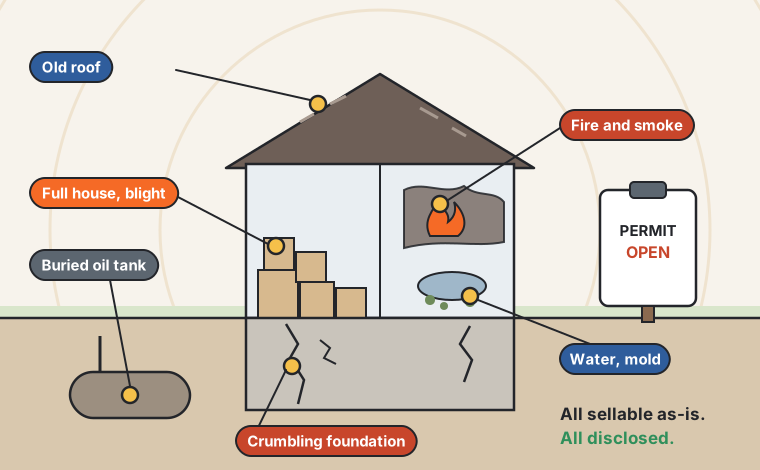
| Problem | Can a mortgage buyer usually close? | Your best routes (honest) | Read more |
|---|---|---|---|
| Crumbling foundation (pyrrhotite), visible cracking | Often not | CFSIC claim, transfer the claim to a buyer, or sell for cash | Crumbling foundation guide |
| Buried heating oil tank, no leak | Often only after removal or testing | Remove it before listing, or credit it | Oil tanks, septic, wells, radon |
| Leaking oil tank | Rarely before cleanup | Clean up and document, or sell for cash with full disclosure | Below |
| Open permits, code violations | Depends on the violation | Close out small permits; sell larger problems as-is | Below |
| Unpermitted addition or basement apartment | Sometimes; appraisers may not count the space | Permit it after the fact, or price it as if it were not there | Below |
| Fire damage | Not until repaired | Settle the insurance claim first, then decide | Below |
| Water damage and mold | After remediation | Fix the source; remediate or credit | Below |
| Hoarder house, blight orders | After cleanout, if sound | Cleanout and list, or sell as-is with contents | Below |
| Vacant land | Land loans are different | Builders, neighbors, developers | Below |
| Mobile home in a park | Limited financing | Sell in place to an approved buyer | Below |
Crumbling concrete foundations
Many Connecticut houses, mostly in the north-central and eastern part of the state, have concrete foundations made with aggregate containing pyrrhotite, which can cause the concrete to crack and deteriorate over time. The Capitol Region Council of Governments (CRCOG) map used for disclosures lists 21 “affected” towns, including Vernon, Enfield, Manchester, South Windsor, East Windsor, Tolland, Ellington, Stafford, Coventry and Willington, and 4 “potentially affected” towns.
For an as-is seller, three facts decide almost everything:
- Disclosure. The main report asks whether the foundation is concrete, about foundation problems, any testing or repairs by a licensed professional (attach the report), and any knowledge of pyrrhotite (CGS 20-327b). If you tested, you disclose the result.
- Financing. A replaced foundation sells like any other house. Visible deterioration usually stalls a mortgage, because appraisers must report structural problems; those houses mostly sell to cash buyers or to owner-occupants taking over a state claim.
- CFSIC money. The Connecticut Foundation Solutions Indemnity Company pays up to $205,000 per house to replace a qualifying foundation (guidelines effective September 15, 2026). An active Type 1 claim can be transferred to a buyer through a Claim Transfer Agreement within 30 days of the sale, before work starts. CFSIC accepts new Type 1 applications until June 30, 2030.
If your foundation qualifies and you can wait for the work, replacing it through CFSIC and then selling, or selling with a transferable claim to an owner-occupant, usually leaves you far more than an as-is cash sale, because a cash buyer has to price in the full cost and risk of the replacement. Call CFSIC’s claims administrator before you sell. Our crumbling foundation guide has the details, the four options and the town list.
Buried oil tanks
Many older Connecticut houses heated with oil once had a tank buried in the yard. The state’s Department of Energy and Environmental Protection (DEEP) does not regulate the installation, use or removal of residential heating oil tanks that serve four or fewer units, and no law makes you remove a working tank before a sale. A leak is different: a release must be reported to DEEP and cleaned up, including any contamination that reached a neighbor.
In practice, the buyer’s lender and insurer decide. Many will not finance or insure a house with an old buried tank without proof it has not leaked. For an as-is sale, that leaves three choices:
- Remove it first and attach the contractor’s report and soil results to the condition report. This often costs less than the price cut buyers ask for (cost ranges are in our oil tank, septic, well and radon guide).
- Disclose it and credit it, letting the buyer remove it after closing. This works with some cash buyers; most mortgage buyers’ lenders will not accept it.
- Sell as-is for cash if you know or suspect a leak and cannot fund the cleanup. Disclose exactly what you know. There is no DEEP funding for residential tank cleanups.
The report asks whether there is an underground storage tank, its age and location, known problems, and whether a tank was removed while you owned the house (with the remover’s name and documentation). Answer all of it.
Code violations, open permits and unpermitted work
Connecticut law requires a building permit before a building or structure is “constructed or altered” (CGS 29-263), and a certificate of occupancy before new or altered space is used (CGS 29-265). Violating the State Building Code can bring a fine of $200 to $1,000 (CGS 29-254a). Three different problems hide under this heading:
- Open permits. A permit was pulled, the work was done, but the final inspection never happened. These are often the easiest to fix: call the building department, schedule the final, and close it. A buyer’s attorney or lender may ask about them.
- Unpermitted work. A finished basement, a deck, an addition or a bathroom built without a permit. Options are to apply for a permit after the fact (the town may require opening walls), to remove the work, or to sell as-is and price the space as if it were not there. Appraisers often do not count unpermitted living space.
- Open code or housing violations. A written order from the building official, housing code enforcement or the fire marshal. Get a copy of the order. Some must be fixed before anyone can live in the house; some are cheap; some make the house a cash-only sale.
Do not guess. Ask the town building department for the permit history of your address before you list; it is public record. Then disclose what you know. Older posts on this site cover selling a house with code violations and selling with liens or tax problems.
Fire damage, water damage and mold
A house damaged by fire or water is usually an insurance question first and a sale question second. If there is an open claim, your mortgage lender is often named on the insurance check, and the payout may depend on whether you rebuild. Talk to your insurer and your attorney before you sign a sale contract, so you know whether the claim proceeds stay with you, go to your lender or transfer with the house.
- Fire damage almost always means a cash or renovation-loan buyer until it is repaired. The report asks about fire and smoke damage.
- Water damage from a burst pipe, roof leak or flood: stop the source first (it keeps getting worse), dry it out, and keep the invoices. The report asks about rot or water damage, basement seepage and flood history.
- Mold. Connecticut has no separate mold disclosure statute, and the report does not ask about mold by name. It does ask about water damage, seepage and interior problems, and visible mold is a known condition. Disclose it. Small areas are often cheap to remediate once the moisture source is fixed; widespread mold usually means an as-is sale.
For flood-prone property, check the flood questions on the current report (added in 2025) and any past flood insurance claims.
Hoarder houses and blight
A house full of belongings is one of the most common reasons owners and heirs choose an as-is sale. You can sell a house with the contents inside; many cash buyers include the cleanout in their offer. If you list it, most agents will want it cleared first so buyers and inspectors can see the floors, walls and mechanicals.
If the house is also visibly neglected, check whether your town has issued a blight notice. Connecticut lets towns adopt blight ordinances with civil penalties for one- to six-unit properties of up to $150 a day if occupied, up to $250 a day if vacant, and up to $1,000 a day for a third violation within 12 months (CGS 7-148(c)(7)(H)(xv)). Unpaid penalties can become a lien on the property (CGS 7-148aa). A blight order is a reason to act quickly: either clean up to stop the clock, or sell to a buyer who will.
If the house belonged to someone who died, do not throw anything away until you know who has authority over the estate. Papers, cash and valuables turn up in full houses. See our guide to an inherited house in Connecticut.
Land
The condition report applies to residential property with one to four dwelling units (CGS 20-327b(c)), so a sale of vacant land does not need it. Land is still sold “as-is” in the sense that the buyer takes it with its soils, wetlands, slopes and access as they are. Buyers will ask about perc tests, wetlands, zoning, road frontage and utilities. Builders, neighbors and developers are the usual buyers; see selling Connecticut land to a developer.
Mobile homes
A mobile (manufactured) home in a Connecticut park can be sold where it sits. The park owner may not require a resident to remove a home that is “safe, sanitary and in conformance with aesthetic standards” when it is sold, and may not withhold approval of a qualified buyer “except for good cause” (CGS 21-79). The buyer must meet the park’s entry requirements and take on the rental agreement. Older homes in poor condition are hard to finance, so as-is sales to cash buyers are common. See ways to sell a mobile home fast.
Who buys as-is houses in Connecticut?
As-is houses in Connecticut are bought by five kinds of buyers: retail buyers with a mortgage who accept a fixer-upper after inspecting it, investors and flippers who renovate and resell, iBuyers that make instant offers on houses in fair condition, local cash home buyers, and wholesalers who put the house under contract and sell that contract to someone else. They pay very different prices.
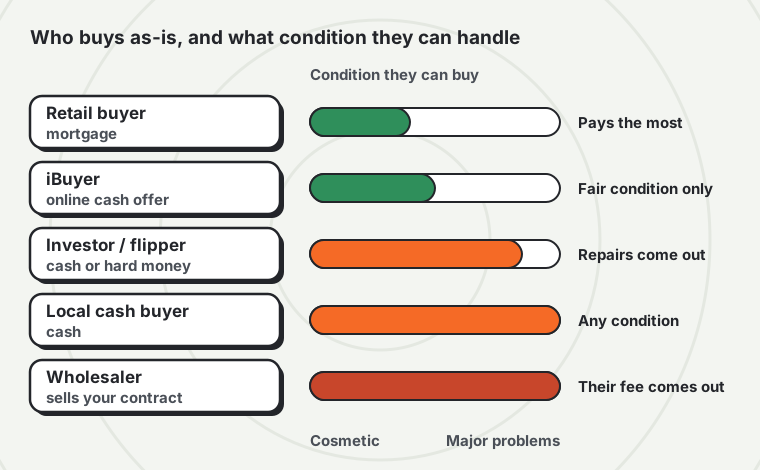
| Buyer | How they pay | Condition they accept | Price, compared with retail | Watch for |
|---|---|---|---|---|
| Retail buyer (owner-occupant) | Mortgage: conventional, FHA, VA, sometimes a renovation loan | Dated or tired, but must pass the appraisal and the lender’s standards | Highest | Inspection walk-aways, low appraisals, loan denials |
| Investor or flipper | Cash or short-term (hard money) loan | Anything they can renovate and resell | Below retail: repairs, costs and profit come out | Retrading the price after inspection |
| iBuyer | Cash, through an online platform | Fair condition, in the markets they serve; not major problem houses | Near market, minus a service fee and repair deductions | Repair deductions after the inspection |
| Local cash home buyer | Cash | Any condition, often with contents inside | Below retail, like an investor | Check they are real: see how to check a cash home buyer |
| Wholesaler | Usually a small deposit; they assign the contract to another investor | Any | Often lowest: their fee comes out of your price | Long inspection periods, “and/or assigns” in the contract, buyers who never close |
Retail buyers with an inspection contingency
The biggest pool of buyers in Connecticut uses a mortgage. Many of them will buy a dated house as-is, and some want one. What stops them is not the word “as-is” but what their inspector and lender find. If your house’s problems are cosmetic (old kitchen, worn floors, wallpaper), a retail buyer is usually your highest price. If the problems are structural, safety-related or environmental, many retail buyers cannot close even if they want to.
Investors and flippers
Investors buy houses they can renovate and resell or rent. They work from the formula in the next sections. Expect them to inspect, to know contractors’ prices, and to ask about permits and the foundation. Good investors close reliably; some make a high offer to win the contract and then lower it after inspection.
iBuyers
iBuyers are companies that make offers online and resell at retail. Opendoor advertises that it buys in parts of Connecticut; check its site for your address. iBuyers generally want houses in fair, financeable condition, charge a service fee, and deduct repairs after their inspection. A true problem house (crumbling foundation, leaking tank, fire damage) is usually outside what they buy.
Local cash buyers
A local cash buyer buys directly, in any condition, and closes on your date. That is what we do: we are a Connecticut company (We Buy Houses In Connecticut, LLC, Connecticut business ID 1314303, based in Wilton), we have bought houses here since 2016, about 10 a year, and we usually close about 2 weeks after first contact, at a Connecticut attorney’s office. We do much of the renovation work ourselves. Read our guide to cash house buyers in Connecticut and the facts about our company, and compare us with anyone else.
Wholesalers
A wholesaler signs a contract to buy your house, then sells (“assigns”) that contract to another investor for a fee. Wholesaling is legal when done openly, but it costs you: the wholesaler’s fee comes out of the price you would otherwise get from the end buyer, and if no end buyer appears, the deal can fall apart after weeks off the market. Look for “and/or assigns” after the buyer’s name, a long inspection period, a tiny deposit and a buyer who cannot show proof of funds.
Which loans fail on a house’s condition in Connecticut?
The loans most likely to fail on a house’s condition in Connecticut are FHA and VA loans, because their appraisers apply minimum property standards: the house must be safe, structurally sound and have working heat, water and electricity, and homes built before 1978 cannot have peeling paint. Conventional loans are more flexible but still need a sound house. Renovation loans and cash have no such limits.
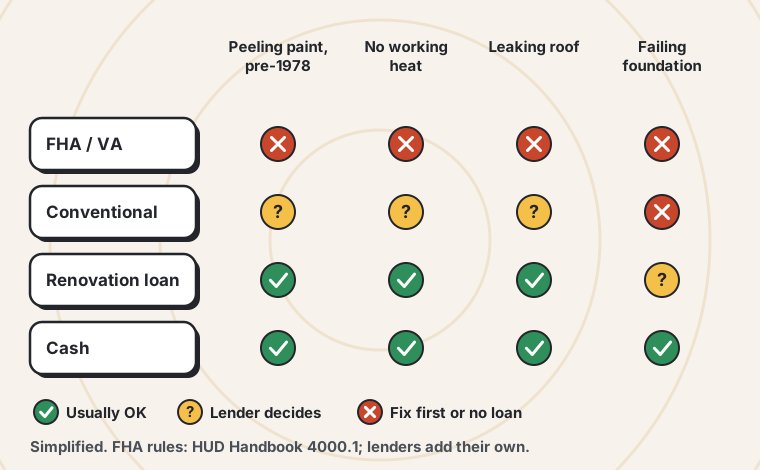
FHA loans are insured by HUD, and HUD’s Single Family Housing Policy Handbook (4000.1) sets the minimum property requirements an FHA appraiser checks. In plain terms, the appraiser must see a house that is safe, sound and secure. VA loans have their own minimum property requirements in the VA lenders’ handbook, along similar lines. Typical items that send an FHA or VA appraisal back “subject to repairs”:
- Peeling, chipping or flaking paint on a house built before 1978 (a lead paint hazard)
- A roof that leaks or has little remaining life
- No working heat, or a heating system that is unsafe
- Exposed or unsafe wiring, missing handrails, broken windows or doors
- Structural problems, including a deteriorating foundation
- No working water or sewer, or a failed septic or well
- Active leaks, rot or water damage
HUD has proposed rewriting these rules (it requested public comment on its minimum property requirements in May 2026 and posted draft revisions), so check the current handbook before you rely on a specific item.
| Loan | Condition rules | Fits a house that… |
|---|---|---|
| FHA | Strict minimum property requirements (HUD 4000.1) | Is dated but safe and sound |
| VA | Strict minimum property requirements | Is dated but safe and sound |
| Conventional | Appraiser must report condition; serious safety or structural issues usually must be fixed | Needs cosmetic work and some repairs |
| Renovation loan (FHA 203(k), conventional renovation) | Repairs are part of the loan | Needs real work but is not a teardown |
| Hard money or investor credit line | Lender looks at the after-repair value | Any condition an investor will take on |
| Cash | None | Any condition |
This is why “list it as-is” and “sell it to a cash buyer” are not the same thing. If your house would pass an FHA or conventional appraisal, the whole retail market can buy it, and listing usually pays more. If it would not, your buyers are cash buyers, investors and renovation-loan buyers, and the price reflects that.
How do cash buyers and investors price an as-is house in Connecticut?
Cash buyers and investors price an as-is house in Connecticut with one formula: the after-repair value (what the house would sell for fully fixed), minus the cost of repairs, minus their costs to buy, hold and resell it, minus a profit margin for the risk. Know each number yourself and you can tell a fair as-is offer from a lowball one.
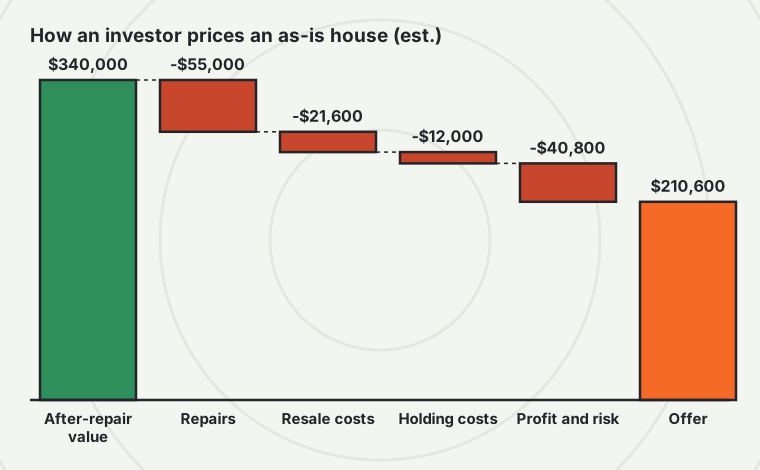
The four numbers
- After-repair value (ARV). What the house would sell for once fully renovated, based on recent sales of renovated houses near you. This is not your Zestimate and not today’s value.
- Repairs. The full cost to bring the house to that standard: roof, kitchen, baths, mechanicals, tank, paint, floors, permits. Investors who do their own work spend less than an owner hiring contractors; investors who hire out spend more.
- Costs to buy, hold and resell. The investor’s own closing costs; property taxes, insurance, utilities and loan interest during the work; and the cost of reselling: an agent’s commission, Connecticut’s conveyance tax (at least 1% on most homes), and attorneys.
- Profit and risk. The margin for being wrong about any of the above. Hidden problems (behind walls, under the slab, in the soil) push this up.
A worked example (est.)
Take a three-bedroom 1960s ranch in a north-central Connecticut town with the standard 0.25% town conveyance rate. Renovated houses like it nearby sell for about $340,000 (est.). It needs a roof, a kitchen, a bathroom, an electrical panel, paint and floors, and has an old buried oil tank.
| Line | Amount (est.) | How it is figured |
|---|---|---|
| After-repair value | $340,000 | Recent sales of renovated, similar houses nearby |
| Minus repairs | −$55,000 | Roof $14,000; kitchen $18,000; bathroom $9,000; paint and floors $8,000; electrical panel $3,000; oil tank removal $3,000 |
| Minus resale costs | −$21,600 | Commission 5% ($17,000), conveyance tax 1% ($3,400), attorney ($1,200) |
| Minus buying and holding costs | −$12,000 | About five months of taxes, insurance, utilities and financing, plus the investor’s purchase closing |
| Minus profit and risk | −$40,800 | 12% of the after-repair value |
| Investor offer | $210,600 | About 62% of the after-repair value |
Notice what moves the answer. Raise the after-repair value by $20,000 and the offer rises by almost as much. Find $20,000 more in repairs and it falls by that much. A margin of 10% instead of 12% adds about $6,800. That is why two honest investors can be $20,000 apart on the same house, and why you should ask each one to show you their numbers.
Why the “70% rule” misleads sellers
National guides quote “investors pay 70% of value”. The original rule of thumb is 70% of the after-repair value minus repairs. In our example that would be $340,000 × 70% − $55,000 = $183,000, well below the $210,600 a full calculation gives. Applied the other way, to the house’s current value, it gives a number that means nothing. Use the full formula, with your own numbers, and treat any single percentage with suspicion.
Turn your photos into a repair list and an as-is number
Send a few photos of the rooms, the roof, the basement and anything that worries you. We price each repair we can see, line by line, and show you the as-is offer with the math behind it. Free, no obligation, and you can use the repair list with any buyer.
See your repairs priced and your as-is number, without a walkthrough
Want your offer faster, or rather not talk to anyone yet? Upload photos of the problem areas. You get an itemized repair estimate and a written as-is cash offer showing every line of the math.
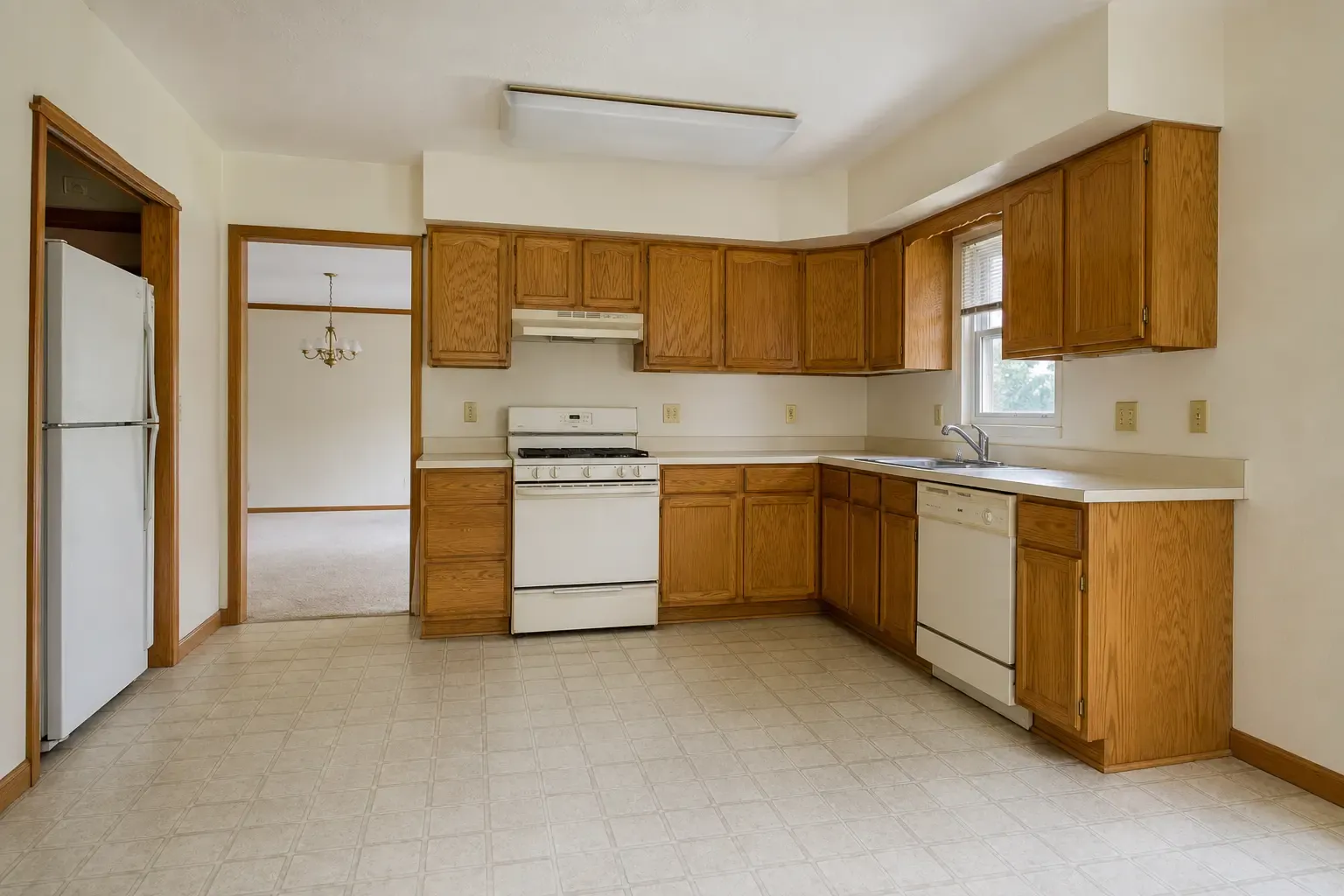 CabinetsFlooring
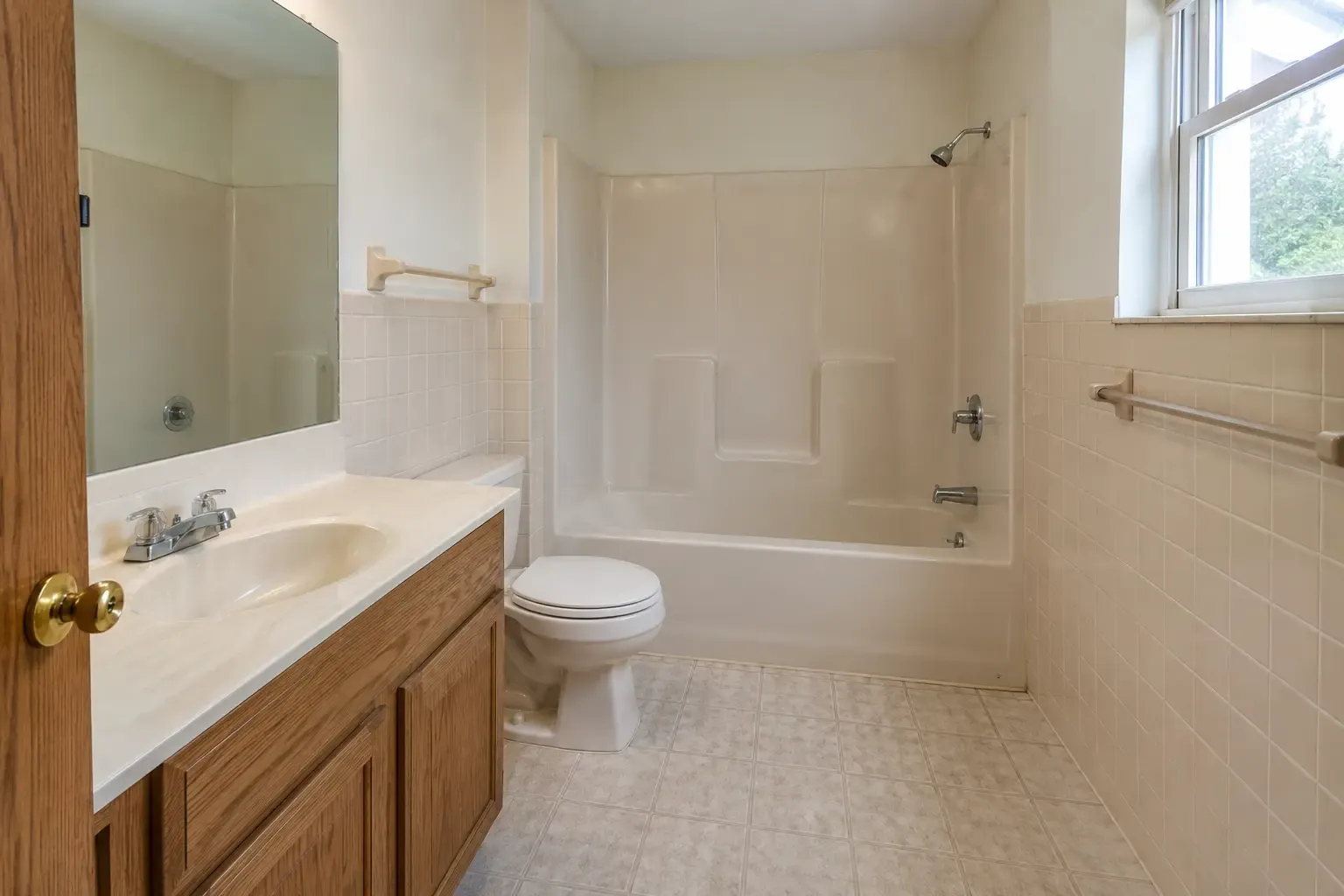 Tub & tile
 Floors
 Roof
We may bring in a partner buyer to close. Your price and terms don't change.
Should you fix the house, list it as-is, or sell it for cash?
Whether you should fix the house, list it as-is or sell it for cash depends on the net after every cost and the months each route takes. Fixing first usually nets the most if you have the cash, the time and a reliable contractor. Listing as-is usually beats a cash sale if a mortgage buyer can still close. A cash sale wins on speed and certainty, and when the house cannot be financed.
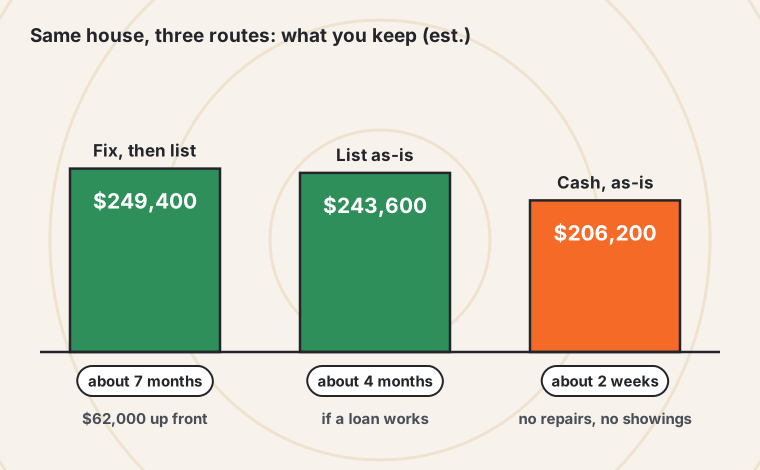
Here is the same example house three ways. All figures are estimates for illustration (est.).
Fix it, then list
$249,400net, in about 7 months (est.)
- Sells for $340,000
- $62,000 repairs, paid up front (an owner pays retail contractor prices)
- $17,000 commission (5%), $3,400 conveyance tax, $1,200 attorney
- $7,000 carrying costs (7 months)
List as-is with an agent
$243,600net, in about 4 months (est.)
- Sells for $270,000 to a buyer whose loan works
- $13,500 commission (5%), $2,700 conveyance tax, $1,200 attorney
- $5,000 credit after the buyer’s inspection
- $4,000 carrying costs (4 months)
Sell as-is for cash
$206,200net, in about 2 weeks (est.)
- Sells for $210,000, contents and all
- $2,100 conveyance tax, $1,200 attorney
- $500 carrying costs
- No repairs, showings, credits or commission
In this example, fixing first nets about $43,200 more than the cash sale, and listing as-is nets about $37,400 more. Those are real differences, and if the house can be financed and you have the time, they are worth having. The cash route is “the pick” only when one of these is true: you do not have $62,000 and seven months; the house cannot pass a lender’s appraisal, so the $270,000 buyer does not exist; a deadline (a Law Day, a probate or divorce date) makes months impossible; or the risk of a renovation going over budget, a buyer walking away or a second winter of carrying costs is worth more to you than the difference.
Where the money goes
Bars are drawn against the fixed-up price of $340,000, so the empty part of the as-is and cash bars is the discount for condition. Carrying costs assume about $1,000 a month in property tax, insurance and utilities and no mortgage payment (est.); if you are still paying a mortgage, the longer routes cost more.
How long each route takes
Typical shapes, not promises. Renovations run over; a well-priced as-is listing can sell in weeks; contract to closing with a mortgage buyer usually takes 30 to 45 days. For more on timing, see how long it takes to sell a house in Connecticut.
Run your own three routes
Put in your price, your town and your mortgage payoff. The calculator applies Connecticut’s conveyance tax for your town, attorney fees and commission, and shows what you keep. Run it once for a fixed-up price and once for an as-is price.
How much would you walk away with?
Slide the numbers to match your house. It works in your browser; nothing is saved or sent.
Estimates for planning. Conveyance tax per CGS 12-494 (state 0.75% up to $800,000, 1.25% to $2.5M, 2.25% above, plus the town rate). Seller attorney about $1,200 to $1,500; flat-fee MLS about $400; listings include three months of taxes, insurance and utilities, a cash sale about two weeks. Your attorney gives you the final numbers.
For a full breakdown of every seller cost, see seller closing costs in Connecticut. If you already have offers in hand, how to compare offers on a house shows how to line them up by net and risk. And our cash buyer vs. realtor comparison puts the two routes side by side for any house.
When should you fix the house instead of selling it as-is?
You should fix the house instead of selling it as-is when the repairs are cheap and visible, when one specific problem (a buried tank, an open permit, a missing handrail, peeling paint) is the only thing stopping a mortgage buyer, or when the state will pay for the big repair, as CFSIC does for qualifying crumbling foundations. Fix what blocks financing; skip remodels.
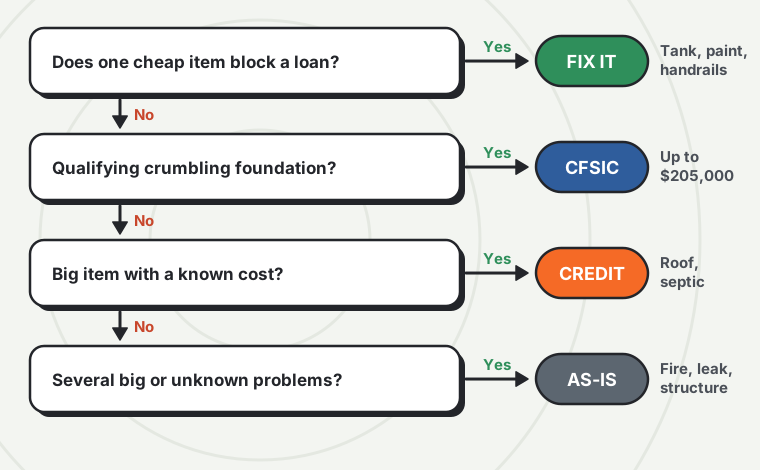
The most valuable repair is usually the one that changes who can buy. A house that fails an FHA appraisal because of peeling paint or a missing handrail loses a large share of its buyers; a few hundred or a few thousand dollars can bring them back. A house with a buried tank may be cash-only until the tank is out; removal often costs less than the discount buyers apply.
| Situation | Usually best | Why |
|---|---|---|
| Cleaning, clutter, paint, small repairs | Fix, then list | Cheap, and buyers pay for what they can see |
| One item blocks a mortgage (tank, handrails, peeling paint, broken heat) | Fix that item, then list | Opens the house to FHA, VA and conventional buyers |
| Open permit for finished work | Close it out, then list | Often just a final inspection |
| Qualifying crumbling foundation, time to wait | CFSIC claim, or transfer the claim with the sale | Up to $205,000 of the cost is paid by CFSIC |
| Big, known item (roof, septic field) | Get a quote; credit or price it in | Buyers discount less when the cost is documented |
| Kitchen and bath remodels | Skip | Rarely pay back before a sale |
| Several big problems, or unknown ones (fire, leak, structure) | Sell as-is | Repair cost and risk exceed the price gain |
| No cash, no time, or a hard deadline | Sell as-is (listing or cash) | Renovation is not possible on your timeline |
Our guide to what to fix before selling in Connecticut goes item by item with cost ranges, and the 13 low-cost fixes that add the most value lists the small jobs with the best return. If your house has been on the market without offers, read why a Connecticut house won’t sell before you cut the price.

When I walk through a house that needs work, the first thing I tell owners is which one or two problems are scaring off the mortgage buyers. Sometimes that is a buried tank or a stack of open permits, and fixing it is the best money they will ever spend on the house. Sometimes it is the foundation, the roof and the wiring all at once, and then selling as-is is the honest answer. Either way, write down everything you know about the house and hand it to every buyer. A problem buyers know about becomes a price. A problem they find after closing becomes a lawsuit.
How do you sell a house as-is in Connecticut, step by step?
To sell a house as-is in Connecticut, find out what is wrong and what you know, gather the paperwork, check permits and liens, decide whether one cheap fix opens the house to mortgage buyers, price it from the after-repair value and the repair list, fill in the disclosures, choose your route, have a Connecticut attorney write the as-is contract, and close with both attorneys.
Write down what you know
List every problem you know about, when it started and what was done about it. Gather inspection reports, contractor quotes, insurance claim letters, foundation tests, tank removal papers and permits. This becomes your condition report and your best protection later.
Check permits, violations and liens
Ask the town building department for the permit history of your address, and ask the town clerk or your attorney about liens, blight penalties and unpaid sewer or water charges. Ask your lender for a payoff. Surprises here delay closings more than condition does.
Hire a Connecticut real estate attorney
Connecticut closings are run by attorneys. Have yours review the as-is language, the inspection contingency, any “no reliance” clause and the buyer’s right to assign the contract before you sign anything.
Find the problem that blocks financing
Ask: would an FHA or conventional appraiser accept this house? If one item stands in the way and it is cheap, fix it. If several big items do, plan for an as-is sale.
Price the repairs and the after-repair value
Get two quotes for the big items, or an itemized estimate from photos. Pull recent sales of renovated houses near you for the after-repair value and of unrenovated ones for the as-is value.
Fill in the disclosures
Complete the Residential Property Condition Report from what you actually know, attach your documents, add the lead paint disclosure if the house was built before 1978, and plan the smoke and carbon monoxide affidavit for closing.
Choose your route and get competing offers
List as-is with an agent if a mortgage buyer can close; ask two or three local cash buyers for written offers either way. Compare nets, not prices, and check each buyer’s proof of funds.
Sign a Connecticut as-is contract
Your attorney writes or reviews it. Watch the inspection period, the deposit, who pays which closing costs, the closing date, and whether the buyer can assign the contract.
Handle the inspection honestly
Let the buyer inspect. If they find something you did not know, it is a negotiation, not a breach. If they try to cut the price for problems you already disclosed, point to the signed report.
Close with both attorneys
You sign the deed, the conveyance tax return and the smoke and carbon monoxide affidavit; your attorney pays off your mortgage and any liens and sends you the rest. See the Connecticut closing process for sellers.
Your as-is selling checklist for Connecticut
This as-is selling checklist covers every task in a Connecticut as-is sale, in order. Tick the items off as you go; your progress is saved on this device.
- List every known problem, with dates and what was done
- Collect inspection reports, quotes, insurance letters and test results
- Get the permit history from the town building department
- Check for liens, blight notices and unpaid water or sewer charges
- Request a mortgage payoff statement
- Hire a Connecticut real estate attorney
- Check whether your town is on the CRCOG crumbling-foundation list
- Find out whether there is (or was) a buried oil tank
- Decide whether one cheap fix opens the house to mortgage buyers
- Price the repairs and look up after-repair and as-is sales nearby
- Fill in the Residential Property Condition Report and attach documents
- Lead paint disclosure and EPA pamphlet (built before 1978)
- Talk to your insurer first if there is fire or water damage
- Get at least two written offers or a listing price opinion
- Verify each cash buyer’s proof of funds and company registration
- Have your attorney review the as-is clause and any assignment clause
- Keep the buyer’s signed receipt of every disclosure
- Sign the smoke and carbon monoxide affidavit at closing (or budget the $250 credit)
How do you avoid lowball offers and scams when selling as-is?
To avoid lowball offers and scams when selling as-is in Connecticut, get more than one written offer, ask each buyer to show the after-repair value and repair numbers behind the price, check that the buyer is a real, registered business with proof of funds, keep the deposit in an attorney’s escrow account, and never sign a contract your own Connecticut attorney has not read.
- Ask for the math. A serious buyer can explain the after-repair value, the repair list and their costs. A buyer who cannot, or will not, is guessing or hoping you will not check.
- Watch for the bait and switch. A high offer, a long inspection period, and then a large “we found problems” price cut a week before closing. Problems you disclosed in writing should not be a surprise.
- Check who you are dealing with. Look the company up in the Connecticut business registry, ask for proof of funds, and read our guide on how to check a cash home buyer in Connecticut.
- Read the buyer’s name line. “ABC LLC and/or assigns” means the contract can be sold to someone else. That is a wholesaler’s tool; know it before you sign.
- Never pay a buyer. Real buyers do not charge sellers fees, and closing money moves only through attorneys.
- Do not let urgency rush you. Even in a foreclosure, a day to have your attorney read a contract is a day well spent.
Can you sell as-is if the house is inherited, in foreclosure or part of a divorce?
Yes, you can sell a house as-is in Connecticut if it is inherited, in foreclosure or part of a divorce, and as-is sales are common in all three because time is short and nobody wants to manage a renovation. Each adds rules about who can sign and by when: the executor and the Probate Court, the Law Day in a foreclosure, or the divorce court’s orders.
- Inherited houses. Executors and administrators are exempt from the condition report (CGS 20-327b(b)(4)) but not from the lead paint rule, and they must still be honest about what they know. See inherited a house: what to do in Connecticut.
- Foreclosure. Selling as-is before your Law Day can protect your equity and credit. See 6 things you can do to stop a foreclosure in Connecticut; a loan modification or the court’s mediation program can beat any sale.
- Divorce. Both owners usually sign, and the court’s orders may control the sale. See selling a house during a divorce in Connecticut.
- Selling without an agent. You can sell as-is by owner too; our guide on selling a house without an agent in Connecticut covers the steps and forms.
- Liens and back taxes. These are paid from the sale proceeds at closing; see selling a house with liens or tax problems.
How old are the houses in your Connecticut town?
The houses in many Connecticut towns are old: in New Haven, the median single-family home was built in 1930, and in Bridgeport, Waterbury and Manchester most were built before 1960. Old houses are where as-is issues live: buried oil tanks, lead paint, old wiring and, in towns on the crumbling-foundation list, concrete foundations from the problem years.
| Town | Crumbling-foundation list (CRCOG) | Homes sold | Median sale price | Median year built (single-family) | Built before 1960 |
|---|---|---|---|---|---|
| Vernon | Affected | 388 | $300,000 | 1961 | 43% |
| Enfield | Affected | 659 | $310,000 | 1960 | 50% |
| Manchester | Affected | 724 | $315,000 | 1953 | 60% |
| South Windsor | Affected | 389 | $397,000 | 1969 | 30% |
| East Windsor | Affected | 155 | $310,000 | 1963 | 46% |
| Waterbury | No | 1,305 | $270,000 | 1955 | 56% |
| Bridgeport | No | 1,166 | $374,500 | 1949 | 74% |
| New Haven | No | 1,022 | $350,000 | 1930 | 83% |
A house built before 1978 needs the lead paint disclosure. A house in a CRCOG town built in 1983 or later, or with a later addition, will get foundation questions from every buyer. Each town page linked above has that town’s mill rate, housing styles and heating fuels.
Questions Connecticut owners ask about selling as-is
Is it legal to sell a house as-is in Connecticut?
Yes, it is legal to sell a house as-is in Connecticut. No Connecticut law requires a seller to make repairs before a sale, and the disclosure law says it does not require the seller to inspect or test the property (CGS 20-327d). You must still give the required disclosures and must not hide defects you know about.
Do I have to fill out the disclosure report if I sell as-is?
Yes, you have to fill out the disclosure report if you sell as-is in Connecticut, unless your sale is one of the nine exempt transfers in CGS 20-327b(b), such as a sale by an executor. If you do not deliver it, the contract must give the buyer a $500 credit at closing (CGS 20-327c).
Can I just give the buyer $500 instead of filling out the report?
You can give the buyer the $500 credit instead of filling out the report in Connecticut, but it does not protect you. The law says the credit does not excuse you from disclosing a defect you actually know about that significantly impairs the value, safety or useful life of the house, and the buyer can sue for actual damages (CGS 20-327c(b)-(c)).
Can a buyer back out of an as-is contract in Connecticut?
A buyer can back out of an as-is contract in Connecticut if the contract gives them a way out, usually an inspection contingency or a mortgage contingency, inside the dates in the contract. No Connecticut statute sets a fixed inspection period; the contract does. Without a contingency, a buyer who walks away may lose the deposit.
Can a buyer sue me after buying my house as-is?
Yes, a buyer can sue you after buying your house as-is in Connecticut if you failed to disclose a known defect that significantly impairs the value, safety or useful life of the house (CGS 20-327c), or if you misrepresented or hid a problem. An honest, complete condition report with your documents attached is the best protection.
Do I have to disclose a problem I didn’t know about?
No, you do not have to disclose a problem you did not know about in Connecticut. Your answers on the report are limited to your actual knowledge, and no constructive knowledge is imputed to you (CGS 20-327e). You also do not have to order tests to find out (CGS 20-327d). Answer “unknown” only when it is true.
How much less will I get if I sell my house as-is?
How much less you get for selling your house as-is depends on the repairs and who can buy it. A dated but financeable house listed as-is may sell close to similar houses in similar condition. A house that only cash buyers can buy is priced from the after-repair value minus repairs, costs and profit; in our worked example that came to about 62% of the after-repair value (est.).
What is the 70% rule for as-is offers?
The 70% rule is an investor rule of thumb: offer 70% of the after-repair value, minus repairs. It is a shortcut, not a law or a fair-price test. In our example it gave $183,000, while a full calculation of repairs, costs and margin gave $210,600 (est.). Ask any buyer to show their actual numbers.
Can I sell a house with a crumbling foundation as-is?
Yes, you can sell a house with a crumbling foundation as-is in Connecticut. You must disclose what you know, including any test results, on the condition report. Before you sell for cash, check whether you qualify for CFSIC, which pays up to $205,000 per house to replace a qualifying foundation; an active Type 1 claim can also transfer to a buyer.
Do I have to remove an underground oil tank before selling?
No, you do not have to remove an underground oil tank before selling in Connecticut; no law requires removing a working residential heating oil tank. But many buyers’ lenders and insurers want it removed or tested, so most sellers remove it, credit it, or sell as-is for cash. A leaking tank must be reported to DEEP and cleaned up.
Can I sell a house with open permits or unpermitted work?
Yes, you can sell a house with open permits or unpermitted work in Connecticut. Small open permits are often closed with a final inspection. For unpermitted work, you can apply for a permit after the fact, remove the work, or sell as-is and price the space as if it were not there. Disclose what you know.
Can someone buy my as-is house with an FHA loan?
Someone can buy your as-is house with an FHA loan only if it meets FHA’s minimum property requirements: safe, structurally sound, with working utilities and no peeling paint on a pre-1978 home. If the appraiser requires repairs, they usually must be done before closing, or the buyer can use an FHA 203(k) renovation loan.
Should I fix my house or sell it as-is?
Whether you should fix your house or sell it as-is depends on the cost and the payoff. Fix cheap, visible items and anything that blocks a mortgage; skip remodels. Sell as-is when repairs are large or unknown, when you lack the cash or time, or when a deadline makes months of work impossible. Run both nets before you decide.
Can I sell a house as-is with all the stuff still inside?
Yes, you can sell a house as-is with all the stuff still inside in Connecticut. Many cash buyers include the cleanout. If the house belonged to someone who died, make sure the executor or administrator has authority and that papers and valuables are found first.
Can I sell a fire-damaged house as-is?
Yes, you can sell a fire-damaged house as-is in Connecticut, usually to a cash or renovation-loan buyer. Talk to your insurance company and your attorney before you sign, because the claim proceeds, your lender’s interest and whether you must rebuild all affect how much you keep.
Is mold a required disclosure in Connecticut?
Connecticut has no separate mold disclosure law, and the condition report does not ask about mold by name. It does ask about water damage, rot, basement seepage and interior problems, so mold you know about is part of what you disclose. Fix the moisture source first; small areas are often cheap to remediate.
Does an investor or cash buyer still need the disclosures?
Yes, an investor or cash buyer still gets the disclosures in Connecticut. The condition report requirement applies to sales of one- to four-unit homes with or without a broker, whoever the buyer is, and the lead paint rule applies to homes built before 1978. Give them anyway and keep the signed receipt.
What is a wholesaler, and should I sign with one?
A wholesaler is a buyer who puts your house under contract and then sells that contract to another investor for a fee. It is legal when it is open, but the fee comes out of your price and deals can fall through. Before you sign, look for “and/or assigns”, a long inspection period, a small deposit and missing proof of funds.
How fast can I sell a house as-is in Connecticut?
You can sell a house as-is in Connecticut in about two weeks to a cash buyer, depending on title work and your attorney’s schedule. Listing as-is typically takes weeks to months on the market plus 30 to 45 days to close with a mortgage buyer.
Who pays the closing costs in an as-is sale?
In an as-is sale in Connecticut, the seller pays the conveyance tax and the seller’s attorney, as in any sale, and the buyer pays their own attorney, title and loan costs. Some cash buyers offer to pay more of the costs; get that in the contract.
Do I need an attorney to sell as-is?
Yes, in practice you need an attorney to sell as-is in Connecticut. Connecticut closings are conducted by attorneys (CGS 51-88a), and an as-is contract has clauses (inspection, assignment, no reliance) that you should not sign without your own attorney reading them.
Can I sell my mobile home as-is in a park?
Yes, you can sell your mobile home as-is in a Connecticut park. The park owner cannot make you move a safe, sanitary home that meets the park’s aesthetic standards, and cannot refuse a qualified buyer except for good cause (CGS 21-79). The buyer must meet the park’s entry rules and take over the rental agreement.
Related Connecticut guides
These related Connecticut guides go deeper on each part of an as-is sale: the problems themselves, the disclosure rules, the costs and the other ways to sell. Start with the master guide, how to sell a house in Connecticut, or the overview of how to sell your house in Connecticut.
The problems
Rules and money
Sources
- Connecticut General Statutes, chapter 392, §§ 20-327b to 20-327e (Uniform Property Condition Disclosure Act: the report, exemptions, the $500 credit, the civil action for nondisclosure, no new warranties, actual knowledge only).
- Residential Property Condition Report (Department of Consumer Protection) and Public Act 25-33 (flood questions).
- CGS § 29-453 (smoke and carbon monoxide affidavit; $250 credit).
- CGS §§ 29-254a, 29-263 and 29-265 (State Building Code penalties, building permits, certificates of occupancy).
- CGS § 7-148(c)(7)(H)(xv) and § 7-148aa (municipal blight ordinances, civil penalties and liens).
- CGS § 21-79 (sale of a mobile manufactured home in a park).
- CGS § 19a-37 (private well testing notice).
- EPA and HUD Lead-Based Paint Disclosure Rule (homes built before 1978).
- HUD Single Family Housing Policy Handbook 4000.1 (FHA minimum property requirements) and HUD request for information on minimum property requirements (May 29, 2026).
- HUD FHA 203(k) rehabilitation mortgage insurance.
- CFSIC underwriting and claims guidelines ($205,000 cap, Type 1 claim transfer, June 30, 2030 deadline) and the CRCOG crumbling foundations town map.
- CT DEEP underground storage tank program (residential heating oil tanks serving four or fewer units are not regulated; releases must be reported).
- Town sales and housing data: Connecticut Office of Policy and Management, published on data.ct.gov (real estate sales Oct 2024 to Sep 2025; 2025 parcel CAMA data).
We buy houses for cash in Connecticut, so read this guide knowing that. If you would like a second opinion on your house, its repairs and your routes, book a call or a walkthrough; we will tell you honestly if listing or fixing first leaves you with more. For every other selling question, go back to how to sell your house in Connecticut. Call us at (203) 529-4712; we speak English and Spanish.
See the house together.
Pick a time that works.
Choose a time for us to walk through the property with you, or ask for a quick call first. We confirm every request personally.
Tuesday, January 13
No open times in the next few weeks. Please call us.
We will confirm by email. Nothing is booked until we do.
View my request
Who wrote this
Jerryll Noorden
Jerryll has bought and sold Connecticut houses since 2016 and has sat at more closing tables than he can count, on both sides. Before real estate he was a robotics scientist at NASA, IHMC and IIT. He wrote this guide because the national sites that rank for it skip the Connecticut rules that cost sellers money. When listing or selling it yourself would get you more than a cash offer, he says so.
This guide explains Connecticut rules in plain English. It is not legal or tax advice. Laws change; for your sale, talk to a Connecticut real estate attorney and a tax professional.
