
- You can sell a house during a divorce in Connecticut, but once the case starts, neither spouse may sell, mortgage or transfer it without the other spouse’s written consent or a court order (the automatic orders in Practice Book § 25-5).
- Whose name is on the deed does not decide who gets the house. At the decree, the court can give the house to either spouse, or order it sold, after weighing the factors in CGS § 46b-81.
- There are four realistic paths: one spouse buys out the other, you sell on the open market, you sell to a cash buyer, or you keep co-owning until a set date. A listing usually brings the highest price; a buyout or a deferred sale can beat selling at all.
- The deed and the mortgage are separate. A quitclaim deed takes a spouse off the title, not off the loan. Both borrowers stay liable until the loan is refinanced or paid off.
- Taxes can be planned. Transfers between spouses incident to divorce are not taxable (IRC § 1041), a deed between spouses or under the divorce decree is exempt from Connecticut’s conveyance tax (CGS § 12-498), and the home-sale exclusion is $500,000 on a joint return or up to $250,000 each.
- This is general information, not legal or tax advice. Every decision in this guide should go through your own divorce attorney and a tax professional.
Can you sell a house during a divorce in Connecticut?
Yes, you can sell a house during a divorce in Connecticut, but not alone. From the moment a divorce complaint is signed and served, Connecticut’s automatic orders bar either spouse from selling, transferring or mortgaging property without the other spouse’s written consent or a court order. In practice, a sale during the case happens when both spouses agree in writing, usually through their attorneys, or when a judge orders it.
A divorce is the end of a marriage and, very often, the end of a shared house. In Connecticut the house is usually the couple’s largest asset, and it is tied to everything else in the case: where the children sleep, who can afford what, and how much each of you leaves with. This guide walks through the law, the options and the money in the order most people meet them. If you want the general picture of selling first, start with our guide on how to sell a house in Connecticut, then come back here for the divorce-specific parts.
Three things make a divorce sale different from any other Connecticut sale:
- Two sellers who may not agree. Every decision (price, agent, offer, closing date) needs both of you, or a court order.
- A court case running at the same time. The automatic orders, temporary (“pendente lite”) orders about who lives in the house and who pays, and eventually the decree itself all shape what you can do and when.
- Different tax rules. Federal tax law has special rules for spouses and former spouses (IRC §§ 121 and 1041), and Connecticut exempts some divorce deeds from its conveyance tax.
We are a Connecticut home-buying company, not a law firm. This guide explains how the rules generally work, with links to the statutes and court rules. Your divorce attorney decides how they apply to your case, and a tax professional should check the tax sections against your own numbers before you sign anything.
What do Connecticut’s automatic orders say about the house?
Connecticut’s automatic orders say that neither spouse may sell, transfer, encumber or hide property, including the house, without the other spouse’s written consent or a court order, and that neither spouse may deny the other use of the home they share. The orders bind the spouse who files when the complaint is signed and the other spouse when served, and they last until the case ends or a judge changes them.
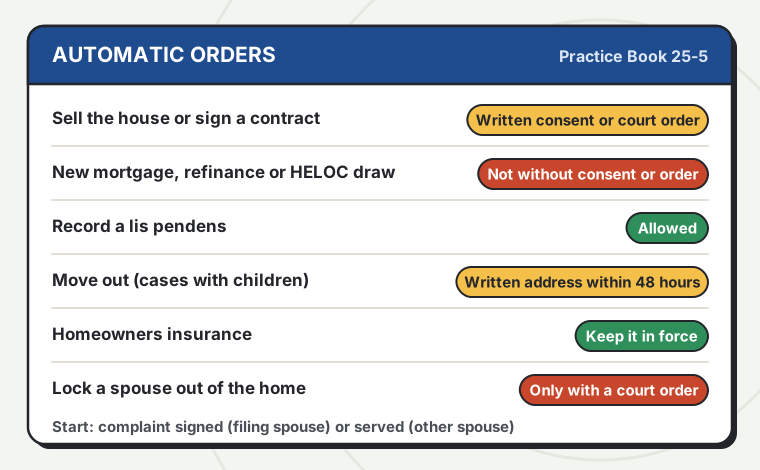
The automatic orders come from Connecticut Practice Book § 25-5. They are printed on the court form JD-FM-158, Notice of Automatic Court Orders, which is served on the other spouse together with the divorce complaint. You do not have to ask for them; they apply in every dissolution, legal separation and annulment case. The ones that matter for a house:
| Automatic order (PB § 25-5) | What it means for the house |
|---|---|
| (b)(1) Neither party shall “sell, transfer, exchange, assign, remove, or in any way dispose of” property without “the consent of the other party in writing, or an order of a judicial authority” | No listing contract that commits the house, no purchase contract and no deed unless the other spouse agrees in writing or a judge approves. |
| (b)(2) Neither party shall conceal any property | Full disclosure of the house, its value, the loans on it and any offers you receive. |
| (b)(3) Neither party shall encumber property, “except for the filing of a lis pendens,” without written consent or a court order | No new mortgage, refinance or home equity loan on your own. A lis pendens (a notice on the land records) is allowed. |
| (b)(4) Neither party shall move a jointly held asset into his or her sole name without written consent or a court order | No quitclaim from joint names into one name during the case without agreement. |
| (b)(5) No unreasonable new debts, “including … further borrowing against any credit line secured by the family residence” | Do not draw on a home equity line of credit during the case. |
| (b)(7) Keep the existing homeowners insurance in full force | Keep paying the homeowners policy; a lapse can hurt both of you and the sale. |
| (b)(8) If you live together on the date of service, neither may deny the other use of the primary residence without a court order | Changing the locks on a spouse is not allowed; exclusive use takes a court order. |
| (a)(2) In cases with children, a party who moves out of the family residence notifies the other party or their attorney in writing within 48 hours, with an address for communication | Moving out is allowed; disappearing is not. |
The same form tells both spouses to complete and exchange sworn financial statements within 30 days of the return day. The house, its mortgage balance and its value go on that statement. If one spouse ignores the orders, the other spouse’s attorney can ask the court to enforce them; the orders themselves warn that breaking them can be punished as contempt of court.
Most divorcing couples who sell during the case sign a written agreement, often called a stipulation, prepared by their attorneys. It typically names the listing price or how it will be set, who picks the agent or buyer, how offers are approved, and where the net proceeds go after closing (often into an attorney’s escrow account until the final division). Many attorneys also file it with the court for approval so the buyer’s title attorney sees a clean record.
Can my spouse sell the house without me if only their name is on the deed?
Not while the case is pending. The automatic orders apply to “any property,” not only jointly titled property, so the spouse on the deed still needs your written consent or a court order. To put the world on notice, Connecticut law also lets either spouse record a notice of lis pendens on the town land records once the complaint is served, if the spouse claims an interest in real property the other spouse owns (CGS § 46b-80). A buyer or lender who checks the land records then takes subject to the divorce case. Ask your attorney whether to file one.
Who gets the house in a Connecticut divorce?
The house goes to whichever spouse the settlement agreement or the judge decides, not automatically to the spouse whose name is on the deed. Connecticut uses equitable distribution: at the decree, the Superior Court may assign any property of either spouse to the other, pass title to the house, or order it sold, after considering the factors in CGS § 46b-81, such as the length of the marriage, each spouse’s income and needs, and each spouse’s contribution to the house.
Connecticut courts can divide all property either spouse owns, whenever and however it was acquired. That includes a house one spouse owned before the marriage, inherited, or holds in their own name. Those facts still matter, because they feed into the factors below, but they do not take the house off the table.
The factors in CGS § 46b-81(c)
In deciding what each spouse receives, the court must consider:
- The length of the marriage
- The causes of the breakdown of the marriage
- The age and health of each spouse
- Each spouse’s station, occupation, and amount and sources of income
- Each spouse’s earning capacity, vocational skills, education and employability
- Each spouse’s estate, liabilities and needs
- Each spouse’s opportunity for future acquisition of capital assets and income
- Each spouse’s contribution to the acquisition, preservation or appreciation in value of their estates
“Equitable” means fair under those factors, not automatically 50/50. Many settlements do split the house equity evenly, and many do not: one spouse may keep more of the house and less of a retirement account, for example. Alimony is decided separately under CGS § 46b-82, and the court considers the property award when it decides alimony.
What the court can do with the house
Section 46b-81(a) gives the court three tools at the time of the decree: assign the house to either spouse, pass title “to either party or to a third person,” or “order the sale of such real property, without any act by either spouse.” When the decree is recorded on the town land records, it transfers title as if it were a deed (CGS § 46b-81(b)). That is why a stubborn spouse cannot block a sale or transfer the judge has ordered by refusing to sign.
Who lives in the house while the case is pending?
Until the court rules, both spouses usually keep the right to live there (automatic order (b)(8)). Either spouse can ask for exclusive use of the family home during the case, and the court may award it “as is just and equitable without regard to the respective interests of the parties in the property” (CGS § 46b-83). Where children are involved, a parent who leaves voluntarily may find the court considers that move when it makes custody orders (§ 46b-83(b)). Talk to your attorney before you move out.
What are your options for the house in a Connecticut divorce?
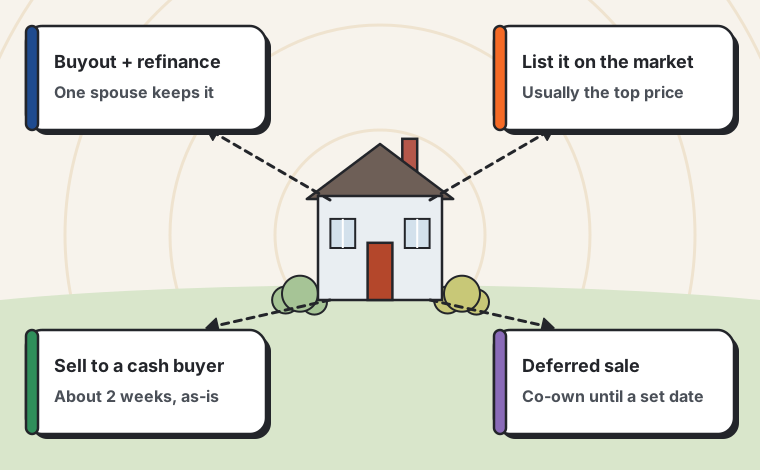
Your options for the house in a Connecticut divorce are four: one spouse keeps it and buys out the other (usually with a refinance), you sell it on the open market and split the money, you sell it to a cash buyer and split the money, or you keep co-owning it until a set trigger, such as the youngest child turning 18, and sell then. The right one depends on whether either of you can afford the house alone, how much time you have, and the condition of the house.
1. Buyout and refinance
Keep itOne spouse keeps the house and pays the other their share of the equity.
- Best when one spouse can qualify for the mortgage alone
- No commission, no showings, no move for the children
- Deed between spouses: no conveyance tax
- Risk: the refinance fails or the house is unaffordable later
2. Sell on the open market
Top priceList with an agent (or by owner) and split the net proceeds.
- Usually the highest price for a house in good shape
- Costs: commission, prep, months of carrying costs
- Needs two spouses to agree on price, offers and showings
- Best when neither can keep the house and there is time
3. Sell to a cash buyer
FastestOne walkthrough, a written offer, closing in about two weeks.
- Lower price than a good listing
- No repairs, showings or financing risk
- Fits houses that need work, deadlines, or spouses who cannot cooperate for months
- Wrong choice for a move-in-ready house when time allows
4. Deferred sale
LaterKeep co-owning until a trigger date, then sell or buy out.
- Keeps the children in their home and school
- Needs a detailed written agreement
- Both stay tied to the mortgage and to each other
- Tax rules can protect the spouse who moved out
The highlighted column is the usual best price, not the usual best choice. Many Connecticut couples are better off with a buyout or a deferred sale than with any sale at all, and we say so below where it applies. We buy houses for cash, so weigh our view with that in mind; the comparison table further down shows where a cash sale wins and where it loses.
| Buyout | Listing | Cash buyer | Deferred sale | |
|---|---|---|---|---|
| Price | Agreed value (appraisal) | Market price, if priced and prepared well | Below a retail sale | Future market price (unknown) |
| Commission | None | About 5% to 6% total (est.) | None | Later, if listed |
| Conveyance tax | Exempt (deed between spouses or under the decree) | Paid by the sellers | Paid by the sellers | Paid at the later sale |
| Repairs, showings | None | Usually expected | None; one walkthrough | Ongoing upkeep |
| Time | Weeks (refinance and appraisal) | Months | About 2 weeks, or your date | Years |
| Cooperation needed | High at the start, then low | High for months | Low: one decision, one walkthrough | High for years |
| Mortgage after | Refinanced into one name (if approved) | Paid off | Paid off | Both stay liable |
| Best for | One spouse can afford it and wants it | Good-condition house, time, cooperation | Needs work, deadline, conflict, or far-away spouse | Young children and enough income to carry it |
How does one spouse buy out the other in Connecticut?
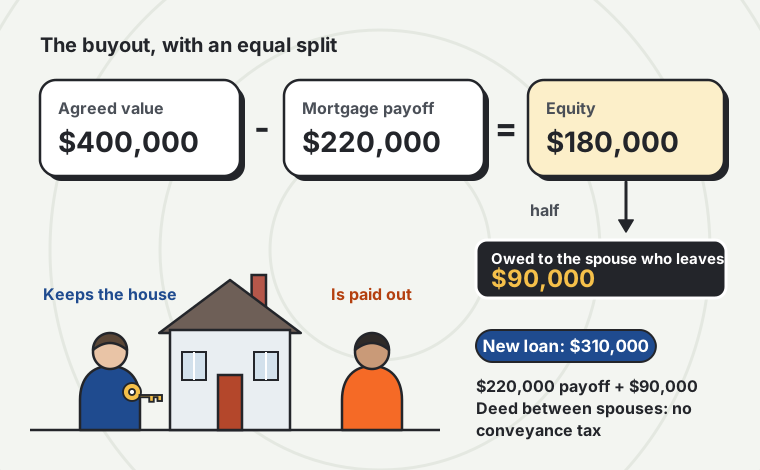
One spouse buys out the other in Connecticut by agreeing on the house’s value, subtracting the mortgage to find the equity, and paying the other spouse their share of that equity, in cash, through a refinance, or by giving up other assets. The leaving spouse then signs a quitclaim deed, which is exempt from Connecticut’s conveyance tax, and the keeping spouse refinances so the leaving spouse is released from the mortgage.
The buyout math, step by step
- Agree on the value. Most couples order one appraisal from a licensed appraiser both trust, or each get one and meet in the middle. Online estimates are a starting point, not a value; a pre-divorce appraisal usually costs a few hundred dollars (est.). Our article on how appraisals affect the price of a Connecticut house explains what appraisers look at.
- Subtract everything owed on the house. The first mortgage, any home equity loan or line, and any liens (unpaid taxes, a contractor’s mechanic’s lien, a judgment lien). Get an actual payoff figure from each lender, not the balance on last month’s statement.
- Decide the split. Equal is common; it is not required. The split is part of the whole settlement, so a larger share of the house may be balanced by a smaller share of a 401(k) or a different alimony number.
- Decide whether to deduct “costs of sale”. Some couples reduce the equity by what a sale would have cost (commission, conveyance tax) because the keeping spouse will pay those costs one day. Others do not, because no sale is happening. It is a negotiating point, not a rule.
- Fund the buyout. With savings, a cash-out refinance, or an offset (the leaving spouse takes more of another asset instead of cash).
- Transfer title and release the loan. The leaving spouse signs a quitclaim deed to the keeping spouse, usually at the refinance closing. The refinance pays off the old joint loan, which is what actually releases the leaving spouse.
The example
$180,000equity
- Agreed value $400,000
- Mortgage payoff $220,000
- Equity $400,000 − $220,000
Equal split
$90,000owed to the spouse who leaves
- Half of $180,000
- Paid in cash, by refinance or by an offset
The refinance needed
$310,000new loan to pay off $220,000 and pay $90,000 in cash
- Plus refinance closing costs
- About 78% of the $400,000 value
Run this before you agree to it. A $310,000 loan at today’s rates may cost far more per month than the old $220,000 loan, especially if the old rate was low. The keeping spouse must qualify on their own income (alimony and child support the lender can document may count), and needs room in the budget for Connecticut property taxes, which in many towns run several hundred to well over a thousand dollars a month (see the town table below).
Sometimes. Federal law bars a lender from calling a home loan due under a due-on-sale clause when a transfer results from a divorce decree or separation agreement “by which the spouse of the borrower becomes an owner of the property” (12 U.S.C. § 1701j-3(d)(7)). That protects the transfer, but it does not release the spouse who leaves from the loan. A release requires the lender’s approval, often through a formal loan assumption with a credit review. Ask the servicer early; it can save a refinance at a higher rate.
When a buyout is the better choice than any sale
A buyout beats selling, including selling to us, when one spouse truly wants the house and can carry it alone. It skips the commission, the conveyance tax (a deed between spouses is exempt), the move, and months of shared decisions. It is the wrong choice when the numbers only work on paper: if the keeping spouse cannot qualify for the refinance, or will be house-rich and cash-poor after the divorce, the house often ends up being sold later anyway, under more pressure.
Should you sell the house before or after the divorce is final in Connecticut?
Whether you should sell the house before or after the divorce is final in Connecticut depends on money, taxes and cooperation. Selling before the decree needs both spouses’ written consent (or a court order), but it turns the house into cash that is easy to divide and can keep the $500,000 joint tax exclusion in play. Selling after the decree follows a clear court order, but leaves you co-owners until closing, and each of you is then generally limited to a $250,000 exclusion.
| Sell before the decree | Sell after the decree | |
|---|---|---|
| Legal permission | Written consent of both spouses or a court order (automatic orders) | The decree or the incorporated agreement sets the terms |
| The money | Net proceeds usually held in an attorney’s escrow account until the court divides them, or split by written agreement | Split exactly as the decree says |
| Federal home-sale exclusion | Up to $500,000 if you are still married on December 31 of the year of sale, file a joint return, and both meet the use test | Up to $250,000 each on separate returns, if each qualifies |
| Carrying costs | Stop at closing | Continue until closing; the decree should say who pays |
| Risk | Agreeing on price and offers mid-case | A co-owner who stalls after the decree (enforcement motions) |
| Best when | You both already agree the house must go, or carrying it is draining money | You disagree about the house, or one spouse may still keep it |
There is no rule that the house must be sold at either moment. Many couples agree early that the house will be sold, sign a stipulation, list it, and let the sale and the divorce run side by side. Others leave the house to the final agreement because it is the piece that balances everything else.
How long does a Connecticut divorce take now?
Less than many guides say. Connecticut used to make most couples wait 90 days after the return date. Public Act 23-46 rewrote CGS § 46b-67: if you reach a full agreement, the court may now proceed after the second day following the return date, and in some cases even before it. Only a contested trial must still wait at least 90 days after the return date, and a judgment against a spouse who never appears must wait at least 30 days (personal or abode service) or until a hearing at least 60 days out (other service). In practice, the speed of a divorce with a house is set by how quickly you agree, not by the calendar.
Two more timing facts. A decree can only enter if one spouse has lived in Connecticut for the 12 months before filing or before the decree, or meets one of the other residency tests in CGS § 46b-44(c). And Connecticut’s quick “nonadversarial” divorce under CGS § 46b-44a is not open to homeowners: one of its conditions is that “neither party has any interest or title in real property.”
Should you list with an agent or sell to a cash buyer during a divorce?
You should list with an agent during a divorce when the house is in good shape, both spouses can cooperate on price, showings and offers for a few months, and nobody faces a deadline. A cash buyer makes more sense when the house needs work, carrying costs are draining both of you, the decree or the bank sets a date, one spouse has moved away, or every joint decision turns into a fight. A cash offer is lower than a good listing; the question is whether the difference is worth the time, cost and friction.
How long each route takes
Typical shapes, not promises. A refinance commonly takes 30 to 45 days once the appraisal is in (est.); contract to closing with a mortgage buyer usually takes 30 to 45 days. Our guide on how long it takes to sell a house in Connecticut breaks down each step.
What listing during a divorce actually asks of you
- Joint decisions, again and again: the agent, the list price, every price drop, every offer, every repair request after the inspection.
- A show-ready house: often with one spouse still living there, sometimes with children, sometimes with the other spouse’s belongings still in the basement.
- Carrying costs for months: mortgage, Connecticut property tax, insurance, utilities and upkeep, and the question of who pays them.
- The disclosure report: Connecticut sellers complete the Residential Property Condition Report or credit the buyer $500 (see the disclosure report explained). Both owners sign, and the spouse who moved out may not know the current condition.
Some agents market themselves as divorce specialists. What matters more than the label is that the agent communicates with both spouses equally, in writing, and sends every offer to both of you (and to both attorneys if you ask).

When a couple is divorcing, I treat both spouses as my client, even if only one of them called me. Both get the same information at the same time, the written offer goes to both attorneys, and nothing moves until both owners have signed. If one of you can keep the house, or the house would sell well on the market and you have the time, I will tell you that. A fast cash sale only makes sense when it solves a real problem.
Agent vs cash buyer during a divorce
| Listing agent | Cash buyer | |
|---|---|---|
| Price | Market price, if the house shows well | Below retail: the buyer prices in repairs, risk and resale |
| Commission | About 5% to 6% total (est.) | None |
| Repairs and cleanout | Usually expected | None; leave what you do not want |
| Showings | Many, over weeks or months | One walkthrough, which both spouses can attend |
| Financing risk | The buyer’s loan can fail late | No loan contingency |
| Closing date | Set by the buyer’s lender | About 2 weeks, or a date that fits the decree |
| Joint decisions | Many | Few: accept or decline one written offer |
A worked example: what each spouse walks away with
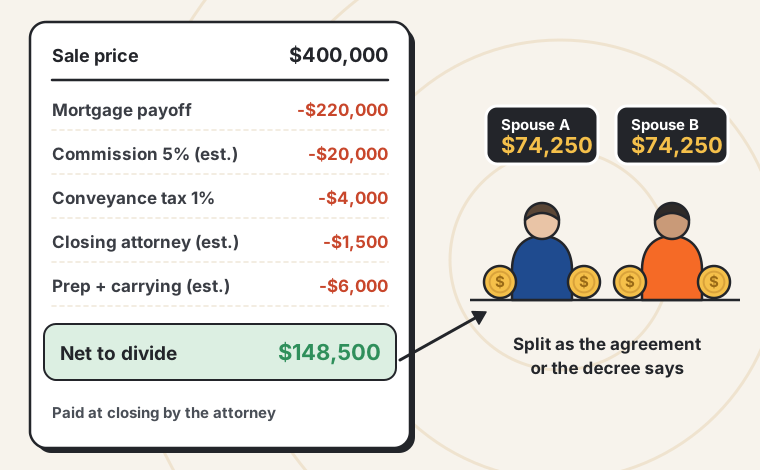
Same house as the buyout example: worth about $400,000 on the open market, $220,000 left on the mortgage, in a town with the standard 0.25% town conveyance tax. Split equally.
List it
$74,250 each$148,500 net, split in two
- $400,000 sale price
- −$220,000 mortgage payoff
- −$20,000 commission at 5% (est.)
- −$4,000 conveyance tax (1%)
- −$1,500 closing attorney (est.)
- −$6,000 prep and 3 months of carrying costs (est.)
Cash offer (example)
$57,300 each$114,600 net, split in two
- $340,000 example offer
- −$220,000 mortgage payoff
- −$3,400 conveyance tax (1%)
- −$1,500 closing attorney (est.)
- −$500 two weeks of carrying costs (est.)
Buyout
$90,000to the spouse who leaves; the other keeps the house
- Half of $180,000 equity
- No commission, no conveyance tax
- Keeping spouse carries a $310,000 refinance
In this example the listing leaves each spouse about $17,000 more than the example cash offer, if the house sells at $400,000 within three months and needs only light prep. That is a real difference, and for a house in good condition it usually decides the question in favor of listing. The cash route narrows the gap or wins when the house needs significant repairs, when it sits for months, when a buyer’s financing falls through, or when the time and conflict of a long listing cost more than the money. The example cash offer is illustrative, not a quote. Use the calculator to run your own numbers, and see how to compare offers on a house in Connecticut before you accept any of them.
How much would you walk away with?
Slide the numbers to match your house. It works in your browser; nothing is saved or sent.
Estimates for planning. Conveyance tax per CGS 12-494 (state 0.75% up to $800,000, 1.25% to $2.5M, 2.25% above, plus the town rate). Seller attorney about $1,200 to $1,500; flat-fee MLS about $400; listings include three months of taxes, insurance and utilities, a cash sale about two weeks. Your attorney gives you the final numbers.
How is the money split at closing?
At a Connecticut closing the seller’s attorney pays off the mortgage and the other liens, pays the conveyance tax and the closing costs, and disburses what is left. In a divorce sale that last step follows your agreement or the court’s order: the net may go into the attorney’s trust account until the decree, or be split on the spot in the agreed shares. Make sure the agreement says who gets credit for payments made after separation (for example, one spouse paid the mortgage alone for a year), and who pays any repair credits the buyer negotiates. Our guide to seller closing costs in Connecticut lists every line on the settlement statement, and the Connecticut closing process for sellers walks through the closing itself.
Two spouses, one set of numbers
A free Home Forecast gives you both the same starting point: a likely sale price from recent sales near you, how long each route would take, and what you would walk away with either way. No sales call, and you can each read it on your own.
Know where you stand,
on your own time.
Watch what homes around you sell for and how fast, so when you are ready, you already know your options.
Follow your numbers as the market moves, and decide when the timing is right.
Can you keep the house until the children are older and sell it later?
Yes, you can keep the house until the children are older and sell it later in Connecticut. This is called a deferred sale: the agreement or decree lets one parent live in the house with the children until a trigger, such as the youngest child turning 18 or finishing high school, a remarriage or a missed payment, and then the house is sold or bought out and the equity divided by a formula set now. It protects the children’s stability but keeps both of you tied to the house and the mortgage for years.
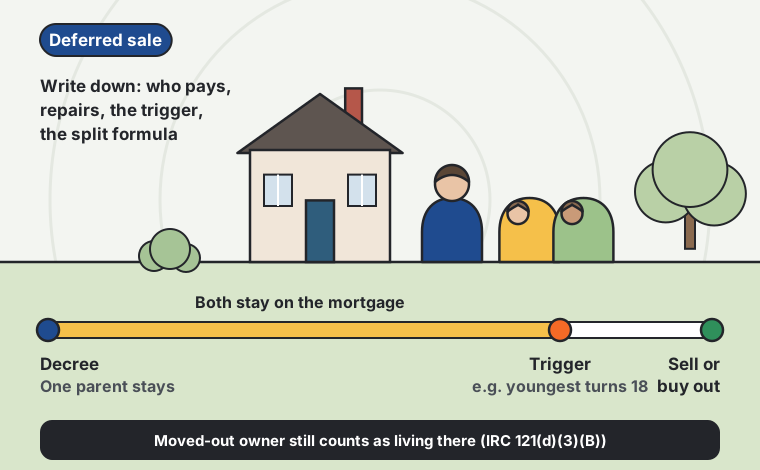
A deferred sale is often the kindest answer for children and the hardest one for the adults. It works when the parent who stays can afford the payments and upkeep, and when both parents can still make a few joint decisions over the years. A good deferred-sale agreement answers, in writing:
- Who lives in the house, and until exactly which event (a date, the youngest’s 18th birthday or high school graduation, remarriage or cohabitation, a move)
- Who pays the mortgage, property tax, insurance and routine upkeep, and what happens if a payment is missed
- Who pays for major repairs (roof, furnace, septic), and whether those payments come back to that spouse at the sale
- How the house is valued at the trigger, and whether the staying spouse has the first right to buy out the other
- The formula for splitting the equity, including credit for principal paid down and improvements made after the decree
- Who picks the agent and sets the price when the time comes, and what happens if you disagree
The tax rule that protects the spouse who moved out
Normally you must live in a home for two of the five years before a sale to use the home-sale exclusion. For divorcing spouses, federal law adds a rule: you are treated as using the house as your main home during any period you own it while your spouse or former spouse “is granted use of the property under a divorce or separation instrument” (IRC § 121(d)(3)(B)). A divorce or separation instrument means the decree or a written instrument incident to it, a written separation agreement, or a support decree (§ 121(d)(3)(C)). So the parent who moved out can still qualify for up to $250,000 of exclusion when the house is finally sold, as long as that parent still owns a share and the use was granted in writing. Make sure the right is written into the agreement; an informal arrangement is not enough. IRS Publication 523 explains the rule under “Separated or divorced taxpayers.”
When a deferred sale goes wrong
Both spouses stay on the mortgage, so a missed payment hurts both credit reports. The spouse who moved out may struggle to qualify for a new mortgage while the old one still counts against them. Houses age, markets move, and the trigger date can arrive at a bad time. If payments stop, act early: our guide on six things you can do to stop a Connecticut foreclosure covers the options, and selling a house in foreclosure in Connecticut explains the sale route if it comes to that.
What happens to the mortgage and the deed when you divorce in Connecticut?
When you divorce in Connecticut, the mortgage and the deed follow different rules. The deed decides who owns the house and can be changed by a quitclaim deed or by recording the divorce decree. The mortgage note is a contract with the lender: every spouse who signed it stays personally liable until the loan is refinanced, paid off by a sale, or the lender formally releases them. A divorce decree cannot take a spouse off a loan; only the lender can.
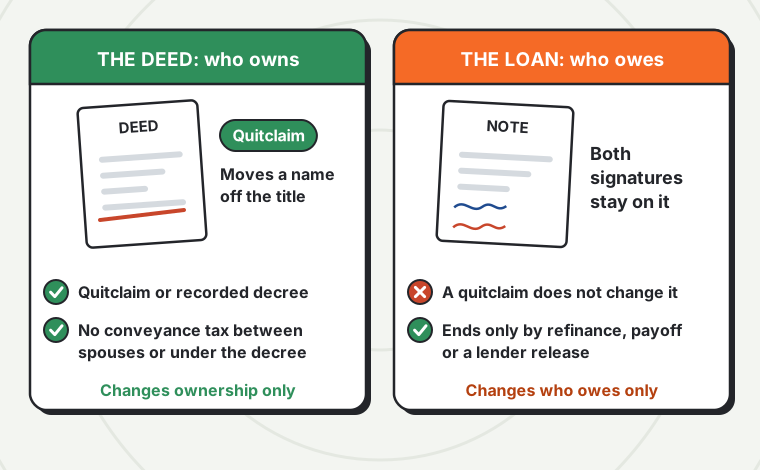
| The deed (title) | The mortgage (the note) | |
|---|---|---|
| What it decides | Who owns the house | Who owes the lender |
| Who is on it | Whoever took title (one spouse or both) | Whoever signed the note (sometimes only one spouse) |
| How it changes | Quitclaim or warranty deed, or recording the decree (CGS § 46b-81(b)) | Refinance, payoff at a sale, or a lender-approved assumption and release |
| What the divorce court can do | Pass title to either spouse or a third person, or order a sale | Order one spouse to pay it and hold the other harmless; it cannot bind the lender |
| Conveyance tax on the change | Exempt between spouses or under the decree (CGS § 12-498(a)(9), (14)) | Not applicable |
Why a “hold harmless” clause is not enough
Settlement agreements often say the spouse who keeps the house will pay the mortgage and “indemnify and hold harmless” the other. That promise is between the two of you. If the keeping spouse stops paying, the lender can still pursue both borrowers, report the late payments on both credit reports, and foreclose. That is why most attorneys pair a buyout with a refinance deadline, and a fallback: if the refinance is not done by a set date, the house is listed for sale.
Liens, equity lines and other title problems
- Home equity lines: the automatic orders bar further borrowing on a line secured by the family home. Ask the lender to freeze the line by joint request if you are worried.
- Lis pendens: if either spouse recorded one under CGS § 46b-80, it must be released, usually under the decree or a stipulation, before a buyer’s title insurer will close.
- Judgment and tax liens: a lien against either spouse can attach to that spouse’s share of the house and gets paid from the sale proceeds.
- Pendente lite orders: temporary orders about who lives in the house and who pays the mortgage stay in force until changed; check them before you sign a listing agreement.
- Old paperwork: a missing mortgage release from an earlier refinance, an unpermitted addition, or an old oil tank can delay any sale. Our list of documents you need to sell a Connecticut house helps you gather them early.
What if the house is worth less than the mortgage?
An underwater house has no equity to divide, only a shortfall. The options are to keep paying until values recover (often with a deferred-sale agreement), a short sale with the lender’s approval, or a deed in lieu of foreclosure. Connecticut exempts some of these deeds from the conveyance tax, including a deed in lieu of foreclosure of the transferor’s principal residence and a sale of a principal residence where the price does not cover the mortgages and priority municipal liens (CGS § 12-498(a)(19) and (20)). Talk to your attorney and the lender before payments stop.
What taxes apply when you sell a house during a divorce in Connecticut?
The taxes that apply when you sell a house during a divorce in Connecticut are federal and Connecticut income tax on any gain above the home-sale exclusion, and the Connecticut conveyance tax on a sale to an outside buyer. Transfers between spouses incident to the divorce are not taxable events (IRC § 1041) and deeds between spouses or under the divorce decree are exempt from the conveyance tax. Married couples filing jointly can exclude up to $500,000 of gain; after the divorce, each spouse can exclude up to $250,000 if they qualify.
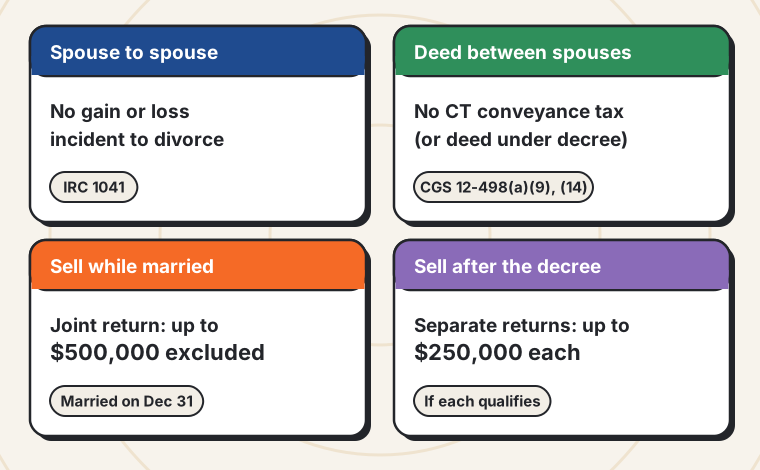
Federal: the home-sale exclusion (IRC § 121)
If you owned and lived in the house as your main home for at least two of the five years before the sale, and have not used the exclusion in the past two years, up to $250,000 of gain is excluded from income. For a married couple filing a joint return, the limit is $500,000 if either spouse meets the ownership test, both meet the use test, and neither used the exclusion in the past two years (IRC § 121(b)(2)). Three divorce-specific points:
- Joint return means still married on December 31. Your filing status depends on your marital status on the last day of the tax year (IRS Publication 504). If your decree enters before December 31 of the year you sell, you cannot file jointly for that year.
- Separate returns: each spouse applies their own $250,000 limit to their own share of the gain, if they qualify.
- Ownership after a transfer: if your spouse transferred the house to you in a § 1041 transfer, your ownership period includes the time your spouse owned it (IRC § 121(d)(3)(A)). You still have to meet the residence test yourself, except for the divorce-instrument rule in the deferred-sale section above.
An example where timing matters (est.)
Say a couple bought a house for $300,000 and sells it for $900,000, after $40,000 of improvements and $45,000 of selling costs: a gain of about $515,000. Both lived there for many years. Sold while married and filed jointly, up to $500,000 is excluded, and about $15,000 is taxable. Sold after the divorce on separate returns, each owns half the gain (about $257,500) and each excludes up to $250,000, so about $7,500 each is taxable: the same total here. The outcome changes when one spouse fails the use test, for example a spouse who moved out more than three years before the sale with no divorce or separation instrument granting the other spouse use of the house. These are illustrative numbers; your tax professional will work out your own.
Federal: transfers between spouses (IRC § 1041)
No gain or loss is recognized when property passes from one spouse to the other, or to a former spouse if the transfer is “incident to the divorce” (IRC § 1041(a)). A transfer is incident to the divorce if it happens within one year after the marriage ends or is related to the end of the marriage (§ 1041(c)). IRS Publication 504 notes this applies even when the transfer is in exchange for cash or the release of marital rights. The catch: the spouse who receives the house takes over the original tax basis (§ 1041(b)). Keeping the house means keeping its built-in gain; $90,000 in cash and $90,000 of house equity are not always worth the same after tax. The rule does not apply if the receiving spouse is a nonresident alien (§ 1041(d)).
Connecticut income tax
Connecticut starts its income tax from your federal adjusted gross income, so gain excluded federally is not taxed by Connecticut, and taxable gain is taxed as ordinary income at Connecticut’s rates (top rate 6.99%). Connecticut has no separate divorce rule for home sales. Our guide to taxes when selling a house in Connecticut covers the rates, nonresident sellers and the property tax proration at closing, and the older post tax tips for selling your Connecticut house has more background.
The Connecticut conveyance tax
A sale to an outside buyer is taxed the normal way: the sellers pay 0.75% to the state on a residential price up to $800,000 (more above that) plus 0.25% to the town, or 0.50% in 16 cities (CGS § 12-494). Two exemptions in CGS § 12-498(a) matter in a divorce:
“(9) Deeds made pursuant to a decree of the Superior Court under section 46b-81 …” and “(14) Deeds between spouses.” In plain terms: the quitclaim from one spouse to the other in a buyout, and a deed made to carry out the divorce decree, owe no conveyance tax. The exemption is claimed on the conveyance tax return when the deed is recorded; your attorney handles it.
Whether a sale to an outside buyer that the court itself orders under § 46b-81 also qualifies under subdivision (9) is a question for your attorney; most divorce sales are voluntary sales by both owners, and the normal tax applies. See the Connecticut conveyance tax guide for every town’s rate.
Who pays the mortgage and the bills on the house while the divorce is pending?
Who pays the mortgage and the bills on the house while a Connecticut divorce is pending is decided by agreement or by a temporary court order. Until then, the automatic orders require both spouses to keep the homeowners insurance in force and bar new debt against the house, and the lender expects every payment no matter who lives there. Either spouse can ask the court for temporary (“pendente lite”) orders on support, the mortgage and exclusive use of the home.
The bills do not pause for the divorce. A typical Connecticut house carries the mortgage, property tax (often paid through escrow), homeowners insurance, utilities, heating fuel and upkeep. Under CGS § 46b-83 the court can award alimony and support pendente lite and exclusive use of the family home during the case. If one spouse asks for initial support with the required affidavit, the hearing is to be held within 60 days of filing the motion.
- Keep paying the mortgage, even if it is not fair yet. Late payments hit both borrowers’ credit and can start a foreclosure, which shrinks the equity you are fighting over. Keep records; credits for payments made after separation are commonly negotiated in the final agreement.
- Keep the insurance and the heat on. Automatic order (b)(7) requires the existing homeowners policy to stay in force, and a frozen pipe in an empty house costs you both. Our guide to the cost of holding a Connecticut property lists every monthly cost.
- Ask for an order if you cannot agree. Your attorney can file a motion for temporary orders on who pays what.
Who is involved: attorneys, mediators and the court?
The people involved in selling a house during a Connecticut divorce are usually two divorce attorneys (one for each spouse), sometimes a mediator who helps you reach an agreement together, the Superior Court’s family staff and judge, and for the sale itself a real estate closing attorney, plus an appraiser, an agent or a buyer, and the mortgage lender. Each has a different job, and only your own attorney represents only you.
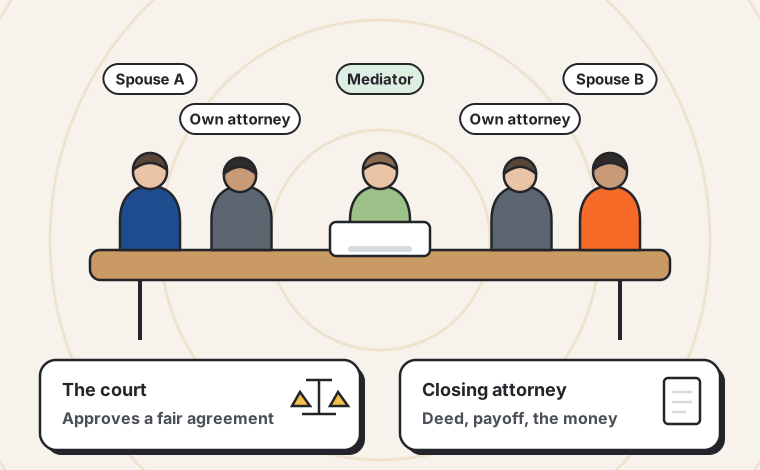
| Who | What they do for the house |
|---|---|
| Your divorce attorney | Advises only you, negotiates the agreement on the house, drafts or reviews the stipulation to sell, and makes sure the decree says exactly who gets what and when. |
| Your spouse’s divorce attorney | Does the same for your spouse. Offers, appraisals and closing figures should go to both attorneys. |
| A mediator | A neutral person who helps both spouses reach an agreement, including on the house. A mediator does not represent either of you. Connecticut law makes communications in a court-designated divorce mediation program privileged (CGS § 46b-53a), and private mediators are widely used. |
| The court and its family staff | The judge reviews your agreement and must find it “fair and equitable under all the circumstances” before making it part of the decree (CGS § 46b-66). The court’s Family Services staff (long known as Family Relations) work with parents on parenting issues and, in some courts, help with negotiations on court days. |
| Conciliator (optional) | Either spouse can request conciliation, two sessions focused on reconciliation or reducing conflict, within the first 90 days after the return date (CGS § 46b-53). Skipping the sessions without good cause can hold up the case until six months after the return date. |
| Closing (real estate) attorney | Runs the sale: title, payoff letters, the deed, the conveyance tax return and the money. Connecticut closings are handled by attorneys. Often one spouse’s divorce attorney is not the closing attorney. |
| Appraiser | Sets a value both sides can use for a buyout or a list price. |
| Agent or buyer | Markets the house, or makes a direct offer. Either way, both owners must sign. |
| Lender or servicer | Supplies payoff figures, approves any assumption, release or short sale. |
Mediation deserves an honest word. A mediated agreement on the house is usually cheaper, faster and calmer than a contested hearing, and it often produces better outcomes for children. If you and your spouse can still sit at a table, mediation with each of you having an attorney review the result is often the best route of all, better than anything we can offer.
What happens when spouses disagree about selling the house in Connecticut?
When spouses disagree about selling the house in Connecticut, the divorce court decides. During the case, the house cannot be sold without written consent or a court order, so the spouse who wants to sell can ask the court to modify the automatic orders. At the final decree, the court can award the house to one spouse, order it sold, or set a deferred sale, without either spouse’s signature, under CGS § 46b-81. A decree that one spouse ignores can be enforced by motion.
- Before the decree: the automatic orders keep the status quo. A spouse who wants to sell sooner can file a motion; the form JD-FM-158 tells both spouses they have a right to a hearing to change the orders. The court’s power under § 46b-81 to order a sale arises “at the time of entering a decree,” so ask your attorney what the court can order before then in your situation.
- At the decree: the court can pass title to either spouse or to a third person, or order the house sold, and the recorded decree works like a deed (§ 46b-81(a)-(b)). Decrees often spell out the list price, how price reductions work, who chooses the agent, and a deadline.
- After the decree: if a spouse refuses to cooperate with an ordered sale (no signatures, no showings, no move-out), the other spouse’s attorney can file a motion for contempt or for orders to carry out the judgment. Property division orders generally cannot be modified later the way alimony can, so get the house terms right the first time.
- Partition: co-owners who are not divorcing use a partition action (CGS § 52-495) to force a division or sale. Between spouses with a divorce pending, the house is normally handled inside the divorce case under § 46b-81 instead; ask your attorney before you consider a separate action.
Two practical points help most. First, put every proposal in writing through the attorneys, so nobody can say later they never saw an offer. Second, agree on a neutral way to set the price (one appraiser, or the average of two) before you argue about anything else; most house fights are really price fights.
How do you sell a house during a divorce in Connecticut, step by step?
To sell a house during a divorce in Connecticut, follow these steps: talk to your own attorney, gather the deed, mortgage and tax records, get an agreed value, decide together whether to buy out, sell or defer, sign a written stipulation, choose the sale route, keep the house insured and paid, review every offer through both attorneys, sign the contract and disclosures together, and close with the proceeds paid or held exactly as agreed.
Talk to your own attorney first
Before you sign a listing agreement, accept an offer or move out, get advice on the automatic orders, temporary orders and how the house fits your whole settlement. Ask about a lis pendens if you are not on the deed.
Gather the house paperwork
The deed (from the town clerk’s land records), the latest mortgage statement and a payoff request, any home equity line, the property tax bill, the homeowners policy, and records of major repairs. Both attorneys will need them for the financial affidavits.
Get an agreed value
One appraisal from an appraiser you both accept, or one each. Agreeing on value early removes the most common fight.
Decide the path: buyout, sale or deferred sale
Check whether either spouse can qualify for a refinance alone. If not, decide between listing and a direct sale, or a deferred sale if children and income make that sensible.
Put it in writing
A stipulation or settlement agreement covering the price (or how it is set), the agent or buyer, who approves offers, who pays the bills until closing, credits for post-separation payments, and where the money goes.
Check the taxes before you pick a date
Ask a tax professional whether selling this year on a joint return or next year on separate returns changes your tax. Note your basis and improvements now, while you are both still talking.
Prepare the house (or do not)
For a listing: clean, declutter, fix safety items, and complete the property condition disclosure report together. For a direct sale: nothing; the buyer takes it as it is.
Review every offer through both attorneys
Compare the net, the financing, the contingencies and the closing date, not only the price. Both owners sign the purchase contract.
Keep the house insured, heated and paid until closing
Follow the automatic orders and any temporary orders. A lapse in insurance or a missed payment costs both of you.
Close and split exactly as agreed
Both owners sign the deed and closing documents (in person or by arrangement with the closing attorney). The closing attorney pays off the loans and the conveyance tax, then pays or escrows the net exactly as the agreement or decree says.
Your divorce sale checklist
- Read the automatic orders (JD-FM-158) and follow them
- Hire your own divorce attorney; do not share one with your spouse
- Pull the deed from the town land records and see whose name is on it
- Request a mortgage payoff and check for home equity lines and liens
- List the house, its value and its loans on your sworn financial affidavit
- Keep paying the mortgage, taxes and insurance; keep receipts
- Agree on one appraiser, or how two appraisals will be combined
- Check whether either spouse can qualify for a refinance alone
- Decide: buyout, listing, cash sale or deferred sale
- Get tax advice on the year of sale and filing status
- Sign a written stipulation before listing or accepting an offer
- Send every offer to both spouses and both attorneys
- Complete the property condition disclosure report together (for a listing)
- Confirm the decree covers the refinance deadline and a fallback sale
- Record the quitclaim or decree, and confirm the old loan is paid off or released
- Update your homeowners insurance, address and estate documents after closing
One visit, both of you
If a direct sale is on the table, book one walkthrough at a time that works for both spouses, or for both attorneys. You each get the same written offer, with no pressure to accept.
See the house together.
Pick a time that works.
Choose a time for us to walk through the property with you, or ask for a quick call first. We confirm every request personally.
Tuesday, January 13
No open times in the next few weeks. Please call us.
We will confirm by email. Nothing is booked until we do.
View my requestWhat about special situations: one name on the deed, a house owned before marriage, foreclosure or a house that needs work?
Special situations in a Connecticut divorce sale, such as one name on the deed, a house owned before the marriage or inherited, missed mortgage payments, a house that needs major work, a rental or multi-family, or a spouse who lives far away, all follow the same core rules: the automatic orders apply, the court can divide the house under CGS § 46b-81, and both owners sign any sale. What changes is the leverage, the timing and the best route.
Only one spouse is on the deed
The house is still part of the divorce; the court can assign it to either spouse regardless of title. The spouse on the deed still needs written consent or a court order to sell during the case, and the other spouse can record a lis pendens (CGS § 46b-80). After the decree, the decree or a deed from the titled spouse carries out the transfer.
The house was owned before the marriage, or inherited
Connecticut courts can still divide it. When and how it was acquired is part of the § 46b-81 analysis (especially each spouse’s contribution to its acquisition, preservation or appreciation), and a short marriage with a premarital house often looks very different from a long one. A prenuptial agreement can change the answer; your attorney will read it with you. If the house came from a parent’s estate that is still open, see our guide on what to do when you inherit a house in Connecticut.
Mortgage payments have stopped
Time is the enemy here. Connecticut foreclosures can end with a Law Day after which the owners lose the house and the equity in it. A sale that closes before then pays off the loan and protects the equity for both spouses; so can a loan modification, or mediation with the lender through the court’s foreclosure mediation program where it applies. Read six things you can do to stop a Connecticut foreclosure and selling a house in foreclosure in Connecticut, and tell both attorneys immediately.
The house needs major work
A divorce is a hard time to manage a roof, a failing septic, an old buried oil tank or a crumbling foundation, and arguing about who pays for repairs can stall a listing for months. You can sell the house as it is, to a cash buyer or to an investor through an agent. Our guide on selling a house as-is in Connecticut covers both, and what to fix before selling a Connecticut house shows which repairs pay back if you list.
A written cash offer from photos, sent to both of you
Want your offer faster, or rather not talk to anyone yet? Upload a few photos of the house. We send the same written offer to both spouses, and both attorneys if you like, with no repairs, no showings and a closing date that fits your agreement.
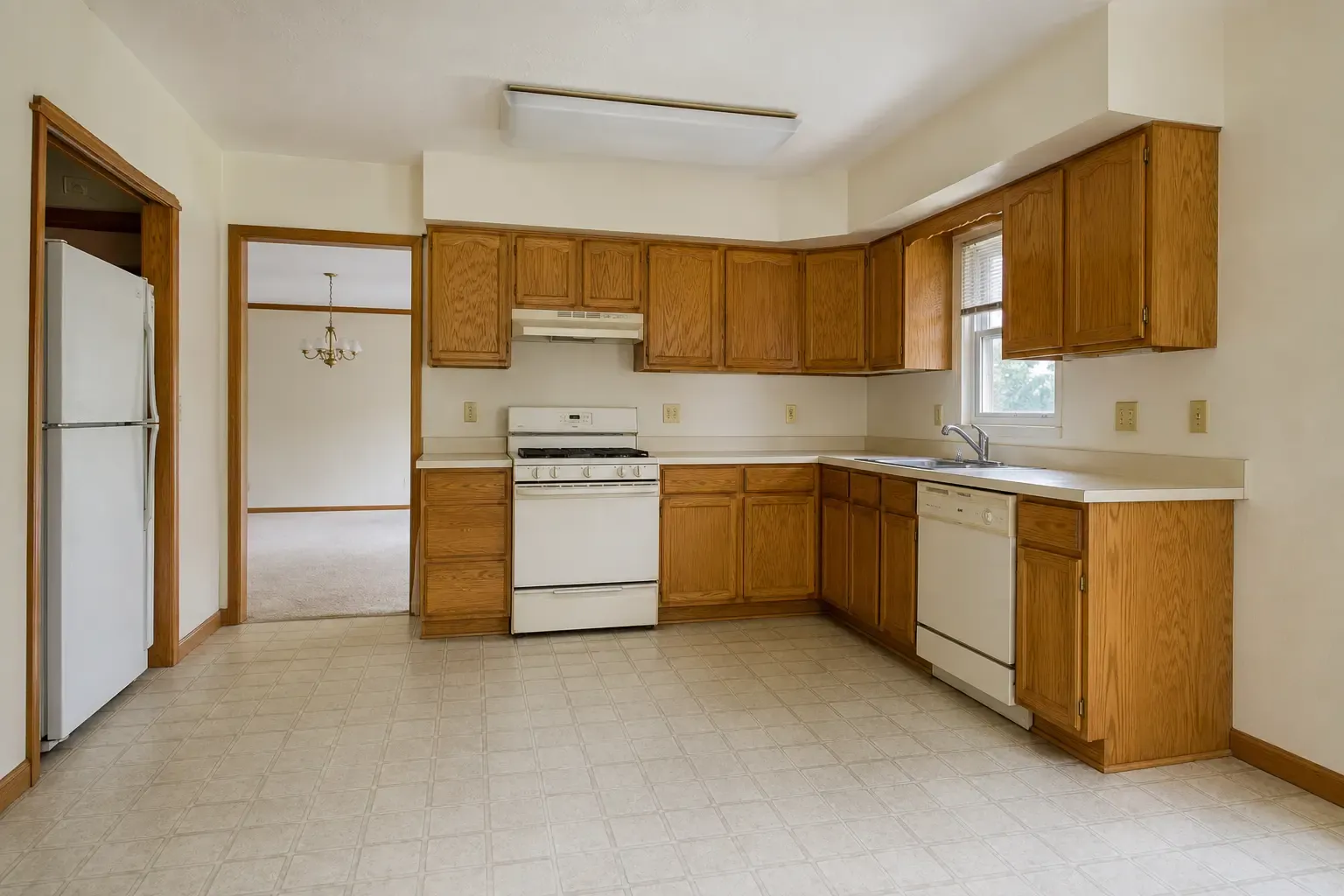 CabinetsFlooring
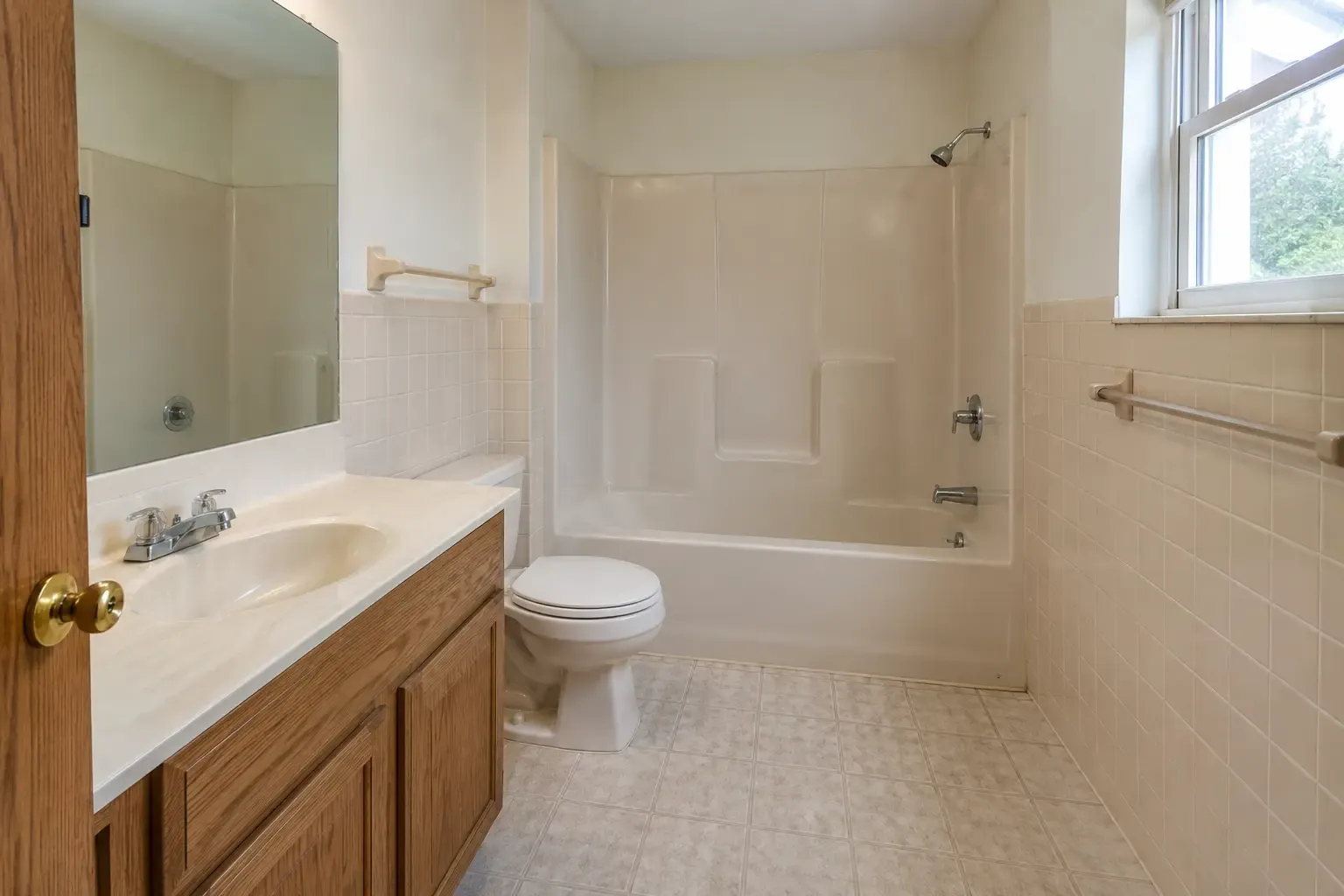 Tub & tile
 Floors
 Roof
We may bring in a partner buyer to close. Your price and terms don't change.
A rental or multi-family house
The § 121 exclusion covers only a main home; a rental’s gain is taxable, and depreciation taken over the years is taxed when you sell. Tenants also have rights that survive a sale. Get tax advice before deciding who keeps a rental, because its tax basis moves with it under § 1041.
One spouse lives out of state or far away
A Connecticut closing does not require both owners in the same room; signatures can be arranged through the closing attorney, sometimes with a power of attorney. A buyer who needs only one walkthrough and closes on a fixed date is often simplest when one owner is far away. If one of you is moving, our guide on relocating and selling a Connecticut house may help.
There is a protective or restraining order
Safety comes first. Communicate only through attorneys, and arrange walkthroughs and signings so the protected spouse never has to be in the house or a room with the other. The court form JD-FM-158 explains that a protected party may ask to appear remotely in family court proceedings (CGS § 46b-15c).
Legal separation, civil unions and unmarried couples
Legal separation and dissolution of a civil union follow the same property statute and automatic orders as divorce. Unmarried co-owners are different: there is no § 46b-81 and no § 1041; a buyout or sale is a normal real estate transaction, and a co-owner who will not agree can face a partition action. Ask an attorney which rules apply to you.
What does keeping or selling the house cost in your Connecticut town?
What keeping or selling the house costs in Connecticut depends on your town. On a sale to an outside buyer, the conveyance tax is 1% of the price in most towns and 1.25% in 16 cities; a deed between spouses or under the decree owes none. While you decide, someone also keeps paying the property tax. Here are both numbers for eight towns, from state records.
| Town | Median sale price | Conveyance tax if sold at the median to an outside buyer | Conveyance tax on a deed between spouses | Property tax on a typical single-family home, per month (est.) |
|---|---|---|---|---|
| South Windsor | $397,000 | $3,970 | $0 | $990 |
| Newington | $336,000 | $3,360 | $0 | $620 |
| Avon | $515,000 | $5,150 | $0 | $1,150 |
| Southington | $382,000 | $4,775 | $0 | $540 |
| Woodbridge | $670,000 | $6,700 | $0 | $1,320 |
| Hartford | $290,000 | $3,625 | $0 | $1,060 |
| New Haven | $350,000 | $4,375 | $0 | $770 |
| Stamford | $699,000 | $7,689 | $0 | $1,490 |
We have written about divorce sales in several of these towns before: selling a house during a divorce in South Windsor, in Newington, in Southington, in Woodbridge, and what to do if the house will not sell during a divorce in Avon. This guide replaces their legal and tax details with the current rules.
Questions Connecticut owners ask about selling a house during a divorce
Can I sell my house during a divorce in Connecticut without my spouse’s permission?
No, you cannot sell your house during a divorce in Connecticut without your spouse’s permission once the case has started. The automatic orders in Practice Book § 25-5 bar either spouse from selling, transferring or mortgaging property without the other’s written consent or a court order, even if only one name is on the deed.
When do the automatic orders start?
The automatic orders start for the spouse who files when they sign the divorce complaint, and for the other spouse when they are served with the complaint and the Notice of Automatic Court Orders (JD-FM-158). They last until the case ends or a judge changes them.
Who gets the house in a divorce in Connecticut?
In a Connecticut divorce, the house goes to whichever spouse the agreement or the court decides, regardless of whose name is on the deed. The court weighs the factors in CGS § 46b-81, including the length of the marriage, each spouse’s income, needs and earning capacity, and each spouse’s contribution to the house, and can also order the house sold.
Is Connecticut a 50/50 state for the house?
No, Connecticut is not a 50/50 state for the house. It is an equitable distribution state: the split must be fair under the factors in CGS § 46b-81, which may or may not mean equal. Many agreements split the equity equally; many trade a larger share of the house for less of another asset.
Can the court force us to sell the house?
Yes, the court can force a sale of the house in a Connecticut divorce. At the decree, CGS § 46b-81 lets the judge order the house sold, or pass title to either spouse or a third person, “without any act by either spouse.” The recorded decree transfers title as if it were a deed.
Can I stay in the house during the divorce?
Yes, you can usually stay in the house during a Connecticut divorce; if you lived there together when the papers were served, neither spouse may deny the other use of the home without a court order. Either spouse can ask the court for exclusive use of the family home during the case under CGS § 46b-83.
Should I move out of the house during the divorce?
Whether you should move out of the house during a Connecticut divorce is a question for your attorney before you go. Moving out is allowed, but with children you must give your new address in writing within 48 hours, and a voluntary move can be considered in later custody orders. Moving out does not give up your ownership.
Does a quitclaim deed take me off the mortgage?
No, a quitclaim deed does not take you off the mortgage. It removes you from the title only. You stay liable on the loan until it is refinanced, paid off by a sale, or the lender formally releases you, which is why buyouts are usually paired with a refinance deadline.
Do we pay conveyance tax when one spouse deeds the house to the other?
No, you do not pay Connecticut conveyance tax when one spouse deeds the house to the other. CGS § 12-498(a)(14) exempts deeds between spouses, and (a)(9) exempts deeds made pursuant to a decree under § 46b-81. A sale to an outside buyer pays the normal conveyance tax.
Is a transfer of the house between spouses taxable?
No, a transfer of the house between spouses, or to a former spouse incident to the divorce, is not a taxable event under IRC § 1041. The spouse who receives the house takes over the original tax basis, so the built-in gain moves with the house and is taxed only when it is eventually sold.
Do we get the $500,000 capital gains exclusion if we sell during the divorce?
You get up to the $500,000 exclusion if you sell during the divorce only if you are still married on December 31 of the year of the sale, file a joint return, and both meet the use test. Otherwise each spouse can exclude up to $250,000 of their own share of the gain, if each qualifies.
I moved out years ago. Can I still use the home-sale exclusion?
Yes, you may still use the home-sale exclusion after moving out years ago, if you still own part of the house and your spouse or former spouse lives there under a divorce or separation instrument. IRC § 121(d)(3)(B) treats you as using the house as your main home during that time. An informal arrangement does not count.
How long does a divorce take in Connecticut now?
A Connecticut divorce can now be quick if you fully agree: since Public Act 23-46 rewrote CGS § 46b-67, the court may proceed after the second day following the return date. A contested trial still cannot start until at least 90 days after the return date, and cases with a house usually take as long as the agreement takes.
Can we use Connecticut’s quick nonadversarial divorce if we own a house?
No, you cannot use Connecticut’s nonadversarial divorce if either of you owns a house. CGS § 46b-44a requires that neither party has any interest or title in real property, along with other conditions such as a marriage of nine years or less and no children.
What is a lis pendens in a divorce?
A lis pendens in a divorce is a notice recorded on the town land records that the house is involved in the divorce case. CGS § 46b-80 lets either spouse record one after the complaint is served if they claim an interest in real property the other owns; anyone who later buys or lends takes subject to the case.
What happens to the house if neither of us can afford it?
If neither of you can afford the house, the usual answer is to sell it and divide the net proceeds, by listing it or selling it directly. If it is worth less than the mortgage, a short sale, a deed in lieu or a loan modification may be options; talk to the lender and your attorneys before payments stop.
Who pays the mortgage while the divorce is pending?
Who pays the mortgage while a Connecticut divorce is pending is set by agreement or by a temporary court order under CGS § 46b-83. Until then, keep paying: the lender holds every borrower responsible, and late payments hurt both credit reports. Credits for payments made after separation are often negotiated in the final agreement.
Do both spouses have to sign to sell the house?
Yes, in practice both spouses sign to sell the house during a Connecticut divorce: joint owners must both sign the deed, and even a sole owner needs the other spouse’s written consent or a court order under the automatic orders. After the decree, a court-ordered sale can proceed under the decree if one spouse refuses.
How do we split the money from the sale?
You split the money from the sale exactly as your written agreement or the decree says. The closing attorney first pays the mortgage, liens, conveyance tax and closing costs, then either pays each spouse their share or holds the net in a trust account until the court divides it.
Can we keep the house until our youngest turns 18?
Yes, you can keep the house until your youngest turns 18 through a deferred-sale agreement or order. It should state who lives there, who pays what, the trigger date, how the house will be valued and how equity is split. Both of you stay tied to the mortgage until the eventual sale or refinance.
Does adultery or fault affect who gets the house?
Fault can affect who gets the house in Connecticut, but usually less than people expect. “The causes for the … dissolution” are one of many factors the court considers under CGS § 46b-81, alongside income, needs, contributions and the length of the marriage.
Related Connecticut guides
For the whole process, start with how to sell a house in Connecticut and the step-by-step master guide to selling a Connecticut house. If you are considering a direct sale, read how to check a cash home buyer in Connecticut first, and see the facts about our company.
Money and taxes
The sale itself
We are We Buy Houses In Connecticut, LLC (Connecticut business ID 1314303), based in Wilton. Jerryll Noorden has bought houses across Connecticut since 2016, about ten a year, closing through Connecticut attorneys, usually about two weeks from first contact. We speak English and Spanish. If a buyout, a listing or mediation is the better answer for your family, we will say so. Call (203) 529-4712.
Sources
- Connecticut General Statutes, chapter 815j: § 46b-44 (residency), § 46b-44a (nonadversarial dissolution), § 46b-53 (conciliation), § 46b-53a (mediation program), § 46b-66 (review of agreements), § 46b-67 (time frame; as amended by Public Act 23-46), § 46b-80 (lis pendens), § 46b-81 (assignment of property and transfer of title), § 46b-82 (alimony), § 46b-83 (pendente lite orders and use of the family home).
- Connecticut Practice Book, 2026 edition, § 25-5 (automatic orders upon service of complaint or application).
- Judicial Branch form JD-FM-158, Notice of Automatic Court Orders (Rev. 1-25).
- CGS chapter 223: § 12-494 (conveyance tax rates) and § 12-498(a)(9), (14), (19), (20) (exempt transactions).
- 26 U.S.C. § 121 (exclusion of gain from sale of principal residence; (b)(2) joint returns; (d)(3) spouses and former spouses).
- 26 U.S.C. § 1041 (transfers of property between spouses or incident to divorce).
- IRS Publication 523, Selling Your Home (separated or divorced taxpayers) and IRS Publication 504, Divorced or Separated Individuals (marital status, property settlements).
- 12 U.S.C. § 1701j-3(d)(7) (Garn-St Germain Act: no due-on-sale on a transfer to a spouse under a divorce decree).
- Connecticut Department of Revenue Services (income tax; conveyance tax return).
- Town sales and mill rates: Connecticut Office of Policy and Management, published on data.ct.gov (real estate sales October 2024 to September 2025; fiscal 2027 mill rates).

Who wrote this
Jerryll Noorden
Jerryll has bought and sold Connecticut houses since 2016 and has sat at more closing tables than he can count, on both sides. Before real estate he was a robotics scientist at NASA, IHMC and IIT. He wrote this guide because the national sites that rank for it skip the Connecticut rules that cost sellers money. When listing or selling it yourself would get you more than a cash offer, he says so.
This guide explains Connecticut rules in plain English. It is not legal or tax advice. Laws change; for your sale, talk to a Connecticut real estate attorney and a tax professional.
