
Key facts at a glance
This guide is one chapter of how to sell a house in Connecticut. It answers one narrow question: which of the three ways to sell (by owner, with an agent, or directly to a cash buyer) leaves you better off, once you count money, time and risk together.
| Fact | Number | Source |
|---|---|---|
| Connecticut median residential sale price, Oct 2024 to Sep 2025 | $395,000 (42,459 recorded sales) | CT OPM Real Estate Sales, data.ct.gov |
| Median days on market in Connecticut, September 2026 | 41 days (28 in May, 61 in January) | Realtor.com data via FRED |
| Share of U.S. homes sold by owner (FSBO) | 5%; 91% of sellers used an agent | NAR 2025 Profile of Home Buyers and Sellers |
| Conveyance tax on a $395,000 sale in most towns | 1% ($3,950): 0.75% state + 0.25% town | CGS 12-494 |
| Who must conduct the closing | A Connecticut attorney, on every route | CGS 51-88a |
| Credit if the seller skips the condition report | $500 to the buyer at closing | CGS 20-327b, 20-327c |
| Commission rate | Not fixed by law; negotiable | CGS 20-325b |
Why is choosing between FSBO, an agent and a cash buyer so hard?
Choosing between FSBO, an agent and a cash buyer is hard because each one asks you to give up something different: by owner you give up your time, with an agent you give up a commission, and with a cash buyer you give up part of the price. Most Connecticut sellers at this point feel torn, suspicious, afraid of a costly mistake and a little worn out before they have even started.
Maybe a friend saved a commission selling by owner and keeps telling you to do the same. Maybe an agent already sat at your kitchen table with a glossy folder. Maybe a postcard offering cash is stuck to your fridge, and you cannot tell if it is a lifeline or a lowball.
That is a fair thing to be suspicious about, so here is who is writing. I am Jerryll Noorden, and I have bought houses in Connecticut since 2016, about ten a year. I sell one of the three options too. That is why this page runs the math for all three with the same inputs and tells you plainly when listing leaves you with more, which on a move-in-ready house it usually does.
If you are trying to make one good decision about one house, and you want the numbers before the sales pitches, this page is for you. You can stop at the decision table if that is all you need.
Which is better in Connecticut: FSBO, an agent or a cash buyer?
Which is better in Connecticut, FSBO, an agent or a cash buyer, depends on the house and your deadline. On a move-in-ready house with time to sell, an agent or a well-run FSBO usually nets the most. When the house needs work you cannot fund, or you need a fixed date in weeks, a direct cash sale often fits better even though the price is lower.

Put simply, the three routes trade the same three things against each other:
- Selling by owner (FSBO) saves the listing side of the commission. You do the pricing, marketing, showings and negotiating, and you still usually pay the buyer’s agent.
- Listing with an agent costs the most in fees and usually brings the highest price, because the house reaches every buyer on the MLS, including buyers using a mortgage.
- A direct sale to a cash buyer has no commission, no repairs, no showings and no lender, and closes in about two weeks. The price is below what a fixed-up house brings on the open market. Our page on why cash offers are lower shows how buyers like us calculate it.
The fair way to choose is to compare what each route puts in your pocket, how long it takes and how likely it is to close. That is what the rest of this page does, using one house at the Connecticut median. If you only want the two-way question of cash versus a realtor, our cash buyer vs. realtor comparison covers it with a Hartford example; here we add the by-owner route and look at it by situation.
Which Connecticut rules apply no matter how you sell?
The Connecticut rules that apply no matter how you sell are the attorney-run closing (CGS 51-88a), the written purchase contract (CGS 52-550), the property condition report or a $500 credit (CGS 20-327b, 20-327c), the smoke and carbon monoxide affidavit (CGS 29-453), the lead paint disclosure for pre-1978 homes, and the state and town conveyance tax (CGS 12-494).
| Rule | By owner | With an agent | Direct cash sale | Statute or source |
|---|---|---|---|---|
| Attorney conducts the closing | Yes | Yes | Yes | CGS 51-88a |
| Purchase contract in writing and signed | Yes, your attorney drafts or reviews it | Yes, usually a standard form | Yes, usually the buyer’s form; have your attorney read it | CGS 52-550(a)(4) |
| Property condition report before the buyer signs, or a $500 credit | Yes | Yes | Yes (no cash-sale exemption) | CGS 20-327b, 20-327c |
| Smoke and CO affidavit at closing | Yes | Yes | Yes | CGS 29-453 |
| Lead paint disclosure, homes built before 1978 | Yes | Yes | Yes | EPA/HUD rule |
| Conveyance tax, paid by the seller | 1% on most sales | 1% on most sales | 1% of the lower cash price | CGS 12-494 |
| Commission notice in any broker agreement | Only if you sign one with a buyer’s agent | Yes: “not fixed by law” | No broker, no commission | CGS 20-325b |
Two more rules are worth knowing. The state conveyance tax rises to 1.25% on the part of a residential price above $800,000, and 16 cities and towns charge 0.50% instead of 0.25% (our conveyance tax guide lists them). And if the buyer you sign with plans to assign the contract instead of closing, Connecticut’s new wholesaler law applies (CGS 20-329aaa and following, effective July 1, 2026); our guide to wholesalers vs. realtors vs. cash buyers explains the difference.
What does each route net on a $395,000 Connecticut house?
What each route nets on a $395,000 Connecticut house, the state median, in our example: about $363,487 listing with an agent, about $371,591 selling by owner if it sells at the same price, and about $310,954 from a direct cash sale. Listing beats cash by about $52,500 here, but takes about three months instead of two weeks.
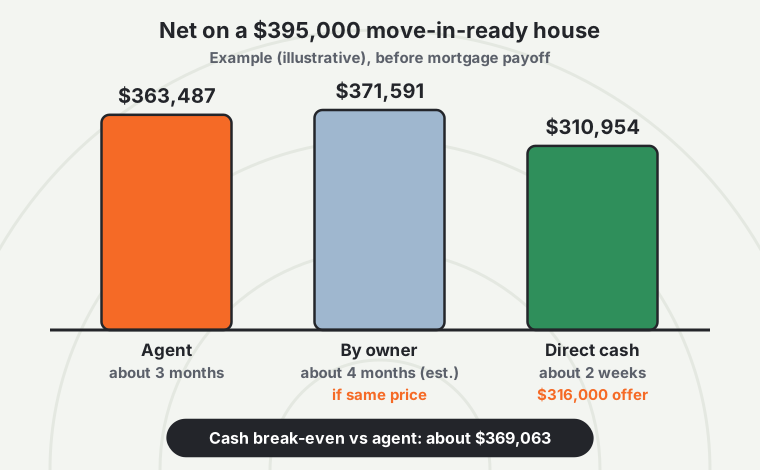
Example (illustrative). The inputs: a move-in-ready single-family house selling for $395,000, the Connecticut median residential price for October 2024 to September 2025. For carrying costs we use Wethersfield, where the overall median was also $395,000: at 39.98 mills (fiscal 2027) on a 70% assessment, property tax is about $921 a month. We add $450 a month for insurance and utilities (est.). The national association data puts the average Connecticut homeowners policy at $2,036 a year, about $170 a month (NAIC, 2023 data). Mortgage interest is left out, so add yours.
| Line | Agent | By owner (FSBO) | Direct cash sale |
|---|---|---|---|
| Sale price | $395,000 | $395,000 (if it matches the agent’s price) | $316,000 (example offer, about 80%) |
| Commissions | -$19,750 (5% total, est.) | -$9,875 (2.5% to the buyer’s agent, est.) | $0 |
| Flat-fee MLS listing | $0 | -$400 (est.) | $0 |
| Conveyance tax, 1% | -$3,950 | -$3,950 | -$3,160 |
| Your attorney | -$1,200 (est.) | -$1,200 (est.) | -$1,200 (est.) |
| Prep and cleaning | -$2,500 (est.) | -$2,500 (est.) | $0 |
| Carrying costs at $1,371 a month | -$4,113 (3 months) | -$5,484 (4 months, est.) | -$686 (half a month) |
| Net before mortgage payoff | $363,487 | $371,591 | $310,954 |
| Time to cash in hand | About 3 months | About 4 months (est.) | About 2 weeks |
Three things stand out once the lines are side by side.
- FSBO’s edge is real but thin. It saves about $8,100 over the agent route here. That saving disappears if the house sells for about $386,600 or less, only about 2% below the agent’s price. A slightly wrong asking price or a weaker negotiation erases it.
- Listing beats cash by about $52,500 on this house. For a cash offer to match the agent’s net, it would have to reach about $369,063, roughly 93% of full price. Buyers who renovate and resell rarely pay that for a house that needs nothing, and we are no exception.
Try it with your own price, town and mortgage payoff:
How much would you walk away with?
Slide the numbers to match your house. It works in your browser; nothing is saved or sent.
Estimates for planning. Conveyance tax per CGS 12-494 (state 0.75% up to $800,000, 1.25% to $2.5M, 2.25% above, plus the town rate). Seller attorney about $1,200 to $1,500; flat-fee MLS about $400; listings include three months of taxes, insurance and utilities, a cash sale about two weeks. Your attorney gives you the final numbers.
Our guide to the cost of selling a house in Connecticut explains each line in more detail, and the commission guide covers how to negotiate the agent’s fee.
How does the math change if the house needs $30,000 of work?
If the house needs $30,000 of work, the math changes in cost and risk more than in ranking. Repairing first and listing nets about $332,116 with an agent and $340,220 by owner in our example, against about $281,254 for a direct cash sale. The open-market routes still lead, but only if you can pay $30,000 up front and wait an extra month.

Example (illustrative). Same house, but the roof and the kitchen are at the end of their life and the work costs $30,000 (est.). On the open-market routes we subtract the $30,000 and one more month of carrying costs ($1,371) for the contractor. On the cash route, the example offer drops by the same $30,000, to $286,000, because the buyer now pays for the work.
| Route | Net before mortgage payoff | Cash you need up front | Time |
|---|---|---|---|
| Repair, then list with an agent | $332,116 | $30,000 plus prep | About 4 months |
| Repair, then sell by owner | $340,220 | $30,000 plus prep | About 5 months (est.) |
| Direct cash sale, as-is | $281,254 | $0 | About 2 weeks |
On paper the ranking holds, so why do so many sellers of houses that need work choose a direct sale anyway? Because the table hides three real-world problems:
- The $30,000 has to come from somewhere. Many sellers do not have it, or would put it on a credit line.
- Repair bids grow. Old houses hide wiring, plumbing and rot behind walls. A $30,000 plan can become $45,000.
- Some problems stop financed buyers outright. An as-is listing to buyers who want a project, explained in our as-is selling guide, is the middle road. An appraiser or an FHA or VA lender can flag a failing roof, peeling paint on an older house or a heating system that does not run. Our guide to selling a house that needs repairs in Connecticut covers which ones.
How do time and the risk of a failed sale compare across the three routes?
Time and the risk of a failed sale compare like this across the three routes: a direct cash sale closes in about two weeks with no lender or appraisal to fail; an agent sale takes about three months in Connecticut and can fall apart over financing, appraisal or inspection; a by-owner sale has the same risks as an agent sale, usually takes longer and leaves you to manage them.
An agent-assisted sale in Connecticut usually runs:
- Prep, 2 to 4 weeks (est.). Cleaning, small repairs, photos.
- On the market, a median of 41 days in September 2026 (Realtor.com via FRED). It was 28 days in May and 61 in January, so the season matters. Our best time to sell guide has the monthly pattern.
- Contract to closing, 30 to 45 days (est.) with a mortgage buyer: inspection, appraisal, loan approval, title.
A by-owner sale follows the same steps, but you do the marketing and handle every call. National data shows FSBO sales are rare (5% in NAR’s 2025 profile), and many of those were sales to someone the seller already knew. We use four months as an estimate.
A direct cash sale skips the market and the lender. You get an offer, sign a contract your attorney has read, and the attorneys close in about two weeks, or on a later date you choose. Our guide to how long it takes to sell a house in Connecticut breaks every route down by week.
Risk is the part most comparisons leave out. A financed buyer can walk away if the loan is denied or the appraisal comes in low, usually through the mortgage contingency in the contract. Each failed contract restarts the clock. A cash buyer can also back out, so the protection is a written contract, a deposit held by an attorney, and proof of funds you have actually seen. Our guide to comparing offers in Connecticut shows how to put a value on “likely to close.”
Which route fits your situation?
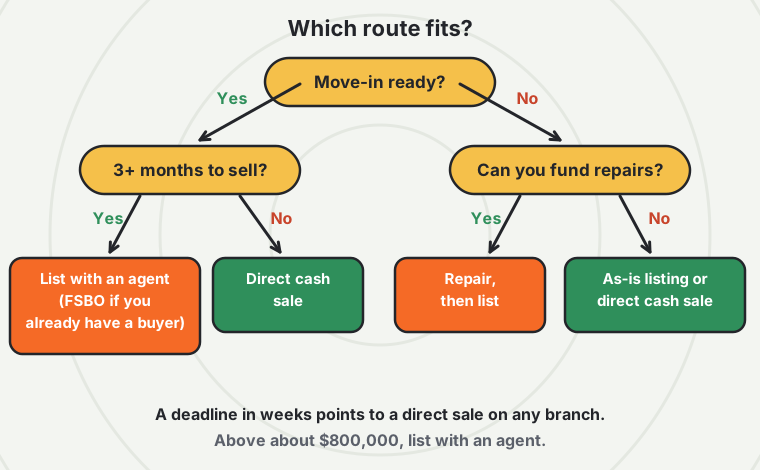
Which route fits your situation depends on four things: the condition of the house, how much time you have, whether you can pay for work up front, and how much of the selling work you want to do. The table below matches common Connecticut seller situations to the route that usually fits best, including the ones where we would tell you not to call us.
| Your situation | Usually fits best | Why |
|---|---|---|
| Move-in ready, 3 months or more, you want the top price | Agent | Widest pool of financed buyers; nets about $52,500 more than cash in our example |
| You already have a buyer (a tenant, a neighbor, family) | By owner, with an attorney | No marketing needed; the attorney handles contract and closing |
| Move-in ready, hot season, you have time and like to negotiate | By owner or a flat-fee MLS listing | Saves the listing side; only works if you price it right |
| Needs work, and you have the cash and the time | Repair, then list | Highest net if the bids hold |
| Needs work you cannot or will not fund | As-is listing or a direct cash sale | No money up front; compare both nets |
| A deadline in weeks: relocation, a purchase, Law Day | Direct cash sale | Fixed date, no lender; see the help-first note below |
| Inherited house, heirs out of state, full of belongings | Depends on condition; often direct | No cleanout, no showings, one closing date for the family |
| Tenants in place who will not cooperate with showings | Direct cash sale or an investor-focused listing | Most owner-occupant buyers need the house empty |
| Price above about $800,000 | Agent, almost always | Few cash buyers at that price; the state tax rises to 1.25% above $800,000 either way |
Still unsure? This short self-check asks the same questions and tells you which way your answers lean:
Is a cash sale right for you, or should you list?
Seven quick questions. There is no wrong answer, and we will tell you honestly if listing would leave you more.
- Does the house need repairs you would rather not pay for or manage?
- Do you need to close by a certain date, or within the next month or two?
- Would showings be hard: tenants, belongings, privacy, or you live out of state?
- Is there a complication: an estate or probate, a divorce, foreclosure, liens or back taxes?
- Could you comfortably cover the mortgage, taxes and utilities for three or more months?
- Is getting the highest possible price more important to you than speed and certainty?
- Would a buyer's bank lend on the house as it is (no major roof, foundation, oil tank or code issues)?
When does selling by owner make sense in Connecticut?
Selling by owner makes sense in Connecticut when the house is easy to finance and priced from recent nearby sales, you already have a buyer or a strong market, you have time to answer calls and run showings, and you hire a Connecticut attorney for the contract and closing. If one of those is missing, the small saving can turn into a loss.
The biggest FSBO risk in our example is price, not paperwork. A 2% pricing mistake wipes out the saving. The second is the buyer’s agent: since the national settlement changes of August 17, 2024, buyers sign their own agreement with their agent, and most offers will still ask you to pay part or all of that fee. Budget for it.
Connecticut makes FSBO easier than many states in one way: the attorney you must hire anyway for the closing can also draft the contract and walk you through the disclosures. Our full guide to selling a house without a realtor in Connecticut covers the 10 steps, the forms and pricing from comparable sales. We do not repeat them here.
When is an agent worth the commission?
An agent is worth the commission when their pricing, marketing and negotiating bring in more than the fee costs, which is most likely on a move-in-ready house that financed buyers compete for, on a higher-priced home, and for a seller who does not have the time or stomach to manage showings, inspections and a buyer’s lender.
The commission is negotiable by law. Every Connecticut listing agreement must state that the rate “is not fixed by law” (CGS 20-325b). In our example, each half point is about $1,975. A good agent can also hold a deal together when an inspection report or a low appraisal threatens it, which is the risk the net table cannot show.
When does a direct sale to a cash buyer make sense?
A direct sale to a cash buyer makes sense when the certainty, speed and lack of work are worth more to you than the price difference: the house needs repairs you cannot fund, it is vacant and costing you every month, there are tenants or belongings inside, or you need a fixed closing date in weeks rather than months.
What a direct sale removes, in plain terms: no repairs, no cleaning, no showings, no commission, no lender, no appraisal, and you can leave behind what you do not want. You pick the closing date. What it costs you is the price. Our cash buyer vs. realtor page runs that trade-off on a $300,000 Hartford house that needs $15,000 of work, and our page on the ways we buy houses explains the other structures we can offer when a straight cash price is too low for you.
If you are thinking about a cash sale, check the buyer first. A real buyer shows proof of funds, closes through Connecticut attorneys in its own name, never charges you a fee and never asks you to sign over your deed outside a closing. Our checklist for vetting a cash home buyer lists eight checks.
Talk to a HUD-approved housing counselor and look at Connecticut’s free Foreclosure Mediation Program before you sell to anyone. Selling may still be the right move, and it can protect your equity, but you should know every option first. Our Connecticut foreclosure guide explains mediation and Law Day.
When should you NOT sell to a cash buyer?
You should not sell to a cash buyer when your house is move-in ready, you have a few months, and you do not need a fixed date: in our $395,000 example, listing nets about $52,500 more. You should also walk away from any cash buyer who rushes you, charges a fee, will not show proof of funds or will not use a Connecticut attorney.
We tell sellers this on the phone. If the house would sell quickly to a buyer with a mortgage and you have time, list it. A cash offer is a tool for the houses and situations where the open market is slow, costly or uncertain, not a shortcut that pays more.

The sellers who end up happiest are the ones who had two real numbers in front of them before they decided: an agent’s written net sheet and a written cash offer. Get both. If the gap is big and you have time, list. If the gap is small or the deadline is real, the decision usually makes itself.
How do you compare all three routes for your own house, step by step?
To compare all three routes for your own house, get a realistic sale price from recent nearby sales, work out the net for each route with the same costs, get at least one written cash offer, find your break-even number, and then weigh time and risk. It takes about a week and costs nothing.
Find your likely sale price
Pull three to six sales from the last three to six months within about a mile, matched on style, size and condition. Your town page and an agent’s market analysis both help. Be honest about condition.
Write a net for each route
Use the same table as above: price, commissions, conveyance tax (1% in most towns), attorney, prep, and carrying costs at your town’s mill rate. The calculator above does this.
Get one or two written cash offers
Ask each buyer to put the price, the closing date, the deposit and any inspection period in writing. No fee, no pressure, and no deadline you cannot meet.
Find your break-even
Add your attorney and a half month of carrying costs to the agent’s net, then divide by 0.99. In our example that is about $369,063. A cash offer below that costs you money; the question is whether the time and certainty are worth the gap.
Have your attorney read the contract you choose
On any route, a Connecticut attorney runs the closing (CGS 51-88a). Have them read the contract before you sign, especially any inspection period, deposit terms and an “and/or assigns” clause.
If you want our number to compare, we can give you an offer from photos and a short call, usually within a day or two, and you can take as long as you like to decide. To get it, or to read how a direct sale works in your area, start from our Wethersfield page or any town page linked below.
See the house together.
Pick a time that works.
Choose a time for us to walk through the property with you, or ask for a quick call first. We confirm every request personally.
Tuesday, January 13
No open times in the next few weeks. Please call us.
We will confirm by email. Nothing is booked until we do.
View my requestQuestions about FSBO, agents and cash buyers in Connecticut
Is it better to sell FSBO, with an agent or to a cash buyer in Connecticut?
Whether it is better to sell FSBO, with an agent or to a cash buyer in Connecticut depends on condition and time. On a move-in-ready house with a few months, an agent or a well-priced FSBO nets the most. On a house that needs work you cannot fund, or with a deadline in weeks, a direct cash sale often fits better despite the lower price.
How much do you save selling by owner in Connecticut?
Selling by owner in Connecticut saves the listing side of the commission, about $9,875 on a $395,000 house at 2.5% (est.), minus a flat-fee MLS listing of about $400. In our example the FSBO net is about $8,100 higher than the agent net, but only if the house sells for the same price.
Do I still pay a buyer’s agent if I sell by owner?
You usually still pay a buyer’s agent if you sell by owner, because most buyers have one and their offer can ask you to cover the fee. Since August 17, 2024, buyers sign their own written agreement with their agent, and whether you pay is a term you negotiate in the offer.
Do I need a lawyer to sell my house in Connecticut without an agent?
Yes, you need a lawyer to sell your house in Connecticut without an agent, because state law says only a Connecticut attorney may conduct a real estate closing (CGS 51-88a). Your attorney can also draft or review the contract, which is the main job an agent’s form would otherwise do.
How much less does a cash buyer pay than the market price?
How much less a cash buyer pays depends on repairs, holding costs and resale costs, but on a move-in-ready house the gap is large: in our example a cash offer would need to reach about 93% of full price to match the agent’s net. Our page on why cash offers are lower shows the formula buyers use.
How long does each route take in Connecticut?
Each route in Connecticut takes roughly: a direct cash sale about two weeks, an agent sale about three months (a median 41 days on market in September 2026 plus 30 to 45 days to close with a mortgage), and a by-owner sale often longer, about four months in our estimate.
Do I pay conveyance tax if I sell to a cash buyer?
Yes, you pay conveyance tax if you sell to a cash buyer in Connecticut, just as on any sale: 0.75% state plus 0.25% town in most towns, on the actual price (CGS 12-494). Because a cash price is lower, the dollar amount is lower too.
Do I have to give a cash buyer the property condition report?
Yes, you have to give a cash buyer the property condition report in Connecticut, or credit $500 at closing. There is no cash-sale exemption in CGS 20-327b; executors, administrators, trustees and conservators are among the sellers who are exempt.
What is the break-even cash offer for my house?
The break-even cash offer for your house is the price at which a cash sale nets the same as listing. Take the agent’s net, add your attorney and a half month of carrying costs, and divide by 0.99 (for 1% conveyance tax). On a $395,000 house in our example it is about $369,063.
Is a direct sale the same as selling to a wholesaler?
A direct sale is not the same as selling to a wholesaler. In a direct sale the buyer closes and takes title itself. A wholesaler signs a contract and sells or assigns it to another buyer; in Connecticut that is regulated since July 1, 2026 (CGS 20-329aaa and following).
Related Connecticut guides
The direct-sale series
Choosing a route
We buy houses across the state, including Wethersfield, Waterford, Southington, Berlin, Avon and Hartford. For the whole process from first step to closing, see how to sell a house in Connecticut.
Plain-English information, not legal or tax advice. The worked examples use public data and labelled estimates; your numbers will differ. Talk to a Connecticut real estate attorney before you sign any contract.
Sources (checked on October 27, 2026)
- Connecticut OPM, Real Estate Sales (data.ct.gov dataset 5mzw-sjtu): residential sales recorded October 2024 to September 2025, median $395,000 (42,459 sales).
- Realtor.com Housing Inventory: Median Days on Market in Connecticut (FRED series MEDDAYONMARCT).
- National Association of Realtors, 2025 Profile of Home Buyers and Sellers (FSBO 5%, agent-assisted 91%).
- National Association of Realtors, settlement FAQs (practice changes effective August 17, 2024).
- CGS § 51-88a (real estate closings by Connecticut attorneys only).
- CGS § 52-550 (agreements for the sale of real property must be in writing).
- CGS §§ 20-325b, 20-327b, 20-327c (commission notice; property condition report; $500 credit).
- CGS § 29-453 (smoke and carbon monoxide affidavit).
- CGS § 12-494 (conveyance tax rates).
- CGS §§ 20-329aaa to 20-329hhh (real estate wholesalers, effective July 1, 2026).
- EPA and HUD lead-based paint disclosure rule (homes built before 1978).
- Connecticut OPM mill rates (Wethersfield, fiscal 2027).
- NAIC Homeowners Insurance Report, 2023 data (Connecticut average HO-3 premium $2,036).
- Connecticut Judicial Branch, Foreclosure Mediation Program.

Who wrote this
Jerryll Noorden
Jerryll has bought and sold Connecticut houses since 2016 and has sat at more closing tables than he can count, on both sides. Before real estate he was a robotics scientist at NASA, IHMC and IIT. He wrote this guide because the national sites that rank for it skip the Connecticut rules that cost sellers money. When listing or selling it yourself would get you more than a cash offer, he says so.
This guide explains Connecticut rules in plain English. It is not legal or tax advice. Laws change; for your sale, talk to a Connecticut real estate attorney and a tax professional.
