
- No Connecticut law stops you from selling a house with a working underground oil tank, and the state does not set a deadline to remove one. But buyers, lenders and insurers push hard for removal, and a leak must be reported and cleaned up.
- Residential heating oil tanks serving four units or fewer are not regulated by DEEP; your town (building department or fire marshal) and the market set the rules. Keep the removal letter and soil test: DEEP does not issue closure letters for homes.
- Connecticut does not require a septic inspection, a well test or a radon test when you sell. Buyers order them anyway, and their lender usually requires a well water test.
- If you have a well, you must tell the buyer that private well testing information is on the Department of Public Health website (CGS 19a-37(d)).
- Radon is common: the Department of Public Health says about 1 in 4 Connecticut homes have elevated levels. Mitigation typically costs $800 to $2,500.
- Disclose what you know on the property condition report and attach your records. A thin file costs more at the negotiating table than a known, priced problem.
Why do oil tanks, septic, wells and radon matter when you sell a Connecticut house?
Oil tanks, septic systems, private wells and radon matter when you sell a Connecticut house because they are the four things buyers’ inspectors test most often, the state’s property condition report asks about every one of them, and each can stall a mortgage or reopen the price. They are also unusually common here: oil is still the leading heating fuel in many Connecticut towns, and a large share of homes outside the cities run on wells and septic.
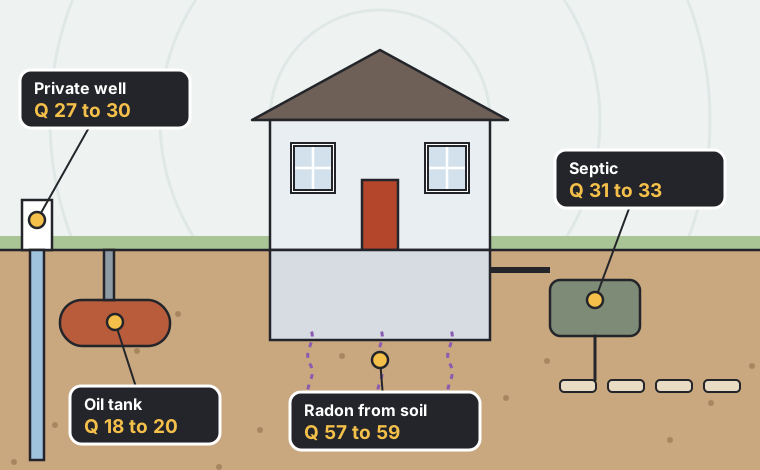
They are one chapter of our guide on how to sell a house in Connecticut, and the one most likely to stall a deal. Look at our town data. In Ledyard 86% of single-family homes list oil heat; in Bethany 83%; in Newtown and Southbury 81%; in Haddam 78%. Many of those same towns rely on private wells and septic. Even in cities, older homes may have an abandoned tank in the yard from before the switch to gas.
The good news is that each of these is a known problem with a known price. This guide explains what Connecticut law says, what buyers and lenders expect, what each fix costs (est.), and when it makes sense to fix, credit or sell as-is.
Which tests will your buyer order?
| Your property | Oil tank | Septic | Well water | Radon | Typical towns (examples) |
|---|---|---|---|---|---|
| City house, public water and sewer, gas heat | Tank sweep if built before about 1970 or the heat was converted | Not needed | Not needed | Air test | West Hartford, Bridgeport, New Haven |
| Suburban house, public water and sewer, oil heat | Confirm tank location; sweep the yard if the tank is in the basement but a fill pipe is outside | Not needed | Not needed | Air test | Bristol, Enfield, Norwalk |
| Rural or exurban house, well and septic, oil heat | Confirm tank type and age; sweep for an old buried tank | Septic inspection, often with pumping | Potability test (lender), often extended panel; flow test | Air test; water test if air is high | Killingworth, Haddam, Easton, Oxford |
| Shoreline house, septic, public or well water | As above | Septic inspection; small lots and high groundwater get extra scrutiny | If on a well: potability and salt (sodium, chloride) | Air test | Guilford, Madison, Old Saybrook, Westbrook |
| Condo unit | Rare (association’s tanks) | Association’s system, if any | Association’s system, if any | Air test in ground-floor units | Any town |
| Any house built before 1978 | Add the federal lead paint disclosure; the buyer has up to 10 days to test for lead unless they waive it | About 4 in 5 homes in New Haven, West Hartford and New Britain predate 1960 | |||
Can you sell a house with an underground oil tank in Connecticut?
Yes, you can sell a house with an underground oil tank in Connecticut. There is no state or town law that prohibits selling a home with a working underground fuel tank, and the state does not require residential tanks to be removed by any date. In practice, buyers, their lenders and their insurers often want the tank removed or tested before closing, so most sellers deal with it before or during the sale.
The Town of Granby puts it simply on its building department FAQ: there are no town or state laws against selling with a working underground tank, but “many of the issues dealing with underground tanks are driven by the marketplace and mortgage industry”, and most people remove the tank before the sale.
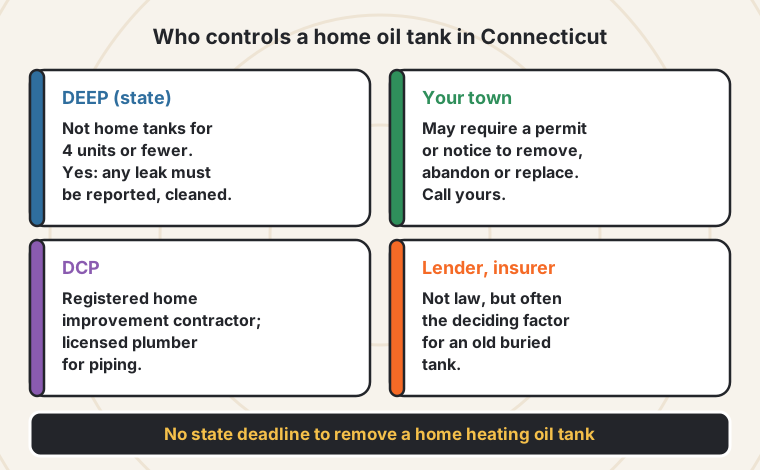
Who regulates a home heating oil tank in Connecticut
| Who | What they control |
|---|---|
| Department of Energy and Environmental Protection (DEEP) | Does not regulate the installation, use or removal of residential heating oil tanks serving four or fewer units. Does regulate tanks serving five or more units. Does regulate any contamination: leaks must be reported and cleaned up. |
| Your town (building department and/or fire marshal) | May require a permit or notice to remove, abandon or replace a tank. Rules differ: Granby’s building department requires a permit to remove an underground tank; Ellington notes that one- and two-family homes are outside the State Fire Prevention Code’s tank rules but its building department may still be involved. Call yours. |
| Department of Consumer Protection (DCP) | The contractor must be a registered home improvement contractor; any piping work needs a licensed plumber. |
| The buyer’s lender and insurer | Not law, but often the deciding factor. Many will not finance or insure a house with an old buried tank without proof it has not leaked. |
A leaking tank must be emptied and removed promptly, the leak reported to DEEP’s Emergency Response and Spill Prevention Division, and the pollution cleaned up, including any that reached a neighbor’s property. There is no DEEP funding for residential tank cleanups, and DEEP does not issue “closure letters” for them. A contractor’s letter report with the soil test results is what buyers and lenders accept.
Should you remove an underground oil tank before selling?
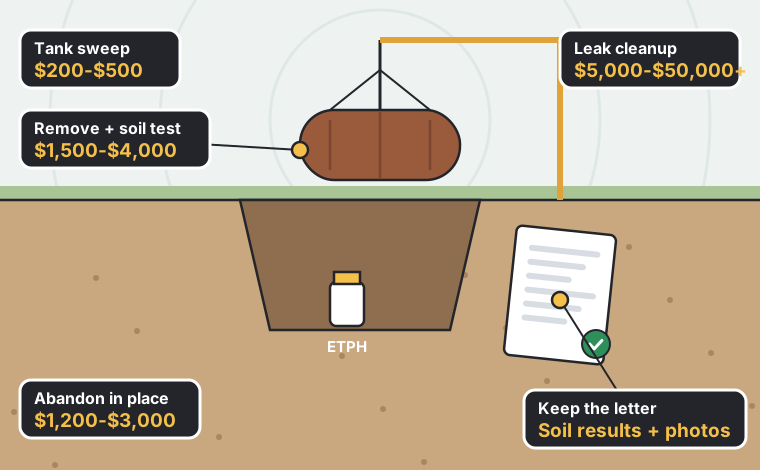
You should usually remove an underground oil tank before selling in Connecticut if it is old or out of service, because buyers, lenders and insurers price a buried tank as an unknown risk. Removal with a soil test typically costs about $1,500 to $4,000 when there is no leak (est.). If the tank is under a deck or addition, a permitted abandonment in place with a clean soil sample is the alternative. If you cannot or will not, disclose it and price it in.
What a clean removal looks like on paper
- A registered home improvement contractor does the work
- Town permit or fire marshal notice, if your town requires one
- Soil samples from under the tank and piping, tested for extractable total petroleum hydrocarbons (ETPH) at a Connecticut-certified lab
- Photos of the tank and the open excavation
- A short letter report from the contractor with the date, tank size, condition and the lab results
- A copy kept with your house records and attached to your disclosure report (question 20)
DEEP discourages abandoning a tank in place (filling it with sand or foam) unless removal is impractical, such as under a deck, patio or addition, or where digging would endanger the foundation. If you abandon it, take a soil sample first; if the sample is contaminated, do not fill the tank, and report the leak.
Tank costs (est.)
| Item | Typical cost in Connecticut (est.) | Fix, credit or skip? |
|---|---|---|
| Tank sweep (metal detector or ground-penetrating radar) to find a suspected buried tank | $200 – $500 | Do it if records are unclear and the house is older |
| Remove a residential underground tank, no leak, with soil test | $1,500 – $4,000 | Usually fix before listing |
| Abandon in place with soil test (where removal is impractical) | $1,200 – $3,000 | Fix if removal is not possible |
| Replace with an indoor above-ground tank | $2,500 – $6,000 | Needed if the house still heats with oil |
| Clean up soil contamination from a leak | $5,000 – $50,000+ | Depends on spread; get a scope before you decide |
| Older above-ground tank showing rust, weeping or a missing vent alarm | $2,500 – $5,000 to replace | Fix or credit; insurers ask about tank age |
Above-ground tanks are a question too
Most Connecticut oil homes have a basement tank. Buyers’ inspectors check its age (often stamped on the tank), rust, wet spots on the bottom, the vent alarm and the fill and vent pipes. Some insurers ask the tank’s age when writing a new policy. A 30-year-old tank with a weeping seam is cheap to replace compared with a basement oil spill. And remember the Connecticut custom: the buyer reimburses you for the oil left in the tank at closing, so get a reading from your oil company.
Do you need a septic inspection to sell a house in Connecticut?
No, you do not need a septic inspection to sell a house in Connecticut: no state law requires one at sale, and the state does not certify septic inspectors. But buyers almost always order one when the house is on septic, often with the tank pumped and the distribution box opened, and a failing system will reopen the price or end the deal. Your pumping records and the town health file are your best tools.
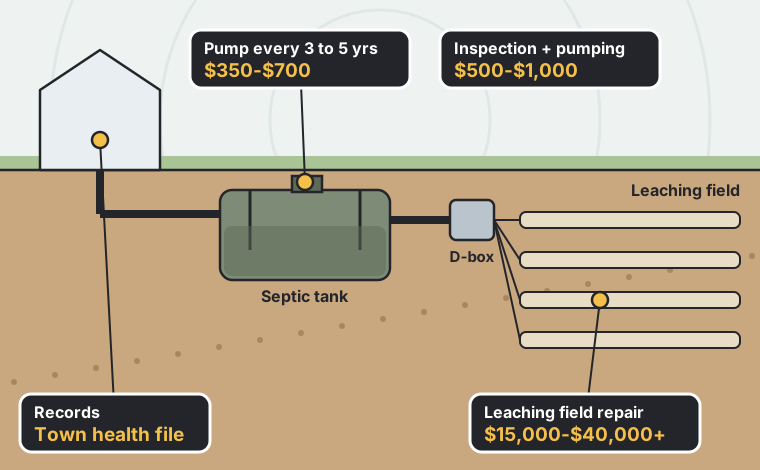
Septic systems in Connecticut are permitted and inspected by local health departments and health districts under the state Public Health Code; the Department of Public Health says it regulates roughly 95% of septic systems that way, with DEEP handling the largest ones. That means the history of your system (permits, repairs, the as-built drawing) sits in your town or district’s file.
What a buyer’s septic inspection looks at
- The tank: pumped, opened, checked for cracks, baffles and the liquid level
- The distribution box and the leaching field: signs of ponding, saturation, odor or wet spots
- Records: age of the system, last pumping, any repairs, the health department file
- Sometimes a dye or hydraulic load test; the DPH warns that none of these tests can guarantee future performance
What to do before you list
Find your records
Pumping receipts and the service company name. The property condition report asks for both (question 33).
Visit the health department
Ask the town sanitarian or health district to pull the file: the permit, the as-built drawing, any repair permits and the number of bedrooms the system was designed for. Buyers’ attorneys check bedroom counts against the design.
Pump if it is due
DPH suggests buyers ask whether the tank was pumped every 3 to 5 years. A recent pumping receipt answers that, and pumping lets you see the tank.
Consider a pre-listing inspection
If the system is old or you have seen wet spots, know before the buyer does. A failing field is a five-figure repair; knowing early lets you fix it, credit it or price it in.
| Septic item | Typical cost in Connecticut (est.) | Fix, credit or skip? |
|---|---|---|
| Pumping (1,000 to 1,500 gallon tank) | $350 – $700 | Do it if more than 3 years since the last one |
| Septic inspection with pumping | $500 – $1,000 | Worth it on older systems |
| Replace a cracked tank cover, baffle or distribution box | $300 – $2,500 | Fix: small cost, big reassurance |
| Repair or replace the leaching field | $15,000 – $40,000+ | Credit or price in; get a designer’s estimate first |
| Full system replacement on a difficult lot | $30,000 – $60,000+ | Usually credit, or sell as-is |
If a buyer’s inspection finds a failing system, the usual Connecticut outcome is a price reduction or a credit based on a designer’s or installer’s estimate, rather than the seller rushing a repair before closing. Repairs need a permit from the health department and a designed system, which takes time.
Do you have to test your well when you sell a house in Connecticut?
No, you do not have to test your well when you sell a house in Connecticut. State law does not require a well test at sale. You must, however, tell the buyer before the sale that private well testing information is on the Department of Public Health website (CGS 19a-37(d)), and in practice the buyer’s mortgage lender usually requires a water test before closing.
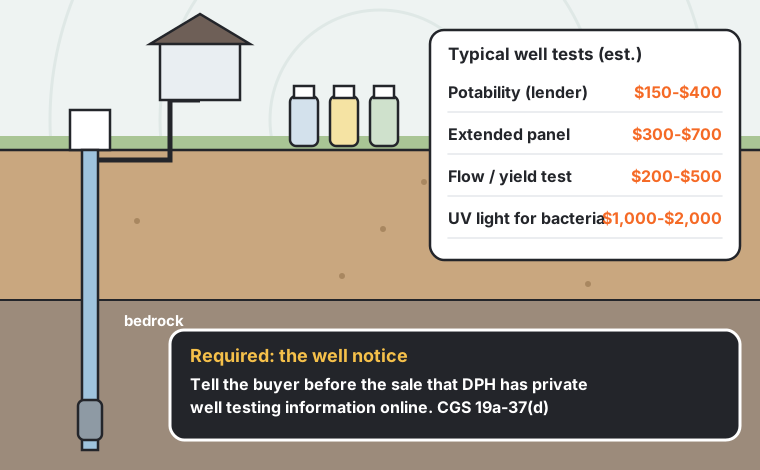
The notice is simple: a written statement in the contract, or a printed DPH fact sheet handed to the buyer, satisfies it. If the buyer has an agent, the agent hands over the DPH material; if not, you, your attorney or the closing attorney do. Failing to give the notice does not void the sale, but there is no reason to skip it.
What gets tested
- Lender potability test. Usually bacteria (coliform) and basic chemistry such as nitrate, nitrite, sodium, chloride, iron, manganese, hardness and pH.
- What DPH recommends adding. Arsenic, uranium and radon occur naturally in some Connecticut groundwater; DPH recommends testing for them at least once and ideally every five years. Since October 1, 2022, new wells must be tested for arsenic and uranium among other things; existing wells are not, unless the local health director has reason to suspect contamination (CGS 19a-37).
- Flow test. How many gallons per minute the well delivers over a few hours. Low yield worries buyers with big families.
- Shoreline extras. Sodium and chloride from road salt or salt water.
| Well item | Typical cost in Connecticut (est.) | Fix, credit or skip? |
|---|---|---|
| Standard potability test | $150 – $400 | Test before listing if your last test is old |
| Extended panel (arsenic, uranium, VOCs, radon in water) | $300 – $700 | Worth it in towns with known bedrock issues |
| Flow / yield test | $200 – $500 | Buyer usually orders |
| UV light for bacteria | $1,000 – $2,000 | Fix or credit |
| Arsenic or uranium treatment | $1,500 – $5,000 | Credit is common |
| Radon in water aeration system | $3,000 – $8,000 | Credit is common |
| New well pump or pressure tank | $1,000 – $3,500 | Fix if failing |
Bacteria is often fixed by shocking the well and retesting, or with a UV light. Arsenic, uranium and radon need treatment equipment, which is a known cost a buyer can price. What hurts sales is a test result that appears for the first time three days before closing. Testing first gives you time.
Do you need a radon test to sell a house in Connecticut?
No, you do not need a radon test to sell a house in Connecticut: no state law requires radon testing or mitigation in home sales. But the Department of Public Health estimates about 1 in 4 Connecticut homes have elevated radon, most buyers test during their inspection, and the property condition report asks whether a test has been done and whether a radon system is in place now or was in the last 12 months.
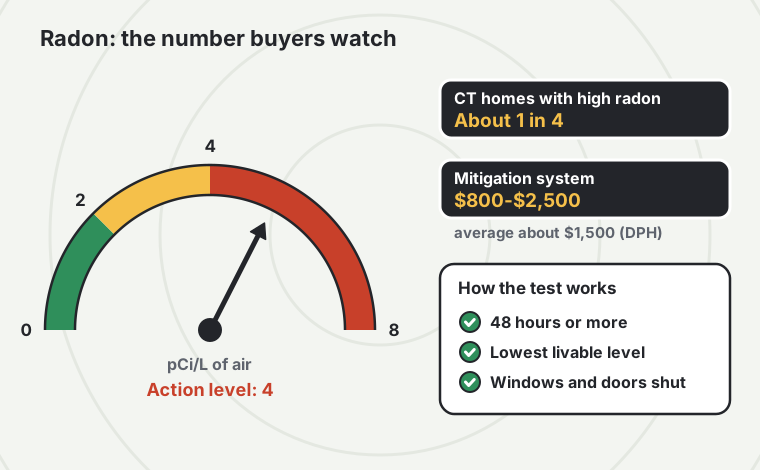
Radon is a radioactive gas from soil and rock. The action level used by DPH and the U.S. Environmental Protection Agency is 4 picocuries per liter (pCi/L) of air; EPA also suggests considering a fix between 2 and 4. Two neighboring houses can have very different levels, so the town average tells you little about your house.
How radon testing works in a sale
- The buyer’s inspector usually places a continuous monitor or two short-term canisters for at least 48 hours in the lowest livable level, with windows and outside doors closed.
- Do not open windows or run fans “to help”. Tampering is easy to spot on a continuous monitor and destroys trust.
- If the result is 4 pCi/L or higher, expect a request for mitigation or a credit. If the house has a well and air radon is high, DPH recommends testing the water too; its guideline for water is 5,000 pCi/L.
Radon costs
| Item | Typical cost | Fix, credit or skip? |
|---|---|---|
| Do-it-yourself short-term test kit | $15 – $40 (est.) | Cheap way to know first; test in winter if you can |
| Professional test (continuous monitor) | $150 – $300 (est.) | Buyer usually orders |
| Sub-slab depressurization (mitigation) system | $800 – $2,500, average about $1,500 (DPH) | Fix: often cheaper than the credit a buyer asks for |
| Radon in water treatment | $3,000 – $8,000 (est.) | Fix or credit |
If you already have a mitigation system, include the installer’s paperwork and a post-mitigation test with your disclosure (questions 57 to 59). A working fan and a recent low test turn radon from an objection into a non-issue.
What do you have to disclose about oil tanks, septic, wells and radon?
In Connecticut you have to disclose what you know about oil tanks, septic, wells and radon on the Residential Property Condition Report: any underground tank and its age and location, any tank removed while you owned the house with the removal paperwork, your water and sewage systems and any problems, your last septic pumping, well test results, and radon tests and systems. You do not have to test, but you must attach reports you have.
| Topic | Report questions | What to attach |
|---|---|---|
| Fuel type and heating problems | 16 | Recent service record helps |
| Underground tank now; problems; removed during your ownership | 18, 19, 20 | Removal letter, soil (ETPH) results, permit |
| Water system type, charges, well test, water problems | 27 to 30 | Most recent well water test |
| Sewage type, sewer charges, septic service company, last pumping, problems | 31 to 33 | Pumping receipts, inspection reports |
| Radon test; radon system now; radon system in previous 12 months | 57 to 59 | Test report; mitigation invoice and post-mitigation test |
A missing report costs a $500 credit at closing (CGS 20-327c), and that credit does not excuse you from disclosing a known defect that significantly affects value, health or safety. Our guide to the Connecticut property condition disclosure explains each section.
Should you fix these problems, give a credit, or sell as-is?
Whether you should fix these problems, give a credit, or sell as-is depends on cost and certainty. Small, cheap items that make lenders nervous (an old buried tank with no leak, a radon level just over 4, a due septic pumping, a bacteria hit on a well) are usually worth fixing before listing. Big, uncertain items (contamination, a failed leaching field) are usually better handled with a credit or an as-is price, because the buyer will discount them anyway.
Fix before listing
- Old underground tank, no known leak
- Radon between 4 and about 10 pCi/L
- Septic pumping overdue; broken cover or baffle
- Bacteria in well water
- Missing paperwork you can get
Credit or price in
- Leaching field near the end of its life
- Arsenic, uranium or radon in water
- Above-ground tank near end of life
- Low well yield
Consider selling as-is
- A confirmed tank leak with unknown spread
- A failed septic on a difficult lot
- Several of these at once, plus other repairs
- No time or money to manage contractors
When in doubt, compare the net. A cash buyer will price these items into the offer; a retail buyer will ask for credits after the inspection. If the total repair bill is small, listing almost always wins. If it is large or uncertain, an as-is sale can come out close once you count commission, carrying costs and the risk of a buyer walking. Our cash buyer vs. realtor comparison lays the two routes side by side, and our guide on what to fix before selling in Connecticut covers the rest of the house.
What should you do in the 30 days before you list?
In the 30 days before you list a Connecticut house with oil, septic or a well, gather your records, confirm whether there is or was a buried tank, pump the septic if it is due, test the well and the radon level, fix the cheap problems, and fill in the property condition report with everything attached. That way the buyer’s inspection confirms what you already told them.
Week 1: records
Pull oil delivery and service records, any tank removal letter, septic pumping receipts, old well tests and radon tests. Visit the health department for the septic and well file.
Week 1: the tank question
If you have oil heat and the house is older, confirm where the tank is and whether there was ever a buried one. Look for an outside fill pipe or vent that goes nowhere. If unsure, order a tank sweep.
Week 2: tests
Start a radon test (48 hours or more, lowest livable level, house closed up). Take a well water sample to a certified lab. Book a septic pumping and, on an older system, an inspection.
Week 3: quotes
For anything that fails, get two written quotes: tank removal, mitigation, water treatment, septic repair. Quotes are what you will negotiate with if you choose to credit rather than fix.
Week 3 to 4: fix the cheap items
Radon system, septic cover or baffle, UV light, tank removal with soil test. Keep every invoice.
Week 4: disclose
Fill in the property condition report and attach the reports. Prepare the well testing notice if you have a well.

The deals that fall apart over these issues are almost never about the cost. A $2,000 radon system or a $3,000 tank removal does not scare a buyer. What scares them is finding the problem themselves, late, with no paperwork, because then they wonder what else they have not found. Spend a few hundred dollars on tests up front and you control the conversation.
Rather not manage tanks, tests and contractors?
Send us the address and a few photos, including the basement and the tank. We will price what we see and give you a cash number you can compare with fixing and listing. If fixing and listing is clearly better for you, we will tell you.
Get your cash offer
without anyone coming over.
Want your offer faster, or rather not talk to anyone yet? Send a few phone photos of each room. We price the repairs from them, line by line, and send your cash offer back, so you see a real number before you ever meet us or pick up the phone.
 CabinetsFlooring
 Tub & tile
 Floors
 Roof
We may bring in a partner buyer to close. Your price and terms don't change.
Questions about oil tanks, septic, wells and radon
Is it illegal to sell a house with an underground oil tank in Connecticut?
No, it is not illegal to sell a house with an underground oil tank in Connecticut. No state or town law prohibits selling a home with a working underground fuel tank, and the state sets no removal deadline. Buyers, lenders and insurers often insist on removal or testing, and a leaking tank must be removed and cleaned up.
Does DEEP regulate home heating oil tanks?
No, DEEP does not regulate the installation, use or removal of residential heating oil tanks serving four or fewer units. DEEP does regulate contamination: leaks must be reported to DEEP’s spill division and cleaned up. Tanks serving five or more units are regulated.
Do I need a permit to remove an oil tank in Connecticut?
You may need a permit to remove an oil tank in Connecticut, depending on your town. Some building departments, such as Granby’s, require a permit to remove or replace an underground tank; others leave it to the fire marshal. Call your building department and fire marshal before work starts.
How much does it cost to remove an underground oil tank in Connecticut?
Removing an underground oil tank in Connecticut typically costs about $1,500 to $4,000 when there is no leak, including soil testing (est.). If the soil is contaminated, cleanup can cost $5,000 to $50,000 or more depending on how far the oil spread.
Can I get a closure letter from DEEP after removing my tank?
No, you cannot get a closure letter from DEEP after removing a residential tank; DEEP does not issue them for residential cleanups. A contractor’s letter report with soil test results from a Connecticut-certified lab is what buyers and lenders generally accept.
Is a septic inspection required to sell a house in Connecticut?
No, a septic inspection is not required to sell a house in Connecticut. No state law requires one at sale. Buyers almost always order one, so having recent pumping records and your health department file ready helps.
How often should a Connecticut septic tank be pumped?
A Connecticut septic tank should generally be pumped every 3 to 5 years, the interval the Department of Public Health suggests buyers ask about. The property condition report asks for the date of the last pumping and how often you pumped.
Do I have to test my well before selling my house in Connecticut?
No, you do not have to test your well before selling your house in Connecticut. You must give the buyer written notice that private well testing information is on the DPH website (CGS 19a-37(d)). The buyer’s lender usually requires a water test anyway.
What should a Connecticut well test include?
A Connecticut well test should include bacteria and basic chemistry for the lender, and, as the Department of Public Health recommends, arsenic, uranium and radon at least once. Shoreline wells should also be tested for sodium and chloride.
Is radon testing required when selling a house in Connecticut?
No, radon testing is not required when selling a house in Connecticut. No state law requires testing or mitigation. Most buyers test during their inspection, and the property condition report asks whether a test was done and whether a radon system exists now or did in the last 12 months.
What radon level is too high in Connecticut?
A radon level of 4 picocuries per liter or higher is too high in Connecticut by the standard DPH and EPA use. EPA also suggests considering mitigation between 2 and 4. For radon in well water, DPH uses 5,000 pCi/L.
How much does radon mitigation cost in Connecticut?
Radon mitigation in Connecticut typically costs $800 to $2,500, with an average of about $1,500, according to the Department of Public Health. A sub-slab depressurization system with a fan is the most common fix.
Who gets the oil left in the tank at closing?
The buyer gets the oil left in the tank at closing, but by Connecticut custom reimburses the seller for it at the current price per gallon. Get a tank reading or receipt from your oil company before closing.
Can I sell a house with a failed septic system?
Yes, you can sell a house with a failed septic system in Connecticut. Disclose it, get a designer’s estimate, and either credit the buyer, lower the price, or sell as-is. Many financed buyers will need the repair handled or credited before their lender closes.
Will a cash buyer buy a house with an oil tank or septic problem?
Yes, a cash buyer will usually buy a house with an oil tank or septic problem, because there is no lender requiring repairs. The offer will reflect the cost and uncertainty of the fix, so get repair quotes to judge whether the offer is fair.
Related Connecticut guides
Before you list
Disclosures and problems
These four issues are a chapter of the sale, not the whole story. For every step from pricing to closing, read our guide on how to sell a house in Connecticut.
Sources
- Connecticut DEEP, Underground Storage Tanks, and DEEP’s residential heating oil UST FAQ as published by the Town of Rocky Hill (no DEEP regulation of residential tanks serving four or fewer units; leak reporting; soil testing; no closure letters).
- Town of Granby, Building and Zoning FAQ (selling with an underground tank; removal permit) and Town of Ellington Fire Marshal, Underground Storage Tanks.
- CGS § 22a-450 (reporting of spills and discharges).
- Connecticut DPH, Subsurface Sewage Disposal Systems and the DPH Home Buyers Guide to septic systems.
- CGS § 19a-37 (well testing notice at sale; new well testing since October 1, 2022; local health director testing) and DPH Private Well Testing.
- OLR Report 2016-R-0263, Private Residential Wells and OLR Report 2023-R-0200, Waiving a Home Inspection (no state requirement to allow or obtain septic, well or radon tests).
- Connecticut DPH Radon Program (1 in 4 homes elevated; mitigation cost; water guideline) and EPA Radon (4 pCi/L action level).
- DCP Residential Property Condition Report (Revised 07/2025) and CGS §§ 20-327b and 20-327c.
- EPA and HUD Lead-Based Paint Disclosure Rule.
- Town heating fuel and housing age: 2025 parcel CAMA data on data.ct.gov, as shown on our town pages.
See the house together.
Pick a time that works.
Choose a time for us to walk through the property with you, or ask for a quick call first. We confirm every request personally.
Tuesday, January 13
No open times in the next few weeks. Please call us.
We will confirm by email. Nothing is booked until we do.
View my request
Who wrote this
Jerryll Noorden
Jerryll has bought and sold Connecticut houses since 2016 and has sat at more closing tables than he can count, on both sides. Before real estate he was a robotics scientist at NASA, IHMC and IIT. He wrote this guide because the national sites that rank for it skip the Connecticut rules that cost sellers money. When listing or selling it yourself would get you more than a cash offer, he says so.
This guide explains Connecticut rules in plain English. It is not legal or tax advice. Laws change; for your sale, talk to a Connecticut real estate attorney and a tax professional.
