
- Most Connecticut houses that do not sell are priced above recent sales. The fix is the newest closed sales near you, not the asking prices of the houses around you.
- Your showings tell you what is wrong. Few showings point to price, photos or exposure. Showings without offers point to price or condition. Offers that collapse point to financing, inspection or appraisal problems.
- Connecticut houses carry problems that block loans: buried oil tanks, failed septic systems, crumbling foundations, peeling paint on older homes, open permits. Many buyers cannot finance them, which shrinks your pool.
- You are not alone. In September 2026, about one in three Connecticut listings on Realtor.com had a price cut (1,984 of 5,934).
- Waiting has a monthly price. Property tax alone runs about $650 to $1,400 a month on a median house in many Connecticut towns, before insurance, utilities and mortgage interest.
- Three ways out: fix and relist, cut the price to where buyers are, or sell as-is. Which one wins depends on what the house needs and what each month costs you.
A house that will not sell wears on you. Every week brings another showing that goes nowhere, another mortgage payment, another tax bill, and the quiet worry that something is wrong with the house or with you. Usually nothing is wrong with you. There is a reason, it can be found, and it can be fixed or worked around. This guide walks through the Connecticut causes one by one. It is part of our guide on how to sell a house in Connecticut.
Why won’t my house sell in Connecticut?
Your house won’t sell in Connecticut, most often, because the price is above what similar houses near you have recently sold for. The other common causes are condition (repairs buyers or their lenders will not accept), financing problems such as an underground oil tank, a failed septic or a foundation concern, weak photos and listing details, hard showings, and the season. Your showing and offer history usually tells you which one it is.
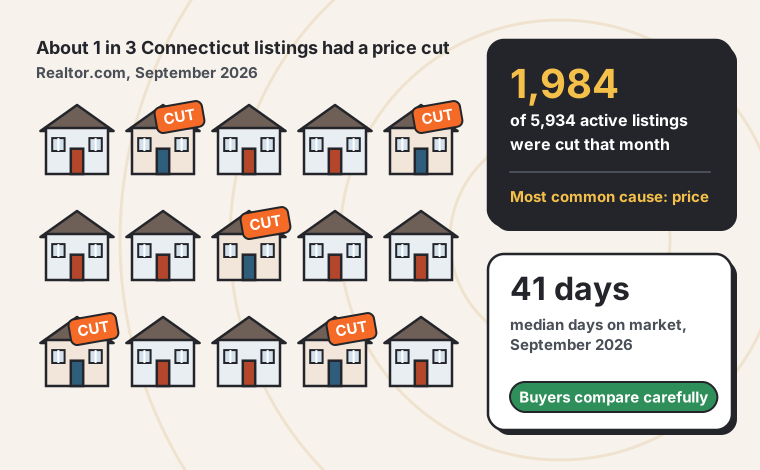
It helps to know the market you are in. Realtor.com’s Connecticut data shows a median of 41 days on market in September 2026, and 1,984 of the state’s 5,934 active listings, about a third, had a price reduction that month. Houses are selling, but the buyers who are out there are comparing carefully.
| What you are seeing | Most likely cause | First fix to try |
|---|---|---|
| Few or no showings | Price too high for the search ranges buyers use; weak photos; limited exposure | Compare with closed sales; new photos; confirm the listing is on SmartMLS and the portals |
| Showings, but no offers | Price above value for the condition; a visible problem (smell, roof, basement water); a better house nearby for the money | Ask for showing feedback; price to condition or fix the visible item |
| Low offers only | Condition or a financing problem the buyers see and you may not | Get a pre-listing inspection or a repair estimate; consider pricing as-is |
| Offers that fall through | Inspection findings; low appraisal; buyer’s loan denied | Fix or disclose the findings; reprice to the appraisal; screen buyers’ financing harder |
| Interest drops after the first two weeks | Priced for the market you hoped for, not the one you have | One meaningful price cut, not several small ones |
| Listing expired with no serious buyers | Price, condition and presentation together | Decide: fix and relist, reprice and relist, or sell as-is |
How long is too long for a house to sit on the market in Connecticut?
A house has been on the market too long in Connecticut when it has passed about twice the typical days on market for the season without a solid offer, or when two to three weeks of showings have brought no offers. In 2026 the statewide median was about 28 to 41 days from spring to fall and about 60 in January (Realtor.com), and many well-priced houses went under contract in the first two weeks.
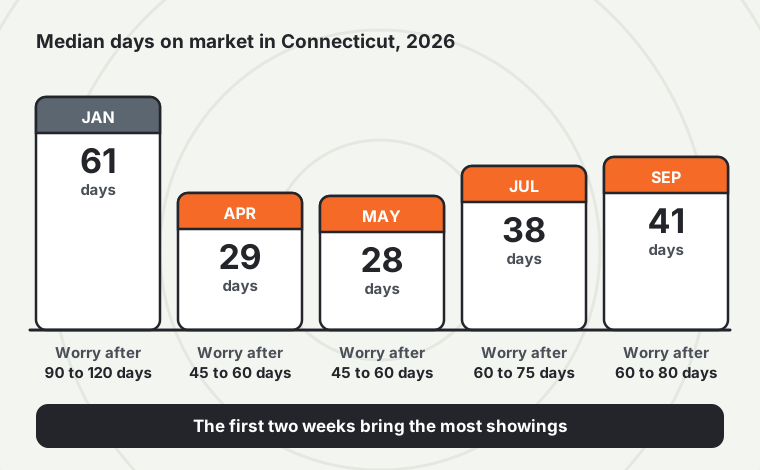
The first two weeks matter most. That is when every buyer already searching in your range sees the listing, and when buyer agents schedule the most showings. After that, new interest comes mainly from buyers who just started looking. A house that sat through its first month without an offer usually needs a change, not more patience.
| Month | CT median days on market, 2026 | Worry if you are past about |
|---|---|---|
| January | 61 | 90 to 120 days |
| April | 29 | 45 to 60 days |
| May | 28 | 45 to 60 days |
| July | 38 | 60 to 75 days |
| September | 41 | 60 to 80 days |
For the full Connecticut timeline by route, see how long it takes to sell a house in Connecticut.
Is my house priced too high for my Connecticut town?
Your house is priced too high for your Connecticut town if it is listed above the recent closed sales of similar houses nearby, adjusted honestly for size, condition and features. Check sales from the last three to six months within about a mile, not the asking prices of competing listings. If your price sits well above your town’s recent sales, buyers need a visible reason to pay it.
How to check your price in an afternoon
- Pull closed sales, not listings. Asking prices tell you what other sellers hope for. Closed sales tell you what buyers paid. Connecticut publishes recorded sales by town on data.ct.gov, and Zillow and Redfin show recent solds.
- Match the house. Same style, similar square feet, bedrooms and baths, same part of town. A Cape is not a Colonial.
- Adjust for condition. A dated kitchen, an old roof or an oil tank in the yard are real discounts to a buyer, and to an appraiser.
- Weight the newest sales. Prices rose quickly from 2020 to 2025, and the pace can change. A sale from a year ago can be far off in either direction.
- Look at what you are competing with. If a better house is listed for the same money down the street, yours will be the one buyers compare it to.
Know your town’s numbers
Each town page on our site lists the town’s median sale price, number of sales and mill rate from state records. For example, the median sale price from October 2024 to September 2025 was $290,000 in Hartford, $339,950 in Hamden, $300,000 in New Britain, $317,500 in Bristol, $315,000 in Manchester and $435,000 in Stratford. A house priced well above its town median needs size, location or condition that buyers can see.
The price-band problem
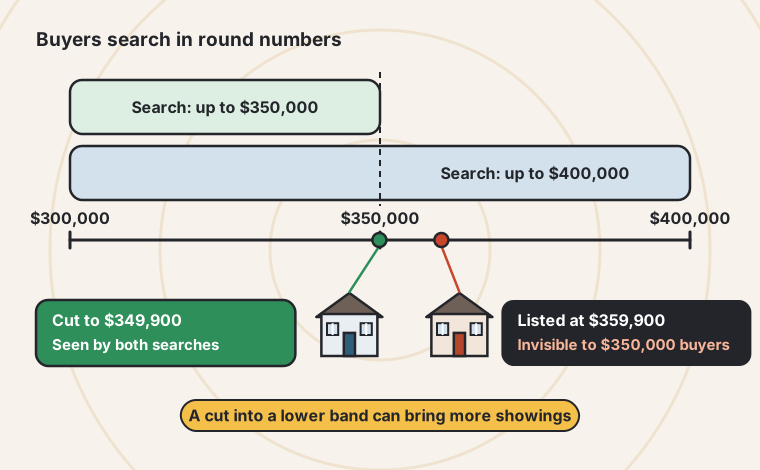
Buyers search in round numbers: up to $300,000, up to $350,000, up to $400,000. A house listed at $359,900 is invisible to every buyer searching “up to $350,000”, and it looks expensive to the ones searching up to $400,000 who also see bigger houses. Sometimes a modest cut that drops you into a lower band brings more showings than a larger cut that does not.
A pre-listing or mid-listing appraisal by a licensed appraiser costs a few hundred dollars (est.) and tells you what the buyer’s bank is likely to see. If your price is above it, a mortgage buyer will likely run into a low appraisal anyway. See how appraisals affect your selling price.
Is the condition of my house stopping it from selling?
The condition of your house stops it from selling when buyers see repairs they do not want to take on, or when their lenders will not finance the house as it is. In Connecticut, the usual culprits are old roofs, dated kitchens and baths, water in the basement, old heating systems, peeling paint on pre-1978 homes, and the inspection items that come with old housing stock: oil tanks, septic systems and foundations.
Connecticut’s houses are old. In New Haven the median single-family house was built around 1930, and in New Britain and West Hartford about four in five were built before 1960 (assessor data behind our town pages). Buyers of older houses expect some work. What they will not take on, unless the price reflects it, is work they cannot see the end of.
- Smell and clutter. Pets, smoke, damp basements and full rooms cost you more showings than most repairs. They are also the cheapest to fix.
- Water. Stains on ceilings, a wet basement, a sump pump that runs constantly. Buyers read water as “unknown cost”.
- Big-ticket systems. A roof near the end of its life, an old boiler or furnace, an old electrical panel. Get a quote so buyers see a number, not a fear.
- Kitchens and baths. Dated is fine at the right price. Broken is not.
Which repairs pay back, and which do not, is covered in what to fix before selling a house in Connecticut.
Can a financing problem keep my Connecticut house from selling?
Yes, a financing problem can keep your Connecticut house from selling, because most buyers need a mortgage and the lender has to approve the house as well as the buyer. FHA and VA appraisers check condition; lenders and insurers balk at underground oil tanks, failed septic systems and suspected crumbling foundations; and open permits or flood zones can delay approval. If buyers cannot finance the house, only cash and renovation buyers are left.
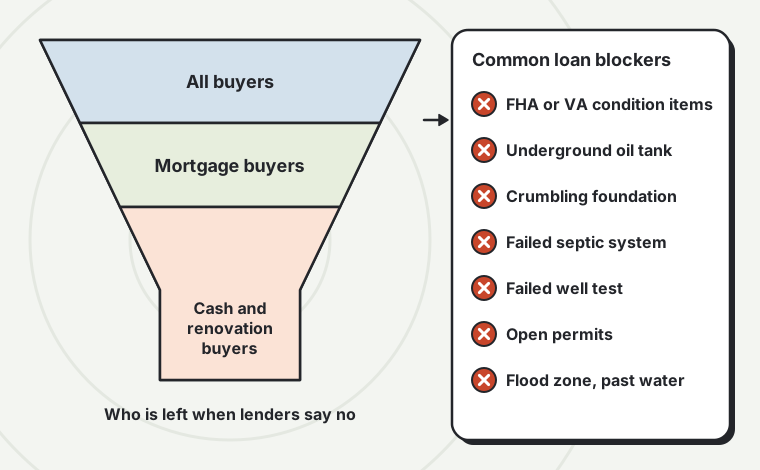
| Problem | Why it blocks buyers | Options |
|---|---|---|
| FHA or VA condition items (peeling paint on pre-1978 homes, missing handrails, roof, heat) | FHA and VA appraisers require the house to meet minimum property standards before the loan closes | Fix the safety items; or price for conventional and cash buyers |
| Underground heating oil tank | Buyers, lenders and insurers often want it gone; a leak means cleanup. DEEP sets no removal deadline, but a leaking tank must be removed promptly | Remove it with a trained contractor and keep the letter report and lab results; or credit the buyer; or sell as-is |
| Crumbling (pyrrhotite) foundation, or a town on the state’s list | Many lenders and buyers want a core test; affected foundations are costly to replace | Answer the condition report’s foundation questions; test; disclose; price in; see our crumbling foundation guide |
| Failed or undersized septic system | Lenders may require repair; repairs need the health district’s approval | Get the repair quote; credit or escrow; or sell as-is |
| Private well with a failed test | Lenders may require potable water | Treatment system, retest |
| Open permits or unpermitted work | Buyers’ attorneys and lenders ask; insurers may balk | Close permits with the building department; disclose |
| Flood zone or past water intrusion | Flood insurance cost; the 2025 condition report asks about flooding and flood insurance | Get a flood insurance quote for buyers; disclose honestly |
Each of these is covered in depth in our guide to oil tanks, septic, wells and radon when selling a house in Connecticut. Whatever you decide, disclose what you know: Connecticut’s Residential Property Condition Report must reach the buyer before they sign (CGS 20-327b), and fixing a problem does not erase your duty to answer the form honestly.
Are my photos and listing hurting my sale?
Your photos and listing hurt your sale if they are dark, few, cluttered or missing the rooms and systems buyers care about, or if the listing leaves out facts buyers filter on. Nearly every buyer sees the house online first. If the photos do not earn a showing, the price never gets a chance. Fresh, bright photos and complete details are among the cheapest fixes there are.
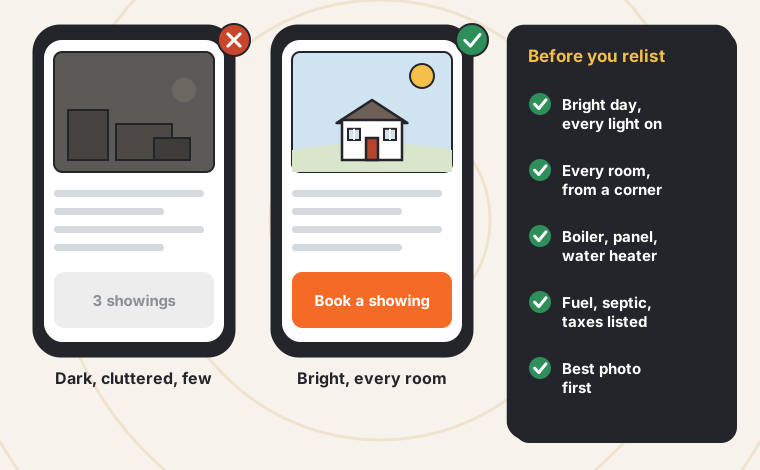
- Photos taken on a bright day, every light on, curtains open
- Every room shown, shot from a corner at chest height
- Exterior from the street and the yard, with snow cleared or in season
- Heating system, electrical panel and water heater photographed (buyers ask)
- No clutter, pets, cars in the driveway or people in the shots
- Listing lists heating fuel, sewer or septic, water source, taxes, year built, lot size
- Recent work called out with years: roof, boiler or furnace, windows, oil tank removal
- Floor plan or a simple sketch
- First photo is the best one, not the front door at dusk
If the listing has been up for a while, new photos with a price change make it look like a new listing to buyers who skipped it the first time.
Is it too hard for buyers to see my house?
It is too hard for buyers to see your house if showings need long notice, are limited to a few hours a week, depend on a tenant’s cooperation, or happen with the owner, pets or a messy house in the way. Every showing request you turn down is a buyer who may see a different house that afternoon. Making access easy is free, and it often adds showings within a week.
- Use a lockbox and allow short-notice showings. Buyers often tour several houses in one afternoon.
- Leave during showings. Buyers will not open closets or talk honestly with the owner in the room.
- Tenant-occupied? Showings depend on the lease and on the tenant’s goodwill. Connecticut landlords must give reasonable notice before entering. Some owners offer the tenant a rent credit for keeping the house show-ready; others sell to a buyer who will buy with the tenant in place. See selling a house with tenants.
- Vacant? Keep the heat on, the walks cleared and the lights on timers. A cold, dark house shows badly and risks frozen pipes.
Could the season, my agent or the market be the problem?
The season, your agent or the market can be part of the problem, but they are rarely the whole answer in Connecticut. Winter is slower (median days on market was about 60 in January 2026, against 28 to 29 in spring), and price cuts climb from late summer into fall. An agent who overpriced the house to win the listing, or who markets it weakly, can make things worse. Price and condition are still the usual causes.
- Season. Connecticut’s closings peak in June through August and bottom out in February. A house listed in November meets fewer buyers. See the best time to sell a house in Connecticut.
- Agent. Ask your agent for the showing count, the feedback from buyer agents, and the comparable sales that support the price. An agent who cannot show you those is not giving you what you need. Your listing agreement sets when and how you can change agents.
- The market in your price band. Count how many similar houses are for sale and how many sold last month. If there are many more listings than sales, buyers can wait for a better deal.
How much does it cost to keep a house that won’t sell in Connecticut?
Keeping a house that won’t sell in Connecticut costs the property tax, insurance, utilities, upkeep and mortgage interest for every month it sits. On a median single-family house, property tax alone runs about $650 a month in New Britain, $1,060 in Hartford, $1,110 in Hamden and $1,400 in Norwalk at fiscal 2027 mill rates. With insurance and utilities, three more months often cost $3,500 to $6,000 before mortgage interest.
| Town | Median single-family price | Mill rate (FY 2027) | Property tax per month | Plus insurance, utilities, upkeep (est. $500) | 3 more months | 6 more months |
|---|---|---|---|---|---|---|
| Hartford | $260,000 | 69.95 | $1,060 | $1,560 | $4,680 | $9,360 |
| East Hartford | $285,000 | 47.24 | $780 | $1,280 | $3,840 | $7,680 |
| Hamden | $355,000 | 53.67 | $1,110 | $1,610 | $4,830 | $9,660 |
| Waterbury | $280,000 | 43.34 | $710 | $1,210 | $3,630 | $7,260 |
| New Britain | $285,000 | 39.18 | $650 | $1,150 | $3,450 | $6,900 |
| Bristol | $330,000 | 35.30 | $680 | $1,180 | $3,540 | $7,080 |
| Manchester | $320,500 | 41.00 | $770 | $1,270 | $3,810 | $7,620 |
| Stratford | $449,000 | 37.73 | $990 | $1,490 | $4,470 | $8,940 |
| Trumbull | $635,000 | 37.42 | $1,390 | $1,890 | $5,670 | $11,340 |
| Norwalk | $750,000 | 32.00 | $1,400 | $1,900 | $5,700 | $11,400 |
Then add your loan. On a $200,000 mortgage balance at 6.5%, the interest alone is about $1,080 a month (est.), money that does not reduce what you owe. Six more months in Hartford with that loan comes to roughly $15,900.
Compare the cost of waiting with the cost of a price cut
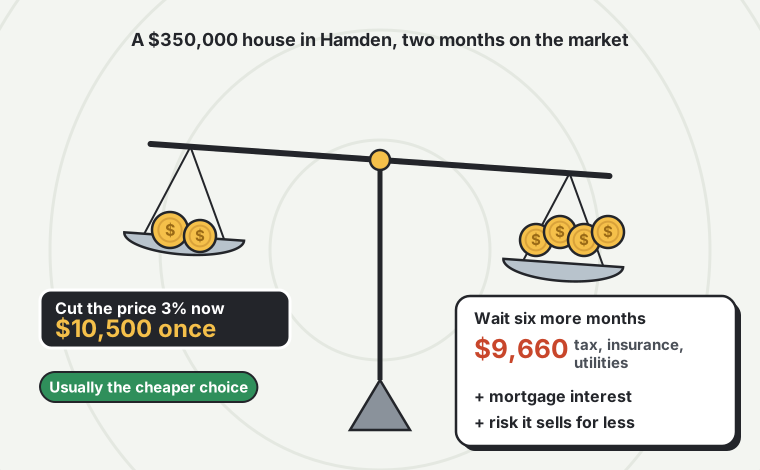
Suppose a $350,000 house in Hamden has sat for two months. A 3% price cut costs $10,500 off the top. Six more months at the old price costs about $9,660 in taxes, insurance and utilities, plus mortgage interest, plus the risk that the house sells for less anyway after going stale. For most owners, the cut that sells the house now is the cheaper choice. The exception is a house that is underpriced for its condition and just needs better presentation.
Many homeowners policies limit coverage for some types of damage, such as vandalism or frozen pipes, once a house has been vacant for a set period, often 30 to 60 days (est.; check your policy). Tell your insurer if the house is empty, keep the heat on and have someone check it weekly. An inherited house that sits through a Connecticut winter is a common source of burst pipes.
Should I relist, cut the price or sell my house as-is?
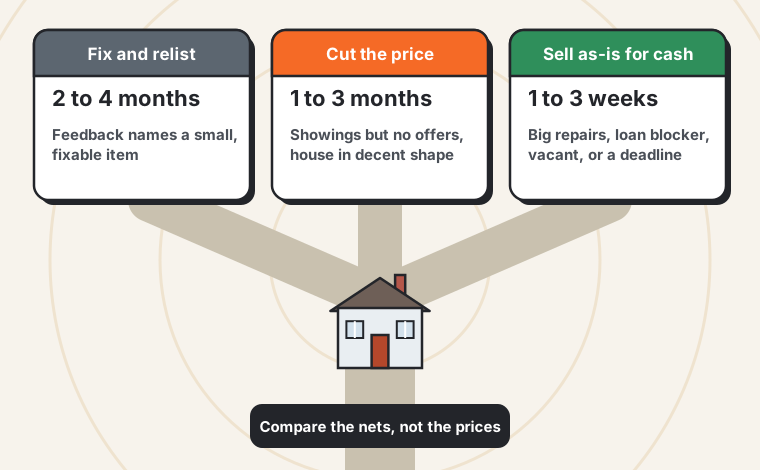
You should relist after fixing what buyers objected to if the house is close to market-ready and the fix is small; cut the price if showings came but offers did not and the house is in decent shape; and sell as-is if the house needs work you cannot or do not want to fund, if lenders will not finance it, or if each month of waiting costs more than the gap between a listing and a cash offer.
| Option | Best when | Time to close (est.) | Watch out for |
|---|---|---|---|
| Fix and relist | The feedback names a small, fixable item: paint, smell, clutter, a repair under a few thousand dollars, new photos | 2 to 4 months | Spending on projects that do not pay back; more carrying months |
| Cut the price | Showings but no offers; the house is in decent shape; you are above recent sales | 1 to 3 months | Many small cuts instead of one meaningful one |
| Change agent or listing strategy | Few showings, weak marketing, no feedback; your listing agreement allows it | 2 to 4 months | Resetting the clock without fixing price or condition |
| Take it off the market and wait | You live there, can afford it, and want to relist in spring | Months | Carrying costs; the same house relisted at the same price |
| Sell as-is to a cash buyer | Major repairs, a loan-blocking problem, a vacant or inherited house, a deadline, or high carrying costs | 1 to 3 weeks | Below retail; compare written offers and verify funds |
If you cut the price, make it count
- One meaningful cut beats several small ones. Small cuts every few weeks tell buyers to keep waiting.
- Cut into a new search band. From $359,900 to $349,900 puts you in front of every buyer searching up to $350,000.
- Refresh the listing at the same time. New photos, a better first image, a clear description of recent work.
- Price to the evidence. The newest closed sales, an appraisal, and the feedback from showings.
Our honest take
We buy houses for cash, so read this knowing that. If your house is in good shape and the problem is price or presentation, a price cut or a relist will almost always net you more than selling to us, and we will tell you so. A cash sale wins when the house needs work buyers’ lenders will not accept, when it sits empty, or when the months of carrying costs, showings and uncertainty are worth more to you than the difference. The cash buyer vs. realtor comparison lays out the math, and this two-minute check can help you see which route fits.
Is a cash sale right for you, or should you list?
Seven quick questions. There is no wrong answer, and we will tell you honestly if listing would leave you more.
- Does the house need repairs you would rather not pay for or manage?
- Do you need to close by a certain date, or within the next month or two?
- Would showings be hard: tenants, belongings, privacy, or you live out of state?
- Is there a complication: an estate or probate, a divorce, foreclosure, liens or back taxes?
- Could you comfortably cover the mortgage, taxes and utilities for three or more months?
- Is getting the highest possible price more important to you than speed and certainty?
- Would a buyer's bank lend on the house as it is (no major roof, foundation, oil tank or code issues)?

When a Connecticut house sits, the owner usually knows the reason before anyone says it out loud: the tank in the yard, the basement that takes water, the price that was set to match a neighbor’s. Say the reason out loud, then price it. Buyers can deal with almost any problem that comes with a number attached. What they walk away from is a problem with no number.
What should I do when my Connecticut listing expires?
When your Connecticut listing expires, take a week to review what happened before you relist: the showing count, every piece of buyer feedback, the closed sales during your listing and what each month is costing you. Then choose deliberately: relist with a new price and photos, fix the main objection first, change your listing strategy, or get a written as-is offer to compare. Expect calls from agents and investors; you do not have to answer any of them today.
Collect the evidence
Ask your agent for every showing, every comment from buyer agents and every offer, even verbal ones. Pull the closed sales near you from the listing period.
Name the reason
Use the diagnosis table at the top of this page. Most expired listings have one main reason and one or two smaller ones.
Price the fix
Get quotes for the repairs buyers objected to, or for the inspection items (oil tank, septic, radon, foundation test) that scared lenders.
Count the cost of waiting
Use the carrying-cost table above with your own tax bill, insurance, utilities and loan.
Compare at least two routes in writing
A relist plan with a realistic price and timeline, and a written as-is offer. Compare the nets, not the prices, with the help of how to compare offers on a house in Connecticut.
Decide, and keep your attorney involved
Whatever you choose, your Connecticut attorney reviews the contract, and you deliver the property condition report before the buyer signs.
See what your house would bring as it is
Send a few photos and the address. We compare it with recent sales near you, price the repairs we see, and send you a written as-is number you can set beside your relist plan. No fees, no obligation, and no calls unless you ask.
Get your cash offer
without anyone coming over.
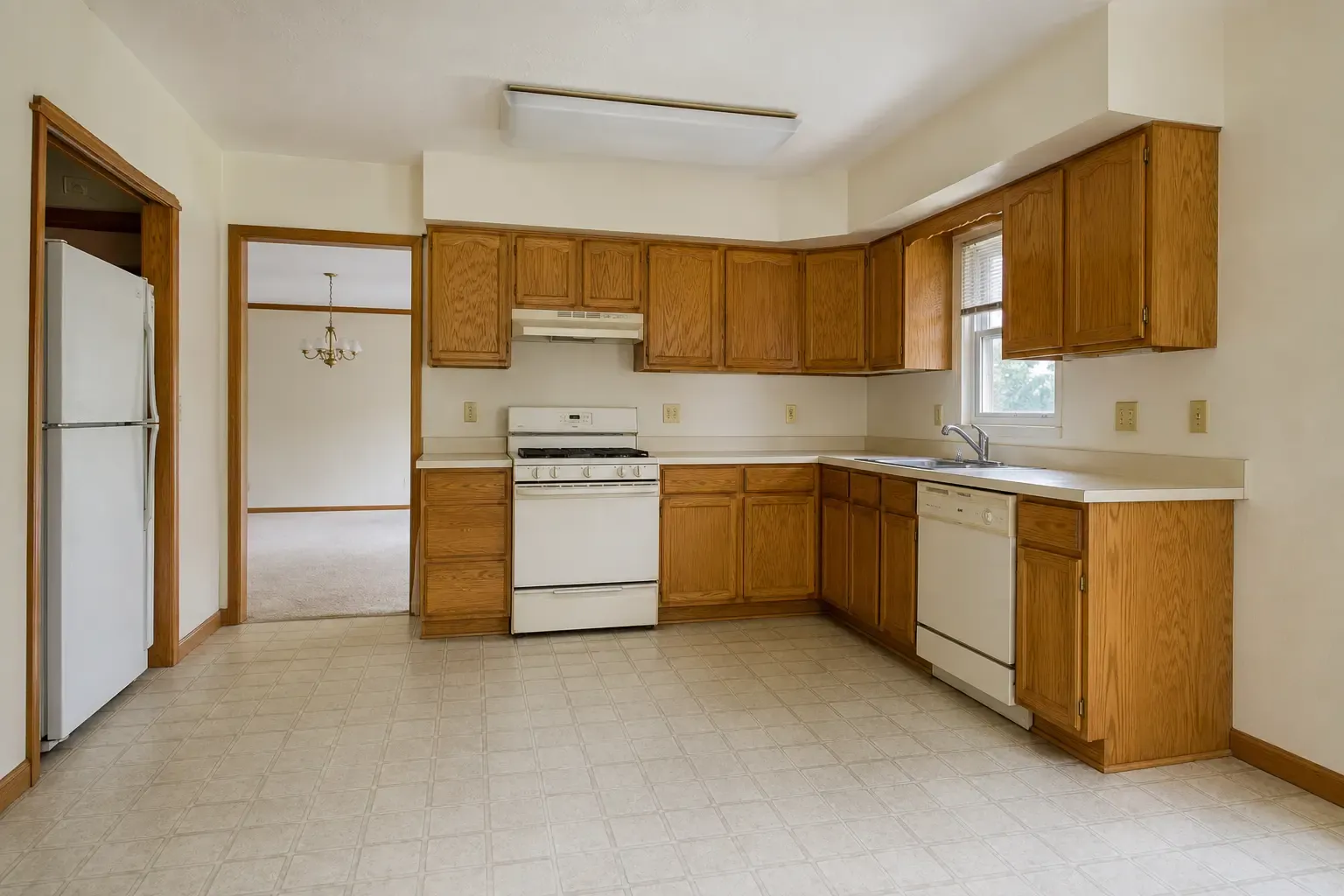
Want your offer faster, or rather not talk to anyone yet? Send a few phone photos of each room. We price the repairs from them, line by line, and send your cash offer back, so you see a real number before you ever meet us or pick up the phone.
 CabinetsFlooring
 Tub & tile
 Floors
 Roof
We may bring in a partner buyer to close. Your price and terms don't change.
Or follow your market before you decide
A free Home Forecast shows your likely sale price from recent sales near you, how long each route would take, and what you would net either way, updated as your market moves.
Know where you stand,
on your own time.
Watch what homes around you sell for and how fast, so when you are ready, you already know your options.
Follow your numbers as the market moves, and decide when the timing is right.
What if the house is inherited, in a divorce or facing foreclosure?
If the house is inherited, part of a divorce or facing foreclosure, a slow sale costs more than money: an estate stays open, a settlement stalls, or a Law Day gets closer. In these cases, certainty and the closing date often matter more than the last few percent of price, and a sale that closes on a known date can be the better result.
- Inherited house: the executor must keep it insured and maintained while it sits, and heirs may disagree on price. See selling an inherited house in Connecticut.
- Divorce: both owners must agree on price changes, which can freeze a listing. A written offer can turn an argument into a yes-or-no decision. See what if your house won’t sell during a divorce.
- Foreclosure: Connecticut’s strict foreclosure lets you sell until the Law Day the court sets, but the sale must close in time. See selling a house in foreclosure in Connecticut and the Judicial Branch’s foreclosure mediation program.
Questions Connecticut owners ask when a house won’t sell
Why is my house not getting any showings?
Your house is not getting showings most likely because the price is above the search range buyers use for houses like it, the photos are weak, or the listing has limited exposure. Compare your price with recent closed sales near you, refresh the photos and confirm the listing is on SmartMLS and the major portals.
Why do buyers look at my house but not make offers?
Buyers look at your house but do not make offers when it is priced above its value for its condition, when a visible problem worries them (water, roof, smell, an oil tank), or when a better house nearby costs the same. Ask your agent for buyer-agent feedback; it usually names the reason.
How long should a house be on the market before I lower the price?
You should consider lowering the price if your house has had showings for two to three weeks without an offer, or has passed about one and a half to two times the typical days on market for the season. In spring 2026 the Connecticut median was about 28 to 29 days.
How much should I lower my asking price?
Lower your asking price enough to make a difference: often a few percent, and ideally into the next lower search band, such as from $359,900 to $349,900. One meaningful cut, based on recent closed sales and showing feedback, usually works better than several small cuts.
Can I sell a house with an underground oil tank in Connecticut?
Yes, you can sell a house with an underground oil tank in Connecticut. DEEP sets no removal deadline for a residential tank, though a leaking tank must be removed promptly. Many buyers, lenders and insurers want it removed or tested, so remove it, credit the buyer, or sell to a cash buyer as-is.
Will an FHA buyer’s lender make me do repairs?
An FHA buyer’s lender may make you do repairs if the FHA appraiser finds the house does not meet minimum property standards, such as peeling paint on a pre-1978 home, missing handrails, a leaking roof or unsafe heat. You can make the repairs, negotiate, or choose a conventional or cash buyer.
Should I take my house off the market and wait?
You should take your house off the market and wait only if you live in it, can comfortably afford the carrying costs, and plan to relist with a better price, photos or season. Relisting the same house at the same price rarely changes the result.
Does relisting reset the days on market?
Relisting may or may not reset the days on market that buyers see, depending on the MLS’s rules and how long the house was off the market, and buyer agents can usually see the listing history. A new price and fresh photos matter more than the counter.
What does it cost to keep an unsold house each month in Connecticut?
Keeping an unsold house in Connecticut costs property tax (about $650 to $1,400 a month on a median house in many towns at fiscal 2027 mill rates), insurance, utilities, upkeep and mortgage interest. For a typical house that is $1,150 to $1,900 a month before the loan.
Is my agent the reason my house isn’t selling?
Your agent may be part of the reason if the house was overpriced to win the listing, the photos are weak or you get no showing feedback. Ask for showing counts, buyer feedback and the comparable sales behind the price. Price and condition are still the most common causes.
Should I sell my house as-is if it won’t sell?
You should consider selling your house as-is if it needs repairs you cannot fund, if buyers’ lenders will not finance it, if it is vacant or inherited, or if each month of waiting costs more than the gap between a listing and a cash offer. Compare the nets in writing first.
Do I still have to disclose problems if I sell as-is?
Yes, you still have to disclose problems if you sell as-is in Connecticut. The Residential Property Condition Report must be delivered before the buyer signs (CGS 20-327b), or you credit the buyer $500 at closing. “As-is” means you will not fix things, not that you can hide them.
Is winter the reason my house is not selling?
Winter can slow a sale in Connecticut (median days on market was about 60 in January 2026), but it is rarely the only reason. Buyers in winter are fewer but serious. If a well-priced house gets showings and no offers in winter, look at price and condition first.
Can a house sell if it has a crumbling foundation?
Yes, a house with a crumbling foundation can sell in Connecticut, but many buyers’ lenders will not finance it as it is. Owners in listed towns answer the condition report’s foundation questions, disclose what they know and price accordingly; cash buyers and renovation buyers are the usual market.
A stalled sale is one step in a longer process. For the whole picture, from pricing to closing, see our guide on how to sell a house in Connecticut.
Related Connecticut guides
Fix the cause
Time and money
Sources
- Realtor.com, Median Days on Market in Connecticut, Price Reduced Count and Active Listing Count, via FRED, Federal Reserve Bank of St. Louis (September 2026 data, retrieved October 2026).
- Connecticut OPM real estate sales on data.ct.gov (town median sale prices) and fiscal 2027 town mill rates (OPM).
- CGS § 12-62a (October 1 assessment date; 70% assessment ratio).
- CGS § 20-327b and § 20-327c (property condition report; $500 credit) and the DCP real estate page (condition and foundation reports effective July 1, 2025, under Public Act 25-33).
- Connecticut DEEP, Residential Home Heating Oil Tanks FAQs.
- HUD Single Family Housing Policy Handbook 4000.1 (FHA minimum property requirements) and VA Lender’s Handbook M26-7 (VA minimum property requirements).
- EPA and HUD Lead-Based Paint Disclosure Rule (homes built before 1978).
- Connecticut Judicial Branch, foreclosure (Law Day; foreclosure mediation).
See the house together.
Pick a time that works.
Choose a time for us to walk through the property with you, or ask for a quick call first. We confirm every request personally.
Tuesday, January 13
No open times in the next few weeks. Please call us.
We will confirm by email. Nothing is booked until we do.
View my request
Who wrote this
Jerryll Noorden
Jerryll has bought and sold Connecticut houses since 2016 and has sat at more closing tables than he can count, on both sides. Before real estate he was a robotics scientist at NASA, IHMC and IIT. He wrote this guide because the national sites that rank for it skip the Connecticut rules that cost sellers money. When listing or selling it yourself would get you more than a cash offer, he says so.
This guide explains Connecticut rules in plain English. It is not legal or tax advice. Laws change; for your sale, talk to a Connecticut real estate attorney and a tax professional.
