
- The formula is simple: monthly carrying cost = property tax + mortgage interest + insurance + heat + utilities + upkeep + security + HOA. Multiply by the months until closing.
- Connecticut property tax = appraised value × 70% × mill rate ÷ 1,000 (CGS 12-62a). In Monroe, at the $560,000 single-family median and a 29.88 mill rate, that is about $976 a month.
- Vacancy changes the insurance. Many homeowners policies limit coverage once a house is empty for 30 to 60 days; vacant-dwelling coverage costs more.
- Winter is the expensive season. Connecticut heating oil averaged $6.154 a gallon the week of October 19, 2026 (EIA). One cold month at 100 gallons is about $615 (est.).
- Our Monroe example costs about $3,000 in a winter month with a mortgage, and about $16,764 over a six-month winter wait (est., labelled inputs below).
- Waiting can still be right. If the extra price you expect is bigger than the carrying cost, wait. Months you can afford = expected gain ÷ monthly cost.
What are the carrying costs of a vacant house in Connecticut?
The carrying costs of a vacant house in Connecticut are everything you pay each month to own it while nobody lives there: property tax, the interest part of any mortgage, vacant-house insurance, heat, electricity and water, lawn care and snow removal, security and checks, HOA dues and a repair reserve. For a typical oil-heated house in a town like Monroe, that is roughly $2,400 to $3,000 a month with a mortgage (est.).
This page is the money side of our guide to how to sell a house in Connecticut. It gives you a worksheet you can fill in with your own bills, the Connecticut rules behind each line, real property tax numbers for Monroe and nearby towns, a fully worked Monroe example, and an honest way to decide whether waiting is worth it. If the house is empty because a parent died, our inherited house page and our guide to cleaning out an inherited house cover the rest.
The one formula to remember:
Monthly cost = property tax + mortgage interest + insurance + heat + electricity + water and sewer + lawn and snow + security and checks + HOA + repair reserve. Cost of waiting = monthly cost × months until the closing. One-time costs such as the commission, attorney fees and conveyance tax are not carrying costs; you pay them whenever you sell.
Why does an empty house feel like such a drain?
An empty house feels like such a drain because it costs you money every month and gives nothing back. You pay two sets of bills, you worry about pipes and break-ins every cold night, you drive over to check it, and the decision to sell keeps getting pushed to next month. Most owners have never added the bills into one number, so the cost stays vague and the waiting continues.
Maybe it was your mother’s house in Monroe, and it has sat since spring while the family decides. Maybe you took a job in another state and the house you left behind has not sold. Maybe you moved into your new home before the old one sold, or you are waiting for spring because someone told you spring is when houses sell.
The bills arrive anyway. The oil company calls for a delivery. The tax bill comes in July and again in January. The insurance company asks whether anyone lives there. You drive past on a Sunday to make sure the heat is on, and you shovel a walk nobody uses.
It is normal to feel stuck: afraid that selling now leaves money on the table, and afraid that waiting makes it worse. It is also normal to be suspicious when a cash buyer talks about “the cost of waiting”. So this page does not tell you what to do. It shows you the arithmetic, including the cases where waiting wins, and lets you decide.
What Connecticut rules drive the cost of holding a house?
The Connecticut rules that drive the cost of holding a house are the property tax rules (assessment at 70% of value times the town mill rate, paid in installments the town sets), your insurer’s vacancy terms, and town blight ordinances that can fine a neglected vacant property up to $250 a day. Heating oil and electricity prices are not set by law but are published weekly and monthly by the state and federal government.
| Cost line | Connecticut rule or data | Source |
|---|---|---|
| Property tax: what is taxed | Houses and land are taxed in the town where they sit | CGS 12-64 |
| Property tax: the assessment | Every town assesses property at 70% of its true and actual value, with an October 1 assessment date | CGS 12-62a |
| Property tax: revaluation | Towns revalue at least every five years on a state schedule, so your assessment can jump | CGS 12-62(b) |
| Property tax: due dates | Each town decides whether tax is paid in one, two or four installments | CGS 12-142 |
| Mill rates | Set yearly by each town; published by the Office of Policy and Management | OPM data on data.ct.gov |
| Neglect of an empty house | Towns with a blight ordinance can fine up to $250 a day at a vacant property, after written notice and time to fix | CGS 7-148(c)(7)(H)(xv) |
| Heating oil price | Connecticut residential average $6.154 a gallon, week of October 19, 2026 (before taxes) | U.S. Energy Information Administration, weekly survey with DEEP |
| Electricity price | Connecticut residential average 24.51 cents per kWh, August 2026 | EIA Electric Power Monthly, Table 5.6.A |
| Insurance on a vacant house | Set by your policy, not by statute; many policies limit coverage after 30 to 60 days vacant | Your policy; Connecticut Insurance Department for complaints |
How do you calculate the property tax on a Connecticut house?
You calculate the property tax on a Connecticut house by multiplying its appraised market value by 70% to get the assessment, then multiplying the assessment by the town’s mill rate and dividing by 1,000. In Monroe, a $560,000 house is assessed at $392,000; at a mill rate of 29.88 that is $11,713 a year, or about $976 a month.
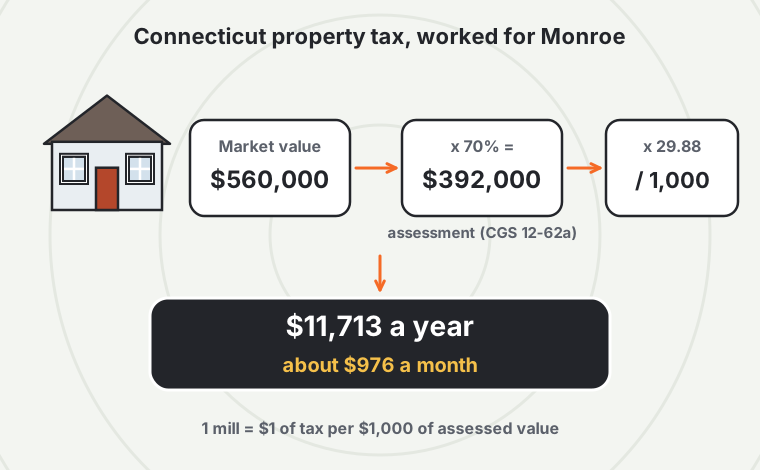
A mill is one dollar of tax per $1,000 of assessed value. The town’s assessor sets your assessment, usually from the last revaluation, so your real bill may differ from the median math. Your exact number is on your tax bill or the assessor’s online field card. Our guide to market value vs. assessed value in Connecticut explains the difference.
Property tax is the one carrying cost you cannot shop around or switch off, and it varies enormously between towns:
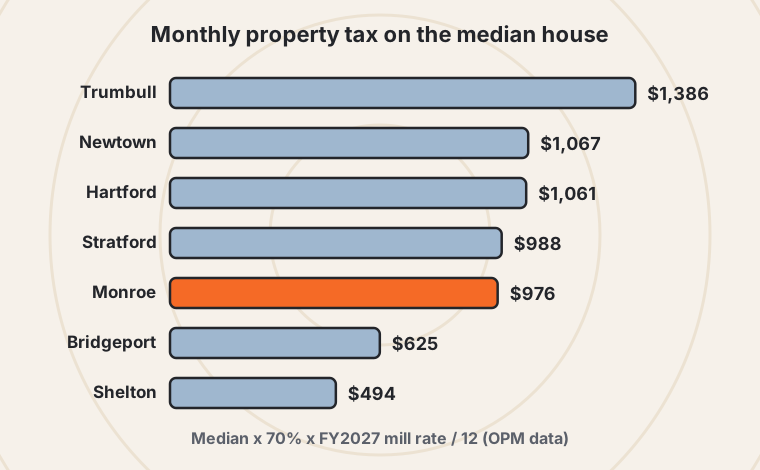
| Town | Median single-family price | Assessment (70%) | Mill rate (FY 2027) | Tax per year | Tax per month | Six months |
|---|---|---|---|---|---|---|
| Monroe | $560,000 | $392,000 | 29.88 | $11,713 | $976 | $5,856 |
| Trumbull | $635,000 | $444,500 | 37.42 | $16,633 | $1,386 | $8,317 |
| Newtown | $625,000 | $437,500 | 29.26 | $12,801 | $1,067 | $6,401 |
| Shelton | $546,500 | $382,550 | 15.51 | $5,933 | $494 | $2,967 |
| Stratford | $449,000 | $314,300 | 37.73 | $11,859 | $988 | $5,929 |
| Bridgeport | $383,500 | $268,450 | 27.95 | $7,503 | $625 | $3,752 |
| Hartford | $260,000 | $182,000 | 69.95 | $12,731 | $1,061 | $6,365 |
Two practical points. Connecticut property tax is generally paid in arrears, and at closing the seller usually credits the buyer for the period the seller owned the house, so you pay for every day you own it whether or not the bill has arrived. And if the house is in an estate, the tax keeps accruing during probate; the estate pays it.
How much of your mortgage payment is really a carrying cost?
The part of your mortgage payment that is really a carrying cost is the interest, plus any escrow for taxes and insurance you are not already counting. The principal portion is not lost; it lowers your loan balance and comes back to you at closing. Monthly interest is roughly your loan balance times your interest rate divided by 12: $200,000 at 3.5% is about $583 a month.
Many owners count the full mortgage payment as the cost of waiting. That overstates it. If your payment is $1,400 and $583 of it is interest, the other $817 or so is principal you get back from the sale, less escrow if your lender collects taxes and insurance (then do not count them twice).
- Interest per month ≈ balance × rate ÷ 12. Your statement shows the exact split.
- Home equity line or second mortgage: add its monthly interest.
- Reverse mortgage on an inherited house: interest and fees keep adding to the balance, and the lender sets deadlines after the borrower dies; ask the servicer for the payoff and the timeline in writing.
- No mortgage: this line is zero, but the money tied up in the house still has a cost. At a savings rate of 4%, $500,000 of equity earns about $1,667 a month somewhere else (est.). We leave that out of the worksheet, but it is real.
For context, Freddie Mac’s 30-year fixed average was 7.40% on October 15, 2026. If you are paying today’s rates on a new house while carrying the old one, the old house’s interest is not the only interest the delay costs you.
What does vacant house insurance cost in Connecticut?
Vacant house insurance in Connecticut usually costs more than a normal homeowners policy, and many owners need it because standard policies often limit coverage once a house has been empty for 30 to 60 consecutive days. Industry sources commonly quote vacancy coverage at 1.5 to 3 times a standard premium (est.). In our Monroe example we use $300 a month (est.); get a real quote for your house.
Read the vacancy clause in your current policy, or call your agent and ask these questions, in writing:
- How many consecutive days can the house be vacant before coverage changes?
- Which perils are limited after that: vandalism, glass breakage, water damage from frozen pipes, theft?
- Does “vacant” mean no one living there, or no furniture, under this policy? An unoccupied but furnished house may be treated differently.
- Is a vacancy endorsement or permit available, and what does it cost?
- What do you require: heat kept on at a set temperature, water shut off, weekly inspections?
- If the owner died: how long does coverage continue for the estate, and who must be named?
If your insurer will not cover the vacancy, a specialty vacant-dwelling policy fills the gap. It usually covers fewer perils at a higher price. Do not let the house go uninsured to save the premium: one burst pipe or fire costs more than years of premiums. If you have a problem with an insurer, the Connecticut Insurance Department takes consumer complaints.
What does it cost to heat and protect an empty house in winter?
Heating and protecting an empty house in a Connecticut winter costs roughly $500 to $800 a month for an oil-heated house kept at a safe temperature (est.), because heating oil averaged $6.154 a gallon in Connecticut the week of October 19, 2026 and a cold month can use 100 gallons or more. The alternative, draining and winterizing the plumbing, is cheaper to run but makes the house harder to show and sell.
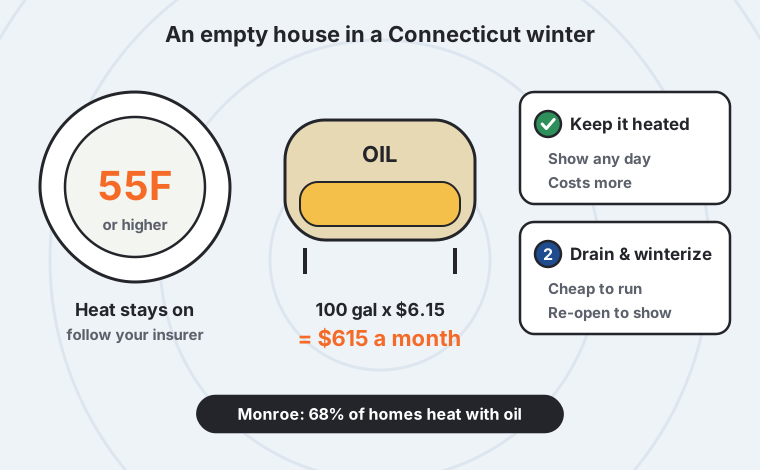
Monroe is oil country: 68% of the town’s single-family houses heat with oil in our town data, and the median house was built in 1970. Newtown is 81% oil and Shelton 61%. For an empty oil-heated house, you have two choices:
Keep it heated
About $615 a month (est.)100 gallons in a cold month at $6.15 a gallon.
- Thermostat at 55°F or higher (a commonly cited minimum; follow your insurer)
- Keep the tank above a quarter; consider automatic delivery
- Showings, inspections and appraisals can happen any day
Drain and winterize
One-time plumber visitWater off, lines blown out, antifreeze in traps, boiler drained if needed.
- Much lower monthly cost
- The house must be de-winterized for inspections and buyers’ tests
- Check your insurer accepts it and that the system was really drained
Whatever you choose, add cheap protection: a Wi-Fi thermostat that alerts you if the temperature drops, a water-leak sensor near the boiler and water heater, and the main water valve shut off if nobody will check the house for days at a time. A burst pipe in a January house that nobody visits can run for a week.
Gas-heated houses usually cost less per month to keep warm, and electric baseboard heat at 24.51 cents a kWh can cost more. Use your own past bills: last winter’s January bill for an occupied house, reduced for the lower thermostat, is a reasonable first guess.
What other monthly costs come with an empty house?
The other monthly costs that come with an empty house are electricity for the sump pump, boiler and lights; water and sewer if the house is on public water; lawn mowing and snow plowing; regular inspections or a security system; HOA or condo fees; and a reserve for repairs that happen while nobody is there. Together these often add $400 to $700 a month (est.).
| Cost | Typical monthly range (est.) | Notes |
|---|---|---|
| Electricity | $50 to $100 | About 250 kWh at 24.51 cents is $61, plus the utility’s fixed customer charge |
| Water and sewer | $0 to $60 | Zero on a private well and septic |
| Lawn and snow | $100 to $200 averaged over the year | Required for showings and by many towns’ ordinances |
| Checks and security | $50 to $200 | A neighbor, a property checker or monitored alarm; insurers often require regular visits |
| HOA or condo fees | Your actual dues | Due until the deed transfers; ask about special assessments |
| Repair reserve | $100 to $500 | Something always fails in an empty house: a sump pump, a gutter, a storm-damaged tree |
| Blight fine risk | $0 if kept up | Up to $250 a day at a vacant property in towns with a blight ordinance, after notice (CGS 7-148) |
How do you fill in a monthly carrying-cost worksheet?
You fill in a monthly carrying-cost worksheet by writing down one month of each bill from your own statements: the property tax bill divided by 12, the interest line on your mortgage statement, the insurance premium divided by 12, a winter and a summer heating figure, utilities, lawn and snow, security, HOA and a repair reserve. Add them for a winter month and a mild month, then multiply by the months you expect to wait.
Tick off each line as you find the real number. Your progress is saved on this device.
- Property tax: annual bill (or assessment × mill rate ÷ 1,000) ÷ 12
- Mortgage interest: from the statement, or balance × rate ÷ 12
- Home equity line or second mortgage interest
- Insurance: annual premium ÷ 12, with the vacancy endorsement or vacant policy
- Heat in a cold month: gallons (or therms) × current price
- Heat in a mild month
- Electricity: last three bills, averaged
- Water and sewer, if on public water
- Lawn mowing and snow plowing, averaged per month
- Inspections, alarm monitoring, smart sensors
- HOA or condo dues
- Repair reserve for the unexpected
- Expected months until closing (listing time plus the buyer’s mortgage time)
How long to assume? A listed house usually takes a few months from listing to closing once you add the buyer’s mortgage process, and longer in winter; see how long it takes to sell a house in Connecticut. Do not forget the months before listing: cleaning, repairs, probate.
What does it cost to hold a vacant house in Monroe?
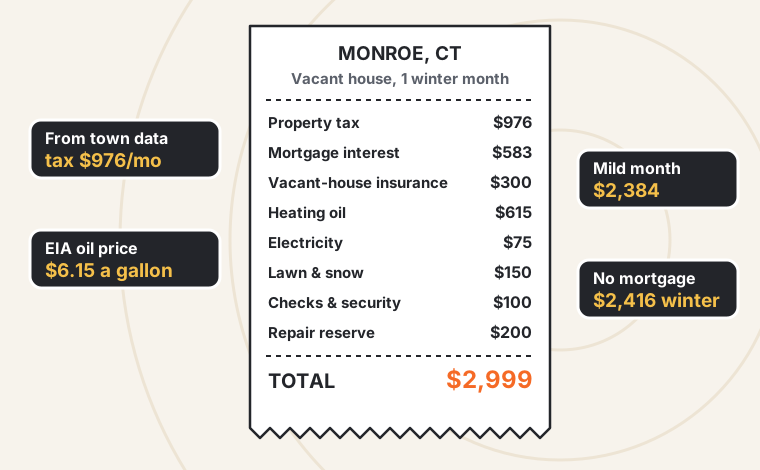
Holding a vacant house in Monroe costs about $3,000 in a winter month and about $2,400 in a mild month in our worked example, which assumes the town’s $560,000 single-family median, Monroe’s 29.88 mill rate, a $200,000 mortgage at 3.5%, oil heat and estimated insurance and upkeep. Without a mortgage it is about $2,400 in winter and $1,800 in a mild month. Six months over a winter cost about $16,764 (est.).
Example (illustrative). A vacant 1970s colonial in Monroe, priced at the town’s single-family median. Every input is labelled; replace any of them with your own numbers.
| Line | Input | Winter month | Mild month |
|---|---|---|---|
| Property tax | $560,000 × 70% × 29.88 ÷ 1,000 ÷ 12 (town data) | $976 | $976 |
| Mortgage interest | $200,000 balance × 3.5% ÷ 12 (input) | $583 | $583 |
| Vacant-house insurance | Estimate; get a quote (est.) | $300 | $300 |
| Heating oil | 100 gallons × $6.15 (EIA CT price; usage est.) | $615 | $0 |
| Electricity | About 250 kWh at 24.51 cents plus customer charge (est.) | $75 | $75 |
| Lawn and snow | Averaged (est.) | $150 | $150 |
| Checks and security | Weekly check or monitoring (est.) | $100 | $100 |
| Repair reserve | Small repairs (est.) | $200 | $200 |
| Total per month | $2,999 | $2,384 | |
| Without the mortgage | Total minus $583 | $2,416 | $1,801 |
Over time, with four cold months and two mild months:
| Wait | With the $200,000 mortgage | No mortgage |
|---|---|---|
| One winter month (about $100 a day) | $2,999 | $2,416 |
| Three months (Dec to Feb) | $8,997 | $7,248 |
| Six months (4 cold + 2 mild) | $16,764 | $13,266 |
Notice what is not in the table: the commission, the attorney, the conveyance tax and any repairs. Those are selling costs, the same whether you sell in November or in May; see closing costs in Connecticut. The table is only the price of time.
How much would you walk away with?
Slide the numbers to match your house. It works in your browser; nothing is saved or sent.
Estimates for planning. Conveyance tax per CGS 12-494 (state 0.75% up to $800,000, 1.25% to $2.5M, 2.25% above, plus the town rate). Seller attorney about $1,200 to $1,500; flat-fee MLS about $400; listings include three months of taxes, insurance and utilities, a cash sale about two weeks. Your attorney gives you the final numbers.
Is it cheaper to wait or to sell now?
Whether it is cheaper to wait or to sell now depends on one comparison: the extra price you realistically expect by waiting, minus the carrying cost of the wait. The months you can afford to wait equal the expected gain divided by your monthly carrying cost. In our Monroe example, a 2% to 4% seasonal gain ($11,200 to $22,400, est.) covers about 3.7 to 7.5 months at $2,999 a month.
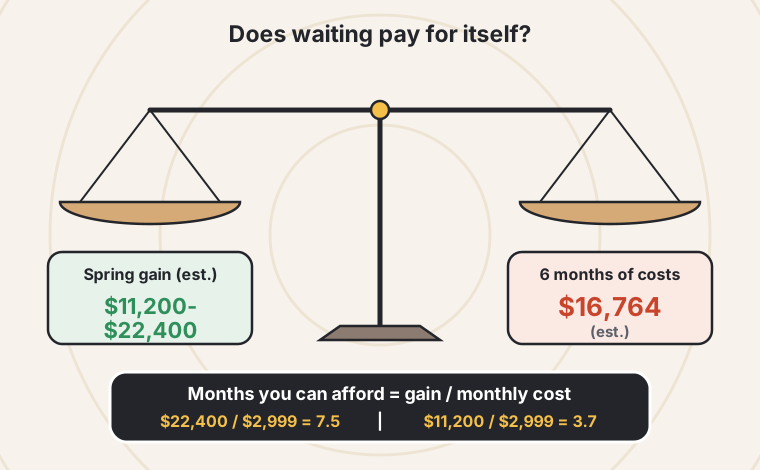
Our best time to sell guide estimates the seasonal premium for the same house at about 2% to 4% (est.). On Monroe’s $560,000 median that is $11,200 to $22,400. Six months of carrying in our example is $16,764. So:
- If you expect the high end ($22,400) and the house is ready to list in spring, waiting can net you a few thousand dollars more. Waiting is reasonable.
- If you expect the low end ($11,200), six months of carrying costs more than the gain. Selling sooner wins.
- If the house needs work before it can get that price, add the repairs and the months they take. That usually tips the math toward selling sooner, or selling as-is.
- If prices are rising faster than carrying costs in your town, waiting gains more. If they are flat or falling, every month is pure cost.
When waiting is the right answer
Waiting can be right, and we will say so. If the house is in good condition, you can comfortably afford the monthly cost, the house is heated and insured, and the gain you can reasonably expect from a spring listing is larger than the months of carrying, list it in spring with a good agent. The same is true if you might move back in, rent it out legally, or if a probate or family decision cannot happen sooner anyway.
When you should NOT sell to a cash buyer
We buy houses for cash, so here is the honest line: if your house is in good shape, priced right and you have the time and money to carry it through a normal listing, listing will usually net more than a cash offer. A cash offer is below the price of a repaired house sold on the open market. It is worth it when the carrying costs, repairs, cleanout or uncertainty are worth more to you than the difference. Compare both with real numbers in our cash buyer vs. realtor guide.
Wait and list in spring
+2% to 4% (est.)Best when the house is ready and the gain beats the carrying cost.
- Months of tax, interest, heat and insurance
- Winter freeze and vacancy risk
- Commission and buyer’s mortgage timeline
List now
Market priceBest when the house shows well even in winter.
- Fewer buyers in November to January
- Still a few months to close
- Repairs a buyer’s lender flags
Sell as-is for cash
Stops the clockBest when carrying, repairs or contents make waiting expensive.
- About two weeks to close, on your date
- No repairs, leave what you do not want
- Price below a repaired retail sale
Know where you stand,
on your own time.
Watch what homes around you sell for and how fast, so when you are ready, you already know your options.
Follow your numbers as the market moves, and decide when the timing is right.
How do you cut or end the carrying costs?
You cut the carrying costs of a vacant house by fixing the insurance before a claim, choosing between heating and winterizing on purpose, dropping services nobody uses, appealing an assessment that is too high, and setting a decision date. You end them by selling, renting the house legally, or moving back in. A cash sale stops the clock in about two weeks once the title work is ready.
Get your real monthly number
Fill in the worksheet above with your own bills, a winter month and a mild month. Most owners are surprised in one direction or the other.
Fix the insurance now
Call your insurer about the vacancy, get the endorsement or a vacant-dwelling policy, and write down what they require (heat, inspections, water off).
Protect the house cheaply
Smart thermostat and leak sensors, timers on lamps, mail forwarded, lawn and walks kept up. Cancel cable and other services nobody uses.
Check the assessment
If the assessment is clearly above what the house would sell for, ask the assessor how to appeal; towns have deadlines each year. Read market value vs. assessed value first.
Set a decision date
Pick a date by which you will list, rent or sell, and compare written numbers before it: an agent’s net sheet and a cash offer. Our offers do not expire while you decide.
If the answer is to stop paying, we buy vacant houses across Connecticut as they are: no repairs, no cleanout, no showings, and you choose the closing date. A typical closing takes about two weeks. I am Jerryll Noorden, and I have bought Connecticut houses since 2016; call me at (203) 529-4712. We never charge fees, you can use your own attorney, and if listing would net you more, I will tell you. More on how it works on our sell a vacant house in Connecticut page and in our guide to selling a house as-is in Connecticut.

Before you decide to wait for spring, put two numbers on one piece of paper: what you think spring will add to the price, and what the house costs you every month until then. Most owners have never written the second number down. Once it is on paper, the decision usually makes itself, one way or the other.
Questions owners ask about holding an empty house
What are carrying costs on a house?
Carrying costs on a house are the recurring costs of owning it: property tax, mortgage interest, insurance, utilities, heat, maintenance, lawn and snow care, security and HOA dues. They continue every month until the house is sold, whether or not anyone lives there.
How do you calculate holding costs on a house?
You calculate holding costs on a house by adding one month of every recurring bill (tax, interest, insurance, heat, utilities, upkeep, HOA) and multiplying by the number of months until closing. Use a winter and a summer month separately in Connecticut, because heat changes the total a lot.
How much does it cost to keep a vacant house in Connecticut?
Keeping a vacant house in Connecticut typically costs from about $1,800 to $3,000 a month for a median-priced house in a town like Monroe, depending on the mortgage and the season (est.). Property tax alone is $976 a month at Monroe’s median, and $1,386 at Trumbull’s.
Does homeowners insurance cover a vacant house?
Homeowners insurance often covers a vacant house only for a limited time. Many policies restrict coverage for vandalism, glass breakage or freeze damage once the house is vacant for 30 to 60 consecutive days. Tell your insurer about the vacancy and ask for a vacancy endorsement or a vacant-dwelling policy.
How much is vacant home insurance?
Vacant home insurance usually costs more than standard homeowners coverage; industry sources commonly quote 1.5 to 3 times the normal premium (est.). The price depends on the house, the town, how long it will be empty and whether it is heated and checked. Get quotes for your own house.
What temperature should I keep an empty house in winter?
Keep an empty house at 55°F or higher in winter, a commonly cited minimum to prevent frozen pipes, and follow any temperature your insurer requires. Houses with pipes on outside walls may need more. If the house cannot be heated reliably, have a plumber drain and winterize it.
Should I turn off the water in a vacant house?
Turning off the main water valve in a vacant house is a good idea when nobody will check it for days at a time, and it limits the damage if a pipe bursts. Keep the heat on anyway, and turn the water back on for cleaning, showings and inspections.
How is property tax calculated in Connecticut?
Property tax in Connecticut is calculated by assessing the house at 70% of its market value (CGS 12-62a) and multiplying the assessment by the town’s mill rate divided by 1,000. A $560,000 Monroe house assessed at $392,000, at 29.88 mills, owes about $11,713 a year.
Do I still pay property tax if the house is empty?
Yes, you still pay property tax if the house is empty. Connecticut taxes houses and land in the town where they sit regardless of occupancy (CGS 12-64), and at closing the seller usually credits the buyer for the taxes covering the time the seller owned it.
Can a Connecticut town fine me for a neglected vacant house?
Yes, a Connecticut town with a blight ordinance can fine the owner of a neglected vacant house up to $250 a day, after giving written notice and a reasonable chance to fix the problem (CGS 7-148(c)(7)(H)(xv)). Keeping the lawn, walks and exterior tidy avoids it.
Are carrying costs tax deductible when I sell?
Some carrying costs may be deductible and some are not, depending on whether the house was your home, an inherited property held for sale or a rental. Selling expenses such as commissions reduce your gain (IRS Publication 523). Ask a tax professional about property tax, interest and upkeep in your case.
Is it better to wait until spring to sell an empty house?
Waiting until spring to sell an empty house is better only if the extra price you expect beats the carrying costs of the wait. In our Monroe example, six winter-to-spring months cost about $16,764, while a 2% to 4% seasonal gain is $11,200 to $22,400 (est.).
How long can I afford to wait before selling?
You can afford to wait about as many months as your expected price gain divided by your monthly carrying cost. A $22,400 expected gain at $2,999 a month covers about 7.5 months; an $11,200 gain covers about 3.7 months. After that, waiting costs you money.
Does a cash sale really save the carrying costs?
A cash sale saves the carrying costs for the months a listing would have taken, because a typical cash closing takes about two weeks. It does not save money overall if the lower price is bigger than those months of costs plus repairs and commission, so compare both net numbers.
Related Connecticut guides
Timing and money
Empty and inherited houses
We buy houses in Monroe and nearby, including Trumbull, Newtown, Shelton, Stratford and Bridgeport. For the whole process, see how to sell a house in Connecticut.
Plain-English information, not tax, legal or insurance advice. Estimates are labelled (est.); use your own bills, policy and tax records.
Sources
- CGS §§ 12-62, 12-62a and 12-64 (revaluation, 70% assessment ratio, taxable real estate).
- CGS § 12-142 (tax installments and due dates set by each town).
- CGS § 7-148(c)(7)(H)(xv) (blight ordinances; up to $250 a day at a vacant property).
- Connecticut OPM real estate sales on data.ct.gov and fiscal 2027 town mill rates (OPM), as shown on our town pages.
- U.S. Energy Information Administration, heating oil and propane update (Connecticut residential heating oil, week of October 19, 2026).
- EIA Electric Power Monthly, Table 5.6.A (Connecticut residential electricity price, August 2026).
- Freddie Mac Primary Mortgage Market Survey (30-year fixed, October 15, 2026).
- Connecticut Insurance Department (consumer help and complaints).
- IRS Publication 523, Selling Your Home (selling expenses and gain).
See the house together.
Pick a time that works.
Choose a time for us to walk through the property with you, or ask for a quick call first. We confirm every request personally.
Tuesday, January 13
No open times in the next few weeks. Please call us.
We will confirm by email. Nothing is booked until we do.
View my request
Who wrote this
Jerryll Noorden
Jerryll has bought and sold Connecticut houses since 2016 and has sat at more closing tables than he can count, on both sides. Before real estate he was a robotics scientist at NASA, IHMC and IIT. He wrote this guide because the national sites that rank for it skip the Connecticut rules that cost sellers money. When listing or selling it yourself would get you more than a cash offer, he says so.
This guide explains Connecticut rules in plain English. It is not legal or tax advice. Laws change; for your sale, talk to a Connecticut real estate attorney and a tax professional.
