
- Work back from your move date. A listed Connecticut house usually takes about two to four months from decision to closing. A cash sale can close in about one to three weeks. If you have less than about ten weeks, plan for selling after you move, renting, or a fast sale.
- You do not have to be in Connecticut to close. Most out-of-state sellers sign a “mail-away” package in front of a notary where they live. Connecticut does not allow remote online (video) notarization for real estate closings or powers of attorney (CGS 3-95b), so the signing is in person, just not here.
- A power of attorney works, with Connecticut rules: it must be signed in front of two witnesses (CGS 1-350d), and it is recorded on the land records with the deed (CGS 47-10). Clear it with your attorney and the buyer’s title insurer before you leave.
- Renting it out can be smart, but watch the 3-year clock. If you lived there 2 of the last 5 years, you generally have up to 3 years after moving out to sell and still use the $250,000 / $500,000 home-sale exclusion (IRS Pub 523). Depreciation you take as a landlord is taxed when you sell.
- Check your employer’s package first. A buyer value option or guaranteed buyout can beat any cash offer. Since 2026, most employer-paid moving costs are taxable income (IRS Pub 15-B).
- An empty house in a Connecticut winter is a risk. Many homeowners policies limit coverage after a house sits vacant for about 60 days, and frozen pipes are often excluded unless the heat stays on or the water is shut off and drained. Call your insurer before you move.
You took the job, the orders came through, or family needs you somewhere else. Now there is a house in Connecticut and a date on the calendar. This guide is the complete playbook for selling a Connecticut house when you have to move: the timeline, the money, the paperwork you can sign from another state, and the honest answer on when a listing, a rental, your employer’s buyout or a cash sale leaves you best off. It is part of our guide on how to sell a house in Connecticut.
What are your options when you have to move and sell a Connecticut house?
When you have to move and sell a Connecticut house, you have five main options: list it with an agent before you move, list it after you move and sell from a distance, take your employer’s relocation buyout if you have one, rent it out and sell later, or sell it directly to a cash buyer. Which one is best depends on your move date, the condition of the house, your mortgage and your tax position.
Most relocating owners start by asking “how fast can I sell?”. The better first question is “what happens to the house on the day I leave?”. If it will be sold, under contract, rented or bought out by then, you are in good shape. If it will sit empty with your mortgage, your heating bill and your property tax still running, every month costs real money and adds risk. The options compared:
| Option | Typical time to cash | Best when | Watch out for |
|---|---|---|---|
| List before you move | About 2 to 4 months | The house is ready to show and your move is three months or more away | Showings while you pack; a closing date that slips past your move |
| List after you move | About 2 to 4 months, after you leave | Your move date is close, the house shows better empty, and you can carry two homes | Two housing payments, vacant-house insurance, winter freeze risk |
| Employer relocation buyout | Often weeks, set by the program | Your package includes a buyer value option or guaranteed buyout | Program deadlines, appraisal-based prices, tax treatment |
| Rent it out, sell later | Rent starts in 1 to 2 months; sale later | Rent covers the costs and you want to keep the option to return or wait | Being a long-distance landlord; the 3-year exclusion window; depreciation recapture |
| Sell to a cash buyer | About 1 to 3 weeks | The house needs work, the timeline is short, or you cannot carry two homes | A lower price than a full listing; vet the buyer |
There is no single right answer. A well-kept colonial in West Hartford with five months before the move should almost always be listed. A tired ranch in Bristol with an oil tank in the yard, a move in three weeks and no relocation package is a different story. The rest of this guide walks through each choice with Connecticut numbers.
How long does it take to sell a Connecticut house before a move date?
Selling a Connecticut house before a move date takes about two to four months with an agent: a few weeks to prepare, a median of roughly 30 to 60 days on the market depending on the season, and 30 to 45 days from signed contract to closing with a mortgage buyer. A cash sale can close in about one to three weeks. Count back from your move date to see which routes still fit.
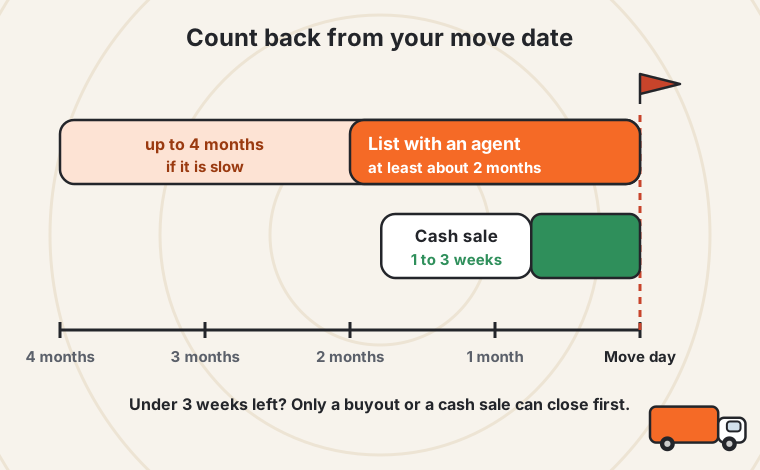
The selling clock has three parts, and only one of them is in your hands:
- Prep (you control it): hiring a Connecticut attorney, choosing an agent, repairs, cleaning, photos and the state disclosure forms. One to six weeks.
- On the market (the market controls it): Connecticut’s median days on market was 28 in May 2026, 41 in September 2026 and 61 in January 2026 (Realtor.com via FRED). Spring is fastest, the holidays slowest.
- Contract to closing (lenders and attorneys control it): inspections, the bank appraisal, the buyer’s mortgage commitment and the title search. About 30 to 45 days with a mortgage buyer. The buyer’s lender must give the buyer the final Closing Disclosure at least three business days before closing, so late loan changes push the date.
Plan backwards from the day you leave
| Time before your move | What still fits | What to do this week |
|---|---|---|
| 4 months or more | A full listing, timed to close before you leave | Hire your attorney, get a price opinion, fix only what inspectors and lenders flag |
| 2 to 4 months | A listing is possible if the house is ready and priced right; have a plan B | List quickly; ask for a closing date with a few weeks of cushion, or a short rent-back |
| 3 to 8 weeks | A listing will probably close after you leave | Decide now: sell from a distance, rent it, take a buyout, or take a cash offer |
| Under 3 weeks | Only a relocation buyout or a cash sale can close before you go | Set up a power of attorney or a mail-away closing; protect the empty house |
Typical shapes, not promises. Relocation buyout timelines are set by each program; ask your relocation company for its schedule in writing. For the full step-by-step clock, see how long it takes to sell a house in Connecticut, and if you can choose your listing month, our best time to sell in Connecticut guide shows the state’s month-by-month sales.
When could your house sell, and for how much?
Get a forecast for your own address: a likely price range from recent sales near you and a realistic time to sell, so you can line it up against your move date.
Know where you stand,
on your own time.
Watch what homes around you sell for and how fast, so when you are ready, you already know your options.
Follow your numbers as the market moves, and decide when the timing is right.
Should you sell your Connecticut house before or after you buy the next one?
Whether you should sell your Connecticut house before or after buying the next one depends on cash and risk. Selling first frees your equity and removes the risk of two mortgages, but you may need temporary housing. Buying first lets you move once, but you must qualify for both loans and carry both homes until the Connecticut house closes. A contingent offer or a rent-back can bridge the gap.
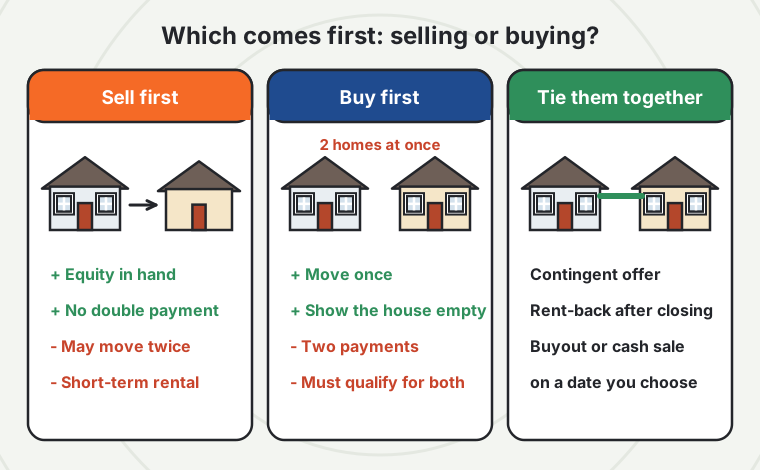
Sell first
- You know your exact budget for the next home
- Your equity is in the bank, ready for a down payment
- No risk of paying two mortgages
- You may need a short-term rental, or a rent-back from your buyer
- You may move twice
Buy first
- You move once, straight into the new home
- The Connecticut house can be shown empty and staged
- You must qualify for both payments, or use a bridge loan
- Every month unsold costs you a second set of bills
- Pressure to cut the price if the sale drags
Tie them together
- Make your purchase contingent on selling the Connecticut house, or
- Sell with a rent-back (use and occupancy) so you stay after closing, or
- Use a relocation buyout or cash sale with a closing date you choose
- Works best when the timing of both sides is planned in writing
Questions to answer before you choose
- Can you qualify for both payments? Ask your lender now, not after you find the next house. Lenders count your Connecticut mortgage, property tax and insurance against you until it is sold or rented under a lease.
- Is the destination market fast or slow? In a competitive market, sellers often refuse offers that depend on you selling first, which pushes you toward selling first or using a bridge.
- How long can you carry the Connecticut house? Add your mortgage payment to the monthly carrying costs in the table below. Multiply by four months. If that number scares you, sell first.
- Do you have a relocation package? A guaranteed buyout removes the risk of buying first. Read the relocation package section before you decide.
How do you pay for the next house before your Connecticut house sells?
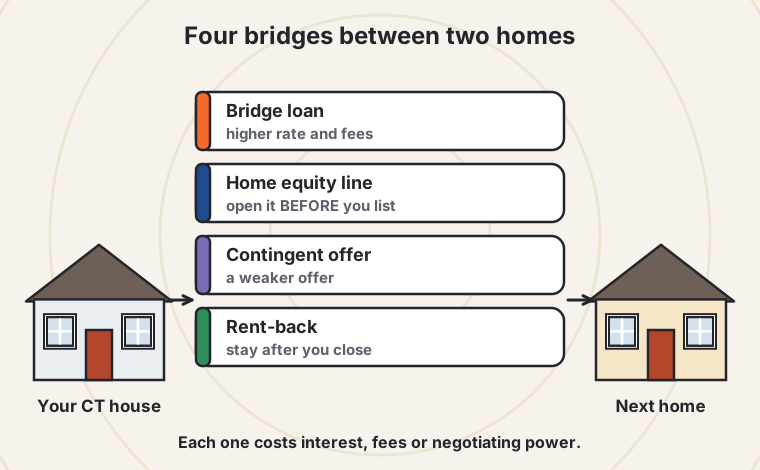
To pay for the next house before your Connecticut house sells, owners use a bridge loan secured by the current house, a home equity line opened before listing, a purchase contingent on the sale, a rent-back after selling first, or savings and an employer advance. Each costs something: interest, fees, a weaker offer, or the risk of carrying two homes if the sale takes longer than planned.
| Bridge option | How it works | Good for | The catch |
|---|---|---|---|
| Bridge loan | A short-term loan against your Connecticut house, repaid when it sells | Buying first in a competitive market | Usually a higher rate and fees than a regular mortgage; you may carry three payments for a while. Get a written quote. |
| Home equity line (HELOC) | Borrow against your equity for the next down payment | Owners with strong equity who plan ahead | Open it before you list: many lenders will not open a line on a house that is already for sale. The line is paid off at your closing. |
| Contingent purchase | Your offer on the next home depends on selling the Connecticut house by a date | Slower destination markets | A weaker offer; sellers may add a “kick-out” clause that lets them take another buyer |
| Rent-back (use and occupancy agreement) | You sell and close, then stay for an agreed period, paying the buyer | Selling first without moving twice | Your attorney writes it; the buyer may hold back part of your proceeds in escrow until you leave, and the buyer’s lender must allow it |
| Employer advance or equity advance | Your relocation program advances part of your equity | Employees with a full relocation package | Repaid from the sale; read the terms and the tax treatment |
| Cash sale on your schedule | A direct buyer closes when you choose, before or after your move | Short timelines, houses that need work | You trade price for speed and certainty |
In Connecticut the attorneys write the purchase contract, so a rent-back is easy to add: the agreement sets the daily or monthly charge, who pays utilities, the move-out date and how much of your proceeds stays in escrow until you hand over the keys. It lets you sell while the house still looks lived-in and move once, on your date. Ask your attorney for a use and occupancy agreement before you accept an offer, and make sure the buyer’s lender allows it.
Should you rent out your Connecticut house or sell it when you relocate?
Renting out your Connecticut house instead of selling makes sense when the rent covers the mortgage, taxes, insurance and repairs with room to spare, you have a reliable local manager, and you might come back or expect prices to rise. Selling is usually better if the numbers are thin, the house needs work, or you would lose the home-sale tax exclusion by waiting more than about three years after you move out.
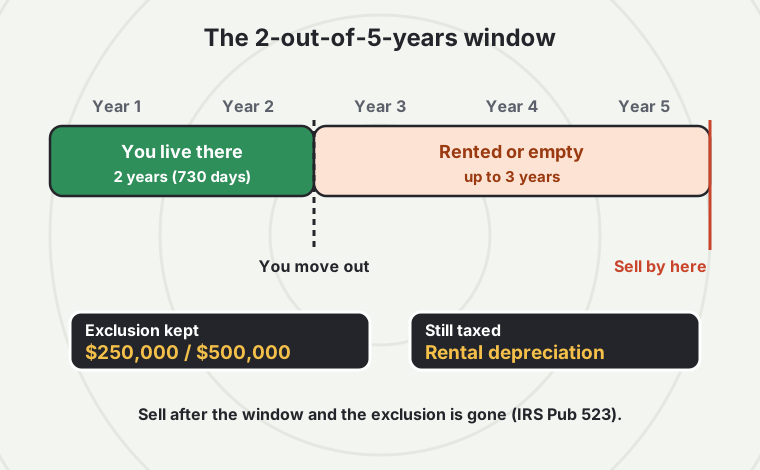
The tax clock most renters forget
The home-sale exclusion lets you exclude up to $250,000 of gain, or $500,000 for most married couples filing jointly, if you owned the house and lived in it as your main home for at least 24 months (730 days) during the 5 years before the sale (IRS Publication 523). The two years do not have to be in a row.
That gives a relocating owner a window. If you lived in the house for two years or more, you can rent it out after you move and still qualify, as long as you sell within about three years of moving out. Wait longer and the exclusion is gone. Time after you last lived in the house, within that five-year window, does not count as “nonqualified use” that would shrink your exclusion.
What changes when you become a landlord
- Depreciation. While the house is a rental you take depreciation deductions (IRS Publication 527). When you sell, the exclusion does not cover depreciation allowed or allowable after May 6, 1997; that part of the gain is taxable even if the rest is excluded (Pub 523).
- Connecticut landlord law applies. You may not take a security deposit of more than two months’ rent, or one month’s rent if the tenant is 62 or older; it goes into an escrow account, earns interest, and must be returned within 21 days after the tenancy ends (or 15 days after you get a forwarding address, whichever is later) (CGS 47a-21). If you later sell, the deposits transfer to the buyer.
- Selling with a tenant is slower. A lease survives a sale, showings need the tenant’s cooperation and proper notice, and many buyers want the house empty. Read our landlord’s guide to selling a rental with tenants in Connecticut before you sign a long lease.
- Insurance changes. A homeowners policy usually does not cover a rented house. You need a landlord (dwelling) policy, and the tenant needs renters insurance.
- Your mortgage. Many owner-occupied mortgages require you to live in the house for a period after buying. Moving for a job is often allowed; check your loan documents and tell your lender.
A rent-or-sell test you can run in ten minutes
| Monthly line (your numbers) | Illustrative example |
|---|---|
| Market rent | $2,600 |
| Minus mortgage principal and interest | −$1,400 |
| Minus property tax (your town’s mill rate) | −$700 |
| Minus landlord insurance | −$150 |
| Minus property manager (often 8% to 10% of rent, est.) | −$230 |
| Minus repairs and vacancy reserve (est. 10%) | −$260 |
| Monthly cash flow | −$140 |
In the example the house loses money every month before any big repair, and the owner is a long-distance landlord for the privilege. That is common in Connecticut towns with high mill rates. Renting wins when the mortgage is small or the rate is very low, the house is in good shape, you have a manager you trust, and you have a reason to keep it. Otherwise, selling while you still qualify for the exclusion is usually the cleaner choice. Our older post on moving when your house hasn’t sold yet covers the short-term version of this decision.
How do employer relocation packages handle your Connecticut house?
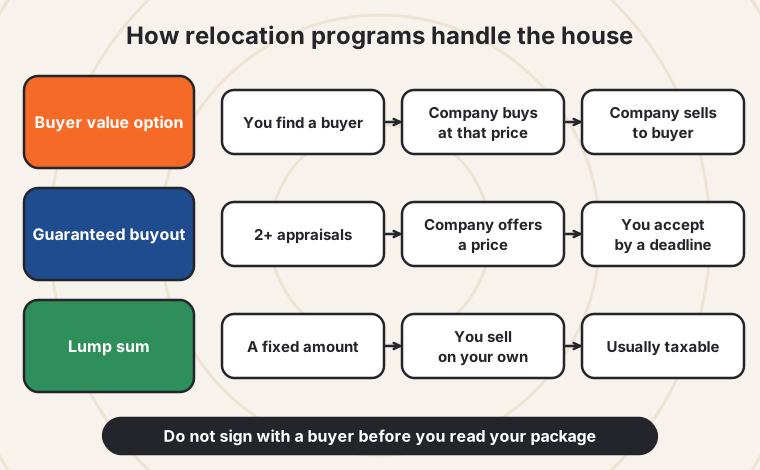
Employer relocation packages handle your Connecticut house in one of a few ways: a buyer value option, where the relocation company steps in to buy the house at the price an outside buyer offers; a guaranteed buyout, where it offers a price based on appraisals if you cannot sell; a lump sum you spend as you choose; or help with selling costs only. Read the house section of your package before you list, because listing the wrong way can disqualify you.
| Program | How the price is set | What it does for you | Ask before you sign |
|---|---|---|---|
| Buyer value option (BVO), sometimes called amended value | You and your agent find a buyer; the relocation company buys at that buyer’s price, then sells to the buyer | The company usually pays the selling costs; you are out once its purchase closes | Which agents you may use, what you may sign with the buyer (often nothing), and the deadlines |
| Guaranteed buyout (GBO) | Usually the average of two or more appraisals, if you do not sell yourself in a set period | A guaranteed exit by a date | How many days you get to market first; the appraisal rules; who pays for repairs found in inspections |
| Lump sum | No price; a fixed amount for the whole move | Flexibility | Whether it is taxed (usually yes) and whether there is a repayment clause if you leave the job |
| Home-sale assistance or loss-on-sale help | You sell on the open market | Pays some selling costs or part of a loss | Caps, documentation, and tax treatment |
The tax side of relocation money since 2026
For years, employer-paid moving costs were partly tax-free. Federal law (P.L. 119-21, signed in 2025) permanently eliminated the exclusion for qualified moving expense reimbursements, so for most employees, moving money from an employer is taxable wages (IRS Publication 15-B). The exceptions are members of the U.S. Armed Forces on active duty who move under a permanent change of station order, and certain employees and new appointees of the intelligence community who must relocate. Many employers “gross up” the payment to cover the tax; ask.
Home-sale programs are treated differently. The IRS has ruled (Revenue Ruling 2005-74) that, in a properly structured program where the relocation company truly buys the house, the employee is treated as selling the house, and the company’s payment of selling costs in that structure is not compensation to the employee. Whether your program fits that ruling depends on its paperwork. Ask your relocation company and your tax adviser; do not assume.
Under a buyer value option, the relocation company usually needs to be the seller to the buyer. If you sign a purchase and sale agreement with a buyer on your own, you may lose the benefit. Tell your agent and your Connecticut attorney that you are in a relocation program on day one.
When the package wins: if you have a buyer value option or guaranteed buyout with selling costs paid, it will usually leave you with more than a direct cash sale. A cash buyer makes sense alongside a package mainly when the buyout price is low because of repairs, when the program’s deadline is too slow for you, or when the package covers only part of the costs.
What taxes do you owe when you sell a Connecticut house after moving away?
When you sell a Connecticut house after moving away, you pay the state and town conveyance tax at closing, your share of the year’s property tax, and federal and Connecticut income tax only on any gain the home-sale exclusion does not cover. Moving out of state does not end Connecticut tax on the sale: nonresidents still owe Connecticut income tax on a taxable gain from Connecticut real estate.
| Tax | Who pays and when | Amount | Relocation point |
|---|---|---|---|
| Conveyance tax (state and town) | Seller, at closing, before the deed is recorded (CGS 12-494) | State 0.75% up to $800,000, 1.25% on $800,000 to $2.5 million, 2.25% above; town 0.25% in most towns, 0.50% in 16 cities; Stamford 0.35% / 0.50% | Same wherever you live. Your attorney files Form OP-236. |
| Property tax proration | Usually a seller credit to the buyer at closing | Your share of taxes not yet billed (towns bill in arrears) | Keep paying town tax bills until closing, even from out of state |
| Federal tax on the gain | You, with your tax return | Often $0 on a main home thanks to the $250,000 / $500,000 exclusion | Partial exclusion possible if you sell before two years because of a job move of 50 miles or more |
| Connecticut income tax on the gain | You, on a Connecticut return (resident, part-year or nonresident) | Taxable gain at Connecticut rates, 2% to 6.99% | Applies to nonresidents for Connecticut real estate (CGS 12-711) |
| Federal FIRPTA withholding | Withheld from a foreign seller’s proceeds at closing | Generally 15% of the amount realized, unless an exception applies | Only for foreign persons, not for U.S. citizens who move to another state |
Selling before you hit two years: the job-move partial exclusion
If you must sell before you have lived in the house for two years, you may still get a partial exclusion. Under IRS Publication 523, a work-related move qualifies if your new job is at least 50 miles farther from the home than your old work location (or, if you had no job, at least 50 miles from the home). Health reasons and certain unforeseeable events can also qualify. The exclusion is then a fraction of $250,000 or $500,000 based on how much of the two years you met.
Is Connecticut tax withheld at closing when you live out of state?
We found no Connecticut rule requiring state income tax to be withheld at closing when a U.S. seller lives in another state. You still owe the tax on any taxable gain and file a Connecticut nonresident or part-year resident return. Ask your attorney to confirm for your closing, and see our guide to taxes when selling a house in Connecticut for the details, including rentals and inherited houses.
How do you sell a Connecticut house when you have already moved out of state?
To sell a Connecticut house after you have moved out of state, put a local team in place: a Connecticut real estate attorney, a listing agent or direct buyer, and someone nearby to check the house. Then sign the disclosures electronically, approve offers by email, and sign the closing documents in front of a notary where you live, or give a trusted person a power of attorney. You do not need to fly back for the closing.
Connecticut makes long-distance selling easier than many states in one way: closings are run by attorneys (CGS 51-88a), and your attorney can handle the payoff, the deed, the conveyance tax return and the wire to you without you in the room. What it does not allow is closing by video notarization. Here is the team you need:
| Who | What they do for an out-of-state seller |
|---|---|
| Your Connecticut real estate attorney | Reviews the contract, orders your mortgage payoff, prepares the deed, conveyance tax return and affidavits, sends you the mail-away package or prepares the power of attorney, and wires your proceeds |
| Listing agent (or a direct buyer) | Pricing, photos, showings, lockbox access, managing inspections and the appraiser |
| A local key holder | A neighbor, friend or paid house-checker who walks through weekly, picks up flyers and mail, and is the emergency contact for the alarm company and the oil dealer |
| Your insurance agent | Confirms the policy still covers the house while it is empty, or moves you to a vacant-home policy |
| Utilities and the oil or propane dealer | Keep heat and power on, set up automatic delivery, and take final readings at closing |
| Town offices | Tax collector (pay bills on time), building department (open permits), water and sewer (final reading) |
What you can do from anywhere
- Sign the listing agreement, the Residential Property Condition Report and the lead paint disclosure electronically, as your agent and attorney allow. Fill in the condition report honestly before you leave, while you still remember the house; a buyer who does not get it before signing receives a $500 credit at closing (CGS 20-327c).
- Review offers and counter-offers by email and video call.
- Approve repair credits after the inspection without traveling.
- Sign the smoke and carbon monoxide affidavit as part of the closing package (or the buyer gets a $250 credit, CGS 29-453). Make sure the detectors are installed and working before you leave, so you can truthfully sign it.
Before you go, gather the papers the buyer and attorneys will ask for. Our list of the documents you need to sell a house in Connecticut covers each one and where to get it, and our Connecticut closing process guide explains every step after the contract.
Can you close on a Connecticut house sale remotely?
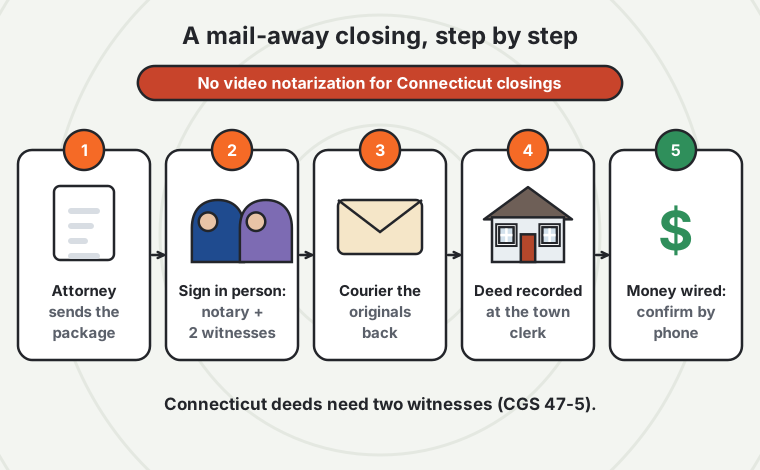
Yes, you can close on a Connecticut house sale remotely, but not by video. Connecticut’s remote notarization law excludes real estate closings (CGS 3-95b), so an out-of-state seller usually signs a “mail-away” closing package in person before a notary where they now live, with two witnesses for the deed, and couriers the originals back to the Connecticut attorney. A power of attorney is the other route.
What Connecticut law says
- No video notarization for closings. Since Public Act 23-28, Connecticut notaries may notarize some documents remotely, but CGS 3-95b(i) bars remote acknowledgment for a real estate closing (as defined in CGS 51-88a) and for a power of attorney. An acknowledgment done that way is ineffective.
- Out-of-state acknowledgments are valid. A deed or power of attorney for Connecticut land that is signed and acknowledged in another state, following that state’s law or Connecticut’s, is valid here (CGS 47-7, with an exception for remotely located signers). Connecticut also recognizes notarial acts by notaries and other officers of other states (CGS 1-57).
- Two witnesses on the deed. A Connecticut deed must be acknowledged and signed in front of two witnesses (CGS 47-5). Many states do not require witnesses, so a notary there may not expect it. Your attorney’s instructions will show where each witness signs; bring a friend, or ask the notary’s office to supply witnesses.
How a mail-away closing works
- Your attorney sends the package. About a week before closing, your Connecticut attorney emails or overnights the deed, the conveyance tax return, the affidavits and the instructions, with a prepaid return envelope.
- You sign in person where you live. At a bank, a law office or a mobile notary, in front of the notary and two witnesses for the deed. Follow the instructions exactly: blue ink if requested, no dates left blank, names exactly as on the deed.
- Courier the originals back. Overnight, with tracking, to your attorney. Originals are needed to record the deed at the town clerk.
- The closing happens without you. The buyer signs with their attorney. Your attorney holds your documents in escrow until the buyer’s funds arrive, pays off your mortgage, records the deed and pays the conveyance tax.
- Your money is wired. Your attorney wires your net proceeds to the account you gave them in writing. Confirm the account by phone at a number you already know.
Criminals watch for real estate closings and send fake “updated wiring instructions” by email. Give your bank details to your attorney once, by phone or in person, and never act on an email that changes them. Call your attorney’s office at the number on their website or engagement letter before any money moves.
Can someone sign for you with a power of attorney when you sell a Connecticut house?
Yes, someone can sign for you with a power of attorney when you sell a Connecticut house. Under Connecticut’s Uniform Power of Attorney Act, the power of attorney must be dated, signed and witnessed by two witnesses, and should be acknowledged before a notary (CGS 1-350d). When your agent signs the deed, the power of attorney is recorded on the town land records with it (CGS 47-10). Clear the document with your attorney and the title insurer first.
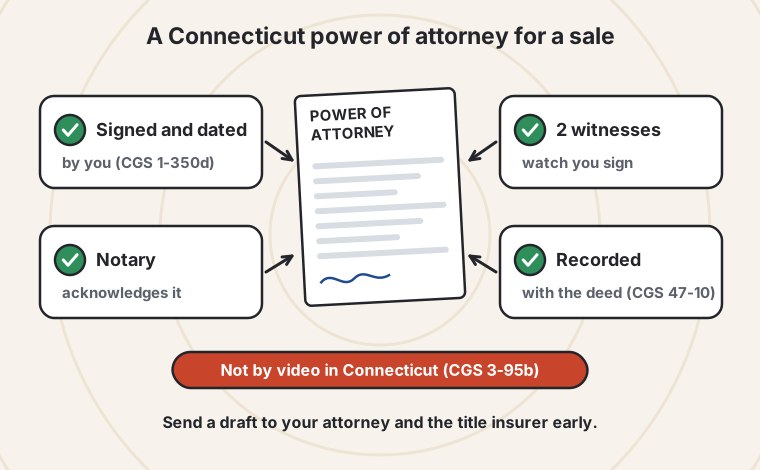
A power of attorney is the best route when you cannot be sure where you will be on closing day (deployments, travel, a new job with no time off), or when the closing documents may change at the last minute. It lets a trusted person, often a family member or your Connecticut attorney, sign everything for you.
| Requirement | Connecticut rule |
|---|---|
| Signed and dated by you | Or by someone in your conscious physical presence at your direction (CGS 1-350d) |
| Two witnesses | Required for a power of attorney signed in Connecticut since October 1, 2016 (CGS 1-350d, 1-350e). Deeds also need two witnesses (CGS 47-5). |
| Notary acknowledgment | Makes the signature presumed genuine (CGS 1-350d); in practice, title insurers want it. Not by remote video in Connecticut (CGS 3-95b). |
| Signed in another state | Valid if it complied with that state’s law when signed (CGS 1-350e), and valid for Connecticut land if executed and acknowledged under that state’s law or Connecticut’s (CGS 47-7) |
| Recorded | Recorded with the deed on the land records of the town where the house is, unless already recorded there and referenced in the deed (CGS 47-10) |
| How the agent signs the deed | For example “Name of owner, by (agent’s signature), his or her agent” (CGS 47-5(c)) |
Practical tips
- Use a limited (specific) power of attorney that names the property address and the sale, rather than a general one. Title insurers and lenders review these documents closely, and a specific one raises fewer questions.
- Send a draft to your attorney and the buyer’s attorney early. Some title insurers have their own requirements; finding out a week before closing is too late.
- Keep the original. The original, signed document is what gets recorded. Overnight it to your attorney.
- Military? Your installation’s legal assistance office can prepare and notarize a power of attorney. Tell your Connecticut attorney which form you plan to use.
- A power of attorney ends at death. If the owner dies, the house is sold through probate instead; see our guide to selling an inherited house in Connecticut.
What are the risks of leaving a Connecticut house vacant while it sells?
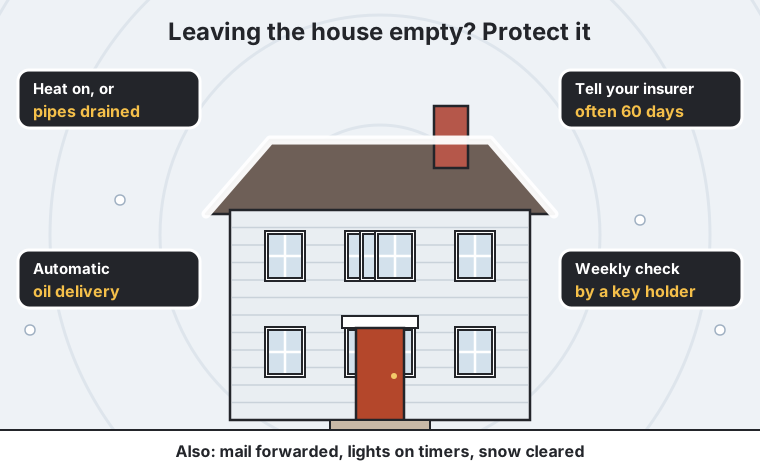
The risks of leaving a Connecticut house vacant while it sells are frozen and burst pipes, water damage nobody sees for days, break-ins and vandalism, and insurance gaps: many homeowners policies limit coverage once a house has been vacant for about 60 consecutive days, and freeze damage is often excluded unless the heat was kept on or the water was shut off and drained. Call your insurer before you move out.
Insurance: the call to make before the moving truck comes
Standard homeowners policies are written for a house someone lives in. Common policy forms exclude vandalism and glass breakage if the house has been vacant for more than 60 consecutive days before the loss, and exclude freezing damage to plumbing in an unoccupied or vacant house unless you kept the heat on or shut off the water and drained the system. Your policy may differ, so ask your agent three questions in writing:
- How many days can the house be empty before any coverage changes?
- What exactly must I do to keep freeze and water coverage (heat setting, water shut-off, inspections)?
- Do I need a vacancy endorsement or a vacant-home policy, and what does it cost?
Connecticut houses rely heavily on heating oil: in many towns, oil heats most single-family homes (town assessor data in the table below). An oil tank that runs dry in January is a common way a vacant house freezes. Put the house on automatic delivery, and ask the dealer to call your key holder, not just you.
Your empty-house checklist
- Call your insurer; get the vacancy rules in writing
- Keep the heat on (a low setting, as your insurer advises) and set up automatic oil or propane delivery
- Or have the house professionally winterized: water off, pipes and water heater drained, antifreeze in traps
- Install a smart thermostat or a low-temperature and water-leak alarm that texts you and your key holder
- Keep electricity on for the sump pump, the alarm and showings
- Forward your mail with the Postal Service and cancel newspapers
- Arrange lawn mowing and snow and ice removal; a buyer’s first impression and your liability both depend on it
- Give a key holder the alarm code and your insurer’s claim number
- Set lights on timers; leave some basic furniture or staging if your insurer allows
- Keep paying the town’s property tax and water and sewer bills on time
- Test smoke and carbon monoxide detectors so you can sign the closing affidavit
- Photograph every room on the day you leave (useful for claims and for the condition report)
If something happens to the house after you sign a contract, such as a burst pipe or a break-in, tell your attorney right away. Your contract decides who bears the risk of loss before closing and what the buyer can do. Your disclosure obligations do not end when you move out.
What does it cost to carry and sell a Connecticut house after you move?
Carrying a Connecticut house after you move costs your mortgage payment plus property tax, insurance, heat, electricity, water, lawn and snow care, and any vacancy coverage, usually somewhere between several hundred and a few thousand dollars a month before the mortgage. Then the sale itself costs commissions if you list, the conveyance tax, your attorney and the property tax proration at closing.
Property tax alone is a large monthly number in many Connecticut towns. The table shows the estimated tax per month on a house selling at the town’s median single-family price, plus the share of homes heated by oil, which matters for winter freeze risk. Each town name links to our page for that town.
| Town | Homes sold (Oct 2024–Sep 2025) | Median sale price | Mill rate (FY 2027) | Est. property tax per month | Single-family homes heated by oil | Town conveyance tax |
|---|---|---|---|---|---|---|
| Groton | 462 | $347,500 | 25.29 | $550 | 77% | 0.25% |
| Ledyard | 257 | $385,000 | 25.87 | $590 | 86% | 0.25% |
| Stamford | 1,493 | $699,000 | 28.47 | $1,490 | 50% | 0.35% (0.50% above $1M) |
| Norwalk | 1,033 | $605,000 | 32.00 | $1,400 | 69% | 0.50% |
| Fairfield | 812 | $879,500 | 19.19 | $1,050 | 43% | 0.25% |
| Danbury | 959 | $443,000 | 25.23 | $700 | 39% | 0.25% |
| West Hartford | 831 | $485,100 | 46.77 | $1,420 | 27% | 0.25% |
| Glastonbury | 477 | $540,000 | 33.73 | $1,210 | 47% | 0.25% |
| Manchester | 724 | $315,000 | 41.00 | $770 | 46% | 0.25% |
| Hartford | 825 | $290,000 | 69.95 | $1,060 | n/a | 0.50% |
| New Haven | 1,022 | $350,000 | 39.962 | $770 | n/a (mixed oil/gas) | 0.50% |
| Milford | 780 | $450,000 | 28.67 | $860 | 37% | 0.25% |
| Waterbury | 1,305 | $270,000 | 43.34 | $710 | 40% | 0.50% |
| Bristol | 882 | $317,500 | 35.30 | $680 | 76% | 0.50% |
A worked example: list now, list after moving, or sell for cash
Say your house would sell for $400,000 on the open market in a town with the standard 0.25% town conveyance tax and property tax of about $800 a month. Your move is in six weeks. These numbers are illustrative, not a quote or a promise.
List now, close after you move
$365,800after selling and carrying costs
- $400,000 price
- −$20,000 commissions (5%, est.)
- −$4,000 conveyance tax (1%)
- −$1,200 attorney (est.)
- −$3,000 prep and repairs (est.)
- −$6,000 four months empty at $1,500 a month (tax, insurance, heat, utilities, upkeep; est.)
- Plus four mortgage payments while you also pay rent or a new mortgage
List and close before you move
$371,800if you can wait about 2 to 4 months
- Same price and selling costs
- No empty months
- Only works if your move date allows it
Illustrative cash offer
$334,400on a $340,000 example offer
- −$3,400 conveyance tax (1%)
- −$1,200 attorney (est.)
- −$1,000 about three weeks of carrying (est.)
- No repairs, showings or empty months
In this example, listing leaves you about $31,000 to $37,000 more than the example cash offer, before you count the mortgage payments while the house sits empty. That is the honest picture for a house in good condition: if you can wait and carry it, listing usually wins. The gap narrows when the house needs major work (which comes off a listing too), when it sits through a winter, or when your carrying costs are high. Run your own numbers in the calculator, and see our guides on the cost to sell a house in Connecticut and the conveyance tax in every town.
How much would you walk away with?
Slide the numbers to match your house. It works in your browser; nothing is saved or sent.
Estimates for planning. Conveyance tax per CGS 12-494 (state 0.75% up to $800,000, 1.25% to $2.5M, 2.25% above, plus the town rate). Seller attorney about $1,200 to $1,500; flat-fee MLS about $400; listings include three months of taxes, insurance and utilities, a cash sale about two weeks. Your attorney gives you the final numbers.
When does a cash sale make sense for a relocation, and when does it not?
A cash sale makes sense for a relocation when the move date is too close for a listing, the house needs repairs you cannot manage from far away, carrying two homes would strain you, or the house is hard to finance. It does not make sense when your employer offers a buyout or a buyer value option, the house is ready to sell, you have time, or a rental would cover its costs. Then a listing, the package or renting usually leaves you more.
A cash sale fits if…
- You move in weeks, not months
- The house needs a roof, a furnace, an oil tank removal or a clean-out
- You cannot qualify for, or do not want, two housing payments
- The house would sit empty through a Connecticut winter
- You want one closing date you choose, before or after your move
- A buyer’s mortgage might fail on condition (foundation, septic, old wiring)
Choose something else if…
- Your relocation package includes a buyout or buyer value option
- The house is updated and similar houses sell fast
- You have three months or more before you need the money
- Rent would cover all costs and you want to keep it
- You can stay put and sell in spring
If you go the cash route, compare more than one offer, check what each buyer actually does (buys and closes, or assigns the contract to someone else), and have your own Connecticut attorney. Our guide to cash home buyers in Connecticut explains how offers are calculated, and the checklist for vetting a cash home buyer in Connecticut shows how to confirm proof of funds, a real local closing record and a written closing date. To weigh any two offers, use our guide on how to compare offers on a house in Connecticut, and for the full side-by-side, see cash buyer vs. realtor in Connecticut.
Moving soon? Get a cash offer from photos
Send the address and a few phone photos from wherever you are. We price the repairs we see and send a written offer with a closing date you choose, so you can compare it with your listing and buyout options.
Know your cash number before you choose a route
Want your offer faster, or rather not talk to anyone yet? Photos from your phone, a written offer, and a closing date that fits your move. No showings, no obligation.
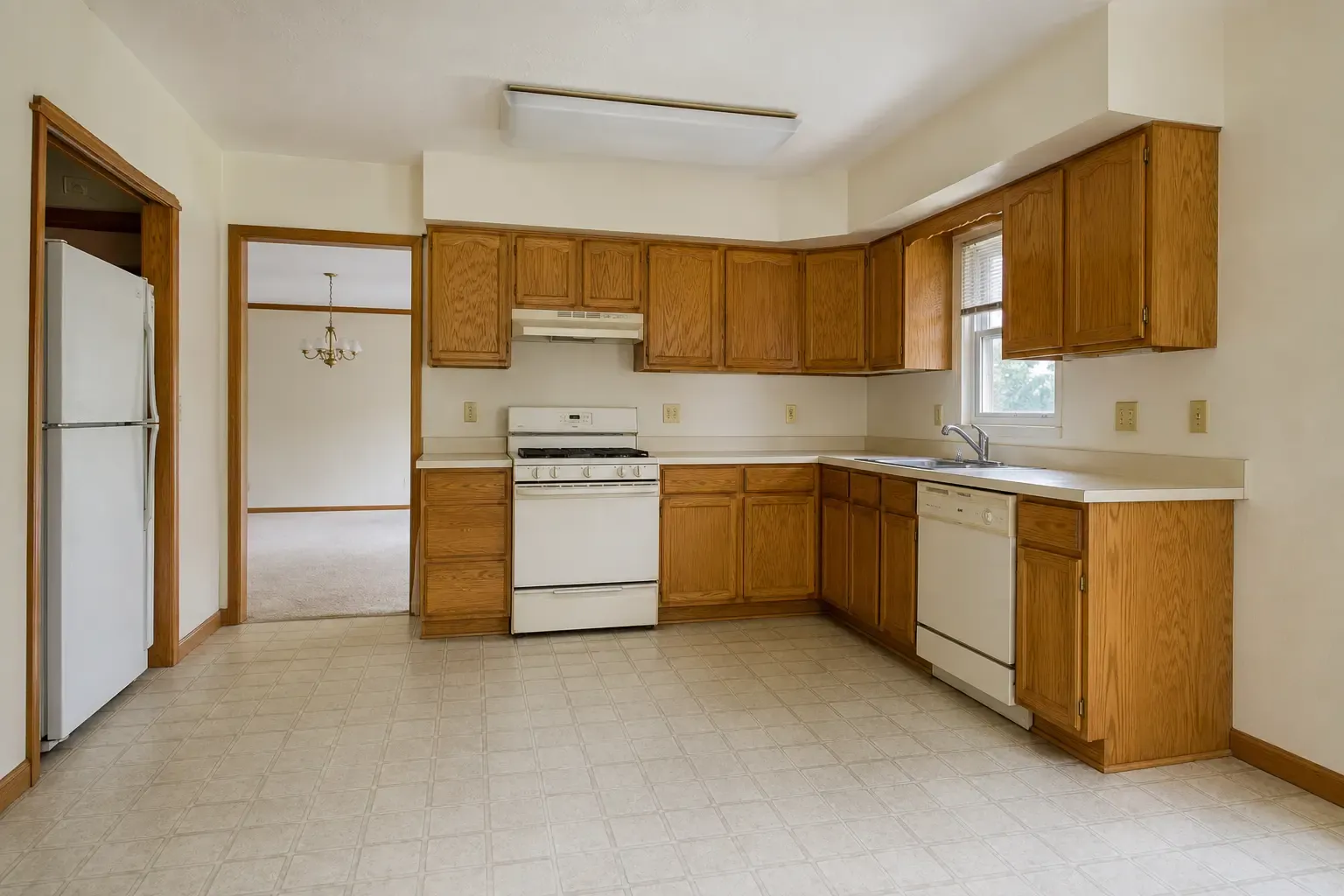 CabinetsFlooring
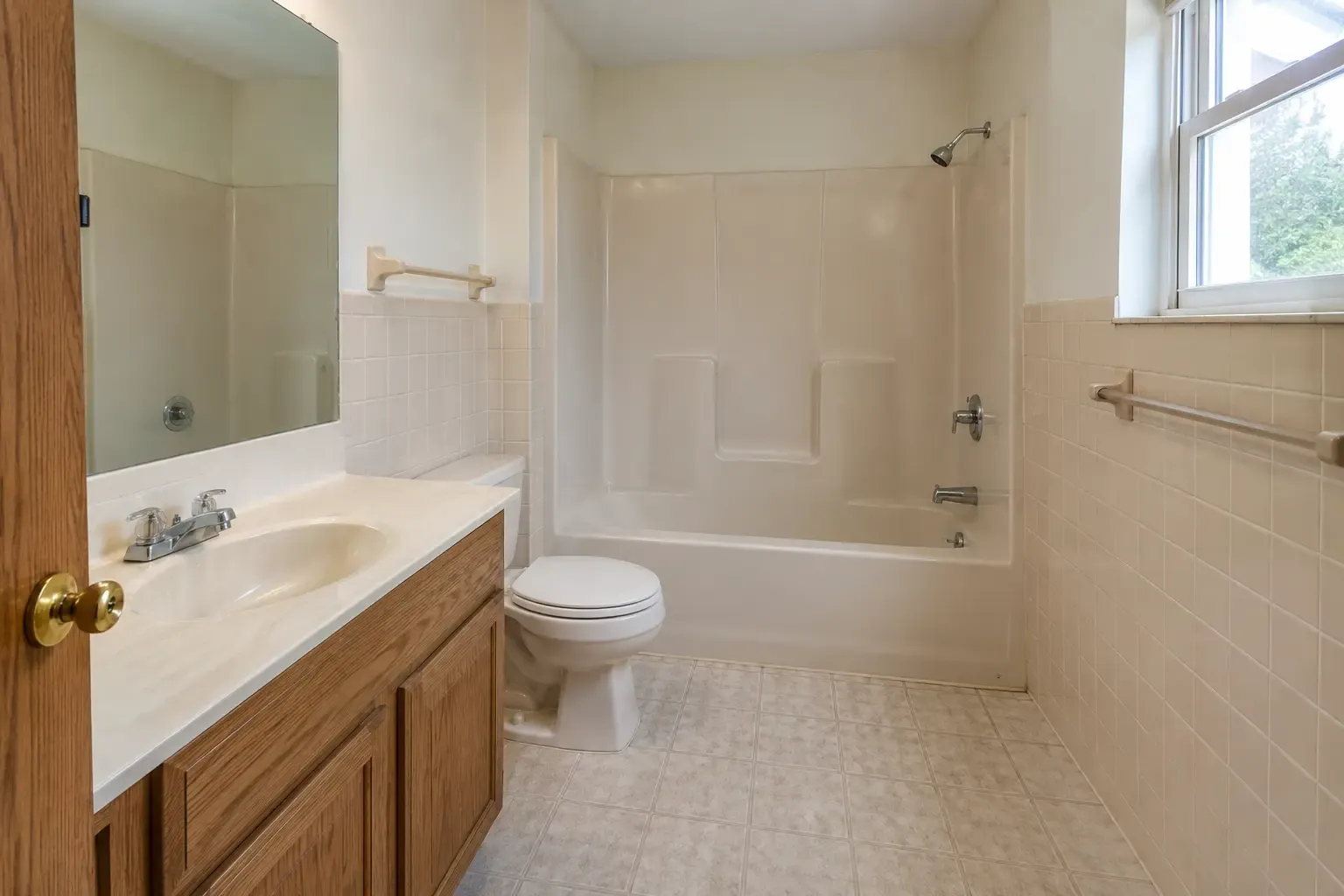 Tub & tile
 Floors
 Roof
We may bring in a partner buyer to close. Your price and terms don't change.
How do you sell your Connecticut house when relocating, step by step?
To sell your Connecticut house when relocating, follow these steps: set your deadline, read your relocation package, get a price and timeline, decide whether to sell, rent or take a buyout, hire a Connecticut attorney, fill in the disclosures before you leave, protect the empty house, plan how you will sign, compare offers on net and timing, and close by mail-away package or power of attorney.
Write down your real deadline
Not just the moving day: the day you need the equity for the next home, the day your new lease or mortgage starts, and the last day you can carry two payments. That deadline decides which routes are open.
Read the house section of your relocation package
Look for a buyer value option, a guaranteed buyout, a lump sum, or help with selling costs. Ask the relocation counselor what you may and may not sign, and by when. Do this before you call an agent.
Get a price and a timeline for your house
Use recent sales near you, an agent’s price opinion, or the forecast tool above. Compare the likely closing date with your deadline.
Decide: sell before, sell after, rent, buyout or cash
Use the tables in this guide. If you are thinking of renting, run the cash-flow test and check your three-year exclusion window.
Hire a Connecticut real estate attorney
Tell them you are relocating and ask how they handle mail-away closings and powers of attorney. Ask for the fee in writing.
Do the paperwork while you are still in the house
Fill in the Residential Property Condition Report, the lead paint disclosure for homes built before 1978, and gather your deed, survey, permits, oil tank, septic and well records.
Fix only what blocks a sale
Leaks, broken heat, missing smoke and CO detectors, anything a lender would flag. From far away, every repair costs more to manage. See what to fix before selling in Connecticut and our low-cost fixes.
Protect the house before you leave
Insurance call, heat or winterizing, automatic oil delivery, alarms, a key holder, mail forwarding, lawn and snow care.
Choose how you will sign
A mail-away closing package signed before a notary and two witnesses where you live, or a recorded power of attorney. Settle this with your attorney before you go.
Compare offers on net and certainty
Price minus commissions, credits and repairs, plus how likely the buyer is to close and when. A slightly lower offer that closes on your date can be worth more than a higher one that needs a mortgage in winter.
Close and confirm the wire
Sign and return the originals, confirm the wiring details by phone, and keep the closing statement for your taxes.

The relocation sales that go sideways are rarely about price. They are about a house that sat empty without anyone checking it, or a signature nobody planned for. Before you hand back the keys to your old life here, settle two things with your attorney: how you will sign from your new home, and who walks through the house every week until it closes.
Your relocation selling checklist for Connecticut
This relocation selling checklist covers every task for selling a Connecticut house when you move, in the order you need them. Tick items off as you go; your progress is saved on this device.
- Write down the move date, the date you need the equity, and the last day you can carry two homes
- Read the relocation package: buyout, buyer value option, lump sum or selling-cost help
- Ask your lender whether you can qualify for both payments, or for a bridge loan
- Open a home equity line before listing, if you plan to use one
- Get a price opinion and a realistic timeline
- Run the rent-or-sell test and check your 3-year exclusion window
- Hire a Connecticut real estate attorney; ask about mail-away closings
- Fill in the Residential Property Condition Report and lead paint disclosure
- Collect the deed, survey, permits, and oil tank, septic, well and radon records
- Fix leaks, heat and safety items; install working smoke and CO detectors
- Call your insurer about vacancy; get the rules in writing
- Set up heat and automatic fuel delivery, or winterize
- Name a local key holder; give them the alarm code and insurer’s number
- Forward mail; arrange lawn and snow care
- Decide on a mail-away closing or a power of attorney, and prepare it with your attorney
- Give your attorney your wiring details by phone, once
- Compare offers on net proceeds, certainty and closing date
- Keep paying town property tax, water and sewer bills until closing
- Keep your closing statement for your tax return
What if you are in the military, divorcing, or the house will not sell before you move?
If you are in the military, divorcing, or the house will not sell before you move, the basic plan is the same but the rules change: service members can suspend the five-year home-sale test for up to ten years, a divorce sale needs both owners’ signatures and often a court order, and a house that will not sell needs a decision on price, renting or a direct sale before the empty months add up.
Military moves (PCS orders)
Connecticut has a large military community around the Naval Submarine Base in Groton and the Coast Guard Academy in New London. Three rules help service members who must sell:
- The five-year test can be suspended. If you are on qualified official extended duty (more than 90 days or indefinite) at a duty station at least 50 miles from the home, or living in government quarters under orders, you can suspend the five-year test period for up to 10 years (IRS Publication 523). That can keep the exclusion alive if you rent the house while stationed elsewhere.
- Moving reimbursements stay tax-free for active-duty members moving under a permanent change of station order (IRS Publication 15-B), unlike most civilian relocations.
- Powers of attorney are routine. Your installation’s legal assistance office can prepare one; get it to your Connecticut attorney for review well before closing.
If you rent the house out while stationed elsewhere, the landlord guide covers Connecticut tenant rules, and our pages for Groton and Ledyard have local sales and tax data.
Relocating during a divorce
If one spouse is moving and the house is jointly owned, both owners must sign the listing, the contract and the deed, and a divorce decree or court orders may control the sale. A mail-away closing or power of attorney works for the spouse who has moved. Our older posts on selling your home during a divorce cover the basics.
The house will not sell before you move
Every month it sits costs you the carrying costs above, plus the mortgage. Look at the reasons in order: price, condition, photos and access. Our guide on why a house won’t sell in Connecticut walks through each one. If the fix is a price cut you can afford, make it once and make it count. If the fix is repairs you cannot manage from away, a direct sale may cost less than another winter.
Older homeowners moving closer to family
A move to be near children or into assisted living often comes with a lifetime of belongings. Our posts on handling all your stuff when you move, when to call a mover and moving long distance help with the logistics. If someone else will handle the sale, set up the power of attorney while the owner can sign it.
What mistakes do Connecticut owners make when they sell and relocate?
The biggest mistakes Connecticut owners make when they sell and relocate are listing before reading the relocation package, leaving an empty house without telling the insurer, planning a video closing that Connecticut does not allow, renting the house past the three-year exclusion window, and choosing an offer on price alone when the closing date and the buyer’s financing matter more for a move.
- Listing before reading the package. Signing a contract on your own can void a buyer value option.
- Assuming you can close by video. Connecticut does not allow remote online notarization for closings or powers of attorney (CGS 3-95b). Plan a mail-away signing or a power of attorney.
- Forgetting the two witnesses. Notaries in many states do not use witnesses. A Connecticut deed needs two (CGS 47-5). A missing witness can delay your closing.
- Leaving the house empty and uninsured. A vacancy clause or a frozen pipe can turn a sale into a claim fight.
- Letting the oil run out. Automatic delivery and a low-temperature alarm cost little.
- Renting “for a year or two” without checking the tax clock. Three years after moving out, the exclusion is gone.
- Treating moving money as tax-free. Since 2026 most employer-paid moving costs are taxable wages.
- Acting on an emailed change to wiring instructions. Always confirm by phone at a known number.
- Waiting until the last week to decide. Every route has a lead time. The decision is cheapest when the move is still months away.
Questions Connecticut owners ask about selling when they relocate
Do I have to be in Connecticut to sell my house?
No, you do not have to be in Connecticut to sell your house. You can sign the listing and disclosures electronically, approve offers by email, and sign the closing documents before a notary and two witnesses where you live, or give someone a power of attorney. Your Connecticut attorney handles the closing.
Can I close on my Connecticut house by video or online notarization?
No, you cannot close on a Connecticut house sale by video or remote online notarization. Connecticut’s remote notarization law excludes real estate closings and powers of attorney (CGS 3-95b). You sign in person before a notary where you live, and the originals are mailed back.
How long before my move should I list my Connecticut house?
You should list your Connecticut house about three to four months before your move if you want it closed before you leave: a few weeks of prep, a month or two on the market, and 30 to 45 days from contract to closing. With less time, plan to sell after you move, rent, take a buyout or sell for cash.
Should I sell before or after I move?
You should sell before you move if you need the equity for the next home or cannot carry two payments. Selling after you move can work if the house shows better empty and you can afford the carrying costs, but protect the empty house and expect two housing payments for a few months.
Can I rent my house out and still avoid capital gains tax?
Yes, you can rent your house out and still use the home-sale exclusion if you lived there at least two of the five years before the sale. In practice that means selling within about three years of moving out. Depreciation you claimed as a landlord is still taxed when you sell (IRS Pub 523).
What if I have lived in the house less than two years?
If you have lived in the house less than two years and move for a new job at least 50 miles farther from the home than your old job, you may qualify for a partial home-sale exclusion under IRS Publication 523. Health reasons and some unforeseeable events can also qualify.
Are employer relocation payments taxable?
Yes, employer relocation payments are taxable for most employees. Federal law permanently eliminated the moving expense reimbursement exclusion, except for active-duty military moving under a permanent change of station order and certain intelligence community employees (IRS Publication 15-B). Ask your employer whether it grosses up the payment.
What is a buyer value option in a relocation package?
A buyer value option is a relocation program where you find a buyer and the relocation company buys your house at that buyer’s price, then sells it to the buyer. The company usually pays the selling costs. Do not sign a contract with the buyer yourself unless the program says you may.
Is a guaranteed buyout better than a cash buyer?
A guaranteed buyout is usually better than a cash buyer when it is based on fair appraisals and the company pays the selling costs. A cash buyer can make sense if the buyout price is cut for repairs, the program is too slow, or your package does not include a buyout.
Can my spouse or a relative sign the closing papers for me?
Yes, your spouse or a relative can sign the closing papers for you with a power of attorney. In Connecticut it must be signed and dated, witnessed by two witnesses and acknowledged before a notary (CGS 1-350d), and it is recorded with the deed (CGS 47-10). A spouse who is a co-owner signs for themselves anyway.
Does Connecticut withhold tax from my proceeds if I now live in another state?
We found no Connecticut rule requiring state income tax to be withheld at closing from a U.S. seller who lives in another state. You still owe Connecticut income tax on any taxable gain and file a nonresident or part-year return. Federal FIRPTA withholding applies only to foreign sellers.
Will my homeowners insurance cover the house while it is empty?
Your homeowners insurance may not fully cover the house while it is empty. Common policy forms exclude vandalism after about 60 consecutive days of vacancy and exclude freeze damage unless the heat was kept on or the water drained. Call your insurer before you move and ask about a vacancy endorsement.
Should I winterize my vacant Connecticut house?
You should winterize your vacant Connecticut house, or keep the heat on with automatic fuel delivery and a low-temperature alarm, from late fall to spring. A professional winterization shuts off and drains the water. Tell your agent so showings and inspections can be planned.
Do I still pay Connecticut property tax after I move?
Yes, you still pay Connecticut property tax after you move, until the closing. Towns bill in arrears, so at closing you usually also credit the buyer for your share of taxes not yet billed. Keep paying the town’s bills on time to avoid interest and liens.
Can I sell my Connecticut house with a tenant in it after I move?
Yes, you can sell your Connecticut house with a tenant in it after you move. The lease survives the sale and the security deposit transfers to the buyer. Showings need proper notice and the tenant’s cooperation. Our landlord guide covers the Connecticut rules.
How fast can a cash buyer close if I am moving?
A cash buyer can usually close in about one to three weeks if you are moving, because there is no mortgage commitment or bank appraisal. The title search still has to be done, and the closing date should be in the written contract.
What happens to my oil left in the tank when I sell?
By Connecticut custom, the buyer reimburses you at closing for the heating oil left in the tank. If you are relocating, keep the tank from running low anyway: a dry tank in winter is a common cause of frozen pipes in an empty house.
Do I need a Connecticut attorney if I use a relocation company?
Yes, you should still have a Connecticut attorney if you use a relocation company. Connecticut closings are handled by attorneys, and your attorney can review the relocation company’s contract, clear title issues and handle your mortgage payoff and deed.
What if my house is worth less than I owe and I have to move?
If your house is worth less than you owe and you have to move, talk to your lender before you list. Options include bringing cash to closing, a short sale approved by the lender, renting it until values recover, or relocation help that covers a loss. Our guide to selling a house in foreclosure in Connecticut explains each one.
Related Connecticut guides
Plan the sale
Money, taxes and paperwork
Sources
- CGS § 3-95b (remote notarization; subsection (i) excludes real estate closings and powers of attorney), from Public Act 23-28 as amended by Public Act 24-97.
- CGS §§ 47-5, 47-7 and 47-10 (deed requirements and two witnesses; conveyances and powers of attorney executed outside Connecticut; power of attorney recorded with the deed).
- Connecticut Uniform Power of Attorney Act, CGS §§ 1-350 et seq. (execution: two witnesses, acknowledgment; validity of out-of-state powers).
- Uniform Recognition of Acknowledgments Act, CGS § 1-57.
- CGS § 51-88a (real estate closings by attorneys).
- CGS § 47a-21 (security deposits: limits, escrow, interest, return, transfer on sale).
- CGS § 12-494 (conveyance tax) and OLR Report 2020-R-0020.
- CGS § 12-711 (Connecticut income tax on nonresidents’ gains from Connecticut real property).
- CGS §§ 20-327b and 20-327c (property condition report; $500 credit) and CGS § 29-453 (smoke and CO affidavit; $250 credit).
- IRS Publication 523, Selling Your Home (exclusion, 24 months in 5 years, work-related move partial exclusion, depreciation after May 6, 1997, uniformed services suspension up to 10 years).
- IRS Publication 527, Residential Rental Property (depreciation of a rented home).
- IRS Publication 15-B, Employer’s Tax Guide to Fringe Benefits (P.L. 119-21 permanently eliminates the moving expense reimbursement exclusion; Armed Forces and intelligence community exceptions).
- IRS Revenue Ruling 2005-74 (employer relocation home-sale programs).
- IRS, FIRPTA withholding (foreign sellers).
- Realtor.com median days on market, Connecticut, via FRED.
- CFPB Regulation Z § 1026.19(f) (Closing Disclosure three business days before closing).
- Town sales, mill rates and heating fuel: Connecticut Office of Policy and Management data on data.ct.gov (real estate sales Oct 2024–Sep 2025, fiscal 2027 mill rates, 2025 assessor parcel data).
See the house together.
Pick a time that works.
Choose a time for us to walk through the property with you, or ask for a quick call first. We confirm every request personally.
Tuesday, January 13
No open times in the next few weeks. Please call us.
We will confirm by email. Nothing is booked until we do.
View my request
Who wrote this
Jerryll Noorden
Jerryll has bought and sold Connecticut houses since 2016 and has sat at more closing tables than he can count, on both sides. Before real estate he was a robotics scientist at NASA, IHMC and IIT. He wrote this guide because the national sites that rank for it skip the Connecticut rules that cost sellers money. When listing or selling it yourself would get you more than a cash offer, he says so.
This guide explains Connecticut rules in plain English. It is not legal or tax advice. Laws change; for your sale, talk to a Connecticut real estate attorney and a tax professional.
