
Key facts at a glance
| Fact | Number | Source |
|---|---|---|
| Homes sold in Norwich, Oct 2024 to Sep 2025 | 712, median $261,000 (single-family $273,220) | CT OPM real estate sales, data.ct.gov |
| Norwich one- to three-family homes built before 1960 | 64% (median year built 1953) | CT parcel (CAMA) data, data.ct.gov |
| Norwich total mill rates, fiscal 2026-27 | 39.38 (City Consolidation District) or 34.44 (Town Consolidation District) | City of Norwich mill rate table (Oct 1, 2025 grand list) |
| Conveyance tax a Norwich seller pays | 1.25% (0.75% state + 0.50% Norwich) | CGS 12-494 |
| Wholesaler registration with Consumer Protection | Required since July 1, 2026 | CGS 20-329bbb (P.A. 25-168) |
| Your right to cancel a wholesale contract | 3 business days, for any reason | CGS 20-329ccc(a) |
| Latest closing date in a wholesale contract | 90 days after signing, unless extended in writing | CGS 20-329ccc(b) |
| State disclosure report before you sign | Required from October 1, 2026 | CGS 20-329eee |
If a “cash buyer” has offered on your Norwich house, there is a fair chance the offer came from a wholesaler. This guide, part of our guide to how to sell a house in Connecticut, takes the four most common wholesaler myths in Connecticut and checks each one against the state’s 2026 wholesaler law and Norwich’s own numbers. It does not repeat the full law; our guide to the 2026 Connecticut wholesaler law covers every rule in detail. For the record: our company buys houses itself and closes in its own name; it is not a wholesaler.
Is this page for you if a wholesaler wants your Norwich house?
This page is for you if you own a house in Norwich and a buyer has offered cash, sent you a contract with “and/or assigns” in it, or asked to bring “partners” through, and you are not sure what you are dealing with. You may have heard that wholesalers are illegal, that they always rip people off, or that they are your only option. Each of those beliefs is partly wrong.
Maybe it is your late mother’s Cape off West Thames Street, or a two-family in Greeneville that needs a roof, and the letters and texts never stop. One buyer seems friendly and promises to close fast. Another one’s contract has a long inspection period and a $100 deposit. People in this spot often feel suspicious of everyone, pressured by the follow-up calls, embarrassed about the house’s condition, confused about who is actually buying, and afraid of signing something they cannot undo.
That caution is healthy. Since July 1, 2026, Connecticut law gives you specific protections when you deal with a wholesaler. Knowing them turns a confusing offer into a simple yes or no.
What is a real estate wholesaler, in one paragraph?
A real estate wholesaler is someone who signs a contract to buy your house without planning to own it, then sells that contract, or resells the house the same day, to another buyer for a profit. Connecticut law calls this facilitating the sale of residential property to a third party “without assuming title” (CGS 20-329aaa). The wholesaler’s profit is the gap between your price and the end buyer’s price.
That gap is usually called the assignment fee. You do not write a check for it, but it comes out of the price your house could have brought from the end buyer. Our guide to what real estate wholesaling is explains the mechanics, and selling your house to a wholesaler weighs the honest pros and cons. Here we focus on the myths.
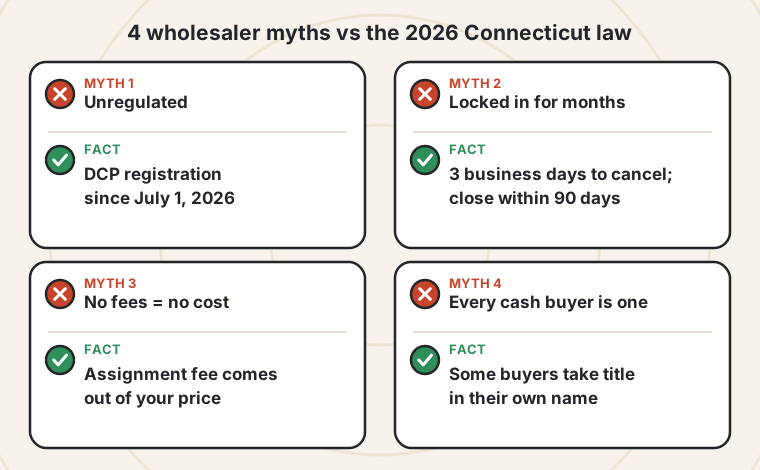
Myth 1: Is wholesaling illegal, or completely unregulated, in Connecticut?
No, wholesaling is neither illegal nor unregulated in Connecticut. It is legal, and since July 1, 2026 anyone acting as a real estate wholesaler must register with the Department of Consumer Protection (CGS 20-329bbb). The law also sets your cancellation right, a 90-day closing limit, a disclosure report and a ban on recording the contract, and treats violations as unfair trade practices (CGS 20-329hhh).
Before 2026, Connecticut had no wholesaler-specific law, which is where the “wild west” reputation came from. Public Act 25-168 changed that. Today a Norwich seller can ask a simple question: “What is your DCP wholesaler registration number?” A wholesaler who holds that registration should answer immediately, and DCP’s website lets you check it.
Two related myths fall away with this one. First, registration does not make a wholesaler your agent: only a licensed real estate broker or salesperson can represent you for a fee (CGS 20-312). Second, a licensed agent who also wholesales still needs the wholesaler registration and must tell you whom they represent. The full rule table is in our Naugatuck guide.
Myth 2: Once you sign with a wholesaler, are you locked in for months?
No, you are not locked in for months once you sign with a wholesaler in Connecticut. You can cancel within three business days for any reason (CGS 20-329ccc(a)), the closing must be no more than 90 days after signing unless everyone agrees in writing to extend (CGS 20-329ccc(b)), and no one may record the contract or a lien to cloud your title (CGS 20-329fff).
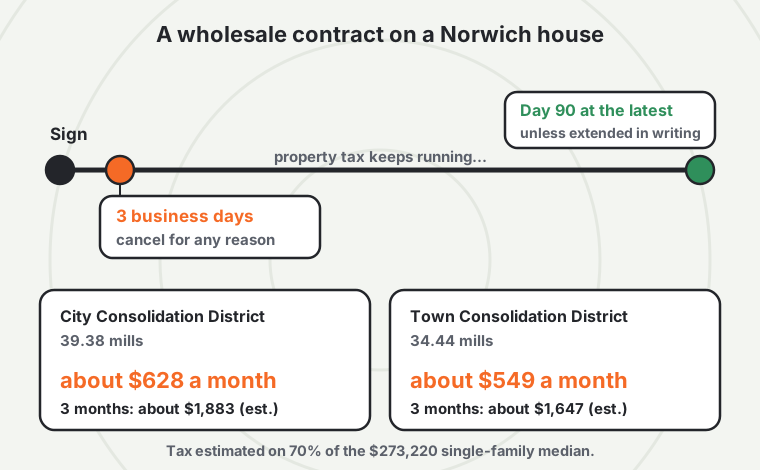
The 90-day cap is a big change, but 90 days is still three months. On a Norwich single-family at the $273,220 median, property tax alone runs about $628 a month in the City Consolidation District (39.38 mills) or about $549 a month in the Town Consolidation District (34.44 mills), estimated on 70% of that value. Three months of waiting is roughly $1,883 or $1,647 in tax before insurance, heat and upkeep (est.). Our Norwich holding-cost guide adds the rest.
The bigger risk is not the cap; it is the contract that falls apart on day 85. A wholesaler who cannot find an end buyer may walk using a long inspection or “due diligence” period, and you start over. That is why your attorney should shorten that period and tie the deposit to it. If you have already signed and want out, see how to back out of a wholesale real estate contract.
Myth 3: If there are no fees or commissions, does selling to a wholesaler cost you nothing?
No. Selling to a wholesaler with no fees or commissions still costs you the assignment fee, because the wholesaler’s profit is the gap between your contract price and the end buyer’s price. From October 1, 2026, the state disclosure report you must receive before signing says the wholesaler may not be the buyer and may profit from assigning your contract (CGS 20-329eee).
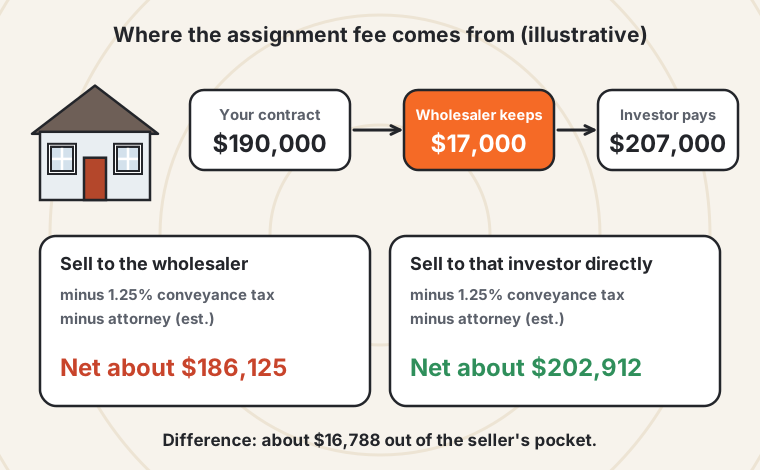
Example (illustrative). Built from Norwich’s public numbers, not a real deal. A dated Norwich single-family that needs a roof and kitchen would sell for close to the $273,220 town median once fixed. A wholesaler signs a contract to buy it at $190,000, then assigns the contract to an investor who pays $207,000. The wholesaler keeps $17,000.
| Line | Sell to the wholesaler | Sell to the same investor directly |
|---|---|---|
| Price on your contract | $190,000 | $207,000 |
| Conveyance tax, 1.25% (CGS 12-494) | -$2,375 | -$2,587.50 |
| Your attorney (est.) | -$1,500 | -$1,500 |
| Net to you before payoffs and tax prorations | $186,125 | $202,912.50 |
Is a wholesaler’s fee ever worth it? Sometimes. If the wholesaler finds a buyer you never would have reached, closes on time, and you value the speed, the fee buys something. But it is a cost, not a free service. Our guide on the assignment fee in real estate shows how to spot it, and “and/or assigns” in a contract explains the clause that makes it possible.
Myth 4: Is every “we buy houses” cash buyer a wholesaler, and are they all out to rip you off?
No. Not every cash buyer is a wholesaler, and not every wholesaler is dishonest. Some cash buyers take title in their own name with their own money; others assign the contract. Wholesalers who hold a DCP registration, disclose what they do, give you the state report and close on time are operating legally. The way to tell is to ask who will be on the deed and whose money closes.
Ask every buyer, in writing:
- Will the company on this contract be the one on the deed?
- Can you show proof of funds in that same name?
- Will you remove “and/or assigns”, or require my written consent to assign?
- If you are a wholesaler, what is your DCP registration number, and where is the state disclosure report?
- Who holds the deposit, and how long is the inspection period?
- Will anyone else walk through my house before closing?
Clear, quick answers are a good sign. Dodging, “my partners”, or pressure to sign today are not. Our guide to checking legitimate house buyers in Connecticut and our scam red flags list go further, and wholesaler vs. realtor vs. cash buyer compares the routes side by side.
Why do Norwich homeowners hear from so many wholesalers?
Norwich homeowners hear from many wholesalers because the city has what investors look for: 712 home sales in a year at a $261,000 median, and older housing: 64% of one- to three-family homes were built before 1960. Older homes that need work trade often to investors, and wholesalers try to get between the owner and those investors.
Norwich also has two total mill rates. Owners in the City Consolidation District pay 39.38 mills and those in the Town Consolidation District pay 34.44 mills for fiscal 2026-27, so the cost of a stalled contract depends on where your house sits. And because Norwich charges the higher 0.50% town conveyance tax, a Norwich seller pays 1.25% of the price in conveyance tax, which your attorney collects at closing. A wholesale contract that sets your price too low makes every percentage cost bite harder.
If your house is in a foreclosure case, it would be heard in the New London Judicial District, and help comes first: the state’s foreclosure mediation program and a HUD-approved housing counselor. Our foreclosure options page explains those before any sale.
Should a Norwich owner sell to a wholesaler, a direct buyer, or list?
A Norwich owner should list when the house is in decent shape and there is time, sell to a direct buyer who takes title when speed and condition matter more than top price, and use a wholesaler only if they hold a DCP registration, are upfront about assigning, and the net still beats the other two. Compare every option on net cash, certainty and time, not on the headline number.
List with an agent
Highest priceUsually the most money for a house that shows well.
- Commission and repairs
- Showings and buyer financing
- Takes the longest
Direct cash buyer
About 2 weeksBuyer takes title with its own funds, as-is.
- Price below retail
- No assignment fee
- Fewest moving parts
Wholesaler
Up to 90 daysContract may be assigned to an investor.
- Assignment fee from your price
- Risk it never closes
- Legal with DCP registration and disclosure
When you should NOT sell to a cash buyer at all. If your Norwich house is in good condition, you have two or three months, and you can handle showings, listing will usually net you more than any cash offer. If you are in a foreclosure case, talk to mediation and a housing counselor first. And if any buyer, wholesaler or not, refuses to let your attorney review the contract, walk away.
Where we fit. We buy houses in Norwich ourselves: our company is the buyer on the contract and on the deed, we pay with our own funds, and we usually close in about two weeks. We never charge a fee. If listing would net you more, we will tell you. Our Norwich house buying page has the city’s numbers, and the ways we buy houses in Connecticut explains each route we offer.
Is a cash sale right for you, or should you list?
Seven quick questions. There is no wrong answer, and we will tell you honestly if listing would leave you more.
- Does the house need repairs you would rather not pay for or manage?
- Do you need to close by a certain date, or within the next month or two?
- Would showings be hard: tenants, belongings, privacy, or you live out of state?
- Is there a complication: an estate or probate, a divorce, foreclosure, liens or back taxes?
- Could you comfortably cover the mortgage, taxes and utilities for three or more months?
- Is getting the highest possible price more important to you than speed and certainty?
- Would a buyer's bank lend on the house as it is (no major roof, foundation, oil tank or code issues)?
How do you protect yourself when a wholesaler makes an offer on your Norwich house?
To protect yourself when a wholesaler offers on your Norwich house, ask whether they will take title, check their DCP registration, insist on the state disclosure report, have your own Connecticut attorney review the contract, keep the deposit in your attorney’s escrow, shorten the inspection period, and remember you can cancel within three business days.
Get two or three written offers
Include at least one buyer who will take title in its own name, and get a realistic listing estimate from an agent.
Ask the six questions
Who is on the deed, proof of funds, assignment, DCP registration and report, deposit and inspection period, extra walk-throughs.
Check the registration
Look up the wholesaler on DCP’s website before you sign.
Have your attorney review
Strike or limit “and/or assigns”, shorten due diligence, set a firm closing date and keep the deposit in escrow.
Use your three business days
If anything feels wrong after signing, cancel in writing within three business days.
Close or walk
A direct buyer typically closes in about two weeks; a wholesale contract must close within 90 days unless you extend it in writing.
Frequently asked questions about wholesaler myths in Connecticut
These are the questions Norwich and other Connecticut homeowners ask most about wholesalers, from whether wholesaling is legal to fees, cancellation and how to tell a wholesaler from an end buyer. For the full statute-by-statute rules, see our Connecticut wholesaler law guide.
Is real estate wholesaling legal in Connecticut?
Yes, real estate wholesaling is legal in Connecticut. Since July 1, 2026, wholesalers must register with the Department of Consumer Protection (CGS 20-329bbb) and follow rules on cancellation, closing dates and disclosure; violations are unfair trade practices (CGS 20-329hhh).
Can I cancel a contract with a wholesaler in Connecticut?
Yes, you can cancel a wholesale contract in Connecticut within three business days for any reason, without penalty other than returning any deposit you received (CGS 20-329ccc(a)).
How long can a wholesaler tie up my house?
A wholesaler cannot set a closing more than 90 days after the contract is signed unless all parties agree in writing to extend; otherwise the contract ends automatically (CGS 20-329ccc(b)).
How do I know if my buyer is a wholesaler?
Your buyer is likely a wholesaler if the contract says “and/or assigns”, the deposit is tiny, the inspection period is long, or they want to bring others through. Ask who will be on the deed and whose money closes. From October 1, 2026, a wholesaler must give you the state disclosure report before you sign.
Do I pay the wholesaler’s fee?
You do not write a check for the wholesaler’s fee, but you effectively pay it, because it is the gap between your price and what the end buyer pays. In our illustrative Norwich example, a $17,000 fee cut the seller’s net by about $16,788.
Can a wholesaler put a lien on my house?
No. Connecticut law bars recording a wholesale contract or any document claiming a lien on your house, and you can clear one that is recorded (CGS 20-329fff). Talk to your attorney if it happens.
What are the Norwich mill rates?
For fiscal 2026-27, Norwich’s total mill rate is 39.38 in the City Consolidation District and 34.44 in the Town Consolidation District, on the October 1, 2025 grand list, per the City of Norwich.
How much conveyance tax does a Norwich seller pay?
A Norwich seller pays 1.25% of the sale price in conveyance tax on a residential sale up to $800,000: 0.75% to the state and 0.50% to the city (CGS 12-494).
Is your company a wholesaler?
No. We Buy Houses In Connecticut buys houses itself, with its own funds, and closes in its own name, usually in about two weeks. We do not charge fees.
Where do I report a wholesaler who broke the rules?
You can report a wholesaler to the Connecticut Department of Consumer Protection, which registers wholesalers, and talk to an attorney about remedies under the Connecticut Unfair Trade Practices Act.
Related guides
- Selling a house to a wholesaler in Connecticut: the 2026 law
- What is real estate wholesaling?
- Selling your house to a wholesaler: honest pros and cons
- Can you back out of a wholesale real estate contract?
- How to sell a mortgage note in Connecticut
- Selling part of a mortgage note
- Selling an unsecured promissory note
- Selling a house in Norwich, CT
- How to sell a house in Connecticut: every route
Sources (checked on October 27, 2026)
- CGS chapter 392a, 20-329aaa to 20-329hhh (real estate wholesalers, 2026 supplement)
- Department of Consumer Protection: real estate wholesaling
- CGS 20-312 (real estate broker and salesperson licensing)
- CGS 12-494 (real estate conveyance tax)
- City of Norwich mill rates
- CT OPM Real Estate Sales, data.ct.gov
- Connecticut Judicial Branch: foreclosure mediation
This guide is general information, not legal advice. Talk to a Connecticut real estate attorney before you sign any contract to sell your house.

Who wrote this
Jerryll Noorden
Jerryll has bought and sold Connecticut houses since 2016 and has sat at more closing tables than he can count, on both sides. Before real estate he was a robotics scientist at NASA, IHMC and IIT. He wrote this guide because the national sites that rank for it skip the Connecticut rules that cost sellers money. When listing or selling it yourself would get you more than a cash offer, he says so.
This guide explains Connecticut rules in plain English. It is not legal or tax advice. Laws change; for your sale, talk to a Connecticut real estate attorney and a tax professional.
