
- Yes, you can sell a Connecticut house with a crumbling (pyrrhotite) foundation. You must disclose what you know on the state’s property condition report, and expect fewer buyers who can get a mortgage.
- 21 towns are “affected” and 4 “potentially affected” on the Capitol Region Council of Governments (CRCOG) map used for real estate disclosures, almost all in north-central and eastern Connecticut. Homes built in 1983 or later are the focus.
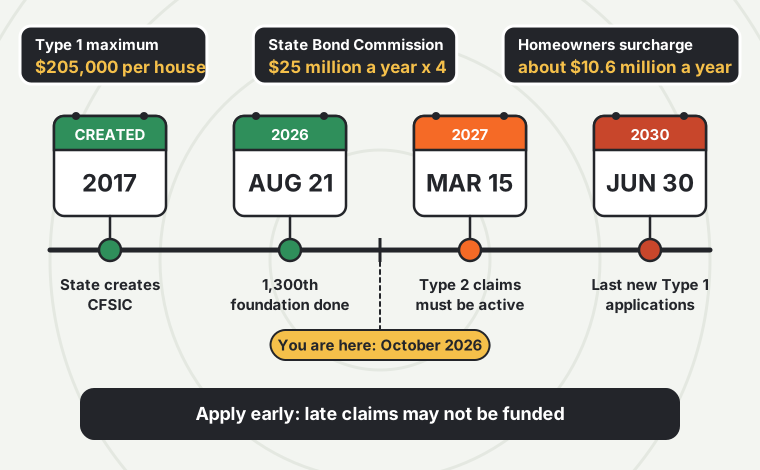
- The state’s repair program, CFSIC, is still paying. It completed its 1,300th foundation in August 2026 and pays up to $205,000 per house. But its funding depends on yearly state money, its reimbursement claims are winding down, and the last new applications are due by June 30, 2030.
- A CFSIC claim can move with the house. A Type 1 (replacement) claim can be transferred to a buyer within 30 days of the sale, before work starts. Reimbursement claims cannot.
- The separate “Residential Foundation Condition Report” is only for bank-owned and town-owned homes. Everyone else answers the foundation questions on the main report.
- Your realistic options are: replace with CFSIC and then sell, sell with the claim transferred, list as-is with full disclosure, or sell for cash. Which one leaves you more depends on your claim status, your timeline and how bad the cracking is.
Can you sell a house with a crumbling foundation in Connecticut?
Yes, you can sell a house with a crumbling foundation in Connecticut. No law stops the sale. You must disclose what you know about the foundation on the state’s Residential Property Condition Report, and you should expect a smaller pool of buyers, because many lenders will not finance a house with visible foundation deterioration. Your options are to repair first, transfer a state repair claim to the buyer, list as-is, or sell for cash.
This guide is one part of our larger guide on how to sell a house in Connecticut. If you own a house in Vernon, Tolland, Ellington, Manchester, South Windsor or one of the other towns in the “foundation belt”, you have probably heard the stories: map-pattern cracks in the basement walls, a neighbor who waited years for help, a buyer who walked after an engineer’s report. Some of that is out of date. The state’s repair company has now replaced more than 1,300 foundations, and the market in these towns has learned to handle the problem. This guide gives you the current facts, as of October 2026, and walks through each route.
What is a crumbling foundation, and why is it a Connecticut problem?
A crumbling foundation is a concrete foundation that slowly cracks and breaks apart because the stone mixed into the concrete contains pyrrhotite, an iron sulfide mineral. When pyrrhotite meets water and oxygen it expands and forms new minerals, and the concrete cracks from the inside. In Connecticut the problem traces to concrete from a now-closed plant in Stafford Springs, poured in homes mostly from 1983 onward.
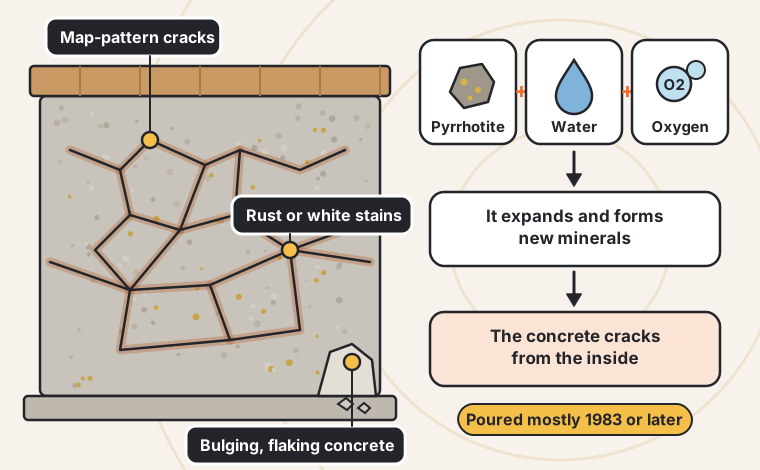
The concrete came from J.J. Mottes Concrete Company in Stafford Springs, using aggregate from a quarry in Willington, which is why the cases cluster within about 20 miles of Stafford. The damage is slow. Many foundations look fine for 10 to 20 years before cracks appear, and some foundations with pyrrhotite never deteriorate. The Department of Housing’s own description: pyrrhotite causes deterioration when it is exposed to oxygen and water, and its presence alone does not necessarily mean the foundation will fail.
Signs owners and inspectors look for
- Map-pattern or spider-web cracking on basement walls, often with horizontal cracks
- Rust-colored or white staining along cracks
- Bulging, flaking or crumbling concrete surfaces
- Doors and windows that start to stick, or cracks in drywall above the basement
- A house or addition built (or a foundation poured) in 1983 or later, in or near the affected towns
Not every cracked foundation has pyrrhotite. Shrinkage cracks, settling and water pressure cause cracks too. That is why the testing below matters.
Which Connecticut towns are affected by crumbling foundations?
The Connecticut towns affected by crumbling foundations, according to the CRCOG map used for real estate disclosures (updated September 28, 2023), are 21 “affected” towns: Andover, Ashford, Bolton, Columbia, Coventry, East Hartford, East Windsor, Ellington, Enfield, Glastonbury, Hebron, Manchester, Mansfield, Somers, South Windsor, Stafford, Suffield, Tolland, Union, Vernon and Willington, plus 4 “potentially affected”: Bloomfield, Granby, Marlborough and Woodstock.
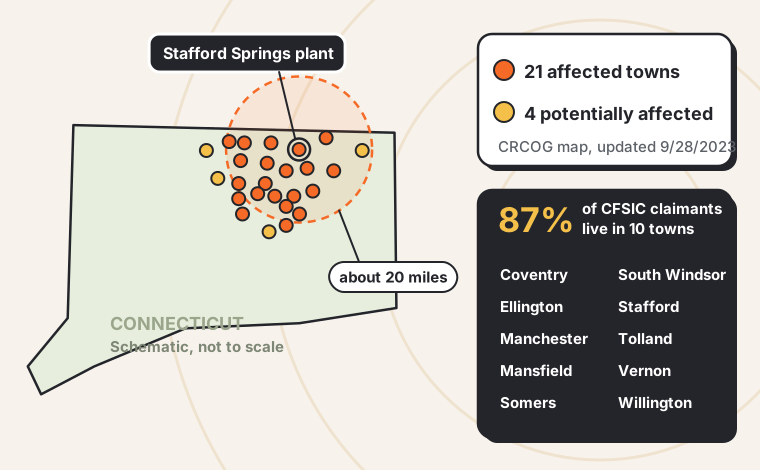
CRCOG defines the two groups this way. Affected towns have homes that have been remediated, and testing data with three or more cases. Potentially affected towns have no reported remediation but three or more cases in testing data, or two or fewer remediated homes with no further cases in testing. CRCOG notes it dropped a 2016 Insurance Department report from its analysis, so older lists you find online may be longer.
Being outside the list does not mean a house is safe, and being on it does not mean a house has a problem. The repair company, CFSIC, reported in May 2024 that its claimants live in 46 of Connecticut’s 169 towns, but 87% of them live in just ten: Coventry, Ellington, Manchester, Mansfield (Storrs), Somers, South Windsor, Stafford, Tolland, Vernon and Willington.
Towns on the list where we have local pages
| Town | CRCOG status | Homes sold | Median sale price | Median year built (single-family) | Mill rate |
|---|---|---|---|---|---|
| East Hartford | Affected | 614 | $282,750 | n/a | 47.24 |
| East Windsor | Affected | 155 | $310,000 | 1963 | 26.64 |
| Enfield | Affected | 659 | $310,000 | 1960 | 33.11 |
| Glastonbury | Affected | 477 | $540,000 | 1975 | 33.73 |
| Manchester | Affected | 724 | $315,000 | 1953 | 41.0 |
| South Windsor | Affected | 389 | $397,000 | 1969 | 37.01 |
| Suffield | Affected | 237 | $400,000 | 1977 | 24.1 |
| Vernon | Affected | 388 | $300,000 | 1961 | 36.31 |
| Bloomfield | Potentially affected | 263 | $340,000 | 1959 | 34.4 |
The median year built tells you something useful. In Manchester and Enfield most single-family homes were built well before 1983, so most of the housing stock is outside the problem window. In South Windsor, Glastonbury and Suffield, a larger share was built after 1983. If your house or an addition was built in 1983 or later, assume buyers will ask.
What do you have to disclose about a crumbling foundation in Connecticut?
In Connecticut you have to disclose what you actually know about your foundation on the Residential Property Condition Report: whether it is concrete, any settling or seepage, any testing or inspection by a licensed professional (with the report attached), any repairs (with the report attached), and any knowledge of pyrrhotite (questions 37 to 43). You do not have to test, but you must not hide damage you know about.
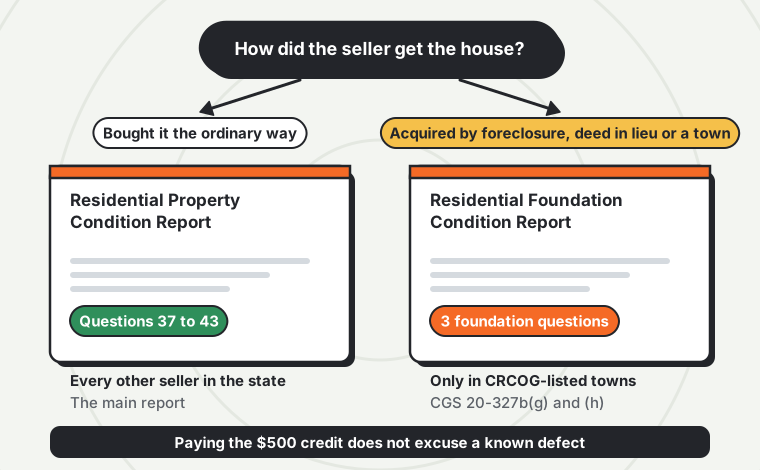
Every seller in the state answers those questions, not only sellers in the CRCOG towns. They were added by June Special Session Public Act 17-2 and Public Act 19-192. The detail matters:
- Question 41 asks if you know of any testing or inspection by a licensed professional related to the foundation, and asks for the method, the areas tested, the results and a copy of the report.
- Question 42 asks about any foundation repairs, with a description and the report.
- Question 43 asks whether you have any knowledge related to pyrrhotite in the foundation.
The report’s “Important Information” section also tells every buyer they may have a concrete foundation inspected by a licensed structural engineer for pyrrhotite. So even if you say nothing, the form itself prompts the buyer to look.
A seller who skips the report credits the buyer $500 at closing (CGS 20-327c). But since 2020 the same statute says that a seller who pays the credit must still disclose a known defect that significantly impairs the home’s value, the occupants’ health or safety, or its useful life, and a buyer can sue for actual damages if they do not. A failing foundation you know about is the textbook example.
The Residential Foundation Condition Report: who it is really for
You will see “Residential Foundation Condition Report” in lists of Connecticut seller forms. It is a real Department of Consumer Protection form, revised 07/2025, but it applies only to homes in CRCOG-listed towns that were acquired by strict foreclosure, foreclosure by sale, a deed in lieu of foreclosure, or by a town or other political subdivision (CGS 20-327b(g) and (h)). Those sellers are exempt from the main report, so the law makes them answer three foundation questions on this short form. If you bought your house the ordinary way, you answer questions 37 to 43 on the main report instead. Our guide to the Connecticut property condition disclosure walks through the whole form.
Should you test your foundation before you sell?
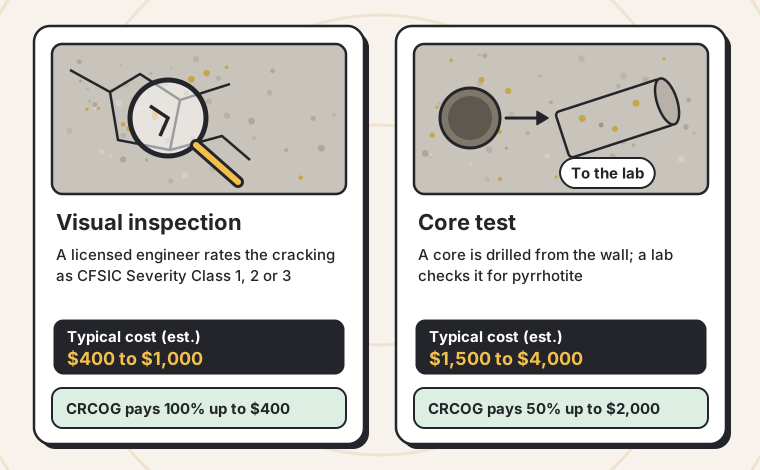
Whether you should test your foundation before you sell depends on what you already see. If your house was built in 1983 or later in an affected town and you see cracking, a visual inspection by a licensed engineer is usually worth it: buyers will order one anyway, and CFSIC requires one for a claim. A core test answers the pyrrhotite question for a clean-looking wall. Either way, once you have a report, you must disclose it.
The two kinds of foundation test
| Visual inspection | Core test | |
|---|---|---|
| Who does it | A Connecticut-licensed professional engineer, or a CFSIC-certified home inspector for CFSIC’s severity rating | A testing firm drills one or more cores from the wall; a lab analyzes them |
| What it tells you | Whether there is visible deterioration consistent with pyrrhotite, and how severe (CFSIC Severity Class 1, 2 or 3) | Whether pyrrhotite is present in the sample, even if the wall looks fine |
| Typical cost (est.) | About $400 to $1,000 | About $1,500 to $4,000 for one or two cores |
| Reimbursement | CRCOG’s testing program: 100% up to $400 for an engineer’s visual (est., check current terms) | CRCOG’s testing program: 50% up to $2,000 (est., check current terms) |
| What CFSIC needs | A severity class from a visual inspection for every Type 1 claim. A positive core is required only for Class 1 (no visible signs); Classes 2 and 3 do not need a core. | |
The CRCOG testing reimbursement program, run with state bond money through the Department of Housing, reimburses homeowners whose homes or additions were built in 1983 or later and are within 20 miles of the former J.J. Mottes plant (or qualify by waiver). Visual inspections must be by a licensed professional engineer for reimbursement. Buyers can apply too, after they buy, even if the test was done before closing. Some towns have also offered their own testing grants. Call CRCOG at (860) 724-4277 for the current amounts before you rely on them.
How CFSIC reads the severity classes
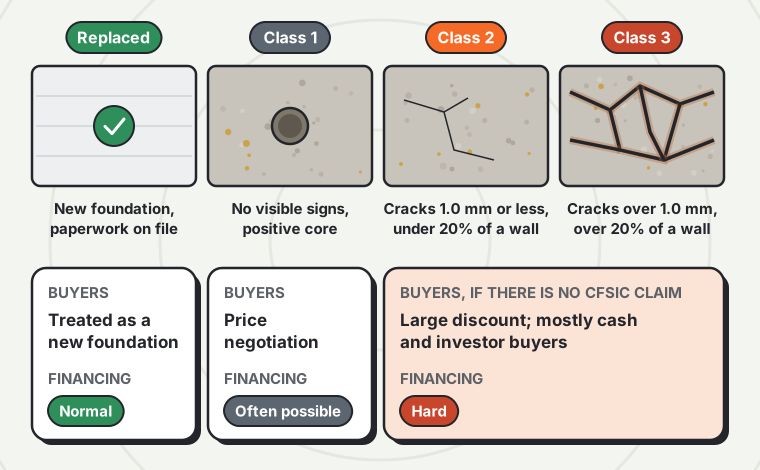
- Class 3: crack widths over 1.0 mm covering more than 20% of a contiguous wall plane.
- Class 2: crack widths of 1.0 mm or less, covering less than 20% of a wall plane.
- Class 1: no visual signs of pyrrhotite, with at least half of the measurable wall area inspected. A pyrrhotite-positive core is needed to make a Class 1 claim active.
CFSIC has said that only two registered Class 1 claimants have ever moved up to Class 2 or 3, and that it has never paid a claim on the strength of a core test alone. A positive core with no cracking is a disclosure item and a price conversation, not necessarily a failing foundation.
Why buyers in these towns test anyway
CFSIC’s rules give buyers a strong reason to test. For a home bought in Connecticut on or after February 1, 2019, the buyer must have either a core analysis or a visual inspection report in hand at the closing to be eligible for CFSIC help later. A careful buyer’s agent in Vernon or Tolland will build that inspection into the contract. So the question is less “will they find out” than “do you want to know first”.
What is CFSIC, and is it still funded in 2026?
CFSIC, the Connecticut Foundation Solutions Indemnity Company, is the nonprofit captive insurer the state created in 2017 to pay for replacing crumbling foundations. It is still funded and paying claims in 2026, with up to $205,000 per house, but its money comes year by year from state bonds and a homeowners-policy surcharge, it is winding down reimbursement claims, and it will accept its last applications on June 30, 2030.
What CFSIC pays
| Claim type | Who it is for | Maximum | Can it transfer to a buyer? |
|---|---|---|---|
| Type 1 (replacement) | Owners whose foundation is compromised and not yet replaced | $205,000 per residential building, less any insurer payments; deposit up to 10% of the contract (max $19,000) | Yes, by Claim Transfer Agreement within 30 days of the sale, before work starts |
| Type 2 (reimbursement) | Owners who already paid to replace all or part of a foundation | $205,000; limited to 125 paid claims over CFSIC’s life, no more than 25 a year | No; paid only to the current owner who paid for the work |
| Condominium units | Through the condo association | $82,000 per eligible unit | Through the association |
Funding and deadlines, as of October 2026
- Progress: CFSIC completed its 1,300th foundation on August 21, 2026, and had issued 1,717 Participation Agreements by April 2026.
- Money coming in: CFSIC’s superintendent wrote in June 2026 that it is scheduled to receive $100 million from the State Bond Commission in four annual $25 million installments, plus about $10.6 million a year from the Healthy Homes surcharge on homeowners insurance policies. In September 2026 it received $10,988,981 in surcharge funds. He also wrote plainly that the Bond Commission “may not continue to fund us.”
- Applications can pause. CFSIC has temporarily closed its Participation Agreement line in the past when funding was late or uncertain. Only a countersigned Participation Agreement guarantees a remediation.
- Type 2 is winding down. The board voted in July 2026 to begin winding down reimbursement claims. Type 2 applications must be received and made active by 5:00 p.m. on March 15, 2027.
- Type 1 deadline: new Type 1 applications are accepted until 5:00 p.m. on June 30, 2030. CFSIC expects to keep operating for at least two years after that.
CFSIC’s own advice is to apply within the next two to three years at most, because late applications may not be funded if the money runs out. An active Type 1 claim is also something you can hand to a buyer. A house with a claim in line is easier to sell than a house without one.
Who else helps
CRCOG administers about $2 million in federal HUD money for low- and moderate-income households, to cover costs CFSIC does not (“gap funding”). Under Public Act 16-45, towns can reassess a house with a deteriorating concrete foundation, which can lower your property tax while you own it. And the IRS issued a safe harbor (Revenue Procedure 2017-60, modified by Revenue Procedure 2018-14) for treating some pyrrhotite repair costs as a casualty loss. Tax rules change, so talk to a tax professional about your year.
Can you sell a house that has an open CFSIC claim?
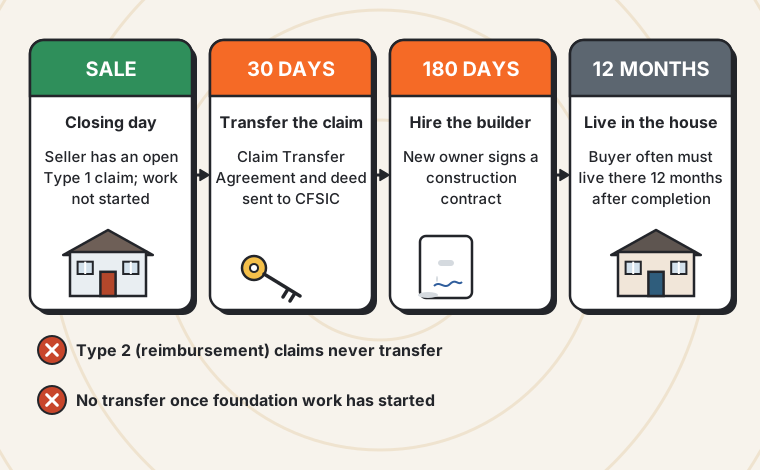
Yes, you can sell a house that has an open CFSIC claim. A Type 1 (replacement) claim can be transferred to the buyer through a Claim Transfer Agreement, which must be completed within 30 days of the sale with the recorded deed. The new owner then has 180 days to sign a construction contract. Claims cannot be transferred once foundation work has started, and Type 2 reimbursement claims never transfer.
What the transfer means in practice:
- The buyer takes your place in line. CFSIC’s guidelines let a new owner of an unreplaced foundation assume the existing claim.
- The buyer may have to live there. For Type 1 claims on homes purchased on or after October 31, 2017, the claimant signs a Twelve-Month Residency Agreement to own and live in the home as a permanent residence for at least 12 months after the certificate of completion or occupancy. That narrows the buyer pool to owner-occupants for a claim-transfer sale.
- Timing is tight. Thirty days to transfer and 180 days to contract with a builder. Your attorney and the buyer’s attorney should put the transfer steps in the purchase contract.
- Once you have been funded, you are done. CFSIC says former co-owners of a home that received remediation money are generally not eligible again, even after selling and buying another house.
Contact the claims administrator, ESIS ProClaim (844-763-1207), before you list, so you know exactly where your claim stands and what a buyer will need.
How do buyers and lenders react to a crumbling foundation in Connecticut?
Buyers and lenders in Connecticut react to a crumbling foundation in proportion to what they can see and document. A house with a replaced foundation and CFSIC paperwork sells like any other house. A house with a positive core and no cracking usually sells with a price adjustment. A house with active, visible deterioration (Severity Class 2 or 3) is hard to finance and usually sells to cash buyers or to owner-occupants taking over a CFSIC claim.
| Foundation status | Typical buyer reaction (est.) | Financing |
|---|---|---|
| Replaced, with CFSIC or engineer sign-off | Treated as a new foundation; a selling point | Normal |
| Built before 1983, no cracking | Usually no concern beyond a normal inspection | Normal |
| Built 1983 or later, no test, no cracking | Buyer orders a visual or core test during the inspection period | Normal if clean |
| Positive core, no visible cracking (Class 1) | Price negotiation; some buyers walk | Often possible; depends on lender and appraiser |
| Visible cracking (Class 2 or 3), no claim | Large discount; mostly cash and investor buyers | Hard; appraisers note structural issues |
| Visible cracking with an active Type 1 claim | Owner-occupant buyers may take over the claim | Case by case |
CFSIC itself argued in October 2026 that a positive core test no longer stops sales the way it did a few years ago: “this used to be the case but increasingly is not.” That matches what the market has learned. Buyers now understand the difference between pyrrhotite being present and a foundation that is failing.
Visible structural damage is different. Lenders rely on appraisers, and FHA and conventional appraisal rules require a house to be structurally sound. An appraiser who sees active deterioration will usually flag it, and the loan can stall until the condition is repaired or explained by an engineer. That is why houses with Class 2 or 3 foundations and no claim mostly sell for cash.
What are your options for selling a house with a crumbling foundation?
Your options for selling a house with a crumbling foundation in Connecticut are: replace it through CFSIC and then sell at full price; sell to an owner-occupant who takes over your CFSIC Type 1 claim; list it as-is with full disclosure and a price that reflects the repair; or sell directly for cash. The best choice depends on your claim status, how much time you have, and how severe the damage is.
Replace with CFSIC, then sell
Highest priceif your claim is funded and you can wait
- Foundation replaced at little or no cost up to $205,000
- Sell later as a normal house
- Months to years: claim, contract, construction
- You may have to move out during the work
Sell with the claim transferred
Middlebuyer takes over your place in line
- Buyer must transfer within 30 days
- Buyer often must live there 12 months after
- Smaller pool of buyers
- Price reflects the hassle the buyer takes on
List as-is with disclosure
Variesprice discounted for the foundation
- Works best with a clean visual and positive core only
- Mortgage buyers may struggle with visible damage
- Commission and months on market
Sell for cash
Lowest pricebut fastest and most certain
- No lender, no appraisal, no repairs
- Close on your date, often in weeks
- Buyer prices in the full replacement risk
Option 1: replace with CFSIC, then sell
If you have time and an active claim, this almost always leaves you with the most money. A replaced foundation removes the problem for good, and the CFSIC paperwork is proof for any future buyer. The costs to you are time, disruption (houses are usually lifted while the old foundation is removed and a new one poured) and anything above the cap or outside what CFSIC covers, such as landscaping, finished basements and some interior work. CRCOG’s gap funding may help lower-income households with those costs.
Option 2: sell and transfer the Type 1 claim
If you need to move before your replacement happens, transferring the claim lets the buyer benefit from your place in line. Price will reflect that the buyer is taking on the construction project and its delays. Make sure your attorney coordinates with ESIS before closing so the transfer happens within 30 days.
Option 3: list as-is with full disclosure
This works best when the foundation has a positive core but no visible damage, or minor cracking with an engineer’s report saying it is not structural. Price it with the risk in mind; buyers will. If there is visible deterioration, expect financed buyers to fall away after their inspection or appraisal.
Option 4: sell for cash
A cash buyer prices the full cost and uncertainty of a replacement into the offer, so this is usually the lowest number. It makes sense when the damage is visible and you have no claim, when the funding timeline is longer than your life allows (a job move, an estate, a divorce, a foreclosure), or when you simply do not want to manage a foundation replacement. We buy houses for cash in these towns, so weigh our view accordingly. If your claim is active and you can wait, we will usually tell you to wait.
A worked example (illustrative)
Take a 1988 raised ranch worth about $380,000 with a sound foundation, in a town where similar homes sell quickly. Suppose an engineer rates the foundation Class 3 and a replacement is estimated at $190,000 (est.).
| Route | Likely price (illustrative) | What it costs you | Time |
|---|---|---|---|
| Replace with CFSIC, then list | Near $380,000 | Commission, closing costs, uncovered extras, months of disruption | Often a year or more from claim to sale |
| List as-is (Class 3, no claim) | Well below value; buyers subtract the full repair plus a risk margin | Commission, closing costs, carrying costs; financed buyers may fail | Several months |
| Cash sale | Lower still, but certain | Conveyance tax and attorney; no commission, no repairs | Weeks |
Run your own numbers with the net proceeds calculator below, and ask any cash buyer to show you how they got to their number.
How much would you walk away with?
Slide the numbers to match your house. It works in your browser; nothing is saved or sent.
Estimates for planning. Conveyance tax per CGS 12-494 (state 0.75% up to $800,000, 1.25% to $2.5M, 2.25% above, plus the town rate). Seller attorney about $1,200 to $1,500; flat-fee MLS about $400; listings include three months of taxes, insurance and utilities, a cash sale about two weeks. Your attorney gives you the final numbers.
How do you sell a house with a crumbling foundation, step by step?
To sell a house with a crumbling foundation in Connecticut, find out what you have (an engineer’s visual and, if needed, a core test), check or open a CFSIC claim, gather every report, decide on your route, disclose fully on the property condition report, price for the foundation’s real status, and let your attorney handle any claim transfer at closing.
Check the basics
When was the house, and any addition, built? Is your town on the CRCOG list? Do you see cracking? A house built before 1983 with sound walls is very unlikely to be a pyrrhotite case.
Get a visual inspection from a licensed engineer
It gives you a severity class, it is what CFSIC needs, and it is what a buyer’s engineer will do anyway. Ask about CRCOG reimbursement before you book.
Decide whether a core test is worth it
If the walls look clean but the house is in the window, a core answers the question. If the walls are clearly cracking, the visual may be enough.
Open or check your CFSIC claim
Even if you plan to sell, an active Type 1 claim is an asset you can transfer. Call ESIS ProClaim at 844-763-1207 or apply at crumblingfoundations.org.
Talk to a Connecticut real estate attorney
About disclosure wording, the claim transfer and the contract. Do it before you list.
Choose your route
Replace and sell, sell with the claim, list as-is, or sell for cash. Get a written cash number and an agent’s opinion so you can compare.
Disclose fully
Answer questions 37 to 43 on the condition report honestly and attach every report. An honest file sells; a surprise kills deals.
Price for the real status
Use sales of similar houses with known foundation status, not the town median.
Close and transfer
If a claim is moving with the house, your attorney sends the recorded deed and the Claim Transfer Agreement to CFSIC within 30 days.

The foundation owners who come out best are the ones who get their paperwork in order before they talk to anyone: the engineer’s report, the claim number, the insurer’s letter. With that in hand you can get real numbers from an agent and from a cash buyer and compare them calmly. Without it, everyone is guessing, and guesses about foundations are always priced low.
Want a number for your house as it stands?
Send the address and a few photos of the basement walls. We will tell you what we would pay as-is and walk you through how the foundation affects it. No obligation and no pressure; if waiting for CFSIC is the better deal for you, we will say so.
Get your cash offer
without anyone coming over.
Want your offer faster, or rather not talk to anyone yet? Send a few phone photos of each room. We price the repairs from them, line by line, and send your cash offer back, so you see a real number before you ever meet us or pick up the phone.
 CabinetsFlooring
 Tub & tile
 Floors
 Roof
We may bring in a partner buyer to close. Your price and terms don't change.
Is a cash sale right for you, or should you list?
Seven quick questions. There is no wrong answer, and we will tell you honestly if listing would leave you more.
- Does the house need repairs you would rather not pay for or manage?
- Do you need to close by a certain date, or within the next month or two?
- Would showings be hard: tenants, belongings, privacy, or you live out of state?
- Is there a complication: an estate or probate, a divorce, foreclosure, liens or back taxes?
- Could you comfortably cover the mortgage, taxes and utilities for three or more months?
- Is getting the highest possible price more important to you than speed and certainty?
- Would a buyer's bank lend on the house as it is (no major roof, foundation, oil tank or code issues)?
Questions about selling a house with a crumbling foundation
Can I sell my house if it has pyrrhotite?
Yes, you can sell your house if it has pyrrhotite. You must disclose what you know on the Connecticut property condition report. A house with pyrrhotite but no visible damage usually sells with a price adjustment; one with active deterioration usually sells to cash buyers or with a CFSIC claim transferred to the buyer.
Do I have to disclose a crumbling foundation in Connecticut?
Yes, you have to disclose a crumbling foundation you know about in Connecticut. Questions 37 to 43 of the property condition report ask about the foundation, testing, repairs and pyrrhotite, and paying the $500 credit does not excuse you from disclosing serious known defects (CGS 20-327c).
Which towns are on the Connecticut crumbling foundation list?
The towns on the Connecticut crumbling foundation list (CRCOG, updated September 2023) are Andover, Ashford, Bolton, Columbia, Coventry, East Hartford, East Windsor, Ellington, Enfield, Glastonbury, Hebron, Manchester, Mansfield, Somers, South Windsor, Stafford, Suffield, Tolland, Union, Vernon and Willington, plus potentially affected Bloomfield, Granby, Marlborough and Woodstock.
Do I need the Residential Foundation Condition Report?
You need the Residential Foundation Condition Report only if your home is in a CRCOG-listed town and you acquired it by foreclosure, a deed in lieu, or as a town. Ordinary homeowners answer the foundation questions on the main property condition report.
How much does CFSIC pay to replace a foundation?
CFSIC pays up to $205,000 per residential building to replace a foundation, less any insurance payments, under its guidelines modified in September 2026. Condo units are capped at $82,000 per eligible unit through the association.
Is CFSIC still accepting applications?
Yes, CFSIC is still accepting Type 1 (replacement) applications, until 5:00 p.m. on June 30, 2030. Type 2 (reimbursement) applications must be active by March 15, 2027, and the board has voted to wind that category down. Funding depends on yearly state money.
Can a buyer take over my CFSIC claim?
Yes, a buyer can take over your CFSIC Type 1 claim through a Claim Transfer Agreement completed within 30 days of the sale, before any foundation work begins. The buyer then has 180 days to sign a construction contract and may need to live in the home for 12 months after the work.
What houses are at risk of pyrrhotite in Connecticut?
The houses at risk of pyrrhotite in Connecticut are mainly homes or additions with concrete foundations poured in 1983 or later, in north-central and eastern Connecticut, within roughly 20 miles of the former J.J. Mottes plant in Stafford Springs.
How much does a core test cost?
A foundation core test in Connecticut typically costs about $1,500 to $4,000 for one or two cores (est.). CRCOG’s testing reimbursement program has covered 50% of core testing up to $2,000 and an engineer’s visual inspection up to $400; check the current terms with CRCOG.
Will a bank give a buyer a mortgage on a house with a crumbling foundation?
A bank may give a buyer a mortgage on a house with a crumbling foundation if the foundation shows no active deterioration, but financing is hard when an appraiser sees visible structural damage. That is why houses with severe cracking and no claim usually sell for cash.
Does homeowners insurance cover a crumbling foundation?
Homeowners insurance usually has not covered crumbling foundations in Connecticut, and CFSIC requires written proof of your insurer’s denial, pending status or payment with every claim. CFSIC reduces its payment by anything your insurer pays.
Can my property taxes go down because of a crumbling foundation?
Yes, your property taxes can go down because of a crumbling foundation. Public Act 16-45 allows Connecticut towns to reassess a home with a deteriorating concrete foundation. Ask your town assessor about the process and what reports they need.
Should I fix the foundation myself before selling?
You should rarely fix a crumbling foundation yourself before selling. Replacement typically costs well into six figures (est.), and CFSIC’s reimbursement category is winding down. Either replace through an active Type 1 claim or sell and price the condition in.
Does a positive core test mean my foundation will fail?
No, a positive core test does not mean your foundation will fail. It means pyrrhotite is present. CFSIC has reported that only two registered Class 1 claimants have ever moved up to Class 2 or 3, and that it has never paid a claim based on a core test alone.
Can I sell a house with a crumbling foundation for cash?
Yes, you can sell a house with a crumbling foundation for cash. A cash buyer needs no lender or appraisal, so visible damage does not block the sale, and you can close on your date. The price will reflect the cost and risk of a replacement.
Related Connecticut guides
Before you list
Other inspection issues
A foundation problem changes the route, not the basics. For the full process from pricing to closing day, see our guide on how to sell a house in Connecticut.
Sources
- CFSIC Underwriting and Claims Management Program and Guidelines (modified effective September 15, 2026): claim types, caps, severity classes, claim transfers, deadlines.
- CFSIC news posts: June 2026 (funding outlook, sunset, buyer testing rule), August 24, 2026 (1,300th foundation), August 31, 2026 (Type 2 wind-down), September 8, 2026 (surcharge funds), October 19, 2026 (core tests and sales), May 20, 2024 (claimants by town).
- Capitol Region Council of Governments, Crumbling Foundations: Towns Affected or Potentially Affected for Real Estate Transactions (map updated 9/28/2023), testing reimbursement, gap funding.
- CRCOG Crumbling Foundation Testing Reimbursement Program (eligibility: built 1983 or later, within 20 miles of J.J. Mottes).
- CGS §§ 20-327b and 20-327c (condition report foundation questions; Residential Foundation Condition Report; $500 credit and serious known defects).
- DCP Residential Property Condition Report and Residential Foundation Condition Report (Revised 07/2025).
- IRS Revenue Procedure 2017-60 (pyrrhotite casualty loss safe harbor), modified by Revenue Procedure 2018-14.
- U.S. Government Accountability Office, GAO-20-649 (crumbling foundations report).
- Town sales, mill rates and year built: Connecticut OPM data and 2025 parcel CAMA data on data.ct.gov.
See the house together.
Pick a time that works.
Choose a time for us to walk through the property with you, or ask for a quick call first. We confirm every request personally.
Tuesday, January 13
No open times in the next few weeks. Please call us.
We will confirm by email. Nothing is booked until we do.
View my request
Who wrote this
Jerryll Noorden
Jerryll has bought and sold Connecticut houses since 2016 and has sat at more closing tables than he can count, on both sides. Before real estate he was a robotics scientist at NASA, IHMC and IIT. He wrote this guide because the national sites that rank for it skip the Connecticut rules that cost sellers money. When listing or selling it yourself would get you more than a cash offer, he says so.
This guide explains Connecticut rules in plain English. It is not legal or tax advice. Laws change; for your sale, talk to a Connecticut real estate attorney and a tax professional.
