
Key facts at a glance
This Avon guide is part of how to sell a house in Connecticut. It shows how to put several cash offers on an Avon house side by side and find the one that really pays you the most, once deposit, inspection period, closing date, costs and assignment rights are counted. The worked example uses Avon’s own sales, tax and conveyance numbers.
| Fact | Number | Source |
|---|---|---|
| Avon residential sales, Oct 2024 to Sep 2025 | 298 (median $515,000) | CT OPM Real Estate Sales, data.ct.gov |
| Avon median single-family sale price | $620,000 | CT OPM Real Estate Sales |
| Avon single-family sales above $800,000 | 68 of 201 (about 1 in 3) | CT OPM Real Estate Sales |
| Avon mill rate, fiscal 2027 | 31.8 mills (about $1,150 a month on $620,000) | CT OPM mill rates |
| Conveyance tax on an Avon sale up to $800,000 | 1.00% (0.75% state + 0.25% Avon) | CGS 12-494 |
| Conveyance tax on a $900,000 Avon sale | $9,500 (state rate rises to 1.25% above $800,000) | CGS 12-494 |
| Wholesale contracts: cancel window and closing cap | 3 business days; 90 days | CGS 20-329ccc |
| Avon’s probate court (estate sales) | Simsbury Regional Probate Court (PD-09) | ctprobate.gov directory |
Why does comparing cash offers on an Avon house feel so confusing?
Comparing cash offers on an Avon house feels confusing because no two offers are written the same way. One has the highest price, another the biggest deposit, a third the fastest closing, and each hides its weak spot in a different clause. Without a way to line them up, most sellers either pick the biggest number or freeze and pick none.
Maybe three investors walked through your parents’ colonial off Route 44 in a week, or you are relocating and the offers came in on three different forms. The numbers are close enough to feel like a coin toss, and far enough apart that a wrong call could cost tens of thousands.
Sellers at this stage often feel overloaded by paperwork that all looks the same, suspicious that the highest offer is too good to be true, afraid of leaving money on the table, guilty about turning down someone who was nice on the walk-through, and impatient to just be done.
I am Jerryll Noorden. I have bought houses in Connecticut since 2016, about ten a year, and my offers sit in piles like yours, next to other buyers’ offers. I would rather you compare them properly, because a fair offer survives a fair comparison. If you have two or more cash offers on an Avon house and want a clear way to rank them, this page is for you.
How do you compare cash offers on an Avon house?
You compare cash offers on an Avon house by turning each one into the same thing: the money you actually keep at closing, then adjusting for risk. Subtract Avon’s 1% conveyance tax, your attorney, any costs the offer pushes onto you and the months of carrying until its closing date. Then check the deposit, the inspection period and whether the buyer can assign the contract. The best offer is the highest likely net, not the highest price.
Our general guide on how to compare offers on a house in Connecticut covers financed offers, appraisal gaps and seller credits. This page stays with cash offers, where there is no loan to fail, so the risks move into the deposit, the inspection clause and the assignment clause. For what cash buyers pay and why, see cash home buyers in Connecticut.
What six terms decide which Avon cash offer is really best?
The six terms that decide which Avon cash offer is really best are the price, the deposit and who holds it, the inspection or due-diligence period, the closing date, who pays which costs, and whether the buyer may assign the contract. Price is only one of the six. The other five decide how much of that price reaches you, and how likely it is to reach you at all.
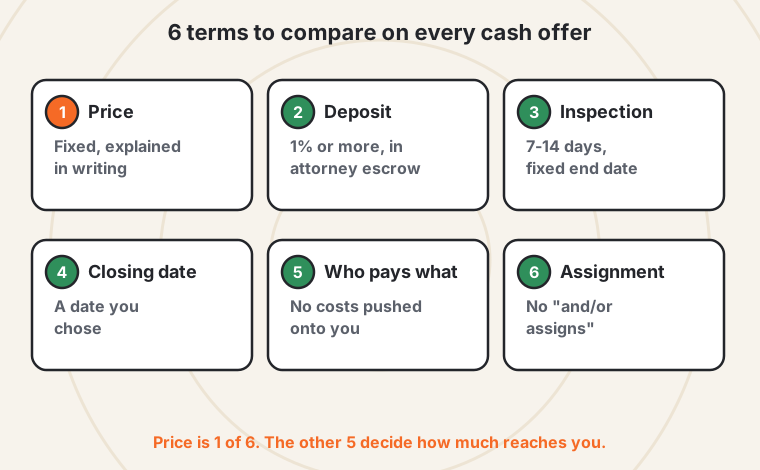
| Term | What a strong offer says | What a weak offer says |
|---|---|---|
| Price | A fixed number, explained | A number “subject to” walk-through, partner approval or appraisal |
| Deposit | 1% or more, held in an attorney’s escrow account | $500 to $1,000, or held by the buyer’s own company |
| Inspection period | 7 to 14 days, or none | 30 days or more “at buyer’s sole discretion” |
| Closing date | A date you chose | “On or before” a date months away, with extensions |
| Who pays what | Buyer pays its own costs; leftover contents allowed | Seller pays buyer’s costs, a cleanout or “fees” |
| Assignment | Buyer named without “and/or assigns” | “and/or assigns”, so someone else may close |
Two of these are Connecticut-specific. The deposit should sit with an attorney, because a Connecticut attorney conducts the closing (CGS 51-88a) and moves the money. And if a buyer plans to assign your contract rather than buy, the 2026 wholesaler law applies: registration with the Department of Consumer Protection, a state disclosure report, three business days for you to cancel and a 90-day cap on the closing date (CGS 20-329ccc).
What does a side-by-side comparison of three Avon cash offers look like?
A side-by-side comparison of three Avon cash offers looks like a table with one row per term and a bottom line for your net at closing. In our example on a dated Avon colonial worth about the $620,000 single-family median once updated, the highest offer, $520,000, nets the most on paper, $507,200, but also carries the smallest deposit, the longest free look and an assignment clause.
Here are three offers (illustrative) on the same house. The house needs updating (see selling a house that needs repairs), so all three are below the median. Avon’s carrying cost is about $1,150 a month in property tax at 31.8 mills, plus about $400 for insurance and utilities (est.), so $1,550 a month.
| Term | Offer A | Offer B | Offer C |
|---|---|---|---|
| Price | $485,000 | $520,000 | $500,000 |
| Deposit (share of price) | $10,000 (2.1%) | $1,000 (0.2%) | $5,000 (1.0%) |
| Inspection period | 7 days | 30 days, sole discretion | 14 days |
| Closing | 14 days | 60 days | 30 days |
| Contents | Leave them | Seller empties (-$3,000 est.) | Seller empties (-$3,000 est.) |
| Assignment | Not assignable | “and/or assigns” | Not assignable |
| Conveyance tax 1% | -$4,850 | -$5,200 | -$5,000 |
| Your attorney (est.) | -$1,500 | -$1,500 | -$1,500 |
| Carrying to closing | -$775 (half a month) | -$3,100 (2 months) | -$1,550 (1 month) |
| Net at closing | $477,875 | $507,200 | $488,950 |
| Net if Offer B drops $40,000 after inspection | n/a | $467,600 | n/a |

On paper, B wins by $18,250 over C and $29,325 over A. But look at what B asks you to accept for that lead: a $1,000 deposit, a 30-day window in which the buyer can walk away for any reason, a closing two months out, and the right to hand your contract to someone else. If B’s buyer asks for $40,000 off after its inspection, a common pattern described in our guide to we buy houses scams and red flags, B drops to $467,600 and you have lost a month.
A is the opposite: the lowest price and the lowest net, but the most certain. C sits in the middle. Which is “best” depends on how much the certainty is worth to you. If you are relocating and must close before a start date, A’s 14 days may be worth $11,000. If you have time, C, or a stronger version of B, may be the right call. Our selling while relocating page covers fixed-date sales.
How do the deposit and inspection period change what an Avon cash offer is worth?
The deposit and inspection period change what an Avon cash offer is worth because together they decide how long the buyer can walk away for free, and what you get if they walk later. A long inspection period with a tiny deposit is a free option for the buyer: your house is off the market while they decide. A short period with a large deposit in escrow means the buyer has real money at stake.
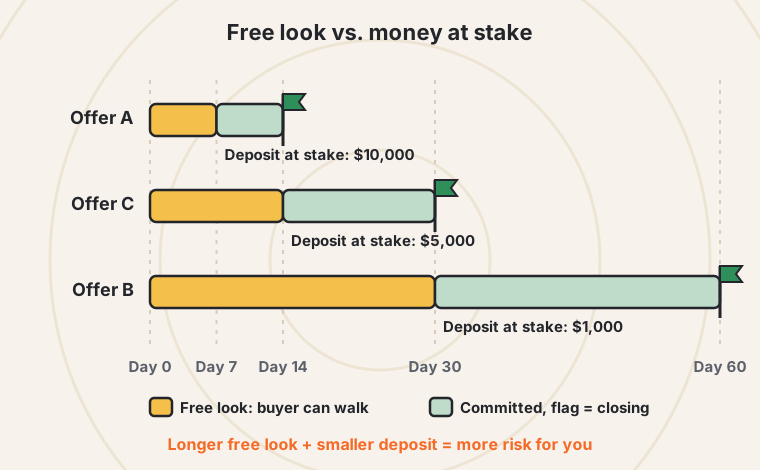
Think of the inspection period as days of “free look”: the buyer can usually cancel and get the deposit back. After it ends, a buyer who fails to close usually forfeits the deposit. So:
- Offer A: 7 free days, then $10,000 at risk for the buyer. Strong.
- Offer C: 14 free days, then $5,000. Reasonable.
- Offer B: 30 free days, then $1,000. At Avon’s $1,550 a month of carrying cost, B’s whole deposit covers less than three weeks of your costs if it falls through.
Also ask where the deposit goes. In Connecticut, it normally sits in an attorney’s escrow account until closing. A deposit “held by buyer” is not really a deposit. Our cash offer contract checklist walks through the deposit, inspection and default clauses word by word.
How do you spot an assignable cash offer, and why does it matter in Avon?
You spot an assignable cash offer by the words “and/or assigns” after the buyer’s name, or a clause saying the buyer may assign or transfer the contract. It matters because the company that signs may not be the one that closes, and its profit comes from the gap between your price and what the next buyer pays. On an Avon house, that gap can be large.
An assignable contract is not illegal. Since July 1, 2026, Connecticut requires anyone who assigns a contract without taking title to be registered with DCP, to give you DCP’s disclosure report before you sign, and to close within 90 days (CGS 20-329bbb to 20-329eee). You can look up a registration on DCP’s license look-up.
For comparing offers, the practical point is simple: if Offer B is assignable, you are not really comparing B’s buyer with A and C. You are comparing an unknown future buyer. Ask B: “Will your company take title?” If the answer is no, ask for the registration number, the disclosure report and a larger deposit. Our guides to “and/or assigns” and wholesaler vs. realtor vs. cash buyer explain the difference in depth, and our Hartford buyer-check guide shows how to look a company up in the land records.
What changes when an Avon house sells for more than $800,000?
What changes when an Avon house sells for more than $800,000 is the state conveyance tax: the state takes 0.75% of the first $800,000 and 1.25% of the part above it, plus Avon’s 0.25% on the whole price (CGS 12-494). On a $900,000 sale that is $9,500 instead of $9,000. About one in three Avon single-family sales last year cleared $800,000, so this affects many Avon comparisons.
The math on $900,000: $6,000 (0.75% of $800,000) plus $1,250 (1.25% of $100,000) to the state, plus $2,250 (0.25%) to Avon, for $9,500. It rarely changes the ranking, but compare nets, not prices. Our Connecticut conveyance tax guide has the full table.
How do you ask cash buyers to improve their offers on an Avon house?
You ask cash buyers to improve their offers on an Avon house by telling every buyer, in writing, that you have several offers and will decide on a set date, and by naming the terms you care about: a larger deposit in attorney escrow, a shorter inspection period, no assignment, your closing date and permission to leave contents. Buyers who are serious will improve terms even when they cannot move price.
- Set one deadline for everyone. “Best and final by Friday at 5.”
- Ask for terms, not just price. In our example, if B raised its deposit to $25,000, cut inspection to 10 days and removed “and/or assigns”, B would be the clear winner. If B refuses all three, that tells you how firm its $520,000 really is.
- Ask each buyer to show its math. A buyer who can explain its offer line by line is less likely to cut it later. See why cash offers are so low.
- Get proof of funds. A bank statement or lender letter that covers the price.
When should you NOT sell your Avon house to a cash buyer?
You should not sell your Avon house to a cash buyer when it is updated or close to it and you have two or three months, because Avon’s financed buyers pay full market value for a house in good shape. With a $620,000 single-family median, even a few percent of difference is tens of thousands of dollars. Cash makes sense when the house needs real work, is vacant, or must close on a fixed date.
- The house is updated. List it, and compare the agent’s net with your best cash offer using our calculator below.
- Every cash offer is weak on terms. That is a sign to list instead.
- The house needs work you can afford and want to do. See selling a house that needs repairs for when repairs pay back and when they do not.
How much would you walk away with?
Slide the numbers to match your house. It works in your browser; nothing is saved or sent.
Estimates for planning. Conveyance tax per CGS 12-494 (state 0.75% up to $800,000, 1.25% to $2.5M, 2.25% above, plus the town rate). Seller attorney about $1,200 to $1,500; flat-fee MLS about $400; listings include three months of taxes, insurance and utilities, a cash sale about two weeks. Your attorney gives you the final numbers.

When I lose a house to another cash buyer, it is usually to a better price with worse terms. Sometimes that works out for the seller, and sometimes they call me back six weeks later. Before you pick the biggest number, ask yourself one question: if this buyer walks on day 30, what have I lost? If the answer is “a month and nothing to show for it,” ask for a bigger deposit first.
How do you compare cash offers on an Avon house, step by step?
You compare cash offers on an Avon house, step by step, by collecting every offer in writing, putting the six terms in one table, working out your net at closing for each, adjusting for deposit and inspection risk, asking every buyer for its best terms by one deadline, and having your own Connecticut attorney read the winner before you sign. It takes a few days, not weeks.
Get every offer in writing
Price, deposit and who holds it, inspection days, closing date, costs, assignment. A phone number is not an offer.
Build the six-term table
One column per offer, as in our example. Mark the weak cells.
Work out each net
Price minus 1% Avon conveyance tax (more above $800,000), your attorney, costs pushed onto you and carrying to closing at about $1,550 a month (est.).
Weigh the risk
Free-look days and deposit size. Ask: what if this buyer walks or cuts the price at the end of its inspection?
Ask for best terms by one deadline
Name the terms you want improved. Check proof of funds and look each company up.
Have your attorney read the winner
Then sign. A typical cash closing takes about two weeks, or the later date you choose. You can request our written offer from our Avon page and line it up against the rest.
Questions about comparing cash offers in Avon
Is the highest cash offer always the best one?
The highest cash offer is not always the best one, because a higher price with a tiny deposit, a long inspection period and an assignment clause can shrink or vanish before closing. Compare each offer’s net at closing and how likely it is to close at that price.
How big should a cash buyer’s deposit be in Connecticut?
A cash buyer’s deposit in Connecticut should be large enough to matter if the buyer walks: about 1% of the price or more is a reasonable ask, held in an attorney’s escrow account. A $500 or $1,000 deposit on an Avon house costs the buyer little if it backs out.
How long should the inspection period be on a cash offer?
The inspection period on a cash offer should usually be 7 to 14 days; some buyers who have already walked through the house need none. Thirty days or more “at buyer’s sole discretion” gives the buyer a free option on your house while it is off the market.
What does “and/or assigns” mean on a cash offer?
“And/or assigns” on a cash offer means the buyer may transfer the contract to someone else, who would then close. In Connecticut, a person who assigns contracts without taking title must register with DCP as a wholesaler and give you a three-business-day cancellation right (CGS 20-329bbb, 20-329ccc).
What is the conveyance tax when selling a house in Avon?
The conveyance tax when selling a house in Avon is 1% of the price up to $800,000: 0.75% to the state and 0.25% to Avon (CGS 12-494). Above $800,000 the state rate on the extra is 1.25%, so a $900,000 sale pays $9,500.
Can I ask several cash buyers for their best and final offer?
Yes, you can ask several cash buyers for their best and final offer. Tell each one in writing that you have other offers and will decide by a set date, and name the terms you care about, such as deposit, inspection days and closing date.
How do I compare cash offers on an inherited Avon house?
You compare cash offers on an inherited Avon house the same way, but the closing date must allow for probate. If the estate is open in the Simsbury Regional Probate Court, a sale by the executor may need court approval (CGS 45a-164), so pick buyers willing to wait for it. See selling an inherited house.
Do I need an attorney to compare cash offers?
You do not need an attorney to compare cash offers, but you should have one read the offer you choose before you sign. Connecticut closings are conducted by attorneys (CGS 51-88a), and your own attorney will catch deposit, default and assignment wording you might miss.
Related guides
Cash buyers
Same series
Avon and nearby
For the whole process from first call to closing, see how to sell a house in Connecticut.
Plain-English information, not legal advice. The three offers are an illustrative example built from public data and labelled estimates; your offers and numbers will differ.
Sources (checked on October 27, 2026)
- Connecticut OPM, Real Estate Sales (data.ct.gov dataset 5mzw-sjtu): Avon residential sales, October 2024 to September 2025.
- Connecticut OPM mill rates (Avon, fiscal 2027: 31.8).
- CGS § 12-494 (conveyance tax rates).
- CGS §§ 20-329aaa to 20-329hhh (real estate wholesalers, effective July 1, 2026).
- DCP: verify a license or registration.
- CGS § 51-88a (closings conducted by Connecticut attorneys).
- CGS § 45a-164 (probate court authority to sell real property).
- Directory of Connecticut Probate Courts (ctprobate.gov): Avon is in the Simsbury Regional Probate Court (PD-09).

Who wrote this
Jerryll Noorden
Jerryll has bought and sold Connecticut houses since 2016 and has sat at more closing tables than he can count, on both sides. Before real estate he was a robotics scientist at NASA, IHMC and IIT. He wrote this guide because the national sites that rank for it skip the Connecticut rules that cost sellers money. When listing or selling it yourself would get you more than a cash offer, he says so.
This guide explains Connecticut rules in plain English. It is not legal or tax advice. Laws change; for your sale, talk to a Connecticut real estate attorney and a tax professional.
