
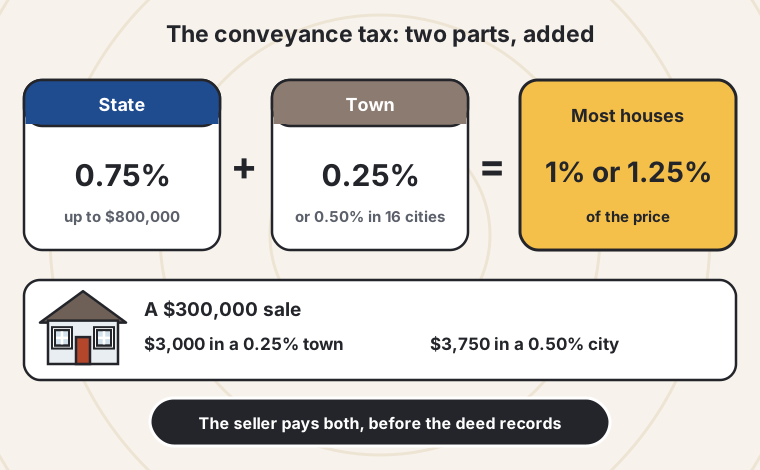
- The seller pays it. Connecticut law makes the conveyance tax payable “by the person conveying the property” when the deed is recorded (CGS 12-495). The deed is not recorded until the return is filed and the tax is paid (CGS 12-497).
- Two parts, added together. A state part (0.75% of the price up to $800,000 on a house or condo) and a town part (0.25% in most towns, 0.50% in 16 cities, 0.35% or 0.50% in Stamford).
- On most Connecticut houses it is 1% or 1.25% of the price. A $300,000 sale costs $3,000 in a 0.25% town and $3,750 in a 0.50% city.
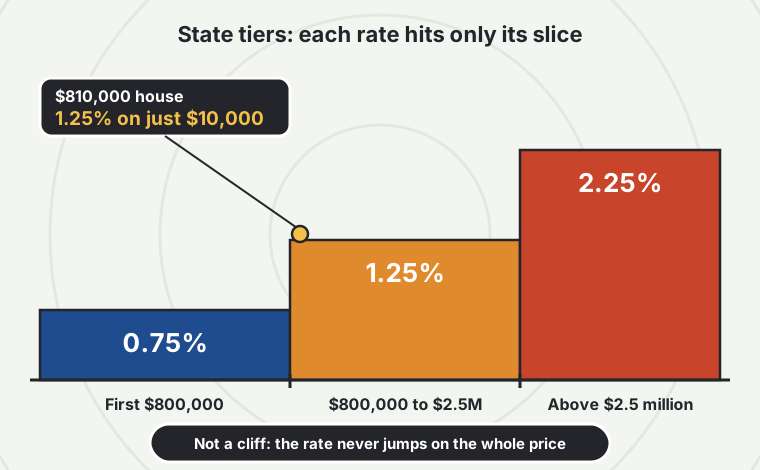
- Higher tiers apply only to the slice above the line. 1.25% on the part of a home’s price between $800,000 and $2.5 million, 2.25% on the part above $2.5 million. It is not a cliff.
- Some sales are exempt under CGS 12-498, including short sales of a principal residence, deeds in lieu of foreclosure, transfers between spouses, divorce-decree transfers and certain crumbling-foundation homes. Some older and disabled homeowners are exempt from the state part.
- The return is Form OP-236. Your attorney normally prepares and files it, usually electronically through the state’s myCTREC system.
What is the Connecticut conveyance tax?
The Connecticut conveyance tax is a tax on the sale of real estate, charged on the price whenever a deed transfers property for $2,000 or more. It has a state part and a town part, the seller pays both, and it is collected by the town clerk before the deed can be recorded. Other states call it a transfer tax or deed stamps; in Connecticut the statutes and the forms call it the real estate conveyance tax.
If you are figuring out how to sell a house in Connecticut, this tax is one of the few costs you cannot negotiate away and cannot avoid by changing how you sell. Agent, by owner or a direct cash sale: the tax is the same, because it is based on the price written in the deed. On a typical Connecticut house it is the second-largest selling cost after commissions, and it is the one owners forget most often.
The rules live in chapter 223 of the Connecticut General Statutes. The main pieces are:
- CGS 12-494 sets the rates: a state part and a municipal part, plus a local option for certain cities.
- CGS 12-495 says who pays (the person conveying the property, which is the seller) and when (upon recording).
- CGS 12-497 says the town clerk cannot record the deed until the return is filed and the tax is paid.
- CGS 12-498 lists the exempt transfers.
The tax is reported on Form OP-236, the Connecticut Real Estate Conveyance Tax Return, from the Department of Revenue Services (DRS). The town clerk keeps the town’s share and sends the state’s share to DRS; the statute gives the clerk ten days to remit it.
In many states, who pays the transfer tax is a local custom that buyers and sellers negotiate. In Connecticut it is written into the statute: the tax “shall be payable by the person conveying the property upon the recording” of the deed (CGS 12-495). A buyer can agree to give you a credit that covers it, but the legal duty to pay stays with you as the seller.
What are the Connecticut conveyance tax rates in 2026?
The Connecticut conveyance tax rates in 2026 are 0.75% state tax on the first $800,000 of a home’s price, 1.25% on the part between $800,000 and $2.5 million, and 2.25% on the part above $2.5 million, plus a town tax of 0.25% in most towns or 0.50% in 16 cities. These rates have applied to homes since July 1, 2020, and the statute has not changed them since.
The state part
| Type of property | State rate | Applies to |
|---|---|---|
| Residential dwelling (single-family house, condo or co-op unit) | 0.75% | The part of the price up to and including $800,000 |
| Residential dwelling | 1.25% | The part of the price above $800,000, up to $2.5 million |
| Residential dwelling | 2.25% | The part of the price above $2.5 million |
| Other residential property (two- to four-family houses, apartment buildings) | 0.75% | The whole price |
| Unimproved land (including farm, forest and open space land) | 0.75% | The whole price |
| Nonresidential property (other than unimproved land) | 1.25% | The whole price |
| Property conveyed to the lender by an owner at least six months behind on the mortgage | 0.75% | The unpaid mortgage plus interest |
Two details in that table save some sellers real money:
- The higher tiers are marginal. A house that sells for $810,000 pays 1.25% on $10,000, not on the whole price. DRS tells filers to put $800,000 on line 16a and only the excess on line 16b.
- Two- to four-family houses stay at 0.75%. DRS defines a “residential dwelling” as a single-family dwelling, condo unit or co-op unit. A multi-family house is “residential property other than residential dwelling” and pays the flat 0.75% state rate on the whole price, even above $800,000. That matters in Fairfield County, where three-family houses can cross $800,000.
The town part
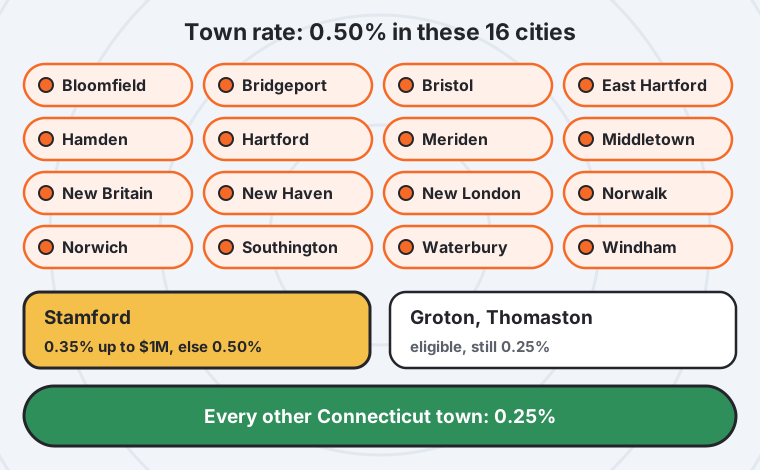
Every Connecticut town charges a base municipal tax of 0.25% of the price (CGS 12-494(a)(2)). The law also lets 19 municipalities add up to another 0.25%: the state’s “targeted investment communities” plus Bloomfield, which qualifies because of a manufacturing plant (CGS 12-494(c)). According to the legislature’s Office of Legislative Research, they use that option like this:
| Town rate | Towns |
|---|---|
| 0.50% (0.25% base + 0.25% local option) | Bloomfield, Bridgeport, Bristol, East Hartford, Hamden, Hartford, Meriden, Middletown, New Britain, New Haven, New London, Norwalk, Norwich, Southington, Waterbury, Windham |
| 0.35% or 0.50% | Stamford: 0.10% extra on properties sold for up to $1 million, 0.25% extra on all other properties |
| 0.25% (eligible, but not using the option) | Groton, Thomaston |
| 0.25% | Every other Connecticut town |
That is where the “16 or 19 towns” confusion online comes from. Nineteen municipalities are allowed to charge more. Sixteen charge the full extra 0.25%, Stamford charges a split rate, and Groton and Thomaston charge nothing extra.
The state tiers apply only to the slice of the price above each line. Stamford’s local option, as OLR describes it, works differently: 0.10% on properties sold for up to $1 million and 0.25% “on all other properties”. A Stamford house at $1,000,000 pays a 0.35% town rate; at $1,010,000 the whole price is taxed at 0.50%. If you are near that line in Stamford, ask your attorney to confirm the town’s current practice before you set a price.
How do you calculate the conveyance tax on a Connecticut home?
To calculate the conveyance tax on a Connecticut home, take 0.75% of the price up to $800,000, add 1.25% of any part between $800,000 and $2.5 million and 2.25% of any part above $2.5 million, then add your town’s rate (usually 0.25%, or 0.50% in 16 cities) times the full price. For most homes under $800,000 that is simply 1% or 1.25% of the price.
Start with the price in the deed
The tax is on the “consideration”: the price, including any debt the buyer takes over. Seller credits for repairs usually reduce the net you receive, not the price in the deed, so ask your attorney how your credits are written. The Connecticut Supreme Court has held that the tax is assessed on the consideration the seller received.
Figure the state part
Up to $800,000: price × 0.75%. Above $800,000: $6,000, plus 1.25% of the amount over $800,000 (up to $2.5 million), plus 2.25% of any amount over $2.5 million. Two- to four-family houses: 0.75% of the whole price.
Figure the town part
Price × your town’s rate: 0.25%, 0.50% in the 16 cities listed above, or Stamford’s 0.35% / 0.50%.
Add them together
That total goes on line 20 of Form OP-236 and is paid at closing out of your proceeds. Amounts are rounded to the nearest whole dollar.
Quick formulas for a house or condo
| Price | 0.25% town | 0.50% town |
|---|---|---|
| Up to $800,000 | Price × 1.00% | Price × 1.25% |
| $800,000 to $2.5 million | $6,000 + 1.25% of the amount over $800,000 + 0.25% of the price | $6,000 + 1.25% of the amount over $800,000 + 0.50% of the price |
| Above $2.5 million | $27,250 + 2.25% of the amount over $2.5 million + 0.25% of the price | $27,250 + 2.25% of the amount over $2.5 million + 0.50% of the price |
How much is the conveyance tax on a $300,000, $800,000, $1.2 million and $3 million house?
The conveyance tax on a Connecticut single-family house is $3,000 at $300,000, $8,000 at $800,000, $14,000 at $1.2 million and $46,000 at $3 million in a town with the standard 0.25% rate. In one of the 16 cities with a 0.50% town rate it is $3,750, $10,000, $17,000 and $53,500. The worked math for each is below.
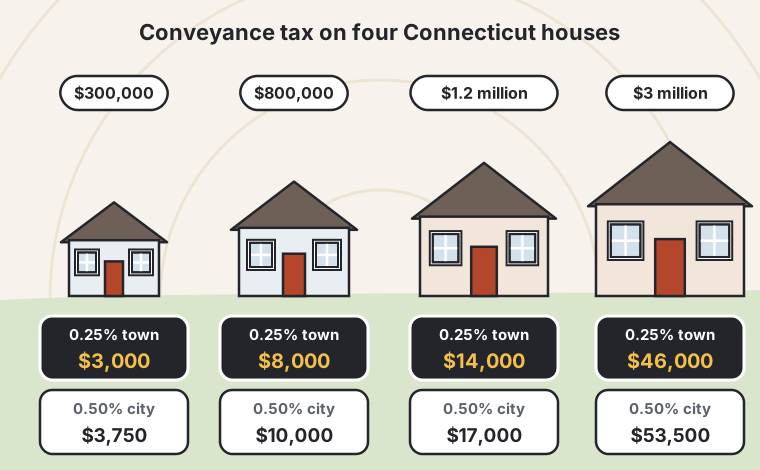
| Sale price | State part | Town 0.25% | Total, 0.25% town | Town 0.50% | Total, 0.50% town | Stamford total |
|---|---|---|---|---|---|---|
| $300,000 | $2,250 | $750 | $3,000 (1.00%) | $1,500 | $3,750 (1.25%) | $3,300 (0.35% town) |
| $800,000 | $6,000 | $2,000 | $8,000 (1.00%) | $4,000 | $10,000 (1.25%) | $8,800 (0.35% town) |
| $1,200,000 | $11,000 | $3,000 | $14,000 (1.17%) | $6,000 | $17,000 (1.42%) | $17,000 (0.50% town) |
| $3,000,000 | $38,500 | $7,500 | $46,000 (1.53%) | $15,000 | $53,500 (1.78%) | $53,500 (0.50% town) |
$300,000 in Enfield (0.25%)
$3,0001% of the price
- State: $300,000 × 0.75% = $2,250
- Town: $300,000 × 0.25% = $750
- The same house in Bristol (0.50%) would pay $3,750
$800,000 in Norwalk (0.50%)
$10,0001.25% of the price
- State: $800,000 × 0.75% = $6,000
- Town: $800,000 × 0.50% = $4,000
- Exactly at the line: no 1.25% slice yet
$1.2 million in Fairfield (0.25%)
$14,0001.17% of the price
- State: $6,000 + ($400,000 × 1.25%) = $11,000
- Town: $1,200,000 × 0.25% = $3,000
- Not 1.25% of the whole price: that would be $15,000 state tax
$3 million in Westport (0.25%)
$46,0001.53% of the price
- State: $6,000 + $21,250 + ($500,000 × 2.25% = $11,250) = $38,500
- Town: $3,000,000 × 0.25% = $7,500
- A Connecticut resident may later recover part of the 2.25% slice as an income tax credit (see below)
A few things to notice. First, under $800,000 the only thing that changes the rate is the town. Second, above $800,000 the effective rate rises slowly, not in a jump. Third, the town you are in can matter as much as the price: a $600,000 house in Norwalk pays $7,500, while a $600,000 house in Westport pays $6,000.
Want the tax as part of your whole bottom line? The calculator below adds the conveyance tax at your town’s rate to commissions, attorney fees and credits.
How much would you walk away with?
Slide the numbers to match your house. It works in your browser; nothing is saved or sent.
Estimates for planning. Conveyance tax per CGS 12-494 (state 0.75% up to $800,000, 1.25% to $2.5M, 2.25% above, plus the town rate). Seller attorney about $1,200 to $1,500; flat-fee MLS about $400; listings include three months of taxes, insurance and utilities, a cash sale about two weeks. Your attorney gives you the final numbers.
What is the conveyance tax in my Connecticut town?
The conveyance tax in your Connecticut town is the 0.75% state rate on the first $800,000 plus your town’s rate: 0.25% in most towns, 0.50% in Bloomfield, Bridgeport, Bristol, East Hartford, Hamden, Hartford, Meriden, Middletown, New Britain, New Haven, New London, Norwalk, Norwich, Southington, Waterbury and Windham, and 0.35% or 0.50% in Stamford. The table shows the tax on a typical single-family sale in every town we cover.
Each row uses that town’s median single-family sale price from state sales records for October 2024 to September 2025, and applies the state tiers and the town rate exactly as the statute does. Click a town for its local sales, mill rate and housing data.
| Town | County | Town conveyance rate | Median single-family sale | State tax | Town tax | Conveyance tax on the median sale | Effective rate |
|---|---|---|---|---|---|---|---|
| Ansonia | New Haven | 0.25% | $380,000 | $2,850 | $950 | $3,800 | 1.00% |
| Avon | Hartford | 0.25% | $620,000 | $4,650 | $1,550 | $6,200 | 1.00% |
| Beacon Falls | New Haven | 0.25% | $350,000 | $2,625 | $875 | $3,500 | 1.00% |
| Berlin | Hartford | 0.25% | $415,000 | $3,112 | $1,038 | $4,150 | 1.00% |
| Bethany | New Haven | 0.25% | $481,450 | $3,611 | $1,204 | $4,814 | 1.00% |
| Bloomfield | Hartford | 0.50% | $336,000 | $2,520 | $1,680 | $4,200 | 1.25% |
| Branford | New Haven | 0.25% | $547,000 | $4,102 | $1,368 | $5,470 | 1.00% |
| Bridgeport | Fairfield | 0.50% | $383,500 | $2,876 | $1,918 | $4,794 | 1.25% |
| Bristol | Hartford | 0.50% | $330,000 | $2,475 | $1,650 | $4,125 | 1.25% |
| Canton | Hartford | 0.25% | $475,000 | $3,562 | $1,188 | $4,750 | 1.00% |
| Cheshire | New Haven | 0.25% | $543,000 | $4,072 | $1,358 | $5,430 | 1.00% |
| Cromwell | Middlesex | 0.25% | $455,000 | $3,412 | $1,138 | $4,550 | 1.00% |
| Danbury | Fairfield | 0.25% | $472,500 | $3,544 | $1,181 | $4,725 | 1.00% |
| Derby | New Haven | 0.25% | $357,500 | $2,681 | $894 | $3,575 | 1.00% |
| East Granby | Hartford | 0.25% | $420,000 | $3,150 | $1,050 | $4,200 | 1.00% |
| East Hartford | Hartford | 0.50% | $285,000 | $2,138 | $1,425 | $3,562 | 1.25% |
| East Hartland (Hartland data) | Hartford | 0.25% | $371,000 | $2,782 | $928 | $3,710 | 1.00% |
| East Windsor | Hartford | 0.25% | $327,950 | $2,460 | $820 | $3,280 | 1.00% |
| Easton | Fairfield | 0.25% | $900,000 | $7,250 | $2,250 | $9,500 | 1.06% |
| Enfield | Hartford | 0.25% | $311,000 | $2,332 | $778 | $3,110 | 1.00% |
| Essex | Middlesex | 0.25% | $671,000 | $5,032 | $1,678 | $6,710 | 1.00% |
| Fairfield | Fairfield | 0.25% | $940,000 | $7,750 | $2,350 | $10,100 | 1.07% |
| Farmington | Hartford | 0.25% | $520,000 | $3,900 | $1,300 | $5,200 | 1.00% |
| Glastonbury | Hartford | 0.25% | $615,000 | $4,612 | $1,538 | $6,150 | 1.00% |
| Groton | New London | 0.25% (eligible for 0.50%, not adopted) | $372,500 | $2,794 | $931 | $3,725 | 1.00% |
| Guilford | New Haven | 0.25% | $606,000 | $4,545 | $1,515 | $6,060 | 1.00% |
| Haddam | Middlesex | 0.25% | $441,500 | $3,311 | $1,104 | $4,415 | 1.00% |
| Hamden | New Haven | 0.50% | $355,000 | $2,662 | $1,775 | $4,438 | 1.25% |
| Hartford | Hartford | 0.50% | $260,000 | $1,950 | $1,300 | $3,250 | 1.25% |
| Killingworth | Middlesex | 0.25% | $485,000 | $3,638 | $1,212 | $4,850 | 1.00% |
| Ledyard | New London | 0.25% | $390,000 | $2,925 | $975 | $3,900 | 1.00% |
| Madison | New Haven | 0.25% | $713,750 | $5,353 | $1,784 | $7,138 | 1.00% |
| Manchester | Hartford | 0.25% | $320,500 | $2,404 | $801 | $3,205 | 1.00% |
| Meriden | New Haven | 0.50% | $316,000 | $2,370 | $1,580 | $3,950 | 1.25% |
| Milford | New Haven | 0.25% | $515,000 | $3,862 | $1,288 | $5,150 | 1.00% |
| Monroe | Fairfield | 0.25% | $560,000 | $4,200 | $1,400 | $5,600 | 1.00% |
| Naugatuck | New Haven | 0.25% | $345,000 | $2,588 | $862 | $3,450 | 1.00% |
| New Britain | Hartford | 0.50% | $285,000 | $2,138 | $1,425 | $3,562 | 1.25% |
| New Haven | New Haven | 0.50% | $329,450 | $2,471 | $1,647 | $4,118 | 1.25% |
| Newington | Hartford | 0.25% | $360,000 | $2,700 | $900 | $3,600 | 1.00% |
| Newtown | Fairfield | 0.25% | $625,000 | $4,688 | $1,562 | $6,250 | 1.00% |
| North Haven | New Haven | 0.25% | $445,000 | $3,338 | $1,112 | $4,450 | 1.00% |
| Norwalk | Fairfield | 0.50% | $750,000 | $5,625 | $3,750 | $9,375 | 1.25% |
| Norwich | New London | 0.50% | $273,220 | $2,049 | $1,366 | $3,415 | 1.25% |
| Old Saybrook | Middlesex | 0.25% | $699,000 | $5,242 | $1,748 | $6,990 | 1.00% |
| Orange | New Haven | 0.25% | $574,950 | $4,312 | $1,437 | $5,750 | 1.00% |
| Oxford | New Haven | 0.25% | $487,000 | $3,652 | $1,218 | $4,870 | 1.00% |
| Plainville | Hartford | 0.25% | $330,000 | $2,475 | $825 | $3,300 | 1.00% |
| Putnam | Windham | 0.25% | $302,500 | $2,269 | $756 | $3,025 | 1.00% |
| Rocky Hill | Hartford | 0.25% | $425,000 | $3,188 | $1,062 | $4,250 | 1.00% |
| Seymour | New Haven | 0.25% | $372,000 | $2,790 | $930 | $3,720 | 1.00% |
| Shelton | Fairfield | 0.25% | $546,500 | $4,099 | $1,366 | $5,465 | 1.00% |
| Simsbury | Hartford | 0.25% | $510,000 | $3,825 | $1,275 | $5,100 | 1.00% |
| South Windsor | Hartford | 0.25% | $460,000 | $3,450 | $1,150 | $4,600 | 1.00% |
| Southbury | New Haven | 0.25% | $590,000 | $4,425 | $1,475 | $5,900 | 1.00% |
| Southington | Hartford | 0.50% | $400,250 | $3,002 | $2,001 | $5,003 | 1.25% |
| Stamford | Fairfield | 0.35% (0.25% + 0.10%) | $899,000 | $7,238 | $3,146 | $10,384 | 1.16% |
| Stratford | Fairfield | 0.25% | $449,000 | $3,368 | $1,122 | $4,490 | 1.00% |
| Suffield | Hartford | 0.25% | $450,500 | $3,379 | $1,126 | $4,505 | 1.00% |
| Trumbull | Fairfield | 0.25% | $635,000 | $4,762 | $1,588 | $6,350 | 1.00% |
| Vernon | Tolland | 0.25% | $322,500 | $2,419 | $806 | $3,225 | 1.00% |
| Wallingford | New Haven | 0.25% | $375,000 | $2,812 | $938 | $3,750 | 1.00% |
| Waterbury | New Haven | 0.50% | $280,000 | $2,100 | $1,400 | $3,500 | 1.25% |
| Waterford | New London | 0.25% | $395,000 | $2,962 | $988 | $3,950 | 1.00% |
| West Hartford | Hartford | 0.25% | $520,000 | $3,900 | $1,300 | $5,200 | 1.00% |
| Westbrook | Middlesex | 0.25% | $585,000 | $4,388 | $1,462 | $5,850 | 1.00% |
| Westport | Fairfield | 0.25% | $2,000,000 | $21,000 | $5,000 | $26,000 | 1.30% |
| Wethersfield | Hartford | 0.25% | $415,000 | $3,112 | $1,038 | $4,150 | 1.00% |
| Windsor | Hartford | 0.25% | $350,000 | $2,625 | $875 | $3,500 | 1.00% |
| Windsor Locks | Hartford | 0.25% | $300,000 | $2,250 | $750 | $3,000 | 1.00% |
| Wolcott | New Haven | 0.25% | $360,000 | $2,700 | $900 | $3,600 | 1.00% |
| Woodbridge | New Haven | 0.25% | $665,000 | $4,988 | $1,662 | $6,650 | 1.00% |
The pattern is clear in the table. In the 0.25% towns the tax on a typical house runs from about $3,000 (Windsor Locks, Putnam) to over $10,000 where prices are higher (Fairfield) and $26,000 in Westport, where the median single-family sale is around $2 million. In the 0.50% cities, lower prices partly offset the higher rate: a median house in Hartford, East Hartford or New Britain pays about $3,250 to $3,600.
Who pays the conveyance tax in Connecticut, the buyer or the seller?
The seller pays the conveyance tax in Connecticut. State law makes it “payable by the person conveying the property” when the deed is recorded (CGS 12-495), and the town clerk will not record the deed until the tax and the return are in (CGS 12-497). The buyer pays nothing toward it unless the two sides agree to a credit in the contract.
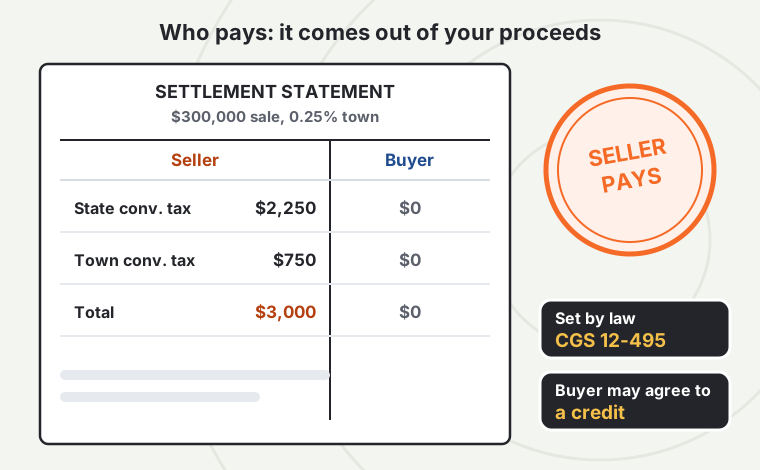
In practice you never write a separate check. Your attorney (or the closing attorney) takes the amount out of your proceeds at closing and pays the town clerk. On your settlement statement it shows as a line in the seller’s column, usually split into the state and town amounts.
Can I ask the buyer to pay it?
You can ask. Some buyers, especially investors, agree to cover some closing costs. But the legal duty stays with you, so what the buyer is really doing is paying you more. In a normal sale, it is cleaner to set the price where you need it and pay the tax yourself.
What about a buyer who takes over my mortgage?
The consideration includes “the amount of any liability assumed” (DRS Form OP-236 instructions, line 14). If a buyer pays you $50,000 and takes over a $250,000 mortgage, the tax is on $300,000.
When and how is the conveyance tax paid?
The conveyance tax is paid at closing, when the deed is recorded with the town clerk where the property sits. Your attorney files Form OP-236, usually electronically through the Department of Revenue Services’ myCTREC system, and pays the tax from your sale proceeds. The town clerk endorses the deed “Conveyance Tax received” and then records it.
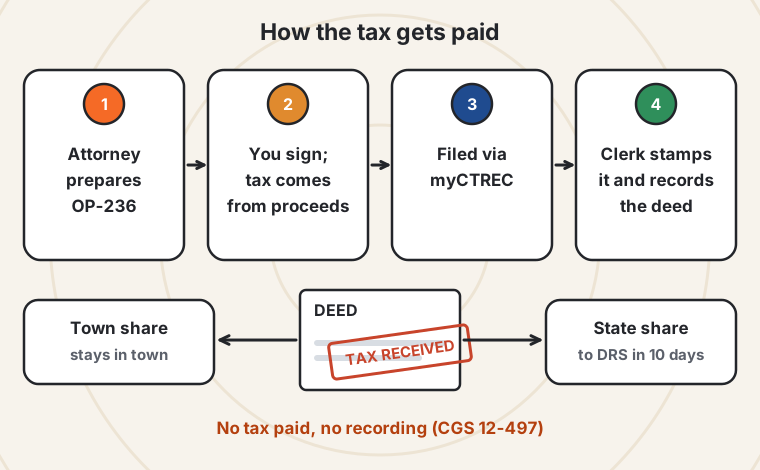
- Before closing. Your attorney prepares the deed and Form OP-236 with your name, the mailing address you will use after the sale, and your Social Security number or federal ID number.
- At closing. You sign the deed and the return (the grantor, the grantor’s attorney or the grantor’s authorized agent may sign the return). The tax is deducted from your proceeds.
- Recording. The deed and the return go to the town clerk. Paper filers give the clerk both pages of the OP-236 with a check to the Commissioner of Revenue Services; electronic filers submit through myCTREC, and participating town clerks approve the return online.
- After recording. The clerk keeps the town’s share and sends the state’s share to DRS (within ten days by statute).
If something was entered wrong, the attorney files an amended OP-236 through myCTREC and pays any extra state tax and interest directly to DRS. If DRS finds tax was underpaid, it can assess the deficiency with interest at 1% per month, plus penalties where there was negligence or fraud (CGS 12-502b).
What is Form OP-236 and what is on it?
Form OP-236 is the Connecticut Real Estate Conveyance Tax Return. It reports who sold, who bought, the property’s town, the type of property, the price split into the state rate tiers, any exemption code, and the total state and town tax due. The seller, the seller’s attorney or an authorized agent signs it, and it must be filed with the town clerk before the deed can be recorded.
The current OP-236 (revised 07/2020) applies to conveyances on or after July 1, 2020. DRS publishes it only as a fillable form on its website and prefers electronic filing through myCTREC. Here is what the main lines mean for a seller, from the DRS instructions:
| Line | What goes there | What to watch |
|---|---|---|
| Line 2 | The town where the property is | If the land sits in two towns, a return is filed for each, with the price allocated on Form AU-263. |
| Lines 3 to 6 | Grantors (sellers): names, mailing address after the sale, SSN or FEIN | Do not give the sold house as your address unless you will still get mail there. More than two sellers, or a seller that is an LLC, partnership, S corporation, estate or trust: attach Schedule A with each member’s or beneficiary’s details. |
| Line 7 | Checked if more than one deed was used | The tax is computed on the total price; splitting deeds never lowers it. |
| Lines 9 to 10 | Grantees (buyers) | Schedule B if there are more than one buyer or the buyer is an entity. |
| Line 14 | Exemption code, if one applies | No code, no exemption: the town clerk cannot accept a claimed exemption without it. |
| Line 15 | Unimproved land | 0.75% state rate. |
| Lines 16a, 16b, 16c | Single-family house, condo or co-op: the price up to $800,000; the part from $800,000 to $2.5 million; the part above $2.5 million | Taxed at 0.75%, 1.25% and 2.25%. |
| Line 17 | Other residential property (two- to four-family, apartments) | 0.75% on the whole price. |
| Line 18 | Nonresidential property | 1.25% on the whole price. |
| Line 19 | Property conveyed to the lender by a delinquent mortgagor | 0.75% on the unpaid mortgage plus interest. |
| Line 20 | Total tax due | All amounts rounded to whole dollars. |
A house with a business on the first floor is classified by the use of the larger share of its square footage, according to the DRS instructions. A mostly residential building gets residential rates; a mostly commercial one pays 1.25% on the whole price.
Which sales are exempt from the Connecticut conveyance tax?
The sales exempt from the Connecticut conveyance tax are listed in CGS 12-498. For homeowners the important ones are a short sale of a principal residence, a deed in lieu of foreclosure on a principal residence, transfers between spouses, transfers under a divorce decree, the first sale of a crumbling-foundation home with an engineer’s report, and deeds for less than $2,000. Some older and disabled homeowners, and properties in enterprise zones, are exempt from the state part only.
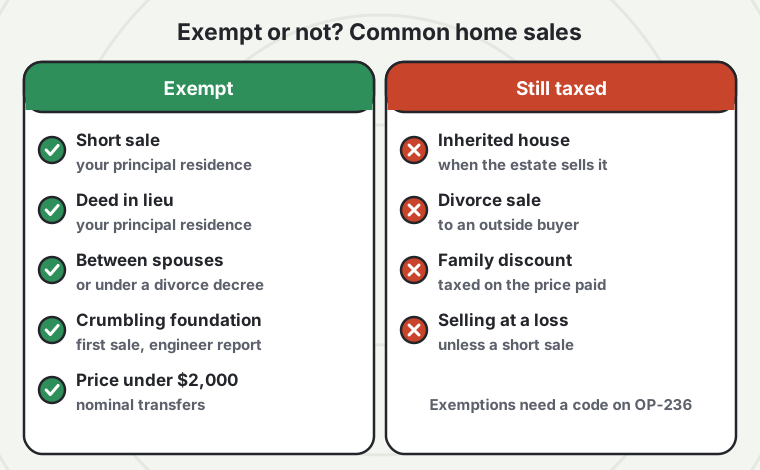
Exempt from both the state and the town tax (CGS 12-498(a))
| Exemption | CGS 12-498(a) | OP-236 code | Who it helps |
|---|---|---|---|
| Sale of your principal residence where the price is not enough to pay off the mortgages plus municipal taxes and liens that come ahead of them (a short sale) | (20) | 22 | Owners selling for less than they owe |
| Deed in lieu of foreclosure on your principal residence | (19) | 21 | Owners giving the house back to the lender |
| Deeds under a Superior Court decree: divorce, annulment or legal separation (46b-81), foreclosure by sale or market sale (49-24), partition (52-495), loss mitigation (49-30t, 49-30u) | (9) | 09 | Divorcing spouses, foreclosure sales, co-owners in a partition |
| Deeds between spouses | (14) | 17 | Married couples moving title between them |
| First sale of a principal residence whose concrete foundation has deteriorated from pyrrhotite, with a licensed professional engineer’s written evaluation | (21) | 23 | Owners of crumbling-foundation homes who have not received Crumbling Foundations Assistance Fund money to fix it |
| Price under $2,000 | (10) | n/a | Nominal transfers |
| Mere change of identity or form of ownership with no change in beneficial ownership | (17) | 20 | For example, moving a house into an entity you wholly own |
| Deeds that secure a debt (a mortgage), releases of a mortgage, tax deeds, deeds of partition | (2), (5), (4), (6) | 02, 05, 04, 06 | Routine filings, not sales |
| Deeds to or from the State of Connecticut or a town or its agencies | (3) | 03 | Sales to a town, the state or a housing authority |
| Employee relocation resales within six months | (18) | 10 | Relocation companies |
| Deeds of property where every dwelling unit is deed-restricted affordable housing (proportional if only some are) | (22) | 24 | Affordable housing owners |
| Other listed transfers: corporate mergers, subsidiary to parent, certain nonprofit and land trust transfers, certain water company land | (7), (8), (11) to (13), (16) | 07, 08, 11, 14, 16, 19 | Organizations |
Exempt from the state tax only (CGS 12-498(b)): the town tax still applies
- Older or disabled homeowners on Connecticut’s property tax relief programs. The sale of the principal residence of someone approved for homeowner tax relief under CGS 12-129b or 12-170aa for the current assessment year, or within 15 months after the end of an assessment year in which they qualified. On a $300,000 sale in a 0.25% town, that removes $2,250 of the $3,000 tax. DRS says the estate of a person who has died cannot claim it. Ask your town assessor whether you were approved.
- Property in a designated enterprise zone (CGS 32-70). DRS requires a letter from the town’s economic development officer confirming the property is inside the zone.
- Property in a designated entertainment district.
If your house will sell for less than the mortgages and municipal liens, the short sale exemption removes the conveyance tax entirely, which matters because every dollar of tax would otherwise come out of money your lender has to approve. If you are handing the house back, a deed in lieu on your principal residence is exempt too. Both are explained in our guide to selling a house in foreclosure in Connecticut.
What is not exempt (common misunderstandings)
- Selling an inherited house. The transfer from the estate to the heirs is usually not a sale, but when the executor or the heirs sell to a buyer, the tax applies at the normal rates. See selling an inherited house in Connecticut.
- Selling during a divorce. A deed from one spouse to the other, or under the divorce decree, is exempt. A sale to an outside buyer is taxed like any sale.
- Selling to a family member at a low price. The tax applies to the consideration paid. DRS warns that transfers for less than adequate consideration may raise federal or Connecticut gift tax questions.
- Selling at a loss. A sale for less than you paid is still taxed unless the price is too low to pay off the mortgage and municipal liens on your principal residence.
Can you get any of the 2.25% conveyance tax back?
Yes, you can get part of the 2.25% conveyance tax back if you are a Connecticut resident. Under CGS 12-704c, a resident who paid the 2.25% rate on the part of a home’s price above $2.5 million can claim a credit against Connecticut income tax: up to one-third of the extra tax paid over the 1.25% rate, in each of three tax years, starting with the third tax year after the sale.
On the $3 million example above, the slice above $2.5 million is $500,000. The 2.25% rate on it is $11,250; at 1.25% it would have been $6,250. The $5,000 difference is the amount the credit is based on, so the credit is up to about $1,667 a year for three years. It is a property tax credit, so it only helps if you are a Connecticut resident with Connecticut income tax to offset. The Office of Legislative Research notes that unused credit can be carried forward. Talk to a tax preparer before you count on it.
Is the Connecticut conveyance tax tax-deductible?
No, the Connecticut conveyance tax is not deductible as a tax on your federal return. The IRS treats transfer taxes a seller pays as a selling expense instead: they reduce the amount you realized from the sale, which lowers any taxable gain. For most owners selling a main home, the gain is already excluded, so it has no effect on what they owe.
IRS Publication 523 says there is no tax deduction for transfer or stamp taxes paid when you sell your home, but a seller can treat them as selling expenses. If you sell a rental, a second home or a house with a gain above the $250,000 / $500,000 home-sale exclusion, keep your settlement statement: the conveyance tax, your attorney’s fee and the commissions all reduce the gain. Our guide to taxes when selling a house in Connecticut walks through the math.
What conveyance tax mistakes do Connecticut sellers make?
The conveyance tax mistakes Connecticut sellers make are leaving it out of their budget, using a national calculator that ignores the town rate, assuming the 1.25% rate applies to the whole price above $800,000, not claiming an exemption they qualify for, and forgetting that a two- to four-family house stays at the flat 0.75% state rate.
- Not budgeting for it. On a $350,000 house it is $3,500 or $4,375. It comes out of your proceeds whether you planned for it or not.
- Using a calculator that ignores your town. The town part doubles in 16 cities.
- Taxing the whole price at the higher rate. Only the slice above $800,000 is at 1.25%.
- Missing the short sale or tax-relief exemptions. If you are underwater, or on your town’s elderly or disabled homeowner relief, ask your attorney about CGS 12-498(a)(20) and 12-498(b)(1).
- Misclassifying the property. A three-family is not a “residential dwelling” for the tiers; a mostly commercial building is not residential at all.
- Splitting the deal into several deeds. DRS computes the tax on the total; the instructions say there should be no difference in the total tax.
Does a cash sale change the conveyance tax?
No, a cash sale does not change the Connecticut conveyance tax rate. The tax is the same percentage of the price whether the buyer pays cash or uses a mortgage, and the seller still pays it. Because a cash offer is usually lower than a retail price, the dollar amount of tax is a little lower too, but that is never a reason by itself to take a lower offer.
We buy houses for cash, so read this knowing that. The conveyance tax is not where a cash sale saves you money. Where it can save money is commissions, repairs, months of mortgage, taxes and utilities while a house sits, and the price cuts after a buyer’s inspection. If your house is updated and you have time, listing it will usually net you more than a cash offer, and we will tell you so. If it needs work, you are on a deadline, or there is an estate, tenants or a foreclosure, the math can go the other way. Our cash buyer vs. realtor comparison lays out both sides.

The conveyance tax rarely kills a deal, but it surprises sellers who are tight on equity. If your payoff, the commission and the tax together come close to your price, ask your attorney for a draft settlement statement before you sign a contract, not the week of closing. And if you are on your town’s elderly tax relief program, say so early; that exemption only works if someone claims it.
If you want a number to compare against your listing math, you can ask us for a cash offer. You will talk to me, Jerryll Noorden, at (203) 529-4712, not a call center. We never charge a fee, every sale closes through Connecticut attorneys, and an offer from us does not expire while you think it over.
See the house together.
Pick a time that works.
Choose a time for us to walk through the property with you, or ask for a quick call first. We confirm every request personally.
Tuesday, January 13
No open times in the next few weeks. Please call us.
We will confirm by email. Nothing is booked until we do.
View my requestQuestions Connecticut sellers ask about the conveyance tax
How much is the conveyance tax in Connecticut?
The conveyance tax in Connecticut is 0.75% state tax on the first $800,000 of a home’s price plus a town tax of 0.25% in most towns, for 1% in total. In the 16 cities with a 0.50% town rate it is 1.25%. Above $800,000 the state rate rises to 1.25% on the part above $800,000 and 2.25% on the part above $2.5 million.
Who pays the conveyance tax in Connecticut?
The seller pays the conveyance tax in Connecticut. CGS 12-495 makes it payable by the person conveying the property when the deed is recorded. The buyer only contributes if the contract gives the seller a credit for it.
Is the Connecticut conveyance tax the same as a transfer tax?
Yes, the Connecticut conveyance tax is the same thing other states call a real estate transfer tax or deed stamps. Connecticut’s statutes and its tax return, Form OP-236, use the name “real estate conveyance tax”.
Which Connecticut towns charge 0.50%?
The Connecticut towns that charge a 0.50% town conveyance tax are Bloomfield, Bridgeport, Bristol, East Hartford, Hamden, Hartford, Meriden, Middletown, New Britain, New Haven, New London, Norwalk, Norwich, Southington, Waterbury and Windham. Stamford charges 0.35% up to $1 million and 0.50% above. Groton and Thomaston are eligible but charge the standard 0.25%.
Is the 1.25% rate charged on the whole price above $800,000?
No, the 1.25% rate is not charged on the whole price. For a house or condo it applies only to the part of the price above $800,000 and up to $2.5 million; the first $800,000 stays at 0.75%. A $900,000 house pays $6,000 plus $1,250 in state tax.
What is the conveyance tax on a two-family or three-family house?
The conveyance tax on a two-, three- or four-family house is 0.75% of the whole price for the state part plus the town rate. DRS classifies these as residential property other than a residential dwelling, so the $800,000 and $2.5 million tiers do not apply.
When is the conveyance tax paid?
The conveyance tax is paid at closing, when the deed is recorded with the town clerk. By law the clerk cannot record the deed until the return is filed and the tax is paid, so your attorney deducts it from your proceeds at the closing table.
What is Form OP-236?
Form OP-236 is the Connecticut Real Estate Conveyance Tax Return from the Department of Revenue Services. It lists the sellers and buyers, the property type, the price by rate tier, any exemption code and the tax due. Your attorney usually files it electronically through myCTREC.
Do I pay conveyance tax on a short sale?
No, you do not pay conveyance tax on a short sale of your principal residence in Connecticut if the price is not enough to pay the mortgages plus municipal taxes and liens that have priority over them. That is CGS 12-498(a)(20), exemption code 22 on Form OP-236.
Is a deed in lieu of foreclosure subject to conveyance tax?
No, a deed in lieu of foreclosure that transfers your principal residence is exempt from the Connecticut conveyance tax under CGS 12-498(a)(19). A deed in lieu on a property that is not your principal residence is taxed at 0.75% on the unpaid mortgage and interest if you were at least six months behind.
Do seniors pay conveyance tax in Connecticut?
Most seniors pay the conveyance tax like anyone else in Connecticut. The exception is a senior or disabled homeowner approved for the state’s homeowner property tax relief programs (CGS 12-129b or 12-170aa) for the current year or within the last 15 months: the sale of their principal residence is exempt from the state part, though the town part still applies.
Is there conveyance tax when transferring a house between spouses or in a divorce?
No, there is no conveyance tax on a transfer between spouses or on a deed made under a Connecticut divorce, annulment or legal separation decree (CGS 12-498(a)(9) and (14)). A sale of the marital home to an outside buyer is taxed normally.
Is there conveyance tax on a house with a crumbling foundation?
There is no conveyance tax on the first sale of a principal residence with a pyrrhotite-damaged foundation if you have a licensed professional engineer’s written evaluation that it was made with defective concrete, and you did not receive Crumbling Foundations Assistance Fund money to fix it (CGS 12-498(a)(21)).
Do I pay conveyance tax when I sell an inherited house?
Yes, you pay conveyance tax when you sell an inherited house to a buyer in Connecticut, at the normal rates. Moving title from the estate to the heirs is usually not a sale for consideration, but the later sale is.
Can I deduct the conveyance tax on my income taxes?
No, you cannot deduct the conveyance tax as a tax. The IRS lets a seller treat transfer taxes as a selling expense, which lowers the gain on the sale (IRS Publication 523). Connecticut residents who paid the 2.25% rate may get a partial state income tax credit under CGS 12-704c.
What happens if the conveyance tax is not paid?
If the conveyance tax is not paid, the town clerk is not allowed to record the deed (CGS 12-497). If DRS later finds the tax was underpaid, it can assess the difference with interest at 1% a month and penalties for negligence or fraud (CGS 12-502b).
Does Connecticut have a “mansion tax”?
Connecticut’s version of a mansion tax is built into the conveyance tax: the state rate on a home rises from 0.75% to 1.25% on the part of the price above $800,000 and to 2.25% on the part above $2.5 million. There is no separate mansion tax.
Does the buyer pay any transfer tax in Connecticut?
No, the buyer pays no conveyance tax in Connecticut. Buyers pay their own costs, such as lender fees, the title search and title insurance, and recording the deed and mortgage, but the conveyance tax is the seller’s.
Related Connecticut guides
The money
The process
Special situations
- Selling in foreclosure (short sale and deed in lieu exemptions)
- Selling an inherited house
- Selling a house with a crumbling foundation
- Cash buyer vs. realtor in Connecticut
The conveyance tax is one line in a bigger plan. For the whole picture, from pricing to closing day, start with our guide to how to sell a house in Connecticut.
This guide explains Connecticut law in plain English. It is not legal or tax advice; your Connecticut attorney confirms the rate and any exemption for your sale.
Sources
- Connecticut General Statutes, chapter 223: § 12-494 (rates), § 12-495 (payable by the person conveying, upon recording), § 12-497 (return and payment before recording), § 12-498 (exemptions), § 12-502b (deficiency interest and penalties).
- Office of Legislative Research, Report 2020-R-0020, Real Estate Conveyance Tax (the 19 eligible municipalities, Stamford’s split rate, Groton and Thomaston; the 2.25% income tax credit).
- DRS, Instructions for Form OP-236 (OP-236 I, Rev. 10/23) (line instructions, property definitions, exemption codes, myCTREC filing).
- DRS real estate conveyance tax forms (Form OP-236, revised 07/2020, for conveyances on or after July 1, 2020).
- CGS § 12-704c(d) (income tax credit for conveyance tax paid at the 2.25% rate).
- IRS Publication 523, Selling Your Home (transfer taxes as selling expenses).
- Town sales data: Connecticut Office of Policy and Management real estate sales, Oct 2024–Sep 2025, published on data.ct.gov.

Who wrote this
Jerryll Noorden
Jerryll has bought and sold Connecticut houses since 2016 and has sat at more closing tables than he can count, on both sides. Before real estate he was a robotics scientist at NASA, IHMC and IIT. He wrote this guide because the national sites that rank for it skip the Connecticut rules that cost sellers money. When listing or selling it yourself would get you more than a cash offer, he says so.
This guide explains Connecticut rules in plain English. It is not legal or tax advice. Laws change; for your sale, talk to a Connecticut real estate attorney and a tax professional.
