
Key facts at a glance
This Hartford guide is part of how to sell a house in Connecticut. It shows how to check a “we buy houses” company with Hartford’s own public records before you sign anything, and which scams aim at Hartford owners in particular. It names no companies. The checks work on every buyer, including us.
| Fact | Number | Source |
|---|---|---|
| Hartford residential sales, Oct 2024 to Sep 2025 | 825 (median $290,000; single-family $260,000) | CT OPM Real Estate Sales, data.ct.gov |
| Hartford residential transfers coded as foreclosures, same period | 45 | CT OPM Real Estate Sales (non-use code 14) |
| Hartford mill rate, fiscal 2027 | 69.95 mills (about $12,730 a year on a $260,000 house) | CT OPM mill rates |
| Interest on overdue Connecticut property tax | 18% a year | CGS 12-146 |
| Conveyance tax on a Hartford sale up to $800,000 | 1.25% (0.75% state + 0.50% Hartford) | CGS 12-494 |
| Wholesalers must register with the state | Since July 1, 2026; 3 business days to cancel | CGS 20-329bbb, 20-329ccc |
| Where Hartford deeds are recorded | Hartford Town Clerk, 550 Main Street (searchable online) | City of Hartford Town and City Clerk |
| Hartford’s probate court and Superior Court district | Hartford Probate Court (PD-01); Judicial District of Hartford | ctprobate.gov; CGS 51-344 |
Why is it so hard to tell whether a Hartford “we buy houses” company is legit?
It is hard to tell whether a Hartford “we buy houses” company is legit because the honest ones and the dishonest ones send the same postcards, texts and signs, use the same friendly words and all say “fair cash offer”. From the outside they look alike. The difference only shows up in public records, in the contract and in how they behave when you ask hard questions.
Maybe the letters started after a tax bill went unpaid, or a stranger knocked on the door of your mother’s two-family in the North End. People in that spot usually feel a few things at once. Suspicious of a pitch that feels too easy. Embarrassed that strangers know about the tax lien or the foreclosure. Rushed by “this offer won’t last”. Afraid of losing decades of equity. And cautiously hopeful that one of these buyers really could make the problem go away.
I am Jerryll Noorden. I have bought houses in Connecticut since 2016, about ten a year, so I am one of the people sending those letters, and I want you to check us like everyone else. If you own a house in Hartford and want to tell the real buyers from the rest in one afternoon, this page is for you.
Are we buy houses companies legit in Hartford?
Most we buy houses companies in Hartford are legit, in the sense that they really buy houses for cash and close with a Connecticut attorney. Some are not buyers at all, some use bait prices, and a few target owners with tax or foreclosure trouble. You can tell which is which with four public records: Hartford land records, the Judicial Branch case look-up, the state business registry and the DCP license look-up.
Our statewide guide on how to check a cash home buyer in Connecticut lists the eight general checks. This page goes one level deeper: how to run the record checks on a Hartford buyer, and what Hartford-specific scams look like. For what regulators have found nationally, see we buy houses scams and red flags; for how cash buyers set prices, see cash home buyers in Connecticut.
How do you check a buyer’s past Hartford purchases in the land records?
You check a buyer’s past Hartford purchases in the land records by searching the Hartford Town Clerk’s online index for the exact company name the buyer will put on your contract, as grantee. A real buyer shows deeds coming in to that company and, for flippers, deeds going back out to new owners months later. No deeds at all, or only contracts and notices, is a warning sign.
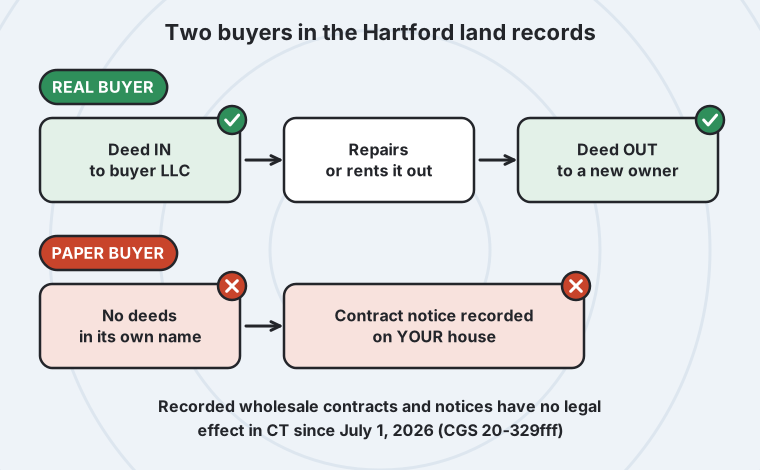
Every Connecticut deed is recorded with the town clerk where the house is. Hartford’s Town and City Clerk, at City Hall, 550 Main Street, offers an online search (SearchIQS). Here is how to use it:
- Get the legal name first. The LLC or corporation that will sign and take the deed, not the brand on the postcard. A buyer who will not give it has answered your question.
- Search that name as grantee (the party receiving the deed). You want deeds into that company, with dates and addresses.
- Look for deeds going back out. A flipper shows up again as grantor a few months later; a landlord may hold for years. Both are normal. Check nearby towns too; each has its own index.
- Search your own address for any “memorandum of contract”, affidavit or lien you did not agree to.
A weak result: no deeds anywhere, or only contract notices on other people’s houses. That usually means a contract seller (wholesaler), not a buyer. Since July 1, 2026, no one may record a wholesale contract or notice against your title, and any such filing has no legal effect (CGS 20-329fff). Our guide on removing a memorandum of contract explains what to do if one is already on your record.
How do you check a Hartford buyer in the Judicial Branch case look-up?
You check a Hartford buyer in the Judicial Branch case look-up by searching the company’s legal name, and the owner’s name, as a party in the civil and small claims case search on jud.ct.gov. A few cases are normal for any active buyer. What you are looking for is a pattern: sellers suing over unfair practices, or the buyer suing sellers to force sales.
The Judicial Branch’s free case look-up covers civil, housing, small claims and foreclosure cases. Hartford cases are filed in the Judicial District of Hartford, which also covers 18 nearby towns (CGS 51-344). Search the company and the people who run it, then read the case type, not just the count:
- Usually fine: contract disputes with contractors, or eviction cases the company filed as a landlord (it confirms they own property).
- Read closely: homeowners suing under CUTPA (unfair trade practices), the buyer suing several sellers to force sales (“specific performance”), or “quiet title” cases over clouded titles.
How do you check the company on the state business registry and the DCP license look-up?
You check the company on the state business registry by searching its exact name on the Secretary of the State’s business search at service.ct.gov, and on the DCP license look-up at elicense.ct.gov. You want an active company with filed annual reports and a real address. If the buyer plans to assign your contract instead of buying, it must hold a DCP wholesaler registration (CGS 20-329bbb).
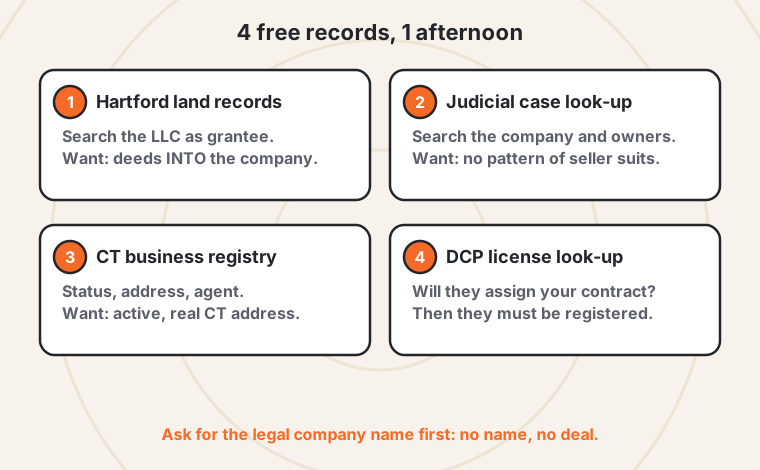
On the business registry, look for “active” status, a formation date that matches the buyer’s claims (“buying in Hartford for 20 years”?), a real address with a named registered agent, and annual reports filed on time.
Then the Department of Consumer Protection. Since July 1, 2026, anyone who signs a contract to buy your house and then sells that contract to someone else, without taking title, must be registered with DCP as a real estate wholesaler (CGS 20-329bbb). They must also give you DCP’s disclosure report, a three-business-day cancellation right and a closing within 90 days (CGS 20-329ccc). A company that buys with its own money does not need that registration. So ask: “Will your company take title, or assign this contract?” and check the answer against DCP’s look-up. Our guide on selling your house to a wholesaler covers the rest of that law.
Check us the same way: our company is We Buy Houses In Connecticut, LLC, registered with the Secretary of the State on July 2, 2019 (business ID 1314303). We buy the houses ourselves. Our legitimate house buyers page shows the rest.
What scams target Hartford homeowners in particular?
The scams that target Hartford homeowners in particular are tax-lien scams aimed at owners behind on property taxes, foreclosure-rescue scams aimed at owners behind on the mortgage, contract-flipping deals that tie up a house and cloud its title, and closings without an attorney. Hartford’s 69.95 mill rate makes tax trouble common, and 45 residential transfers in a year were coded as foreclosures, so these pitches find willing ears.
Most Hartford buyers are not crooks, but the owners under the most pressure are the easiest to hurt. Here are the four patterns, and the honest version of each.
1. The tax-lien pitch
At Hartford’s 69.95 mill rate, a $260,000 house (the city median) owes about $12,730 a year. Overdue tax runs 18% a year in interest (CGS 12-146), about $2,291 on one unpaid year, and a town may sell its liens to a private company with the same rights, including foreclosure (CGS 12-195h). Local news has reported Hartford lien sales in past years.

The scam: “We’ll pay your back taxes now if you sign the house over to us,” sometimes with a promise you can buy it back later. You give up the house first and trust them for the rest.
The honest version: a signed purchase contract at a stated price, and a Connecticut attorney who pays the taxes and interest from the sale money at closing. Before you sell at all, ask the Hartford tax collector about a payment plan. Our page on selling a house with tax liens in Connecticut shows how the payoff works.
2. Foreclosure “rescue”
Someone offers to stop your foreclosure for a fee, or to “save” the house if you deed it over and rent it back. Federal rules ban most advance fees for mortgage relief (12 CFR 1015.5), and if you sign the deed over, the mortgage usually stays in your name.
If you have been served with a foreclosure, Connecticut’s foreclosure mediation program is free for eligible homeowners and is run by the courts (CGS 49-31l to 49-31n; jud.ct.gov/foreclosure). The Department of Banking’s foreclosure hotline is 1-877-472-8313. Talk to them, and to a HUD-approved housing counselor, before you sign anything with any buyer. Our guide on the Connecticut foreclosure process explains Law Day and the options.
If selling turns out to be the right answer, sell with a contract and an attorney closing before Law Day, and keep your equity. See selling a house before foreclosure.
3. The contract flip that clouds your title
The “buyer” signs with a long inspection period and an “and/or assigns” clause, shops your contract, and cancels or cuts the price if nobody bites. Connecticut’s 2026 law gives you three business days to cancel a wholesale contract and voids recorded notices (CGS 20-329ccc, 20-329fff). Read what “and/or assigns” means before you sign.
4. The kitchen-table closing
“Our notary will bring the papers to you.” In Connecticut, only a Connecticut attorney may conduct a real estate closing (CGS 51-88a), and the money moves through the attorney’s account. Never sign a deed outside that process.
What should a fair cash offer on a Hartford house look like in the numbers?
A fair cash offer on a Hartford house looks like a written number the buyer can explain line by line: the value after repairs, minus the repair cost, minus resale and holding costs at Hartford’s 1.25% conveyance rate and 69.95 mill rate, minus a margin. A legit buyer will show you that math. A buyer who cannot, or whose price only exists until the inspection, is a warning sign.
Here is that math on a Hartford single-family house that needs work. It is an example, not an offer.
| Line | Amount | Basis |
|---|---|---|
| Value after repairs | $260,000 | Hartford single-family median, Oct 2024 to Sep 2025 |
| Repairs | -$35,000 | Example (est.) |
| Resale costs: 5% commission, 1.25% conveyance, attorney | -$17,750 | $13,000 + $3,250 + $1,500 (est.) |
| Holding 5 months: taxes plus insurance and utilities | -$7,300 | $1,060 a month tax (69.95 mills) + $400 a month (est.) |
| Buyer’s purchase closing costs | -$2,000 | Est. |
| Buyer’s margin | -$27,950 | About 11% of resale value (example) |
| Cash offer | $170,000 | Example (illustrative) |
| Seller pays: conveyance 1.25% and own attorney | -$3,625 | $2,125 + $1,500 (est.) |
| Seller’s net | $166,375 | Before any mortgage or lien payoff |
That gap between $260,000 and $170,000 is why cash offers are lower; our page on why cash offers are so low walks through each line. For legitimacy, what matters is whether the buyer explains the gap, puts it in writing and keeps the price unless it finds something nobody could see.
Note that Hartford’s local conveyance tax is 0.50%, double most towns. For Hartford’s sales by property type, see alternatives to listing in Hartford.
How much would you walk away with?
Slide the numbers to match your house. It works in your browser; nothing is saved or sent.
Estimates for planning. Conveyance tax per CGS 12-494 (state 0.75% up to $800,000, 1.25% to $2.5M, 2.25% above, plus the town rate). Seller attorney about $1,200 to $1,500; flat-fee MLS about $400; listings include three months of taxes, insurance and utilities, a cash sale about two weeks. Your attorney gives you the final numbers.
When should you NOT sell your Hartford house to a cash buyer?
You should not sell your Hartford house to a cash buyer when the house is in good shape and you have a few months, when a payment plan or loan modification would let you keep it, or when the only buyers calling you fail the record checks above. A cash sale trades price for speed and certainty. If you do not need speed, you are usually paying for nothing.
Get an agent’s opinion on an updated house, ask the tax collector about a payment plan, try foreclosure mediation first, and never sign because you feel pushed. A fair offer is still fair next week; we do not put deadlines on ours.

When someone asks me whether a buyer is legit, I ask them one question back: did the buyer tell you the legal name of the company that will sign? Most problems start right there. Get the name, search it as grantee in the land records, and look it up on the state registry. Ten minutes, and you will know more than the buyer’s website will ever tell you.
How do you vet a Hartford house buyer in one afternoon, step by step?
You vet a Hartford house buyer in one afternoon by getting the company’s legal name, searching it in Hartford’s land records, the Judicial Branch case look-up, the state business registry and DCP’s license look-up, then reading the contract with your own Connecticut attorney before you sign. Each step takes minutes, and a real buyer will help you do every one.
Get the legal name and the offer in writing
Ask which company signs and takes the deed, and get the terms by email.
Search the Hartford land records
Search the name as grantee, look for deeds in and out, and search your own address.
Search the Judicial Branch case look-up
Search the company and owners. Look for patterns of seller complaints.
Check the business registry and DCP
Active status, real address. If they assign, look up the DCP registration.
Have your own attorney read the contract
Check the deposit and who holds it, the inspection period, the closing date and any assignment clause. Our cash offer contract checklist lists every clause to read.
Compare at least two offers
Put the offers side by side on net, deposit and terms, as in our guide to comparing cash offers. A typical cash closing takes about two weeks, or the later date you pick.
If you would like to put us through the same checks, start on our Hartford page.
Questions about checking we buy houses companies in Hartford
Are we buy houses companies in Hartford a scam?
We buy houses companies in Hartford are not a scam as a group: most really buy and close with a Connecticut attorney. A minority are contract flippers, bait-price buyers or foreclosure-rescue operators, so check each one in the public records.
How can I see what houses a buyer has bought in Hartford?
You can see what houses a buyer has bought in Hartford by searching the company’s legal name as grantee in the Hartford Town Clerk’s online land records index. Each deed shows the date, address and parties.
Does a cash buyer in Connecticut need a license?
A cash buyer in Connecticut that buys the house itself does not need a real estate license. Since July 1, 2026, anyone who contracts to buy a house and then assigns the contract without taking title must register with the Department of Consumer Protection as a real estate wholesaler (CGS 20-329bbb).
Can someone pay my Hartford back taxes if I sign the house over?
Someone can offer to pay your Hartford back taxes if you sign the house over, but it is risky: you give up title first and rely on their promise. The safe way is a sale where a Connecticut attorney pays the taxes and interest from the proceeds at closing, after you have agreed on a price. See selling a house with tax liens.
What interest does Hartford charge on late property taxes?
Hartford, like every Connecticut town, charges interest of 18% a year on overdue property tax (CGS 12-146). On a $260,000 house at Hartford’s 69.95 mill rate, a full year of unpaid tax is about $12,730, which adds about $2,291 a year in interest.
Can a buyer put a lien on my house if I back out?
A buyer cannot record a wholesale contract or notice against your Connecticut house: since July 1, 2026, such a filing has no legal effect and town clerks may refuse it (CGS 20-329fff). A buyer with a real contract can still sue, so have an attorney read any contract before you sign.
Who should close a cash sale of a Hartford house?
A Connecticut attorney should close a cash sale of a Hartford house; state law requires an attorney to conduct real estate closings (CGS 51-88a). You can hire your own attorney even if the buyer has one. Never sign a deed at your kitchen table outside an attorney’s closing.
What if a buyer already recorded something against my Hartford house?
If a buyer already recorded something against your Hartford house, get a copy from the town clerk and call a Connecticut real estate attorney. A recorded wholesale contract or notice has no legal effect (CGS 20-329fff), and you can also complain to DCP.
Related guides
Checking a buyer
Same series
Hartford and nearby
For the whole process from first call to closing, see how to sell a house in Connecticut.
Plain-English information, not legal advice. The example uses public data and labelled estimates; your house and numbers will differ.
Sources (checked on October 27, 2026)
- Connecticut OPM, Real Estate Sales (data.ct.gov dataset 5mzw-sjtu): Hartford residential sales and non-use codes, October 2024 to September 2025.
- Connecticut OPM mill rates (Hartford, fiscal 2027: 69.95).
- City of Hartford Town and City Clerk: land records and online search link.
- Connecticut Judicial Branch case look-up.
- Connecticut business records search (Secretary of the State).
- DCP: verify a license or registration, and DCP real estate wholesaling.
- CGS §§ 20-329aaa to 20-329hhh (real estate wholesalers, effective July 1, 2026).
- CGS § 12-146 (18% interest on delinquent property tax) and CGS § 12-195h (assignment of tax liens).
- CGS § 12-494 (conveyance tax).
- CGS § 51-88a (closings conducted by Connecticut attorneys).
- CGS § 51-344 (judicial districts).
- CGS §§ 49-31l to 49-31n (foreclosure mediation) and Judicial Branch foreclosure resources.
- CT Department of Banking: avoiding foreclosure.
- 12 CFR § 1015.5 (no advance fees for mortgage assistance relief services).
- Connecticut Probate Courts (Hartford Probate Court, PD-01, 250 Constitution Plaza).

Who wrote this
Jerryll Noorden
Jerryll has bought and sold Connecticut houses since 2016 and has sat at more closing tables than he can count, on both sides. Before real estate he was a robotics scientist at NASA, IHMC and IIT. He wrote this guide because the national sites that rank for it skip the Connecticut rules that cost sellers money. When listing or selling it yourself would get you more than a cash offer, he says so.
This guide explains Connecticut rules in plain English. It is not legal or tax advice. Laws change; for your sale, talk to a Connecticut real estate attorney and a tax professional.
