
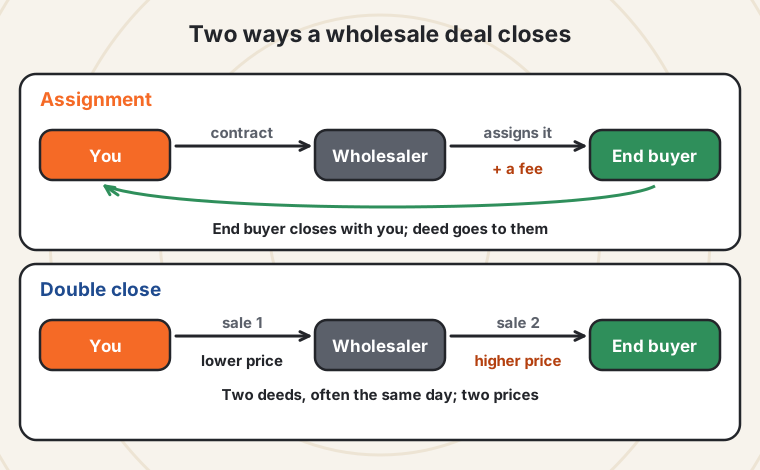
- A wholesaler is a middleman, not a buyer. They sign a contract to buy your house, then sell that contract (an “assignment”) or resell the house the same day (a “double close”) to the real buyer for more.
- Wholesaling is legal in Connecticut, and since July 1, 2026 it is regulated. Wholesalers must be registered with the Department of Consumer Protection (CGS 20-329bbb).
- You get three business days to cancel a wholesale contract for any reason, and the closing date cannot be more than 90 days out unless you agree in writing (CGS 20-329ccc).
- From October 1, 2026, the wholesaler must give you the state’s written wholesale disclosure report before you sign (CGS 20-329eee).
- A wholesaler may not record the contract or a lien against your house (CGS 20-329fff). Violations are unfair trade practices under CUTPA.
- The cost to you is usually the assignment fee: the gap between your price and what the end buyer pays.
- Protect yourself with proof of funds, a deposit held by your attorney, a short inspection period, and no assignment clause.
What should you expect when selling your house to a wholesaler in Naugatuck?
When you sell your Naugatuck house to a wholesaler, expect someone who signs a contract to buy it but plans to sell that contract, or resell the house, to another buyer for a profit. Since July 1, 2026 the wholesaler must be registered with the Department of Consumer Protection, you can cancel within three business days, and the closing must be within 90 days unless you agree in writing to extend.
This is the Naugatuck version of our statewide guide to selling your house to a wholesaler, which covers every part of the process in depth. Here we focus on what a wholesaler offer means at Naugatuck prices and taxes, and on the 2026 Connecticut rules you can use at the kitchen table.
This guide is part of our guide to how to sell a house in Connecticut. It answers one question in depth: what really happens when the “cash buyer” on your contract is a wholesaler, what Connecticut law now says, and how to protect yourself. We use Naugatuck as the local example because it is a typical Naugatuck Valley market: 470 sales in a year, a $330,000 median price, and many older houses, the kind investors look for.
Wholesaling is not automatically bad. Some wholesalers find good buyers and close on time. The problem is that many sellers do not know they are dealing with a middleman, so they cannot judge whether the price, the timeline or the contract terms are fair. After reading this, you will.
Is this page for you if you think your buyer is a wholesaler?
This page is for you if you got a cash offer on your Connecticut house and something feels off: the contract says “and/or assigns,” strangers want to walk through, your house showed up in an online investor group, or the closing keeps moving. You may feel confused, misled or stuck. You have more rights than you think, and there are clear steps to take.
Most people who search for this have already talked to a “we buy houses” company. Maybe you answered a postcard or a text. The person was friendly, offered cash, promised a fast close, and sent a short contract. Then came the surprises: a 30-day inspection period, a $100 deposit, a request to let “my partner” or “my contractor” in, then another visit, then another.
It is normal to feel confused (who is actually buying my house?), embarrassed (did I sign something I should not have?), anxious (the taxes and the mortgage keep running), trapped (can I even get out?), and skeptical of every buyer now. Many Connecticut homeowners have been in exactly this spot, which is why the legislature passed a law about it.
Here is the reassuring part. Connecticut now gives you a three-business-day cancellation right, a 90-day limit on how long a wholesale contract can tie up your house, a state disclosure form, and a ban on wholesalers recording liens against your property. And if you still want a fast, as-is sale, you can get one from a buyer who actually buys.
What is a real estate wholesaler, and how does wholesaling work?
A real estate wholesaler is a person or company that signs a contract to buy a house without planning to own it. Connecticut law defines a wholesaler as someone who contracts with a seller to facilitate the sale of the seller’s residential property to a third party “without assuming title” (CGS 20-329aaa). The wholesaler earns money by assigning the contract for a fee or by buying and reselling the house the same day.
Assignment of contract
The wholesaler signs a purchase contract with you, usually naming the buyer as “ABC LLC and/or assigns.” They then market the contract to investors. When they find one, they sign an assignment: the investor steps into the wholesaler’s place, pays the wholesaler an assignment fee, and closes with you at your original price. You sign your deed to the end buyer, not the wholesaler.
Double close
The wholesaler buys your house and resells it to the end buyer, often on the same day and sometimes using the end buyer’s money. Two deeds are recorded. The end buyer may never learn your price and you may never learn theirs. A double close involves the wholesaler taking title briefly, so ask your attorney how it is treated under the new law; what matters for you is the same: is the money real, and will it close?
Why the price is lower
The end buyer, usually a renovator or landlord, has a maximum price. The wholesaler needs room for their fee inside that number. So a wholesaler’s offer to you is, by design, below what the end buyer would have paid you directly. That is not illegal. It is just a cost you should see clearly.
Is wholesaling legal in Connecticut, and what does the 2026 law require?
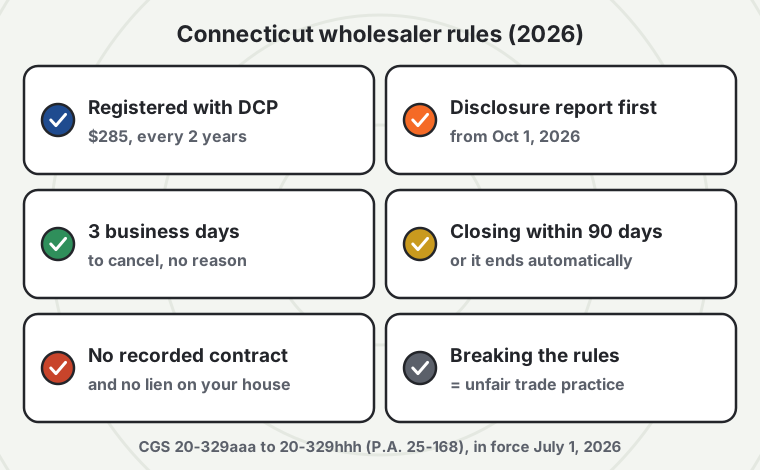
Wholesaling is legal in Connecticut, but since July 1, 2026 it is regulated by Public Act 25-168, now CGS 20-329aaa to 20-329hhh. Wholesalers must hold a Department of Consumer Protection registration, give sellers a three-business-day cancellation right, set a closing within 90 days, give the state disclosure report before signing (from October 1, 2026), and never record the contract or a lien. Violations are unfair trade practices.
| Rule | What it says | What it means for you | Law |
|---|---|---|---|
| Who is a wholesaler | A person who enters a wholesale contract to facilitate or orchestrate the sale of a seller’s residential property to a third party without assuming title, for compensation | If your buyer plans to pass the deal on, they are a wholesaler, whatever they call themselves | CGS 20-329aaa |
| Registration | No person may act as a real estate wholesaler without a DCP registration; $285 nonrefundable fee; valid up to 2 years. DCP says there are no exceptions | Ask for the registration and check it on DCP’s license lookup | CGS 20-329bbb |
| Licensed agents who wholesale | A broker or salesperson may also hold a wholesaler registration; one does not replace the other | If they are licensed, they must tell you whom they represent and what duties they owe you | CGS 20-329bbb(a)(2); 20-329eee(b)(4)(A) |
| Cancellation | The contract must give you three business days to review it with an attorney and to cancel without reason or penalty, except returning any deposit you received | Signed in a hurry? Cancel in writing within three business days | CGS 20-329ccc(a) |
| Closing date | No closing more than 90 days after everyone signs; extensions only in writing signed by all; otherwise the contract ends automatically | A wholesaler cannot tie up your house indefinitely | CGS 20-329ccc(b) |
| Disclosure report | From October 1, 2026, before signing, the wholesaler gives you the DCP wholesale disclosure report; you and the wholesaler sign it | No report, no contract. It explains assignment, marketing and your right to check value | CGS 20-329eee |
| Your duty | Before signing, the seller gives the wholesaler a residential condition report meeting CGS 20-327b and satisfies federal reporting rules (such as lead paint for pre-1978 homes) | Fill in the property condition report honestly; the wholesaler must pass it to any assignee | CGS 20-329ddd; 20-329ccc(c) |
| Notice to the end buyer | Before assigning, the wholesaler tells the third party it holds only a future interest, not title, and passes on your condition report | The end buyer should know who owns the house | CGS 20-329ccc(c) |
| No liens or recorded contracts | No one may record a wholesale contract or a document claiming a lien; no purchaser’s lien under 49-92a; if recorded, you can clear it with an affidavit of facts (CGS 47-12a) | A wholesaler cannot cloud your title to stop you selling to someone else | CGS 20-329fff |
| Enforcement | Any violation is an unfair or deceptive trade practice | You can complain to DCP and talk to an attorney about CUTPA remedies | CGS 20-329hhh; 42-110b |
| Real estate licensing | Acting as a real estate broker (selling or negotiating sales of real estate for others for a fee) requires a license | Wholesaling registration does not let someone act as your agent | CGS 20-311(25); 20-312 |
The statute spells out the notice the DCP report must contain. In short: the wholesaler may not be the one buying your house; they may market it during the contract; they may expect to profit or earn an assignment fee; your contract may let them accept or reject offers without asking you; the town’s assessed value “is not the same as the fair market value”; the price is negotiable; you may have an attorney or appraiser review the deal; and you can cancel within three business days. Read every page, and initial only what you understand.
How can you tell an end buyer from a wholesaler?
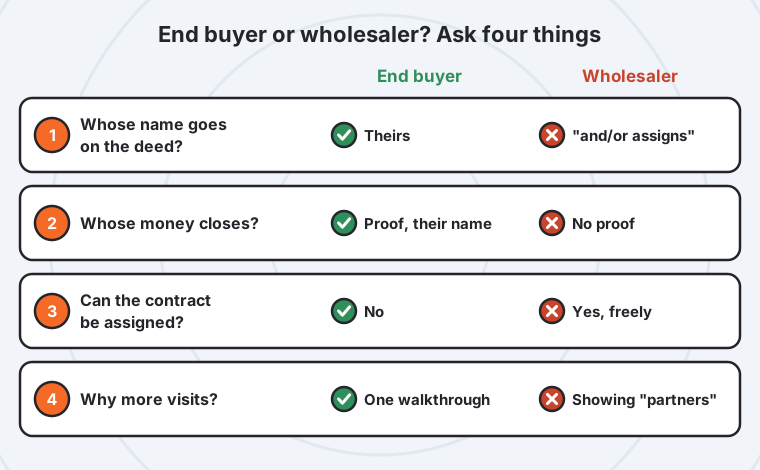
You can tell an end buyer from a wholesaler by asking who will take title and whose money closes, and then checking the paperwork. An end buyer closes in their own name with funds they can prove, and does not need “and/or assigns,” a long inspection period or extra showings. A wholesaler is registered with the Department of Consumer Protection and, from October 1, 2026, must hand you the state disclosure report.
| Question | End buyer usually | Wholesaler usually |
|---|---|---|
| Whose name goes on the deed? | The company or person on the contract | “Buyer and/or assigns”: someone not yet known |
| Proof of funds? | Bank statement or lender letter in the buyer’s own name | None, or a letter in another company’s name |
| Inspection period | A few days, or none | 2 to 4 weeks or more, cancel for any reason |
| Deposit | Meaningful, held by an attorney | Token amount, or held by the buyer’s company |
| Visits | One walkthrough, maybe a contractor | Repeated showings to “partners” |
| Your house online | No | Posted to investor email lists or social media groups |
| Registration and disclosure | Not required | DCP registration; state disclosure report before signing (from 10/1/2026) |
For the full checklist on vetting any cash buyer (business registration, reviews, attorney, proof of funds, no upfront fees), use our guide on how to check a cash home buyer in Connecticut. We will not repeat all eight checks here. And for what a legitimate buyer looks like in general, see legitimate cash home buyers in Connecticut.
What are the red flags in a wholesaler’s contract?
The red flags in a wholesaler’s contract are an “and/or assigns” buyer name, a long inspection or due-diligence period with a free exit, a very small deposit held by the buyer, no proof of funds, a closing date weeks or months away, permission to market your house or bring others through, and any document you are asked to sign that would be recorded on the land records.
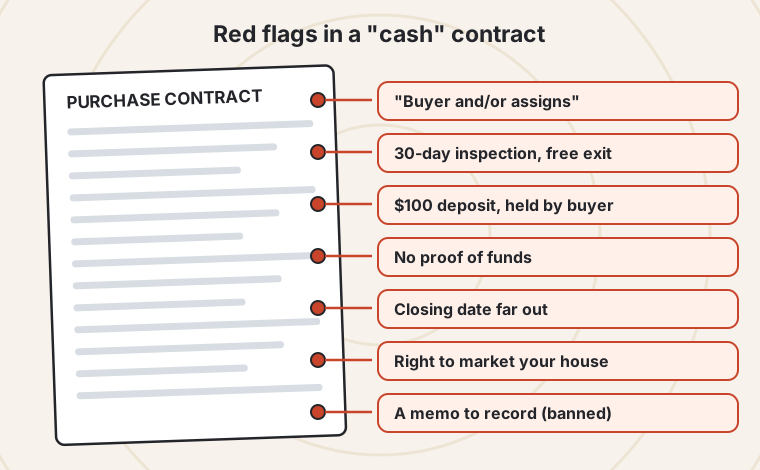
- “And/or assigns.” The buyer can hand the contract to anyone. Ask: “If you don’t close, who does?”
- A long inspection period. 30 days of “cancel for any reason” is 30 days of free time to find an end buyer. If they don’t, they walk away.
- A token deposit. $10 or $100, or “deposit due after inspection,” means they lose nothing if they walk.
- No proof of funds, or proof in a different name than the contract.
- A far-off closing date, especially near the 90-day limit, or vague language like “on or about.”
- Marketing rights. Clauses letting them advertise the property, put up signs, take photos for “partners,” or show it to others.
- Anything to record. A “memorandum of contract” or “affidavit” to file at the town clerk. In Connecticut a wholesaler may not record one (CGS 20-329fff).
- Pressure. “Sign today or the offer is gone.” Real buyers can wait three business days; the law gives you that time anyway.
How much does selling to a wholesaler cost you?
Selling to a wholesaler usually costs you the assignment fee, which is the difference between the price on your contract and what the end buyer pays. In an illustrative Naugatuck example, a wholesaler contracts at $210,000 and assigns to an investor paying $230,000; the $20,000 fee comes out of what you could have received selling to that investor directly, and your net drops from about $226,200 to $206,400.
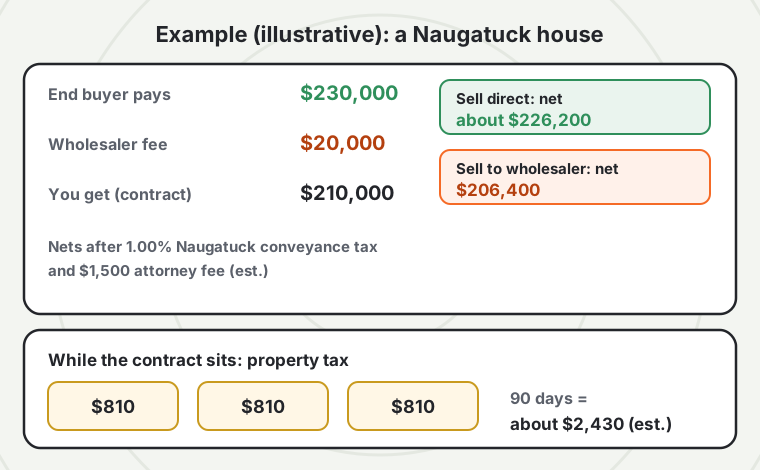
Example (illustrative). A Naugatuck house needs a new roof, kitchen and baths. An investor who renovates would pay $230,000 as-is. A wholesaler offers you $210,000 and assigns the contract to that investor for a $20,000 fee. Naugatuck’s conveyance tax is 1.00% (0.75% state plus 0.25% town, CGS 12-494). Attorney fees are an estimate.
| Line | Sell to the wholesaler | Sell directly to the end buyer |
|---|---|---|
| Price you receive | $210,000 | $230,000 |
| Conveyance tax, Naugatuck 1.00% | -$2,100 | -$2,300 |
| Your attorney (est.) | -$1,500 | -$1,500 |
| Your net (before mortgage payoff) | $206,400 | $226,200 |
| Assignment fee paid to the wholesaler (by the end buyer) | $20,000 | $0 |
The waiting cost. While a contract sits, you keep paying for the house. At Naugatuck’s fiscal 2027 mill rate of 40.44, property tax on the median single-family value of $345,000 is about $9,770 a year, or $810 a month (our town data). A wholesale contract that runs the full 90 days and then falls through costs you about $2,430 in property tax alone (est.), plus insurance, utilities, any mortgage payments, and three months of lost time.
The fee itself is not the main danger. The main danger is the deal that never closes because the wholesaler never found a buyer at their price. Run your own net-at-closing numbers with the calculator below.
How much would you walk away with?
Slide the numbers to match your house. It works in your browser; nothing is saved or sent.
Estimates for planning. Conveyance tax per CGS 12-494 (state 0.75% up to $800,000, 1.25% to $2.5M, 2.25% above, plus the town rate). Seller attorney about $1,200 to $1,500; flat-fee MLS about $400; listings include three months of taxes, insurance and utilities, a cash sale about two weeks. Your attorney gives you the final numbers.
What questions should you ask a possible wholesaler before you sign?
Before you sign with a possible wholesaler, ask whether they will take title themselves, for proof of funds in the contract buyer’s name, for their Department of Consumer Protection wholesaler registration number, whether they plan to assign or market the contract, who holds the deposit, how long the inspection period is, and what happens if they do not close.
- “Will your company be the one on the deed? Will you remove ‘and/or assigns’?”
- “Can you send proof of funds in the same name that is on the contract?”
- “Are you registered as a real estate wholesaler with DCP? What is your registration number?”
- “Do you plan to assign this contract or market my house to other buyers?”
- “If you assign it, will you tell me the assignment fee?”
- “Will the deposit be held by my attorney, and how much is it?”
- “How long is the inspection period, and can it be 7 days or less?”
- “Can we set a firm closing date, with no automatic extensions?”
- “Have you given me the state’s wholesale disclosure report?” (required from October 1, 2026)
- “Are you a licensed real estate agent? If so, whom do you represent?”
A straight answer to each is a good sign. A dodge on title, money or the deposit tells you what you need to know.
How do you protect yourself when selling to a wholesaler or cash buyer?
To protect yourself when selling to a wholesaler or any cash buyer in Connecticut, have your own Connecticut real estate attorney review the contract, require proof of funds in the buyer’s name, have the deposit held by your attorney, strike the assignment clause or require your written consent, shorten the inspection period, set a firm closing date, and use your three-business-day right to cancel if anything feels wrong.
Get your own attorney before you sign
Connecticut closings are handled by attorneys, and the wholesaler’s attorney is not yours. The state disclosure itself tells sellers they may have an attorney review the contract.
Demand proof of funds in the contract buyer’s name
A recent bank statement or lender letter. A letter for a different LLC means someone else is paying.
Put the deposit with your attorney
A meaningful deposit, due within a few days, held in your attorney’s escrow account. It gives the buyer a reason to close.
Remove “and/or assigns”
Write in: “This contract may not be assigned without the seller’s prior written consent.” If they refuse, you have learned they are a wholesaler.
Shorten the clock
An inspection period of 7 days or less and a firm closing date. The law caps wholesale contracts at 90 days; you can agree to much less.
Use your three business days
Cancel in writing if anything changed or feels wrong. Under CGS 20-329ccc(a) you owe no reason and no penalty, only the return of any deposit paid to you.
A wholesaler may not record a wholesale contract, memorandum or lien on the land records. If one was recorded, it does not give notice to a good-faith buyer, the town clerk may refuse it, and you may clear it by recording an affidavit of facts (CGS 20-329fff, 47-12a). Ask your attorney, and report it to the Department of Consumer Protection.
What can you do if you already signed with a wholesaler?
If you already signed with a wholesaler in Connecticut, check the date first: within three business days you can cancel for any reason. After that, read the contract with an attorney for the inspection period, closing date and extension terms; remember the contract ends automatically if it is not closed within 90 days unless you agreed in writing to extend; and report violations to the Department of Consumer Protection.
Count the days
Three business days from signing: cancel in writing, keep a copy, return any deposit you received.
Find the dates
Inspection deadline, closing date, any extension clause. A wholesale contract has to close within 90 days of signing unless you signed a written extension (CGS 20-329ccc(b)).
Check the registration
Look up the wholesaler on DCP’s license lookup. Acting without registration violates CGS 20-329bbb and is a CUTPA violation.
Ask for the disclosure report
If you signed on or after October 1, 2026 without receiving it, tell your attorney.
Get help and decide
Your attorney can tell you whether the buyer is in default and what your options are. If the deal is valid and the buyer performs, closing may still be the simplest path.
Is a wholesaler, a direct cash buyer or a listing better for you?
Whether a wholesaler, a direct cash buyer or a listing is better depends on your house and your timeline. A listing usually brings the highest price for a house in good shape. A direct cash buyer who takes title closes as-is with no assignment fee and fewer moving parts. A wholesaler can work if they are registered, honest about assigning, and close on time, but you pay their fee and carry the risk that they never find a buyer.
Wholesaler
Up to 90 daysThe legal maximum before the contract ends, unless extended in writing.
- As-is, often no repairs
- Price includes room for an assignment fee
- May not close if no end buyer is found
- Must be DCP-registered; you get 3 business days to cancel
Direct cash buyer
About 2 weeksTypical first contact to closing with us.
- Buyer takes title in its own name
- No repairs; leave what you do not want
- Price below a retail listing; that is the honest trade-off
- No middleman fee in the price
List with an agent
Highest priceUsually, for a house in good condition.
- Showings, inspections, buyer financing
- Repairs and credits often negotiated
- Commission and a longer timeline
- Best if you have time and the house shows well
Jerryll Noorden started in real estate in 2016 doing wholesale deals, before he began buying houses himself, so he knows how these contracts are written from the inside. Today his company, We Buy Houses In Connecticut, buys houses itself, about 10 a year since 2016, across Connecticut. Ask us the same questions on this page; you should get straight answers. For how cash offers are calculated and when cash makes sense, read cash home buyers in Connecticut, and for the bigger decision, selling to a cash buyer vs. listing with a realtor.
Is a cash sale right for you, or should you list?
Seven quick questions. There is no wrong answer, and we will tell you honestly if listing would leave you more.
- Does the house need repairs you would rather not pay for or manage?
- Do you need to close by a certain date, or within the next month or two?
- Would showings be hard: tenants, belongings, privacy, or you live out of state?
- Is there a complication: an estate or probate, a divorce, foreclosure, liens or back taxes?
- Could you comfortably cover the mortgage, taxes and utilities for three or more months?
- Is getting the highest possible price more important to you than speed and certainty?
- Would a buyer's bank lend on the house as it is (no major roof, foundation, oil tank or code issues)?
When you should NOT sell to a cash buyer (or a wholesaler)
- Your house is in good shape and you have a few months: a listing will likely net more. See the best time to sell in Connecticut.
- You are behind on your mortgage and may qualify for a modification or mediation: get free help first. See selling before foreclosure in Connecticut.
- Anyone asks for an upfront fee, asks you to sign over your deed before closing, or will not let your attorney review the papers: walk away.
- You are not sure what the house is worth: get a broker’s opinion or an appraisal first. The state disclosure itself says the price is negotiable.
What should Naugatuck homeowners know about wholesalers?
Naugatuck homeowners should know that their borough is a busy market for investors: 470 sales in a year, a $330,000 median price, and about 40% of single-family homes built before 1960. Older houses that need work attract wholesalers, and Naugatuck’s high mill rate of 40.44 means every month a contract sits costs real money in property tax.
In the Naugatuck Valley, many houses are older ranches, colonials and raised ranches, more than half heated by oil (our town data). Those are the houses that trigger repairs on a buyer’s inspection and push owners toward an as-is sale, which is where wholesalers advertise. The same applies next door in Waterbury, Beacon Falls, Seymour, Oxford and Wolcott.
| Town | Sales (12 months) | Median price | Mill rate FY2027 | Est. yearly tax at single-family median |
|---|---|---|---|---|
| Naugatuck | 470 | $330,000 | 40.44 | $9,770 |
| Waterbury | 1,305 | $270,000 | 43.34 | $8,490 |
| Beacon Falls | 85 | $350,000 | 23.67 | $5,800 |
| Wolcott | 224 | $357,000 | 28.90 | $7,280 |
If you have a house that needs work in Naugatuck, you may also want selling a house that needs repairs in Connecticut, and for estates, selling a house during probate in Connecticut.
How do you sell your house for cash safely in Connecticut?
To sell your house for cash safely in Connecticut, get two or three written offers, ask each buyer whether they will take title, check proof of funds and any wholesaler registration, have your own attorney review the contract, keep the deposit in your attorney’s escrow, and pick a firm closing date. With a direct buyer, about two weeks from first contact to closing is common.
Collect offers
Ask at least two buyers for written offers. Compare net cash, timeline and conditions with how to compare offers on a house.
Ask the title question
“Will you be the one on the deed?” Then check proof of funds in that name.
Read the contract with your attorney
Assignment clause, inspection period, deposit, closing date. Fix them before signing.
Fill in your disclosures
The property condition report (see the Connecticut property condition disclosure) and the lead paint form for pre-1978 homes.
Close
Your attorney handles the deed, payoff and conveyance tax. With us, about 2 weeks is typical, and you pick the date. No repairs; leave what you do not want.
If you want a number from a buyer who buys the house itself, you can book a short call or walkthrough below.
See the house together.
Pick a time that works.
Choose a time for us to walk through the property with you, or ask for a quick call first. We confirm every request personally.
Tuesday, January 13
No open times in the next few weeks. Please call us.
We will confirm by email. Nothing is booked until we do.
View my requestWholesaler questions Connecticut sellers ask
Is wholesaling legal in Connecticut?
Yes, wholesaling is legal in Connecticut, but since July 1, 2026 a real estate wholesaler must hold a registration from the Department of Consumer Protection and follow seller protections in CGS 20-329aaa to 20-329hhh, including a three-business-day cancellation right and a 90-day closing limit.
Do wholesalers need a license in Connecticut?
Wholesalers in Connecticut need a real estate wholesaler registration from the Department of Consumer Protection ($285, valid up to two years), not a broker’s license. DCP says there are no exceptions. A licensed agent who wholesales needs the registration too, and must disclose whom they represent.
What is a real estate wholesaler?
A real estate wholesaler is a person who signs a contract to buy a house in order to pass the deal to another buyer for a profit, without taking title. Connecticut’s definition is in CGS 20-329aaa.
How do I know if my buyer is a wholesaler?
You can usually tell your buyer is a wholesaler if the contract says “and/or assigns,” the inspection period is long, the deposit is tiny, there is no proof of funds in the buyer’s name, or other people keep asking to see the house. From October 1, 2026, a wholesaler must also give you the state disclosure report before you sign.
Can I cancel a contract with a wholesaler in Connecticut?
Yes, you can cancel a wholesale contract in Connecticut within three business days of signing, for any reason and without penalty, except returning any deposit paid to you (CGS 20-329ccc(a)). After that, your rights depend on the contract, so talk to an attorney.
How long can a wholesaler tie up my house?
A wholesaler can tie up your Connecticut house for at most 90 days from signing. The contract ends automatically after 90 days unless you and the wholesaler sign a written extension (CGS 20-329ccc(b)).
What does “and/or assigns” mean in a real estate contract?
“And/or assigns” in a real estate contract means the named buyer can transfer the contract to someone else, who then buys your house on the same terms. It is the standard sign of a possible wholesale deal. You can strike it or require your written consent to any assignment.
Is a wholesaler the same as a cash buyer?
No, a wholesaler is not the same as a cash buyer. A cash buyer purchases the house with its own funds and takes title. A wholesaler controls the contract and finds a cash buyer to pay you, keeping the difference as a fee.
How much does a wholesaler make?
A wholesaler makes the assignment fee or the resale markup: the difference between your contract price and what the end buyer pays. Connecticut’s disclosure warns sellers that the wholesaler may profit this way. You can ask for the fee in writing.
Can a wholesaler put a lien on my house?
No, a wholesaler cannot put a lien on your Connecticut house. CGS 20-329fff bans recording a wholesale contract, a notice of it, or any document claiming a lien, including a purchaser’s lien. If one is recorded, it does not give notice to a good-faith buyer, and you can clear it with an affidavit of facts.
Is it bad to sell to a wholesaler?
It is not always bad to sell to a wholesaler. A registered wholesaler who is upfront, uses a short timeline and closes can solve a hard sale. The downsides are a lower price (their fee comes from it) and the risk that they never find a buyer, leaving you weeks behind.
Do I still fill out the property condition report with a wholesaler?
Yes, you still fill out the property condition report. Connecticut requires the seller to give the wholesaler a written residential condition report meeting CGS 20-327b before signing a wholesale contract, and the wholesaler must pass it to any assignee (CGS 20-329ddd and 20-329ccc(c)).
Where do I complain about a wholesaler in Connecticut?
You can complain about a wholesaler to the Connecticut Department of Consumer Protection, which registers wholesalers and investigates violations, including wholesaling without a registration. Violations are unfair trade practices under CUTPA (CGS 20-329hhh), so an attorney can advise on private remedies.
Does the wholesaler law apply to every property?
Connecticut’s wholesaler law applies to residential real property as defined in the real estate licensing law, CGS 20-311, which covers homes such as one-to-four family houses. Ask an attorney if your property is land, commercial or mixed-use.
Related Connecticut guides
Choosing a buyer
Planning the sale
We buy houses in Naugatuck and nearby, including Naugatuck, Waterbury, Ansonia, Derby, Seymour and Oxford. For every step of a sale, see how to sell a house in Connecticut.
Plain-English information, not legal advice. Have a Connecticut real estate attorney review any purchase contract before you sign.
Sources
- CGS 20-329aaa to 20-329hhh (Real Estate Wholesalers, P.A. 25-168, effective July 1, 2026; 2026 Supplement).
- Department of Consumer Protection, Real Estate Wholesaling (explainer and FAQ).
- DCP, Real Estate Wholesaler registration.
- DCP news release: real estate wholesalers required to register (2026).
- OLR bill analysis, HB 5572 (2025), An Act Concerning Real Estate Wholesalers.
- CGS 20-311, 20-312 and 20-327b (real estate licensing definitions, license requirement, property condition report).
- CGS 42-110b (Connecticut Unfair Trade Practices Act).
- CGS 12-494 (real estate conveyance tax).
- Town data: our town facts file (sales Oct 2024-Sep 2025; fiscal 2027 mill rates from the CT Office of Policy and Management).

Who wrote this
Jerryll Noorden
Jerryll has bought and sold Connecticut houses since 2016 and has sat at more closing tables than he can count, on both sides. Before real estate he was a robotics scientist at NASA, IHMC and IIT. He wrote this guide because the national sites that rank for it skip the Connecticut rules that cost sellers money. When listing or selling it yourself would get you more than a cash offer, he says so.
This guide explains Connecticut rules in plain English. It is not legal or tax advice. Laws change; for your sale, talk to a Connecticut real estate attorney and a tax professional.
