
- Yes, you can sell an inherited house in Connecticut before probate is finished, but only the executor or administrator appointed by the Probate Court can sign the deed, and usually only with court approval or a power of sale in the will.
- The paperwork that holds up most estate sales is not the deed. It is the probate fee lien and the estate tax lien. Both attach to Connecticut real estate and must be released before a buyer’s attorney will close.
- Every Connecticut estate files an estate tax return, even when no tax is due. For deaths in 2026, tax applies only above $15 million; most families file the short Form CT-706 NT with the Probate Court within six months.
- Probate fees are set by statute: about $990 on a $250,000 estate and $1,515 on a $400,000 estate, capped at $40,000 (CGS 45a-107).
- Heirs usually owe little or no income tax on the sale, because the house’s tax basis “steps up” to its value at the date of death.
- Executors do not give the Property Condition Disclosure Report or the smoke and CO affidavit; both laws exempt them. Lead paint disclosure still applies to homes built before 1978.
When a parent or relative dies and leaves a house in Connecticut, you are suddenly dealing with grief, a court you have never heard of, a house that needs heat and insurance, and family members who may not agree. This guide explains, step by step, how Connecticut probate works for a house, who can sell it and when, what it costs, the two liens that stall most estate sales, the taxes, and what to do when heirs disagree. It is part of our master guide on how to sell a house in Connecticut.
We buy houses for cash, including from estates, so read the selling sections knowing that. Where listing the house, keeping it or renting it is the better choice for your family, this guide says so.
Can you sell an inherited house in Connecticut before probate is finished?
Yes, you can sell an inherited house in Connecticut before probate is finished, once the Probate Court has appointed an executor or administrator. That fiduciary signs the deed, either under a power of sale in the will or with the court’s approval after a petition and hearing. Heirs cannot sell on their own while the house is still in the deceased owner’s name, and nobody can sell before a fiduciary is appointed.
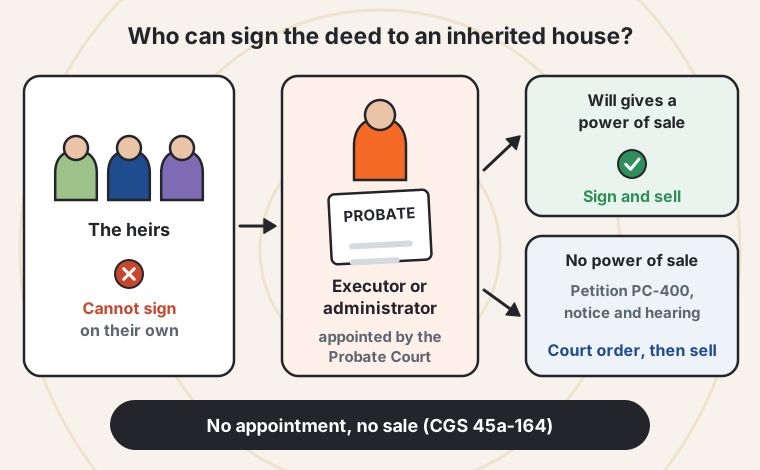
Many families assume they have to wait until the estate is closed. They do not. In most Connecticut estates, the house can be listed, put under contract and sold during the administration, and the money held in the estate account until the court approves the final distribution. What you cannot skip are three things:
- An appointed fiduciary. The executor named in the will is formally appointed when the will is admitted to probate; with no will, the court appoints an administrator. Until then, nobody has authority to sign. Appointment often takes two to four weeks after the petition is filed (Probate Court user guide).
- Authority to sell real estate. The fiduciary needs either a power of sale in the will or a Probate Court order authorizing the sale (CGS 45a-164; Probate Court user guide, Step 5).
- Clear title for the buyer. The buyer’s attorney will want the probate fee and the Connecticut estate tax provided for, so the liens they create on the house can be released (CGS 45a-107b, 12-398).
When the house does not go through probate
Not every inherited house is in the probate estate. If the deed named the owners as joint tenants with right of survivorship, the survivor already owns the house. If the house was in a living trust, the trustee can sell it under the trust. In both cases you still need the Connecticut estate tax return filed and the estate tax lien released before a sale, because the return must report survivorship and trust property too (Probate Court user guide, Question 5). See special situations below.
What national inherited-house guides get wrong about Connecticut
| What you will read | What is true in Connecticut |
|---|---|
| “You must wait for probate to end before you list.” | An appointed executor or administrator can sell during administration, with a power of sale in the will or court approval. |
| “Small estates skip probate.” | Connecticut’s small estate affidavit is only for estates of $40,000 or less in solely owned personal property with no solely owned Connecticut real estate (CGS 45a-273). If the house was in the decedent’s name alone, a full estate is opened. |
| “Estate tax only matters for the rich.” | Tax is due only above $15 million (2026), but every estate files a return, and the estate tax lien on the house must be released before a sale (CGS 12-398). |
| “Connecticut has an inheritance tax.” | It does not. Connecticut has an estate tax, paid by the estate, not by the heirs. |
| Probate costs are given as a percentage “set by the court”. | Probate Court fees are fixed by statute on a sliding scale, the same in every Connecticut court, and they are a lien on the house until paid (CGS 45a-107, 45a-107b). |
| “Fill out the seller’s disclosure.” | Executors, administrators and trustees are exempt from the Property Condition Disclosure Report and the smoke and CO affidavit (CGS 20-327b(b)(4), 29-453(f)(8)). |
| “Ask the county probate court.” | Connecticut has no county government. It has 54 probate districts; the estate is handled where the decedent lived. |
Should you sell, keep or rent an inherited house in Connecticut?
You should sell an inherited house in Connecticut if no heir wants to live in it, the heirs need their shares in cash, or the taxes, insurance and repairs would strain the estate. You should keep it if one heir wants it and can buy out the others or the will leaves it to them. You should rent it only if it is in rentable shape, the heirs agree on who manages it, and the rent covers the costs with room to spare.
Sell it
Cash, splitThe most common choice
- Heirs get their shares in cash
- Stops the carrying costs: taxes, insurance, heat
- Little or no income tax thanks to the step-up
- Best when no heir wants to live there
Keep it
One heirOften a buyout
- An heir takes the house as part of their share
- Or buys the others out with a mortgage
- Needs court approval if the fiduciary sells to themself (CGS 45a-164(c))
- Best when one heir truly wants it
Rent it
IncomeA business, not a keepsake
- Needs a code-compliant, rentable house
- Someone has to manage tenants and repairs
- Co-owners must agree on money and decisions
- Depreciation later reduces the step-up advantage
The question to settle first is whether the house is worth more to your family as a house or as money. Sentiment is real, and so are a Connecticut property tax bill, a vacant-house insurance policy and a 1950s furnace. Our older post on whether to sell or keep an inherited property goes into the family side. If you are leaning toward selling, the two-minute self-check below compares listing and a cash sale for your situation.
Is a cash sale right for you, or should you list?
Seven quick questions. There is no wrong answer, and we will tell you honestly if listing would leave you more.
- Does the house need repairs you would rather not pay for or manage?
- Do you need to close by a certain date, or within the next month or two?
- Would showings be hard: tenants, belongings, privacy, or you live out of state?
- Is there a complication: an estate or probate, a divorce, foreclosure, liens or back taxes?
- Could you comfortably cover the mortgage, taxes and utilities for three or more months?
- Is getting the highest possible price more important to you than speed and certainty?
- Would a buyer's bank lend on the house as it is (no major roof, foundation, oil tank or code issues)?
How does probate work in Connecticut?
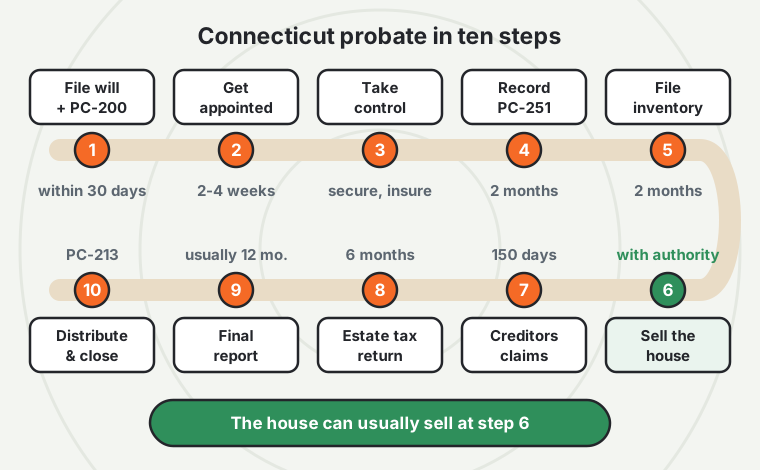
Probate in Connecticut works in ten steps: file the will and a petition with the Probate Court within 30 days of death, get the executor or administrator appointed, take control of the property, record a notice in the land records, file an inventory within two months, raise cash (including selling the house, with authority), handle creditors’ claims, file the estate tax return within six months, file a final financial report, and distribute what is left.
Connecticut’s Probate Courts are local courts, separate from the Superior Court. There are 54 probate districts. The estate is handled by the court for the district where the person who died (the “decedent”) lived. Probate Court staff can give you forms and procedural help but not legal advice. The steps below follow the Office of the Probate Court Administrator’s own user guide.
File the will and the petition within 30 days
File the original will, a copy of the death certificate and the Petition/Administration or Probate of Will (PC-200) with the Probate Court where the decedent lived. List every heir and beneficiary with addresses and send them copies. Anyone holding the original will must deliver it to the court within 30 days.
Get appointed and post a bond if required
The court may hold a hearing, accept written waivers, or use a “streamline” notice. It then appoints the executor named in the will, or an administrator if there is no will. The court usually requires a probate bond unless the will excuses it, the estate is small, or all heirs waive it.
Take control of the property
Open an estate bank account, secure the house, notify utilities, and make sure the house is insured. Keep estate money completely separate from your own.
Record the Notice for Land Records (PC-251) within two months
If the decedent owned Connecticut real estate, record the notice of the fiduciary’s appointment with the town clerk in each town where it is located.
File the inventory within two months
List and value everything in the decedent’s name alone, at fair market value at the date of death, with a copy of the deed and the mortgage balance (CGS 45a-341). Real estate can be valued by an appraisal, a broker’s market analysis, the assessment adjusted to 100% of market value, or an arm’s-length sale within six months of death.
Raise cash, including selling the house
The fiduciary can sell personal property but needs Probate Court permission to sell real estate unless the will specifically authorizes it. This is where most estates sell the house. See how court approval works.
Handle creditors’ claims
The court publishes a newspaper notice to creditors within 14 days of the appointment. Creditors generally have 150 days from the appointment to present claims (CGS 45a-356). The fiduciary can shorten that for known creditors with a written notice giving at least 90 days (CGS 45a-357, form PC-234), then files the Return of Claims (PC-237).
File the estate tax return within six months
Every estate files one. Most file Form CT-706 NT with the Probate Court; estates above $15 million (2026) file Form CT-706/709 with the Department of Revenue Services. Probate fees are billed from it. See the liens and estate tax.
File the final financial report, usually within 12 months of death
Most estates use the simpler Financial Report (PC-246). If the estate stays open more than a year, file a status update (PC-286). The court approves the report after a hearing, waivers or a streamline notice.
Distribute and close
Distribute the remaining assets as the court orders, then file the Affidavit of Closing (PC-213) within 30 days if the court asks for it.
For a deeper walk through the court side, see our older posts on the probate process for a house and whether a house can be sold while in probate.
How long does probate take in Connecticut?
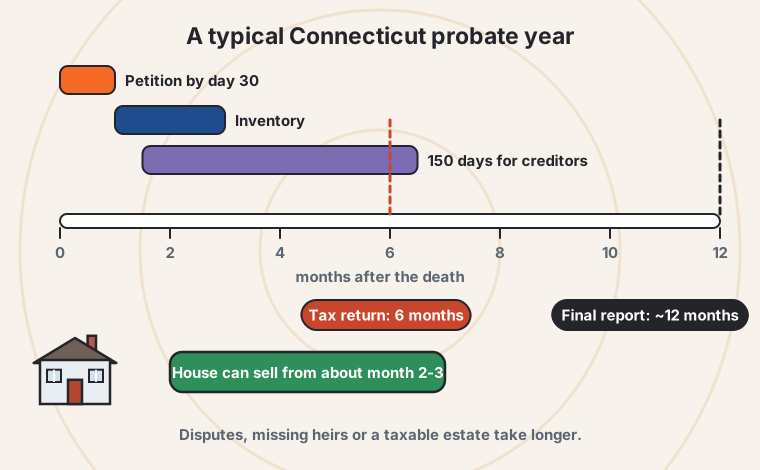
Probate in Connecticut usually takes about 9 to 12 months for a straightforward estate. The Probate Court’s guide expects the final financial report usually within 12 months of death. The fixed points are: the petition within 30 days of death, the inventory within two months of appointment, at least 150 days for creditors, and the estate tax return within six months of death. Disputes, missing heirs, a taxable estate or an insolvent estate take longer.
| Milestone | Deadline or typical time | Source |
|---|---|---|
| File the will and petition (PC-200) | Within 30 days of death | Probate Court user guide, Step 1 |
| Fiduciary appointed | Often 2 to 4 weeks after filing; sooner for a temporary administrator in an emergency | User guide, Question 14 |
| Newspaper notice to creditors | Within 14 days of appointment | User guide, Step 6 |
| Notice for Land Records (PC-251) | Within 2 months of appointment | User guide, Step 3 |
| Inventory | Within 2 months of appointment; extendable to 4 months | CGS 45a-341 |
| Creditors’ claim period | 150 days from the first fiduciary’s appointment | CGS 45a-356 |
| Estate tax return (CT-706 NT or CT-706/709) | 6 months from death; one extension of up to 6 months for CT-706 NT | User guide, Step 7 |
| Return of Claims (PC-237) | Within 60 days after the 150-day period | User guide, Step 6 |
| Final financial report or account | Usually within 12 months of death | User guide, Step 8 |
| Status update (PC-286) if still open | Within 3 months after the first anniversary of appointment, then yearly | User guide, Step 8 |
| Appeal of a Probate Court decision | Generally 30 days from the date the decision was sent | User guide, Question 20 |
When can the house actually be sold?
The bars show order, not exact months. A sale can usually close from about the second or third month, once the fiduciary is appointed and has authority. A court approval hearing, if needed, and the lien releases are what most often set the closing date. Plan for them from day one.
Who has the authority to sell an inherited house in Connecticut?
The authority to sell an inherited house in Connecticut belongs to the executor named in the will or the administrator appointed by the Probate Court, not to the heirs. The fiduciary proves that authority with a probate certificate from the court. If the will gives the executor a power to sell real estate, the executor can sell without a separate court order; otherwise the fiduciary must petition the court and get an order approving the sale.
| Situation | Who signs the deed | Court approval to sell? |
|---|---|---|
| Will names an executor and gives a power of sale | The executor | Not usually; the will authorizes it |
| Will names an executor, no power of sale | The executor | Yes: petition and order under CGS 45a-164 |
| No will | The administrator appointed by the court | Yes: petition and order |
| House specifically left to a named person | The executor, if the house must be sold | Yes, with special rules (CGS 45a-428); the devisee can consent |
| Joint tenancy with right of survivorship | The surviving owner | No probate sale; estate tax lien still released |
| House in a living trust | The trustee | Under the trust’s terms; estate tax lien still released |
| Fiduciary wants to buy the house | The fiduciary, to themself | Yes, after a hearing with notice saying so (CGS 45a-164(c)) |
What a fiduciary owes the heirs
The executor or administrator is a fiduciary: they must act in the best interests of the estate and its beneficiaries, keep estate money separate, keep records, and account to the court. In practice that means getting a fair price, documenting how the price was set, telling the heirs what is happening, and not favoring one heir. Fiduciary and attorney fees are based on the work done and are subject to court approval; many family members serve for little or nothing (user guide, Question 3).
How do you get Probate Court approval to sell a house in Connecticut?
You get Probate Court approval to sell a house in Connecticut by having the executor or administrator file a petition to sell real property (form PC-400) describing the house, the buyer, the price and the terms. The court sets notice to the heirs and beneficiaries, holds a hearing, and authorizes the sale if it finds the sale is in the best interests of the parties (CGS 45a-164). Many fiduciaries sign the contract first, subject to court approval.
Check the will
If the will gives the executor a power to sell real estate, ask your attorney whether court approval is still needed. Often it is not.
Establish the value
The inventory value at date of death is the starting point. Many courts want a recent appraisal or broker’s opinion with the petition, especially for a private sale. A price well below value invites objections.
Sign the contract subject to approval
The purchase contract should say the sale is subject to Probate Court approval and give a realistic closing date after the hearing.
File the petition
The Petition to Sell or Mortgage Real Property (PC-400) sets out the property, the buyer, the price, and whether the sale is private or public. A specific devisee can sign a consent. If the fiduciary is the buyer, the notice must say so (CGS 45a-164(c)).
Notice and hearing
The court decides who gets notice and holds a hearing. Heirs who agree can sign waivers, which usually speeds things up. If any heir is a minor, unborn or under a disability, the court may appoint a guardian ad litem (CGS 45a-164(d)).
The order and the bond
The order authorizes the fiduciary to sign the deed. The court may require a probate bond to cover the sale proceeds unless one is already in place or excused (CGS 45a-164(b)).
Close and record
The fiduciary signs a fiduciary’s deed. The attorneys record the deed, the probate certificate and the lien releases, and the net proceeds go into the estate account.

The estate sales that slip are rarely about the buyer. They slip because the estate tax return was never filed, so there is no release of lien, or because one heir hears about the price for the first time at the hearing. File the CT-706 NT early, and send every heir the price and the reasoning before the petition goes in.
What does probate cost in Connecticut?
Probate in Connecticut costs a statutory Probate Court fee based on the size of the estate, plus any attorney’s fees, fiduciary’s fees, bond premium, publication and recording costs. The court fee is about $990 on a $250,000 estate, $1,515 on $400,000 and $2,115 on $600,000, rising to a $40,000 cap; assets passing to a surviving spouse count at half. Attorney’s fees vary with the work and are subject to court approval.
| Basis for fees (value of the estate) | Probate Court fee |
|---|---|
| $0 to $500 | $25 |
| $501 to $1,000 | $50 |
| $1,000 to $10,000 | $50 plus 1% of the amount over $1,000 |
| $10,000 to $500,000 | $150 plus 0.35% of the amount over $10,000 |
| $500,000 to $2,000,000 | $1,865 plus 0.25% of the amount over $500,000 |
| $2,000,000 to $8,877,000 | $5,615 plus 0.5% of the amount over $2,000,000 |
| $8,877,000 and over | $40,000 |
What the fee is based on
- Everything, not just the probate estate. The basis is the greatest of the inventory, the gross estate for estate tax purposes, or the Connecticut taxable estate, so a house held in survivorship or in a trust can still count (CGS 45a-107(b)(1); user guide, Question 18).
- Half for the spouse. The value of property passing to a surviving spouse is counted at 50%.
- Out-of-state real estate. For a Connecticut resident, real estate and tangible property in other states are left out of the basis; for a nonresident, only the Connecticut real estate and tangible property count (CGS 45a-107(b)(5)-(6)).
- Interest. Unpaid fees bear interest at 0.5% per month starting 30 days after the invoice, or 30 days after the estate tax return was due if it was filed late.
An example
Mom’s estate is the house, worth $400,000 at her death, and $50,000 in the bank, all passing to her children. The basis is $450,000. The fee is $150 plus 0.35% of $440,000, which is $1,690. If the house had passed to a surviving spouse instead, it would count at half.
The other costs of settling an estate
| Cost | Who sets it | Typical amount |
|---|---|---|
| Probate Court fee | Statute (CGS 45a-107) | See the table above |
| Probate attorney | Agreement, subject to court approval | Varies widely with the estate; ask for a written estimate |
| Executor or administrator fee | Reasonable for the work, subject to court approval | Family members often serve for little or nothing |
| Probate bond premium | Surety company | Only if the court requires a bond |
| Recording and copy fees | Town clerk and court | Small |
| Carrying the house | You | Property tax, insurance, utilities, lawn and snow, every month until it sells |
| Selling costs | Market and statute | Conveyance tax (1% in most towns), attorney, commission if listed |
What are the probate fee lien and the estate tax lien, and why do they hold up a sale?
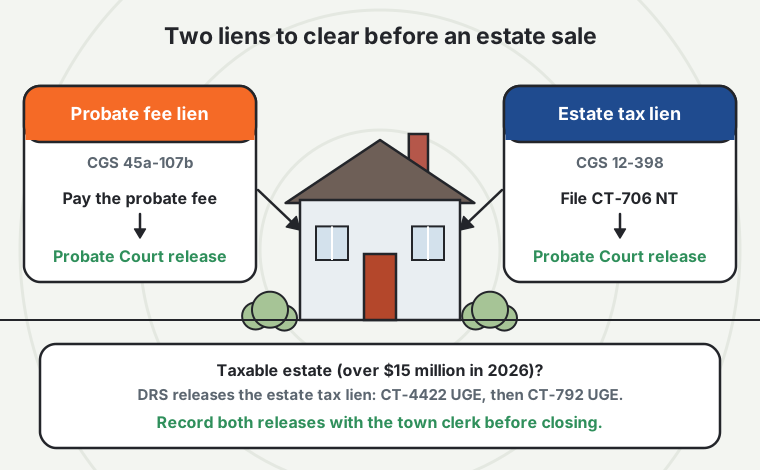
The probate fee lien and the estate tax lien are two automatic liens Connecticut places on a decedent’s real estate: one for the Probate Court fee (CGS 45a-107b) and one for the Connecticut estate tax (CGS 12-398). They hold up a sale because a buyer’s attorney will not close until both are released or provided for. For most families, filing Form CT-706 NT and paying the probate fee gets the Probate Court to issue the releases.
| Probate fee lien | Estate tax lien | |
|---|---|---|
| Law | CGS 45a-107b | CGS 12-398(d) and (e) |
| Applies to | Connecticut real estate included in the basis for probate fees, for deaths on or after January 1, 2015 | Connecticut real estate transferred at death, including survivorship and trust property |
| How it is cleared | Pay the probate fee and interest | File the estate tax return; pay any tax due |
| Who issues the release | The Probate Court, within 10 days after full payment, or earlier if payment is adequately assured | Nontaxable estates: the Probate Court, after the CT-706 NT. Taxable estates: DRS, on Form CT-4422 UGE, issuing Form CT-792 UGE |
| Recorded where | Town clerk where the house is | Town clerk where the house is |
| Effect | Conclusive proof the fee is paid and the lien discharged | Conclusive proof the house is released from the lien |
How to keep the liens from delaying your closing
- Gather date-of-death values early: appraisal, bank statements, life insurance and retirement accounts, anything in survivorship or trust
- File Form CT-706 NT with the Probate Court as soon as values are known, not on the six-month deadline
- Pay the probate fee invoice promptly; ask the court about release on adequate assurance if the sale will pay it
- For a taxable estate, have your attorney file Form CT-4422 UGE with DRS for the release
- Give the buyer’s attorney copies of the releases, or a plan for them, before the closing date is set
- Record the releases with the town clerk at or before closing
If a parent or grandparent died years ago and nobody ever filed the estate tax return, the lien can still be sitting on the house. A person with a title interest can petition the Probate Court to release a probate fee lien in narrow cases where the death was more than ten years ago and no estate was opened (CGS 45a-107b(d)). Most of the time, the simpler fix is to file the overdue return. Start early; these take weeks.
Do you owe estate tax or inheritance tax in Connecticut?
You almost certainly do not owe Connecticut estate tax, and Connecticut has no inheritance tax. For deaths in 2026, Connecticut taxes only the part of an estate above $15 million, at 12%, matching the federal exemption. But every Connecticut estate must file a return: Form CT-706 NT with the Probate Court for estates at or below the exemption, within six months of death.
- The exemption. For decedents dying on or after January 1, 2023, Connecticut’s exemption equals the federal basic exclusion amount (CGS 12-391). For 2026 that is $15 million (DRS; Probate Court user guide).
- The rate. 12% of the amount above the exemption, with total Connecticut estate and gift tax capped at $15 million (CGS 12-391).
- No portability. Each spouse has their own Connecticut exemption.
- Who files. Every Connecticut resident’s estate, and nonresidents who owned Connecticut real estate or tangible property (user guide, Step 7).
- Which form. At or under $15 million with no Connecticut QTIP election: Form CT-706 NT, with the Probate Court only. Over $15 million: Form CT-706/709 with DRS and a copy to the Probate Court (DRS).
- The deadline. Six months from death. The Probate Court can grant one extension of up to six months for a CT-706 NT if Form CT-706 NT EXT is filed before the due date.
- Federal. A federal estate tax return is needed only if the gross estate plus adjusted taxable gifts exceeds the federal exemption: $15 million for deaths in 2026.
What taxes do you pay when you sell an inherited house in Connecticut?
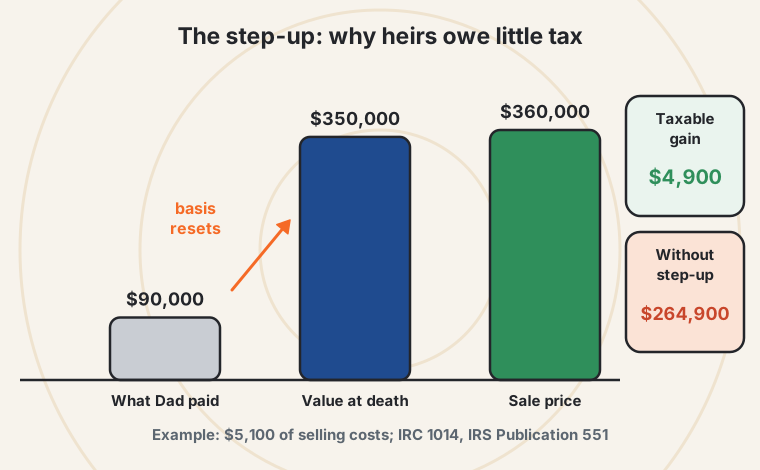
When you sell an inherited house in Connecticut you pay the conveyance tax at closing (1% of the price in most towns, 1.25% in 16 cities), and income tax only on any gain above the house’s value at the date of death. Because the tax basis steps up to that value (IRC 1014), most heirs who sell within a year or so of the death owe little or no income tax. Any gain is long-term, and Connecticut taxes it as income.
How the step-up works, with numbers
Say your father bought the house for $90,000. It was worth $350,000 when he died (the inventory value). The estate sells it eight months later for $360,000, paying $3,600 in conveyance tax and $1,500 to the attorney (est.).
With the step-up
$4,900taxable gain
- $360,000 sale price
- minus $5,100 selling costs
- minus $350,000 basis (value at death)
Without it (a gift during life)
$264,900taxable gain
- $360,000 sale price
- minus $5,100 selling costs
- minus $90,000 basis (what he paid)
Sold for less than the value at death
a lossusually
- Selling costs alone can create a loss
- Deductibility depends on whether the house was personal use; ask a tax pro
This is why a house deeded to children before death, instead of passed at death, can cost the family a large tax bill: a lifetime gift carries over the parent’s original basis. Ask an estate attorney before anyone “puts the house in the kids’ names”.
The taxes, one by one
| Tax | Does it apply? | Rule |
|---|---|---|
| Connecticut conveyance tax | Yes, on the sale to a buyer | 0.75% state plus 0.25% or 0.50% town on most homes; paid by the seller (the estate or heirs) at closing (CGS 12-494). A deed from the estate to the heirs for no money is effectively exempt (consideration under $2,000, CGS 12-498(a)(10)). |
| Federal income tax on the gain | Only on gain above the stepped-up basis | Basis is generally fair market value at death (IRC 1014; IRS Publication 551). Inherited property is treated as held long-term. |
| Connecticut income tax | Only on a taxable gain | Connecticut taxes capital gains as income, at rates up to 6.99%. |
| Home sale exclusion ($250,000/$500,000) | Usually not | Only if the heir owned and lived in the house as a main home 2 of the last 5 years (IRS Publication 523). |
| Connecticut estate tax | Only above $15 million (2026) | Paid by the estate, not the heirs (CGS 12-391). |
| Inheritance tax | No | Connecticut does not have one. |
| Property tax | Yes, until the sale | Prorated at closing; Connecticut towns bill in arrears, so the seller usually credits the buyer. |
More detail: taxes when selling a house in Connecticut, tax consequences when selling an inherited house and the Connecticut conveyance tax by town.
What if the heirs disagree about selling the inherited house?
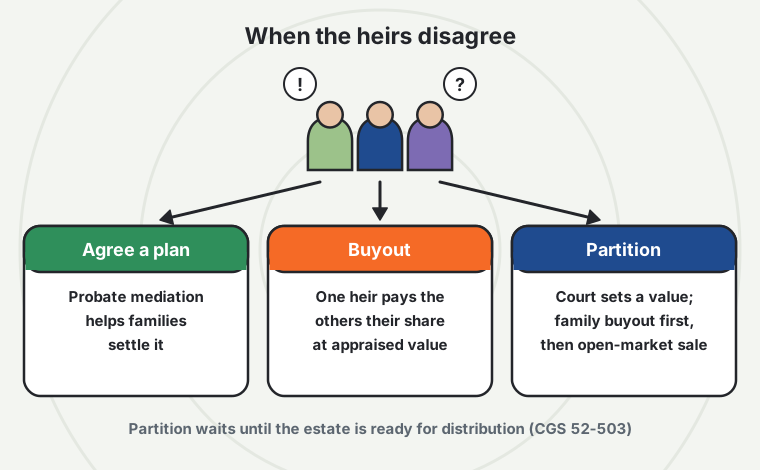
If the heirs disagree about selling an inherited house in Connecticut, the executor or administrator can still ask the Probate Court to authorize a sale, and the court decides what is in the best interests of the estate after hearing everyone. After the estate is distributed, co-owning heirs who cannot agree can buy each other out or ask a court for partition, where Connecticut’s Uniform Partition of Heirs’ Property Act gives family members the right to buy out the heir who wants to sell before any forced sale.
During the estate: the fiduciary and the court decide
While the house is in the estate, heirs do not each get a veto. The fiduciary petitions to sell; heirs get notice and can object at the hearing; the court decides whether the sale is in the best interests of the parties (CGS 45a-164). An heir who wants the house can make an offer, ideally at or above appraised value. If the house was specifically left to one person, different rules apply (CGS 45a-428).
The Probate Courts also offer mediation for family disputes (ctprobate.gov, Probate Mediation). It is usually faster and cheaper than a contested hearing, and it is often the place where a buyout gets agreed.
After distribution: buyout or partition
- Buyout. The heir who wants the house pays the others their share of an agreed value, often with a mortgage. Get an appraisal everyone accepts.
- Sale by agreement. All co-owners list or sell together and split the proceeds by their shares (not necessarily evenly).
- Partition. Any co-owner can ask the Superior Court to divide the property or order it sold (CGS 52-495, 52-500). No partition of property belonging wholly to an estate in settlement can be made until the estate is ready for distribution (CGS 52-503).
- Heirs’ property protections. If at least one co-owner got title from a relative and enough of the interests are held by relatives, the court applies the Uniform Partition of Heirs’ Property Act: it sets the value, lets the other co-owners buy out the one who asked for the sale, prefers dividing the land where possible, and requires an open-market sale through a broker rather than a quick auction if a sale is ordered (CGS 52-503f to 52-503r; P.A. 15-234).
Numbers. Show every heir the same three figures: a fair value from an appraisal or recent sales, what a listing would net after repairs, commission and months of carrying costs, and a written cash offer. Disagreements about feelings rarely end; disagreements about numbers often do.
What if the inherited house has a mortgage, a reverse mortgage or other debts?
If the inherited house has a mortgage, the loan does not disappear, but the lender generally cannot call it due just because the owner died and the house passed to a relative. Keep paying it from the estate, or sell and pay it off at closing. A reverse mortgage becomes due at the death of the last borrower, and heirs have limited time to sell or pay it off. Other debts are paid from the estate through the creditors’ claim process.
- Regular mortgage. Federal law bars lenders from enforcing a due-on-sale clause on a home transfer to a relative resulting from the borrower’s death, or to a spouse or children (12 U.S.C. 1701j-3(d)). Contact the servicer, tell them about the death, and ask to be confirmed as a “successor in interest” so you can get loan information. Keep the payments current from the estate if you can; a foreclosure eats equity fast.
- Behind on payments? Read our guide to foreclosure in Connecticut. A surviving spouse who took title on the death can use the court’s foreclosure mediation program as a permitted successor-in-interest.
- Reverse mortgage. A federally insured reverse mortgage (HECM) becomes due when the last borrower dies. Heirs can keep the house by paying it off, or sell it; HUD rules generally let heirs satisfy the loan for the lesser of the balance or 95% of the current appraised value. Contact the servicer right away, because the time limits are short.
- Home equity line or second mortgage. Also paid from the sale.
- Unpaid property taxes, water and sewer. These are liens on the house; they are paid at closing.
- State aid. If the decedent received state assistance, the state may have a claim against the estate; the probate petition and small estate affidavit ask about it (CGS 45a-273(b)).
- Credit cards and medical bills. Paid from the estate in the statutory order of priority. Heirs are not personally liable for the decedent’s unsecured debts just because they are family, but distributions made too early can be reached by valid claims (user guide, Step 6).
How do you protect and insure a vacant inherited house in Connecticut?
You protect and insure a vacant inherited house in Connecticut by telling the insurance company about the death and the vacancy right away, getting vacant-dwelling coverage if the policy limits it, keeping the heat on or winterizing, securing doors and windows, stopping mail and visible signs of vacancy, and checking the house at least weekly. The Probate Court’s guide says the fiduciary should make sure any dwelling is secured, protected from the elements and insured.
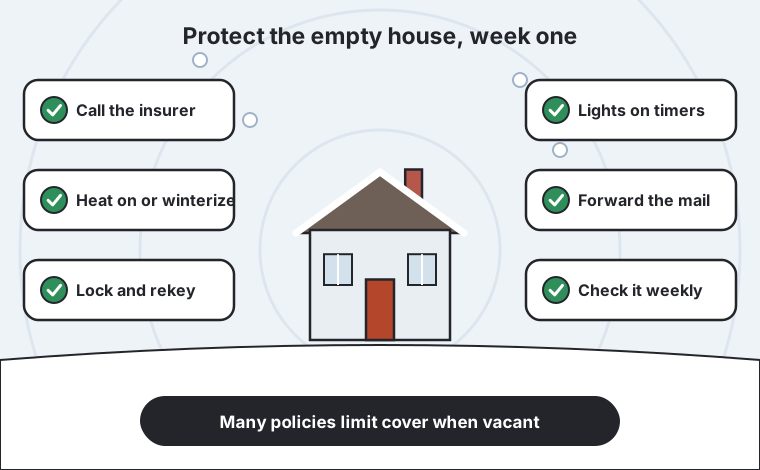
An empty house is the most expensive asset in most estates. It costs money every month and can lose value fast: a frozen pipe in January, a roof leak nobody sees, a break-in, a lapsed policy. In Connecticut, winter is the main risk.
- Call the homeowner’s insurer: report the death, name the fiduciary, ask about vacancy limits and get vacant-dwelling coverage if needed
- Keep the heat on at a safe setting and the oil tank or gas service paid, or have a plumber winterize the house
- Shut the main water valve if the house will sit empty in winter and is not heated
- Change or rekey the locks; keep a list of who has keys
- Put lights on timers; keep the lawn mowed and the walk shoveled
- Forward the mail to the fiduciary through the post office
- Visit at least weekly, or have a neighbor or service check; photograph each visit
- Remove valuables, papers and any firearms safely and legally
- Pay property tax, utility and insurance bills from the estate account
- Keep receipts: these are estate administration expenses
Firearms need special care. In Connecticut they can be transferred only to people legally eligible to receive them; handguns need authorization from the Department of Emergency Services and Public Protection, and assault weapons and large-capacity magazines have extra rules, including Probate Court approval before distribution to an heir (user guide, Question 15).
How do you clean out an inherited house before selling?
You clean out an inherited house before selling by first securing important papers and valuables, then letting heirs take items as the will or the family agrees, selling what has value, donating what is useful, and hauling away the rest. Do not throw away paperwork until the estate is closed. If the house is selling to a cash buyer as-is, you can usually leave what nobody wants.
Find the papers first
Wills, deeds, insurance policies, bank and brokerage statements, tax returns, titles, the oil company account, and any safe deposit box key. The Probate Court can authorize access to a safe deposit box to look for a will. Keep everything until the court approves the final report.
Photograph and list everything
The inventory must list valuable items, and items specifically left to someone in the will must be listed individually. Photos stop arguments later.
Let heirs choose, fairly
Follow the will. Where it is silent, agree a method: taking turns, or values charged against each heir’s share.
Sell, donate, haul
Estate sale companies, consignment, donation pickups and a dumpster or hauling crew. Get prices in writing.
Or skip it
Many cash buyers, including us, buy the house with the contents. That saves weeks, but take what matters to the family first.
Our post on preparing an inherited house for sale has more practical tips.
Should you fix up an inherited house or sell it as-is?
You should fix up an inherited house only where the repair clearly earns back more than it costs and the estate has the cash and the time: a deep clean, paint, small repairs and anything a buyer’s lender will flag. You should sell it as-is when it needs major work, the heirs want a quick, certain split, or nobody can manage contractors. Executors in Connecticut do not give the Property Condition Disclosure Report, but they must not hide known defects.
Many inherited Connecticut houses were owned for decades by an older parent. They are often sound but dated, with an older furnace or boiler, an oil tank, original windows, a 60 or 100-amp electric panel and deferred maintenance. Statewide, many towns’ housing stock is old: in the towns in our table below, the median single-family house was built between 1930 and 1975.
| Approach | Best when | Watch out for |
|---|---|---|
| Clean, paint, small repairs, then list | The house is sound; you have a few months | Costs come out of the estate up front; get heirs to agree on the budget |
| Bigger renovation, then list | Rarely in an estate | Months of carrying costs, contractor risk, heir disputes over spending |
| List as-is with an agent | A good location, some buyer demand, time | Lender-required repairs can kill deals with financed buyers |
| Sell as-is for cash | Major repairs, out-of-state heirs, a deadline, contents still inside | Price is below a renovated retail sale; compare written offers |
Disclosures when an estate sells
- Property Condition Disclosure Report: exempt. Transfers by executors, administrators, trustees and conservators are exempt (CGS 20-327b(b)(4)), so there is no $500 credit either.
- Smoke and carbon monoxide affidavit: exempt. Same exemption for executors, administrators, trustees and conservators (CGS 29-453(f)(8)). Many buyers still ask; working detectors are cheap and protect everyone.
- Lead paint: applies. For homes built before 1978, the federal lead-based paint disclosure and pamphlet still apply.
- No hiding. An exemption from a form is not permission to conceal a known defect. If the fiduciary knows about a problem, such as a leaking oil tank or a wet basement, disclose it.
See what to fix before selling a house in Connecticut, oil tanks, septic, wells and radon and our guide to the property condition disclosure.
What are the steps to sell an inherited house in Connecticut?
The steps to sell an inherited house in Connecticut are: get the will and petition filed so a fiduciary is appointed; secure and insure the house; value it; confirm authority to sell (a power of sale or a court order); choose how to sell; sign a contract subject to any court approval; file the estate tax return and pay the probate fee so both liens can be released; and close with Connecticut attorneys, with the proceeds going into the estate account.
Open the estate
File the will and PC-200 with the Probate Court where the decedent lived, within 30 days. Ask for a temporary administrator if the house needs urgent action.
Secure and insure the house
Locks, heat, insurance, mail. Do it the first week.
Get the probate certificate and record the notice
Once appointed, order probate certificates and record the Notice for Land Records (PC-251).
Value the house
An appraisal or broker’s opinion at date of death. It sets the inventory value, the step-up basis and the price everyone will judge the sale against.
Start the estate tax return
Gather values for the CT-706 NT now. It is the key to the estate tax lien release.
Decide with the heirs: sell, keep or rent
Share the numbers. If one heir wants it, discuss a buyout at the appraised value.
Pick the way to sell
List with an agent, sell by owner, or take a written cash offer. Compare net proceeds, not prices.
Sign a contract subject to court approval if needed
Then file PC-400 if the will has no power of sale. Send every heir the price and reasoning.
Release the liens
File the CT-706 NT (or CT-706/709), pay the probate fee, get the release certificates.
Close
The fiduciary signs the deed; the attorneys pay off any mortgage, the conveyance tax and closing costs; the net goes into the estate account until distribution.
How much would you walk away with?
Slide the numbers to match your house. It works in your browser; nothing is saved or sent.
Estimates for planning. Conveyance tax per CGS 12-494 (state 0.75% up to $800,000, 1.25% to $2.5M, 2.25% above, plus the town rate). Seller attorney about $1,200 to $1,500; flat-fee MLS about $400; listings include three months of taxes, insurance and utilities, a cash sale about two weeks. Your attorney gives you the final numbers.
Should you list the inherited house or sell it for cash?
You should list an inherited house with an agent if it is in decent shape, the heirs agree, and the estate can carry it for a few months; that usually gets the highest price. You should sell it for cash if it needs major work, the contents are still inside, the heirs are out of state or in a hurry, or a financed buyer is unlikely. Compare the net to the estate after repairs, commission and carrying costs, not the price.
| List with an agent | Sell by owner | Sell for cash as-is | Sell to an heir | |
|---|---|---|---|---|
| Price | Highest, if the house shows well | Market, if priced and negotiated well | Below retail | Usually appraised value |
| Commission | Yes | Buyer’s agent, usually | None | None |
| Clean-out and repairs | Expected | Expected | None; contents can stay | Up to the heir |
| Showings | Many | Many | One walkthrough | None |
| Time to close | Months | Months | About 2 weeks once authority is in hand | Depends on the heir’s financing |
| Court approval | The same in every route: needed unless the will gives a power of sale; for a sale to the fiduciary, always (CGS 45a-164) | |||
| Best for | Sound house, agreeing heirs, time | Experienced fiduciary, ready house | Dated or damaged house, distance, deadlines | One heir who wants it |
Our honest take
We buy inherited houses for cash, so weigh this accordingly. If the house is in good shape, the heirs get along and the estate can carry it for a few months, list it: a good agent will usually net the family more than any cash offer, ours included. A cash sale earns its discount when the house needs a lot, the heirs live far away, the contents are still inside, or months of taxes, insurance and heat would eat the difference. Get a written number either way and put it next to a listing estimate. Our cash buyer vs. realtor comparison shows the math, and our service page explains how we buy inherited houses in Connecticut. Check any buyer first with our guide on how to check a cash home buyer.
Want a written number to show the other heirs?
Send the address and a few photos. We compare the house with recent sales nearby, price the repairs we see and send a written cash offer, with the contents left in if you want. Use it next to a listing estimate; it costs nothing.
A written cash offer the whole family can see
Want your offer faster, or rather not talk to anyone yet? Add the address and a few photos. You get a written as-is offer, contents included if you like, and a closing date that fits the probate timeline. No clean-out, no repairs, no showings.
 CabinetsFlooring
 Tub & tile
 Floors
 Roof
We may bring in a partner buyer to close. Your price and terms don't change.
What if your situation is different?
If your situation is different, the Connecticut rules change in specific ways: a house held in survivorship or a living trust skips probate but still needs the estate tax lien released, an out-of-state owner’s Connecticut house needs a Connecticut probate proceeding, a house with tenants is sold subject to their rights, and a house left to a minor needs court involvement. Here is how each works.
| Situation | What happens in Connecticut |
|---|---|
| Joint tenancy with right of survivorship | The survivor owns the house. Record the death certificate as the survivor’s attorney directs, file the estate tax return (survivorship property is reported), and record the release of lien before selling. |
| Living (revocable) trust | The successor trustee sells under the trust. The estate tax return still reports the trust property, and the lien release is still needed. Probate fees can still apply because the fee basis includes the gross estate for estate tax purposes (CGS 45a-107(b)(1)), and the probate fee lien reaches trust real estate (CGS 45a-107b). |
| Decedent lived in another state | A Connecticut house needs a Connecticut proceeding (often called ancillary), in the district where the real estate is. The fee is based only on the Connecticut real and tangible property (CGS 45a-107(b)(6)). |
| Heir lives out of state | Common and workable. Fiduciaries can sign by mail with a notary; Connecticut attorneys run the closing. |
| No will | Intestacy decides who inherits: for example, children share everything if there is no spouse; a spouse and children of both take $100,000 plus half to the spouse and half to the children (user guide, Question 11). |
| Heir is a minor or incapacitated | The court may appoint a guardian ad litem for the sale hearing (CGS 45a-164(d)); the minor’s share may need a guardian of the estate. |
| Tenants in the house | Tenants keep their rights under their lease and Connecticut landlord-tenant law. Sell with tenants in place or agree a move-out; see our landlord guides. |
| A relative is living in the house | They have no automatic right to stay rent-free. The fiduciary decides with the court; talk early. |
| House specifically left to one person | It goes to that person unless it must be sold to pay debts, taxes and expenses (CGS 45a-428). |
| Small estate with no real estate in the decedent’s name | The affidavit in lieu of probate (PC-212) may work for $40,000 or less (CGS 45a-273); an estate tax return is still required. |
What does it cost to settle and sell an inherited house in your Connecticut town?
The cost to settle and sell an inherited house in Connecticut depends on its value and its town. If the house at your town’s median single-family price were the whole estate, the Probate Court fee would run from about $1,100 to $3,000 in the towns below, and the conveyance tax on its sale from about $3,200 to $10,400. Here are the figures for 14 towns we cover, from state records.
| Town | County | Single-family median | Homes sold | Median year built | Probate fee if the house were the whole estate | Town conveyance rate | Conveyance tax at the median |
|---|---|---|---|---|---|---|---|
| West Hartford | Hartford | $520,000 | 831 | 1951 | $1,915 | 0.25% | $5,200 |
| Hamden | New Haven | $355,000 | 810 | 1952 | $1,358 | 0.50% | $4,438 |
| Manchester | Hartford | $320,500 | 724 | 1953 | $1,237 | 0.25% | $3,205 |
| Wethersfield | Hartford | $415,000 | 331 | 1957 | $1,568 | 0.25% | $4,150 |
| Milford | New Haven | $515,000 | 780 | 1955 | $1,902 | 0.25% | $5,150 |
| Fairfield | Fairfield | $940,000 | 812 | 1955 | $2,965 | 0.25% | $10,100 |
| Stamford | Fairfield | $899,000 | 1,493 | 1956 | $2,862 | 0.35% | $10,384 |
| Norwalk | Fairfield | $750,000 | 1,033 | 1955 | $2,490 | 0.50% | $9,375 |
| Glastonbury | Hartford | $615,000 | 477 | 1975 | $2,152 | 0.25% | $6,150 |
| Groton | New London | $372,500 | 462 | 1960 | $1,419 | 0.25% | $3,725 |
| Danbury | Fairfield | $472,500 | 959 | 1972 | $1,769 | 0.25% | $4,725 |
| New Haven | New Haven | $329,450 | 1,022 | 1930 | $1,268 | 0.50% | $4,118 |
| Waterbury | New Haven | $280,000 | 1,305 | 1955 | $1,095 | 0.50% | $3,500 |
| Bristol | Hartford | $330,000 | 882 | 1962 | $1,270 | 0.50% | $4,125 |
The probate fee basis includes every asset, so add bank accounts and other property to get your estate’s fee. See every town we cover on our Connecticut towns page, and our older town guides for Vernon and Farmington.
What belongs on your inherited-house checklist in Connecticut?
Your inherited-house checklist in Connecticut covers every task in a Connecticut estate sale, in order, from the first week to the closing. Tick the items off as you go; your progress is saved on this device.
- Get several certified death certificates
- Find the original will and any trust documents
- File the will and PC-200 with the Probate Court within 30 days
- Call the insurer; arrange vacant-dwelling coverage if needed
- Secure the house: locks, heat or winterizing, mail forwarding
- Get appointed and order probate certificates
- Open an estate bank account
- Record the Notice for Land Records (PC-251) within two months
- Get a date-of-death appraisal or broker’s opinion
- File the inventory within two months of appointment
- Contact the mortgage or reverse mortgage servicer
- Gather values for the estate tax return (CT-706 NT)
- Agree with the heirs: sell, keep, rent or buy out
- Clean out or decide to sell with contents
- Choose how to sell and get written numbers
- Sign a contract subject to Probate Court approval, if needed
- File PC-400 if the will has no power of sale
- File the CT-706 NT and pay the probate fee
- Get both lien releases and give them to the buyer’s attorney
- Close with Connecticut attorneys; deposit the net in the estate account
- File the final financial report and distribute
Questions Connecticut families ask about inherited houses and probate
Can I sell an inherited house before probate is complete in Connecticut?
Yes, you can sell an inherited house before probate is complete in Connecticut, once an executor or administrator has been appointed. The fiduciary signs the deed under a power of sale in the will or with Probate Court approval, and the net proceeds go into the estate account until the court approves distribution.
Does an executor need court approval to sell a house in Connecticut?
An executor needs Probate Court approval to sell a house in Connecticut unless the will specifically authorizes the sale of real estate. Without that power, the executor files a petition to sell (PC-400), the court gives notice to the heirs and holds a hearing, and it authorizes the sale if it is in the parties’ best interests (CGS 45a-164).
How long does probate take in Connecticut?
Probate in Connecticut usually takes about 9 to 12 months for a simple estate; the Probate Court’s guide expects the final report usually within 12 months of death. Creditors have 150 days from the appointment and the estate tax return is due six months after death. Disputes or a taxable estate take longer.
How much are probate fees in Connecticut?
Probate fees in Connecticut are set by statute: $150 plus 0.35% of the amount over $10,000 for estates up to $500,000, so about $990 on $250,000 and $1,515 on $400,000; $1,865 plus 0.25% over $500,000 up to $2 million; capped at $40,000 (CGS 45a-107). Property passing to a spouse counts at half.
What is the probate fee lien?
The probate fee lien is an automatic Connecticut lien on a decedent’s real estate for the Probate Court fee (CGS 45a-107b). The Probate Court issues a certificate of release within 10 days after the fee and interest are paid, and the certificate is recorded with the town clerk.
What is the estate tax lien release in Connecticut?
The estate tax lien release in Connecticut is a certificate showing that the Connecticut estate tax lien on a decedent’s real estate is discharged (CGS 12-398). For estates under the exemption, the Probate Court issues it after Form CT-706 NT is filed; for taxable estates, DRS issues Form CT-792 UGE. Buyers’ attorneys require it before closing.
Does Connecticut have an inheritance tax?
No, Connecticut does not have an inheritance tax. It has an estate tax, paid by the estate, and for deaths in 2026 it applies only to the part of a Connecticut taxable estate above $15 million, at 12%.
Do I have to file a Connecticut estate tax return if no tax is due?
Yes, you have to file a Connecticut estate tax return even if no tax is due. Estates at or under the $15 million exemption (2026) file Form CT-706 NT with the Probate Court within six months of death. The return is also what probate fees are billed from and what clears the estate tax lien.
Do I pay capital gains tax when I sell an inherited house in Connecticut?
Usually you pay little or no capital gains tax when you sell an inherited house in Connecticut, because the tax basis steps up to the value at death (IRC 1014). You pay tax only on gain above that value, which is treated as long-term; Connecticut taxes it as income at rates up to 6.99%.
Who pays the conveyance tax when an estate sells a house?
The seller, meaning the estate, pays the conveyance tax when an estate sells a house in Connecticut: 0.75% state plus 0.25% or 0.50% town on most homes, at closing (CGS 12-494). A deed from the estate to the heirs for no payment is effectively exempt.
Can one heir force the sale of an inherited house in Connecticut?
Yes, one heir can ask a court to force the sale of an inherited house in Connecticut through partition, but only after the estate is ready for distribution (CGS 52-503). For family-owned property, the Uniform Partition of Heirs’ Property Act lets the other heirs buy out the one who wants to sell at a court-set value first (CGS 52-503f to 52-503r).
Can the executor sell the house if the heirs do not agree?
Yes, the executor can sell the house in Connecticut even if the heirs do not all agree, with Probate Court approval or a power of sale in the will. Heirs get notice and can object at the hearing, and the court decides whether the sale is in the best interests of the parties.
Does the executor have to fill out the property condition disclosure?
No, an executor does not have to fill out Connecticut’s Property Condition Disclosure Report; transfers by executors, administrators, trustees and conservators are exempt (CGS 20-327b(b)(4)). They are also exempt from the smoke and CO affidavit (CGS 29-453(f)(8)). The federal lead paint disclosure still applies to homes built before 1978.
What happens to the mortgage on an inherited house?
The mortgage on an inherited house stays in place and must be paid, but the lender generally cannot call it due just because the owner died and the house passed to a relative (12 U.S.C. 1701j-3(d)). Keep paying it from the estate or pay it off when the house is sold.
What if the inherited house has a reverse mortgage?
If the inherited house has a federally insured reverse mortgage, the loan becomes due when the last borrower dies. Heirs can pay it off or sell; HUD rules generally let them satisfy it for the lesser of the balance or 95% of the appraised value. Contact the servicer quickly, because the deadlines are short.
Do I need a lawyer for probate in Connecticut?
You do not need a lawyer for probate in Connecticut, but the Probate Court recommends professional help for tax returns, unusual assets or disputes. You will need a Connecticut real estate attorney for the sale itself, because Connecticut closings are run by attorneys.
Can I use the small estate process if the house was in my parent’s name?
No, you cannot use Connecticut’s small estate affidavit if your parent owned Connecticut real estate in their name alone. The affidavit (PC-212) is only for estates of $40,000 or less in solely owned personal property with no solely owned Connecticut real estate (CGS 45a-273).
How do I insure a vacant inherited house?
To insure a vacant inherited house, call the existing insurer right away, report the death and the vacancy, and ask about the policy’s vacancy limits. Many standard homeowners policies limit coverage after a house is vacant for a set period, so you may need a vacant-dwelling policy until it sells.
Can I sell an inherited house with the furniture still in it?
Yes, you can sell an inherited house with the furniture still in it. Many cash buyers buy houses with the contents, and a listing buyer can agree to it in the contract. Remove papers, valuables, firearms and anything specifically left to someone in the will first.
How fast can an estate sell a house for cash in Connecticut?
An estate can usually sell a house for cash in Connecticut in about two weeks once the fiduciary has authority to sell and the lien releases are in hand or provided for. If court approval is needed, the hearing date usually sets the closing date.
Related Connecticut guides
Probate and inherited houses
Selling and closing
Want to talk it through?
Book a short call. We will walk through where the estate is, what the house would sell for each way, and the steps left before a closing, even if the answer is to list it.
See the house together.
Pick a time that works.
Choose a time for us to walk through the property with you, or ask for a quick call first. We confirm every request personally.
Tuesday, January 13
No open times in the next few weeks. Please call us.
We will confirm by email. Nothing is booked until we do.
View my requestSources
- Office of the Probate Court Administrator, Administration of Decedents’ Estates user guide (2026): the ten steps, deadlines, forms PC-200, PC-251, PC-212, PC-234, PC-237, PC-246, PC-286, PC-213, intestacy shares, fees and interest.
- Connecticut Probate Courts, Fees and Expenses and Probate Mediation.
- CGS chapter 801b: § 45a-107 (probate fees), § 45a-107b (probate fee lien and release), § 45a-164 (sale of real property).
- CGS chapter 802b: § 45a-273 (small estates), § 45a-326 (partition in probate), § 45a-341 (inventory), §§ 45a-356 and 45a-357 (creditors’ claims), § 45a-428 (specifically devised real property).
- CGS chapter 217: § 12-391 (estate tax rate and exemption), § 12-398 (estate tax lien and release).
- Connecticut Department of Revenue Services, Estate and Gift Tax Information ($15 million exemption for 2026; CT-706 NT; CT-4422 UGE and CT-792 UGE).
- CGS chapter 919: §§ 52-495, 52-500, 52-503 (partition) and §§ 52-503f to 52-503r (Uniform Partition of Heirs’ Property Act).
- CGS § 20-327b(b)(4) and CGS § 29-453(f)(8) (fiduciary exemptions from the condition report and the smoke and CO affidavit).
- CGS §§ 12-494 and 12-498 (conveyance tax and exemptions).
- IRS Publication 551, Basis of Assets (inherited property) and IRS Publication 523, Selling Your Home.
- 12 U.S.C. § 1701j-3(d) (due-on-sale limits on transfers at death) and HUD, Home Equity Conversion Mortgages.
- EPA and HUD Lead-Based Paint Disclosure Rule (homes built before 1978).
- Connecticut Secretary of the State, Register and Manual: Probate Courts (54 probate districts).
- Town sales and housing data: Connecticut Office of Policy and Management, published on data.ct.gov (sales October 2024 to September 2025; 2025 parcel data).

Who wrote this
Jerryll Noorden
Jerryll has bought and sold Connecticut houses since 2016 and has sat at more closing tables than he can count, on both sides. Before real estate he was a robotics scientist at NASA, IHMC and IIT. He wrote this guide because the national sites that rank for it skip the Connecticut rules that cost sellers money. When listing or selling it yourself would get you more than a cash offer, he says so.
This guide explains Connecticut rules in plain English. It is not legal or tax advice. Laws change; for your sale, talk to a Connecticut real estate attorney and a tax professional.
