
- Every Connecticut foreclosure goes through Superior Court. The bank cannot take your house without a judge, a judgment and a deadline called Law Day.
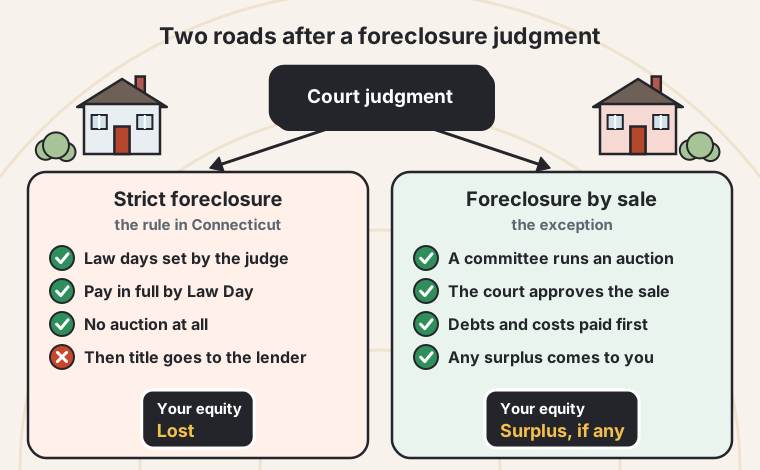
- Most Connecticut foreclosures are “strict” foreclosures. There is no auction: if nobody pays off the debt by Law Day, title passes to the lender and any equity you had is gone. Ask for a foreclosure by sale if you have equity.
- The court’s Foreclosure Mediation Program is free for owner-occupied 1-4 family homes. You must file two forms within 15 days of the return date on your summons (CGS 49-31l).
- You can sell your house at any point before Law Day and keep whatever is left after the payoff. Time, not paperwork, is usually the problem.
- A loan modification, mediation or bankruptcy can save the house; a sale, short sale or deed in lieu saves your credit and your equity. Which one fits depends on whether you can afford the house going forward.
- Anyone who charges a fee to “stop your foreclosure” or asks you to sign over your deed is a red flag. In Connecticut, paid foreclosure help needs a Department of Banking license unless the helper is your attorney (CGS 36a-671).
If you are behind on your mortgage in Connecticut, you have more time and more options than the letters from your lender suggest. This guide walks through the whole Connecticut foreclosure process, step by step: the deadlines that matter, the court’s mediation program, Law Day, what happens to your equity, and every way out, including the ones that do not involve selling. It is part of our master guide on how to sell a house in Connecticut.
We are a Connecticut cash home buyer, so read the selling sections knowing that. Where a loan modification, mediation, a short sale or simply listing the house is the better deal for you, this guide says so.
How does foreclosure work in Connecticut?
Foreclosure in Connecticut works through the courts. The lender sues you in Superior Court, the court decides how much you owe, and then it enters one of two judgments: a strict foreclosure, which sets a Law Day by which you must pay the debt or lose the title, or a foreclosure by sale, which sells the house at a court-supervised auction. Until that deadline passes, you still own the house and can pay, refinance or sell.
Connecticut is a “judicial foreclosure” state. That one fact shapes everything else. In about half the country, a lender can sell a house at auction without ever going to court. In Connecticut it cannot. Every step happens inside a Superior Court case with a docket number, deadlines set by statute and the Practice Book, and a judge who has wide discretion because foreclosure is an “equitable” action.
Four features make Connecticut different from what most national foreclosure articles describe:
- Strict foreclosure. Connecticut is one of very few states that still uses strict foreclosure for most homes. The court does not sell the house. It sets “law days”, and if nobody redeems (pays off the debt) by the last one, title simply passes to the lender. Connecticut courts have put it plainly: strict foreclosure is the rule, foreclosure by sale the exception (annotation to CGS 49-24).
- Law Day. Your Law Day is the last day you can redeem. It is set by the judge at judgment, not by the bank, and it can be moved by motion before it passes.
- Court mediation. Since 2008, Connecticut’s Judicial Branch has run a free foreclosure mediation program for owner-occupied homes. It slows the case down and puts a neutral court employee in the room with you and the lender (CGS 49-31k to 49-31o).
- A deficiency only by motion. If the house is worth less than you owe, the lender has to ask the court for a deficiency judgment within 30 days after the redemption period expires, and the court values the house itself (CGS 49-14).
Who is involved in a Connecticut foreclosure
| Who | What they do |
|---|---|
| The lender or loan servicer (the “plaintiff”) | Sues to foreclose. The servicer is the company you send payments to; it often acts for the actual owner of the loan. |
| You, the homeowner (the “defendant” or “mortgagor”) | Can appear, request mediation, raise defenses, redeem, sell, or negotiate at any time before Law Day. |
| State marshal | Serves the lawsuit papers on you and, at the very end, carries out an ejectment if one is ordered. |
| Superior Court judge | Decides the debt, picks strict foreclosure or sale, sets law days or the sale date, rules on motions to extend. |
| Foreclosure mediator | A Judicial Branch employee, neutral, trained in foreclosure law. Runs mediation sessions; does not give legal advice (CGS 49-31m). |
| Committee of sale | In a foreclosure by sale, a Connecticut attorney appointed by the court to advertise and run the auction (CGS 49-25). |
| Junior lienholders | A second mortgage, home equity line, the town for unpaid taxes or sewer charges, a judgment creditor. Each gets its own law day to redeem in strict foreclosure (CGS 49-19). |
What national foreclosure guides get wrong about Connecticut
Most pages that rank for this topic are written for every state at once. Here is what they get wrong for a Connecticut homeowner:
| What you will read | What is true in Connecticut |
|---|---|
| “The sheriff auctions your home.” | Most Connecticut homes are not auctioned at all; they go by strict foreclosure. When the court does order a sale, a committee (an attorney appointed by the judge) runs it, and the judge must approve the sale (CGS 49-25, 49-26). |
| “Foreclosure takes 3 to 4 months.” | Not in Connecticut. Federal rules bar the first filing until you are more than 120 days behind, the mediation period alone can run up to 7 months from the return date, and law days are set after that. Contested cases run much longer. |
| “You have a redemption period after the sale.” | In a strict foreclosure, your right to redeem ends on your Law Day. In a foreclosure by sale, it ends when the court approves the sale. There is no right to buy the house back afterwards. |
| “The lender files a separate lawsuit for the deficiency.” | The lender files a motion in the same case, within 30 days after the redemption period expires, and the court sets the value of the house (CGS 49-14). |
| “Mediation is mandatory.” | It is optional for you and mandatory for the lender once you ask for it. If you do not file the certificate within 15 days of the return date, you need a judge’s permission to get in late. |
| “Pay a foreclosure consultant to negotiate for you.” | Anyone who charges you to negotiate with your lender, including a short sale, needs a Connecticut debt negotiation license unless they are your attorney (CGS 36a-671, 36a-671c). |
How long does foreclosure take in Connecticut?
Foreclosure in Connecticut usually takes well over a year from the first missed payment to Law Day, and longer when the homeowner uses mediation, contests the case or appeals (est.). Federal rules stop the lender from filing until you are more than 120 days behind, mediation can run up to 7 months from the return date, and the first law day is commonly set one to three months after judgment.
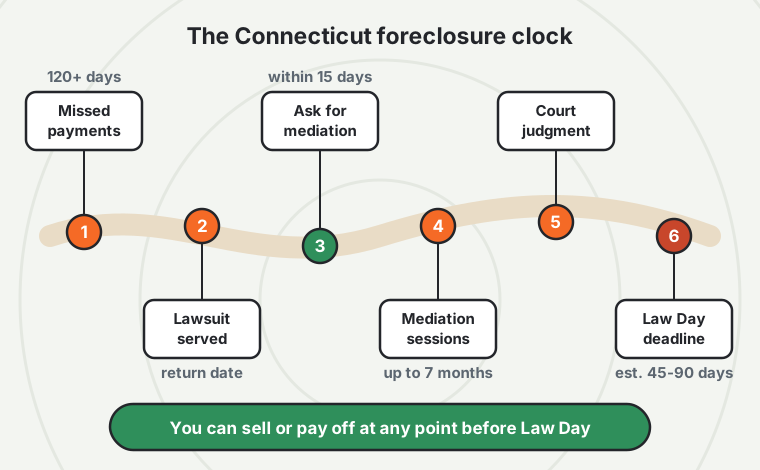
There is no single number, because a Connecticut foreclosure is a lawsuit and lawsuits move at the pace of the court and the parties. What we can give you are the fixed points, which come from statutes and federal rules, and the usual gaps between them.
| Stage | Fixed rule | Typical time (est.) |
|---|---|---|
| Missed payments and late notices | Servicer must try to reach you about loss mitigation early in the delinquency (federal Regulation X) | Months 1-4 |
| Earliest the lawsuit can start | Not until you are more than 120 days delinquent (12 CFR 1024.41(f)) | Month 4 or later |
| Pre-foreclosure notice (EMAP) | For most owner-occupied homes, the lender must mail a notice giving you 60 days to meet with it or a counselor and apply to CHFA’s Emergency Mortgage Assistance Program before it can sue (CGS 8-265ee) | Often sent with or after the default letter |
| Lawsuit served, return date | A state marshal serves the writ, summons and complaint with the mediation notice and forms attached (CGS 49-31l(a)) | Varies |
| Request mediation | File the Appearance (JD-CL-12) and Foreclosure Mediation Certificate (JD-CV-108) within 15 days of the return date | Days 1-15 after return date |
| Lender’s financial package | Due to you and the mediator within 35 days of the return date | By day 35 |
| Premediation with the mediator | Usually ends about 84 days after the return date (Judicial Branch FAQ) | Weeks 5-12 |
| Mediation sessions | Ends at the earlier of 3 sessions or 7 months after the return date, unless the court extends it (CGS 49-31n) | Months 3-7 after return date |
| Litigation pause | For up to 8 months from the return date, no motions except mediation-related ones, and no judgment until mediation ends (CGS 49-31l(f)) | Up to month 8 |
| Motion for judgment and hearing | Lender may file default and judgment motions together after the pause (CGS 49-31l(g)) | Weeks to months |
| Law Day (strict foreclosure) | Set by the judge at judgment | Commonly 45 to 90 days after judgment, sometimes as early as about 21 days (practitioner estimate) |
| Sale date (foreclosure by sale) | Set by the judge at judgment; sale must be approved by the court | Often about 2 months after judgment (practitioner estimate) |
| Appeal | Filing an appeal generally stays the case (Practice Book 61-11) | Can add a year or more (practitioner estimate) |
The foreclosure clock at a glance
The bars are not to scale in months; they show the order of events. The green bar is the one that matters if you are thinking about selling: you can sell, refinance or pay off the loan at any point until your Law Day passes (or, in a foreclosure by sale, until the court approves the sale).
Owners hear “foreclosure takes over a year in Connecticut” and wait. Then the mediation ends, the lender files for judgment, and the judge sets a law day a few weeks out. A sale takes 2 to 6 weeks to close even with a cash buyer, and a listing takes months. Decide what you want to do while you still have the slow part of the clock.
What happens before the bank files a foreclosure in Connecticut?
Before the bank files a foreclosure in Connecticut, you will get late notices, calls about loss mitigation, a default or “notice of intent to accelerate” letter, and for most owner-occupied homes an EMAP notice that gives you 60 days to meet with the lender or a counselor and apply for state emergency mortgage help. Federal rules bar the lawsuit until you are more than 120 days behind. This is the cheapest and easiest time to fix the problem.
The letters you will receive, in order
Late notices and early outreach
Your servicer must try to contact you early in a delinquency about options to avoid foreclosure, and assign staff to help you (federal Regulation X, 12 CFR 1024.39 and 1024.40). Open every letter. Write down every call: date, name, what was said.
Notice of default and intent to accelerate
Your mortgage requires the lender to give you notice of the default and a date to cure it before it “accelerates” the loan (demands the whole balance). Connecticut law also requires the lender to include the Judicial Branch notice of community-based resources with that letter (CGS 49-31r). See our explainer on the Connecticut notice of default.
The EMAP notice
For most owner-occupied homes, before it can sue, the lender must send you a notice by registered or certified mail. You then have 60 days to have a meeting or call with the lender or meet a consumer credit counseling agency, and to contact the Connecticut Housing Finance Authority (CHFA) about the Emergency Mortgage Assistance Program (CGS 8-265ee). Use those 60 days.
The 120-day line
Federal Regulation X says a servicer cannot make the first filing for foreclosure until you are more than 120 days delinquent (12 CFR 1024.41(f)). If you send a complete loss mitigation application before then, the servicer cannot file until it has evaluated you and any appeal is finished.
The lawsuit
A state marshal hands you (or leaves at your home) a writ, summons and complaint. The front pages include the notice of foreclosure mediation, the mediation certificate, a blank appearance form and information on housing counselors (CGS 49-31l(a)). The lender also records a lis pendens on your town’s land records, which warns any buyer that the house is in litigation.
What Connecticut’s emergency mortgage help is
The Emergency Mortgage Assistance Program (EMAP) is run by the Connecticut Housing Finance Authority, within available funds (CGS 8-265dd). You can apply if you have received the lender’s notice of intent to foreclose, are 60 days or more behind, expect to be because of a hardship beyond your control, or your mortgage is in forbearance (CGS 8-265ff). The Department of Banking describes the help as a 30-year, fixed-rate loan. It is not a grant, and it is not guaranteed, but it is built exactly for a temporary hardship: a job loss, an illness, a divorce.
Department of Banking foreclosure hotline: 1-877-472-8313 (weekdays). HUD-approved housing counselors: 1-800-569-4287. CHFA: 1-877-571-2432. Connecticut Fair Housing Center foreclosure advice: 1-888-247-4401. Statewide Legal Services: 1-800-453-3320. All are free; none should ask you for money.
What is Law Day in Connecticut?
Law Day in Connecticut is the deadline, set by the judge in a strict foreclosure judgment, by which you must redeem the house by paying the full debt the court found, plus interest and costs. If you have not redeemed by the end of your Law Day, and no junior lienholder redeems on theirs, title passes to the lender for good and you no longer own the house.
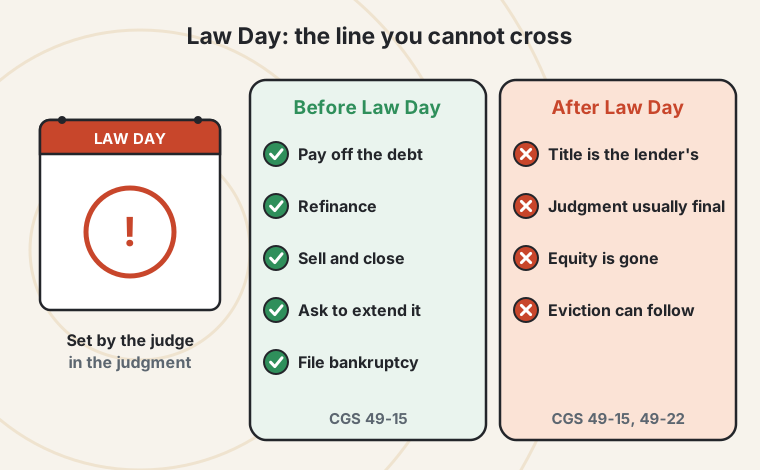
“Law day” sounds like a court date. It is not. You do not have to go anywhere on your Law Day. It is a deadline. Here is how it works in a strict foreclosure:
- Law days run in order. The owner gets the first law day. Then each junior lienholder (a second mortgage, a home equity line, a judgment lien) gets its own day, in reverse order of priority (CGS 49-19). If a junior lienholder pays off the first mortgage on its day, it takes the title, subject to anything ahead of it.
- Redeem means pay in full. To redeem you pay the amount of the judgment debt, interest and the costs the court allowed. Catching up the missed payments is not enough once there is a judgment, unless the lender agrees.
- Selling counts. You do not need to find the cash yourself. If you sell the house and the closing happens before Law Day, the lender is paid from the sale and the case ends.
- Law Day can move. Before it passes, you (through a written motion) can ask the court to open the judgment and set a new law day, for cause (CGS 49-15(a)). Judges often consider a signed sale contract, an approved modification, or a refinance commitment. They do not have to grant it.
- After it passes, it is almost always final. A strict foreclosure judgment cannot be opened after title has become absolute in the lender, except in narrow cases where every party agrees (CGS 49-15(a)(2)).
- Bankruptcy reopens it automatically, but only if you file before title becomes absolute (CGS 49-15(b)). More on that below.
“No such judgment shall be opened after the title has become absolute in any encumbrancer” (CGS 49-15). Everything you want to do, whether it is a sale, a refinance, a modification or a bankruptcy, has to happen or be filed before your Law Day passes.
How do I find my Law Day?
Your Law Day is in the judgment, which is mailed to every party who filed an appearance. That is one more reason to file the appearance form. You can also look up your case on the Judicial Branch website by name, docket number or, for cases with return dates on or after January 1, 2014, by property address, or call the clerk of the court in the judicial district where the case is filed.
What is the difference between strict foreclosure and foreclosure by sale?
The difference between strict foreclosure and foreclosure by sale in Connecticut is what happens to the house and its equity. In a strict foreclosure there is no auction: title passes to the lender if nobody redeems by Law Day, so any equity is lost. In a foreclosure by sale, a court-appointed committee auctions the house, the court approves the sale, and money left after the debts and costs is paid to junior lienholders and then to you.
Strict foreclosure
No auctionThe rule in Connecticut
- Court sets law days, owner first
- Pay in full by Law Day or lose title
- Equity above the debt is lost
- Lender may move for a deficiency within 30 days after the redemption period (CGS 49-14)
- Usual when there is little or no equity
Foreclosure by sale
Court auctionThe exception
- Any party can ask for it by written motion (CGS 49-24)
- Court appoints a committee and an appraiser; owner can ask for a second appraiser (CGS 49-25)
- Redemption possible until the court approves the sale
- Surplus goes to junior liens, then the owner (CGS 49-27)
- Usual when there is real equity
Foreclosure by market sale
A listingOnly if you and the first-mortgage lender agree
- Appraisal, then a broker listing (CGS 49-24b to 49-24d)
- Court approves the contract (CGS 49-24f)
- Junior liens get right-of-first-refusal law days (CGS 49-24g)
- Exempt from the conveyance tax (CGS 12-498(a)(9))
- Rarely used, worth asking about
When does the judge choose a sale?
The judge has discretion. In practice, a court orders strict foreclosure when the debt is close to or above the value of the house, and a foreclosure by sale when there is meaningful equity to protect, or when the United States is a party. The burden is on you to show it. If your house is worth clearly more than the judgment debt, ask your attorney to file a motion for foreclosure by sale and bring an appraisal. That single motion can be worth tens of thousands of dollars.
How a Connecticut foreclosure sale works
- The decree. The judge appoints a committee to make the sale, fixes the sale date, decides how it is advertised, and appoints a disinterested appraiser; on the owner’s motion, a second appraiser (CGS 49-25).
- The auction. The committee runs a public auction, often on a Saturday. Bidders put down a deposit; the foreclosing lender can usually bid its debt instead of cash (practitioner description).
- Approval. The committee reports the sale and the court decides whether to approve it. You can redeem by paying the debt up to that approval; if you pay before the sale, the case stops (CGS 49-25).
- The deed and the money. The committee deeds the house to the buyer (CGS 49-26). Proceeds are paid into court and distributed by a supplemental judgment: costs and the plaintiff’s debt first, then junior liens, then you (CGS 49-27, 49-29).
- A protection on the price. If the house sells for less than the court appraisal, the lender cannot collect the shortfall until half of the difference between the appraised value and the sale price has been credited to the debt (CGS 49-28).
How does the Connecticut Foreclosure Mediation Program work?
The Connecticut Foreclosure Mediation Program works by putting you and your lender in front of a neutral Judicial Branch mediator to look for a way to avoid foreclosure or end it on agreed terms. It is free, covers owner-occupied 1-4 family homes that are your primary residence, and starts when you file an Appearance (JD-CL-12) and a Foreclosure Mediation Certificate (JD-CV-108) within 15 days of the return date on your summons.
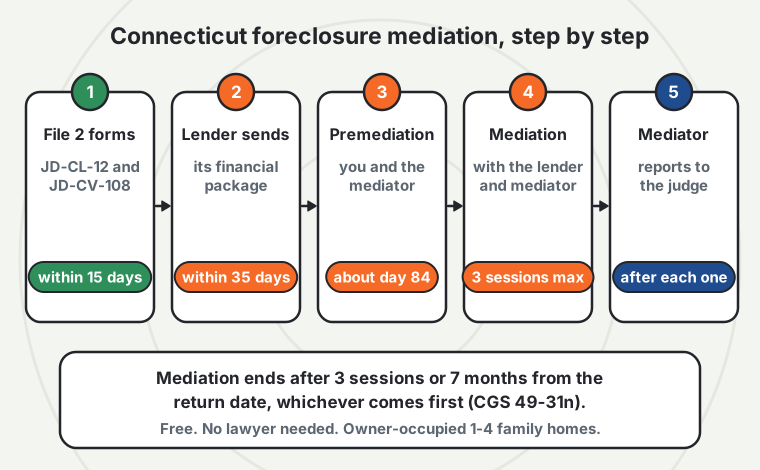
Its official name is the Ezequiel Santiago Foreclosure Mediation Program. The legislature has extended it to cases with return dates through June 30, 2029 (CGS 49-31l). Mediation can cover keeping the house (reinstatement, a repayment plan, a loan modification, restructuring the debt) and leaving it on your terms (a short sale, a deed in lieu, the timing of law days or a sale date) (CGS 49-31m).
Who qualifies
- You are the borrower and an owner-occupant, and the house is your primary residence.
- It is a 1-4 family home in Connecticut.
- A foreclosure case has been filed. Tax lien and condominium lien foreclosures are not covered.
- Certain spouses and former spouses who took title on a death or a divorce can qualify as “permitted successors-in-interest” (CGS 49-31k(9)), and religious organizations can qualify.
- You do not need a lawyer, and there is no application fee (Judicial Branch FAQ).
How to request mediation, step by step
Find the return date on your summons
It is printed on the summons. Count 15 days from that date. That is your deadline, not 15 days from when you were served.
File two forms with the court clerk
The Appearance (JD-CL-12) and the Foreclosure Mediation Certificate (JD-CV-108), both attached to the papers you were served and available at jud.ct.gov. Send a copy of the certificate to the lender’s attorney and certify that you did (CGS 49-31l(c)).
Gather your financial papers now
Pay stubs, two months of bank statements, tax returns, a hardship letter, a household budget, and information on any other income in the house. The lender must send you and the mediator its financial package within 35 days of the return date (CGS 49-31l(d)).
Premediation with the mediator
You meet the mediator without the lender. The mediator checks your forms, explains options, may refer you to a housing counselor or CHFA, and helps get a complete package to the lender. It usually ends about 84 days after the return date.
Mediation sessions
Up to three sessions, or seven months after the return date, whichever comes first, unless the judge extends it (CGS 49-31n(a)). Sessions are in person at the courthouse unless the mediator allows a virtual session. The lender must respond to a complete request within 35 days, with reasons if it says no (CGS 49-31n(b)).
The mediator’s report
After each session the mediator files a report with the court within three business days. You have five business days to add your own information on form JD-CV-133. Reports are public; your personal financial documents are not.
Missed the 15 days?
You can still ask. File a motion for permission to file the mediation certificate late (JD-CV-96, Part I) together with the JD-CV-108 and JD-CL-12. A judge decides. If mediation was ended and your situation has changed, a Petition for Reinclusion (JD-CV-136) asks to get back in.
Does mediation work?
Often, but not always. The Judicial Branch’s 2014 evaluation of cases filed from July 2008 to June 2014, covering about 31,000 participating homeowners, found that homeowners who went through mediation kept their homes at a markedly higher rate than eligible homeowners who did not. Mediation does not stop the foreclosure on its own. It pauses the litigation (for up to 8 months from the return date, no judgment can enter while mediation is running) and gives you a structured shot at a deal. If no deal is reached, the case resumes and you still have to respond to it.

If you want to keep the house and your income can carry a modified payment, request mediation. It costs nothing and it buys months. If you already know you want to sell, request it anyway: the mediator can help you agree on law days that give your sale time to close, and the lender’s attorney is far more flexible about dates when a signed contract is on the table.
What can you do to stop foreclosure in Connecticut?
To stop foreclosure in Connecticut you can catch up the arrears (reinstatement), agree a repayment plan or forbearance, get a loan modification, apply for CHFA emergency mortgage help, use the court’s mediation program, refinance, sell the house before Law Day, negotiate a short sale or deed in lieu, or file bankruptcy. The first six keep the house. The next three end the foreclosure by giving up the house on your terms.
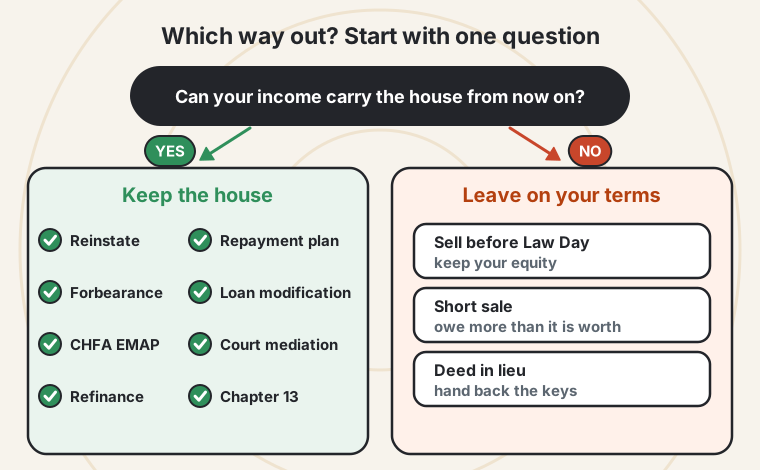
The honest way to choose is to answer one question first: if the arrears disappeared tomorrow, could you afford the payment, taxes and insurance every month from now on? If yes, work on the options that keep the house. If no, a modification will often only delay the same problem, and the options that let you leave on your own terms will usually leave you with more money and better credit.
| Option | Keeps the house? | Best when | Watch out for |
|---|---|---|---|
| Reinstatement | Yes | You have the cash to catch up all arrears, fees and costs | After judgment the lender does not have to accept less than full redemption |
| Repayment plan | Yes | A short, finished hardship; you can pay the regular payment plus extra | Missing a plan payment usually restarts the foreclosure |
| Forbearance | Yes, for now | A temporary drop in income with a clear end date | The skipped payments still come due; plan how before it ends |
| Loan modification | Yes | Your income has recovered but cannot cover the old payment | Trial period first; incomplete packages are the top reason for delays |
| CHFA EMAP | Yes | Temporary hardship beyond your control; you can afford the house afterwards | Within available funds; strict eligibility (CGS 8-265ff) |
| Court mediation | Usually | Owner-occupied 1-4 family home; any of the above | 15-day deadline; it pauses but does not end the case |
| Refinance | Yes | Real equity and a credit score that still qualifies | Hard once you are several payments behind |
| Chapter 13 bankruptcy | Usually | Steady income; you need years to catch up | 3 to 5 year plan; attorney fees; affects other debts |
| Sell before Law Day | No | You have equity, or the house no longer fits your budget | The closing must happen before Law Day |
| Short sale | No | You owe more than the house is worth | Lender approval takes weeks to months; ask for a deficiency waiver |
| Deed in lieu | No | Underwater, no other liens, lender agrees | Equity, if any, goes to the lender; get the release in writing |
| Chapter 7 bankruptcy | Usually not | You need relief from other debts too | Only delays the foreclosure if you cannot cure the arrears |
An older version of this page listed six things: sell, borrow money, ask the lender for forgiveness, refinance, rent the house out, and declare bankruptcy. All six are still on the table above, except renting, which only helps if the rent covers the full payment and you can afford to live somewhere else; it does not cure the arrears by itself, and a foreclosure can still go ahead with tenants in the house. What the old list missed are the tools Connecticut homeowners actually use most: court mediation, CHFA’s EMAP and a sale timed to close before Law Day. If you are earlier in the process, our post on what to do when you are behind on mortgage payments covers the first missed payments.
Can you catch up your mortgage and stop the foreclosure?
Yes, you can usually catch up your mortgage and stop a Connecticut foreclosure before judgment by paying everything that is past due, including late fees and the lender’s legal costs. This is called reinstatement. Connecticut has no general statute giving you that right; it comes from your mortgage contract or the lender’s agreement. After a judgment, you generally have to redeem by paying the full debt, unless the lender agrees to less.
Reinstatement is the simplest fix if you have the money, for example from a tax refund, a family loan, a 401(k) hardship withdrawal or a new job. Before you send anything:
- Ask for a reinstatement statement in writing. Connecticut requires the lender to provide a payoff or reinstatement statement by the date you request, as long as that date is at least seven business days after it receives your written request. If it is late, it loses interest that accrues after the date you asked for (CGS 49-10a).
- Check every fee. Inspection fees, attorney’s fees and “corporate advances” add up. Ask what each line is for. Your attorney or a housing counselor can challenge charges that do not belong.
- Pay the way the statement says, usually certified funds or wire, and get written confirmation that the loan is reinstated and that the lender will withdraw the foreclosure.
Repayment plans and forbearance
If you cannot pay it all at once, a repayment plan spreads the arrears over several months on top of your regular payment. A forbearance lowers or pauses payments for a set time. Both are best for a hardship that is clearly over or clearly temporary. Ask exactly what happens when the forbearance ends: a lump sum, a repayment plan, a deferral to the end of the loan, or a modification. Get it in writing.
How does a loan modification work in Connecticut?
A loan modification in Connecticut works by permanently changing your mortgage terms, such as the interest rate, the length of the loan or the treatment of the arrears, so that the payment fits your income. You apply to your servicer with a complete financial package, usually make three trial payments, and then sign a permanent modification. In a foreclosure case, the court mediation program is the best place to push one through.
Modifications are what most homeowners in mediation are trying to get. The process is the same whether you apply on your own or in mediation; mediation adds deadlines and a neutral person who reports to the judge.
Get the application and a checklist
Ask the servicer for its loss mitigation application, or download it from its website. Note the date you ask.
Send a complete package
Pay stubs, bank statements, tax returns, a hardship letter, a monthly budget, and proof of any other household income. Keep copies and proof of delivery. Under federal rules, the servicer must tell you within 5 business days whether the application is complete, and must decide on a complete application within 30 days (12 CFR 1024.41(b) and (c)).
Use the federal dual-tracking protection
If the servicer receives your complete application more than 37 days before a foreclosure sale, it cannot move for a foreclosure judgment or order of sale, or conduct a sale, until it has decided and any appeal is over (12 CFR 1024.41(g)). Ask your attorney how that applies to law days in your strict foreclosure case.
Make the trial payments on time
Usually three months. Missing one usually ends the trial.
Sign the permanent modification
Read it. Check the new balance, rate, term, any balloon payment, and whether the foreclosure case will be withdrawn.
Connecticut law also lets a lender and an underwater homeowner agree to modify the mortgage, transfer the house in satisfaction of the debt, or arrange a transfer to a third party, with the court entering a “judgment of loss mitigation” (CGS 49-30p to 49-30w). It is voluntary on both sides. Ask about it in mediation if you owe far more than the house is worth.
When a modification is the wrong answer
A modification that lowers your payment by a little, adds the arrears to the balance and leaves you with no equity can keep you in a house you still cannot afford. If the modified payment would take more than you can reliably pay every month, or the house needs repairs you cannot fund, look hard at selling while you still have equity.
Can you sell your house before Law Day in Connecticut?
Yes, you can sell your house before Law Day in Connecticut, and you keep whatever is left after the mortgage, liens and closing costs are paid. The lender is paid in full at the closing and the foreclosure ends. The catch is time: the sale has to close before your Law Day, or the court has to extend it, so a cash buyer or a fast, well-priced listing is usually needed.
Selling is the way out that protects the most money when you have equity and cannot afford to keep the house. It is also the most misunderstood. Many owners believe the bank has to approve the sale, that a house in foreclosure cannot be listed, or that the foreclosure “takes” their equity. None of that is true before Law Day:
- You still own the house. You can sign a listing or a purchase contract at any time before Law Day.
- The bank does not have to approve a full-payoff sale. It only has to approve a short sale, where the price will not cover what you owe.
- The lis pendens is not a problem for the closing. Your attorney orders a payoff, the lender is paid at closing, and the lender withdraws the case and releases the mortgage.
- Your equity is yours. After the payoff, any junior liens, the conveyance tax and closing costs, the rest goes to you.
How to sell a house in foreclosure in Connecticut, step by step
Find your exact deadline
Look up your case on jud.ct.gov or ask the clerk: has judgment entered, and what is your Law Day or sale date? If no judgment yet, how far along is mediation?
Get a payoff statement
Ask your lender in writing for a payoff good through a date a few weeks out (CGS 49-10a). It will include arrears, interest, late fees and the lender’s foreclosure costs. Ask for payoffs on any second mortgage or line of credit too.
Check for other liens
Unpaid property taxes, sewer or water charges, judgment liens and tax liens all have to be paid from the sale. Your attorney’s title search will find them.
Work out your number
Price minus payoffs, minus the conveyance tax (most Connecticut towns: 1% of the price; 1.25% in 16 cities), minus your attorney and any commission. Use the calculator below.
Pick the route that fits your time
Months before Law Day: a listing at the right price usually gets you the most. Weeks before Law Day, or a house that needs work: a cash buyer who can close on a fixed date. Either way, have a Connecticut attorney.
Sign a contract and tell the lender’s attorney
Send a copy of the signed contract and the closing date. Ask whether the lender will agree to extend law days or postpone a sale if the closing date is after Law Day.
File a motion to extend Law Day if you need it
Your attorney files a written motion to open the judgment and set a new law day before the current one passes (CGS 49-15(a)). It must be filed and decided in time. A signed contract with a real closing date is the strongest reason you can give.
Close and get paid
At the closing your attorney pays off the lender, other liens and the conveyance tax, and wires you the rest. The lender then withdraws the case and records a release of the mortgage.
How much would you walk away with?
Slide the numbers to match your house. It works in your browser; nothing is saved or sent.
Estimates for planning. Conveyance tax per CGS 12-494 (state 0.75% up to $800,000, 1.25% to $2.5M, 2.25% above, plus the town rate). Seller attorney about $1,200 to $1,500; flat-fee MLS about $400; listings include three months of taxes, insurance and utilities, a cash sale about two weeks. Your attorney gives you the final numbers.
A worked example
Say your house in Hartford would sell for $280,000 as it is, and the lender’s payoff, including the arrears, interest and its foreclosure costs, is $215,000. Hartford is one of the 16 towns with a 0.50% town conveyance tax, so the total conveyance tax is 1.25%.
Sell before Law Day
about $60,300to you (example)
- $280,000 price
- minus $215,000 payoff
- minus $3,500 conveyance tax (1.25%)
- minus $1,200 attorney (est.)
Strict foreclosure
$0to you
- Title passes to the lender after Law Day
- The equity above the debt is lost
- A foreclosure stays on your credit report for 7 years
Foreclosure by sale
less, latersurplus after an auction (if any)
- Auction prices are usually below a market sale
- Costs of the sale and appraisal come off the top
- You wait for the supplemental judgment
The numbers are an illustration, not a quote. Your payoff, your price and your town’s conveyance rate will differ. The point is the shape: with equity, a sale before Law Day almost always beats letting the case run.
Need a firm number and a closing date before Law Day?
Send a few photos and the address. We look at recent sales near you and the repairs we can see and send back a written cash offer with a closing date you choose. Compare it with what a listing would net; we will tell you if listing makes more sense.
A written cash offer with a closing date before your Law Day
Want your offer faster, or rather not talk to anyone yet? Add the address and a few photos. You get a written offer, the closing date you need and the payoff handled by Connecticut attorneys. No showings, no repairs.
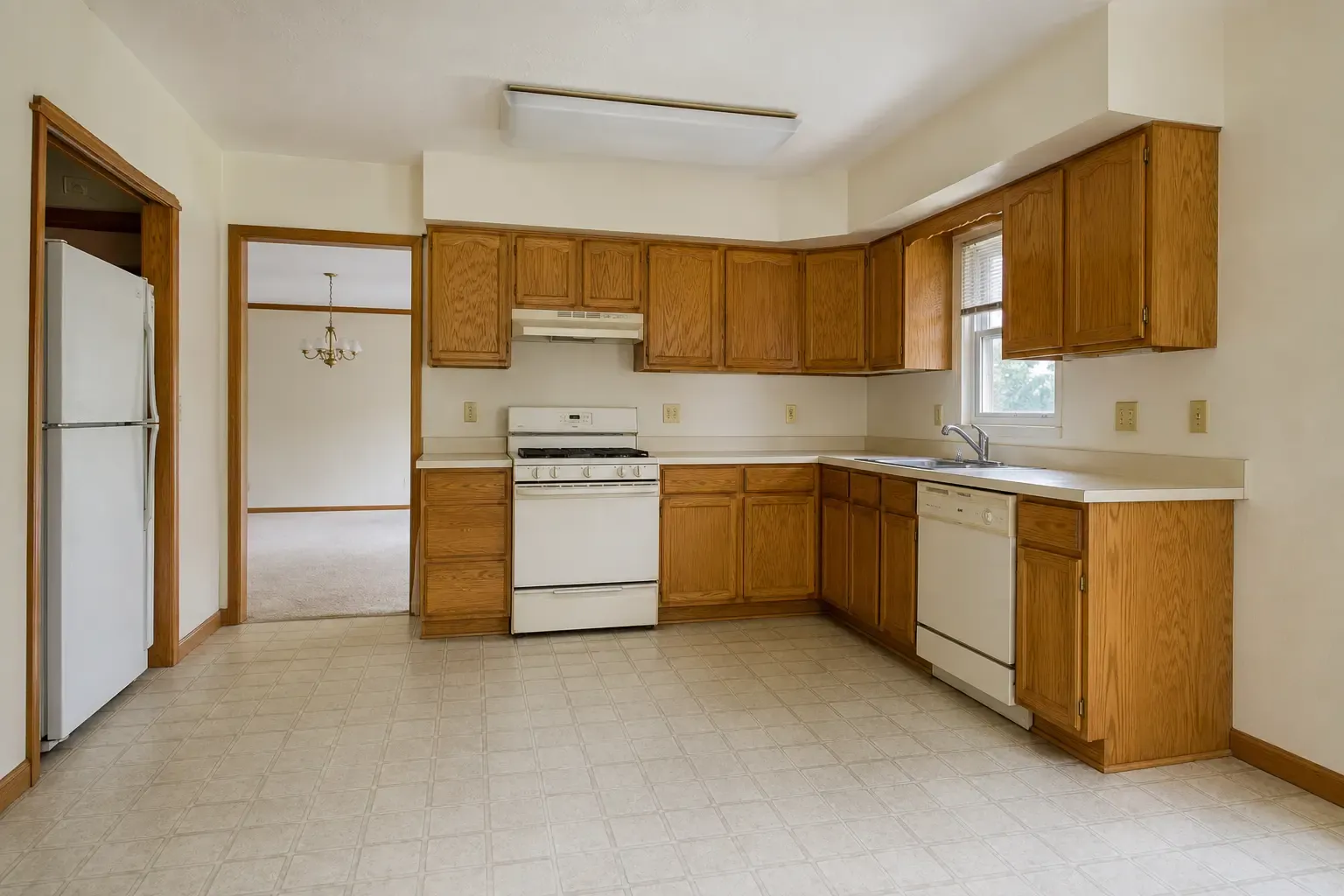 CabinetsFlooring
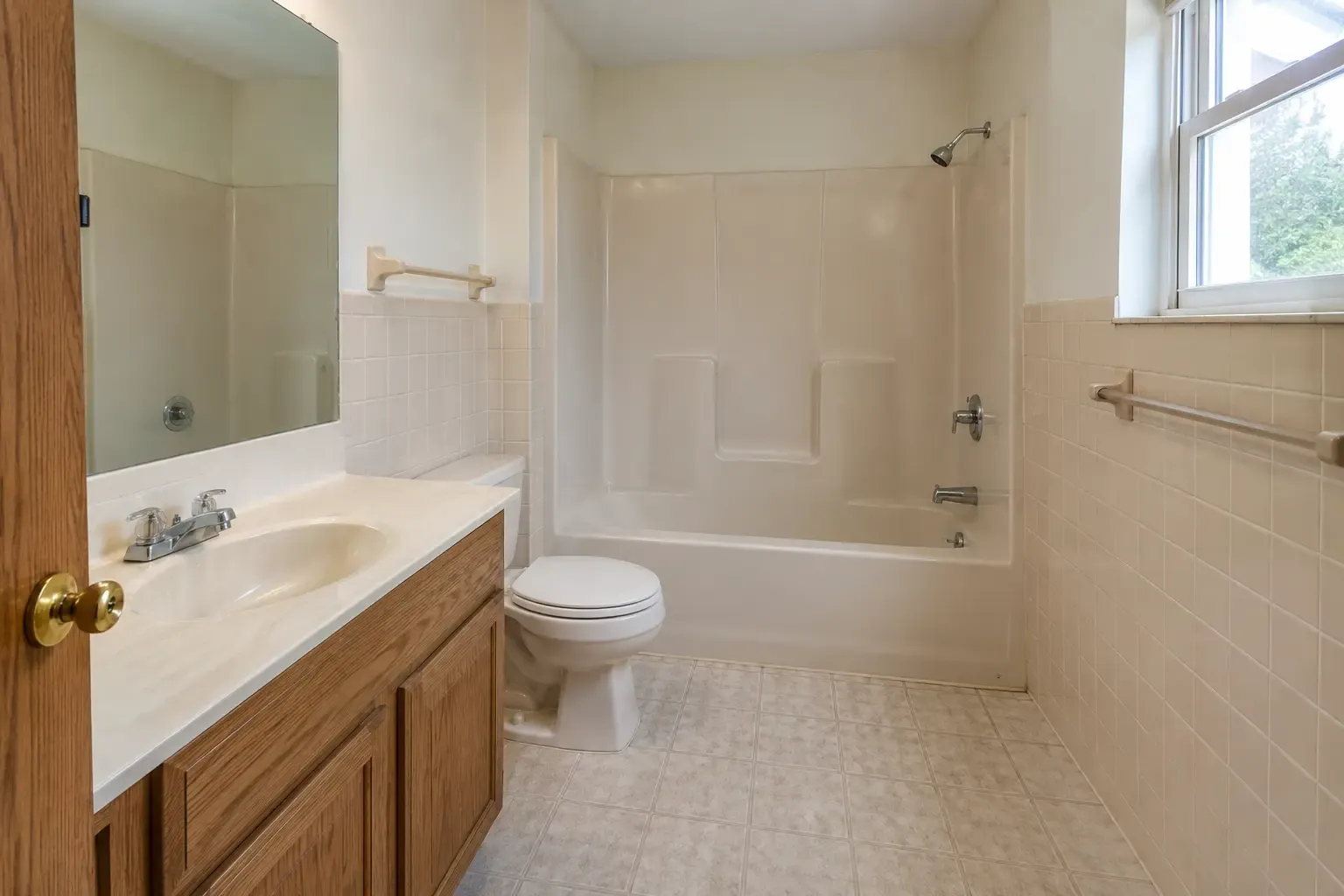 Tub & tile
 Floors
 Roof
We may bring in a partner buyer to close. Your price and terms don't change.
Selling for cash is not the only fast route; read our cash buyer vs. realtor comparison and our service page for selling a house in foreclosure in Connecticut. If you use any cash buyer, vet them first with our guide on how to check a cash home buyer in Connecticut.
What is a short sale in Connecticut, and when does it make sense?
A short sale in Connecticut is a sale for less than you owe on the mortgage, with the lender’s written agreement to accept the sale proceeds and release its lien. It makes sense when the house is worth less than the debt, you cannot afford to keep it, and you want to avoid a foreclosure judgment. In Connecticut, a short sale of your principal residence is also exempt from the conveyance tax.
A short sale takes longer than a regular sale because the lender (and any mortgage insurer or investor behind it) has to review your hardship, your finances and the offer. Expect weeks to months. Start early, and keep the lender’s attorney informed so law days or sale dates can be timed around the approval.
Connecticut rules that matter in a short sale
- No conveyance tax. The state and town conveyance tax does not apply to a transfer of your principal residence when the price is not enough to pay the mortgages and any municipal liens that come ahead of them (CGS 12-498(a)(20)).
- Who can charge you to negotiate it. Negotiating a short sale for a fee is “debt negotiation” in Connecticut and needs a Department of Banking license, unless it is done by your attorney (CGS 36a-671, 36a-671c). A licensed real estate agent can list the house; a “short sale negotiator” charging you a fee needs the license.
- The deficiency. Ask the lender to state in its approval letter that the sale satisfies the debt in full and that it waives any deficiency. Without that, the lender may still be able to pursue the balance.
- Taxes on forgiven debt. Forgiven mortgage debt can be taxable income (the lender may send Form 1099-C). The federal exclusion for forgiven debt on a main home applied to debt discharged through December 31, 2025, and to later discharges under a written arrangement made before 2026; the insolvency exclusion still applies if your debts exceed your assets (IRS Form 982). Ask a tax professional before you sign.
Our older post compares the two in plain terms: short sale vs. foreclosure.
What is a deed in lieu of foreclosure in Connecticut?
A deed in lieu of foreclosure in Connecticut is an agreement where you sign the house over to the lender and the lender releases the mortgage debt, ending the foreclosure without a judgment. Lenders usually agree only when the house is underwater, the title is clear of other liens, and a sale has been tried. In Connecticut, a deed in lieu of your principal residence is exempt from the conveyance tax.
A deed in lieu is a clean exit when nothing else works: no auction, no law days, often a set move-out date and sometimes relocation money. It is a bad deal when you have equity, because the lender keeps the house and all of its value. Before you sign one:
- Get an appraisal or a broker’s opinion of value; if you have equity, sell instead
- Get the lender’s written agreement that the deed satisfies the debt in full, with no deficiency
- Find out what happens to a second mortgage or home equity line; the first lender usually requires them cleared
- Agree a move-out date and any relocation payment in writing
- Ask how the lender will report it to the credit bureaus
- Confirm the conveyance tax exemption with your attorney (CGS 12-498(a)(19))
- Have your own attorney review the deed and the agreement
More: can I give my house back to the bank?
Does bankruptcy stop foreclosure in Connecticut?
Yes, filing bankruptcy stops a Connecticut foreclosure, at least for now. The moment you file, a federal automatic stay bars the lender from continuing the case, and Connecticut law automatically opens a strict foreclosure judgment if you file before title becomes absolute, so new law days must be set later. Chapter 13 can save the house by spreading the arrears over a 3 to 5 year plan; Chapter 7 usually only delays the foreclosure.
- The automatic stay. A bankruptcy petition automatically stops most collection, including a pending foreclosure (11 U.S.C. 362(a)). If you had another bankruptcy case dismissed within the past year, the stay can expire after 30 days unless the court extends it (11 U.S.C. 362(c)(3)).
- Law days reset. When you file, a strict foreclosure judgment against you opens automatically, without anyone asking, as long as title has not yet become absolute. You must file a copy of the petition or an affidavit with the foreclosure court. The judgment stands except for the law days, which are reset after the stay ends (CGS 49-15(b)).
- Chapter 13. You keep the house and cure the arrears through a court-approved plan of up to 5 years while paying the regular mortgage (11 U.S.C. 1322(b)(5), 1322(d)). It works if your income is steady enough to do both.
- Chapter 7. It wipes out many unsecured debts but does not cure mortgage arrears. The lender can ask the bankruptcy court to lift the stay and then resume. It can still help if freeing up income from other debts lets you afford the house.
- Your equity. Connecticut’s homestead exemption protects up to $250,000 of equity in your home in bankruptcy and against most judgment creditors (CGS 52-352b(21)).
A bankruptcy filed only to stop a law day, without a plan to cure or sell, often ends with the stay lifted and new law days a few weeks later, plus a bankruptcy on your record. If you file, file with a plan. A bankruptcy can also be the bridge that gives a sale time to close.
What happens to your equity in a Connecticut foreclosure?
Your equity in a Connecticut foreclosure depends on the type of judgment. In a strict foreclosure, equity above the debt is lost when title passes to the lender after Law Day. In a foreclosure by sale, any surplus after the debts and costs is paid to junior lienholders and then to you, though auction prices are usually lower than a market sale. Selling the house yourself before Law Day protects the most equity.
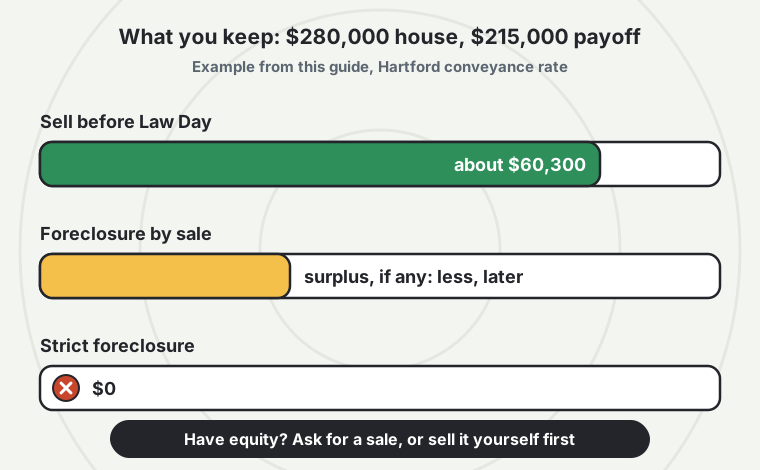
This is the single most expensive misunderstanding in Connecticut foreclosures. Homeowners with real equity, often long-time owners, older owners or heirs who inherited a house with a small mortgage, let a strict foreclosure run because they assume the bank will sell the house and send them the difference. It will not. In a strict foreclosure there is no sale and no surplus.
How to protect your equity
- Know your number. Compare a realistic sale price with your payoff and other liens. Your town’s recent sales are a starting point; our town table lists median single-family prices from state records.
- Appear in the case. If you do not appear, you can be defaulted and lose the chance to argue for a sale.
- Ask for a foreclosure by sale. Any party can move for it in writing (CGS 49-24). Bring evidence of value. If the court orders a sale, ask for a second appraiser (CGS 49-25).
- Better still, sell it yourself. A market sale before Law Day almost always brings more than a court auction, and you control the date.
This section is about mortgage foreclosures. Towns can also foreclose for unpaid property taxes, and condominium associations for unpaid common charges (CGS 47-258). Those cases are not covered by the mediation program. If a town or association has sued you, call an attorney quickly; the amounts are often small compared with the equity at risk.
Can the lender come after you for the rest of the debt in Connecticut?
Yes, the lender can come after you for the rest of the debt in Connecticut, but only by asking the court for a deficiency judgment in the foreclosure case. After a strict foreclosure, it must file the motion within 30 days after the redemption period expires, and the court sets the house’s value and awards only the difference between that value and the debt. After a foreclosure by sale, the deficiency is based on the sale, with a protection if the house sold below the appraisal.
| After strict foreclosure | After foreclosure by sale | |
|---|---|---|
| Deadline | Motion within 30 days after the time for redemption expires (CGS 49-14) | Determined in the same case after the sale (CGS 49-28) |
| How it is measured | Debt minus the court’s valuation of the house, after an evidentiary hearing | Debt minus the sale proceeds applied to it |
| Your protection | You can present your own appraisal at the hearing | If the sale price is below the court appraisal, half of the difference must be credited first (CGS 49-28) |
| Afterwards | The lender can collect only the amount of that judgment (CGS 49-14); foreclosure bars any other action on the debt (CGS 49-1) | Other collection is stayed while the case is pending (CGS 49-28) |
In practice, many lenders do not pursue deficiencies against homeowners with few assets, but you should not rely on that. Whatever exit you choose, a short sale, a deed in lieu or a modification that later fails, ask for the lender’s waiver of any deficiency in writing.
What happens after Law Day passes in Connecticut?
After Law Day passes in Connecticut and nobody redeems, title to the house becomes absolute in the lender, the judgment generally cannot be opened, and the lender can ask the court for an execution of ejectment. A state marshal can then remove the occupants and their belongings no fewer than five business days after serving the execution. The foreclosure is reported on your credit for seven years.
- Title. The lender records a certificate of foreclosure on the land records (CGS 49-16) and owns the house.
- Moving out. If you are still in the house, the lender can get an execution of ejectment. The marshal must try to notify you at least five business days before giving the town 24 hours’ notice, and can remove belongings to a town-designated storage place (CGS 49-22).
- Tenants. Tenants in a foreclosed house generally get at least 90 days’ notice under the federal Protecting Tenants at Foreclosure Act, and Housing Choice Voucher tenants keep their lease with the new owner (CGS 49-31q).
- Deficiency. Watch for a deficiency motion within 30 days (CGS 49-14).
- Credit. Under the federal Fair Credit Reporting Act, most negative items, including a foreclosure, can be reported for seven years.
Read more on the consequences of foreclosure for Connecticut homeowners.
How do you spot a foreclosure rescue scam in Connecticut?
You spot a foreclosure rescue scam in Connecticut by what it asks of you: money up front before any help, a promise to stop the foreclosure or guarantee a modification, a request to sign over your deed or “rent back” your own house, instructions to stop paying or talking to your lender, or a negotiator with no Connecticut debt negotiation license. Paid foreclosure help in Connecticut needs a Department of Banking license unless it comes from your attorney.
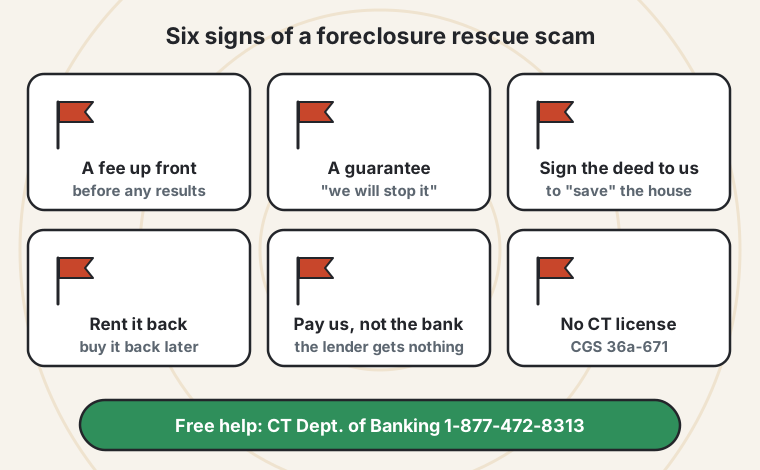
The Connecticut Department of Banking warns that foreclosure “rescuers” are often after the house itself or the equity in it. The schemes change; the patterns do not.
| Red flag | Why it matters |
|---|---|
| A fee before any results | Federal rules ban most companies from collecting fees for mortgage relief before you have a written offer from your lender that you accept (FTC and CFPB Mortgage Assistance Relief Services rule, 12 CFR 1015). |
| “We guarantee to stop your foreclosure” | Nobody can guarantee what a lender or a judge will do. |
| “Sign the deed to us and rent it back until you can buy it back” | The classic sale-leaseback. You lose the title and the equity; buy-backs rarely happen. |
| “Make your payments to us, not your lender” | The lender gets nothing and the foreclosure keeps going. |
| “Don’t talk to your lender, lawyer or counselor” | Isolating you is how the scheme works. |
| A “forensic loan audit” for a fee | The Department of Banking lists paid audits and non-lawyer modification fees as warning signs. |
| No Connecticut license | Debt negotiation, including foreclosure rescue and short sale negotiation, requires a license and a surety bond (CGS 36a-671, 36a-671d). Check NMLS Consumer Access. |
| Free help from HUD counselors, CHFA, the court and legal aid | Real help in Connecticut is free or comes from your own attorney. |
What a legitimate sale to a cash buyer looks like
A cash buyer is not a rescue. A real sale is simple: a written purchase contract with a price, a closing date, a Connecticut attorney for you, the lender paid off at the closing table, and the balance wired to you. You move out; the buyer owns the house. If anyone offers to let you stay and buy it back, or asks you to sign a deed before a closing with attorneys, walk away and call the Department of Banking at 1-877-472-8313. Our guide on how to check a cash home buyer lists the checks to run on us or anyone else.
What if your situation is different?
If your situation is different, the Connecticut foreclosure rules change in specific ways: a second mortgage or home equity line can foreclose on its own, a condo association or the town can foreclose for unpaid charges or taxes, heirs and divorced spouses have special status, reverse mortgages follow their own timeline, and vacant houses can move faster. Here is how each one works.
| Situation | What is different in Connecticut |
|---|---|
| Second mortgage or HELOC forecloses | A junior lender can foreclose even if the first mortgage is current. It forecloses subject to the first mortgage. Mediation is available if you qualify. |
| Condo association foreclosure | Associations have a lien for unpaid common charges (CGS 47-258) and can foreclose. Not covered by the mediation program. |
| Town tax foreclosure | Unpaid property taxes are a lien the town can foreclose. Not covered by mediation. Call the tax collector about a payment plan early. |
| Inherited house with a mortgage | A surviving spouse who takes title on death can qualify for mediation as a permitted successor-in-interest (CGS 49-31k(9)). Other heirs should get the estate opened fast. See our guide to inherited houses and probate in Connecticut. |
| Divorce | A spouse who received the house in a divorce decree can qualify for mediation (CGS 49-31k(9)). Both names on the note are still liable until the loan is paid or refinanced. |
| Reverse mortgage | Heirs of a reverse mortgage borrower are excluded from the mediation definition (CGS 49-31k(1)). Contact the servicer immediately; federally insured reverse mortgages have set timelines for heirs to sell or pay. |
| Vacant or abandoned house | The lender can file for default and judgment at the same time if it proves the house is vacant and abandoned (CGS 49-31s), so the case can move much faster. |
| Tenants in the house | Tenants generally keep their lease or get 90 days’ notice after a foreclosure. Selling with tenants is possible; see our landlord guides. |
| Military service | The federal Servicemembers Civil Relief Act gives extra protection against foreclosure on mortgages taken out before active duty. Ask your lender and a legal assistance office. |
What should you do this week if you are facing foreclosure in Connecticut?
If you are facing foreclosure in Connecticut, this week you should find your exact stage and deadlines, file the appearance and mediation certificate if you are within 15 days of the return date, call a free HUD-approved counselor or the Department of Banking hotline, get a written payoff or reinstatement figure, and decide honestly whether you can afford the house going forward. Then pick the option that matches that answer.
- Find the return date on the summons and count 15 days
- File the Appearance (JD-CL-12) and Foreclosure Mediation Certificate (JD-CV-108)
- Look up the case on jud.ct.gov and note any judgment, Law Day or sale date
- Call the Department of Banking foreclosure hotline (1-877-472-8313) or a HUD-approved counselor
- Apply to CHFA’s Emergency Mortgage Assistance Program if your hardship is temporary
- Request a written reinstatement and payoff statement (CGS 49-10a)
- Gather pay stubs, bank statements, tax returns and a hardship letter
- Send a complete loss mitigation application and keep proof of delivery
- Write down the monthly payment you can truly afford
- Estimate your equity from recent sales near you
- If you have equity and cannot keep the house, decide how to sell before Law Day
- Talk to a Connecticut foreclosure or bankruptcy attorney before signing anything
- Do not pay anyone up front, and do not sign over your deed outside a real closing
Should you keep the house, list it, or sell it for cash?
You should keep the house if a modification, mediation or a Chapter 13 plan gives you a payment you can afford for years. You should list it with an agent if you have equity and several months before Law Day. You should sell for cash if Law Day is close, the house needs work, or a listing would not close in time. You should consider a short sale or deed in lieu if you owe more than the house is worth.
| Keep it (modify or mediate) | List with an agent | Sell for cash | Short sale or deed in lieu | |
|---|---|---|---|---|
| You keep the house | Yes | No | No | No |
| You keep your equity | Yes | Most of it | Most of it, less the discount | None |
| Time needed | Months (mediation, trial payments) | Months to list and close | About 2 weeks, or your date | Weeks to months for approval |
| Repairs and showings | None | Usually expected | None | Showings for a short sale |
| Credit impact | Smallest, if it holds | Late payments only | Late payments only | Reported as settled or deed in lieu |
| Best when | Income recovered; you want to stay | Equity and time before Law Day | Law Day close, house needs work | Underwater; cannot afford it |
Not sure which side of the line you are on? The self-check takes two minutes.
Is a cash sale right for you, or should you list?
Seven quick questions. There is no wrong answer, and we will tell you honestly if listing would leave you more.
- Does the house need repairs you would rather not pay for or manage?
- Do you need to close by a certain date, or within the next month or two?
- Would showings be hard: tenants, belongings, privacy, or you live out of state?
- Is there a complication: an estate or probate, a divorce, foreclosure, liens or back taxes?
- Could you comfortably cover the mortgage, taxes and utilities for three or more months?
- Is getting the highest possible price more important to you than speed and certainty?
- Would a buyer's bank lend on the house as it is (no major roof, foundation, oil tank or code issues)?
Our honest take
We buy houses for cash, so weigh this accordingly. If you can afford the house with a modified payment, keep it: mediation is free and works for many Connecticut homeowners. If you have equity and months before Law Day, a well-priced listing will usually net you more than any cash offer, including ours. A cash sale earns its discount when the clock is short, the house needs work, or the uncertainty of a listing could cost you the whole equity at Law Day. Whatever you choose, do it before your Law Day, not after. See our guide to selling without an agent, how long it takes to sell a house in Connecticut and what it costs to sell.
What are houses selling for in your Connecticut town?
Single-family houses in these Connecticut cities and towns sold for a median of about $260,000 to $385,000 from October 2024 to September 2025, according to state sales records. Use your town’s median as a first check on whether you have equity, then compare it with your payoff. Here are ten of the larger towns we cover.
| Town | County | Single-family median | Homes sold | Mill rate (FY 2027) | Town conveyance rate | Conveyance tax at the median |
|---|---|---|---|---|---|---|
| Hartford | Hartford | $260,000 | 825 | 69.95 | 0.50% | $3,250 |
| New Haven | New Haven | $329,450 | 1,022 | 39.962 | 0.50% | $4,118 |
| Bridgeport | Fairfield | $383,500 | 1,166 | 27.95 | 0.50% | $4,794 |
| Waterbury | New Haven | $280,000 | 1,305 | 43.34 | 0.50% | $3,500 |
| New Britain | Hartford | $285,000 | 768 | 39.18 | 0.50% | $3,563 |
| Meriden | New Haven | $316,000 | 749 | 29.99 | 0.50% | $3,950 |
| Norwich | New London | $273,220 | 712 | 34.15 | 0.50% | $3,415 |
| East Hartford | Hartford | $285,000 | 614 | 47.24 | 0.50% | $3,563 |
| Bristol | Hartford | $330,000 | 882 | 35.3 | 0.50% | $4,125 |
| Manchester | Hartford | $320,500 | 724 | 41.0 | 0.25% | $3,205 |
A median is only a starting point: your house’s condition, size and street matter more. See every town we cover on our Connecticut towns page, and our post on the foreclosure process in New Haven.
Questions Connecticut homeowners ask about foreclosure
How long does foreclosure take in Connecticut?
Foreclosure in Connecticut usually takes well over a year from the first missed payment to Law Day (est.), and longer if you use mediation, contest the case or appeal. The lender cannot file until you are more than 120 days behind, mediation can run up to seven months from the return date, and the first law day is commonly set one to three months after judgment.
What is Law Day in Connecticut?
Law Day in Connecticut is the deadline set by the judge in a strict foreclosure by which you must pay off the debt the court found, or lose the title. If nobody redeems by the end of the last law day, title becomes absolute in the lender and the judgment generally cannot be reopened (CGS 49-15).
Can I sell my house before Law Day in Connecticut?
Yes, you can sell your house before Law Day in Connecticut. You still own it until Law Day passes. The lender is paid from the sale at closing and you keep the rest. If the closing will fall after Law Day, your attorney must file a motion to extend it before it passes.
Can Law Day be extended?
Yes, Law Day can be extended in Connecticut if you file a written motion to open the judgment, for cause, before the Law Day passes (CGS 49-15). Judges often consider a signed sale contract, an approved modification or a refinance commitment, but they decide case by case.
What is the deadline to ask for foreclosure mediation in Connecticut?
The deadline to ask for foreclosure mediation in Connecticut is 15 days after the return date on your summons. File the Appearance (JD-CL-12) and the Foreclosure Mediation Certificate (JD-CV-108) with the court and send a copy of the certificate to the lender. After that, you need a judge’s permission on form JD-CV-96.
Does foreclosure mediation cost anything?
No, Connecticut’s foreclosure mediation does not cost anything. There is no application fee, and you do not need a lawyer, although you can bring one. The mediators are Judicial Branch employees.
Does mediation stop the foreclosure?
Mediation pauses a Connecticut foreclosure but does not stop it. For up to eight months from the return date, no judgment can enter while mediation is running (CGS 49-31l(f)). If you reach an agreement, such as a modification, the case can end. If not, it resumes.
What is the difference between strict foreclosure and foreclosure by sale?
The difference between strict foreclosure and foreclosure by sale is that a strict foreclosure has no auction: title passes to the lender after Law Day and any equity is lost. A foreclosure by sale is a court-supervised auction run by a committee; surplus after the debts goes to junior lienholders and then to the owner.
Will I lose my equity in a Connecticut foreclosure?
You will lose your equity in a Connecticut strict foreclosure, because title passes to the lender with no sale. To protect it, ask the court for a foreclosure by sale (CGS 49-24) or sell the house yourself before Law Day, which usually brings the highest price.
Can the bank sue me for the balance after foreclosure in Connecticut?
Yes, the bank can seek the balance after foreclosure in Connecticut, but only through a deficiency judgment in the same case. After a strict foreclosure it must move within 30 days after the redemption period expires, and the court values the house (CGS 49-14). Ask for a written deficiency waiver in any short sale or deed in lieu.
Does bankruptcy stop a Connecticut foreclosure?
Yes, bankruptcy stops a Connecticut foreclosure for now. The automatic stay halts the case, and a strict foreclosure judgment opens automatically if you file before title becomes absolute, so law days are reset later (CGS 49-15(b)). Chapter 13 can let you cure the arrears over three to five years.
How much equity does Connecticut protect in bankruptcy?
Connecticut protects up to $250,000 of equity in your home under its homestead exemption (CGS 52-352b(21)). Your bankruptcy attorney will compare it with the federal exemptions and tell you which set protects more.
Do I pay conveyance tax on a short sale in Connecticut?
No, you do not pay conveyance tax on a short sale of your principal residence in Connecticut when the price is not enough to pay the mortgages and any municipal liens with priority (CGS 12-498(a)(20)). A deed in lieu of foreclosure of your principal residence is also exempt (CGS 12-498(a)(19)).
Is forgiven mortgage debt taxable?
Forgiven mortgage debt can be taxable income. The federal exclusion for debt forgiven on a main home covered discharges through December 31, 2025, and later ones under a written arrangement made before 2026; you may still qualify if you were insolvent (IRS Form 982). Check with a tax professional before you sign a short sale or deed in lieu.
What is EMAP in Connecticut?
EMAP is the Emergency Mortgage Assistance Program run by the Connecticut Housing Finance Authority (CHFA). Within available funds, it can help homeowners with a temporary hardship catch up through a 30-year fixed-rate loan. Most lenders must tell you about it, and give you 60 days, before they sue (CGS 8-265ee).
How do I find out my Law Day?
You find out your Law Day from the judgment, which is mailed to every party who filed an appearance, or by looking up your case on the Connecticut Judicial Branch website by name, docket number or property address, or by calling the court clerk.
What happens if I stay in the house after Law Day?
If you stay in the house after Law Day, the lender, now the owner, can get an execution of ejectment. A state marshal can remove you and your belongings no fewer than five business days after serving it, with belongings taken to a storage place the town designates (CGS 49-22).
Is it legal to charge me for help stopping foreclosure?
Charging you for help stopping foreclosure is legal in Connecticut only for a licensed debt negotiator or your attorney (CGS 36a-671, 36a-671c), and federal rules ban most fees before you accept a written offer from your lender. Free help is available from HUD-approved counselors, CHFA and the Department of Banking.
Will a cash buyer pay off my mortgage at closing?
Yes, in a real cash sale your mortgage is paid off at closing. In Connecticut, attorneys run the closing: your attorney orders the payoff, pays the lender, any liens and the conveyance tax from the sale price, and wires you the balance. Never sign a deed outside an attorney-run closing.
Can I stop a foreclosure by selling to a family member?
Yes, you can stop a foreclosure by selling to a family member if they can close before Law Day and the price covers the payoff and liens. They will need financing or cash in time. Have both sides use Connecticut attorneys and get a written payoff from the lender.
Does a foreclosure in Connecticut affect my credit?
Yes, a foreclosure affects your credit; it can be reported for seven years. Selling before Law Day, even after late payments, avoids the foreclosure itself on your report. A short sale or deed in lieu is usually reported differently from a completed foreclosure.
Related Connecticut guides
Foreclosure basics
Selling fast and right
Want to talk it through?
Book a short call. We will look at your dates, your payoff and what your house would sell for, and tell you plainly which route leaves you with the most, even if it is not selling to us.
See the house together.
Pick a time that works.
Choose a time for us to walk through the property with you, or ask for a quick call first. We confirm every request personally.
Tuesday, January 13
No open times in the next few weeks. Please call us.
We will confirm by email. Nothing is booked until we do.
View my requestSources
- Connecticut General Statutes, chapter 846 (Mortgages): § 49-1 (foreclosure bars further action), § 49-10a (payoff and reinstatement statements), § 49-14 (deficiency judgment), § 49-15 (opening strict foreclosure judgments; bankruptcy), § 49-19 (law days of encumbrancers), § 49-22 (ejectment), §§ 49-24 to 49-29 (foreclosure by sale and by market sale), §§ 49-30p to 49-30w (underwater mortgages), §§ 49-31k to 49-31s (foreclosure mediation; tenants; vacant property).
- CGS §§ 8-265cc to 8-265kk (Emergency Mortgage Assistance Program; 60-day pre-foreclosure notice).
- CGS §§ 36a-671 to 36a-671f (debt negotiation licensing, including foreclosure rescue and short sale negotiation).
- CGS §§ 12-494 and 12-498 (conveyance tax and exemptions for deeds in lieu, short sales and court-ordered sales).
- CGS § 52-352b(21) (homestead exemption).
- Connecticut Judicial Branch, Foreclosure Mediation Program and homeowner questions (forms JD-CL-12, JD-CV-108, JD-CV-96, JD-CV-133, JD-CV-136; premediation; session rules); Mortgage Foreclosure Mediation Program Evaluation (2014).
- Connecticut Department of Banking, Avoiding Foreclosure (hotline 1-877-472-8313, counselors, EMAP, scam warnings).
- 12 CFR 1024.41 (Regulation X loss mitigation: 120-day rule, 37-day rule) and 12 CFR 1015 (Mortgage Assistance Relief Services; advance fee ban).
- 11 U.S.C. § 362 (automatic stay) and 11 U.S.C. § 1322 (Chapter 13 plans).
- IRS Form 982 and IRS Publication 4681 (canceled debts, foreclosures, abandonments).
- Barclay Damon, The Idiosyncrasies of Connecticut’s Mortgage Foreclosure Process (2023) (practitioner timing of law days, sales and appeals).
- Town sales and mill rates: Connecticut Office of Policy and Management, published on data.ct.gov (sales October 2024 to September 2025; fiscal 2027 mill rates).

Who wrote this
Jerryll Noorden
Jerryll has bought and sold Connecticut houses since 2016 and has sat at more closing tables than he can count, on both sides. Before real estate he was a robotics scientist at NASA, IHMC and IIT. He wrote this guide because the national sites that rank for it skip the Connecticut rules that cost sellers money. When listing or selling it yourself would get you more than a cash offer, he says so.
This guide explains Connecticut rules in plain English. It is not legal or tax advice. Laws change; for your sale, talk to a Connecticut real estate attorney and a tax professional.
