
- A short sale is a sale you run, for less than you owe, with the lender’s written approval. A foreclosure is a court case the lender runs, and in Connecticut it usually ends with the lender taking the title after Law Day. Both are part of the bigger question of how to sell a house in Connecticut when you are behind.
- A short sale is usually the less damaging of the two: you control the timing, Fannie Mae’s waiting period for a new mortgage is 4 years instead of 7, and there is no foreclosure judgment on your record.
- Neither one automatically wipes out the debt. In a short sale you need a written deficiency waiver. After a strict foreclosure the lender has 30 days after the redemption period ends to ask the court for a deficiency, measured against the court’s valuation of the house (CGS 49-14).
- Connecticut does not charge conveyance tax on a short sale of your principal residence when the price cannot cover the mortgages and priority town liens (CGS 12-498(a)(20)).
- Forgiven debt can be taxable. The federal exclusion for forgiven mortgage debt on a main home ended for most discharges after December 31, 2025; the insolvency exclusion still applies (IRS Form 982).
- If your house is worth more than you owe, neither option applies. A normal sale before Law Day pays the lender in full and puts your equity in your pocket.
What is the difference between a short sale and a foreclosure in Connecticut?
The difference between a short sale and a foreclosure in Connecticut is who is in control and how it ends. In a short sale you sell the house to a buyer for less than you owe, and the lender agrees in writing to take the proceeds and release its mortgage. In a foreclosure the lender sues you, a judge enters a judgment, and in the usual strict foreclosure the title passes to the lender if you do not pay by your Law Day.

This guide is part of our larger guide on how to sell a house in Connecticut. It answers one narrower question: if you are behind on your mortgage and the house may be worth less than you owe, which is better for you, a short sale or a foreclosure? And what if you actually have equity, so that neither one fits?
Two plain definitions first, because the rest of the page builds on them.
- Short sale. You (usually with a real estate agent) find a buyer at a fair market price. The price is not enough to pay off the mortgage and the selling costs. Before closing, the lender reviews your hardship, your finances and the offer, and agrees in writing to accept less than the full payoff and release its lien. You still own the house until the closing, and you sign the deed.
- Foreclosure. The lender files a lawsuit in Superior Court. Connecticut courts mostly use strict foreclosure: the judge sets a Law Day, a deadline to pay the debt in full. If nobody pays by then, the title passes to the lender with no auction and no sale (CGS 49-24 lets the court order a foreclosure by sale instead, usually when there is equity). The full process is in our Connecticut foreclosure guide; this page only covers what you need to compare the two.
A third option sits between them: a deed in lieu of foreclosure, where you sign the house over to the lender in exchange for releasing the debt. It has its own guide: deed in lieu of foreclosure in Connecticut.
Is it normal to feel this stuck when you are choosing between a short sale and foreclosure?
It is normal to feel stuck when you are choosing between a short sale and a foreclosure, because both sound like losing and the words used by lenders and courts are confusing. Many Connecticut homeowners go through a foreclosure case, and many come out of it with their credit recovering and a plan. The first step is to understand what each option really does, and to get free help.
Maybe the letter from your lender’s attorney is on the kitchen table, unopened for a week. Maybe you have not told your family. Maybe someone at work said “just do a short sale” as if it were a form you fill in. You may feel ashamed that it got this far, trapped because both doors look bad, angry at a servicer that lost your paperwork twice, and afraid of being chased for money for years. You may also be suspicious of everyone who calls, including us. All of that is reasonable.
Here is something specific to Connecticut that most people do not know: if your foreclosure has a return date before July 1, 2029 and the house is your owner-occupied one-to-four family home, you can ask for the state’s free Foreclosure Mediation Program, run by the Judicial Branch. A mediator sits with you and the lender, and a short sale is one of the things you can put on the table there (CGS 49-31k to 49-31n).
This page is for you if you are behind, or about to be, and want to know what each road costs. We will tell you when a short sale beats foreclosure, when foreclosure is not as bad as you fear, and when you should do neither.
Connecticut Department of Banking foreclosure hotline: 1-877-472-8313. HUD-approved housing counselors: 1-800-569-4287. Connecticut Housing Finance Authority (CHFA): 1-877-571-2432. Statewide Legal Services: 1-800-453-3320. The Judicial Branch’s mediation program has no fee and you do not need a lawyer to use it. None of these should ever ask you for money. Call one of them this week, even if you also call us.
How do a short sale and a foreclosure compare side by side in Connecticut?
A short sale and a foreclosure in Connecticut compare like this: a short sale is usually faster to recover from, keeps you in control of the move-out date, avoids conveyance tax on a principal residence that sells for less than the debt, and has a shorter mortgage waiting period. A foreclosure costs you nothing up front but adds legal fees to the debt, ends on the court’s schedule, and can still leave a deficiency.
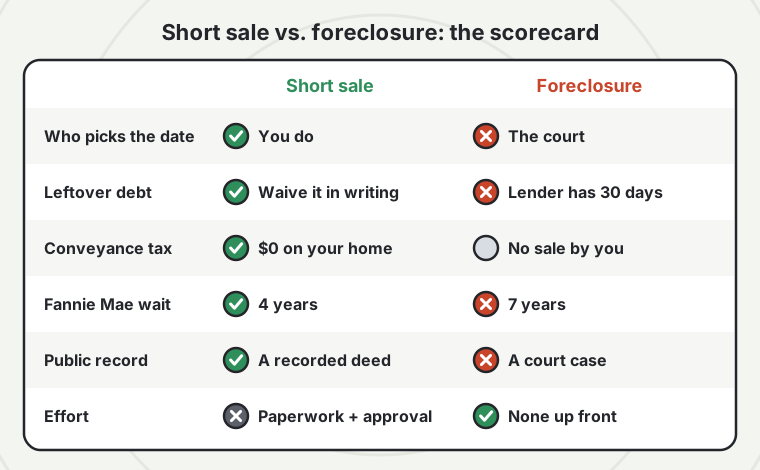
| Point | Short sale | Foreclosure (strict, the Connecticut norm) | Rule or source |
|---|---|---|---|
| Who controls it | You list, choose the buyer and sign the contract; the lender must approve | The lender and the court; you can appear, mediate and ask for more time | CGS 49-24; 49-15 |
| How it ends | A closing with attorneys; the lender is paid what it agreed to accept | Title passes to the lender after your Law Day (and any junior lienholders’ law days) if no one redeems | CGS 49-19; 49-15 |
| The leftover debt (deficiency) | Owed unless the lender’s approval letter waives it in writing | Lender may move for a deficiency within 30 days after the redemption period ends; measured against the court’s valuation | CGS 49-14; 49-1 |
| Taxes on forgiven debt | Forgiven balance can be income (Form 1099-C) | Same rule for any debt the lender cancels; the transfer can also count as a sale for tax (Form 1099-A) | IRS Pub. 4681; Form 982 |
| Conveyance tax | None on your principal residence if the price cannot cover the mortgages and priority town liens | No sale by you, so no seller conveyance tax | CGS 12-498(a)(20); 12-498(a)(9) |
| Credit and the next mortgage | Fannie Mae: 4 years (2 with extenuating circumstances) | Fannie Mae: 7 years (3 with extenuating circumstances, with limits) | Fannie Mae Selling Guide B3-5.3-07 |
| Timeline | Weeks to months for lender review; must close before Law Day | Many months from the return date to judgment; mediation alone can run up to 7 months | CGS 49-31n; 49-31l(f) |
| Your equity | None by definition (the house is worth less than the debt) | Any equity is lost in a strict foreclosure | CGS 49-24 |
| Cost to you | Commission and closing costs are usually paid from the sale proceeds, if the lender approves them | Nothing up front, but the lender’s attorney fees and costs are added to the debt | Lender approval letter; foreclosure judgment |
| Public record | A recorded deed, like any sale | A Superior Court case with your name on it | jud.ct.gov case lookup |
The short version: if the house is truly underwater and you cannot keep it, a short sale is usually the better exit, but only if you get the deficiency waiver in writing and start early enough to close before Law Day. If the house is not underwater, skip to what to do when you have equity.
How does a short sale work during a Connecticut foreclosure?
A short sale works during a Connecticut foreclosure by running alongside the court case: you list the house, accept an offer, send it to the lender with your hardship package, and close only after the lender approves in writing. The foreclosure case keeps going in the background, so the sale has to close before your Law Day, or the court has to move the Law Day.
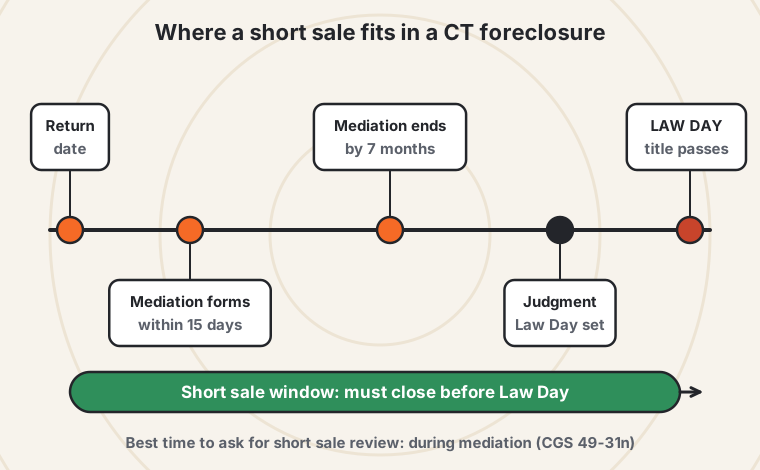
Connecticut gives you a few tools that make a short sale more realistic than in many states:
- Mediation. The notice that comes with the lawsuit tells you to file an appearance and the foreclosure mediation certificate within 15 days of the return date (CGS 49-31l(c)). For up to 8 months from the return date, most motions in the case are paused (CGS 49-31l(f)). Mediation ends at the third session or 7 months after the return date, whichever comes first, unless the court extends it (CGS 49-31n(a)). A short sale review can be a mediation topic.
- Law Day can move. Before your Law Day passes, you can ask the court in writing to open the judgment and set a new Law Day for cause (CGS 49-15). A signed short sale contract with a pending approval is the kind of thing judges consider. They do not have to grant it.
- After Law Day it is almost always over. Once title has become absolute in the lender, the judgment generally cannot be opened (CGS 49-15). A short sale contract does not stop that clock.
- Foreclosure by market sale. Connecticut also has a court-supervised hybrid where, with the owner’s consent, the house is listed and sold on the open market inside the foreclosure case (CGS 49-24a to 49-24g). It is rarely used, but ask your attorney about it if the lender is willing.
The short sale steps, in order
Get your numbers
Ask the servicer for a payoff statement and find out about any second mortgage, home equity line, judgment liens or unpaid taxes. Pull recent sales in your town to see what the house would really sell for.
Call the lender’s loss mitigation department
Ask for a short sale package (often a hardship letter, two years of tax returns, recent pay stubs and bank statements, and a financial form). If you are in mediation, raise it with the mediator.
List the house with a short sale experienced agent
The agent markets it at a realistic price. The listing usually says “subject to lender approval”.
Accept an offer and submit it
The contract, the buyer’s proof of funds or pre-approval, and an estimated settlement statement go to the lender (and to every lienholder who must release).
Wait for valuation and approval
The lender orders its own valuation and may counter. Get the approval letter, read the deficiency language, and check the closing deadline in it.
Close before the deadline and before Law Day
Your attorney and the buyer’s attorney close the sale. The lender gets the approved amount; you get the release.
Every lienholder has to release its lien. A home equity line or second mortgage often wants a payment to sign off, and the first lender may cap what it will allow. Find out about junior liens on day one; they are the most common reason short sales stall.
If you want to know more about what a short sale is in general, our older local post what is a short sale and how does it benefit you in Norwich, CT covers the basics.
Will you still owe money after a short sale or a foreclosure in Connecticut?
You can still owe money after a short sale or a foreclosure in Connecticut. After a short sale, the shortfall stays a debt unless the lender’s written approval waives it. After a strict foreclosure, the lender can ask for a deficiency judgment within 30 days after the redemption period expires, and the court awards only the difference between its own valuation of the house and the debt (CGS 49-14).

This is the part most national articles get wrong for Connecticut. The rules are different for each road:
| Short sale | Strict foreclosure | |
|---|---|---|
| Is there a deadline for the lender? | No special deadline; an unwaived shortfall is an ordinary debt the lender can try to collect | Yes: a motion within 30 days after the time for redemption expires (CGS 49-14(a)) |
| How the leftover is measured | Debt minus what the lender actually received from the sale | Debt minus the court’s valuation after an evidentiary hearing, where you can bring your own appraisal (CGS 49-14(a)) |
| Other suits on the same debt | Possible unless waived | Foreclosure bars further action on the debt except through the deficiency judgment (CGS 49-1; 49-14) |
| How to protect yourself | Approval letter says the sale is “in full satisfaction of the debt” and the lender “waives any deficiency” | Appear in the case, bring evidence of value to the hearing, and negotiate a waiver in mediation |
Example (illustrative): the same Norwich house, two roads
Take a house in Norwich valued at the town’s median sale price of $261,000 (state sales data, October 2024 to September 2025). The owner owes $290,000 (illustrative).
- Short sale: the house sells for $261,000. Commission at 5% (est.) is $13,050 and other closing costs (est.) are $3,000, so the lender receives about $244,950. Without a waiver, the shortfall is about $45,050 (est.).
- Strict foreclosure: by Law Day, interest, the lender’s attorney fees and costs have pushed the debt to, say, $305,000 (est.). If the court values the house at $261,000, a deficiency judgment would be about $44,000.
The two numbers are close. The real difference is not the size of the leftover debt. It is that in a short sale you can negotiate the waiver before you sign, while in a foreclosure you find out after the fact whether the lender files the motion. In practice many lenders approve short sales with a full waiver, and many do not pursue deficiencies against owners with few assets, but you should never rely on that without it in writing.
“Accepted in full satisfaction of the debt”, “waives any deficiency”, and “will not pursue the borrower for any remaining balance”. If the letter says the lender “reserves the right” to collect the balance, or asks you to sign a promissory note, do not close until your attorney has negotiated it.
Do you pay taxes on a short sale or a foreclosure?
You can pay taxes on a short sale or a foreclosure, because debt a lender forgives is generally taxable income and the lender may send you Form 1099-C. The federal exclusion for forgiven debt on a main home covered discharges through December 31, 2025, and later ones under a written arrangement made before 2026. If your debts exceed your assets, the insolvency exclusion can still shield the forgiven amount (IRS Form 982).
The tax side has three pieces. None of them is a reason to pick foreclosure over a short sale; they apply to both.
- Canceled debt. If the lender forgives $600 or more, it generally files Form 1099-C. That forgiven amount is income unless an exclusion applies. Keep the approval letter and settlement statement; your tax preparer needs them.
- The main-home exclusion has expired. The qualified principal residence indebtedness exclusion on Form 982 applies to discharges before January 1, 2026, or under a written arrangement entered into before that date. A short sale or foreclosure finished in 2026 without such an arrangement generally does not qualify, unless Congress changes the law again. Check IRS.gov/Form982 for updates.
- Insolvency still works. If, just before the debt was canceled, your total debts were more than the value of everything you owned, you can exclude forgiven debt up to the amount you were insolvent (IRS Publication 4681). Bankruptcy discharges are also excluded.
- The house transfer itself. A foreclosure or short sale also counts as a sale for income tax. A loss on your own home is not deductible; a gain may be covered by the $250,000 / $500,000 home-sale exclusion (IRS Publication 523). Connecticut taxes any taxable gain as income.
Our guide to taxes when selling a house in Connecticut covers the home-sale exclusion and the state side in more detail. For your own numbers, talk to a tax professional before you sign the approval.
Do you pay Connecticut conveyance tax on a short sale?
You do not pay Connecticut conveyance tax on a short sale of your principal residence when the price is not enough to pay the mortgages on the house plus any town taxes and charges that have priority over them (CGS 12-498(a)(20)). The Department of Revenue Services has said these exemptions cover both the state and the municipal conveyance tax. A short sale of a rental or second home does not get this exemption.
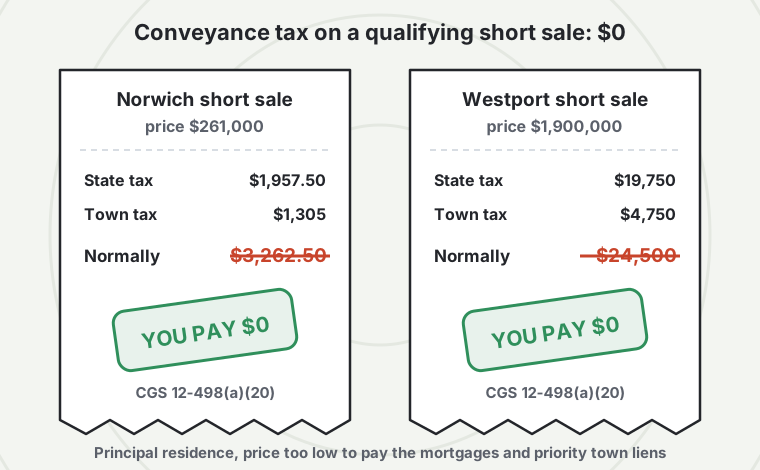
This exemption, added in 2010, is easy to miss, and it is worth real money. Here is what the tax would have been at two town medians (sales October 2024 to September 2025):
| Town | Median sale price | State tax | Town tax | Total, normally | On a qualifying short sale |
|---|---|---|---|---|---|
| Norwich | $261,000 | 0.75% = $1,957.50 | 0.50% = $1,305 | $3,262.50 | $0 |
| Manchester | $315,000 | 0.75% = $2,362.50 | 0.25% = $787.50 | $3,150 | $0 |
| Westport | $1,900,000 | 0.75% of $800,000 + 1.25% of $1,100,000 = $19,750 | 0.25% = $4,750 | $24,500 | $0 |
Two related points. A deed in lieu of foreclosure of your principal residence is exempt under its own line (CGS 12-498(a)(19)), and deeds made under a court’s foreclosure-by-sale decree are exempt too (CGS 12-498(a)(9)). And your attorney still files the conveyance tax return (Form OP-236) and claims the exemption. Our Connecticut conveyance tax guide has every town’s rate.
Which hurts your credit more, a short sale or a foreclosure?
A foreclosure usually hurts your credit more than a short sale, and the clearest proof is the mortgage waiting period afterwards. Under Fannie Mae’s rules, you generally wait 7 years after a foreclosure for a new conventional mortgage, but 4 years after a short sale (or 3 and 2 years with documented extenuating circumstances). Both can stay on your credit report for up to 7 years.
| Loan type | After a short sale | After a foreclosure | Status |
|---|---|---|---|
| Fannie Mae conventional | 4 years (2 with extenuating circumstances) | 7 years (3 with extenuating circumstances, max 90% loan-to-value, principal residence only until 7) | Fannie Mae Selling Guide B3-5.3-07 |
| Freddie Mac conventional | Generally similar to Fannie Mae | Generally similar to Fannie Mae | Check with the lender |
| FHA | Generally 3 years; HUD has an exception when the borrower was current on payments before the short sale | Generally 3 years | Check HUD Handbook 4000.1 with the lender |
Exact score drops depend on your whole credit file, and no honest source can promise a number. What we can say: the missed payments before either event do most of the damage, and both events are reported. The difference shows up most in how soon you can borrow again. The federal Fair Credit Reporting Act generally limits negative items like these to 7 years on your report.
For more on life after a foreclosure, see the consequences of foreclosure in Connecticut for sellers.
When is a short sale better than a foreclosure, and when is it not?
A short sale is better than a foreclosure when the house is worth less than you owe, you cannot keep it, you have time to close before Law Day, and the lender will waive the deficiency in writing. It is not better when the lender refuses a waiver and you have assets to protect, when there is no time left, or when you have equity, in which case a normal sale beats both.
Short sale fits when
Underwater + timeThe house is worth less than the payoff and you have months, not days, before Law Day.
- The lender will put a full deficiency waiver in writing
- Any second mortgage will release
- You want the 4-year Fannie Mae wait instead of 7
- You want to choose your move-out date
Foreclosure (or a deed in lieu) may be acceptable when
No time, no buyerLaw Day is too close to market and close a sale, or the house cannot sell.
- No buyer at a price the lender accepts
- You have few assets and the lender is unlikely to pursue you (get advice first)
- You plan to file bankruptcy anyway
- The lender offers a deed in lieu with a waiver
Neither fits when
You have equityThe house is worth more than everything you owe on it.
- The lender will not approve a short sale
- A strict foreclosure would hand your equity to the lender
- A normal sale before Law Day pays everyone and you keep the rest
One more option belongs on the list before either exit: keeping the house. A loan modification, a repayment plan, Connecticut’s Emergency Mortgage Assistance Program or a Chapter 13 bankruptcy can all stop a foreclosure. The foreclosure guide covers each one; if you are only one or two payments behind, start with what to do when you are behind on your mortgage.
What should you do if you owe less than your house is worth?
If you owe less than your house is worth, you should not do a short sale or let it go to foreclosure. You should sell it, by listing or to a cash buyer, before your Law Day. The lender is paid in full at closing, the foreclosure ends, and whatever is left after the mortgage, liens and closing costs is yours. In a Connecticut strict foreclosure, that equity goes to the lender instead.
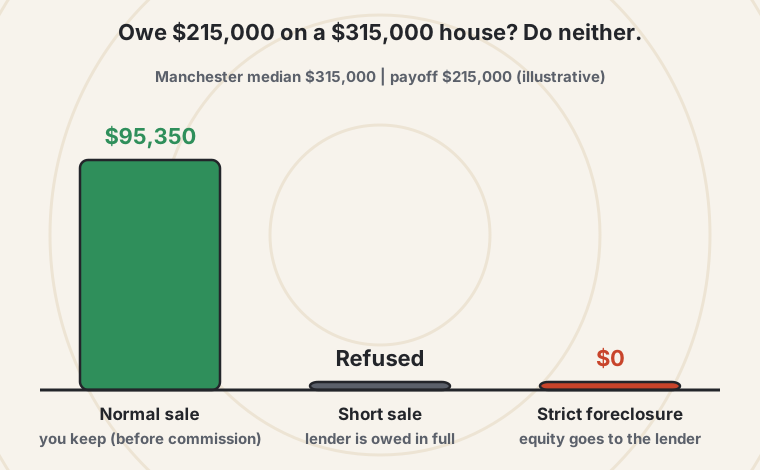
Many owners in foreclosure have more equity than they think. Connecticut prices rose across most towns in the last few years, and people who bought or refinanced a decade ago often owe far less than today’s value. Before you assume “short sale”, check.
Example (illustrative): a Manchester house with equity
- Value: $315,000, the Manchester median sale price (state sales data, October 2024 to September 2025).
- Payoff with arrears, interest and the lender’s fees: $215,000 (illustrative).
- Conveyance tax: 0.75% state + 0.25% town = $3,150 (no exemption, because the price covers the mortgage).
- Your attorney: about $1,500 (est.).
- Left for you before any commission: $95,350. If you list with an agent at 5% (est.), $15,750 more comes off, leaving $79,600, but only if the listing sells and closes before Law Day.
- Short sale: not approved; the lender has no reason to take less than it is owed.
- Strict foreclosure: $0 to you. You can ask the court for a foreclosure by sale (CGS 49-24) to protect a surplus, but auction prices are usually lower than a market sale.
Run your own numbers here. Enter a realistic price for your town and your payoff:
How much would you walk away with?
Slide the numbers to match your house. It works in your browser; nothing is saved or sent.
Estimates for planning. Conveyance tax per CGS 12-494 (state 0.75% up to $800,000, 1.25% to $2.5M, 2.25% above, plus the town rate). Seller attorney about $1,200 to $1,500; flat-fee MLS about $400; listings include three months of taxes, insurance and utilities, a cash sale about two weeks. Your attorney gives you the final numbers.
If the numbers show equity, the question is no longer short sale vs. foreclosure. It is listing vs. selling for cash, and the deciding factor is usually time. Our page on selling a house before foreclosure in Connecticut explains how a sale before Law Day works, and cash buyer vs. realtor compares the two honestly.
Can a cash buyer help with a short sale or foreclosure in Connecticut?
A cash buyer can help with a short sale or foreclosure in Connecticut in two ways: by buying a house with equity quickly enough to close before Law Day, and by making a short sale offer the lender can approve without waiting on a buyer’s mortgage. A cash buyer cannot make a lender accept a short sale, stop a foreclosure by itself, or legally charge you a fee to negotiate with your lender.
Here is how we work, so you can judge us like anyone else. We are Jerryll Noorden’s company. We buy about 10 houses a year in Connecticut and have since 2016, as-is, with no repairs and no cleaning out. You can leave what you do not want.
- If you have equity: we make a written cash offer, you choose the closing date (about two weeks is typical when the title is clear), and your own Connecticut attorney handles the closing. The lender is paid from the proceeds and the case ends. No fees, no commission.
- If you are underwater: we can make an offer subject to the lender’s short sale approval. Lenders want a fair market price, so we will tell you if a listing with an agent is likely to get a higher offer the lender will accept. Some short sale lenders also ask buyer and seller to sign an “arm’s length” statement that they are not related; that is normal.
- What we never do: charge you anything, ask you to sign your deed over before a closing with attorneys, offer to “rent it back to you”, or tell you to stop talking to your lender, counselor or lawyer.
In Connecticut, anyone who charges you to negotiate with your lender, including a short sale, is doing “debt negotiation” and needs a Department of Banking license and a bond, unless they are your attorney (CGS 36a-671, 36a-671c, 36a-671d). Federal rules also ban most mortgage relief companies from charging before you accept a written offer from your lender (12 CFR 1015). Check any negotiator on NMLS Consumer Access before you sign anything.
When you should not sell to a cash buyer
- You have plenty of time before Law Day, the house is in good shape, and a listing is likely to net you more even after commission.
- A loan modification or the Emergency Mortgage Assistance Program could realistically let you keep the house and you want to.
- The house is deeply underwater and the lender’s approval depends on a full market price; a listing usually serves you better.
- Anyone, including us, pressures you to sign today. A fair offer is still fair next week.
Is a cash sale right for you, or should you list?
Seven quick questions. There is no wrong answer, and we will tell you honestly if listing would leave you more.
- Does the house need repairs you would rather not pay for or manage?
- Do you need to close by a certain date, or within the next month or two?
- Would showings be hard: tenants, belongings, privacy, or you live out of state?
- Is there a complication: an estate or probate, a divorce, foreclosure, liens or back taxes?
- Could you comfortably cover the mortgage, taxes and utilities for three or more months?
- Is getting the highest possible price more important to you than speed and certainty?
- Would a buyer's bank lend on the house as it is (no major roof, foundation, oil tank or code issues)?
What should you do this week if you are deciding between a short sale and foreclosure?
This week, if you are deciding between a short sale and foreclosure, find out where you are in the court case, get a payoff and an honest value for the house, call a free housing counselor, and file the mediation forms if you have been served. Those four steps tell you which road is open: keeping the house, a short sale, a deed in lieu, or a normal sale with equity.
Find your stage
Look at the court papers for the return date, any judgment date and any Law Day. The Judicial Branch case lookup on jud.ct.gov shows the docket. If a Law Day is set, everything below is urgent.
File for mediation if you can
If you have been served and the house is your owner-occupied home, file the appearance and the mediation certificate within 15 days of the return date (forms on jud.ct.gov/foreclosure). Late requests can sometimes still be made.
Get the payoff and every lien
Ask the servicer for a written payoff. List any second mortgage, home equity line, tax bills and judgment liens.
Get an honest value
Check recent sales in your town, ask an agent for a broker opinion, or ask us for a free written number. Compare value with total debt.
Choose the road and get it in writing
Underwater and cannot keep it: short sale with a written waiver (or a deed in lieu). Equity: sell before Law Day. Can afford a fixed payment: modification. Talk to a Connecticut attorney before you sign any agreement with your lender.

The most expensive mistake I see is not choosing the wrong option. It is waiting. People sit on the court papers hoping it will sort itself out, and by the time they look at the numbers there are three weeks left before Law Day, which is too little time for a short sale and barely enough for any sale. Get the payoff and a real value the week the papers arrive. Then you have choices.
If you want a written number for your house while you weigh your options, or just want to talk it through with someone local, book a time here. There is no cost and no obligation, and we will tell you if a short sale, a listing or a counselor is the better fit.
See the house together.
Pick a time that works.
Choose a time for us to walk through the property with you, or ask for a quick call first. We confirm every request personally.
Tuesday, January 13
No open times in the next few weeks. Please call us.
We will confirm by email. Nothing is booked until we do.
View my requestQuestions Connecticut homeowners ask about short sales and foreclosure
Is a short sale better than a foreclosure in Connecticut?
A short sale is usually better than a foreclosure in Connecticut when the house is worth less than you owe: you keep control of the timing, there is no foreclosure judgment, Fannie Mae’s waiting period for a new mortgage is 4 years instead of 7, and a principal residence short sale owes no conveyance tax. It is only better if the lender waives the deficiency in writing.
Can I do a short sale after the foreclosure has been filed?
Yes, you can do a short sale after a foreclosure has been filed in Connecticut, as long as it closes before your Law Day passes. The case keeps moving while the lender reviews the sale, so tell the lender’s attorney and the mediator, and ask the court to move the Law Day if an approved sale needs more time (CGS 49-15).
Can the lender come after me after a short sale in Connecticut?
The lender can come after you after a short sale in Connecticut if the approval letter does not waive the deficiency, because the unpaid balance remains a debt. Ask for wording that the sale is accepted in full satisfaction of the debt and that the lender waives any deficiency, and have your attorney review it before closing.
How long does the lender have to seek a deficiency after a Connecticut foreclosure?
After a strict foreclosure in Connecticut, the lender has 30 days after the time for redemption expires to file a motion for a deficiency judgment. The court holds a hearing, sets its own valuation of the house and awards only the difference between that valuation and the debt (CGS 49-14).
How long after a short sale can I buy a house again?
After a short sale you can usually get a Fannie Mae conventional mortgage after 4 years, or 2 years with documented extenuating circumstances, compared with 7 years after a foreclosure (Fannie Mae Selling Guide B3-5.3-07). FHA loans generally require 3 years, with an exception for some borrowers who were current before the sale; confirm with a lender.
Do I pay taxes on a short sale?
You may pay income tax on a short sale if the lender forgives part of the debt, because canceled debt is generally income and the lender may issue Form 1099-C. The main-home exclusion covered discharges through December 31, 2025, so for 2026 sales the insolvency exclusion on Form 982 is the main relief. Ask a tax professional.
Do I pay Connecticut conveyance tax on a short sale?
You do not pay Connecticut conveyance tax on a short sale of your principal residence when the price cannot pay the mortgages and any town liens that have priority over them (CGS 12-498(a)(20)). The exemption applies to both the state and the town tax. Your attorney claims it on Form OP-236.
How long does a short sale take in Connecticut?
A short sale in Connecticut usually takes weeks to several months, because the lender has to review your hardship package, order its own valuation and approve the offer, and any second lienholder must agree too. Start as early as possible, ideally while your case is in mediation, so the sale can close before Law Day.
Who pays the closing costs in a short sale?
In a short sale the commission and most closing costs are usually paid out of the sale proceeds, so they come out of what the lender receives, but only the costs the lender approves on the settlement statement. Your own attorney fee and any amount a second lienholder demands may need to be negotiated.
Does a foreclosure stay on my credit report forever?
A foreclosure does not stay on your credit report forever. Under the federal Fair Credit Reporting Act, negative items like a foreclosure or short sale can generally be reported for up to 7 years. The effect on your score fades over that time, especially if your other accounts are paid on time.
Is a deed in lieu better than a short sale?
A deed in lieu is not usually better than a short sale, but it is simpler: you hand the house to the lender instead of finding a buyer. Lenders often want a short sale tried first, and both need a written deficiency waiver. Fannie Mae’s waiting period is 4 years for either. See our deed in lieu guide.
What if I have equity but I am in foreclosure?
If you have equity but are in foreclosure, sell the house before Law Day rather than doing a short sale or letting the foreclosure finish. The lender is paid in full at closing and you keep what is left. In a Connecticut strict foreclosure there is no sale and no surplus, so the equity is lost.
Can I stay in my house during a short sale?
You can usually stay in your house during a short sale, because you still own it until the closing. You agree a move-out date with the buyer in the contract. In a foreclosure you can stay until title passes, but after that the lender can seek an ejectment order.
Does Connecticut’s mediation program help with short sales?
Connecticut’s Foreclosure Mediation Program can help with short sales: the mediator can push the lender to review a short sale package and set deadlines for its answers. It is free, open to owner-occupants of one-to-four family homes with return dates through June 30, 2029, and ends at the third session or 7 months after the return date (CGS 49-31n).
Related Connecticut guides
Foreclosure
Money
We buy houses across Connecticut, including Hartford, Bridgeport, Norwich, Manchester, Waterbury and New Haven. For the whole process, start with how to sell a house in Connecticut.
Plain-English information, not legal or tax advice. Reviewed by Jerryll Noorden, October 2026. Talk to a Connecticut attorney about your case and a tax professional about forgiven debt.
Sources
- Connecticut General Statutes, chapter 846: § 49-1 (foreclosure bars further action), § 49-14 (deficiency judgment, 30 days, court valuation), § 49-15 (opening strict foreclosure judgments), § 49-19 (law days), §§ 49-24 and 49-24a to 49-24g (foreclosure by sale and market sale), §§ 49-31k to 49-31n (foreclosure mediation: 15-day forms, 8-month pause, 7-month mediation period, return dates through June 30, 2029).
- CGS § 12-494 and § 12-498 (conveyance tax rates; exemptions (a)(9), (a)(19) and (a)(20)) and DRS Special Notice 2010(4) (exemptions apply to state and municipal tax).
- CGS §§ 36a-671 to 36a-671d (debt negotiation licensing, including short sales).
- Connecticut Judicial Branch, Foreclosure Mediation Program.
- Connecticut Department of Banking, Avoiding Foreclosure (hotline and counselors).
- Fannie Mae Selling Guide B3-5.3-07 (waiting periods after foreclosure, deed in lieu and preforeclosure sale).
- IRS Instructions for Form 982, IRS Publication 4681 (canceled debts, foreclosures, abandonments) and IRS Publication 523 (selling your home).
- 12 CFR 1015 (Mortgage Assistance Relief Services; advance fee ban) and CFPB: If I can’t pay my mortgage loan, what are my options?
- Fair Credit Reporting Act, 15 U.S.C. § 1681c (reporting periods for negative information).
- Town sales and medians: Connecticut Office of Policy and Management sales data on data.ct.gov (October 2024 to September 2025); town conveyance tax rates per OLR Report 2020-R-0020.

Who wrote this
Jerryll Noorden
Jerryll has bought and sold Connecticut houses since 2016 and has sat at more closing tables than he can count, on both sides. Before real estate he was a robotics scientist at NASA, IHMC and IIT. He wrote this guide because the national sites that rank for it skip the Connecticut rules that cost sellers money. When listing or selling it yourself would get you more than a cash offer, he says so.
This guide explains Connecticut rules in plain English. It is not legal or tax advice. Laws change; for your sale, talk to a Connecticut real estate attorney and a tax professional.
