
Key facts at a glance
| Fact | Number | Source |
|---|---|---|
| Homes sold in New London, Oct 2024 to Sep 2025 | 278, median $300,000 | CT OPM real estate sales, data.ct.gov |
| Median sale by type | Single-family $310,000 (145 sales); two-family $320,000 (47); three-family $399,900 (19); condo $163,250 (60) | CT OPM real estate sales, data.ct.gov |
| Median year built | Single-family 1930 (58% before 1940); two-family 1900 | 2025 CT parcel (CAMA) data, data.ct.gov |
| Heating fuel, single-family | 54% natural gas, 41% oil | 2025 CT parcel (CAMA) data, data.ct.gov |
| Mill rate, fiscal 2027 | 27.1 (about $490 a month on a $310,000 house) | CT OPM mill rates, data.ct.gov |
| Conveyance tax the seller pays | 1.25% up to $800,000 (0.75% state + 0.50% New London) | CGS 12-494; OLR 2020-R-0020 |
| Probate court and Superior Court | Probate district for New London and Waterford; New London Judicial District | CGS 45a-2; CGS 51-344 |
Most investors will not pay close to a retail asking price, and anyone who promises to is usually planning to renegotiate later. But “close to asking” is possible in a few specific situations, and New London has more of them than most Connecticut towns: lots of two-families, steady rental demand, and an asking price that is sometimes already an as-is price. This guide shows when an investor can pay near asking, when they cannot, and the math on New London’s own numbers. It is part of our guide to how to sell a house in Connecticut.
Will an investor pay close to asking price for a New London house?
An investor will pay close to asking price for a New London house only when the asking price already reflects the house’s condition, when the repairs are light, or when a landlord values the rent more than a flipper values the resale. On a rented two-family at New London’s $320,000 median, landlord math can reach about 93% of asking. On a fixer listed at a fixed-up price, expect closer to 55% to 75%.
The reason is simple. An investor’s price comes from the house, not from your asking price. A flipper starts from what the house will sell for once fixed and subtracts the repairs, the costs of reselling and holding it, and a margin. A landlord starts from the rent. Your asking price only matters as a yardstick: the closer it sits to what the investor’s math produces, the closer their offer looks to “asking”. Our pillar on cash home buyers in Connecticut explains the formula in full; here we apply it to New London.
Why does the gap between asking price and an investor’s offer feel so personal?
The gap between your asking price and an investor’s offer feels personal because the asking price carries your history with the house, what a neighbor’s house sold for, and what an online estimate told you. An investor’s number ignores all of that and prices only repairs, time and risk. The gap is not a judgment of you or your home; it is a different way of counting.
Maybe it is a two-family near Ocean Avenue you have rented out for years, and the tenant on the second floor is moving. Maybe it is your grandparents’ 1920s colonial with the original radiators, and you have a number in your head from the last time anyone sold on your street. You may feel hopeful that someone will just pay what it is worth, defensive when the first offer comes in low, confused about why two offers differ so much, pressured by carrying costs, and doubtful that any investor is straight with you.
You can know ahead of time whether an investor is likely to come close to your number, and what to do if they will not. This page is for you.
When can an investor pay close to asking in New London?
An investor can pay close to asking in New London in four situations: the house is priced as-is rather than at a fixed-up price, it needs only light cosmetic work, it is a multi-family with tenants and rents a landlord wants, or the buyer can resell quickly with little risk. When two or three of these are true at once, an offer at 85% to 95% of asking is realistic.
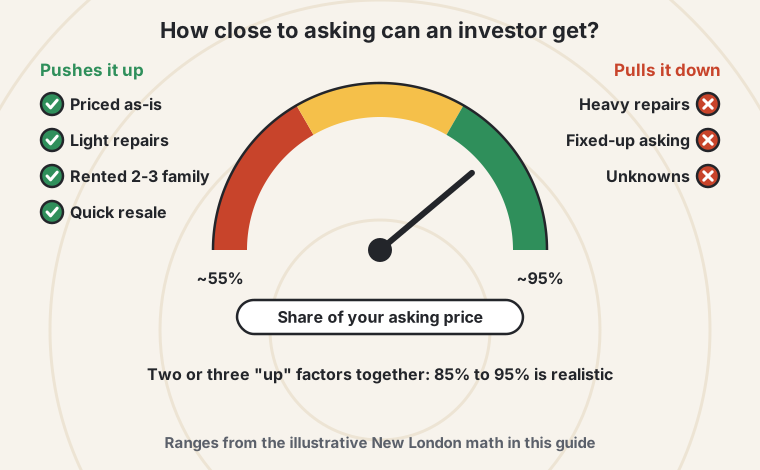
- The asking price is already an as-is price. If you priced the house for its condition (say, below the $310,000 single-family median because it needs a kitchen), an investor’s formula may land near it.
- The repairs are light. Paint, floors, fixtures and a cleaning. Fewer repairs mean fewer months of holding costs and a smaller cushion.
- It rents well. New London has many two- and three-families: 66 of the 278 residential sales in our period. A landlord buying a rented two-family prices the rent, and good rent can carry a higher price than a flip.
- Quick, low-risk resale. A sound house in a part of town where renovated houses sell fast lets a buyer accept a thinner margin.
Demand from workers moving to the region also helps. The state’s Office of Military Affairs reposted reporting that Electric Boat planned to hire about 8,000 people in 2026, about 2,500 of them for trades work in Groton. More households looking for housing near the shipyard and the submarine base supports both rents and resale prices in New London County.
How does your asking price change what “close to asking” means?
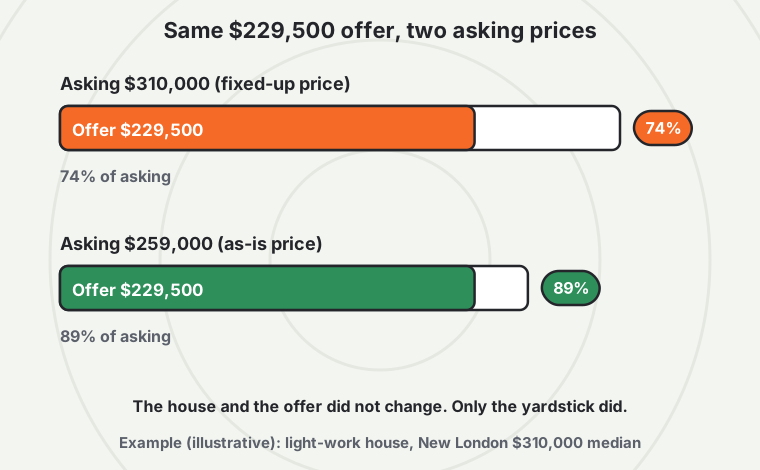
Your asking price changes what “close to asking” means because the investor’s offer stays the same whatever you ask. In our New London example, an offer of about $229,500 on a house needing light work is 74% of a $310,000 fixed-up asking price but 89% of a $259,000 as-is asking price. The house and the offer did not change; only the yardstick did.
| Line | Light-work house | Moderate-work house |
|---|---|---|
| After-repair value (New London single-family median) | $310,000 | $310,000 |
| Repairs (est.) | -$12,000 | -$60,000 |
| Resale commission 5% (est.) | -$15,500 | -$15,500 |
| Conveyance tax on the resale, 1.25% | -$3,875 | -$3,875 |
| Resale attorney and purchase closing (est.) | -$3,700 | -$3,700 |
| Property tax ($490 a month) and insurance and utilities ($450, est.) | -$2,820 (3 months) | -$5,640 (6 months) |
| Interest at 11% and 2 points (est.) | -$11,478 | -$17,029 |
| Margin (est.) | -$31,000 (10%) | -$37,200 (12%) |
| Formula offer | About $229,500 | About $167,000 |
| Share of a $310,000 asking price | 74% | 54% |
So the useful question is not “will an investor pay my asking price?” but “is my asking price a fixed-up price or an as-is price?” If you priced off renovated sales or an online estimate, a flipper’s offer will look low. If you priced for the condition, it may look close. Our guide to pricing a house to sell in Connecticut explains how to set an as-is price, and why cash offers are so low explains each line of the discount.
Why can a landlord pay more for a New London two-family?
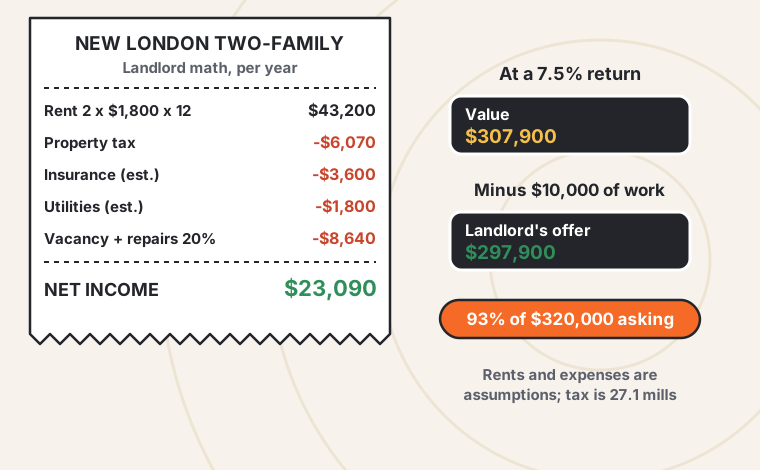
A landlord can pay more for a New London two-family because they price the rent, not a resale. With two units renting for $1,800 each, the house earns about $23,090 a year after taxes, insurance and a cushion for vacancy and repairs. A landlord who wants a 7.5% return would pay about $307,900, or about $297,900 after $10,000 of turnover work: about 93% of the $320,000 median.
| Line | Per year | How it was figured |
|---|---|---|
| Rent, two units at $1,800 a month | $43,200 | Assumption; check current New London rents |
| Property tax | -$6,070 | 27.1 mills on 70% of $320,000 |
| Insurance | -$3,600 | (est.) |
| Owner-paid utilities (water, sewer, common lights) | -$1,800 | (est.) |
| Vacancy, repairs and management, 20% of rent | -$8,640 | (est.) |
| Net operating income | $23,090 | |
| Value at a 7.5% return | About $307,900 | $23,090 / 0.075 (the return a landlord wants is an assumption) |
| Minus turnover repairs | -$10,000 | (est.) |
| Landlord’s offer | About $297,900 | About 93% of a $320,000 asking price |
The details move the number quickly. Below-market rents, a unit that needs a full renovation, an old boiler shared by both units, or a tenant who does not pay all pull it down. New London’s two-families are old (median year built 1900), so lead paint, old wiring and heating are the usual issues. Our guide to selling a multi-family house in Connecticut and our page on selling a rental with tenants go deeper.
When will an investor not pay close to asking?
An investor will not pay close to asking when the asking price is a fixed-up price on a house that needs work, when the repairs are heavy or unknown, or when the house is hard to resell or rent. In New London, where the median single-family house dates from 1930, that often means old systems, lead paint and deferred maintenance that the buyer has to price in.
- Heavy work. With $60,000 of work, the formula drops to about $167,000, 54% of a $310,000 asking price.
- Unknowns. A wet basement, an old buried oil tank (41% of single-family houses here heat with oil), knob-and-tube wiring or an addition without permits all add cushion.
- Old paint. Most New London houses were built before 1978. Federal law requires lead paint disclosure on them, and buyers budget for lead-safe work.
- A difficult tenancy. A tenant who does not pay or will not leave means months of lost rent and legal costs for the buyer.
An offer that comes in at or above asking on a house like this deserves a closer look, not a celebration. Watch for a long inspection period, a tiny deposit, or a contract that can be assigned; those let a buyer lock up the house and renegotiate later. Our guides to checking a cash home buyer and scam red flags show what to look for.
When should you not sell your New London house to an investor?
You should not sell your New London house to an investor when it is in good enough shape for a buyer’s bank, you have time to list, and the investor’s best offer is well below what you would net on the market. A sound single-family at the $310,000 median usually nets more listed, even after commission and a few months of carrying costs.
Listing makes sense when the roof, heat and wiring are sound and the house shows reasonably well. An as-is listing is also a real option: many New London buyers use FHA or conventional loans on older houses that pass an appraisal. A direct sale makes more sense when the house would fail a lender’s appraisal, a tenant situation blocks showings, an estate or a move has a deadline, or you would rather not manage repairs. For the honest comparison, see cash buyer vs. realtor.

If a rental is part of the sale, bring the leases, the rent ledger and the last year of utility bills to the first conversation. A landlord buyer prices what can be proven. The more of the rent you can show, the less cushion they need, and the closer the offer gets to your number.
How do you get the closest offer to your asking price?
To get the closest offer to your asking price, set an as-is price you can defend, gather the paperwork that removes unknowns, ask both a flipper and a landlord buyer for written offers with their math, compare your net from each, and have your own attorney review the contract. With a clear title, a direct sale typically closes in about two weeks.
Know both prices
Find what similar renovated houses sold for and what the house is worth as it is. Your asking price should be one or the other, on purpose.
Remove the unknowns
Leases, rent records, the boiler’s age, oil tank details, permits, any inspection reports. Each one shrinks a buyer’s cushion.
Ask the right buyers
For a multi-family, include at least one landlord buyer. For a fixer, include a buyer who renovates.
Compare nets, not prices
Subtract New London’s 1.25% conveyance tax, your attorney and any commission from each offer. Then compare terms: deposit, inspection period, closing date.
Close through attorneys
Give the property condition report or credit the buyer $500 (CGS 20-327c), sign the smoke and carbon monoxide detector affidavit at closing (CGS 29-453; the old $250 credit option was removed), and get paid when the deed is recorded.
How much would you walk away with?
Slide the numbers to match your house. It works in your browser; nothing is saved or sent.
Estimates for planning. Conveyance tax per CGS 12-494 (state 0.75% up to $800,000, 1.25% to $2.5M, 2.25% above, plus the town rate). Seller attorney about $1,200 to $1,500; flat-fee MLS about $400; listings include three months of taxes, insurance and utilities, a cash sale about two weeks. Your attorney gives you the final numbers.
We do not have a separate New London page yet; our page for every Connecticut town we buy in is where to ask for a number. We buy in New London County too, including Groton, Waterford and Norwich.
Questions about investor offers and asking price in New London
Will an investor pay close to asking price?
An investor will pay close to asking price only when the asking price matches the house’s condition, the repairs are light, or a landlord values the rent. On a fixer priced like a renovated house, expect about 55% to 75% of asking.
What percentage of asking do investors usually offer?
Investors do not offer a fixed percentage of asking; they price the house. In our New London examples, the same formula gave 74% of a $310,000 asking price for light work and 54% for $60,000 of work.
Do landlords pay more than flippers in New London?
Landlords often pay more than flippers for a rented New London two- or three-family, because they price the rent and keep the house. Our illustrative two-family came to about 93% of a $320,000 asking price.
Is an investor offer above asking a good sign?
An investor offer above asking on a house that needs work is a reason to read the contract carefully. Look for a long inspection period, a small deposit or an assignment clause that could lead to a lower price later.
How much is the conveyance tax in New London, CT?
The conveyance tax in New London, CT is 1.25% of the price up to $800,000: 0.75% to the state and 0.50% to the city (CGS 12-494). On a $229,500 sale that is about $2,869, paid by the seller.
Should I lower my asking price for an investor?
You should not lower your asking price for an investor; ask for their math instead. If you are listing, price for the house’s condition so buyers of every kind take it seriously.
Can an investor buy my New London house with tenants in it?
An investor can buy your New London house with tenants in it. Leases and security deposits transfer to the buyer. A landlord buyer may pay more for paying tenants and less for a tenant who does not pay.
How fast can an investor close in New London?
An investor can usually close in New London in about two weeks once the title is clear. An estate in the New London and Waterford probate court, a lien or a tenant issue can add time.
Does lead paint lower an investor’s offer?
Lead paint lowers an investor’s offer when the buyer must do lead-safe work during renovation or before renting to families with young children. Most New London houses were built before 1978, so buyers expect it and budget for it.
Related guides
The offer
Other towns, other angles
Pricing and comparing
For every route and step, see how to sell a house in Connecticut. For a no-obligation number on a New London house, start at our Connecticut towns page.
Plain-English information, not legal advice. Talk to a Connecticut attorney about your sale.
Sources (checked on October 27, 2026)
- Connecticut OPM Real Estate Sales (New London, recorded Oct 2024 to Sep 2025, residential sales of $30,000 or more), data.ct.gov.
- OPM mill rates, fiscal 2027, data.ct.gov.
- 2025 Connecticut Parcel and CAMA Data (New London year built and heating fuel), data.ct.gov.
- CGS 12-494 (conveyance tax) and OLR report 2020-R-0020 (towns with the 0.50% rate).
- CGS 20-327b and 20-327c (property condition report, $500 credit).
- CGS 29-453 (smoke and carbon monoxide detector affidavit).
- CGS 45a-2 (probate districts) and CGS 51-344 (judicial districts).
- EPA and HUD lead-based paint disclosure rule.
- Connecticut Office of Military Affairs (repost of The Day, Feb 7, 2026, on Electric Boat hiring).
See the house together.
Pick a time that works.
Choose a time for us to walk through the property with you, or ask for a quick call first. We confirm every request personally.
Tuesday, January 13
No open times in the next few weeks. Please call us.
We will confirm by email. Nothing is booked until we do.
View my request
Who wrote this
Jerryll Noorden
Jerryll has bought and sold Connecticut houses since 2016 and has sat at more closing tables than he can count, on both sides. Before real estate he was a robotics scientist at NASA, IHMC and IIT. He wrote this guide because the national sites that rank for it skip the Connecticut rules that cost sellers money. When listing or selling it yourself would get you more than a cash offer, he says so.
This guide explains Connecticut rules in plain English. It is not legal or tax advice. Laws change; for your sale, talk to a Connecticut real estate attorney and a tax professional.
