
Our mission
Robotic technology for the sake of humanity
Only when we recognize there is a problem can we devote resources to solving it. Not many people can do what we do, and if those who can won’t, who will?
- NASA
- IHMC
- Italian Institute of Technology
- Exoskeletons for paraplegics
The question we get most
Why does a house buyer talk about robots?
Plain and simple, this is our mission: we advance, invent and develop new technologies to help people. It has to do with NASA, robots, and helping people who cannot walk… walk again.
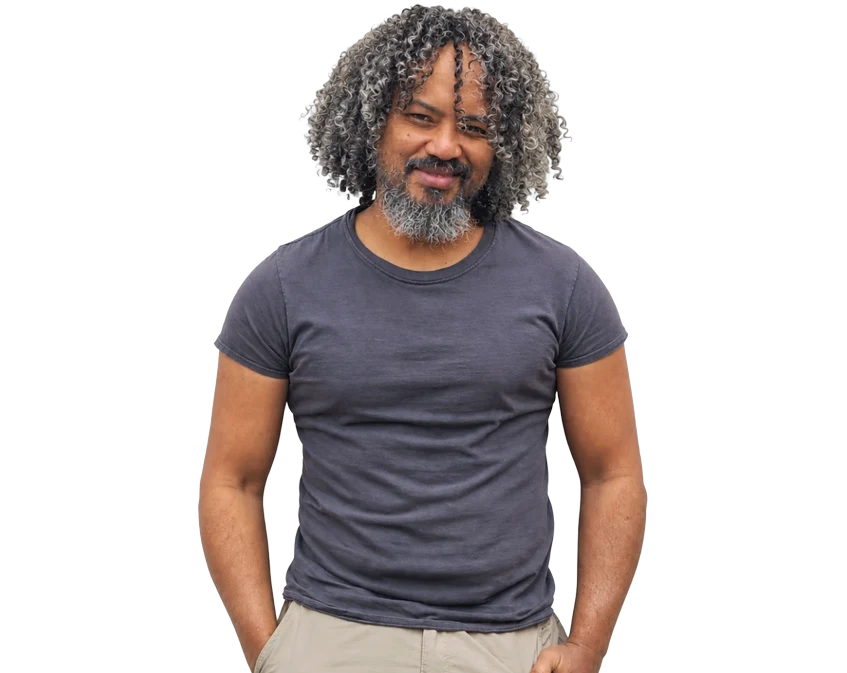
I (Jerryll) am a robotics scientist. I have worked for IHMC (the Institute for Human and Machine Cognition), NASA and IIT (the Italian Institute of Technology).
Government agencies like NASA, and independent research institutes like IHMC, depend on government funding to keep developing technology that people badly need. More than once in my career, that funding stopped completely, and with it the hopes of the people who needed it.

The work
An exoskeleton gives people the muscle to walk
I was the lead engineer and scientist on state-of-the-art robotics. At NASA and IHMC I worked on exoskeletons: robots that give mobility to paraplegic people, keep astronauts strong in space, and help with rehabilitation.
The exoskeleton, or exo for short, holds the user’s legs at the thighs and shins and guides them through a normal walking gait. In simple terms, it provides the muscle.
- Standing loads the bones. The exo carries its own weight but not the user’s, so bones carry load again.
- Muscles flex and stretch. Long hours in a wheelchair cause bone loss and stiff muscles.
- Rehabilitation speeds up, and older people with mobility problems get help too.
Why it became personal
Mark changed the way I looked at my job
I was asked to build a robotic suit to help wounded soldiers walk again, a project funded by the Office of Naval Research for soldiers with lower-body injuries. To me it was a fun, very challenging sci-fi project. I had a task and I fulfilled it.
Then it was time to find people to test it, and I met Mark Daniels, paralyzed from the hips down. He had gotten used to the wheelchair, but simple things like changing a lightbulb, or picking up his daughter and swinging her around, were impossible. The job became a mission.
When we first got Mark walking again after years in a wheelchair, we asked him what he was looking forward to most. We expected “to run, to jump, to climb a tree again.”
“To stand, and be at eye level talking to someone.”
Mark, the first time he walked again in the exoskeleton
He didn’t want to be looked down on when people talked to him. It is funny how your perspective changes when something stops being a task, when you get to know the people you are doing it for. Mark and I became close friends, and I was determined to build better robots: lighter and stronger, for people like Mark.
Always roadblocks
Why I started buying houses
No matter the goal, there are always forces working against you. But where there is a will, there is a way.
The research always relied on government funding. Then the inevitable happened: the government stopped funding robotics hardware. Everything we had built gave people like Mark a taste of freedom, then took it away. That is unacceptably cruel.
So I quit my job and started this business to earn the capital to fund my own robotics research institute. No government, no private sponsors deciding where the money goes. Just a commitment to technology that does good.
See it for yourself
Pictures say more than words. Video says more than pictures.

Look how far we have come
WALKMAN: a humanoid that goes where people shouldn’t
Replacing people with robots is not always a bad thing. Imagine getting 15 people out of a burning building without putting more lives at risk.
WALKMAN is a six-foot disaster-relief humanoid that can walk, open doors, drive a car and use human tools, so it can do the job in places too dangerous for people.
Peer-reviewed
Publications
- Design and Evaluation of Mina: a Robotic Orthosis for Paraplegics. Peter D. Neuhaus, Jerryll H. Noorden, Travis J. Craig, Tecalote Torres, Justin Kirschbaum, Jerry E. Pratt. Proceedings of the 2011 International Conference on Rehabilitation Robotics (ICORR 2011), Zurich, Switzerland.
- Development of the IHMC Mobility Assist Exoskeleton. Hian Kai Kwa, Jerryll H. Noorden, Matthew Missel, Travis Craig, Jerry E. Pratt, Peter D. Neuhaus. Proceedings of the 2009 IEEE International Conference on Robotics and Automation (ICRA ’09), Kobe, Japan.
Every house helps
Sell your house, and help someone walk again
We buy houses in any condition, in all eight Connecticut counties: Hartford, Litchfield, New Haven, Fairfield, Tolland, Middlesex, New London and Windham. Foreclosure, an inherited house, a divorce, or tired of being a landlord: we can help. No realtors, no commissions, no repairs.
