
Key facts at a glance
| Fact | Number | Source |
|---|---|---|
| Homes sold in Danbury, Oct 2024 to Sep 2025 | 959, median $443,000 (up about 8%) | CT OPM real estate sales, data.ct.gov |
| Median single-family sale | $472,500 | CT OPM real estate sales, data.ct.gov |
| Median two-family sale | $577,500 (40 sales) | CT OPM real estate sales, data.ct.gov |
| Median year built; heating | 1972; 39% oil, 36% natural gas | 2025 CT parcel (CAMA) data, data.ct.gov |
| Mill rate, fiscal 2027 | 25.23 (about $8,340 a year on a $472,500 house) | CT OPM mill rates, data.ct.gov |
| Conveyance tax the seller pays | 1.00% up to $800,000 (0.75% state + 0.25% city) | CGS 12-494 |
| Wholesalers (contract sellers) must register with the state | Since July 1, 2026; 3 business days to cancel | CGS 20-329aaa to 20-329hhh (Public Act 25-168) |
| Probate court and Superior Court | Danbury Probate District (No. 43); Danbury Judicial District | CGS 45a-2; CGS 51-344 |
Selling a house to an investor is simple when you know the steps and how the buyer builds the number. This guide, part of our guide to how to sell a house in Connecticut, takes a Danbury house through an investor sale from first call to closing: the offer math on Danbury’s own median, how to check the buyer, what to look for in the contract, and when you should not sell to an investor at all.
Why does selling a Danbury house to an investor feel risky?
Selling a Danbury house to an investor feels risky because you are dealing with one buyer who sets the price, many “we buy houses” mailers look alike, and you have heard about contracts that get flipped to someone else or closings that never happen. Those worries are reasonable, and each one has a concrete check that answers it.
Maybe the house is a 1970s raised ranch that needs a kitchen, a roof and a furnace. Maybe it is a two-family near downtown with a tenant who does not pay. Maybe you inherited it, or you are moving for work and cannot fix it from afar. You may feel skeptical of every offer, afraid of being taken advantage of, impatient to be done, unsure what the house is worth as it stands, and a bit ashamed of its condition.
You do not need to be an expert. You need a process and a few checks. This page is for you.
How do you sell your house to an investor in Danbury, CT?
To sell your house to an investor in Danbury, CT, decide your walk-away number, contact two or three buyers, check each one, let them walk through, get written offers, have your own Connecticut attorney review the contract, and close through attorneys. A typical investor sale takes about two weeks from first call to closing, longer if an estate or a lien has to be cleared.
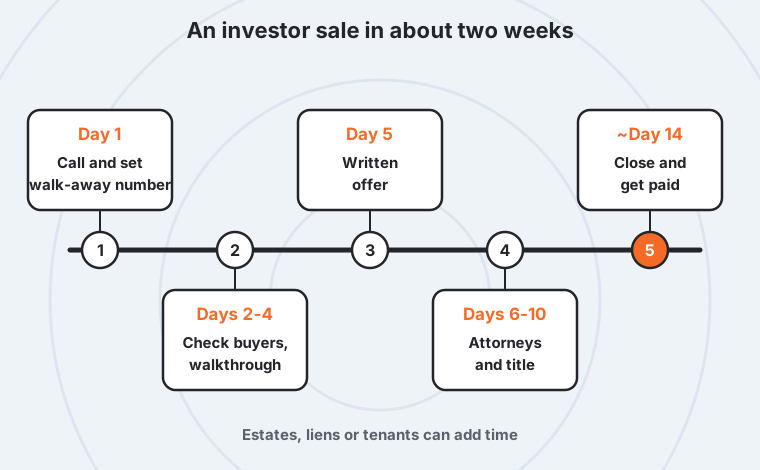
Know your walk-away number
Find your mortgage payoff and estimate what the house would sell for fixed up and as it is. Decide the lowest net you would accept before anyone quotes you.
Contact two or three buyers
One offer tells you little. Two or three show you the range. Give each the same facts about the house.
Check each buyer
Registered business, proof of funds, real closed purchases, attorney-run closing, no upfront fees. Details below.
One walkthrough, as it is
No cleaning or repairs. Show the basement, roof, heating system and anything you know is wrong.
Get the offer in writing
Price, deposit, inspection period (if any), who pays which costs, the closing date and whether the contract can be assigned.
Your attorney reviews and runs your side
Connecticut closings are handled by attorneys. Yours reviews the contract, orders the payoff and prepares the deed and the conveyance tax return.
Close and get paid
You sign, the deed is recorded in the Danbury land records, and the proceeds are wired after the 1.00% conveyance tax, your payoff and your attorney.
How does an investor calculate an offer on a Danbury house?
An investor typically calculates an offer on a Danbury house by estimating its after-repair value, taking about 70% of that, and subtracting the repair cost. On a house worth $472,500 fixed up (Danbury’s single-family median) that needs $45,000 of work, that rule of thumb gives about $285,750. Buyers vary, but this is why an offer sits well below the median.
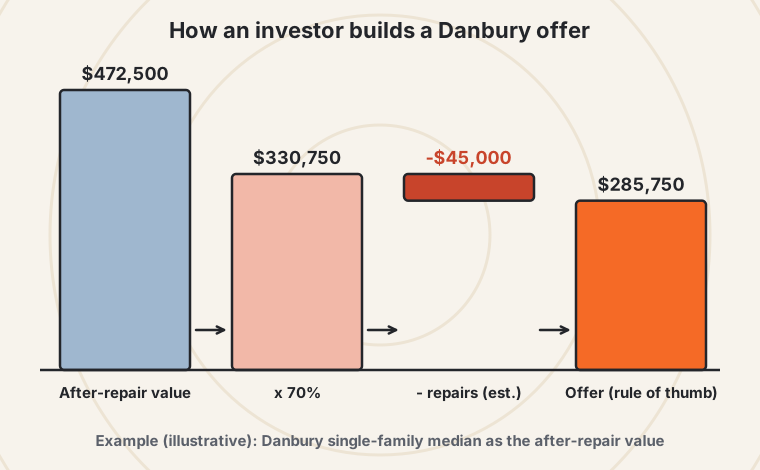
| Step | Number | What it covers |
|---|---|---|
| After-repair value (ARV) | $472,500 | What the house would sell for fixed up; here, Danbury’s single-family median |
| Times 70% | $330,750 | The 30% covers the investor’s resale commission, closing costs, holding costs, financing and profit |
| Minus repairs (est.) | -$45,000 | Roof, kitchen, heating and paint in this example |
| Rule-of-thumb offer | $285,750 | Rounded in this example to a $285,000 offer |
| Your conveyance tax, 1.00% | -$2,850 | Paid by the seller (CGS 12-494) |
| Your attorney (est.) | -$1,500 | Your own Connecticut attorney |
| You net (before any mortgage payoff) | $280,650 | No commission, no repairs, no showings |
You can use the same math to check any offer. Ask the buyer what after-repair value and repair cost they used. If their ARV is far below what similar renovated houses on your street sold for, or their repair estimate looks padded, say so. Our explainer on why cash offers are so low goes through each part of the 30%. To compare with a listing, the statewide comparison of a cash buyer vs. a realtor runs both nets side by side.
How much would you walk away with?
Slide the numbers to match your house. It works in your browser; nothing is saved or sent.
Estimates for planning. Conveyance tax per CGS 12-494 (state 0.75% up to $800,000, 1.25% to $2.5M, 2.25% above, plus the town rate). Seller attorney about $1,200 to $1,500; flat-fee MLS about $400; listings include three months of taxes, insurance and utilities, a cash sale about two weeks. Your attorney gives you the final numbers.
How do you check a Danbury investor before you sign?
To check a Danbury investor before you sign, confirm the company is registered with the Connecticut Secretary of the State, ask for proof of funds, look up real purchases in the town land records, insist your own attorney and an attorney-run closing handle the money, and never pay a fee. If the buyer plans to assign the contract, Connecticut now requires a state wholesaler registration.
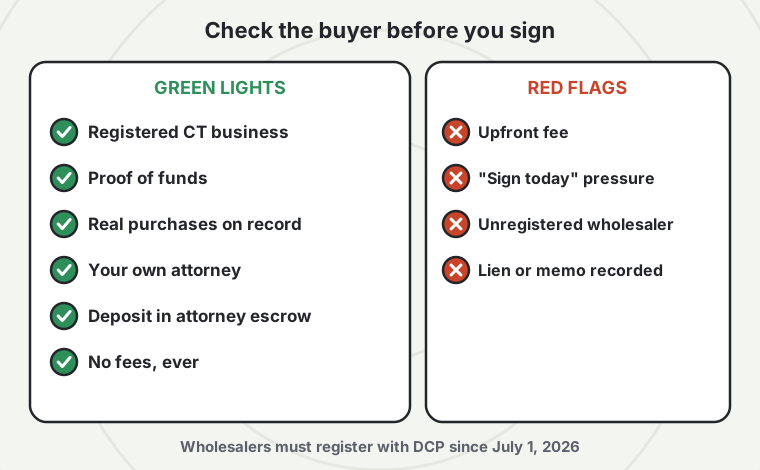
- Business registration: search the company on the Connecticut Secretary of the State’s business records. A real buyer has an active entity with a name that matches the contract.
- Proof of funds: a recent bank or lender letter showing the money to close. Cash buyers close without a mortgage contingency.
- Real purchases: ask for addresses of houses they have bought in the area, and check a few in the town land records.
- Your own attorney: you choose your attorney; the deposit goes into an attorney’s escrow account, not to the buyer.
- No fees: a legitimate buyer never charges you to make an offer or to buy your house.
- Assignment: if the contract says “and/or assigns” or the buyer will sell the contract to someone else, that buyer is acting as a wholesaler. Since July 1, 2026 Connecticut wholesalers must register with the Department of Consumer Protection, and you get three business days to cancel (CGS 20-329aaa to 20-329hhh).
Our full checklist on how to check a cash home buyer in Connecticut has eight checks, and our page on we-buy-houses scams and red flags lists what regulators have found. For how assignment works and what the new law requires, see our guide to selling a house to a wholesaler in Connecticut.
What should be in the contract when you sell to an investor?
The contract when you sell to an investor should state the price, a deposit held by an attorney, a short or no inspection period, that the house is sold as-is, who pays which closing costs, a firm closing date, and whether the buyer may assign the contract. Your own Connecticut attorney should read it before you sign, because a loose contract is where most investor-sale problems start.
| Term | What to look for | Red flag |
|---|---|---|
| Price and deposit | A real deposit held in an attorney’s escrow | A token deposit or the deposit held by the buyer |
| Inspection period | A few days, or none for a true as-is purchase | A long “inspection” period the buyer can use to walk away or renegotiate |
| As-is clause | The buyer takes the house with known and unknown defects | Repair requests after signing |
| Assignment | Either no assignment, or a wholesaler holding a state registration who gives the state disclosures | “And/or assigns” with no explanation |
| Closing date | A firm date you chose | Open-ended or “on or about” with repeated extensions |
| Recording | Nothing recorded against your house before closing | A memorandum of contract or lien filed on your land records |
You still give the buyer the property condition report or a $500 credit (CGS 20-327c), and the federal lead disclosure if the house was built before 1978. Selling as-is changes who fixes things, not what you must disclose.
What is different about selling an investor a house in Danbury?
What is different about selling to an investor in Danbury is the price level and the housing mix: the single-family median is $472,500, two-families sold at a median of $577,500, and the median house was built in 1972. Higher values mean the conveyance tax and the gap between an as-is offer and a retail sale are larger in dollars, so checking the numbers matters more.
A few Danbury specifics: the city’s conveyance tax is the standard 0.25% on top of the state’s 0.75%, but the state rate rises to 1.25% on the part of a residential price above $800,000 (CGS 12-494), which matters for larger homes in the northern and western parts of the city. Heating is split between oil (39%) and natural gas (36%), so an oil tank question is common but not universal. An estate goes through the Danbury Probate District (No. 43), which serves only the city, and an executor can sell with the court’s authority (CGS 45a-164); see our guide to selling a house in probate. A foreclosure or partition case would be in the Danbury Judicial District, which covers Bethel, Brookfield, Danbury, New Fairfield, Newtown, Redding, Ridgefield and Sherman (CGS 51-344).
If the house is a rental with tenants, investors will often buy it with the leases in place; our guide to selling a two- to four-family to an investor covers rent rolls, deposits and estoppels.
When should you not sell your Danbury house to an investor?
You should not sell your Danbury house to an investor when it is in good, financeable condition and you have a couple of months, because Danbury’s market (up about 8% last year with 959 sales) rewards ready houses with retail buyers who pay more than any investor can. Also walk away if the buyer fails any of the checks above.
An investor’s price has to leave room for repairs, resale costs and profit. If your house needs little work, that room comes out of your pocket for no reason. List it instead, and see our cluster guide on every route to sell for how. An investor sale earns its discount when the house needs major work, the timeline is short, tenants or an estate complicate things, or you want privacy and certainty more than the top price.

Ask every buyer the same two questions: what do you think it is worth fixed up, and what do you think the work costs? A buyer who answers plainly is showing you their math. One who will not answer, or who drops the price after the walkthrough without a reason you can see, is telling you something too. And if the house only needs paint and carpet, list it; you do not need us.
What are the alternatives to selling to an investor?
The alternatives to selling a Danbury house to an investor are listing with an agent, selling it yourself, listing it as-is to retail buyers who want a project, or creative routes like a lease option or seller financing. Each keeps more of the price but adds time, work or risk.
For a side-by-side view, our guides to alternatives to listing, a decision map for every selling option and the pros and cons of a direct buyer cover the trade-offs. When you want a number to compare, ask for one on our Danbury page.
Frequently asked questions
How do I sell my house to an investor in Danbury?
To sell your house to an investor in Danbury, set your walk-away number, contact two or three buyers, check each one, allow a walkthrough, get written offers, have your own attorney review the contract, and close through attorneys, typically in about two weeks.
How much will an investor pay for my Danbury house?
An investor will usually pay about 70% of the house’s after-repair value minus the repair cost, though buyers vary. On a house worth $472,500 fixed up that needs $45,000 of work, that rule of thumb gives about $285,750.
Do I pay a commission when I sell to an investor?
No, you do not pay a commission when you sell directly to an investor with no agent involved. You still pay the 1.00% conveyance tax and your own attorney, and any mortgage payoff comes out of the proceeds.
Is it safe to sell my house to a “we buy houses” company?
It is safe when the buyer is a registered business with proof of funds and real past purchases, your own attorney handles your side, the deposit sits in attorney escrow, and you pay no fees. Walk away from pressure, upfront fees or a contract you do not understand.
What if the investor wants to assign my contract?
If an investor wants to assign your contract, they are acting as a wholesaler. Since July 1, 2026 Connecticut requires wholesalers to register with the Department of Consumer Protection and gives you three business days to cancel (CGS 20-329aaa to 20-329hhh).
Do I still have to fill out the disclosure form?
Yes. Even in an as-is sale to an investor, you give the buyer the Residential Property Condition Report or a $500 credit at closing (CGS 20-327c), plus the lead disclosure for a home built before 1978.
What is the conveyance tax in Danbury?
The conveyance tax in Danbury is 1.00% of the price up to $800,000: 0.75% to the state and 0.25% to the city. The state portion rises to 1.25% on the part above $800,000 (CGS 12-494).
Can I sell to an investor during probate in Danbury?
Yes. The executor or administrator can sign a contract and close with the Danbury Probate District’s authority under CGS 45a-164, and many investors will wait for that approval.
How fast can an investor close in Danbury?
An investor can typically close in about two weeks once both attorneys have the contract, title is clear and the payoff is ordered. You can usually pick a later date if you need time to move.
Can I back out after accepting an investor’s offer?
It depends on the contract. A wholesaler’s contract gives you three business days to cancel by law; other contracts are binding once signed unless they say otherwise, which is why your attorney should review it first.
Related guides
Checking the buyer
The decision
For the full process, see how to sell a house in Connecticut. For a no-obligation number on a Danbury house, visit our Danbury page.
Plain-English information, not legal advice. Have a Connecticut attorney review any contract before you sign.
Sources (checked on October 27, 2026)
- Connecticut OPM Real Estate Sales (Danbury, recorded Oct 2024 to Sep 2025), data.ct.gov.
- OPM mill rates, fiscal 2027, data.ct.gov.
- 2025 Connecticut Parcel and CAMA Data (Danbury year built and heating fuel), data.ct.gov.
- CGS 12-494 (conveyance tax).
- CGS 20-329aaa to 20-329hhh (real estate wholesalers; Public Act 25-168).
- CGS 20-327b and 20-327c (property condition report).
- CGS 45a-2 (probate districts), CGS 45a-164 (fiduciary sale) and CGS 51-344 (judicial districts).
- Connecticut Secretary of the State business records search.
- Department of Consumer Protection: real estate wholesaler registration.
- EPA and HUD lead-based paint disclosure rule.
See the house together.
Pick a time that works.
Choose a time for us to walk through the property with you, or ask for a quick call first. We confirm every request personally.
Tuesday, January 13
No open times in the next few weeks. Please call us.
We will confirm by email. Nothing is booked until we do.
View my request
Who wrote this
Jerryll Noorden
Jerryll has bought and sold Connecticut houses since 2016 and has sat at more closing tables than he can count, on both sides. Before real estate he was a robotics scientist at NASA, IHMC and IIT. He wrote this guide because the national sites that rank for it skip the Connecticut rules that cost sellers money. When listing or selling it yourself would get you more than a cash offer, he says so.
This guide explains Connecticut rules in plain English. It is not legal or tax advice. Laws change; for your sale, talk to a Connecticut real estate attorney and a tax professional.
