
- Compare offers on net, not price. Subtract the buyer’s agent fee, closing-cost credits, repairs, the conveyance tax, your attorney and the carrying costs until closing. The highest price is often not the best offer.
- Then weigh the risk of each offer not closing. Financing type, down payment, mortgage and inspection contingencies, an appraisal gap clause and a verified pre-approval decide whether the net on paper reaches your bank account.
- FHA and VA offers can be good offers, but their appraisers check the condition of the house, and the contracts let the buyer walk away without losing the deposit if the appraisal is low.
- Seller credits have limits. Fannie Mae caps interested-party contributions at 3%, 6% or 9% of the price depending on the down payment; FHA and VA set their own caps.
- In our worked example, the second-highest offer nets the most, and the highest offer drops below a lower cash offer if its appraisal comes in short.
- Your Connecticut attorney should review the terms before you sign. Connecticut sales have their own rules: the disclosure report before the contract, the conveyance tax, tax proration in arrears and the oil adjustment.
Getting more than one offer is a good problem. It is also the moment Connecticut sellers make some of their most expensive mistakes, usually by picking the biggest number on the first page. This guide shows how to turn each offer into a net figure in Connecticut dollars, how to weigh the risk that it falls apart, and how three real-world-style offers compare side by side. It is part of our guide on how to sell a house in Connecticut.
How do you compare offers on a house in Connecticut?
To compare offers on a house in Connecticut, work out what each offer nets you after the buyer’s agent fee, any closing-cost credits, expected repairs or inspection credits, the conveyance tax, your attorney and the carrying costs until closing. Then rank the offers by how likely they are to close on time: financing type, down payment, contingencies, appraisal protection, deposit and a verified pre-approval or proof of funds.
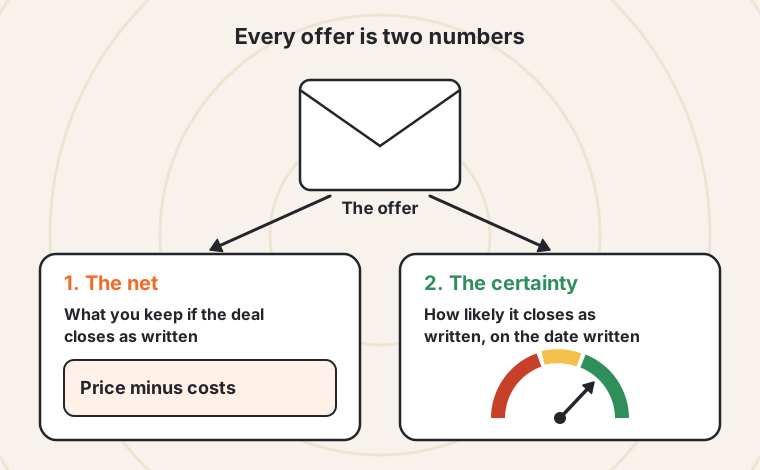
Think of every offer as two numbers:
- The net: what you keep if the deal closes as written.
- The certainty: how likely it is to close as written, on the date written.
A $10,000 higher net is worth little if the buyer’s loan is shaky and a failed deal sends you back to market for two months. A slightly lower offer that is almost certain to close can be the better deal. Your agent, if you have one, will lay out the offers; your attorney will spot contract problems. The decision is yours.
Ask each buyer for a written offer with the price, financing type, down payment, deposit amount, contingencies with dates, any credits or fees they want you to pay, the closing date and a pre-approval letter or proof of funds. You cannot compare verbal offers, and a buyer who will not put terms in writing is telling you something.
What should you subtract from each offer to find your net?
From each offer on a Connecticut house, subtract any buyer’s agent fee you agree to pay, closing-cost credits (seller concessions), repairs or credits you expect after inspection or appraisal, the conveyance tax (usually 1% to 1.25% of the price), your attorney’s fee, and the property tax, insurance, utilities and mortgage interest you will carry until that buyer closes. The costs that do not change between offers still matter for your total.

| Item | Changes between offers? | Connecticut detail |
|---|---|---|
| Price | Yes | The starting point, not the answer. |
| Buyer’s agent fee | Yes | Since the NAR settlement took effect on August 17, 2024, buyers sign their own agreement with their agent, and many ask the seller to pay that fee in the offer. It is negotiable. |
| Seller concessions (closing-cost credits) | Yes | A credit toward the buyer’s closing costs. Capped by loan program (see below). |
| Conveyance tax | Yes, with the price | Seller pays: 0.75% state up to $800,000 (1.25% on the part from $800,000 to $2.5 million) plus 0.25% town, or 0.50% in 16 cities including Hartford, New Haven, Bridgeport, Hamden and Waterbury (CGS 12-494). |
| Inspection credits or repairs | Yes | Offers with no inspection contingency, or “as-is” offers, remove this line. |
| Lender-required repairs | Yes | FHA and VA appraisers check condition: peeling paint on older homes, missing handrails, roof and heating problems. |
| Carrying costs until closing | Yes, with the date | Property tax, insurance, utilities and mortgage interest for each extra week. |
| Your attorney | No | About $1,000 to $1,500 for a straightforward sale (est.). |
| Your listing agent’s commission | Usually no | Set by your listing agreement, as a percentage of the price. |
| Property tax proration | Barely | Connecticut taxes in arrears, so you usually credit the buyer for your share to the closing date, whichever buyer you choose. |
| Oil adjustment | No | By Connecticut custom, the buyer reimburses you for heating oil left in the tank. |
| Disclosure and smoke/CO credits | No | $500 if you did not deliver the property condition report (CGS 20-327c); $250 if you do not provide the smoke and carbon monoxide affidavit (CGS 29-453). Avoid both. |
The full list of seller costs, with a calculator, is in our guide to closing costs in Connecticut. For the conveyance tax by town, see the Connecticut conveyance tax.
What does a comparison of three offers look like?
A comparison of three offers on a Connecticut house puts each offer’s price, fees, credits, taxes, expected repairs and carrying costs in one table and ends with a net. In our example on a house listed at $400,000, a $415,000 FHA offer nets about $367,550, a $405,000 conventional offer nets about $375,655, and a $375,000 cash offer nets about $359,925, before weighing which is most likely to close.
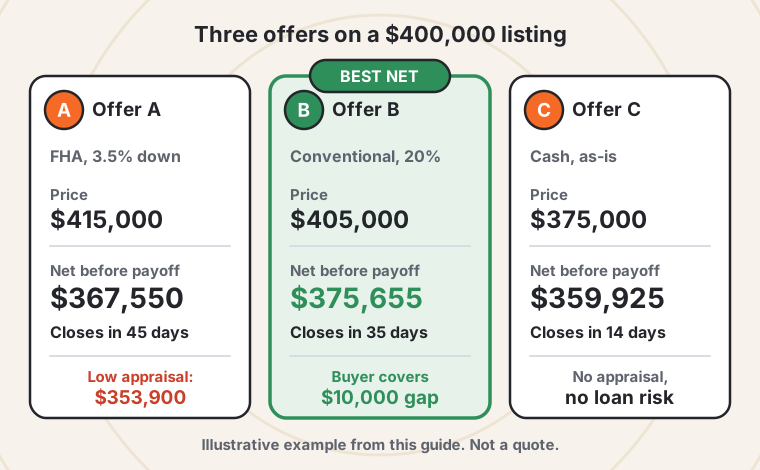
The setup: a three-bedroom house listed at $400,000 in a Connecticut town with the standard 0.25% town conveyance tax. The seller has a listing agent at 2.5%. Three offers arrive the same weekend:
- Offer A: $415,000, FHA loan with 3.5% down. Asks the seller to pay the buyer’s agent 2.5% and credit 3% toward closing costs. Inspection, appraisal and mortgage contingencies; closing in 45 days.
- Offer B: $405,000, conventional loan with 20% down. Asks the seller to pay the buyer’s agent 2%. No closing-cost credit. Will cover an appraisal gap of up to $10,000. Inspection and mortgage contingencies; closing in 35 days.
- Offer C: $375,000, cash, as-is. No buyer’s agent. No inspection or financing contingency. Proof of funds attached. Closing in 14 days.
| Offer A: FHA | Offer B: conventional | Offer C: cash, as-is | |
|---|---|---|---|
| Price | $415,000 | $405,000 | $375,000 |
| Listing agent (2.5%) | −$10,375 | −$10,125 | −$9,375 |
| Buyer’s agent fee requested | −$10,375 (2.5%) | −$8,100 (2%) | $0 |
| Closing-cost credit to buyer | −$12,450 (3%) | $0 | $0 |
| Conveyance tax (1%) | −$4,150 | −$4,050 | −$3,750 |
| Seller’s attorney (est.) | −$1,200 | −$1,200 | −$1,200 |
| Lender-required repairs (est.) | −$2,500 | $0 | $0 |
| Inspection credit (est.) | −$4,000 | −$4,000 | $0 (as-is) |
| Carrying costs to closing (est. $1,600/month) | −$2,400 (45 days) | −$1,870 (35 days) | −$750 (14 days) |
| Net before mortgage payoff | $367,550 | $375,655 | $359,925 |
| If the appraisal comes in at $400,000 (A) or $395,000 (B) | $353,900 if you cut the price to $400,000 | $375,655 (buyer covers the $10,000 gap) | No appraisal: $359,925 |
| Main risks | Low appraisal; FHA condition items; 3.5% down leaves little room | Mortgage approval; inspection requests | Lowest price; verify funds |
What the example shows
- The highest price came third on the most likely outcome. Offer A’s $10,000 price edge over B disappears into a bigger agent fee and a 3% credit.
- The appraisal is the swing factor. If A’s appraisal comes in at the list price and you agree to meet it, A nets about $353,900, less than the cash offer.
- Offer B is the best deal here: a strong down payment, no credit request, and an appraisal gap clause that protects the price.
- The cash offer is the most certain and the fastest, but about $15,700 below B on paper. It wins only if B’s risks (a failed loan, a big inspection request, two months back on the market) are likely, or if speed is worth that much to you.
- If the cash offer had come to you directly, with no listing agent involved, it would net about $369,300, within about $6,400 of B and with none of B’s risk. That is the real comparison many owners of houses that need work face.
Run your own numbers in the calculator below. Put in each offer’s price, agent fee and credits, and your town’s conveyance tax rate.
How much would you walk away with?
Slide the numbers to match your house. It works in your browser; nothing is saved or sent.
Estimates for planning. Conveyance tax per CGS 12-494 (state 0.75% up to $800,000, 1.25% to $2.5M, 2.25% above, plus the town rate). Seller attorney about $1,200 to $1,500; flat-fee MLS about $400; listings include three months of taxes, insurance and utilities, a cash sale about two weeks. Your attorney gives you the final numbers.
How do cash, conventional, FHA and VA offers compare?
Cash offers close fastest and most surely, with no lender appraisal or loan approval, but usually at a lower price. Conventional offers with 20% down are the strongest financed offers. FHA and VA offers are often perfectly good, but their appraisals check the house’s condition and their contracts let the buyer walk away without losing the deposit if the appraisal is below the price.
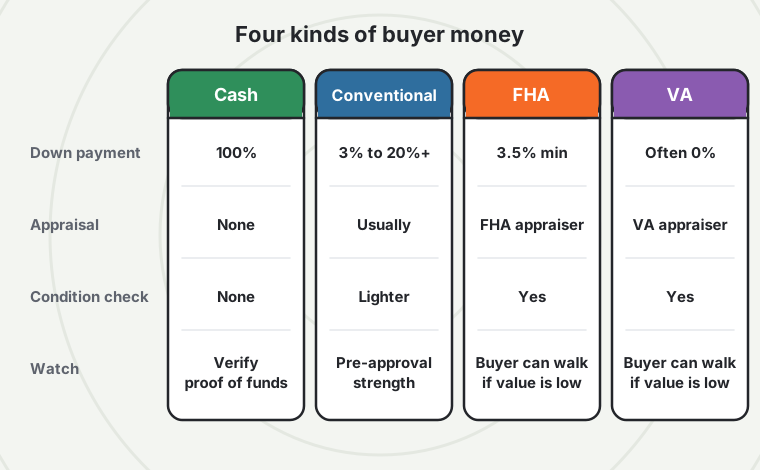
| Financing | Typical down payment | Appraisal | Condition requirements | Seller credit limit | What to watch |
|---|---|---|---|---|---|
| Cash | 100% | None required | None from a lender | None | Verify proof of funds; confirm the deposit is in escrow |
| Conventional (Fannie Mae/Freddie Mac) | 3% to 20%+ | Usually | Lighter; safety and soundness | 3%, 6% or 9% by down payment (2% for investment property) | Pre-approval strength; low down payment means less cushion for a gap |
| FHA | 3.5% minimum | Yes, FHA appraiser | Minimum property requirements: safety, soundness, defective paint in older homes | 6% (est., per HUD guidance) | Amendatory clause lets the buyer walk if the appraisal is low; repair conditions |
| VA | Often 0% | Yes, VA appraiser | Minimum property requirements, similar to FHA | 4% concessions (est., per VA guidance), plus normal closing costs | Escape clause on a low appraisal; repair conditions |
| Renovation loan (FHA 203(k), HomeStyle) | Varies | “As completed” value | Work is part of the loan | Program limits | More steps, longer closing |
Why the condition of your house changes the best offer
Connecticut housing is old. In New Haven, the median single-family house was built around 1930; in Bridgeport and Hamden, two-thirds or more were built before 1960 (assessor data behind our town pages). FHA and VA appraisers look for peeling paint on pre-1978 homes, missing handrails, roof leaks, broken heat and other safety items, and the lender may require repairs before closing. On a dated house, a conventional or cash offer can be worth more than a slightly higher FHA offer.
Houses with bigger problems, such as a buried oil tank, a failed septic or a crumbling foundation, may not qualify for most loans at all. Then the realistic buyers are cash buyers and renovation lenders. See what to fix before selling a house in Connecticut.
Which contingencies matter most in a Connecticut offer?
The contingencies that matter most in a Connecticut offer are the mortgage contingency (the date by which the buyer must get a loan commitment), the inspection contingency (how long the buyer has to inspect and ask for repairs), the appraisal terms, and any home-sale contingency (the buyer must sell their own house first). Fewer, shorter contingencies mean less risk for you.
| Contingency | What it lets the buyer do | Stronger for you | Weaker for you |
|---|---|---|---|
| Mortgage (financing) | Cancel and recover the deposit if no loan commitment by a date | Short date; large down payment; verified pre-approval | Long date; new or weak pre-approval |
| Inspection | Inspect, then ask for repairs or credits or cancel | Short window (about 7 to 10 days); “informational only”; waived | Long window; open-ended terms |
| Appraisal | Renegotiate or cancel if value is low | Appraisal gap coverage (buyer pays the difference up to an amount) | Low down payment and no gap coverage |
| Home sale | Cancel if the buyer’s own house does not sell | No home-sale contingency | Buyer’s house not yet listed or under contract |
| Attorney review | Have attorneys review and modify the contract | Normal in Connecticut and protects both sides; your attorney should review too | |
| Specialized tests (septic, well, radon, oil tank) | Test and request a fix | Tests you did before listing, with reports in hand | Unknown status, discovered after the contract |
Two Connecticut points come before any contingency. First, the buyer must receive your Residential Property Condition Report before signing the contract (CGS 20-327b), or you credit $500 at closing. Second, for homes built before 1978 the federal lead rule gives the buyer a 10-day opportunity to test for lead paint unless they waive it.
What is an appraisal gap and how should it change your decision?
An appraisal gap is the difference between the contract price and a lower bank appraisal. The lender bases the loan on the lower value, so someone must cover the gap: the buyer with more cash, the seller with a price cut, or both. When an offer is above recent sales, look for an appraisal gap clause that commits the buyer to cover a set amount, and check that their savings can really pay it.
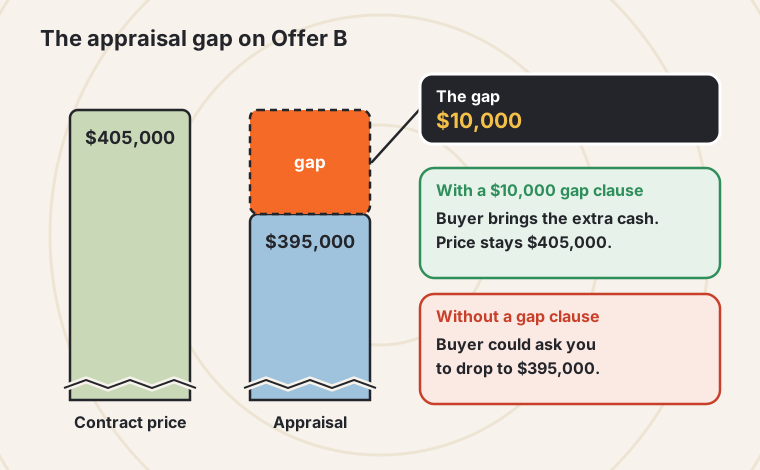
How it works on our example: Offer B is $405,000 with 20% down. If the appraisal comes back at $395,000, the lender bases the loan on $395,000. Without a gap clause, the buyer could ask you to drop to $395,000. With a $10,000 gap clause, the buyer brings the extra $10,000 and the price stays at $405,000.
- Price above recent sales? Expect the appraisal to test it. Ask for gap coverage, or weigh the offer as if it were at the comparable-sales value.
- Small down payment? A buyer with 3.5% down may not have the cash to cover a gap, whatever the offer says.
- FHA and VA: the buyer can walk away without losing the deposit if the appraisal is below the price (HUD’s amendatory clause and the VA escape clause). They can still choose to go ahead and pay the difference.
For more, see our guide on how appraisals affect your selling price in Connecticut.
How much can a buyer ask you to pay toward their closing costs?
How much a buyer can ask you to pay toward their closing costs depends on their loan. Fannie Mae allows seller and other interested-party contributions of up to 3% of the price when the buyer puts down less than 10%, 6% with 10% to 24.99% down, and 9% with 25% or more down (2% on investment property). FHA’s limit is generally reported as 6% and VA’s concessions limit as 4%. A credit can never exceed the buyer’s actual costs.
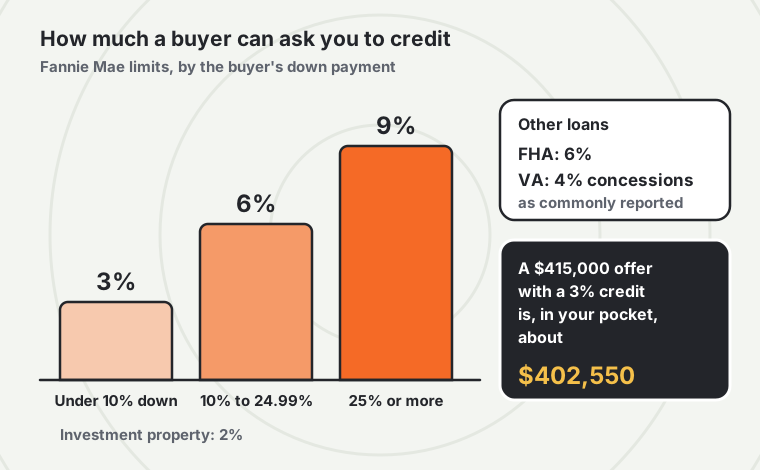
Credits are not free money for the buyer; they are a price cut by another name. A $415,000 offer with a 3% credit is, in your pocket, about a $402,550 offer. Some buyers ask for credits because they are short on cash for closing, which also tells you they may have little cushion for an appraisal gap or a surprise.
Since the National Association of Realtors settlement practice changes took effect on August 17, 2024, offers of pay to buyer agents can no longer be posted on the MLS, and buyers must sign a written agreement with their own agent before touring homes. Many buyers now ask the seller to pay their agent in the offer. It is a cost you can accept, reduce or decline, like any other term.
How much of a deposit should a buyer put down in Connecticut?
There is no legal minimum deposit in Connecticut. A common pattern is a small deposit with the offer and a larger one when the contract is signed, often bringing the total to several percent of the price; the money is held in an attorney’s or broker’s escrow account. A bigger deposit shows commitment and gives you more protection if a buyer defaults without a contractual reason.
- Who holds it: an attorney’s or broker’s escrow account, never you or the buyer directly.
- When the buyer gets it back: if they cancel under a contingency in the contract (no mortgage commitment, a failed inspection within the window).
- When you may keep it: if the buyer breaches the contract without a valid reason, as the contract allows. Your attorney handles this.
- Cash offers: look for a meaningful deposit and proof of funds, such as a recent bank or brokerage statement, ideally verified by your attorney.
How much is a faster closing date worth?
A faster closing date is worth the carrying costs you avoid, plus the lower chance that something goes wrong while you wait. In Connecticut that is property tax (often $500 to $1,500 a month in our town data), insurance, utilities and your mortgage interest. Thirty days sooner on a house that costs $1,600 a month to carry is worth about $1,600, more for a vacant house or one you are paying two mortgages on.
The property tax proration itself does not reward a quick or slow closing much, because Connecticut taxes are paid in arrears and split by the day: you pay for the days you own the house either way. What changes is the cash you spend each month and the time for things to go wrong.
| Town | Mill rate (fiscal 2027) | Property tax per month on the town’s median single-family house |
|---|---|---|
| New Haven | 39.96 | $770 |
| Hamden | 53.67 | $1,110 |
| Cheshire | 31.36 | $990 |
| Milford | 28.67 | $860 |
| Manchester | 41.00 | $770 |
| West Hartford | 46.77 | $1,420 |
If the closing date matters more to you than the last dollar (a new job, a purchase you must close, an estate), say so early, and weigh offers that can meet it. See how long it takes to sell a house in Connecticut for each route’s timeline.
How do you judge whether an offer will actually close?
You judge whether an offer will actually close by checking the buyer’s financing and their room for surprises: a pre-approval you verified with the lender (not just a letter), a larger down payment, cash reserves for an appraisal gap, no need to sell another house, short contingency windows, a meaningful deposit, and a lender and attorney who can meet the closing date.
- Called the lender to confirm the pre-approval is current and based on reviewed income and credit
- Checked the loan type (cash, conventional, FHA, VA, renovation) and the down payment
- Confirmed the buyer does not need to sell another home first
- Read the mortgage commitment date and the inspection window
- Checked for an appraisal gap clause and the cash to back it
- Confirmed the deposit amount and who will hold it
- For cash: saw proof of funds and had your attorney confirm it
- Asked the buyer’s agent how firm the closing date is
- Had your Connecticut attorney review the contract before signing

The offer that hurts a seller most is not the low one. It is the high one that falls apart on day 40, after you have turned the other buyers away and the house has gone stale on the market. Before you accept any offer, call the lender, ask what has actually been verified, and ask yourself what you will do if this buyer disappears. If the answer is “start over in a slower month”, the safer offer may be the better one.
How should you handle multiple offers in Connecticut?
To handle multiple offers in Connecticut, set a deadline for all offers, ask every buyer for their “highest and best” terms in writing, compare them on net and certainty, and counter or accept in writing through your agent or attorney. Treat buyers the same, keep escalation clauses honest by verifying the competing offer, and do not sign anything until your attorney has reviewed it.
- Escalation clauses raise a buyer’s price by a set amount above a competing offer, up to a cap. Check the cap, the appraisal terms and whether the buyer can cover the higher price if the appraisal does not.
- Backup offers keep a second buyer in line if the first falls through. Ask your attorney how to word one.
- Counter-offers can fix one weakness in a good offer: a shorter inspection window, a smaller credit, a gap clause.
Selling by owner? The same rules apply, and your attorney becomes your negotiator on paper. See selling a house without an agent in Connecticut.
How do you judge whether a cash offer is fair?
To judge whether a cash offer on a Connecticut house is fair, compare its net with what a listing would realistically net after repairs, commissions, credits, carrying costs and the risk of a failed deal, not with the list price. A fair cash offer is below retail by roughly the cost of repairs, the buyer’s resale costs and a margin, and it comes with proof of funds, an attorney closing and no fees to you.
- Ask how the number was built. A serious buyer can explain the repairs they priced and the sales they compared.
- Check the terms, not only the price. As-is, no inspection contingency, who pays which closing costs, the deposit, and the closing date you choose.
- Watch for fees and pressure. You should pay no fee to receive or accept an offer. A buyer who pushes you to sign today, or asks you to sign the deed before closing, is a buyer to walk away from.
- Compare at least one listing scenario. If your house is ready and you have time, listing usually nets more. We will tell you that when it is true.
Our page on what a fair cash offer for your house looks like and the cash buyer vs. realtor comparison go deeper. If the decision is close, this two-minute check can help.
Is a cash sale right for you, or should you list?
Seven quick questions. There is no wrong answer, and we will tell you honestly if listing would leave you more.
- Does the house need repairs you would rather not pay for or manage?
- Do you need to close by a certain date, or within the next month or two?
- Would showings be hard: tenants, belongings, privacy, or you live out of state?
- Is there a complication: an estate or probate, a divorce, foreclosure, liens or back taxes?
- Could you comfortably cover the mortgage, taxes and utilities for three or more months?
- Is getting the highest possible price more important to you than speed and certainty?
- Would a buyer's bank lend on the house as it is (no major roof, foundation, oil tank or code issues)?
What mistakes do Connecticut sellers make when comparing offers?
The mistakes Connecticut sellers make when comparing offers are choosing the highest price without subtracting fees and credits, accepting an unverified pre-approval, ignoring appraisal risk on offers above recent sales, overlooking FHA and VA condition items on older homes, forgetting the conveyance tax and carrying costs, and signing before their Connecticut attorney has read the contract.
- Price over net. Always build the table.
- Letters instead of lenders. Call and verify.
- Appraisal blindness. An offer far above recent sales is an offer the appraiser will test.
- Ignoring the house’s condition. Old paint, an old tank or an old roof can turn a high FHA offer into a repair list.
- Forgetting Connecticut costs. The conveyance tax rises with the price, and the property tax proration is usually a charge to you, not a refund.
- Letting the deadline rush you. A few hours to call lenders and your attorney is normal.
- Not keeping a backup. Tell the second-best buyer you would like to stay in touch.
Questions Connecticut sellers ask about comparing offers
How do I compare two offers on my house?
To compare two offers on your house, subtract from each price the buyer’s agent fee, any closing-cost credit, expected repairs, the conveyance tax, your attorney and the carrying costs until that closing date. Then compare how likely each is to close: financing, down payment, contingencies, appraisal coverage and deposit.
Is a cash offer better than a financed offer?
A cash offer is not always better than a financed offer. Cash closes faster and more surely, with no lender appraisal or loan approval, but it is usually lower. A strong conventional offer with a bigger net often wins; a cash offer wins when the financed offer carries real risk or your timing matters.
Should I accept the highest offer on my house?
You should not automatically accept the highest offer on your house. After agent fees, credits and repairs, the highest price can net less than a lower offer, and it may be less likely to close if it depends on a low-down-payment loan and an appraisal above recent sales.
Are FHA offers bad for sellers?
FHA offers are not bad for sellers, but they carry two extra risks: the FHA appraiser checks the house’s condition and may require repairs, and the buyer can walk away without losing the deposit if the appraisal is below the price. On a well-kept house priced at market, an FHA offer can be a good offer.
What is an appraisal gap clause?
An appraisal gap clause is a promise in the offer that the buyer will pay the difference, up to a set amount, if the bank’s appraisal comes in below the price. It protects your price in a competitive market. Check that the buyer has the cash to back it.
How much can a buyer ask me to pay in closing costs?
A buyer can ask you to pay closing costs up to the limit of their loan program: for Fannie Mae loans, 3%, 6% or 9% of the price depending on the down payment (2% on investment property); FHA generally 6%; VA concessions generally 4%. Every credit reduces your net dollar for dollar.
Do I have to pay the buyer’s agent in Connecticut?
No, you do not have to pay the buyer’s agent in Connecticut. Since August 17, 2024, buyers sign their own agreement with their agent, and the fee is negotiable. Many buyers ask the seller to pay it in the offer; you can accept, reduce or decline that request.
What is a normal deposit on a house in Connecticut?
There is no legally required deposit on a house in Connecticut. A common pattern is a small deposit with the offer and a larger one when the contract is signed, held in an attorney’s or broker’s escrow account. A larger deposit signals a more committed buyer.
How long is the inspection period in Connecticut?
The inspection period in a Connecticut contract is negotiated, and about 7 to 14 days is common (est.). A shorter window is better for you. Septic, well and radon tests can take longer to schedule and get results, so agree on realistic dates.
What is a mortgage contingency in Connecticut?
A mortgage contingency in Connecticut is a contract term that lets the buyer cancel and recover the deposit if they cannot get a written loan commitment by a set date. A short date and a buyer with a verified pre-approval reduce your risk.
Does the closing date change my net in Connecticut?
The closing date changes your net in Connecticut mainly through carrying costs: property tax, insurance, utilities and mortgage interest for each extra week. The property tax proration itself is split by the day, so you pay for the days you own the house whichever buyer you choose.
Should I counter every offer?
You do not have to counter every offer, but countering is usually worth it when an offer is close. Counter on the one or two terms that matter most to you, such as the credit, the inspection window or the closing date, and keep the buyer engaged.
How do I know if a cash buyer really has the money?
To know if a cash buyer really has the money, ask for proof of funds, such as a recent bank or brokerage statement in the buyer’s name, and have your attorney confirm it. A meaningful deposit held in escrow and an attorney closing are further signs of a real buyer.
Who pays the conveyance tax when I accept an offer?
You, the seller, pay the Connecticut conveyance tax when you sell, whichever offer you accept. It is 0.75% of the price to the state up to $800,000, plus 0.25% to most towns or 0.50% in 16 cities, paid at closing before the deed is recorded (CGS 12-494).
Can I accept a backup offer?
Yes, you can accept a backup offer in Connecticut, which steps in if the first contract is cancelled. Have your attorney write it so it is clearly secondary and you cannot be bound to two buyers at once.
Comparing offers is the last big decision before the closing. For every step that leads up to it, see our guide on how to sell a house in Connecticut.
Related Connecticut guides
Money
When things stall
Sources
- Fannie Mae Selling Guide B3-4.1-02, Interested Party Contributions (3%, 6%, 9%; 2% for investment property).
- HUD, FHA amendatory clause model document and HUD Single Family Housing Policy Handbook 4000.1 (FHA appraisal, property requirements and seller contributions).
- VA Lender’s Handbook, M26-7 (VA appraisals, minimum property requirements and seller concessions).
- CGS § 12-494 (conveyance tax) and OLR Report 2020-R-0020 (municipal rates).
- CGS § 20-327b and § 20-327c (property condition report before the contract; $500 credit).
- CGS § 29-453 (smoke and carbon monoxide affidavit; $250 credit).
- CGS § 12-62a (October 1 assessment date; 70% assessment ratio).
- EPA and HUD Lead-Based Paint Disclosure Rule (10-day inspection opportunity, homes built before 1978).
- NAR settlement practice changes, effective August 17, 2024.
- Town mill rates and median sale prices: Connecticut Office of Policy and Management data on data.ct.gov (fiscal 2027 mill rates; sales Oct 2024 to Sep 2025).
See the house together.
Pick a time that works.
Choose a time for us to walk through the property with you, or ask for a quick call first. We confirm every request personally.
Tuesday, January 13
No open times in the next few weeks. Please call us.
We will confirm by email. Nothing is booked until we do.
View my request
Who wrote this
Jerryll Noorden
Jerryll has bought and sold Connecticut houses since 2016 and has sat at more closing tables than he can count, on both sides. Before real estate he was a robotics scientist at NASA, IHMC and IIT. He wrote this guide because the national sites that rank for it skip the Connecticut rules that cost sellers money. When listing or selling it yourself would get you more than a cash offer, he says so.
This guide explains Connecticut rules in plain English. It is not legal or tax advice. Laws change; for your sale, talk to a Connecticut real estate attorney and a tax professional.
