
- Yes, you can sell a Connecticut rental with tenants in it. A sale does not end a lease. The buyer steps into your shoes as landlord, with the same leases and the same tenants. The general steps are in our guide to how to sell a house in Connecticut; this page covers the tenant parts.
- The security deposit moves with the house. At closing you hand every deposit, plus interest, to the buyer (CGS 47a-21). The 2026 interest rate is 0.49%.
- Showings need cooperation, not just a key. Tenants may not unreasonably refuse entry for showings, but you must give reasonable notice and come at reasonable times (CGS 47a-16).
- Selling is not a reason to evict. You can end a month-to-month tenancy for “lapse of time” with a notice to quit, or a lease at its end, but only through housing court. Changing the locks is a crime.
- Taxes are bigger on a rental than on a home. Depreciation you took (or could have taken) is taxed up to 25%, the home-sale exclusion usually does not apply, and Connecticut taxes the gain as income. A 1031 exchange can defer it.
- A cash sale is one option, not the only one. If the building is in good shape with good tenants, keeping it, hiring a manager or listing it to investors on the MLS often leaves you with more.
Can you sell a rental property with tenants in it in Connecticut?
Yes, you can sell a rental property with tenants in it in Connecticut. The sale does not cancel the lease: the buyer becomes the new landlord, takes over the leases and the security deposits, and the tenants stay on the same terms. What you cannot do is force a tenant out because you are selling. That needs a lawful reason, a notice to quit and, if the tenant stays, a court case.
This is the landlord’s guide to selling a Connecticut rental: a single-family house, a condo you rent out, or a two-, three- or four-family. It covers what happens to the lease and the deposit, how to show an occupied house without a fight, how to end a tenancy the legal way if a buyer wants it empty, Section 8 tenants, multi-family rules, the taxes landlords owe, and when each way of selling wins. If you have never sold a house in Connecticut, read the general steps first, then come back here.
Connecticut matters here. Landlord and tenant rules are state law, in chapters 830 to 834 of the General Statutes, and they changed in 2023 and again in 2025. National “how to sell with tenants” pages miss most of it. A few examples:
- Deposit returns are 21 days, not 30. Since Public Act 23-207, a landlord has 21 days after the tenancy ends (or 15 days after getting a forwarding address, if later) to return a deposit with interest. Miss it and you can owe twice the deposit (CGS 47a-21).
- Every deposit earns interest. Connecticut landlords pay interest on security deposits at a rate the Banking Commissioner sets each year: 0.49% for 2026 and 0.52% for 2025.
- A notice to quit must now be served by a marshal. Since Public Act 25-78, the notice to quit is served by a proper officer, and it must have the state’s right-to-counsel notice attached (CGS 47a-23, 47a-75).
- Some tenants can only be evicted for good cause. In buildings with five or more units, tenants who are 62 or older or have a lasting disability (or live with such a family member) are protected by CGS 47a-23c.
- Lockouts are crimes. Changing the locks, removing doors or putting a tenant’s things on the curb without a court order is criminal lockout (CGS 53a-214) and can cost double damages (CGS 47a-46).
What are your options when you sell a house with tenants in Connecticut?
Your options when you sell a house with tenants in Connecticut are: sell it occupied to an investor who wants the rent, wait for the lease to end and sell it empty, pay the tenant to leave early under a written cash-for-keys agreement, sell it to the tenant, or keep it and hire a property manager. Which one wins depends on the lease, the rent, the tenant and the condition of the house.
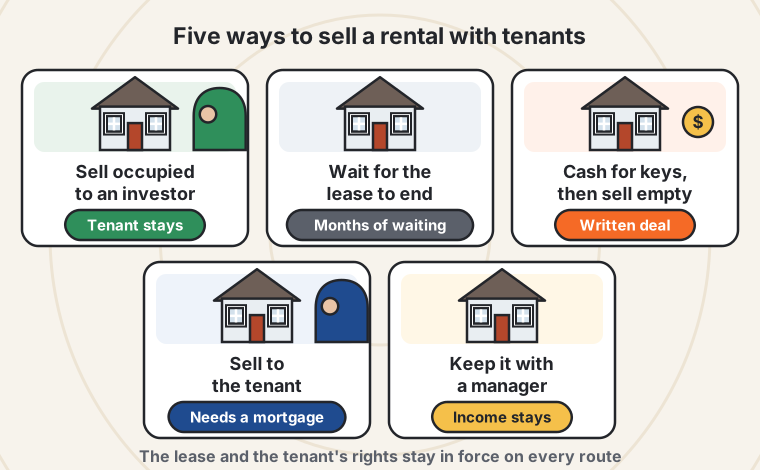
| Route | Best when | Watch out for |
|---|---|---|
| Sell occupied to an investor (listed on the MLS or direct) | The tenant pays on time, the rent is close to market, and the building is in decent shape | Investors price on rent, not on what an owner-occupant would pay; below-market rent lowers your price |
| Wait for the lease to end, then sell vacant | The lease ends soon, the tenant plans to leave, and the house would appeal to owner-occupants | Months of waiting; the tenant may not leave on time, and an empty house still costs you taxes, insurance and heat |
| Cash for keys, then sell vacant | You need the house empty sooner and the tenant is willing | The deal must be voluntary and in writing; pay only when the keys come back |
| Sell to the tenant | The tenant wants to buy and can get a mortgage | Financing often falls through; set a deadline and keep the tenancy separate from the sale contract |
| Keep it and hire a property manager | The building makes money and you mostly want out of the day-to-day work | Management fees; you still own the risk and the repairs |
| Sell to a cash buyer as-is | The tenant is behind or hard to deal with, the house needs work, or you need a fixed date | Price is lower than a retail sale; check the buyer (see our guide to checking a cash home buyer) |
Is there a “right of first refusal” for tenants in Connecticut?
Not for an ordinary rental sale. Some national pages say Connecticut tenants can match a buyer’s offer. Connecticut has no general statute that gives a residential tenant that right; it comes up only in special cases (such as condominium conversions) or if the lease itself gives the tenant an option to buy. Read your lease. If it has a purchase option or a right of first refusal, your attorney has to deal with it before you sign with a buyer.
Should you sell your rental property or keep renting it?
You should sell your Connecticut rental if it no longer pays you for the time and risk, a big repair is coming, the tenant situation has broken down, or you need the cash or the tax step-up for something better. You should keep it, or hand it to a property manager, if it has good tenants, steady income and no big repairs ahead, because selling triggers taxes and costs that a good rental keeps working to cover.
Most landlords who call us are not asking “can I sell?” They are asking “should I?” Here is the honest version.
Selling usually makes sense if…
- The rent no longer covers taxes, insurance, repairs and your time
- A roof, boiler, oil tank or foundation bill is coming
- A tenant is months behind, or the relationship has broken down
- You live out of state and managing it is wearing you down
- You inherited the property and do not want to be a landlord (see selling an inherited house in Connecticut)
- You want to trade into a better property with a 1031 exchange
Keeping it usually makes sense if…
- The tenants pay on time and take care of the place
- The rent leaves you real cash after every cost
- The big systems are newer and nothing major is due
- Your problem is the work, not the building: a manager can fix that
- Selling now would trigger a large tax bill you could defer or avoid by waiting
- You do not need the cash for anything better
One test helps: write down what you would net from a sale today (after the conveyance tax, your attorney, any commission and the taxes in the tax section), and what that money would earn somewhere else. Then compare it with the rental’s real yearly cash flow after every expense, including repairs and vacancy. If the rental clearly wins and you only hate the work, interview two or three property managers before you sell. If it is close, or the building needs money you do not want to spend, selling is reasonable.
Is a cash sale right for you, or should you list?
Seven quick questions. There is no wrong answer, and we will tell you honestly if listing would leave you more.
- Does the house need repairs you would rather not pay for or manage?
- Do you need to close by a certain date, or within the next month or two?
- Would showings be hard: tenants, belongings, privacy, or you live out of state?
- Is there a complication: an estate or probate, a divorce, foreclosure, liens or back taxes?
- Could you comfortably cover the mortgage, taxes and utilities for three or more months?
- Is getting the highest possible price more important to you than speed and certainty?
- Would a buyer's bank lend on the house as it is (no major roof, foundation, oil tank or code issues)?
What happens to the lease when you sell a rented house in Connecticut?
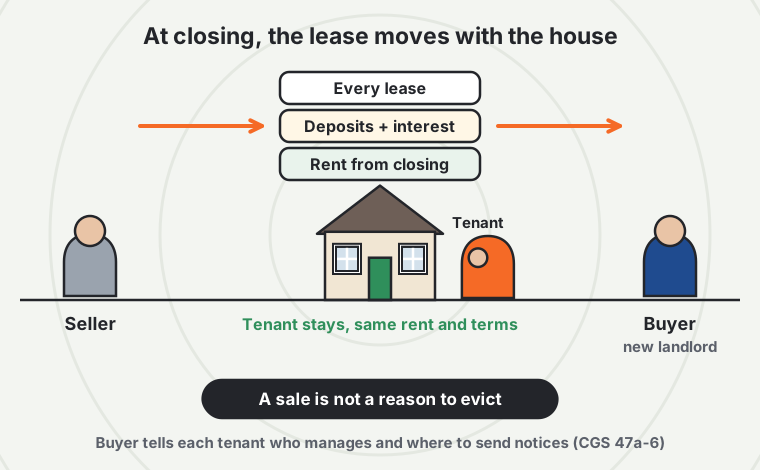
When you sell a rented house in Connecticut, the lease stays in force and transfers to the buyer. A fixed-term lease runs until its end date on the same rent and terms; a month-to-month tenancy continues until someone ends it the legal way. The buyer cannot evict a tenant because of the sale, and has to give the tenant written notice of who the new landlord is and where to send rent and notices.
Fixed-term leases
A one-year lease signed last spring still runs to its end date after you sell. The buyer collects the rent from closing on and must honor the lease terms: the rent, who pays which utilities, parking, pets, everything. A buyer who wants to live in the house has to wait until the lease ends, or agree something with the tenant. That is why owner-occupant buyers often skip houses with long leases left, and why investors usually do not mind.
Check the lease for three things before you list: the end date, any renewal option the tenant can exercise, and any clause about a sale (some leases let the landlord end the lease early on a sale with notice; many do not). Your attorney can tell you whether a sale clause in your lease is enforceable.
Month-to-month and oral tenancies
If there is no written lease, or the lease has expired and the tenant still pays monthly, Connecticut treats the tenancy as month to month (CGS 47a-3b and 47a-3d). Either you or the buyer can end it for “lapse of time” with a notice to quit, as explained below, unless the tenant is protected by the good-cause rule for older and disabled tenants. The sale itself does not end it.
Protected tenants: 62 and older or disabled, in buildings of five or more units
Connecticut’s CGS 47a-23c protects tenants who live in a building or complex with five or more units and who are 62 or older, or have a physical or mental disability expected to last at least 12 months (or live with a spouse, sibling, parent, grandparent or child who does). These tenants can only be evicted for specific reasons: nonpayment, refusing a fair and equitable rent increase, serious lease or safety violations, the landlord permanently taking the unit off the market, or the landlord moving in as a principal residence. “Lapse of time” is not on the list, and the last three reasons cannot be used during an existing lease. A buyer of a five-plus-unit building should expect these tenants to stay.
What the new owner must tell the tenant
The new landlord must give each tenant, in writing, the name and address of the person who manages the property and the person authorized to receive notices and court papers (CGS 47a-6). The new landlord must also tell each tenant, within 30 days of receiving the deposits, how much is held for that tenant and at which bank (CGS 47a-21(h)(4)). A short joint letter from you and the buyer, delivered right after closing, takes care of both and stops tenants from paying the wrong person.
A sale is not a ground for eviction. The grounds for a notice to quit are listed in CGS 47a-23: lapse of time, nonpayment of rent after the grace period, lease violations, nuisance and a few others. Neither you nor the buyer can end a lease early just because ownership changed, unless the lease itself allows it.
What happens to the tenant’s security deposit when you sell?
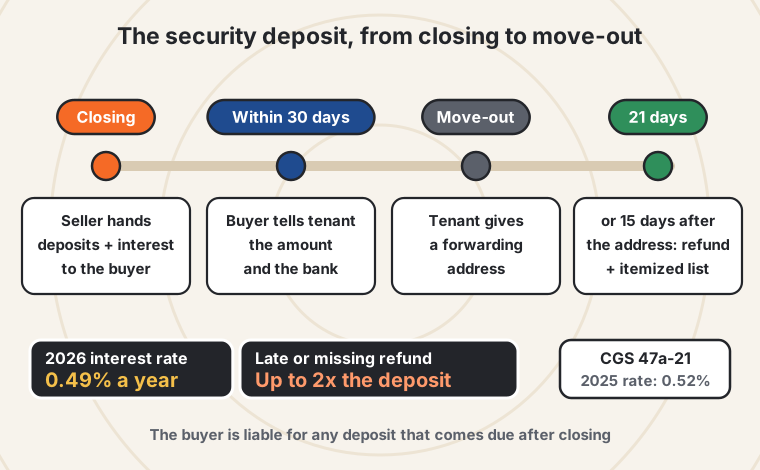
When you sell a rental in Connecticut, you must hand every tenant’s security deposit, plus the interest it has earned, to the buyer at closing (CGS 47a-21). The buyer becomes responsible for returning it when the tenancy ends, and must tell each tenant in writing within 30 days how much is held and at which bank. In 2026 the interest rate on deposits is 0.49%.
The rules in plain English
| Rule | What Connecticut requires | Statute |
|---|---|---|
| Maximum deposit | Two months’ rent; one month’s rent if the tenant is 62 or older (and a tenant who turns 62 can ask for the excess back) | CGS 47a-21(b) |
| Where it is kept | In an escrow account at a Connecticut bank, for the tenant’s benefit; it is the tenant’s money, not yours | CGS 47a-21(c), (h)(1) |
| Interest | At least the “deposit index” for each year, paid or credited every year on the tenancy’s anniversary: 0.49% for 2026, 0.52% for 2025 | CGS 47a-21(i); Department of Banking |
| On a sale | The seller withdraws and delivers the full deposits plus accrued interest to the buyer | CGS 47a-21(h)(3)(A) |
| Notice to the tenant | Within 30 days of receiving a deposit from the previous landlord, the new landlord tells the tenant the amount and the bank | CGS 47a-21(h)(4) |
| Return after move-out | Within 21 days after the tenancy ends, or 15 days after receiving the tenant’s forwarding address in writing, whichever is later, with interest and an itemized list of any deductions | CGS 47a-21(d)(2) |
| Penalty for a late or missing return | Twice the deposit; if only the interest is missing, $10 or twice the interest, whichever is greater | CGS 47a-21(d)(2) |
| Who is liable after the sale | The buyer, for any deposit that becomes due while they own the property | CGS 47a-21(e) |
How much interest do you owe? A quick example
A tenant paid a $2,000 deposit. For a full year of tenancy in 2026, the minimum interest is 0.49% of $2,000, or $9.80. The interest is calculated year by year at that year’s rate, compounded annually, so a deposit held since 2015 has earned a little each year at each year’s rate. Your attorney or bookkeeper should total it up before closing; the Department of Banking publishes the rate for every year since 1994. It is a small number, but it is the one sellers most often forget, and the penalty for leaving it out is real.
What if you never put the deposit in escrow?
It happens, especially with landlords who rented out a former home. The law still treats the deposit as the tenant’s money and still makes you deliver it, with interest, at closing. Tell your attorney early. The fix is usually simple: the deposit and interest are credited to the buyer on the closing statement. Do not let a buyer “forget” the deposits either. If the buyer later fails to return a deposit, the tenant will look for whoever was landlord.
Can you keep part of the deposit for damage before you sell?
Only when a tenancy ends. While the tenant is still living there, the deposit stays whole and transfers whole. If the tenant moves out before closing, you handle the return or the itemized deductions yourself, within the 21-day or 15-day deadline, before or after closing as the timing falls.
Can you show a rented house to buyers in Connecticut?
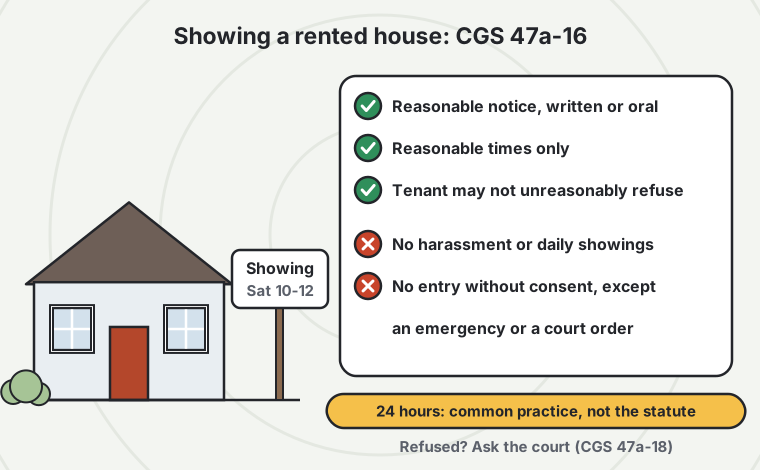
Yes, you can show a rented house to buyers in Connecticut. A tenant may not unreasonably refuse entry so the landlord can show the unit to prospective buyers, appraisers or inspectors, but the landlord must give reasonable written or oral notice and come only at reasonable times, except in an emergency (CGS 47a-16). Connecticut law does not set a fixed number of hours; many leases say 24 hours.
What the law says, and what it does not
- The tenant must not unreasonably withhold consent to entry for showing the unit to “prospective or actual purchasers, mortgagees”, for inspections, and for repairs (CGS 47a-16(a)).
- You must give reasonable notice, written or oral, and enter only at reasonable times (47a-16(c)). Twenty-four hours is a common standard in leases and practice, not a number in the statute.
- You may not abuse the right of entry or use it to harass the tenant (47a-16(c)). Showings every evening for weeks can cross that line.
- Without the tenant’s consent you may enter only in an emergency, with a court order, under the extended-absence rule, or if the tenant has abandoned the unit (47a-16(d)).
- If the tenant refuses, you can ask the court to order access or end the rental agreement, and recover damages and attorney’s fees (CGS 47a-18).
- If the landlord enters unlawfully or harasses, the tenant can recover at least one month’s rent plus attorney’s fees (CGS 47a-18a).
How to get a tenant to cooperate
The legal minimum gets you in the door. Cooperation gets you a clean, bright house and a tenant who says nice things to buyers. What works:
- Tell the tenant first, in person or by phone, then in writing. Say you are selling, that the lease stays in force, and that the deposit transfers to the buyer. Fear of being thrown out is the reason most tenants resist.
- Agree on a showing schedule. Two or three set windows a week, with a day’s notice, is easier for everyone than random calls.
- Offer something for the trouble. A rent credit for each month the house is on the market, a cleaning service before photos, or a moving bonus if they leave by an agreed date. Put it in writing.
- Bundle the visits. Do the photos, the appraisal and the inspection on as few days as possible.
- Protect the tenant’s things and privacy. Ask buyers not to photograph personal items, and keep valuables out of sight.
- Do not raise the rent mid-lease or cut services. You cannot raise rent during a lease, any increase needs 45 days’ written notice (CGS 47a-4e), and a rent increase or eviction shortly after a tenant complains about repairs can be presumed retaliation for six months (CGS 47a-20).
Many investors make an offer from the listing photos, the rent roll and one walkthrough. Selling occupied to an investor is often the least disruptive route for the tenant, which is one reason tenants tend to cooperate with it.
How do you legally end a tenancy before selling a house in Connecticut?
To legally end a tenancy before selling a house in Connecticut, you need a lawful reason (the lease has ended or a month-to-month tenancy is ended for lapse of time, nonpayment after the 9-day grace period, or a serious lease violation), a written notice to quit served by a marshal at least three days before the quit date, and, if the tenant does not leave, a summary process (eviction) case in housing court. Only a state marshal with a court execution can remove a tenant.
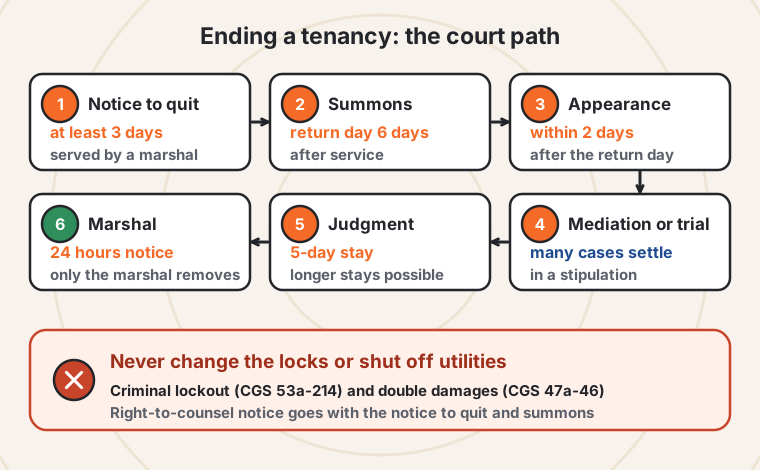
Step 1: have a lawful reason
The reasons are in CGS 47a-23. For a seller, the common ones are:
- Lapse of time: a fixed-term lease has ended, or you are ending a month-to-month tenancy. This is the usual route for a landlord who wants the house empty to sell, and it is not available against tenants protected by CGS 47a-23c.
- Nonpayment of rent: rent not paid within the 9-day grace period (4 days for a weekly tenancy) after it was due (CGS 47a-15a). Since January 1, 2026, the grace period is 5 days longer for any month in which the landlord’s own online payment system prevented payment.
- Lease violations: for most violations, you must first give a written notice describing the breach and at least 15 days to fix it, if it can be fixed (CGS 47a-15). Serious nuisance is an exception.
Step 2: the notice to quit
The notice to quit must be in writing, name each adult occupant, give the address and the reason in the words of the statute, and give at least three full days before the quit date (CGS 47a-23). Since Public Act 25-78, an attested copy must be served by a proper officer, in practice a state marshal; you cannot hand it over yourself. The notice must have the Judicial Branch’s right-to-counsel notice attached (CGS 47a-75), because tenants with household income at or below 80% of the state median, or who receive certain benefits, may get a free lawyer. The court’s notice-to-quit form is JD-HM-7.
If the property has a federally backed mortgage (FHA, VA, USDA, Fannie Mae or Freddie Mac) or is in certain federal housing programs, the federal CARES Act requires a 30-day notice to vacate in nonpayment cases. Federal agencies and many courts treat that requirement as still in force. Ask your attorney whether your loan makes the property “covered”.
Step 3: summary process in housing court
Summons and complaint
If the tenant is still there after the quit date, your attorney (or you) issues a summary process summons and complaint. It can be made returnable six days, inclusive, after service, and must be returned to court at least three days before the return day (CGS 47a-23a). A marshal serves it, again with the right-to-counsel notice. The entry fee is $175 (jud.ct.gov).
The tenant’s appearance
The tenant has until two days after the return day to file an appearance. If no appearance is filed, you can move for a default judgment, which the court enters by the next court day (CGS 47a-26).
Use and occupancy payments
If the tenant appears, you can ask the court to order the tenant to pay the last agreed rent into court while the case is pending (CGS 47a-26b). That keeps money coming in during a contested case.
Mediation or trial
Most housing courts send cases to a housing mediator first. Many cases end in a written stipulation: a move-out date, sometimes with a payment plan or money for moving costs. Otherwise the case goes to trial.
Judgment and the stay
After a judgment for you, execution is automatically stayed for five days, not counting Sundays and legal holidays, and any appeal must be filed in that window (CGS 47a-35). A tenant can apply for a longer stay of up to six months, or up to three months if the judgment was for nonpayment (CGS 47a-37, 47a-39).
Execution and the marshal
When the stays run out, the court issues a summary process execution. A state marshal notifies the town and makes reasonable efforts to notify the tenant at least 24 hours before the removal (CGS 47a-42, as amended in 2025). Only the marshal removes people and belongings.
Changing the locks, shutting off heat or water, removing doors or putting belongings out without a court execution is criminal lockout, a class C misdemeanor (CGS 53a-214). The tenant can also sue under the entry and detainer statute and recover double damages and costs (CGS 47a-43, 47a-46). A buyer’s attorney who hears about a self-help eviction will slow your closing down, too.
Retaliation can sink your case
If, in the six months before you file, the tenant complained in good faith to a town or state agency, asked you for repairs, filed a complaint with a fair rent commission, or joined a tenants’ union, your eviction case can be challenged as retaliation (CGS 47a-20). The exceptions include nonpayment of rent and a notice ending a periodic tenancy that was given before the complaint (CGS 47a-20a). Fix open repair requests before you start, and keep a record.
For more on problem tenancies, see how Connecticut landlords deal with tenants who do not pay rent and four ways to deal with a frustrating tenant.
How long does an eviction take in Connecticut, and what does it cost?
An eviction in Connecticut takes at least three to four weeks from the notice to quit to a default judgment when the tenant does not respond, and often two to four months or more when the tenant appears, mediates, or asks for a stay of execution (est.). The court’s entry fee is $175; marshal fees and attorney’s fees come on top, and the rent you do not collect is usually the biggest cost.
The statutory clock, step by step
These are the minimums written into the statutes. Real cases add the time it takes to get a marshal, a court date and, in contested cases, mediation and trial dates.
Shapes, not promises (est.). A stay of execution can last up to six months, or three months after a nonpayment judgment (CGS 47a-39). A cash-for-keys agreement takes as long as the date you both sign.
| Cost item | Amount | Note |
|---|---|---|
| Summary process entry fee | $175 | Judicial Branch fee schedule (CGS 52-259); can be waived for low income |
| Marshal service of the notice to quit and the summons | Varies | Set by statute per service plus mileage; ask the marshal |
| Marshal’s eviction (execution) | Varies | Paid by the landlord (CGS 47a-42) |
| Landlord’s attorney | Varies widely (est.) | Flat fees are common for uncontested cases; contested cases cost more |
| Lost rent while the case runs | Often the largest cost | Ask for use and occupancy payments into court (CGS 47a-26b) |
| Repairs after move-out | Varies | Deduct only actual damage beyond normal wear, itemized within the deadline |

When a landlord tells me “I’ll just get them out, then sell”, I ask one question first: does the buyer actually need it empty? Many investors would rather keep a paying tenant. If the tenant pays, an eviction may cost you months and goodwill for nothing. If the tenant does not pay, start the legal process right away, do every step by the book, and talk to buyers in parallel. Never let a buyer or anyone else talk you into changing the locks.
How does cash for keys work in Connecticut?
Cash for keys in Connecticut is a voluntary written agreement in which the landlord pays the tenant to move out by a set date and hand back the keys, usually in exchange for leaving the unit broom-clean and ending any claims. It is legal and often faster and cheaper than an eviction, but it must be truly voluntary, and the money should change hands only when the keys do.
What goes in the agreement
- Names of every adult occupant, and the address and unit
- The move-out date and time, and what happens if it is missed
- The amount, and that it is paid at the key handover, after a walkthrough
- The condition the unit must be left in (broom-clean, no belongings, no trash)
- How the security deposit and interest are handled (it is separate from the cash-for-keys payment, and still due under CGS 47a-21)
- Any rent forgiven or still owed
- What happens to belongings left behind
- Mutual releases of claims, if both sides want them
- That the tenant had the chance to talk to a lawyer
- Signatures and dates from every adult occupant and the landlord
How much do landlords pay?
There is no standard Connecticut amount, and we are not going to invent one. Landlords usually start from what an eviction would cost them: lost rent for the months a contested case could take, attorney and marshal fees, and the price difference between selling occupied and selling empty. Tenants weigh it against moving costs, a new deposit and first month’s rent. A fair offer covers the tenant’s real moving costs and saves you real time.
Rules that keep it clean
- Keep it voluntary. No threats, no cut-off utilities, no hints that a refusal means a lockout. Pressure can be treated as harassment or retaliation.
- If a case is already in court, put the deal in a court stipulation. The housing mediator can help write it, and it gives you a judgment if the date is missed.
- Return the deposit on time anyway. The 21-day deadline still applies, with interest and an itemized list of any deductions.
- Do the walkthrough with the tenant, and take dated photos.
- Section 8 tenants: tell the housing authority; the voucher may help the family move, and the HAP contract ends when the family leaves.
Can you sell a house with a Section 8 tenant in Connecticut?
Yes, you can sell a house with a Section 8 (Housing Choice Voucher) tenant in Connecticut. The lease and the housing assistance payments (HAP) contract can be assigned to the buyer, but only with the housing authority’s written consent, and the buyer must agree to be bound by the HAP contract. During the initial lease term you cannot end the tenancy for a business reason such as a sale, and Connecticut law forbids refusing a buyer or tenant because of a voucher.
How a sale with a voucher tenant works
- Tell the housing authority early. Your HAP contract requires you to notify the public housing agency (PHA) before a change of ownership. Ask for its change-of-ownership packet.
- The buyer signs on. Before the PHA approves an assignment, the new owner must agree in writing to be bound by the HAP contract and the lease. PHAs usually ask for the recorded deed or closing statement, a W-9 and direct-deposit details.
- Expect a gap in payments. Housing assistance payments go to the new owner only after the PHA approves the assignment. Your attorneys should agree how the subsidy is prorated if it arrives late.
- Inspections continue. The unit stays subject to the program’s inspections, so open repair items transfer to the buyer as a known cost.
Ending a voucher tenancy
Federal rules allow “other good cause” for ending a voucher tenancy, including a business or economic reason such as the sale of the property, but not during the initial lease term, when only something the family did or failed to do counts (24 CFR 982.310(d)). The owner must give the PHA a copy of any eviction notice to the tenant (24 CFR 982.310(e)). Connecticut’s notice to quit and summary process rules apply on top.
Source of income is protected in Connecticut
Under CGS 46a-64c, it is illegal to refuse to rent or sell, or to set different terms, because of a person’s “lawful source of income”, which includes housing vouchers. That binds you and the buyer. The main exception is a two-family house where the owner lives in the other unit. Do not market the property with “no Section 8” language, and do not let a buyer ask you to remove a voucher tenant because of the voucher.
What is different about selling a two-, three- or four-family in Connecticut?
Selling a two-, three- or four-family in Connecticut differs in who buys it (investors and owner-occupants using residential loans), how it is priced (mostly on the rents), and the paperwork: the Property Condition Disclosure Report still applies to one- to four-unit buildings, the smoke and carbon monoxide affidavit applies to one- and two-family homes, and you will need a rent roll, every lease and every deposit with its interest.
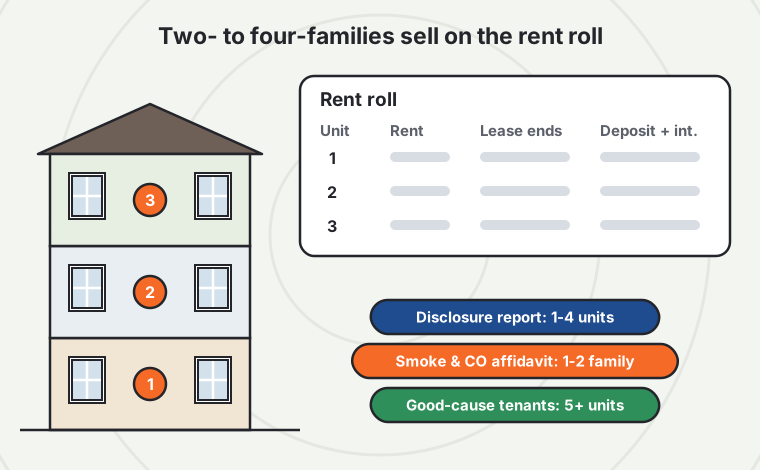
Who buys multi-families
- Owner-occupants who live in one unit and rent the others. Residential mortgages, including FHA, cover one- to four-unit buildings when the buyer lives in one of them, so these buyers often want one unit empty at closing.
- Small investors who buy for the rent. They want leases, a clean rent roll and tenants who pay.
- Cash buyers who take buildings with vacancies, deferred maintenance or problem tenancies. See our notes on selling a multi-family to an investor.
Rules that apply by building size
| Rule | 1 unit | 2 units | 3-4 units | 5+ units |
|---|---|---|---|---|
| Property Condition Disclosure Report (CGS 20-327b), or a $500 credit | Yes | Yes | Yes | No (commercial sale) |
| Smoke and CO affidavit at closing (CGS 29-453), or a $250 credit | Yes | Yes | No | No |
| Lead paint disclosure (federal, built before 1978) | Yes | Yes | Yes | Yes |
| Deposits transfer with interest (CGS 47a-21) | Yes | Yes | Yes | Yes |
| Good-cause protection for 62+ and disabled tenants (CGS 47a-23c) | No | No | No | Yes |
| Source-of-income rule (CGS 46a-64c) | Yes (room rentals in an owner’s home excepted) | Yes, except owner-occupied two-family | Yes | Yes |
Practical points for multi-family sellers
- Vacate one unit if owner-occupants are your best buyers. A buyer who plans to live in the building needs a unit to live in. Timing one lease ending (or one cash-for-keys deal) to the closing can widen your buyer pool.
- Separate meters matter. Know which utilities each tenant pays. If you pay heat for all units, buyers will price that in.
- Know your certificates. Some cities inspect or license rental units, and illegal or unpermitted units show up in title and appraisal work. Ask your town’s building and housing code offices before you list.
- Old buildings, old systems. Many Connecticut multi-families are in older cities. Expect questions about the oil tank, lead paint, knob-and-tube wiring and the roof. Our guide to oil tanks, septic, wells and radon covers the systems buyers ask about.
What documents do buyers want when you sell a rental property in Connecticut?
Buyers of a Connecticut rental want a rent roll, a copy of every lease and amendment, a list of security deposits with the interest owed, signed tenant estoppel certificates, the last year or two of income and expenses, utility and tax bills, open repair or code notices, and, for a voucher tenant, the HAP contract. Your attorney adds them to the usual seller documents.
The rental documents, one by one
| Document | What it shows | Tip |
|---|---|---|
| Rent roll | Each unit: tenant, rent, lease start and end, deposit, interest, arrears | Make it match the leases and the bank account to the dollar |
| Leases and amendments | The terms the buyer inherits | Include any side letters, pet or parking agreements, renewal options |
| Security deposit statement | Deposits held, the escrow bank, interest accrued | Needed to credit the buyer at closing (CGS 47a-21) |
| Tenant estoppel certificates | Each tenant confirms rent, deposit, lease dates and that no claims are open | Buyers’ lenders often require them; ask tenants early and politely |
| Rent ledger per unit | Charges, payments and balance | Tenants can request it too (CGS 47a-3a(d), from July 1, 2025) |
| Income and expense statement | Rents collected, taxes, insurance, utilities, repairs | Your Schedule E is a good starting point |
| HAP contract and PHA contacts | Subsidy amount and the agency | Start the change-of-ownership packet before closing |
| Open notices | Code orders, housing complaints, fair rent filings, pending court cases | Disclose them; buyers find them anyway |
| Service contracts and warranties | Boiler service, oil delivery, trash, snow | Say which ones end at closing |
For the full list of seller paperwork, see the documents you need to sell a house in Connecticut and the Connecticut property condition disclosure, section by section.
Your rental sale checklist
- Read every lease: end dates, renewal options, sale clauses, purchase options
- Check which tenants are month to month and which are protected (62+, disabled, 5+ units)
- Confirm every deposit, its escrow bank and the interest owed through closing
- Build a rent roll that matches the leases and the bank deposits
- Fix open repair requests and code items, or price them in
- Talk to each tenant before the sign goes up; agree a showing schedule in writing
- Decide the route: occupied to an investor, vacant, cash for keys, sale to the tenant, or keep
- Hire a Connecticut real estate attorney before you sign with a buyer
- For a voucher tenant, notify the housing authority and request the change-of-ownership packet
- Send tenants estoppel certificates two to three weeks before closing
- Prepare the deposit and interest credit for the closing statement
- Prorate the month’s rent and any arrears with the buyer
- Send the joint “new landlord” letter to every tenant right after closing (CGS 47a-6)
- Talk to your tax preparer about depreciation recapture and a possible 1031 exchange before you sign
How do buyers price a rental property with tenants in Connecticut?
Buyers price a Connecticut rental with tenants mostly on its income: the rents, minus taxes, insurance, repairs, vacancy and any utilities you pay, divided by the return they want. Owner-occupant buyers price an empty single-family on comparable sales instead. That is why below-market rent, a long lease or a tenant who does not pay can lower the price of an occupied house, and why a well-rented multi-family can sell well to investors.
The investor’s math, in one example
Here is how an investor looks at a two-family. Every number below is illustrative, not a quote or a market statistic.
| Line | Per year (illustrative) |
|---|---|
| Rent: $1,500 + $1,400 a month | $34,800 |
| Minus property tax, insurance, repairs, vacancy, owner-paid utilities | −$13,800 |
| Net operating income (NOI) | $21,000 |
| Value if the buyer wants a 7% return (NOI ÷ 0.07) | $300,000 |
| Value if the buyer accepts a 6% return (NOI ÷ 0.06) | $350,000 |
Two things follow. First, at a 7% return every extra $4,800 a year of net rent (about $200 a month per unit here) adds about $68,600 of value. Rent that sits far below market costs you at sale. You cannot raise rent during a lease, and any increase needs 45 days’ written notice (CGS 47a-4e), so plan ahead if you have time. Second, Connecticut property taxes are a large expense line. A building in a high-mill-rate city carries a bigger tax bill per dollar of value, which investors subtract before they price it. The town table below shows mill rates for the main rental cities.
Occupied vs. vacant: when each sells for more
- Vacant usually wins for a single-family or condo in a town where owner-occupants compete, because those buyers pay more than investors and need the house empty.
- Occupied usually wins for a multi-family with market rents and reliable tenants, because investors pay for the income and save the vacancy months.
- Occupied by a non-paying tenant sells at a discount on every route. The buyer is pricing in an eviction. Starting the legal process before you list can narrow that discount.
For a value range on your own building, use the photo tool below or our guide to what a fair offer is. To compare offers that differ on price, timing and tenant terms, see how to compare offers on a house in Connecticut.
Get a cash offer on your rental, tenants and all
Want your offer faster, or rather not talk to anyone yet? Send a few photos and the rent roll. We price the building as it stands, with the tenants in place, and you decide whether to take it, list it or keep it.
 CabinetsFlooring
 Tub & tile
 Floors
 Roof
We may bring in a partner buyer to close. Your price and terms don't change.
What taxes do you owe when you sell a rental property in Connecticut?
When you sell a rental property in Connecticut you owe the seller’s conveyance tax at closing, federal capital gains tax on your profit, federal tax of up to 25% on the depreciation you took or could have taken (unrecaptured section 1250 gain), possibly the 3.8% net investment income tax, and Connecticut income tax on the gain at your Connecticut rate, up to 6.99%. The $250,000/$500,000 home-sale exclusion usually does not apply to a rental.
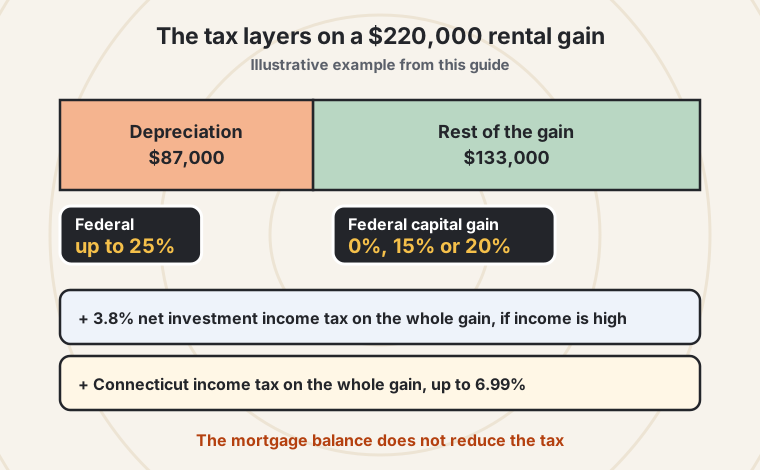
The layers, one by one
| Tax | Rate | On what | Source |
|---|---|---|---|
| Connecticut conveyance tax | 0.75% state up to $800,000 (higher above), plus 0.25% or 0.50% town | The sale price, paid at closing | CGS 12-494 |
| Unrecaptured section 1250 gain | Up to 25% | The gain equal to the depreciation allowed or allowable on the building | IRS Topic 409; Pub 544; Form 4797 |
| Long-term capital gain | 0%, 15% or 20%, by taxable income | The rest of the gain, if held more than a year | IRS Topic 409 |
| Net investment income tax | 3.8% | Investment income, including rental gains, above $200,000 of income (single) or $250,000 (married filing jointly) | IRS Topic 559 |
| Connecticut income tax | Your Connecticut rate, up to 6.99% | The gain, as ordinary income | CT DRS |
Depreciation recapture: the part landlords forget
Residential rental buildings are depreciated over 27.5 years (IRS Publication 527). Each year that depreciation lowers your taxable rental income, and it also lowers your cost basis. When you sell, the gain up to the amount of depreciation is “unrecaptured section 1250 gain”, taxed at up to 25%. The rule counts depreciation “allowed or allowable”: if you never claimed it, the IRS still treats it as taken. Your preparer reports the sale on Form 4797.
A worked example (illustrative)
A landlord bought a two-family for $260,000, of which $200,000 was the building. Depreciation of $200,000 over 27.5 years is about $7,273 a year; after 12 years that is about $87,000. The landlord sells for $420,000 and pays $27,000 in selling costs (commission, conveyance tax and attorney).
| Step | Amount (illustrative) |
|---|---|
| Sale price minus selling costs ($420,000 − $27,000) | $393,000 |
| Adjusted basis: purchase price minus depreciation ($260,000 − $87,000) | $173,000 |
| Total gain | $220,000 |
| Of which unrecaptured section 1250 gain, taxed at up to 25% | $87,000 → up to $21,750 |
| Of which long-term capital gain, at 15% (or 20%) | $133,000 → $19,950 (or $26,600) |
| Net investment income tax, if income is above the threshold (3.8% of $220,000) | up to $8,360 |
| Connecticut income tax at the top 6.99% rate | up to $15,378 |
Notice that the mortgage balance does not reduce the tax. Owners who refinanced and took cash out can owe more tax than the cash they receive at closing. Run the numbers before you sign, not after.
What if the rental used to be your home?
If you lived in the house as your main home for at least two of the five years before the sale, the home-sale exclusion of $250,000 ($500,000 for most married couples) may still apply to part of the gain (IRS Publication 523). Two limits: depreciation claimed after May 6, 1997 cannot be excluded and is taxed as above, and years of rental use after 2008 before you moved back in can reduce the exclusion. Time spent renting it out after you moved out, within the five-year window, does not count against you. If you moved out and started renting it within the last three years, talk to your preparer now: the window closes.
For the full Connecticut picture, including nonresident sellers and the conveyance tax by town, see taxes when selling a house in Connecticut and the Connecticut conveyance tax by town.
How much would you walk away with?
Slide the numbers to match your house. It works in your browser; nothing is saved or sent.
Estimates for planning. Conveyance tax per CGS 12-494 (state 0.75% up to $800,000, 1.25% to $2.5M, 2.25% above, plus the town rate). Seller attorney about $1,200 to $1,500; flat-fee MLS about $400; listings include three months of taxes, insurance and utilities, a cash sale about two weeks. Your attorney gives you the final numbers.
Can you avoid the tax with a 1031 exchange when you sell a Connecticut rental?
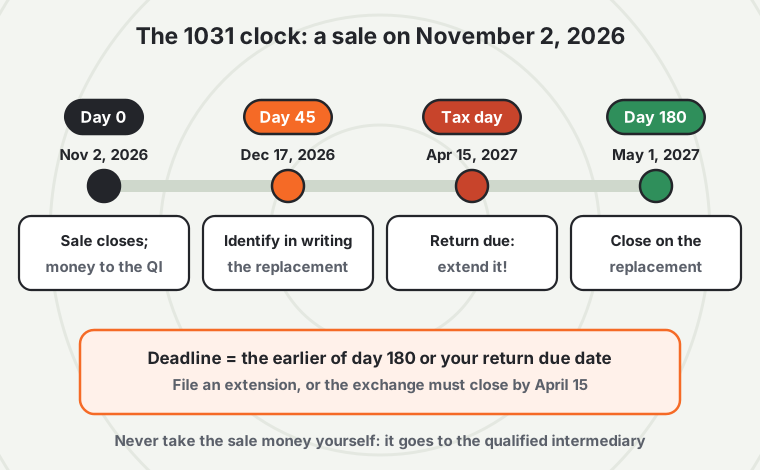
You can defer, not erase, the tax on a Connecticut rental sale with a 1031 like-kind exchange: you sell the rental through a qualified intermediary, identify replacement real estate held for business or investment in writing within 45 days, and close on it by the earlier of 180 days or your tax return’s due date (with extensions). Cash you take out is taxed, and the conveyance tax is still due at closing.
The rules that matter
- Real property only, held for business or investment. Since 2018 only real property qualifies. A rental house can be exchanged for another rental, a multi-family, land held for investment or commercial property. Your own home cannot be the replacement property.
- Never touch the money. The sale proceeds go to a qualified intermediary, not to you. If the money comes to you, the exchange fails.
- Identify in writing within 45 days after you transfer the property, with a clear description such as a street address (Form 8824 instructions).
- Receive the replacement by the earlier of 180 days after the sale or the due date, including extensions, of your tax return for the year of the sale.
- “Boot” is taxed. Cash you keep, or a smaller mortgage on the new property than on the old one, is generally taxable.
- Report it on Form 8824 with your return for the year of the sale.
A dated example
You close the sale of your rental on November 2, 2026. Day 45 is December 17, 2026: your written list of replacement properties must be with the intermediary by then. Day 180 is May 1, 2027, but your 2026 tax return is due April 15, 2027. Unless you file an extension, your exchange must close by April 15. With an extension, you have until May 1. This is the most common way exchanges fail on a technicality.
Does a cash sale work with a 1031 exchange?
Yes. The exchange is about how you handle the money and what you buy next, not about who buys your property. A cash buyer can close on a date that fits your exchange, which helps when you already have a replacement property lined up. Tell your attorney and the buyer at the start that you are doing an exchange; the contract usually includes a short clause asking the buyer to cooperate at no cost.
If you are older and plan to hold the property for life, ask your tax preparer about the step-up in basis your heirs may receive. Selling a heavily depreciated rental late in life can cost more tax than leaving it to heirs. That is a family and estate decision; it is worth one conversation before you sell.
How to sell a rental with tenants in Connecticut: step by step
To sell a rental with tenants in Connecticut, read the leases, confirm the deposits and interest, talk to the tenants, choose your route (occupied, vacant, cash for keys, to the tenant, or keep), hire a Connecticut attorney, gather the rental documents, set a showing plan, price on the rents, sign a contract that deals with the tenants and deposits, and close with a deposit credit and a new-landlord letter.
Read every lease and list every tenant
End dates, rent, deposits, renewal options, any sale clause or purchase option, and every adult who lives there. Mark which tenancies are month to month and which tenants may be protected under CGS 47a-23c.
Reconcile the deposits
Match each deposit to the escrow account, add the interest owed for each year at that year’s rate, and fix any shortfall now. You will hand the full amount to the buyer at closing.
Get tax advice before you choose
Ask your preparer to estimate the recapture and capital gains tax, and whether a 1031 exchange, a sale next year or holding makes more sense. The answer can change the route.
Talk to the tenants
Explain that the lease stays in force and the deposit transfers. Ask about their plans. A tenant who wants to move anyway can save you months; a tenant who wants to buy may be your buyer.
Choose the route
Sell occupied to investors, wait for the lease to end, agree a cash-for-keys deal, sell to the tenant, or keep the building with a manager. Use the comparison below.
Hire a Connecticut real estate attorney
Your attorney drafts or reviews the contract, handles the deposit transfer, the rent proration, the estoppel certificates and the closing, and can refer you to a landlord-tenant attorney if an eviction is needed.
Build the rental package
Rent roll, leases, deposit statement, income and expenses, utility bills, open notices and, for voucher tenants, the HAP contract. Fill in the Property Condition Disclosure Report for a one- to four-unit building.
Set the showing plan in writing
Agree windows and notice with each tenant, offer a rent credit for the disruption, and bundle the photos, appraisal and inspection.
Price it and take offers
Price on the rents for investors and on comparable sales for owner-occupants. Compare offers on net proceeds, timing, financing and what each buyer expects about the tenants.
Sign a contract that deals with the tenants
It should list the leases and deposits, say whether the buyer takes the building occupied or vacant, set the rent proration and estoppel requirements, and, for a 1031, include the cooperation clause.
Close and hand over
Deposits plus interest are credited to the buyer, rents are prorated, keys and records change hands, and you and the buyer send each tenant the new-landlord letter (CGS 47a-6).
What mistakes do Connecticut landlords make when selling a rental?
The mistakes Connecticut landlords make most often when selling a rental are trying to force tenants out because of the sale, forgetting the security deposit interest, showing the unit without proper notice, raising rent or cutting services after a repair complaint, ignoring depreciation recapture until the tax bill arrives, and promising a buyer a vacant house they cannot deliver.
| Mistake | What it can cost | Do this instead |
|---|---|---|
| Changing locks or shutting off utilities to “speed things up” | Criminal lockout charge; double damages (CGS 53a-214, 47a-46) | Notice to quit and summary process, or a written cash-for-keys deal |
| Serving your own notice to quit | A defective notice; the case is dismissed and you start over | Have a marshal serve it with the right-to-counsel notice (P.A. 25-78; CGS 47a-75) |
| Forgetting deposit interest at closing | $10 or twice the interest; buyer and tenant disputes | Calculate interest year by year and credit it to the buyer |
| Promising “delivered vacant” in the contract | A breach if the tenant does not leave in time | Promise vacancy only after the tenant has left, or make it a condition with a deadline |
| Showing without notice, or every day | At least one month’s rent plus fees (CGS 47a-18a) | A written showing schedule with reasonable notice |
| Raising rent or filing after a repair complaint | A retaliation defense for six months (CGS 47a-20) | Fix the repair first; document everything |
| Ignoring depreciation recapture | Tax of up to 25% on the depreciation, even if never claimed | Get a tax estimate before you choose a route |
| Marketing “no Section 8” | Discrimination complaint (CGS 46a-64c) | Market to all buyers; disclose the HAP contract |
For a house a tenant has damaged, see what to do when your last tenant trashed your Connecticut house; for what to repair and what to leave, see what to fix before selling a house in Connecticut.
When is a cash sale the right way to sell a rental in Connecticut, and when is it not?
A cash sale is the right way to sell a Connecticut rental when the tenant is behind or uncooperative, the building needs work lenders will not finance, you need a fixed closing date or a 1031 deadline, or you are tired of managing from far away. It is not the right way when the building is in good shape with paying tenants and market rents: then listing it to investors on the MLS, or keeping it with a manager, usually leaves you more.
List it (occupied or vacant)
Top pricefor a building in good shape with paying tenants or a vacant single-family
- Commission and a longer timeline
- Showings with tenants in place
- Buyer financing and appraisal risk
Keep it with a manager
Income stayswhen the numbers work and the work is the problem
- No sale costs or tax now
- Management fee
- You keep the repair risk
Sell for cash, as-is
Certaintywhen tenants, repairs or a deadline make listing hard
- Tenants stay in place; no showings circus
- Lower price than a retail sale
- Check the buyer before you sign
If you are weighing a cash offer, compare it with a listing on net proceeds after commission, months of carrying costs and the repairs a retail buyer will ask for, and check the buyer: proof of funds, a real Connecticut attorney, and no request for a large fee from you. Our guide to checking a cash home buyer in Connecticut and guide to cash home buyers in Connecticut cover both, and cash buyer vs. realtor in Connecticut compares the routes side by side. If the buyer is a wholesaler who will assign your contract, read what to expect when selling to a wholesaler first.
Two special cases. If you are selling because you are moving away, our guide to selling a Connecticut house when you relocate covers renting it out vs. selling and managing a sale from out of state. If the rental is behind on its mortgage, read selling a house in foreclosure in Connecticut before you do anything else: timing matters.
See the house together.
Pick a time that works.
Choose a time for us to walk through the property with you, or ask for a quick call first. We confirm every request personally.
Tuesday, January 13
No open times in the next few weeks. Please call us.
We will confirm by email. Nothing is booked until we do.
View my requestConnecticut rental cities: prices, mill rates and conveyance tax
Connecticut’s main rental cities differ a lot in price, property tax and conveyance tax, and investors price all three in. The table shows recorded sales and median prices for October 2024 to September 2025, the fiscal 2027 mill rate, the town conveyance tax rate and the share of single-family homes built before 1960, from state data, with a link to each town page.
| Town | Homes sold (Oct 2024-Sep 2025) | Median sale price | Mill rate (FY 2027) | Town conveyance tax | Single-family homes built before 1960 |
|---|---|---|---|---|---|
| Hartford | 825 | $290,000 | 69.95 | 0.50% | n/a |
| New Haven | 1,022 | $350,000 | 39.962 | 0.50% | 83% |
| Bridgeport | 1,166 | $374,500 | 27.95 | 0.50% | 74% |
| Waterbury | 1,305 | $270,000 | 43.34 | 0.50% | 56% |
| New Britain | 768 | $300,000 | 39.18 | 0.50% | 78% |
| Norwich | 712 | $261,000 | 34.15 | 0.50% | 64% |
| Meriden | 749 | $300,000 | 29.99 | 0.50% | n/a |
| East Hartford | 614 | $282,750 | 47.24 | 0.50% | n/a |
| Bristol | 882 | $317,500 | 35.3 | 0.50% | 46% |
| Hamden | 810 | $339,950 | 53.67 | 0.50% | 67% |
| Manchester | 724 | $315,000 | 41.00 | 0.25% | 60% |
| Ansonia | 185 | $390,000 | 29.46 | 0.25% | 63% |
| Derby | 157 | $329,990 | 38.44 | 0.25% | 51% |
A high mill rate means a bigger tax line in an investor’s numbers; a 0.50% town conveyance rate means a bigger closing cost for you. Older housing stock means more questions about oil tanks, lead paint and wiring. Each town page has the details and the local sales.
Questions Connecticut landlords ask about selling a rental with tenants
Can a landlord sell a house with tenants in Connecticut?
Yes, a landlord can sell a house with tenants in Connecticut. The sale does not end the lease; the buyer becomes the landlord on the same terms and takes over the security deposits with interest.
Do tenants have to move out when a house is sold in Connecticut?
No, tenants do not have to move out when a house is sold in Connecticut. A fixed-term lease runs to its end date, and a month-to-month tenancy continues until it is ended with a notice to quit for a lawful reason. A sale is not, by itself, a reason to evict.
How much notice does a Connecticut landlord have to give to show the house?
A Connecticut landlord has to give reasonable written or oral notice and come at reasonable times to show the house (CGS 47a-16). The statute does not set a number of hours; 24 hours is a common lease term and practice. In an emergency, no notice is needed.
Can my tenant refuse showings?
Your tenant cannot unreasonably refuse showings to prospective buyers in Connecticut. If a tenant does, you can ask the court for an order giving access or ending the rental agreement, plus damages and attorney’s fees (CGS 47a-18). Talking first and offering a rent credit usually works better.
What happens to the security deposit when a rental is sold in Connecticut?
When a rental is sold in Connecticut, the seller must deliver every security deposit plus accrued interest to the buyer (CGS 47a-21(h)(3)). The buyer then owes the tenant its return when the tenancy ends, and must tell the tenant within 30 days where the deposit is held.
What is the security deposit interest rate in Connecticut for 2026?
The security deposit interest rate in Connecticut for 2026 is 0.49%, the deposit index set by the Banking Commissioner. The 2025 rate was 0.52%. Interest is paid or credited each year on the tenancy’s anniversary.
How long does a landlord have to return a security deposit in Connecticut?
A landlord in Connecticut has 21 days after the tenancy ends, or 15 days after receiving the tenant’s forwarding address in writing, whichever is later, to return the deposit with interest or send an itemized list of deductions. Missing it can cost twice the deposit.
Can I evict a tenant because I want to sell?
You cannot evict a tenant in Connecticut simply because you want to sell. You can end a month-to-month tenancy or a lease that has ended for “lapse of time” with a notice to quit, except for tenants protected under CGS 47a-23c, and then go to housing court if the tenant stays.
How long is a notice to quit in Connecticut?
A notice to quit in Connecticut must give at least three days before the quit date (CGS 47a-23), and it must be served by a marshal with the right-to-counsel notice attached. For nonpayment, it can only be served after the 9-day grace period; covered federally backed properties may need a 30-day notice.
Is cash for keys legal in Connecticut?
Yes, cash for keys is legal in Connecticut when it is voluntary and in writing. The landlord pays the tenant to move out by an agreed date, paid at the key handover. The security deposit and interest are still due under the normal rules.
Can I sell a house with a Section 8 tenant in Connecticut?
Yes, you can sell a house with a Section 8 tenant in Connecticut. The HAP contract can be assigned to the buyer with the housing authority’s written consent, and the buyer must agree to be bound by it. Refusing a buyer or tenant because of a voucher is illegal under CGS 46a-64c.
Does the Property Condition Disclosure Report apply to a rental?
Yes, the Property Condition Disclosure Report applies to a Connecticut rental of one to four units, unless the transfer is exempt. If you do not deliver it, you credit the buyer $500 at closing (CGS 20-327b, 20-327c). Fill it in as honestly as you can, even if you have not lived there.
Do I owe depreciation recapture if I never claimed depreciation?
Yes, you generally owe tax on depreciation you could have claimed even if you never claimed it, because the IRS counts depreciation “allowed or allowable”. The gain equal to that depreciation is taxed at up to 25%. Your preparer may be able to catch up on missed depreciation before the sale.
Can I use a 1031 exchange if I sell to a cash buyer?
Yes, you can use a 1031 exchange if you sell to a cash buyer. The exchange depends on a qualified intermediary holding the proceeds and on the 45-day and 180-day deadlines, not on who buys your property. Add a cooperation clause to the contract.
Does Connecticut tax the gain on a rental sale?
Yes, Connecticut taxes the gain on a rental sale as income, at your Connecticut rate of up to 6.99%. Connecticut also charges the seller’s conveyance tax at closing: 0.75% state on most homes plus 0.25% or 0.50% town.
Should I sell my rental occupied or vacant?
You should usually sell a single-family or condo vacant if owner-occupants are the likely buyers, and a multi-family occupied if the tenants pay market rent. A non-paying tenant lowers the price on every route; starting the legal process early helps.
Can I raise the rent before I sell to get a better price?
You can raise the rent only at the end of a lease or on a month-to-month tenancy, with at least 45 days’ written notice (CGS 47a-4e). A rent increase within six months after a good-faith repair complaint can be challenged as retaliation (CGS 47a-20).
What is a tenant estoppel certificate?
A tenant estoppel certificate is a short signed statement in which the tenant confirms the rent, the deposit, the lease dates and that there are no open claims. Buyers and their lenders often ask for one before closing on a rental.
What if my tenant wants to buy the house?
If your tenant wants to buy the house, treat it as a normal sale: a written contract through attorneys, a deadline for mortgage approval, and the lease kept separate. If the financing fails, the tenancy simply continues on its terms.
Can I sell a rental while an eviction case is pending?
Yes, you can sell a Connecticut rental while an eviction case is pending, but tell your attorney and the buyer. The buyer may take over the case, wait for the outcome, or price in the risk. A court stipulation with a move-out date makes the sale easier to plan.
Related Connecticut guides for landlords
Tenants and landlording
Money and taxes
If you are still deciding, our guide to how to sell a house in Connecticut walks through every route, and the guide to how long it takes to sell a house in Connecticut shows the clock for each one.
Sources
- Connecticut General Statutes, chapter 830 (landlord and tenant): § 47a-3b, 47a-3d, 47a-4e (45-day rent increase notice), 47a-6 (identification of landlord), 47a-15 (cure notice), 47a-15a (grace period, late fees), 47a-16 (entry), 47a-18 and 47a-18a (court relief), 47a-20 and 47a-20a (retaliation); and the 2026 Supplement (§ 47a-3a(d) ledger, P.A. 25-146; § 47a-15a extension, Nov. Sp. Sess. P.A. 25-1).
- CGS chapter 831, § 47a-21 (security deposits: maximums, escrow, transfer to a successor, notice, 21-day return, interest; P.A. 23-207).
- CGS chapter 832 (summary process): § 47a-23 (notice to quit; service by a proper officer, P.A. 25-78), 47a-23a, 47a-23c, 47a-26, 47a-26b, 47a-35, 47a-37, 47a-39, 47a-42 (as amended by P.A. 25-78).
- CGS chapter 833 (entry and detainer, § 47a-43 and 47a-46) and chapter 834 (§ 47a-75, right to counsel in eviction proceedings).
- CGS § 53a-214 (criminal lockout) and CGS § 46a-64c (discriminatory housing practices, lawful source of income).
- Connecticut Department of Banking, 2026 deposit index (0.49%) and deposit index and interest rates by year.
- Connecticut Judicial Branch, A Landlord’s Guide to Eviction (Summary Process), Self-Represented Parties: Residential Summary Process (Landlord) and court fees (summary process entry fee $175).
- 24 CFR 982.310 (Housing Choice Voucher: owner termination of tenancy, notice to the PHA).
- IRS Topic 409, Capital gains and losses (unrecaptured section 1250 gain, maximum 25%); IRS Topic 559, Net investment income tax; Publication 527, Residential Rental Property; Publication 544, Sales and Other Dispositions of Assets; Publication 523, Selling Your Home.
- IRS Instructions for Form 8824, Like-Kind Exchanges (45-day identification, 180-day or return due date, qualified intermediaries).
- CGS § 12-494 (conveyance tax) and OLR Report 2020-R-0020; CGS § 20-327b and 20-327c (property condition disclosure); CGS § 29-453 (smoke and CO affidavit); EPA lead disclosure rule.
- Federal Register, March 25, 2024 (USDA Rural Housing Service final rule describing the CARES Act § 4024(c) 30-day notice as a continuing statutory requirement) and 15 U.S.C. § 9058(c).
- Town sales, mill rates and housing data: Connecticut Office of Policy and Management, published on data.ct.gov (real estate sales Oct 2024-Sep 2025, fiscal 2027 mill rates, 2025 parcel data).

Who wrote this
Jerryll Noorden
Jerryll has bought and sold Connecticut houses since 2016 and has sat at more closing tables than he can count, on both sides. Before real estate he was a robotics scientist at NASA, IHMC and IIT. He wrote this guide because the national sites that rank for it skip the Connecticut rules that cost sellers money. When listing or selling it yourself would get you more than a cash offer, he says so.
This guide explains Connecticut rules in plain English. It is not legal or tax advice. Laws change; for your sale, talk to a Connecticut real estate attorney and a tax professional.
