
- Part of our guide to how to sell a house in Connecticut, for landlords. Your tenant gets a 9-day grace period (4 days for a week-to-week tenancy) before unpaid rent lets you end the tenancy, plus 5 more days in any month your own online payment system blocked the payment (CGS 47a-15a).
- The first legal step is a written notice to quit (court form JD-HM-7), served by a state marshal at least three full days before the quit date, with the state’s right-to-counsel notice attached (CGS 47a-23, 47a-75).
- If the tenant stays, you file summary process in housing court: summons JD-HM-32 and nonpayment complaint JD-HM-8, a $175 entry fee, then a default, a mediated agreement or a trial.
- Uncontested cases take about 5 to 8 weeks from the missed rent; contested ones often 2 to 4 months or more (est.). After a nonpayment judgment, a stay can add up to 3 months, and only if the tenant deposits the full arrearage (CGS 47a-37, 47a-39).
- Never change the locks, shut off utilities or remove belongings. That is criminal lockout and can cost you double damages (CGS 53a-214, 47a-46).
- You do not have to finish an eviction to sell. A Connecticut rental can be sold with the tenant still inside; the buyer takes over the lease, the deposit and the problem.
What can you do when a tenant is not paying rent in Connecticut?
When a tenant is not paying rent in Connecticut, you can wait out the 9-day grace period, try a written payment plan, then serve a notice to quit through a state marshal and file a summary process (eviction) case in housing court if the tenant stays. You can also offer cash for keys or sell the building with the tenant in place. You cannot lock the tenant out or cut off utilities.
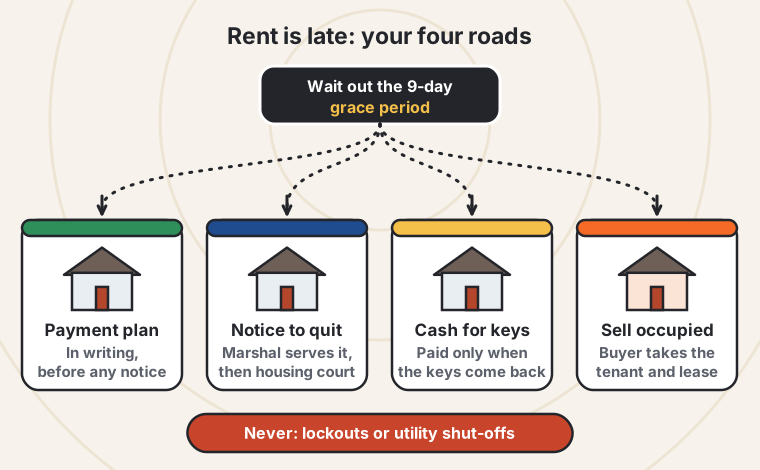
This page is the nonpayment chapter of our guide to how to sell a house in Connecticut. Our landlord’s guide, selling a rental property with tenants in Connecticut, already explains every eviction ground, Section 8 tenancies and how leases and deposits pass to a buyer. Here we go deep on one problem: the rent stopped. You will find the exact rules, the court forms, what each month costs you, how to get some of the money back, and how to decide between fighting it out and selling.
A quick word on who is writing. I am Jerryll Noorden. I have bought houses in Connecticut since 2016, many of them two- and three-families in towns like Hartford, New Britain and Waterbury, often with tenants still inside. I am not a lawyer, and nothing here is legal advice. Every legal rule below links to the statute or the Judicial Branch page it comes from, so you or your attorney can check it.
Why does a tenant who stops paying feel so personal, and is this page for you?
A tenant who stops paying feels personal because you are still paying the mortgage, the taxes and the insurance on the unit they live in, often after you did them favors. It is normal to feel angry, trapped, guilty and tired all at once. This page is for Connecticut landlords who want the legal steps, the real numbers and an honest look at every way out.
Maybe you own a three-family in Hartford’s North End or a two-family off Arch Street in New Britain. Maybe it was your parents’ house and you became a landlord by accident. You fixed the leak the same week. You let the rent slide once when they had a hard month. Now the texts go unanswered, or you get a promise for Friday that never comes.
Meanwhile the bills do not wait. Hartford’s mill rate for fiscal 2027 is 69.95, among the highest in Connecticut. On a $260,000 property that is about $12,730 a year in taxes, roughly $1,060 a month, before the mortgage, insurance, water and sewer. One unit’s rent is often the whole margin.
Here is what we want you to know first. This happens to careful landlords with signed leases and good screening. It is not a failure of character. And it is solvable: Connecticut’s process is slow in places but it is predictable, and there is more than one exit. If you are reading this at the kitchen table with your rent ledger open, this page is for you. Read the rules once, pick a road, and write your dates on a calendar.
What are the Connecticut rules for a tenant who does not pay rent?
The Connecticut rules for a tenant who does not pay rent are in Title 47a of the General Statutes: a 9-day grace period and a capped late fee (47a-15a), a written notice to quit served by a marshal with at least three days to leave (47a-23), the right-to-counsel notice (47a-75), summary process in housing court (47a-23a to 47a-26b), stays of execution (47a-35 to 47a-39) and a ban on lockouts (47a-43, 47a-46, 53a-214).
| Rule | What it means for you | Statute or source |
|---|---|---|
| Rent is due without demand | Rent is payable at the agreed time and place without a reminder; if the lease is silent, at the start of each month at the unit | CGS 47a-3a(a)-(b) |
| Ledger on request | The tenant can ask for a copy of the ledger showing charges, payments and the balance; cash payments need a written receipt | CGS 47a-3a(c)-(d) (ledger rule since July 1, 2025) |
| Grace period | 9 days after the due date (4 days for a one-week tenancy) before nonpayment can end the tenancy; 5 more days for any month your own online rent payment system prevented payment | CGS 47a-15a(a), as amended effective Jan. 1, 2026 |
| Late fee cap | Only if the lease allows it, only after the grace period, and no more than the lesser of $5 a day up to $50, or 5% of the late rent; one late fee per late payment | CGS 47a-15a(b) |
| Payments go to rent first | Every payment is applied to rent first, then to other fees | CGS 47a-7d(e) |
| Accepting late rent can waive the eviction | Taking overdue rent while knowing it is overdue waives your right to end the tenancy for that missed rent | CGS 47a-19 |
| Notice to quit | Written, naming the address and the reason in the statute’s words, giving at least three days before the quit date; an attested copy served by a proper officer (a state marshal) | CGS 47a-23(a)-(c), as amended by PA 25-78; form JD-HM-7 |
| Right-to-counsel notice | The Judicial Branch’s one-page notice must be attached to the notice to quit and to the summons and complaint | CGS 47a-75(f) |
| Federal 30-day notice | For properties with a federally backed mortgage or in covered federal housing programs, a tenant cannot be required to vacate for nonpayment until 30 days after a notice to vacate | CARES Act, 15 U.S.C. 9058(c); court form JD-HM-41 |
| Summons and complaint | May be returnable six days, inclusive, after service and returned to court at least three days before the return day | CGS 47a-23a; forms JD-HM-32 and JD-HM-8 |
| Default | If the tenant does not appear within two days after the return day, the court enters judgment for possession by the next court day after your motion | CGS 47a-26; form JD-HM-9 |
| Use and occupancy | If the tenant appears, the court can order the last agreed rent paid into court while the case is pending | CGS 47a-26b; form JD-HM-27 |
| Automatic stay | Execution is stayed five days after judgment (Sundays and legal holidays excluded); appeals must be filed in that window | CGS 47a-35 |
| Nonpayment stay | The tenant can apply for a longer stay only after depositing the full arrearage within five days of judgment; the total stay cannot exceed three months for nonpayment | CGS 47a-37, 47a-39; form JD-HM-21 |
| Eviction by marshal only | A state marshal removes occupants and belongings under a court execution, after at least 24 hours’ notice; you pay the marshal and can recover the cost | CGS 47a-42; form JD-HM-2 |
| No self-help | Lockouts, utility shut-offs and removing belongings are criminal lockout and give the tenant a claim for double damages | CGS 53a-214, 47a-43, 47a-46 |
| Retaliation | Evictions soon after a good-faith tenant complaint can be challenged, but nonpayment of rent is an exception | CGS 47a-20, 47a-20a |
Three changes most landlord websites have not caught up with. Since Public Act 25-78, you cannot hand the notice to quit to the tenant yourself; an attested copy must be served by a proper officer, in practice a state marshal (CGS 47a-23(c)). Since January 1, 2026, the grace period is five days longer for any month in which your own online payment portal blocked the payment, and nonpayment is not a ground for that month until the extension runs (CGS 47a-15a, 47a-23(a)(1)(D)). And since July 1, 2025, a tenant can ask you for a copy of the rent ledger (CGS 47a-3a(d)). Keep that ledger clean; it becomes your evidence.
What should you do in the first two weeks after a tenant misses rent?
In the first two weeks after a tenant misses rent in Connecticut, update your ledger, contact the tenant in writing, offer a written payment plan if it makes sense, check whether your loan triggers the federal 30-day notice, and line up a marshal and an attorney. If rent is due on the 1st, the grace period runs through the 10th, so the earliest day to serve a notice to quit is the 11th.
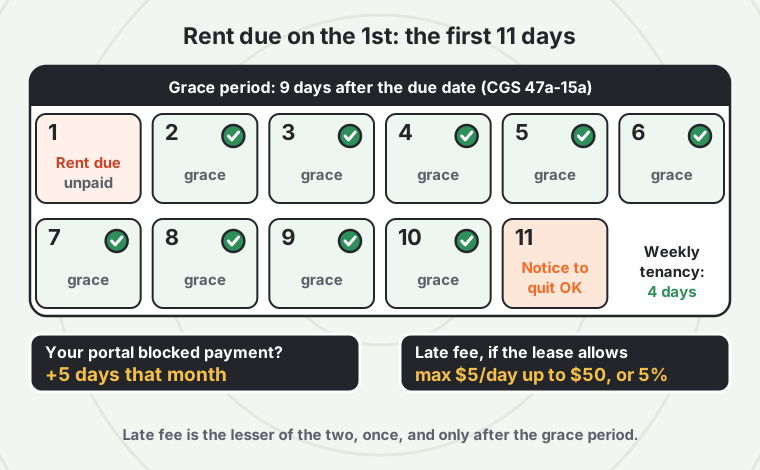
Day 1 to day 10: document and talk
- Write it down. Record every charge and payment, with dates. If the tenant pays cash, give a written receipt (CGS 47a-3a(c)). A clean ledger wins cases; a messy one invites a defense.
- Reach out once, in writing. A short text or letter: rent was due on the 1st, the amount, and a request to call. Ask what happened. A lost job, a hospital stay or a late benefit check is a different problem from a tenant who simply stopped.
- Do not charge a late fee yet. Late fees are allowed only if the lease says so, only after the grace period, and only up to the lesser of $5 a day (maximum $50) or 5% of the late rent (CGS 47a-15a(b)).
- Check your loan. If the building has an FHA, VA, USDA, Fannie Mae or Freddie Mac loan, or takes part in a covered federal housing program, the CARES Act 30-day notice to vacate may apply (15 U.S.C. 9058(c)). Ask your lender or servicer, or have your attorney look it up, before you serve anything.
- Look for repair complaints. Open requests or code complaints do not stop a nonpayment case the way they can stop other evictions (CGS 47a-20a), but a tenant can raise conditions as a defense or in a separate action. Fix what is open.
Should you agree to a payment plan?
Often, yes, if the tenant has a real way to catch up. A plan can get you paid without a court case. Put it in writing: the total owed, the amounts and dates, that current rent stays due on time, and what happens if a payment is missed. Both of you sign.
Know the trap. Accepting overdue rent while knowing it is overdue waives your right to end the tenancy for that missed rent (CGS 47a-19). So agree on the plan before you serve a notice to quit, or talk to your attorney about doing it inside the court case as a stipulation, where the housing mediator writes it up and the judge can enforce it.
Day 11 and after: decide
If rent is still unpaid after the grace period and there is no plan, decide that week. Every week you wait is another week of rent you probably will not see. The legal road starts with the notice to quit. If you are leaning toward selling, you can start that conversation the same day; the two do not exclude each other.
How do you serve a notice to quit for nonpayment in Connecticut?
To serve a notice to quit for nonpayment in Connecticut, complete the Judicial Branch form JD-HM-7 with each adult occupant’s name, the full address with unit number, a quit date at least three full days away and the reason “nonpayment of rent”, attach the right-to-counsel notice, and have a state marshal serve an attested copy. Covered federal properties need a 30-day notice to vacate instead of three days.
- Who signs. The owner or lessor, their legal representative, or their attorney (CGS 47a-23(a)).
- Who is named. Every adult tenant and occupant. If you know someone lives there but not their name, the statute lets you use “John Doe” or “Jane Doe” (CGS 47a-23(b)).
- The reason. Use the statute’s words: nonpayment of rent. Do not mix in a long story.
- The date. At least three full days between service and the quit date. Many attorneys add a day or two of margin so a counting error cannot sink the case.
- The attachment. The right-to-counsel notice from jud.ct.gov, because tenants with household income at or below 80% of the state median, or who receive certain benefits, can get a free lawyer (CGS 47a-75).
- Service. Give the signed notice and copies to a state marshal. The marshal serves each occupant or leaves it at the unit and returns the original to you endorsed; you need that endorsed copy later. The fee is set by statute per service plus mileage (CGS 52-261); ask the marshal for a quote.
For a month-to-month or week-to-week tenancy, a nonpayment notice to quit ends the tenancy for that period, turns it into a tenancy at sufferance, and still works if you serve it in the month after the missed rent (CGS 47a-23(d)). And if you expect the tenant to offer money after the quit date, your attorney can add the statutory use-and-occupancy disclaimer to the notice, which lets you accept payments “for use and occupancy only and not for rent, with full reservation of rights” without restarting (CGS 47a-23(e)).
If the CARES Act applies, the notice must give at least 30 days to vacate; the court also has a CARES Act affidavit of compliance, form JD-HM-41. The statute lets a federal notice be combined with the state notice to quit (CGS 47a-23(e)). If you are not sure whether your building is covered, assume your attorney needs to check, because a defective notice means starting over.
How does summary process work for nonpayment of rent in Connecticut?
Summary process for nonpayment of rent in Connecticut starts after the quit date passes: you issue a summons (JD-HM-32) and a nonpayment complaint (JD-HM-8), a marshal serves them with the right-to-counsel notice, and you file in housing court with the $175 entry fee. If the tenant does not appear you move for a default judgment; if they appear, the case usually goes to a housing mediator, then to trial if it does not settle.
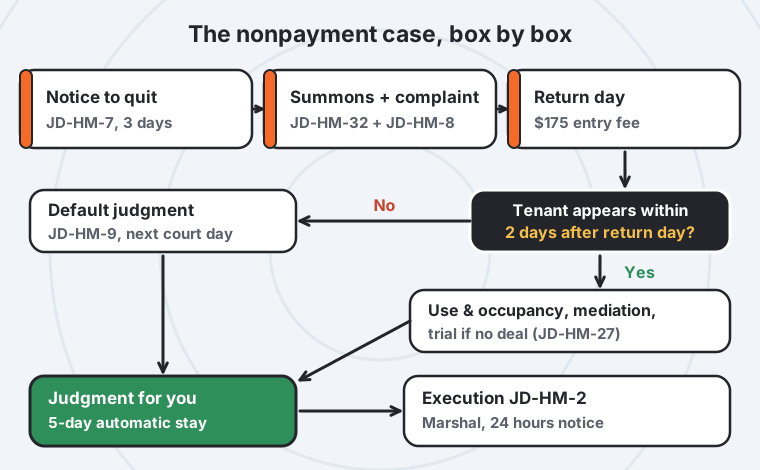
Summons and complaint
Once the quit date has passed and the tenant is still there, you or your attorney prepare the summons (JD-HM-32) and the nonpayment complaint (JD-HM-8). The complaint can be made returnable six days, inclusive, after service and must be returned to court at least three days before the return day (CGS 47a-23a). Attach the endorsed notice to quit and the right-to-counsel notice. A marshal serves the tenant.
Filing
File in the housing session for the town where the property is, with the $175 summary process entry fee (CGS 52-259). Hartford, New Britain, New Haven, Bridgeport, Waterbury and Stamford-Norwalk have housing dockets (CGS 47a-70); towns elsewhere file in the judicial district where the property is.
The tenant’s appearance
The tenant has until two days after the return day to file an appearance. If they do not, file a motion for default for failure to appear (JD-HM-9) with the endorsed notice to quit, and the court enters judgment for possession by the next court day (CGS 47a-26).
Use and occupancy payments
If the tenant appears, file a motion for use and occupancy (JD-HM-27). Unless the tenant objects within five days, the court orders the last agreed rent deposited with the court within ten days of the motion, for as long as the case lasts (CGS 47a-26b). This is the single best tool to stop the bleeding in a contested case.
Mediation
Contested cases usually go to a Judicial Branch housing mediator first (CGS 47a-69). Many nonpayment cases end here in a stipulation: the tenant pays the arrears on a schedule and stays, or agrees to move by a date, sometimes with rent forgiven. The judge enters it as a judgment (JD-HM-13). If the tenant breaks it, you file an affidavit of noncompliance (JD-HM-22) instead of starting over.
Trial and judgment
If mediation fails, the judge hears the case. You prove the tenancy, the missed rent, the expired grace period, the notice to quit and that the tenant stayed. The tenant can raise defenses in an answer (JD-HM-5): a defective notice, rent paid or tendered, waiver by accepting rent, or serious code violations. Bring the lease, the ledger, the endorsed notice and your texts.
Summary process gives you possession. It does not, by itself, give you a money judgment for the back rent; that is a separate claim, covered below.
You are allowed to file summary process yourself, and the Judicial Branch publishes the forms. But nonpayment cases are lost on technicalities: a wrong date, a missing attachment, a payment accepted at the wrong time. More tenants now have free lawyers through the right-to-counsel program, so a landlord without one is often the only unrepresented person in the room. For a first eviction, an attorney who does summary process every week is usually money well spent.
What happens after a nonpayment judgment: stays, execution and the state marshal?
After a nonpayment judgment in Connecticut, execution is automatically stayed for five days, not counting Sundays and legal holidays. The tenant can ask for a longer stay only by depositing the full arrearage with the court within those five days, and a nonpayment stay cannot exceed three months in total. When the stays end, you get an execution and a state marshal removes the occupants after at least 24 hours’ notice.
- The five-day stay. Automatic, and the window for any appeal (CGS 47a-35).
- The longer stay. For nonpayment judgments, the tenant must first deposit the full arrearage with the clerk within five days; the clerk pays it to you under the court’s order (CGS 47a-37). The court may then grant a stay if the tenant cannot find comparable housing despite diligent effort, up to three months total for nonpayment (CGS 47a-39). The application is form JD-HM-21. Put plainly: a nonpayment stay usually means you got paid the arrears.
- The execution. You ask the clerk for the summary process execution (JD-HM-2) and give it to a marshal. The marshal notifies the town’s chief executive officer, then serves the tenant and occupants at least 24 hours before the removal (CGS 47a-42).
- Belongings. The marshal delivers belongings to the town’s designated storage place, not the curb. Unclaimed property can be sold by the town after 15 days. You pay the marshal for the removal and can recover that cost from the tenant (CGS 47a-42(c)).
- Do not sit on it. An execution cannot be issued more than six months after the judgment, not counting time the judgment was stayed (CGS 47a-41a).
Can you change the locks or shut off utilities on a tenant who will not pay?
No. In Connecticut you cannot change the locks, shut off heat, water or electricity, remove doors or put a non-paying tenant’s belongings out without a court execution. Doing so is criminal lockout, a class C misdemeanor, and the tenant can sue under the entry and detainer statute for double damages and costs. Only a state marshal with an execution can remove a tenant.

We hear the “just change the locks” advice all the time, usually from someone who owns rentals in another state. In Connecticut it backfires fast. The tenant can file a verified lockout complaint (JD-HM-24) and get a judge to restore them to the unit within days, the police can charge you under CGS 53a-214, and the double-damages claim under CGS 47a-46 can wipe out more than the rent you were owed. A buyer’s attorney who learns about a lockout will also slow your sale down. Keep every step inside the court process, even when it feels unfair.
How long does an eviction for nonpayment take in Connecticut?
An eviction for nonpayment in Connecticut takes about 5 to 8 weeks from the missed rent when the tenant does not respond, and often 2 to 4 months or more when the tenant appears, mediates or goes to trial (est.). A nonpayment stay can add up to 3 months, and a CARES Act 30-day notice adds about 4 weeks. Court calendars and marshal schedules decide the rest.

| Step | Statutory minimum | Realistic (est.) | Rule |
|---|---|---|---|
| Grace period | 9 days after the due date (4 weekly; +5 if your portal failed) | 9 days | CGS 47a-15a |
| Notice to quit to quit date | 3 full days (30 days if CARES Act applies) | 1 to 2 weeks, including getting a marshal | CGS 47a-23; 15 U.S.C. 9058(c) |
| Summons served to return day | 6 days, inclusive | 1 to 2 weeks | CGS 47a-23a |
| Appearance deadline, then default | 2 days after the return day; judgment by the next court day | Several days to 2 weeks | CGS 47a-26 |
| Mediation and trial (if contested) | No fixed minimum | 3 to 10 weeks | CGS 47a-69; court calendar |
| Automatic stay after judgment | 5 days, excluding Sundays and holidays | About 1 week | CGS 47a-35 |
| Longer stay (nonpayment) | Only if the full arrearage is deposited | 0 to 3 months | CGS 47a-37, 47a-39 |
| Execution and marshal | At least 24 hours’ notice to the tenant | 1 to 3 weeks to schedule | CGS 47a-42 |
Two things stretch cases the most: the tenant getting a lawyer (more motions and a later trial date) and stipulations that are broken and restored. Two things shorten them: a clean notice the first time, and a use-and-occupancy order early, because a tenant who must pay into court anyway often prefers to settle on a move-out date. For how this compares with the time to sell, see how long it takes to sell a house in Connecticut.
How much does a nonpayment eviction cost a Connecticut landlord?
A nonpayment eviction costs a Connecticut landlord the $175 court entry fee, marshal fees for the notice, the summons and the eviction, attorney’s fees, and above all the rent lost while the case runs. In our illustrative Hartford example the total comes to about $9,475 to $15,875 (est.), while the building’s taxes, insurance and mortgage keep running.
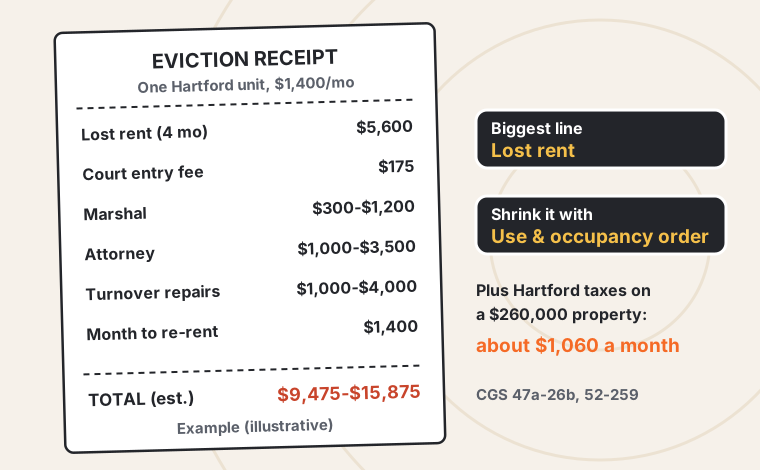
Example (illustrative). One unit in a Hartford three-family, rent $1,400 a month (assumed). The tenant misses rent, appears in court, and the case ends about three months later. These are labelled inputs, not quotes; get real ones from your attorney and marshal.
| Cost item | Low (est.) | High (est.) | Note |
|---|---|---|---|
| Lost rent: the missed month plus about 3 months of case | $5,600 | $5,600 | 4 x $1,400; less any use and occupancy the court orders paid in |
| Summary process entry fee | $175 | $175 | CGS 52-259 (can be waived for low-income filers) |
| Marshal: notice to quit, summons, eviction | $300 | $1,200 | Statutory service fees plus mileage (CGS 52-261); removal paid by you, recoverable (CGS 47a-42) |
| Landlord’s attorney | $1,000 | $3,500 | Flat fees are common for defaults; contested cases cost more |
| Turnover: cleaning, paint, small repairs | $1,000 | $4,000 | Deduct only damage beyond normal wear from the deposit |
| Month to re-rent the unit | $1,400 | $1,400 | One month vacant at $1,400 |
| Total | $9,475 | $15,875 | Before your own carrying costs |
Now add what the building costs you while the unit pays nothing. Property tax in Connecticut is the mill rate times 70% of the appraised value. At Hartford’s 69.95 mills, a property appraised at $260,000 pays about $12,730 a year, roughly $1,060 a month. In New Britain (39.18 mills) the same calculation on $285,000 is about $650 a month; in Waterbury (43.34 mills) on $280,000 it is about $710 a month. Your building’s own assessment decides your number.
If you are weighing whether to keep or sell, run your own figures in the calculator below: price, payoff, the town’s conveyance tax and your costs.
How much would you walk away with?
Slide the numbers to match your house. It works in your browser; nothing is saved or sent.
Estimates for planning. Conveyance tax per CGS 12-494 (state 0.75% up to $800,000, 1.25% to $2.5M, 2.25% above, plus the town rate). Seller attorney about $1,200 to $1,500; flat-fee MLS about $400; listings include three months of taxes, insurance and utilities, a cash sale about two weeks. Your attorney gives you the final numbers.
Can you recover the unpaid rent from a Connecticut tenant?
You can try to recover unpaid rent from a Connecticut tenant by applying the security deposit to it after move-out and suing for the rest, in small claims for up to $5,000 or in Superior Court above that. Summary process gets you possession, not money. Collecting a judgment takes wage, bank or property executions, and many former tenants have little to collect from, so weigh the cost first.
- Use and occupancy first. Money the court orders paid in during the case (CGS 47a-26b) is the most reliable money you will see.
- The security deposit. Unpaid rent is one of the “tenant’s obligations” you may deduct (CGS 47a-21(a)(14)). Return the balance with interest and an itemized statement within 21 days after the tenancy ends, or 15 days after you receive a forwarding address, whichever is later. Miss that and you can owe twice the deposit (CGS 47a-21(d)(2)). Details in our guide to what to do when a tenant trashed your Connecticut house.
- Small claims. Up to $5,000, $95 entry fee, form JD-CV-40; landlord-tenant small claims go to the housing session where there is one (jud.ct.gov). Small claims decisions cannot be appealed.
- Collecting. A judgment lets you apply for a wage execution, a bank execution or a property execution, $105 per application, and the judgment can be enforced for 10 years from the date (jud.ct.gov small claims FAQ).
Be realistic. A tenant who could not pay $1,400 in rent often cannot pay a $6,000 judgment either. Many landlords decide the money is gone and put their energy into getting the unit back or selling. That is a business decision, not a defeat.
Does cash for keys work with a tenant who is not paying rent?
Cash for keys often works with a tenant who is not paying rent in Connecticut: you forgive the arrears and pay a set amount when the tenant hands back the keys by an agreed date, leaving the unit empty and broom-clean. It is legal if truly voluntary, and it can be faster and cheaper than a contested eviction. If a case is already filed, put the deal in a court stipulation so you get a judgment if the date is missed.
Start from your own numbers. If a contested case would cost you three more months of rent plus fees, an offer of forgiven arrears and a few weeks’ rent in cash, paid at the key handover, can be a bargain for both sides. The tenant leaves without an eviction judgment on their record and with money for a moving truck and a deposit.
Keep it clean: no threats, no utility games, money only at the walkthrough, every adult occupant signs, and the security deposit is still handled under CGS 47a-21. Our landlord’s guide has a full cash-for-keys checklist for Connecticut.
Is there rental assistance that can pay the tenant’s back rent in Connecticut?
Rental assistance for back rent in Connecticut exists in some years and towns but changes often. The pandemic-era UniteCT program stopped taking new applications in 2023, and its follow-on eviction prevention fund was time-limited. Today the practical routes are 2-1-1 Connecticut, the local housing authority for voucher tenants, the right-to-counsel program, and the housing mediator, who knows what is available in your court.
Assistance helps you as much as the tenant: it is the fastest way to get arrears paid and keep a unit occupied. So ask, early. Tell the tenant to call 2-1-1, and ask the mediator at the first court date. If the tenant has a Housing Choice Voucher, call the housing authority; their share of the rent may have changed after a drop in income. Programs and their funding change from year to year, so confirm what is open before you count on it.
When is selling the building with the tenant in place the cleaner exit?
Selling the building with the tenant in place is the cleaner exit when you no longer want to be a landlord, the case will be contested, the unit needs work, or your own finances cannot carry several more months without rent. A buyer who purchases occupied takes over the lease, the deposit and the eviction. It is usually not the best choice if the tenant is likely to catch up or the building would sell for much more vacant and you can wait.
Connecticut does not require a vacant building to sell. When a rental is sold, the deposits and their interest are handed to the buyer at closing (CGS 47a-21(h)(3)) and the buyer becomes the landlord. What changes with a non-paying tenant is who will buy: most owner-occupant buyers with a mortgage want the unit empty or paying, while investors and cash buyers price the problem in and take it over. Our guide to selling a rental property with tenants in Connecticut covers how that works with leases and showings.
Work it out and keep the building
Payment plan or stipulationBest when the tenant has a real way to catch up.
- Keeps your rental income
- No sale costs
- Risk: the plan fails and you start the court clock later
Evict, then list
2 to 6+ months, then a listingBest when you can carry the building and it shows well empty.
- Highest likely price, from owner-occupant buyers
- You pay the eviction, turnover and commissions
- Months of lost rent and carrying costs first
Sell occupied to a cash buyer
About 2 weeks typicalBest when you want out and the case or the repairs will drag.
- No eviction to finish, no repairs, no showings to arrange
- The buyer takes the tenant, lease and deposit
- Trade-off: the price is below what a renovated, vacant building would bring
Cash for keys, then decide
As fast as the agreed dateBest when the tenant will leave for help with moving.
- Often cheaper than a contested case
- Leaves you with an empty unit to rent or sell
- Must be voluntary and paid only at the key handover
When you should not sell to us
If the tenant has a real plan to catch up and the building otherwise works for you, keep it. If the building is in good shape, the unit is already empty or about to be, and you can wait a couple of months, listing with an agent will usually net you more than a cash sale. If you have a very low mortgage rate and a building that cash-flows when everyone pays, one bad tenant may not be a reason to sell. We will tell you that on the phone. Our side-by-side comparison of a cash buyer versus a realtor in Connecticut lays out the trade-offs, and how to compare offers shows how to put both on the same page.
Is a cash sale right for you, or should you list?
Seven quick questions. There is no wrong answer, and we will tell you honestly if listing would leave you more.
- Does the house need repairs you would rather not pay for or manage?
- Do you need to close by a certain date, or within the next month or two?
- Would showings be hard: tenants, belongings, privacy, or you live out of state?
- Is there a complication: an estate or probate, a divorce, foreclosure, liens or back taxes?
- Could you comfortably cover the mortgage, taxes and utilities for three or more months?
- Is getting the highest possible price more important to you than speed and certainty?
- Would a buyer's bank lend on the house as it is (no major roof, foundation, oil tank or code issues)?

Landlords often tell me they will sell “once the tenant is out.” Ask yourself whether the buyer actually needs it empty. An investor buying a Hartford or Waterbury two- or three-family is buying the rent roll and the building, and many would rather take over a court case already in motion than wait for you to finish it. If you are going to sell anyway, start the conversation while the case is running. Keep doing every legal step by the book in the meantime, because a clean file is worth money to the next owner.
How do you sell a Connecticut rental with a tenant who is not paying, step by step?
To sell a Connecticut rental with a tenant who is not paying, gather the lease, the ledger, the deposit records and any court papers, get a written offer from a buyer who buys occupied, sign a contract that says the buyer takes the tenancy as it is, and close through Connecticut attorneys. With us, closing typically takes about two weeks, and you leave the tenant, the unit and its contents as they are.
Pull your papers together
The lease (or a note that it is month-to-month or oral), your rent ledger, the security deposit amount, the bank where it is held and interest owed, and any notice to quit or court papers. Missing something is fine; tell us what exists.
Call or send the address
Call me, Jerryll, at (203) 529-4712, or send the address and a few details. Start with just the address, the rents and a few photos you already have. You never need to confront the tenant for us.
Get a written offer
We give you a written number for the building as it is: tenant inside, arrears unpaid, repairs undone. It does not expire while you think it over or talk to your attorney.
Sign a contract that deals with the tenant
The contract states the tenancy transfers, how the deposit and interest are credited at closing, and what happens to a pending court case. Your attorney reviews it.
Close in about two weeks
A Connecticut attorney conducts the closing (CGS 51-88a). The town and state conveyance tax is paid from your proceeds (1.25% in Hartford, New Britain and Waterbury on a sale up to $800,000). You keep no keys, no ledger and no court dates.
No repairs. No cleanout. No eviction to finish. No fees to us. That is the whole point of selling occupied. To see the pros and cons from the landlord’s side once more, read our page on selling a rental property with tenants in Connecticut.
See the house together.
Pick a time that works.
Choose a time for us to walk through the property with you, or ask for a quick call first. We confirm every request personally.
Tuesday, January 13
No open times in the next few weeks. Please call us.
We will confirm by email. Nothing is booked until we do.
View my requestQuestions Connecticut landlords ask about tenants who do not pay rent
How many days late can rent be in Connecticut before I can act?
Rent can be up to 9 days late in Connecticut (4 days for a week-to-week tenancy) before nonpayment lets you end the tenancy. If rent is due on the 1st, you can serve a notice to quit from the 11th. The period is 5 days longer for any month your own online payment system prevented payment (CGS 47a-15a).
How much can a Connecticut landlord charge for late rent?
A Connecticut landlord can charge a late fee only if the lease provides for it, only after the grace period, and no more than the lesser of $5 a day up to $50, or 5% of the late rent. Only one late fee can be charged per late payment (CGS 47a-15a(b)).
What is a notice to quit in Connecticut?
A notice to quit in Connecticut is the written notice that ends the tenancy and tells the occupants to leave by a date at least three days away, for a reason stated in the statute, such as nonpayment of rent. It is the first legal step of an eviction; the court form is JD-HM-7 and it must be served by a marshal (CGS 47a-23).
Can I serve the notice to quit myself in Connecticut?
No. Since Public Act 25-78, an attested copy of the notice to quit must be served by a proper officer, which in practice means a state marshal. You (or your attorney) sign it; the marshal serves it and returns it endorsed (CGS 47a-23(c)).
Can a landlord change the locks on a tenant who does not pay in Connecticut?
No. A Connecticut landlord who changes the locks, shuts off utilities or removes a tenant’s belongings without a court execution commits criminal lockout (CGS 53a-214) and can owe the tenant double damages and costs (CGS 47a-43, 47a-46). Only a state marshal can remove a tenant.
If my tenant offers partial rent after the notice to quit, should I take it?
Be careful taking partial rent after a notice to quit. Accepting overdue rent while knowing it is overdue waives your right to end the tenancy for that rent (CGS 47a-19). A use-and-occupancy disclaimer on the notice lets you accept payments for use and occupancy only (CGS 47a-23(e)). Ask your attorney before you deposit anything.
Does the CARES Act 30-day notice still apply in Connecticut?
The CARES Act 30-day notice to vacate is in the federal statute (15 U.S.C. 9058(c)) and is widely treated as still applying to nonpayment cases for properties with a federally backed mortgage or in covered federal housing programs. The Connecticut court has a CARES Act affidavit form, JD-HM-41. Ask your attorney whether your building is covered.
Can a tenant stop the eviction by paying everything they owe?
Connecticut’s summary process statutes do not give a tenant a general right to stop a nonpayment eviction just by paying after the notice to quit, but you may choose to accept payment and end the case, and many cases settle that way in mediation. After judgment, a tenant who deposits the full arrearage within five days may apply for a stay of up to three months (CGS 47a-37, 47a-39).
Can I sue my tenant for unpaid rent in Connecticut?
Yes, you can sue a tenant for unpaid rent in Connecticut in a separate money action: small claims for up to $5,000 ($95 entry fee, form JD-CV-40) or Superior Court above that. Summary process only gets you possession. You can also deduct unpaid rent from the security deposit, with an itemized statement (CGS 47a-21).
Does my tenant get a free lawyer in a Connecticut eviction?
Many do. Connecticut’s right-to-counsel program provides free lawyers to tenants with household income at or below 80% of the state median or who receive certain benefits, within available funding. You must attach the program’s notice to the notice to quit and to the summons and complaint (CGS 47a-75).
Can I sell my rental property if the tenant is not paying rent?
Yes, you can sell a Connecticut rental while a tenant is not paying rent. The buyer takes over the tenancy and the security deposits (CGS 47a-21(h)(3)), and any eviction becomes the new owner’s job. Cash buyers and investors buy occupied buildings; most mortgage buyers who plan to live there want the unit empty or paying.
Do I have to disclose the tenant problem when I sell?
You should tell any buyer about the tenancy, the arrears and any court case; they affect the buyer’s rights and the closing, and the purchase contract has to deal with them. Your attorney decides exactly what goes in the contract and the disclosures. See our guide to the Connecticut property condition disclosure.
Related Connecticut guides for landlords
Landlord guides
Money and timing
We buy two-, three- and four-families with tenants in place across Connecticut, including Hartford, New Britain, Waterbury, Meriden, East Hartford, New Haven and Bridgeport. For the full process from start to finish, see how to sell a house in Connecticut.
Plain-English information, not legal advice. Eviction rules are technical and change; talk to a Connecticut attorney before you serve a notice to quit or file in housing court. Reviewed by Jerryll Noorden, October 2026.
Sources
- CGS §§ 47a-3a, 47a-7d and 47a-15a, 2026 Supplement (rent payment and ledger, payment order, grace period, late fees, online-payment extension).
- CGS §§ 47a-11, 47a-19, 47a-20 and 47a-20a (tenant duties, acceptance of overdue rent, retaliation).
- CGS §§ 47a-23 and 47a-42, 2026 Supplement (notice to quit and service by a proper officer under PA 25-78; eviction by state marshal).
- CGS §§ 47a-23a, 47a-26, 47a-26b, 47a-35, 47a-37, 47a-39 and 47a-41a (summary process complaint, default, use and occupancy, stays, executions).
- CGS §§ 47a-43 and 47a-46 (entry and detainer; double damages).
- CGS §§ 47a-69, 47a-70 and 47a-75 (housing mediators, housing dockets, right to counsel and the required notice).
- CGS § 53a-214 (criminal lockout).
- CGS § 47a-21 (security deposits: deductions, 21-day return, transfer to a buyer).
- CGS §§ 52-259 and 52-261 ($175 summary process entry fee; marshal service fees).
- Connecticut Judicial Branch housing forms (JD-HM-2, 5, 7, 8, 9, 13, 21, 22, 24, 27, 32, 41).
- Connecticut Judicial Branch small claims FAQ ($5,000 limit, $95 fee, executions $105, 10-year enforcement).
- 15 U.S.C. § 9058 (CARES Act 30-day notice to vacate for covered properties).
- Office of the Governor, January 2023 (UniteCT and the eviction prevention fund).
- CGS § 12-494 (state and municipal conveyance tax) and CGS § 51-88a (attorney closings).

Who wrote this
Jerryll Noorden
Jerryll has bought and sold Connecticut houses since 2016 and has sat at more closing tables than he can count, on both sides. Before real estate he was a robotics scientist at NASA, IHMC and IIT. He wrote this guide because the national sites that rank for it skip the Connecticut rules that cost sellers money. When listing or selling it yourself would get you more than a cash offer, he says so.
This guide explains Connecticut rules in plain English. It is not legal or tax advice. Laws change; for your sale, talk to a Connecticut real estate attorney and a tax professional.
