
- A Connecticut two-, three- or four-family sells on its rents. Investors divide net operating income by a cap rate; owner-occupants also need the numbers to work for their lender. (The general steps are in our guide to how to sell a house in Connecticut.)
- The buyer pool depends on the unit count. One to four units can be bought with residential mortgages, including FHA, by a buyer who lives in one unit. Five or more units is a commercial sale.
- The paperwork is bigger than a single-family: a rent roll, every lease, tenant estoppel letters, and every security deposit plus interest, which you hand to the buyer at closing (CGS 47a-21).
- Old buildings bring two Connecticut questions: is every unit legal (certificate of occupancy, CGS 29-265), and is there lead paint where children under six live (CGS 19a-111c)?
- Occupied or vacant changes the price. Good tenants at market rent help with investors; an empty unit helps with owner-occupants; a non-paying tenant lowers every offer.
- Listing usually nets more for a clean, well-rented building. A cash sale fits when the building, the tenants or your time make a retail sale hard. The worked example below shows both.
How do you sell a multi-family house in Connecticut?
To sell a multi-family house in Connecticut, you price it on the rents, gather a rent roll, leases and deposit records, decide whether to sell it occupied or with a unit empty, give the buyer the property condition report (CGS 20-327b), and close through Connecticut attorneys, handing every tenant’s security deposit and interest to the buyer (CGS 47a-21). You can list it, sell it off-market to an investor, or sell it for cash as it stands.
This guide is the multi-family chapter of our guide to how to sell a house in Connecticut. If your main question is the tenants (notices, showings, evictions, cash for keys), our landlord guide, selling a rental property with tenants in Connecticut, covers that in full. This page goes deeper on what is different about a two-, three- or four-family: how buyers value it, how their financing shapes your sale, the paperwork, certificates of occupancy and lead paint in older buildings, and the honest money math. If you just want to know what we would pay for your building with the tenants in place, see how we buy rental properties with tenants.
The old version of this page was titled “5 things you should know about selling your multi-family property to a North Haven investor.” The five things still matter. They are now inside a fuller answer: who buys, how they price, what they need from you, what can go wrong, and when an investor is the wrong buyer.
Why does selling a multi-family feel so much harder than selling a house?
Selling a multi-family feels harder than selling a house because other people live in it. You are not only selling a building; you are deciding what happens to tenants, juggling showings around their lives, and trying to prove income from records that may be scattered across years. Most owners who reach this page are tired, worried about being lowballed, and unsure where to start. That is normal, and every part of it can be handled.
Maybe you bought a three-family in New Britain twenty years ago and have done every repair yourself since. Maybe you inherited your parents’ two-family in New Haven, live in Massachusetts and get a call every time the boiler hiccups. Maybe one tenant has not paid since spring, and you are carrying the mortgage, the taxes and the oil for the whole building out of your own pocket.
Owners in that spot tell us they feel:
- Worn out. The 6 a.m. calls in January, the turnover painting, the water bill that tripled because of a running toilet in the second-floor unit.
- Trapped. You would sell tomorrow, but the tenants are there, the leases run another year, and you assume no one buys a building like this.
- Guilty. Some of these tenants have been with you for a decade. You do not want them put out on the street because you are done.
- Embarrassed. The back stairs need work, the third floor has not been updated since the 1980s, and the books are a shoebox.
- Suspicious. Every postcard says “we buy multi-families for cash.” You assume they all want to steal it.
- Cautiously hopeful. You suspect the building is worth more than you think, if you only knew how buyers do the math.
This page is for you. Below is how Connecticut multi-families are actually valued, what the law requires when you sell one with tenants, and the honest comparison between listing and a cash sale, including when we would tell you not to sell to us.
What kinds of multi-family houses are you selling in Connecticut?
The multi-family houses you are most likely selling in Connecticut are older two- and three-families: Hartford’s three-story “perfect sixes” (two apartments per floor) and triple-deckers, and the two- to four-family houses that line the streets of New Haven, Bridgeport, Waterbury, New Britain and Meriden. Most were built before 1960 for factory and mill workers, which is why buyers ask about lead paint, old wiring, oil tanks and whether every unit is legal.
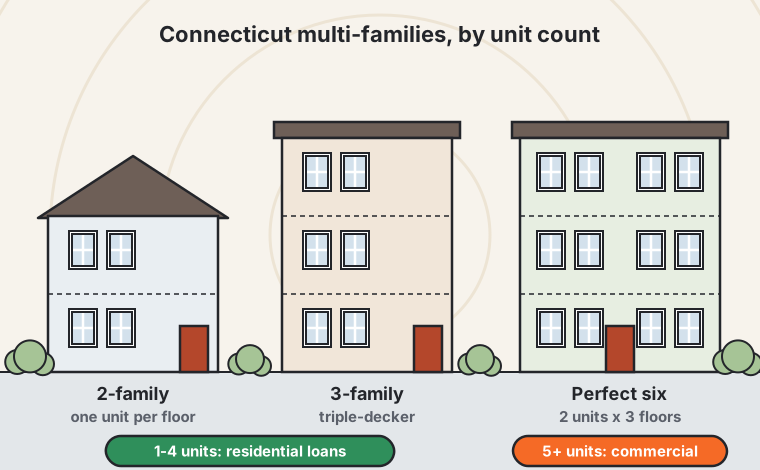
Connecticut’s cities grew around brass mills, typewriter and hardware factories, insurance offices and the railroads. Workers needed housing close to work, and builders answered with stacked flats: one family per floor, front and back porches, a shared cellar and often separate heating plants. The result is a housing stock that looks different from city to city:
- Hartford. The “perfect six” is a brick or frame three-story building with two apartments on each floor, common in Frog Hollow, Parkville and the South End. Because it has six units, it is a commercial property for lending purposes, which narrows the buyer pool to investors with commercial loans or cash. Hartford also has many wood-frame triple-deckers (three units, one per floor).
- New Haven. Two- and three-families in Fair Haven, the Hill, Dixwell and Westville. By town data, the median single-family home in New Haven was built in 1930, and 55% of single-family parcels predate 1940; the multi-family stock is at least as old.
- Bridgeport. Two- and three-families across the East Side, East End, Black Rock and the North End. The median single-family home was built in 1949.
- Waterbury. Brass-era triple-deckers and two-families in the North End, Brooklyn and Town Plot.
- New Britain. “Hardware City” two- and three-families near downtown and Broad Street; 78% of the city’s single-family parcels were built before 1960.
- North Haven and the suburbs. North Haven is mostly single-family (ranches, colonials and capes, median built 1961), with a smaller number of two-families and owner-occupied in-law setups. Those sell mostly to owner-occupants, who pay for the house more than the rent.
The main multi-family cities in numbers
| Town | Homes sold | Median sale price | Mill rate (FY 2027) | Town conveyance tax | Median year built (single-family) |
|---|---|---|---|---|---|
| Hartford | 825 | $290,000 | 69.95 | 0.50% | n/a |
| New Haven | 1,022 | $350,000 | 39.962 | 0.50% | 1930 |
| Bridgeport | 1,166 | $374,500 | 27.95 | 0.50% | 1949 |
| Waterbury | 1,305 | $270,000 | 43.34 | 0.50% | 1955 |
| New Britain | 768 | $300,000 | 39.18 | 0.50% | 1953 |
| North Haven | 244 | $439,500 | 30.56 | 0.25% | 1961 |
Two numbers in that table matter for a multi-family seller. The mill rate drives the property tax, the biggest expense an investor subtracts before pricing your building. And the conveyance tax: all five big cities charge the higher 0.50% town rate, so a seller there pays 1.25% of the price in total, against 1.00% in North Haven. Our Connecticut conveyance tax guide has every town.
Which Connecticut rules apply when you sell a two-, three- or four-family?
The Connecticut rules that apply when you sell a two-, three- or four-family are the property condition report (CGS 20-327b, or a $500 credit), the conveyance tax (CGS 12-494), the transfer of every security deposit with interest (CGS 47a-21), reasonable-notice showings (CGS 47a-16), the federal lead paint disclosure for pre-1978 buildings, and the building’s certificate of occupancy (CGS 29-265). The smoke and carbon monoxide affidavit applies only to one- and two-family homes (CGS 29-453).
| Rule | What it means for a multi-family seller | 2 units | 3-4 units | Source |
|---|---|---|---|---|
| Residential condition report | Give the buyer the DCP report before they sign, or credit $500 at closing. Covers one- to four-family property. | Yes | Yes | CGS 20-327b, 20-327c |
| Smoke and CO affidavit | Signed at closing for buildings designed for one or two families (no credit option since PA 23-164). | Yes | No (fire code still applies) | CGS 29-453 |
| Conveyance tax | State 0.75% up to $800,000 plus the town’s 0.25% or 0.50%; the seller pays. | Yes | Yes | CGS 12-494 |
| Security deposits | Withdraw every tenant’s deposit plus accrued interest and deliver it to the buyer; the buyer notifies tenants within 30 days. | Yes | Yes | CGS 47a-21(h)(3)(A), (h)(4) |
| Showings | Tenants may not unreasonably refuse entry to show the unit to buyers; you give reasonable notice and come at reasonable times. | Yes | Yes | CGS 47a-16 |
| Rent increases before a sale | No increase during a lease; at least 45 days’ written notice otherwise. | Yes | Yes | CGS 47a-4e |
| Lead paint disclosure | Pre-1978 buildings: disclose known lead paint and give the EPA pamphlet; buyer gets a 10-day chance to test. | Yes | Yes | EPA/HUD rule (federal) |
| Lead remediation duty | An owner must remediate toxic lead levels where children under six live. | Yes | Yes | CGS 19a-111c |
| Certificate of occupancy | Buildings erected or altered after Oct 1, 1970 may not be occupied without one; matters for added or converted units. | Yes | Yes | CGS 29-265 |
| Good-cause eviction protection (62+, disabled) | Applies only in buildings of five or more units, so it does not cover a two- to four-family. | No | No | CGS 47a-23c |
A sale does not end a lease. The buyer steps into your shoes as landlord, with the same rents, terms and end dates, and becomes responsible for the deposits (CGS 47a-21). If a buyer needs a unit empty, that has to be arranged lawfully, by a lease ending, a voluntary move or a court process. The landlord guide explains how tenancies end legally in Connecticut.
How do buyers value a multi-family in Connecticut?
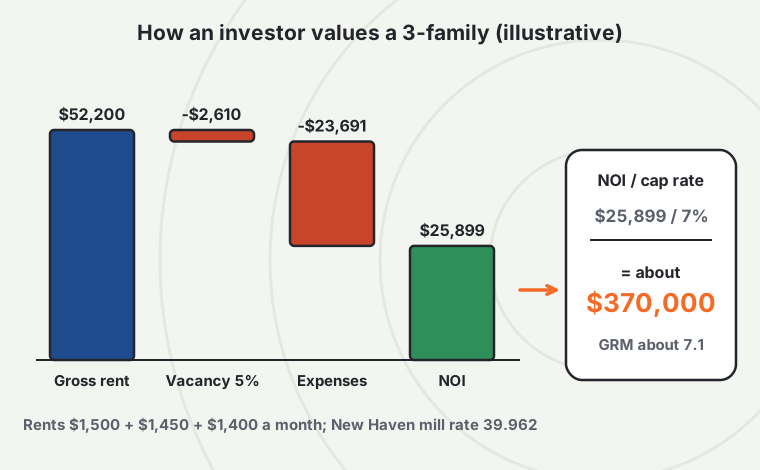
Buyers value a multi-family in Connecticut mainly by its income. They take the gross rents, subtract vacancy and the operating expenses (property tax, insurance, repairs, owner-paid utilities, reserves) to get net operating income, then divide by the return they want, the cap rate. They cross-check with the gross rent multiplier (price divided by yearly rent), price per unit and comparable sales. Owner-occupants also weigh the unit they will live in.
The four numbers investors use
- Net operating income (NOI). Yearly rent actually collected, minus the costs of running the building. Mortgage payments are not included; NOI is about the building, not the owner’s loan.
- Cap rate. NOI divided by price. A buyer who wants a 7% return on a building that nets $25,899 a year will pay about $370,000. A lower cap rate means a higher price. Cap rates move with interest rates, the neighborhood and the building’s condition.
- Gross rent multiplier (GRM). Price divided by gross yearly rent. It is a quick screen that ignores expenses, so two buildings with the same rent but very different tax bills can look the same on GRM and very different on NOI.
- Price per unit. Price divided by the number of apartments. Useful for comparing similar buildings on the same street; misleading across different unit sizes or conditions.
Worked example: a New Haven three-family (illustrative)
Every number below is an assumption chosen to show the method, not a quote, an appraisal or a market statistic. The only real inputs are New Haven’s fiscal 2027 mill rate of 39.962 and Connecticut’s 70% assessment ratio.
| Line | Assumption | Per year |
|---|---|---|
| Gross scheduled rent | $1,500 + $1,450 + $1,400 a month (est.) | $52,200 |
| Vacancy and unpaid rent | 5% of gross (est.) | −$2,610 |
| Effective gross income | $49,590 | |
| Property tax | Assessor’s appraisal $350,000 (est.) × 70% = $245,000 assessment × 39.962 mills | −$9,791 |
| Insurance | Landlord policy (est.) | −$4,200 |
| Repairs and maintenance | About 10% of gross (est.) | −$5,200 |
| Owner-paid utilities | Water, sewer, hallway lights (est.) | −$2,400 |
| Reserves | Roof, boilers, porches over time (est.) | −$2,100 |
| Net operating income | Expenses total $23,691, about 45% of gross rent | $25,899 |
| Value at an 8% cap rate | $25,899 ÷ 0.08 | about $323,700 |
| Value at a 7% cap rate | $25,899 ÷ 0.07 | about $370,000 |
| Value at a 6.5% cap rate | $25,899 ÷ 0.065 | about $398,400 |
Three lessons fall out of this example.
- Rent drives price. Raising each of the three rents by $100 a month adds $3,600 a year of gross rent, about $3,420 of NOI after vacancy, and roughly $48,900 of value at a 7% cap rate. Rents far below market cost you real money at sale. You cannot raise rent during a lease, and an increase needs at least 45 days’ written notice (CGS 47a-4e), so plan that a year ahead if you have the time.
- Taxes matter more in high-mill-rate cities. The same building in a city with a higher mill rate carries a bigger tax line and so supports a lower price at the same cap rate. Investors do this math automatically; owners often forget it when they compare their building to one in another town.
- Problems become dollars. A unit paying nothing, a roof at the end of its life or an unpermitted third-floor apartment all show up as lower NOI, a higher cap rate, or a deduction from price. The cleaner your records, the less a buyer has to guess, and guessing is always priced against you.
Before you talk to any buyer, write down each unit’s rent, what the tenants pay for utilities, last year’s tax, insurance and repair costs, and any unit that is empty or behind. With those five lines you can calculate your own NOI and see what different cap rates mean. Nobody can talk you into a number when you have done the math yourself.
Who buys two- to four-family houses in Connecticut, and how does their financing change your sale?
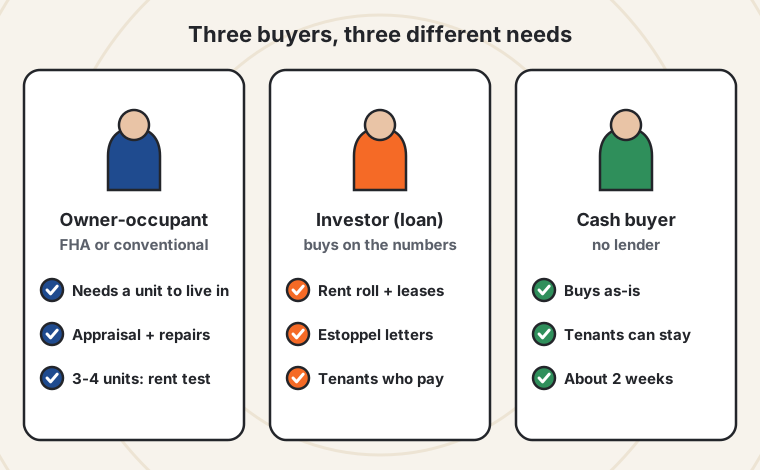
Two- to four-family houses in Connecticut are bought by owner-occupants who live in one unit and rent the rest, by small investors, and by cash buyers. Their financing shapes your sale: FHA and conventional loans cover one to four units when the buyer lives there, but bring an appraisal, property standards and sometimes a rental-income test; investor loans need clean rent records; cash buyers skip lender conditions but price in the risk they take on.
Owner-occupants (the house hackers)
A buyer who will live in one unit can use residential financing on a one- to four-unit building, including an FHA-insured loan. Fannie Mae raised its maximum loan-to-value ratio for certain owner-occupied two- to four-unit homes in 2023, which lowered down payments for qualified buyers (Fannie Mae 2023 Annual Housing Activities Report); lenders commonly describe this as allowing as little as 5% down. These buyers often pay the most for two-families in decent shape, because they are buying a home with rent help, not only an investment.
What they bring with them:
- They need a unit to live in. If every unit is leased for another year, most owner-occupant buyers cannot use the building. Timing one lease to end near closing widens your buyer pool.
- An appraisal and property standards. FHA appraisers look for health and safety problems; in pre-1978 buildings, peeling or chipping paint is a common repair condition. Missing handrails, broken windows and exposed wiring also come up.
- A rental-income test on three- and four-unit FHA loans. HUD’s handbook requires that the building’s projected rental income, after a vacancy factor, cover the mortgage payment for three- and four-unit properties (the “self-sufficiency” test). Below-market rents can make a three-family fail the test even when the buyer has good income.
- Financing contingencies and more time. A loan-backed sale commonly takes 30 to 60 days after contract (est.), and it can fall through late if the appraisal or underwriting goes wrong.
Small investors with loans
Investors who will not live in the building generally need a larger down payment and lend on the numbers. They want the rent roll, leases, estoppel letters and an expense history, and they compare your building to others on cap rate. They are comfortable with tenants in place if the rents are paid and close to market.
Cash buyers
Cash buyers, including us, buy without a lender, so there is no appraisal condition, no FHA property standards and no self-sufficiency test. That matters for buildings with an empty unit, a non-paying tenant, deferred maintenance, an unpermitted unit, lead hazards or an owner who needs to close on a specific date. The trade-off is price: a cash buyer prices in the repairs, the vacancy and the risk, so a cash offer is normally below what a clean building would bring on the open market.
Five units and up
A perfect six or any building with five or more units is a commercial sale: residential loans and the residential condition report do not apply, commercial lenders underwrite almost entirely on NOI, and older tenants and tenants with disabilities have good-cause eviction protection (CGS 47a-23c). The valuation method above still holds; the buyer pool is smaller and more professional.
What documents do you need to sell a multi-family with tenants in Connecticut?
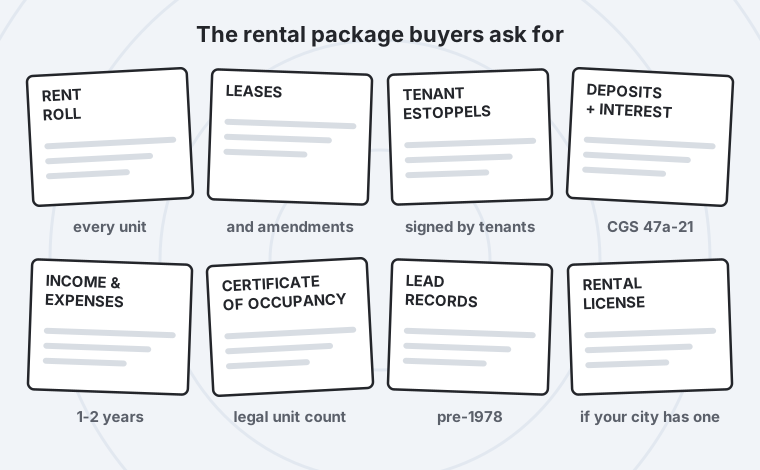
To sell a multi-family with tenants in Connecticut you need, beyond the usual seller documents, a rent roll for every unit, a copy of every lease and amendment, a security deposit schedule with interest, signed tenant estoppel certificates, a year or two of income and expenses, utility and tax bills, any certificates of occupancy or rental licenses, and any lead paint records. Your attorney adds them to the contract and the closing.
The rent roll
One line per unit: tenant names, rent, lease start and end, deposit held, who pays which utilities, and any balance owed. It is the first thing every buyer asks for, and the first thing they check against the leases and your bank statements. If a tenant pays in cash, start depositing it and keep a ledger now.
Tenant estoppel certificates
An estoppel is a short signed statement from each tenant confirming their rent, deposit, lease dates, that rent is paid through a certain date and that they have no claims against the landlord. It stops a tenant from later saying “I prepaid three months” or “the old owner promised me a new kitchen.” Lenders for investor buyers often require them. Ask politely, early, and explain that nothing about their lease changes. A tenant cannot be forced to sign, so if one refuses, your attorney can offer a seller’s certificate instead.
Deposits and interest
List each deposit, the escrow bank and the interest accrued. At closing you withdraw and deliver every deposit plus interest to the buyer (CGS 47a-21(h)(3)(A)), usually as a credit on the closing statement. The landlord guide explains how deposit interest is calculated and what to do if a deposit was never put in escrow.
Your multi-family package checklist
Tick items off as you gather them; your progress is saved on this device.
- Rent roll (unit, tenant, rent, lease dates, deposit, utilities, arrears)
- Every lease, renewal, amendment and side agreement (parking, pets, storage)
- Security deposit schedule, escrow bank statement and interest owed
- Tenant estoppel certificates (or a seller’s certificate for any tenant who will not sign)
- Rent ledgers for each unit for the last 12 to 24 months
- Income and expense summary or Schedule E for the last one or two years
- Property tax bill and assessor’s field card (shows the recorded number of units)
- Utility bills: which meters are separate, which the owner pays
- Insurance declarations page and any recent claims
- Certificates of occupancy and building permits for any added or converted unit
- City rental license or inspection records, if your city has a program
- Lead inspections, abatement records or health department orders, if any
- Oil tank, boiler and roof records; service contracts
- Any open code violations, housing court files or eviction paperwork
- Section 8 HAP contracts for voucher tenants
- Residential condition report, completed and signed
The general seller paperwork (deed, payoff, OP-236 and the rest) is in our guide to the documents you need when selling a house in Connecticut.
What happens to the tenants and their security deposits when you sell a multi-family?
When you sell a multi-family in Connecticut, the tenants stay under their existing leases and the buyer becomes their landlord. You hand every security deposit plus accrued interest to the buyer at closing (CGS 47a-21(h)(3)(A)), and the buyer must tell each tenant in writing within 30 days how much it holds and at which bank (CGS 47a-21(h)(4)). Nobody has to move because of the sale itself.
The details (notice for showings, ending month-to-month tenancies, summary process, cash for keys, Section 8 tenancies) are covered step by step in the landlord guide, selling a rental property with tenants in Connecticut, so this page will not repeat them. Three multi-family specifics are worth adding:
- Showings are multiplied. Three units means three households to coordinate. Under CGS 47a-16 a tenant may not unreasonably refuse access for a showing, but you must give reasonable notice and come at reasonable times. Batching showings into one or two windows a week keeps goodwill, and goodwill is what gets estoppel letters signed.
- A non-paying tenant affects the whole building’s price. Buyers price in the eviction time and the lost rent. If you are dealing with one now, read what to do about tenants who don’t pay rent in Connecticut before you list.
- A trashed unit is a repair line, not a dead end. A unit left in bad shape by the last tenant lowers NOI until it is fixed; a cash buyer will price the repair, a retail buyer may walk. See help, my last tenant trashed my Connecticut house.
Tell your tenants the truth early: the building is being sold, their leases and deposits are protected by law, and you will give notice before every showing. Tenants who feel respected are far less likely to make the sale hard.
Do you need a certificate of occupancy or a rental license to sell a multi-family in Connecticut?
You do not need a new certificate of occupancy to sell a typical older Connecticut multi-family, but buyers, lenders and their attorneys will check that the number of units matches what the town has approved. Under CGS 29-265, a building erected or altered after October 1, 1970 may not be occupied until a certificate of occupancy is issued, so an added or converted unit without permits is a real issue. Some cities, such as New Haven and Hartford, also license or inspect rental housing.
The unit count is the question
Many Connecticut two-families became three-families at some point: an attic finished into an apartment, a basement unit, a storefront turned into living space. If that work was never permitted, the assessor’s card may say two units while you collect three rents. That gap causes three problems:
- Lenders lend on the legal unit count. An appraiser may give no value to the illegal unit’s rent, and a lender may refuse the loan if the unit is a safety problem (egress, ceiling height, fire separation).
- Buyers price in the risk. An investor who cannot count on the third rent will value the building as a two-family, and may also price the cost of removing the unit.
- Your disclosure has to be honest. The residential condition report asks about permits and code issues; answer what you know.
Before you list, pull the assessor’s field card and ask the building department for the permit history. If the numbers do not match, talk to a Connecticut attorney about whether the unit can be legalized through zoning and building approval, or whether to price and sell the building as its legal unit count.
City rental licensing
New Haven’s Livable City Initiative runs a residential rental licensing program that covers non-owner-occupied two- and three-family buildings and larger properties, with exemptions. Hartford’s housing code includes a rental licensing program that the city has been phasing in, starting with larger buildings. Rules and phases change, so check with the city before listing; an expired license or open housing code orders will come up in the buyer’s search and should be disclosed. Other cities, including Bridgeport, Waterbury and New Britain, handle rental housing through their housing code and inspection offices; ask whether your building has any open orders.
What does lead paint mean when you sell an older Connecticut multi-family?
Lead paint means three things when you sell an older Connecticut multi-family. Federal law requires you to disclose known lead paint in a pre-1978 building, give the EPA pamphlet and offer a 10-day testing window. Connecticut law requires an owner to remediate toxic lead levels where children under six live (CGS 19a-111c). And FHA appraisals often require peeling paint to be fixed, which affects owner-occupant buyers.
Almost every multi-family in Hartford, New Haven, Bridgeport, Waterbury and New Britain was built before 1978, so assume the question will come up.
- Disclosure. You must disclose any lead paint or lead hazards you know about and hand over any reports you have, give the buyer the EPA pamphlet, and allow a 10-day period to test unless the buyer waives it. Each tenant was also supposed to get a lead disclosure with their lease.
- Health department orders. In Connecticut, when a child’s blood lead level reaches 5 micrograms per deciliter (on and after January 1, 2025), the local director of health investigates the source and orders the responsible person to act (CGS 19a-111). An open abatement order is a serious matter in a sale; give it to your attorney immediately.
- The owner’s duty. An owner of a dwelling with toxic levels of lead where children under six live must remediate it through testing, abatement or management (CGS 19a-111c). A buyer inherits that duty, which is why buyers of occupied pre-1978 buildings with young children ask about it.
Lead work in a rental must be done by properly trained and licensed contractors, and costs vary widely by building. If the cost or the logistics are out of reach, selling the building as-is to a buyer who will handle the work is a legitimate option, as long as you disclose what you know.
Should you sell your Connecticut multi-family occupied or vacant?
You should sell your Connecticut multi-family occupied if the tenants pay market rent on time and your likely buyer is an investor, and with at least one unit vacant if your likely buyer is an owner-occupant who needs a place to live. A building with a non-paying or holdover tenant sells at a discount on every route, so starting the legal process before you list, or selling to a buyer who takes that on, narrows the gap.
| Situation | Best likely buyer | Usually better | Why |
|---|---|---|---|
| All units leased at market rent, tenants pay | Investor | Occupied | Investors pay for proven income and skip months of vacancy. |
| Two-family in good shape, one lease ending | Owner-occupant | One unit empty at closing | Owner-occupants often pay most for two-families and need a unit to live in. |
| Rents well below market, long-term tenants | Investor or cash buyer | Occupied, priced on actual rents | Buyers value current rent, not your hopes; rent increases need 45 days’ notice (CGS 47a-4e). |
| One tenant not paying | Cash buyer, or any buyer after the case is resolved | Discount either way | Buyers price in eviction time and lost rent. |
| Building fully vacant, needs work | Cash buyer or rehab investor | Sell as-is | No income to price and no lender-ready condition; see selling a vacant house. |
Never pressure a tenant to leave to make a sale easier. A voluntary move-out agreement with a payment (“cash for keys”) is legal when it is genuinely voluntary and written down; the landlord guide covers how it works.
Can you use a 1031 exchange when you sell a Connecticut multi-family?
You can use a 1031 exchange when you sell a Connecticut multi-family held for rental or investment: the proceeds go to a qualified intermediary, you identify replacement real estate within 45 days and close on it within 180 days (or your tax return due date, if earlier), and tax is deferred, not erased. If you live in one of the units, the part you live in may qualify for the home-sale exclusion instead, so the sale is split.
The full 1031 rules, a dated example and how depreciation recapture works are in the landlord guide’s section on taxes and 1031 exchanges for Connecticut rentals, and in taxes when selling a house in Connecticut. The multi-family twist is the owner-occupied unit:
- Live in one unit, rent the others? IRS Publication 523 says that when part of the property is a separate dwelling unit you rent out, you allocate the gain between your home and the rental part. The home share can qualify for the $250,000 ($500,000 married) exclusion if you meet the two-out-of-five-year tests; the rental share cannot, and depreciation you took on it is taxable.
- The rental share can go into an exchange. IRS guidance allows the exclusion and a 1031 exchange to apply to different parts of the same sale in some cases. Ask a tax professional before you sign a contract, because the exchange has to be set up before closing.
- Connecticut taxes the gain as income (top rate 6.99%), and the conveyance tax is due at closing whether or not you exchange.
A cash sale works fine with an exchange. Tell the buyer and your attorney at the start; the contract usually gets a short clause asking the buyer to cooperate at no cost.
How much will you net when you sell a multi-family in Connecticut?
How much you net when you sell a multi-family in Connecticut is the price minus the agent commission (if any), the conveyance tax (1.25% of the price in Hartford, New Haven, Bridgeport, Waterbury and New Britain; 1.00% in towns at the 0.25% rate), your attorney, repairs a buyer’s lender requires, lost rent from emptying a unit, and your mortgage payoff. Deposits are passed to the buyer, not kept.
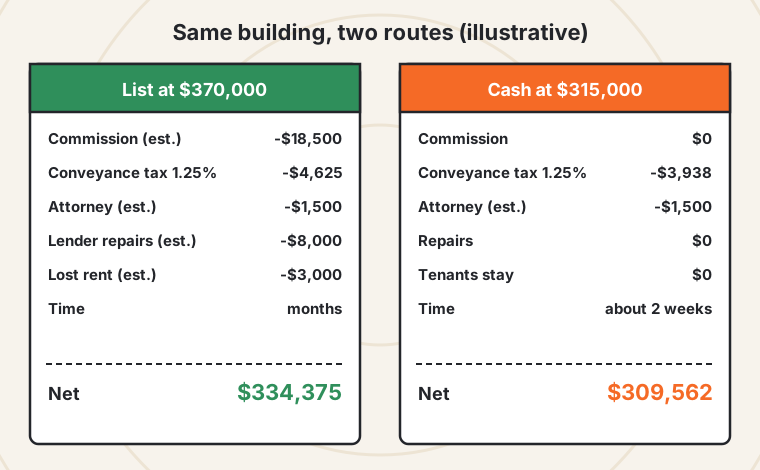
Worked example: the same New Haven three-family, two routes (illustrative)
| Line | List with an agent | Sell to a cash buyer |
|---|---|---|
| Price | $370,000 (the 7% cap value above) | $315,000 (illustrative offer) |
| Agent commission | −$18,500 (5%, est.) | $0 |
| Conveyance tax (0.75% state + 0.50% New Haven) | −$4,625 | −$3,938 |
| Seller’s attorney | −$1,500 (est.) | −$1,500 (est.) |
| Repairs required by the buyer’s lender (paint, handrails, windows) | −$8,000 (est.) | $0 (bought as-is) |
| Lost rent: one unit vacated for an owner-occupant | −$3,000 (2 months × $1,500, est.) | $0 (tenants stay) |
| Net before mortgage payoff | $334,375 | $309,562 |
| Typical time to close | Months, including a 30 to 60 day loan process (est.) | About 2 weeks, or the date you choose |
In this example, listing puts about $24,800 more in your pocket. That is the honest answer for a building in decent shape with paying tenants. The gap shrinks, or flips, when the building needs major work a lender will not accept, when a unit is empty or not paying, when a unit is not legal, or when the months of carrying costs and management are worth more to you than the difference. Put your own numbers into the calculator:
How much would you walk away with?
Slide the numbers to match your house. It works in your browser; nothing is saved or sent.
Estimates for planning. Conveyance tax per CGS 12-494 (state 0.75% up to $800,000, 1.25% to $2.5M, 2.25% above, plus the town rate). Seller attorney about $1,200 to $1,500; flat-fee MLS about $400; listings include three months of taxes, insurance and utilities, a cash sale about two weeks. Your attorney gives you the final numbers.
What are your honest options for selling a multi-family in Connecticut?
Your honest options for selling a multi-family in Connecticut are to list it with an agent who knows income property, sell it off-market to an investor or a tenant, sell it as-is for cash, or keep it and hire a property manager. Listing usually brings the highest price for a well-rented building in good shape; a cash sale fits when the condition, the tenants, a legal issue or your timeline make a retail sale hard.
List with an agent
Highest price, usuallyBest for a building in decent shape with paying tenants and clean records.
- Reaches owner-occupants and financed investors
- Commission and lender-required repairs
- Showings in occupied units; loan can fall through
Sell to a tenant or a known investor
Fewer costs, fewer buyersGood when a tenant wants to buy or a local investor already knows the building.
- No commission if no agent is involved
- Hire a Connecticut attorney for the contract
- Price can be lower without competition
Sell as-is for cash
About 2 weeksFits buildings with repairs, vacancies, problem tenancies, unit-count issues or a deadline.
- No repairs, no lender, tenants can stay
- No commission or fees
- Price is below the retail value of a clean building
Keep it and hire a manager
Income, less workMakes sense if the numbers work and you mainly want out of the day-to-day.
- Managers commonly charge a share of collected rent (est.)
- You keep the appreciation and the tax benefits
- Repairs and vacancies are still yours
When you should NOT sell your multi-family to a cash buyer
- The building is in good shape, rented at market, and you have time. List it. The worked example above shows why.
- You only want out of management. A good property manager may solve the problem and keep your income.
- You have not had tax advice. Depreciation recapture and a possible 1031 exchange can change the right answer; one conversation with a tax preparer first is worth it.
- Someone is pressuring you. Any buyer who rushes you, asks for a fee, or wants you to sign a deed before closing is a red flag. Our guide on how to check a cash home buyer in Connecticut lists what to verify.
If you inherited the building, the probate steps come first; see selling an inherited house. To compare offers that differ on price, timing and tenant terms, read how to compare offers on a house in Connecticut, and for the bigger picture, cash buyer vs. realtor in Connecticut.
How does selling a multi-family to a cash buyer work in Connecticut?
Selling a multi-family to a cash buyer in Connecticut works in five steps: you share the address, rent roll and a few photos; the buyer reviews the numbers and sees the building at a time that suits the tenants; you get a written offer that does not expire while you decide; your attorney reviews the contract; and you close at a Connecticut attorney’s office, typically in about two weeks, with deposits credited to the buyer.
Send the basics
The address, the rent roll (even handwritten), which units are occupied, and anything you know about repairs, permits or problem tenancies. Photos help. You do not need to clean, fix or empty anything.
One walkthrough, scheduled around the tenants
We give tenants proper notice (CGS 47a-16) and see the units in one visit. If a tenant will not allow access, we can still make an offer based on what we can see and what you tell us.
A written offer with the math
We show how we got to the number: rents, expenses, repairs and the return we need. The offer does not expire while you think it over, and if listing would net you more, we will tell you.
Your attorney reviews the contract
Connecticut closings are conducted by attorneys. Your attorney checks the contract, the deposit credit and the tenant clauses. We pay no fees to you and charge none.
Close on your date
Typically about two weeks from a signed contract, or later if you need time (for an exchange, a probate order or a move). Deposits and interest are credited to us, we send the new-landlord notice to each tenant, and the tenants stay in their homes.

The single most useful thing a multi-family seller can do is make the rent roll match reality. Write down what each tenant actually pays, not what the lease says, and which utilities you cover. When the paper and the bank statements agree, every buyer, including me, has less to guess at, and guessing is where offers drop. If a unit is not on the town’s records, say so up front. It is a solvable problem when it is on the table and an expensive one when it surfaces two days before closing.
If you want a number for your building, tenants and all, call me, Jerryll Noorden, at (203) 529-4712. I have bought Connecticut houses since 2016. Start with the address and the rents, or send photos below.
Get your cash offer
without anyone coming over.
Want your offer faster, or rather not talk to anyone yet? Send a few phone photos of each room. We price the repairs from them, line by line, and send your cash offer back, so you see a real number before you ever meet us or pick up the phone.
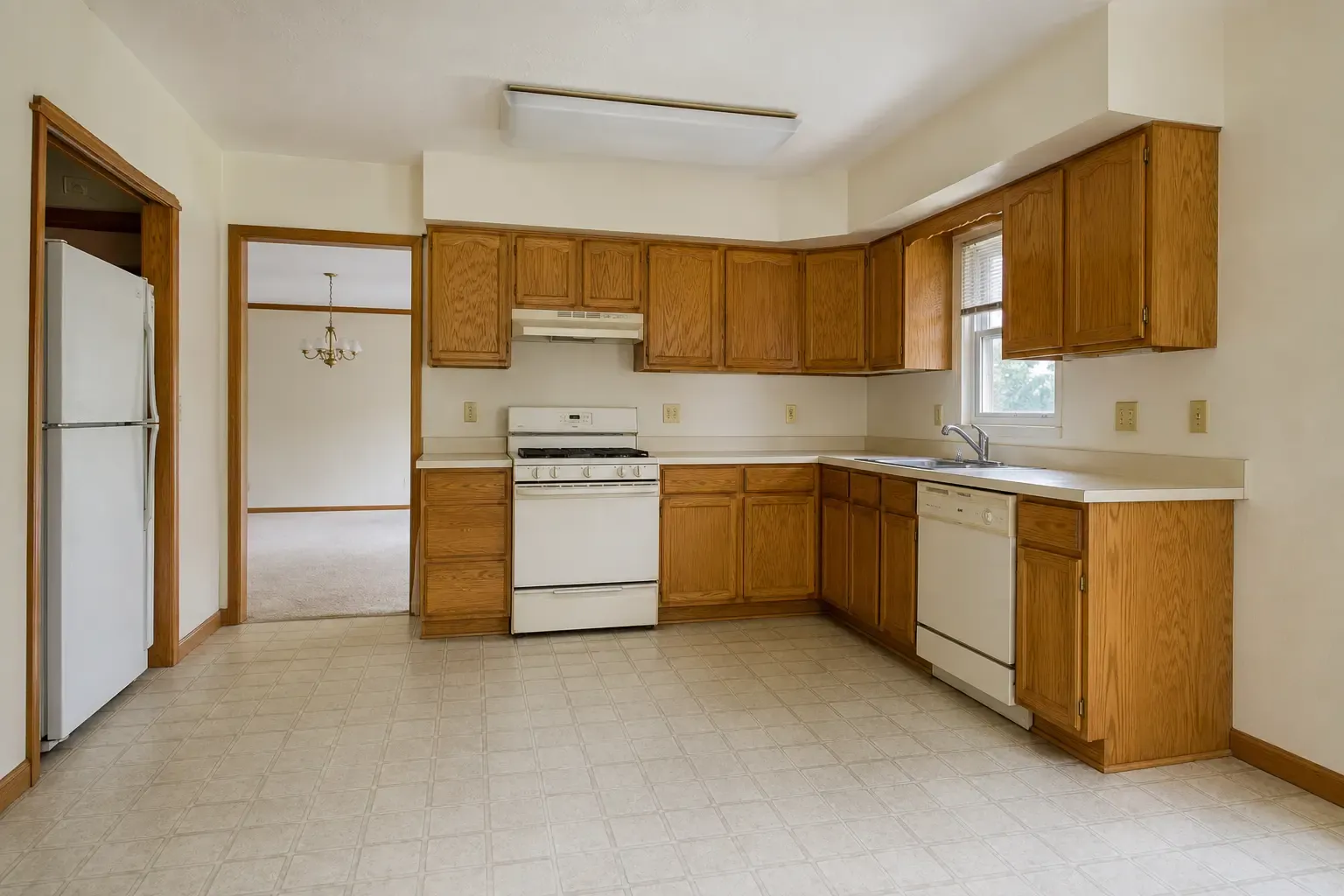 CabinetsFlooring
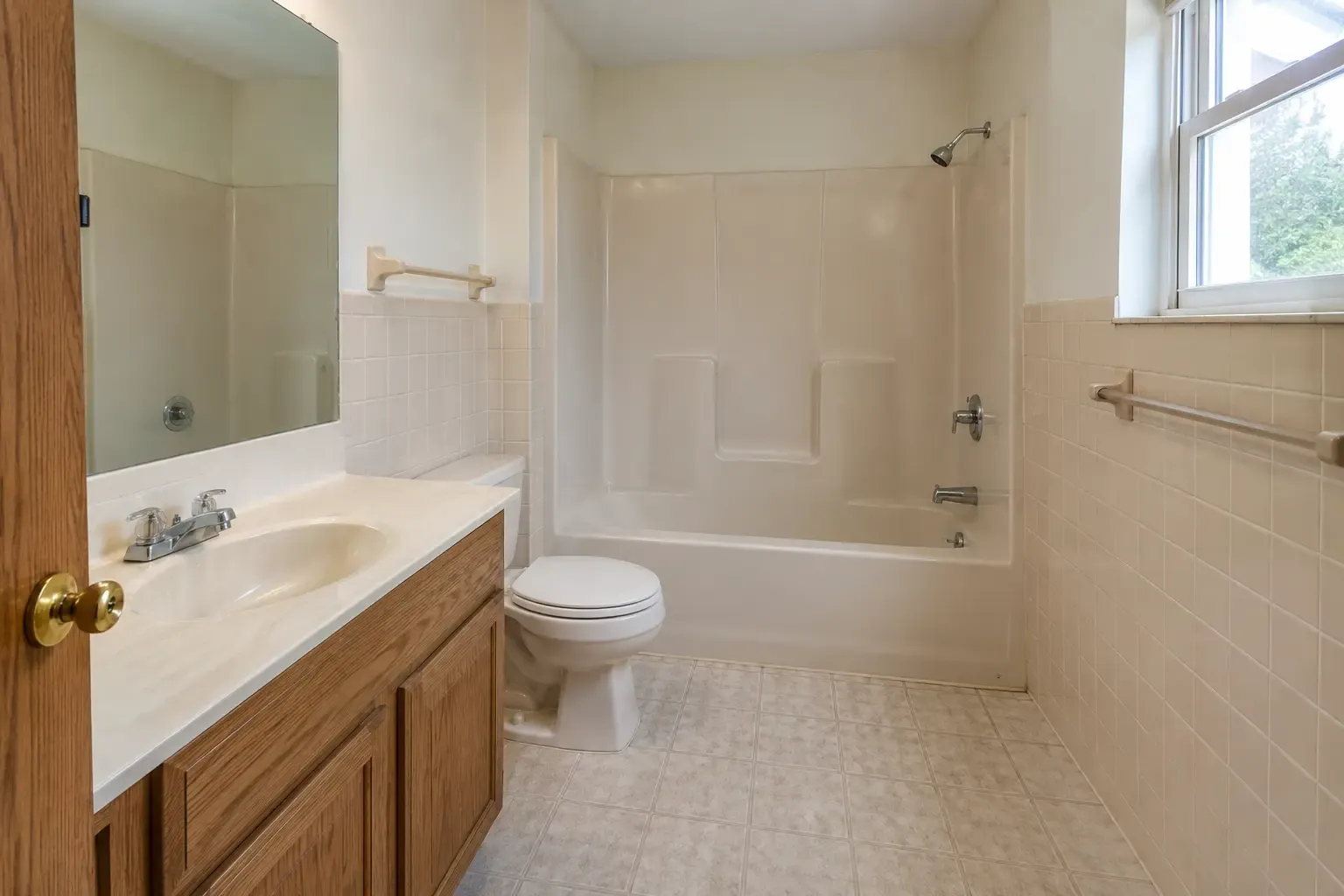 Tub & tile
 Floors
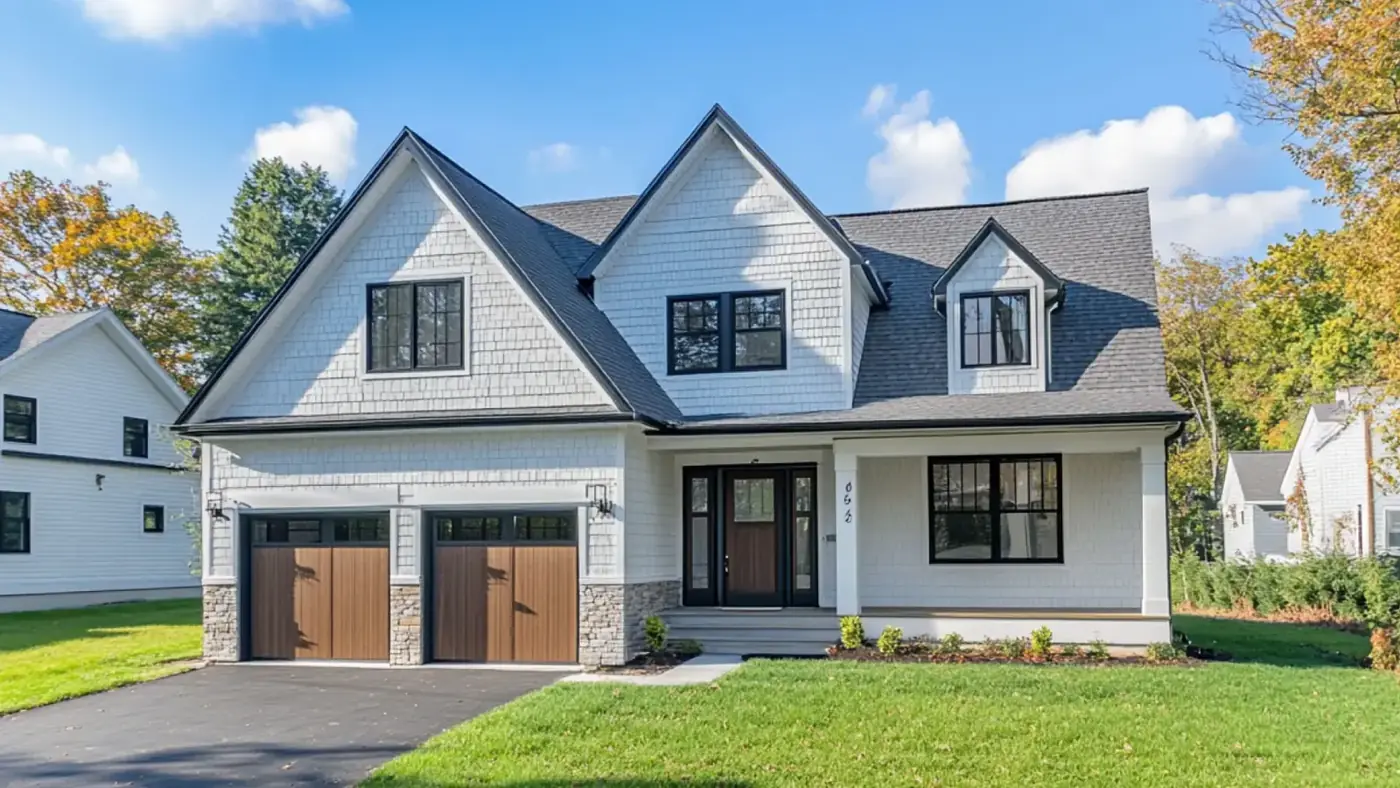 Roof
We may bring in a partner buyer to close. Your price and terms don't change.
Questions Connecticut owners ask about selling a multi-family
Can I sell my multi-family house in Connecticut with tenants in it?
Yes, you can sell your multi-family house in Connecticut with tenants in it. The leases continue with the new owner, and you transfer every security deposit plus interest to the buyer at closing (CGS 47a-21). Investors often prefer buildings with paying tenants.
How do I figure out what my multi-family is worth?
To figure out what your multi-family is worth, calculate net operating income (rents collected minus taxes, insurance, repairs, owner-paid utilities and reserves) and divide it by the cap rate buyers in your area expect. Check the result against recent sales of similar buildings and the gross rent multiplier.
What is a good cap rate for a multi-family in Connecticut?
A good cap rate for a multi-family in Connecticut depends on the city, the building’s condition and interest rates; there is no single number. Buyers expect higher cap rates (lower prices) for older buildings in weaker locations and lower cap rates for well-kept buildings in strong neighborhoods. Ask for recent comparable sales.
What is a gross rent multiplier?
A gross rent multiplier is the price divided by the building’s gross yearly rent. A three-family with $52,200 of yearly rent that sells for $370,000 has a GRM of about 7.1. It is a quick screen; it ignores taxes and expenses, so use it alongside NOI.
Can a buyer use an FHA loan on a three-family house?
Yes, a buyer can use an FHA loan on a three-family house if they will live in one of the units. For three- and four-unit properties, HUD requires the projected rental income to meet a self-sufficiency test against the mortgage payment, so below-market rents can limit FHA buyers.
Do I have to give the buyer the tenants’ security deposits?
Yes, you have to give the buyer the tenants’ security deposits plus accrued interest at closing. Connecticut law requires the selling landlord to withdraw and deliver the full deposits to the successor (CGS 47a-21(h)(3)(A)); it is normally a credit on the closing statement.
What is a tenant estoppel certificate?
A tenant estoppel certificate is a short signed statement in which a tenant confirms their rent, deposit, lease dates and that they have no claims against the landlord. Buyers and their lenders use it to confirm the rent roll. Tenants are not required to sign, so ask early and explain why.
Does the smoke and carbon monoxide affidavit apply to a three-family?
No, the smoke and carbon monoxide affidavit does not apply to a three-family. Connecticut requires it at closing for buildings designed for one or two families and for condo units (CGS 29-453). Three- and four-families still have to meet fire code requirements.
Do I need to fill out the property condition report for a multi-family?
Yes, you need to fill out the property condition report for a two-, three- or four-family, because Connecticut’s disclosure law covers one- to four-family residential property. If you do not deliver it before the buyer signs, you credit the buyer $500 at closing (CGS 20-327b, 20-327c).
What if one of my units is not legal?
If one of your units is not legal, buyers and lenders will usually value the building at its legal unit count, and you must answer the disclosure honestly. Ask the building and zoning offices whether the unit can be legalized, or sell the building as-is to a buyer who accepts the issue.
Do I have to remove lead paint before selling a multi-family in Connecticut?
You do not have to remove lead paint before selling a multi-family in Connecticut, but you must disclose what you know for a pre-1978 building, and any open health department order must be dealt with. Owners must remediate toxic lead levels where children under six live (CGS 19a-111c), and that duty passes to the buyer.
Is it better to sell a multi-family vacant or occupied?
It is usually better to sell a multi-family occupied when tenants pay market rent and your buyer is an investor, and with a unit empty when your buyer is an owner-occupant. A non-paying tenant lowers the price either way.
Can I do a 1031 exchange if I sell my multi-family for cash?
Yes, you can do a 1031 exchange if you sell your multi-family for cash. The exchange depends on a qualified intermediary holding the proceeds and on you buying replacement investment property on time, not on how the buyer pays. Set it up before closing.
I live in one unit of my two-family. How is the sale taxed?
If you live in one unit of your two-family, the sale is generally split: the share for your unit can qualify for the home-sale exclusion if you meet the two-out-of-five-year tests, and the rental share is taxed as a rental sale, including depreciation recapture (IRS Publication 523). Get tax advice before you sell.
How fast can I sell a multi-family in Connecticut?
You can sell a multi-family in Connecticut to a cash buyer in about two weeks once a contract is signed, if the title is clear. A financed sale usually takes longer, commonly 30 to 60 days after contract, plus the time to find the buyer.
Related Connecticut guides
Landlords
Money and paperwork
We buy multi-families across the state, including in Hartford, New Haven, Bridgeport, Waterbury, New Britain, Meriden and North Haven. For the full process, see how to sell a house in Connecticut, and if you own a rental with tenants, see how we buy rentals as they are.
Plain-English information, not legal, tax or financial advice. Talk to a Connecticut attorney and a tax professional about your building.
Sources
- CGS § 47a-21 (security deposits; transfer to the successor and notice to tenants).
- CGS § 47a-16 and § 47a-4e (landlord entry for showings; notice of rent increases).
- CGS § 47a-23c (good-cause eviction protection in buildings of five or more units).
- CGS § 20-327b and § 20-327c (residential condition report; $500 credit).
- CGS § 29-453 (smoke and carbon monoxide affidavit for one- and two-family buildings).
- CGS § 29-265 (certificate of occupancy).
- CGS § 19a-111 and § 19a-111c (lead poisoning investigation and the owner’s duty to remediate).
- CGS § 12-494 (conveyance tax).
- EPA and HUD lead-based paint disclosure rule.
- HUD Single Family Housing Policy Handbook 4000.1 (FHA one- to four-unit properties; rental income and property standards).
- Fannie Mae 2023 Annual Housing Activities Report (higher maximum LTV for certain owner-occupied two- to four-unit homes).
- IRS Publication 523 (home-sale exclusion; property used partly as a home) and Instructions for Form 8824 (like-kind exchanges).
- City of New Haven, Livable City Initiative (residential rental licensing) and City of Hartford, Licenses and Inspections (housing code and rental licensing).
- Town data: Connecticut OPM sales data (Oct 2024 to Sep 2025), fiscal 2027 mill rates, 2025 parcel CAMA data; town conveyance rates per OLR Report 2020-R-0020.
See the house together.
Pick a time that works.
Choose a time for us to walk through the property with you, or ask for a quick call first. We confirm every request personally.
Tuesday, January 13
No open times in the next few weeks. Please call us.
We will confirm by email. Nothing is booked until we do.
View my request
Who wrote this
Jerryll Noorden
Jerryll has bought and sold Connecticut houses since 2016 and has sat at more closing tables than he can count, on both sides. Before real estate he was a robotics scientist at NASA, IHMC and IIT. He wrote this guide because the national sites that rank for it skip the Connecticut rules that cost sellers money. When listing or selling it yourself would get you more than a cash offer, he says so.
This guide explains Connecticut rules in plain English. It is not legal or tax advice. Laws change; for your sale, talk to a Connecticut real estate attorney and a tax professional.
