
Key facts at a glance
| Fact | Number | Source |
|---|---|---|
| Homes sold in Madison, Oct 2024 to Sep 2025 | 289 (median $660,000; single-family $713,750) | CT OPM real estate sales, data.ct.gov |
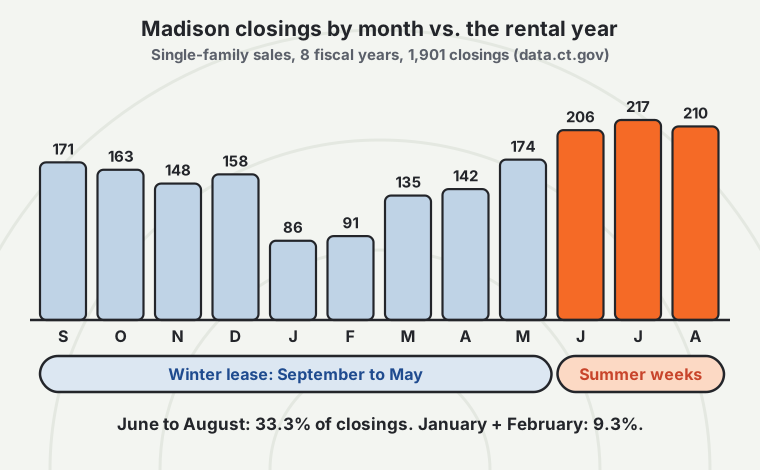
| Madison single-family closings recorded June to August | 33.3% (January and February: 9.3%) | Our query of data.ct.gov 5mzw-sjtu, 1,901 sales over 8 fiscal years |
| Madison mill rate, fiscal 2027 | 23.06 mills (about $888 a month on a $660,000 house) | CT OPM mill rates; assessment at 70% (CGS 12-62a) |
| Conveyance tax the seller pays in Madison | 1.00% up to $800,000 ($6,600 on $660,000); state share 1.25% above $800,000 | CGS 12-494 |
| Room occupancy tax on a furnished stay of 30 days or less | 15% | DRS Special Notice 2019(9); DRS room occupancy page |
| Rental contracts outside the room occupancy tax | 90 consecutive days or more, or unfurnished | DRS Special Notice 2019(9) |
| Notice to quit when a winter lease ends and the tenant stays | At least 3 days before the quit date, then a court case | CGS 47a-23 |
A Madison beach house that is rented September to May and booked by the week in summer is really two rental businesses under one roof, and each one changes how, when and to whom you can sell. This guide explains how to sell a shoreline rental with a winter lease in Madison: what kind of tenancy you have, what the short-term rental rules mean for a buyer, how to time the sale around summer bookings, and who buys. It is one chapter of our guide to how to sell a house in Connecticut; the general landlord questions are in our guide to selling a rental with tenants in Connecticut.
Why does selling a seasonal rental feel so tangled?
Selling a seasonal rental feels tangled because the calendar works against you. The winter tenant is in the house during the months buyers shop, summer guests have paid for weeks you may not own anymore, and Madison’s best selling months are the same months the house earns the most. Nothing about that is unusual, and each knot comes undone in order.
Maybe the cottage was your parents’ and the family stopped using it. Maybe you live out of state, manage it through a platform and a cleaner, and the numbers no longer justify the work. You might feel torn between one more summer of income and getting out, anxious about guests who already paid, awkward about telling a winter tenant you like, unsure whether a buyer can even keep renting it the way you did, and worn down by flood insurance, septic and oil bills on a house you rarely sleep in. Under that, you are probably hopeful there is a clean way to time it.
This page is for you. It takes the calendar apart month by month.
Can you sell a Madison shoreline rental while a winter tenant lives there?
Yes, you can sell a Madison shoreline rental while a winter tenant lives there. A winter lease is an ordinary fixed-term residential lease, so it stays in force after the sale and binds the buyer. You must give the tenant reasonable notice before showings (CGS 47a-16), and at closing the security deposit and interest go to the buyer (CGS 47a-21). The real question is whether your buyer wants the tenant.
A typical Madison winter lease runs from early September to late May or June, furnished, often with the tenant paying oil and electric. Because it has an end date, a buyer who wants the house for summer can simply wait it out, and a buyer who wants rental income gets nine months of rent with the deed.
The closing mechanics are the same as any occupied sale: the deposit and its interest transfer, rent is prorated, and the new owner sends the tenant a written notice (CGS 47a-6). Our guide to tenant estoppels and lease transfer at closing walks through every line with a worked example, so this page stays on what is different at the shore.
What kind of rental do you have, and why does it matter for the sale?
The kind of rental you have decides which rules apply when you sell. A winter or year-round lease is a landlord-tenant relationship under Connecticut’s lease statutes, and it passes to the buyer. A furnished stay of 30 days or less is a short-term rental subject to the 15% room occupancy tax, booked one guest at a time, and those bookings do not pass to a buyer automatically.
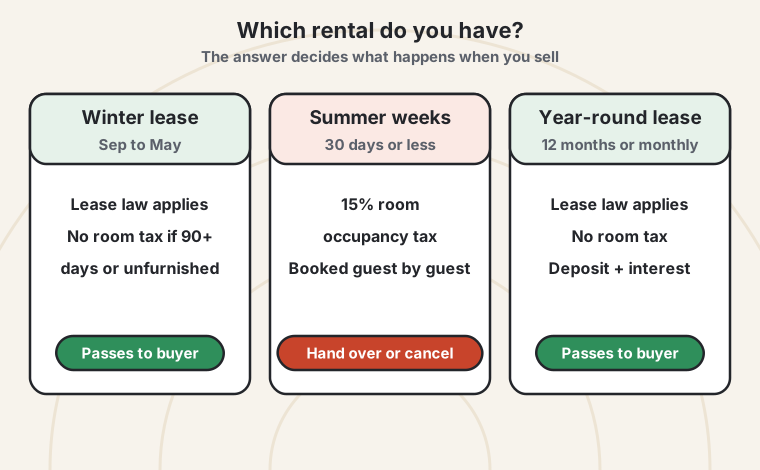
| Rental type | Typical Madison term | Room occupancy tax | What happens when you sell |
|---|---|---|---|
| Winter lease | September to May or June, furnished | Not on a contract of 90+ days; unfurnished rentals are also outside it | Lease and deposit transfer to the buyer (CGS 47a-21) |
| Summer weeks | One or two weeks, June to August | 15%, collected by the platform when booked through one | Bookings for dates after closing must be handed over by agreement or cancelled |
| Month-long summer rental | 30 days or a few months | Contracts under 90 days are taxed for the first 30 days | Same as summer weeks; check whether it is a lease |
| Year-round lease | 12 months or month to month | None | Lease and deposit transfer to the buyer |
One legal wrinkle is worth an attorney’s five minutes. Connecticut’s landlord-tenant chapter does not apply to “transient occupancy in a hotel or motel or similar lodging” (CGS 47a-2). Whether a week in a private beach house counts as similar lodging, or as a short tenancy, can matter if a summer guest refuses to leave or disputes a deposit. Ask before you sign a contract that hands bookings to a buyer.
What are the short-term rental rules for a Madison house?
The short-term rental rules for a Madison house start with the state: furnished stays of 30 days or less carry a 15% room occupancy tax, which booking platforms collect and remit for the stays they handle (DRS Special Notice 2019(9)). At the town level, Madison has debated a short-term rental ordinance for years; we could not confirm an adopted ordinance as of October 2026, so a buyer who plans to keep renting by the week should check with Madison’s land use office first.
Here is what we could confirm, and what we could not:
- State tax. The 15% room occupancy tax applies to the short-term rental of all or part of a home. Platforms that meet the state’s threshold must register and collect it. Rentals you take directly, without a platform, are your responsibility to report.
- State registry. A 2026 bill to create a state short-term rental registry (HB 5536) was reported out of the Finance Committee, but the General Assembly’s bill history shows no action after it was placed on the House calendar on April 16, 2026. As far as we can tell, there is no state registry today.
- Madison. Madison’s Board of Selectmen discussed regulatory options for short-term rentals in January 2023. The possible objectives it reviewed included tracking rental activity, reducing neighborhood nuisances and preserving Madison’s legacy as a summer vacation community, and the meeting materials noted that zoning regulations could be an alternative to an ordinance. We found no adopted ordinance, but town rules can change between our check and your sale.
Why this matters to you as a seller: the price an investor pays for a summer rental depends on whether it can keep earning summer rent. If the rules are unclear, investors price in the risk. A tidy file with your booking history, the platform’s tax records and a note from the town on current rules makes your house easier to value.
When should you sell a Madison rental: before, during or after the summer?
The best time to sell a Madison rental depends on who you want to buy it. For an owner who wants to live there or use it in summer, list in March and close in June, right after the winter lease ends: 33.3% of Madison single-family closings are recorded in June, July and August. For an investor, a fall sale with the winter lease signed shows nine months of income in place.
Each window trades one thing for another:
| Window | How it works | Best buyer | What you give up |
|---|---|---|---|
| List in March, close in June | Showings with the winter tenant on notice; tenant leaves end of May; close vacant | Second-home or year-round owner | Summer bookings after closing |
| Run the summer, list in September | Keep the season’s income; sign the winter lease or leave it vacant | Investor (with lease) or owner (vacant) | The peak summer buyer pool |
| Sell any time with tenants in place | Lease and deposit transfer; bookings handed over by agreement | Rental investor or cash buyer | Some price, in exchange for certainty |
Example (illustrative). Take a Madison house worth the $660,000 town median. Property tax at 23.06 mills is about $888 a month (70% assessment). If it sits empty from June to September while listed, that is roughly $3,552 of tax alone, before insurance, utilities and septic. The conveyance tax at closing is $6,600 at Madison’s 1.00% rate whenever you sell. The timing choice is mostly about which buyers you reach and what income you give up, not about the closing costs.
How much would you walk away with?
Slide the numbers to match your house. It works in your browser; nothing is saved or sent.
Estimates for planning. Conveyance tax per CGS 12-494 (state 0.75% up to $800,000, 1.25% to $2.5M, 2.25% above, plus the town rate). Seller attorney about $1,200 to $1,500; flat-fee MLS about $400; listings include three months of taxes, insurance and utilities, a cash sale about two weeks. Your attorney gives you the final numbers.
What happens to summer bookings and guest deposits when you sell?
Summer bookings and guest deposits do not transfer to a buyer on their own. Bookings for dates after your closing must either be honored by the buyer under a written agreement, with the money you collected for those dates credited to the buyer at closing, or cancelled and refunded under your platform’s policy. Decide which before you accept an offer, because it changes the buyer’s price.
- List every booking with dates, guest, amount paid and how it was booked (platform or direct).
- Platform bookings: read the platform’s rules on cancelling as a host and on transferring a listing. Host cancellations can carry penalties.
- Direct bookings: money you hold for stays after closing belongs on the settlement statement as a credit to the buyer, if the buyer agrees to honor them.
- Put it in the contract: which bookings the buyer honors, the credit, who handles cleaning and check-in, and what happens if a guest cancels.
- Tell guests early if their stay will be cancelled, so they can rebook.
Most second-home buyers want the house empty for their own summer, so they will ask you to cancel. Investors may happily take a booked summer, because booked weeks are proof of income.
What if the winter tenant will not leave by June?
If the winter tenant will not leave when the lease ends, the lease has ended “by lapse of time,” and you must serve a notice to quit at least three days before the quit date and then bring a summary process case in Superior Court (CGS 47a-23). You cannot change the locks or remove belongings yourself. That process can take weeks, which can wreck a June closing and the first summer bookings.
Protect yourself before it happens. Put the end date and the reason (a planned sale or summer use) in the winter lease, confirm in April that the tenant has a place to go, and do not promise a buyer a vacant June closing until the tenant has actually left. If you are already stuck, our problem tenant guide explains notices to quit, mediation and cash for keys, and the nonpayment guide covers a tenant who has also stopped paying. Some sellers in this spot sell to a buyer who will take the house with the tenant in it and handle the rest.
Who buys Madison shoreline rentals, and what do they want from you?
Madison shoreline rentals are bought by four kinds of buyers: second-home buyers who want it empty by summer, year-round owners who want it empty and in good repair, rental investors who want the lease, the booking history and clarity on town rules, and cash buyers who take it as it stands. Knowing which buyer you are selling to tells you whether to keep or end the tenancy.
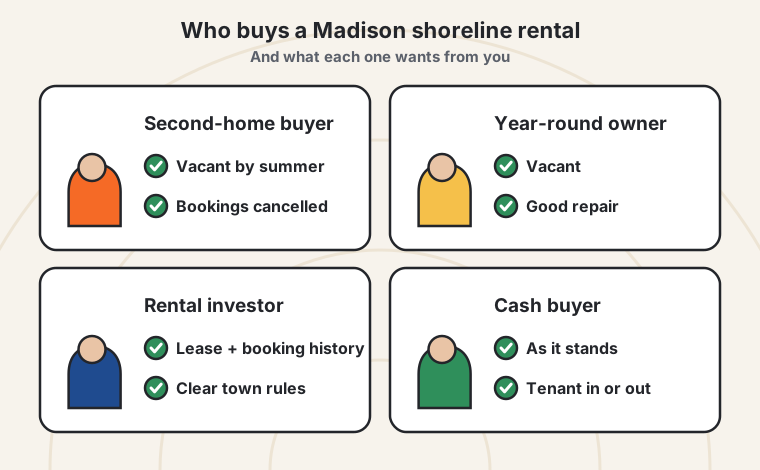
Financed owner-occupants and second-home buyers bring the highest prices in a market where the median single-family sale was $713,750. Their lenders and insurers will ask about the flood zone and the septic, and the Connecticut condition report asks about both (CGS 20-327b). Investors look at the numbers: winter rent, summer gross, the 15% tax the platform remitted, flood insurance and repairs. Our sibling guides on selling faster in Madison and hidden costs for Madison sellers cover the listing side.
When should you not sell your Madison rental to a cash buyer?
You should not sell your Madison rental to a cash buyer when the house is in good condition, the winter lease ends on time, and you can list it in spring for a summer closing. Madison’s owner-occupant and second-home buyers pay full market price for a well-kept shoreline house, and a cash buyer’s price will be lower. A cash sale fits a house that needs work, a tenant who will not leave, or an owner who cannot manage a listing from afar.
Signs a cash sale may be the better fit:
- Storm or water damage, an old roof or a failing septic that financed buyers will balk at.
- A winter tenant who is behind or will not commit to leaving.
- An estate or family group that wants one clear number and one closing date.
- An owner out of state who cannot handle showings, bookings and repairs.
If that is you, see how we buy rentals with tenants in place. We are a small Connecticut company, buying about 10 houses a year since 2016, and we will tell you if listing in spring would put more in your pocket.
How do you sell a Madison rental with a winter lease, step by step?
To sell a Madison rental with a winter lease, decide which buyer you are selling to, line up the calendar (lease end date, summer bookings), gather leases, deposits and booking records, check the town’s current rules, choose your listing window, and put the tenant and booking terms in the contract. A cash sale with the tenant in place typically closes in about two weeks.
Pick your buyer
Owner or second-home buyer (sell vacant, spring listing) or investor (sell with lease and bookings).
Line up the calendar
Note the winter lease end date and every summer booking. Do not sign next winter’s lease until you have decided.
Gather the records
Lease, deposit and interest records, booking history, platform tax statements, flood insurance, septic and oil tank papers.
Check the rules
Ask Madison’s land use office about current short-term rental rules, in writing if you can.
Sign a contract that covers the tenants
Lease transfer or vacant delivery, booking hand-over or cancellation, and the credits for both.
Close and hand over
Deposit and interest to the buyer (CGS 47a-21), keys and records, and the new-landlord letter (CGS 47a-6).
Want a number for the house as it stands, tenant and all? Ask on our Madison page.
Questions Madison owners ask about selling a seasonal rental
Can I sell my Madison house in the middle of a winter lease?
Yes, you can sell your Madison house in the middle of a winter lease. The lease stays in force and the buyer becomes the landlord, taking over the deposit and interest at closing (CGS 47a-21). A buyer who wants the house empty can close after the lease ends or negotiate an early move-out with the tenant.
Do summer rental bookings transfer to the buyer?
Summer rental bookings do not transfer to the buyer automatically. The buyer must agree in writing to honor them, with the money you collected for those dates credited at closing, or you cancel and refund them under your platform’s rules.
Is there a short-term rental ordinance in Madison, CT?
We could not confirm an adopted short-term rental ordinance in Madison, CT as of October 2026. The Board of Selectmen discussed regulatory options in January 2023. Check with Madison’s land use office before you sell or buy a house to rent by the week.
What tax applies to a summer rental in Connecticut?
A furnished summer rental of 30 days or less in Connecticut is subject to the 15% room occupancy tax (DRS). Platforms collect it on the stays they book; direct rentals are the owner’s responsibility. Contracts of 90 consecutive days or more, and unfurnished rentals, are outside the tax.
Is a winter rental subject to the room occupancy tax?
A winter rental is not subject to the room occupancy tax if the contract runs 90 consecutive days or more, or if the house is rented unfurnished (DRS Special Notice 2019(9)). A September-to-May lease meets the 90-day test.
When is the best month to sell a house in Madison?
The busiest months to close a sale in Madison are June, July and August, which together account for 33.3% of single-family closings in our eight-year query of state data. That usually means listing in March or April. January and February together account for only 9.3%.
What if my winter tenant will not move out in June?
If your winter tenant will not move out in June, the lease has ended by lapse of time and you must serve a notice to quit at least three days before the quit date, then file summary process (CGS 47a-23). You cannot change the locks yourself. Plan the sale date around that risk.
Who pays the conveyance tax when I sell in Madison?
The seller pays the conveyance tax when you sell in Madison: 0.75% to the state and 0.25% to the town on a residential sale up to $800,000, and 1.25% state on the part above $800,000 (CGS 12-494). On $660,000, that is $6,600.
Will a cash buyer keep my winter tenant?
Many cash buyers will keep a paying winter tenant and take the lease and deposit at closing. Ask before you sign, and put the answer in the contract so your tenant knows what to expect.
Related guides
Landlord guides
Same cluster
Madison and the shoreline
For the whole process, see how to sell a house in Connecticut. If selling with the tenant in place is the cleaner exit, here is how we buy rentals with tenants.
Plain-English information, not legal or tax advice. Talk to a Connecticut attorney about your lease and bookings, and confirm current town rules with Madison.
Sources (checked on October 27, 2026)
- DRS Special Notice 2019(9), Room Occupancy Tax on Short-Term Rentals.
- DRS room occupancy tax information (15% rate).
- CGA bill status, HB 5536 (2026), state short-term rental registry.
- Madison Board of Selectmen minutes, January 10, 2023 (short-term rental discussion).
- CGS 47a-2, 47a-6 and 47a-16 (exempt arrangements, identification of landlord, entry to show).
- CGS 47a-21 (security deposits and transfer to a successor).
- CGS 47a-23 (notice to quit).
- CGS 12-494 (conveyance tax).
- CGS 20-327b (property condition report).
- Connecticut OPM Real Estate Sales (Madison), data.ct.gov.
- OPM mill rates, fiscal 2027, data.ct.gov.
See the house together.
Pick a time that works.
Choose a time for us to walk through the property with you, or ask for a quick call first. We confirm every request personally.
Tuesday, January 13
No open times in the next few weeks. Please call us.
We will confirm by email. Nothing is booked until we do.
View my request
Who wrote this
Jerryll Noorden
Jerryll has bought and sold Connecticut houses since 2016 and has sat at more closing tables than he can count, on both sides. Before real estate he was a robotics scientist at NASA, IHMC and IIT. He wrote this guide because the national sites that rank for it skip the Connecticut rules that cost sellers money. When listing or selling it yourself would get you more than a cash offer, he says so.
This guide explains Connecticut rules in plain English. It is not legal or tax advice. Laws change; for your sale, talk to a Connecticut real estate attorney and a tax professional.
