
- Part of our guide to how to sell a house in Connecticut, for landlords. A problem tenant who pays but breaks the rules, disturbs others or will not leave is handled through one of four legal paths, each set by statute. Rent not paid? That has its own path: see tenants who do not pay rent in Connecticut.
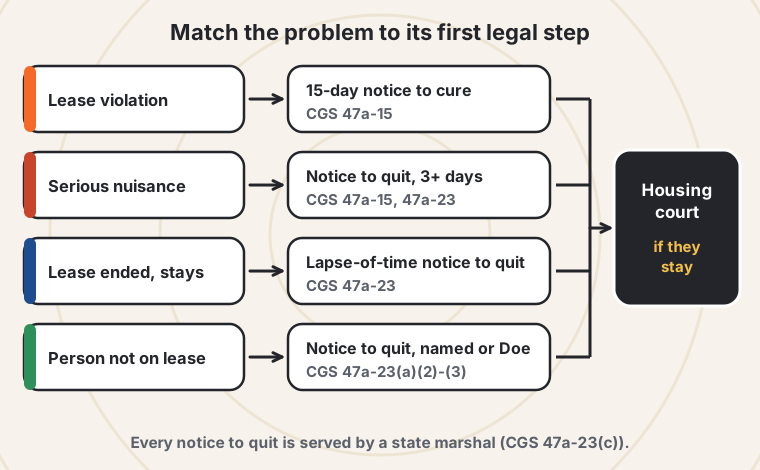
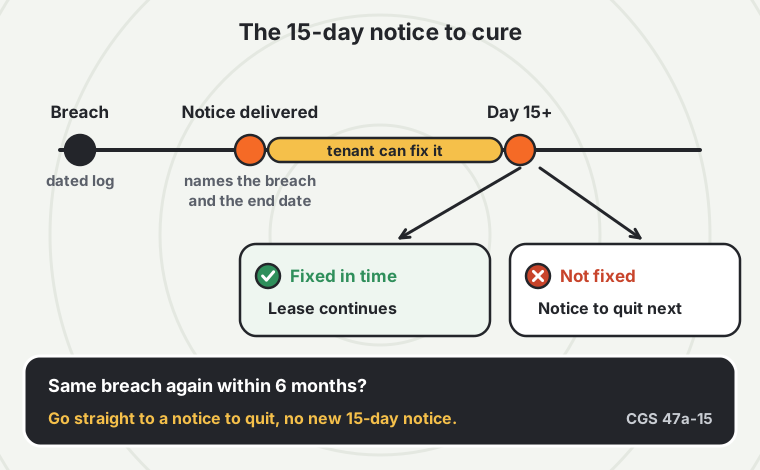
- Lease violations need a written notice and at least 15 days to fix the problem first, often called a Kapa notice. If the same breach recurs within six months, you can go straight to a notice to quit (CGS 47a-15).
- A serious nuisance skips the 15-day notice. Violence or threats, wilful destruction, an immediate danger, or drug dealing or prostitution go straight to a notice to quit, and the tenant cannot apply for the long stay after judgment (CGS 47a-15, 47a-37).
- A tenant who will not leave after the lease ends is removed for “lapse of time” with a notice to quit and housing court, except tenants 62+ or disabled in buildings of five or more units, who are protected (CGS 47a-23, 47a-23c).
- Three things can sink your case: acting within six months of a good-faith repair complaint (retaliation, CGS 47a-20), a defective notice, and any self-help such as changing the locks (CGS 47a-43, 47a-46).
- You can also sell the building with the tenant in it. The buyer takes over the lease and the problem.
How do you deal with a problem tenant in Connecticut as a landlord?
To deal with a problem tenant in Connecticut, name the problem in legal terms (a lease violation, a nuisance, a serious nuisance, or a tenant holding over after the lease ended), document it, and use the matching notice: a 15-day notice to cure under CGS 47a-15, or a notice to quit under CGS 47a-23 served by a state marshal. If the tenant stays, you file in housing court. You can also negotiate a move-out or sell with the tenant in place.
This page is the problem-tenant chapter of our guide to how to sell a house in Connecticut. Our landlord’s guide, selling a rental property with tenants in Connecticut, already covers selling occupied, leases and deposits, and Section 8. Our nonpayment guide covers the court forms step by step. Here we go deep on the tenants who make landlords’ lives hardest without necessarily owing money: the rule-breaker, the nuisance and the holdover.
A word on who is writing. I am Jerryll Noorden. I have bought houses in Connecticut since 2016, many of them two- and three-families in towns like Hartford, New Britain and Manchester, often with tenants still inside. I am not a lawyer, and nothing here is legal advice. Every rule below links to the statute it comes from, so you and your attorney can check it.
Why does a problem tenant wear you down, and is this page for you?
A problem tenant wears you down because the problem never clocks out: the noise, the extra people, the damage or the refusal to leave follow you home, and every other tenant and neighbor expects you to fix it. It is normal to feel frustrated, unsafe, powerless and tired all at once. This page is for Connecticut landlords who want to know exactly what the law lets them do, and what it does not.
Maybe you own a two-family in Manchester or a three-family in Hartford’s South End and live on the second floor. The downstairs tenant pays, mostly, but the boyfriend who “visits” has lived there since spring, the dog the lease does not allow barks all night, and the good tenant on the third floor just told you she is not renewing. Maybe the lease ran out in June and the tenant simply has not left. Maybe there was a fight in the hallway and the police came.
Many landlords in this spot hear the same thing from friends: “Connecticut law favors tenants; there is nothing you can do.” That is not quite right. Connecticut law favors process. It gives tenants notice, a chance to fix some problems, and a day in court, and it punishes landlords who skip steps. A landlord who follows the steps, in order, with good records, usually gets possession.
It is also normal to feel conflicted. The tenant may have kids, be older, or be going through something hard. You can be fair and still enforce your lease. If you are reading this after another call from a neighbor, this page is for you. Find your problem in the next section, read its path, and write the dates on a calendar.
Which Connecticut rules apply to a problem tenant?
The Connecticut rules that apply to a problem tenant are the tenant’s duties in CGS 47a-11, the 15-day notice to cure in CGS 47a-15, the grounds and notice to quit in CGS 47a-23, protection for older and disabled tenants in CGS 47a-23c, the retaliation ban in CGS 47a-20, the stay rules in CGS 47a-37 and 47a-39, and the ban on lockouts in CGS 47a-43 and 47a-46.
| Rule | What it means for you | Statute |
|---|---|---|
| Tenant’s duties | Follow health and fire codes, keep the unit as clean and safe as its condition permits, dispose of garbage, use systems reasonably, not damage the premises, and not disturb neighbors or create a nuisance, including through guests | CGS 47a-11(a)-(g) |
| Notice to cure (Kapa notice) | For a material lease violation or a 47a-11 breach affecting health, safety or the building, a written notice naming the breach and ending the lease on a date at least 15 days after the tenant receives it | CGS 47a-15 |
| Cure and recurrence | If a fixable breach is fixed within 15 days, the lease continues; if substantially the same breach recurs within six months, you may serve a notice to quit without a new 15-day notice | CGS 47a-15(1)-(2) |
| Serious nuisance | Bodily harm or a credible threat, substantial wilful destruction, conduct that is an immediate and serious danger, or prostitution or illegal drug sales on the premises; no 15-day notice needed | CGS 47a-15 |
| Nuisance | Includes conduct that “interferes substantially with the comfort or safety” of other tenants or neighbors | CGS 47a-32 |
| Grounds for a notice to quit | Lapse of time, an expressed lease term, lease or rule violation, 47a-11 breach, nuisance or serious nuisance, an occupant who never had a right to be there, or a right that has ended | CGS 47a-23(a) |
| Notice to quit | In writing, giving at least three days before the quit date, naming the reason in the statute’s words; an attested copy served by a proper officer (a state marshal) | CGS 47a-23(a)-(c), 2026 Supplement |
| Month to month by default | Without a fixed term, the tenancy is month to month (week to week for weekly rent); holding over after a lease ends does not create a new lease | CGS 47a-3b, 47a-3d |
| Protected tenants | In buildings or complexes of five or more units, tenants 62 or older or with a lasting disability (or living with such a family member) can be evicted only for listed good causes, not lapse of time | CGS 47a-23c |
| Retaliation | No eviction, rent increase or service cut within six months after a good-faith code complaint, repair request or tenants’ union activity, with listed exceptions | CGS 47a-20, 47a-20a, 47a-33 |
| Entry | A tenant may not unreasonably refuse entry to inspect, repair or show the unit to buyers; you give reasonable notice and come at reasonable times | CGS 47a-16 |
| Stays after judgment | Five-day automatic stay; then up to six months for most grounds, three for nonpayment, and no stay application after a nuisance judgment | CGS 47a-35, 47a-37, 47a-39 |
| No self-help | Lockouts, utility shut-offs and removing belongings expose you to double damages and a criminal charge | CGS 47a-43, 47a-46, 53a-214 |
What counts as a lease violation, and how does the 15-day notice work in Connecticut?
A lease violation in Connecticut is a material breach of the rental agreement, of your written rules, or of the tenant’s duties in CGS 47a-11 that materially affects other tenants’ health and safety or the building. Before ending the lease for it, you deliver a written notice that describes the breach and says the lease ends on a date at least 15 days after the tenant receives it. If a fixable breach is fixed in time, the lease continues.
Common lease violations
- Unauthorized occupants: a partner, relative or friend who moved in without approval, if your lease limits occupants.
- Pets the lease does not allow (note: assistance animals for a person with a disability are not “pets” under fair housing law).
- Smoking where the lease bans it.
- Sanitation and hoarding: garbage, pests, blocked exits or items against the heater, which breach the duty to keep the unit “as clean and safe as the condition of the premises permit” (CGS 47a-11(b)).
- Damage the tenant or guests cause wilfully or negligently (CGS 47a-11(f)).
- Running a business from the unit where the lease forbids it; a tenant must occupy the unit only as a dwelling unless otherwise agreed (CGS 47a-17).
- Refusing entry for repairs or inspections after reasonable notice (CGS 47a-16).
“Material” matters. A judge will ask whether the breach is serious enough to end a home. One late trash day is not; a second family living in a one-bedroom, a large dog in a no-pets building after written warnings, or a blocked fire exit probably is.
How to write the notice
- Describe the acts or omissions specifically: what, where, when. “On October 3 and 10, an adult not on the lease was living in the unit” beats “lease violations”.
- State that the lease will end on a date at least 15 days after the tenant receives the notice, unless the breach is remedied (for fixable breaches).
- Deliver it in a way you can prove. The statute says “deliver”; many landlords use a state marshal anyway so there is a sworn return of service.
- Keep a copy and calendar the date. Count from the day the tenant receives it, and give yourself a margin.
Connecticut attorneys often call this a “Kapa notice”, after a court decision that discussed it. Under any name, skipping it, or writing it vaguely, is one of the most common reasons a lease-violation eviction is dismissed and the landlord has to start again.
After the 15 days
If the tenant fixed the problem, the lease continues, and you watch the calendar: if substantially the same breach comes back within six months, you can serve a notice to quit without a new 15-day notice (CGS 47a-15(2)). If the tenant did not fix it, you serve a notice to quit under CGS 47a-23 citing the violation, through a state marshal, and then summary process if they stay. The court path is the same one described in our nonpayment guide.
When is a tenant a nuisance or a serious nuisance in Connecticut?
A tenant is a nuisance in Connecticut when their conduct, or their guests’, interferes substantially with the comfort or safety of other tenants or neighbors (CGS 47a-32), such as repeated loud parties or harassment. A tenant is a serious nuisance when they inflict or credibly threaten bodily harm, wilfully destroy a substantial part of the premises, create an immediate and serious danger, or use the premises for prostitution or illegal drug sales (CGS 47a-15).
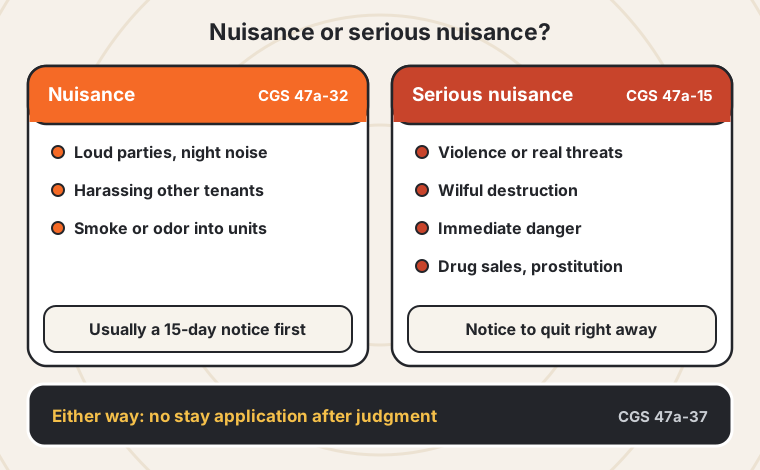
Many landlord websites lump these together. The difference decides your first step:
| Nuisance | Serious nuisance | |
|---|---|---|
| Examples | Repeated loud music or parties, yelling and slamming at night, harassing other tenants, smoke or odor drifting into other units | Assault or a credible threat, setting a fire or smashing walls, leaving a gas stove on with intent, dealing drugs from the unit |
| Definition | Conduct that interferes substantially with others’ comfort or safety (CGS 47a-32) | The four categories in CGS 47a-15 (A)-(D) |
| First step | Usually a 15-day notice to cure as a 47a-11(g) breach, then a notice to quit | A notice to quit right away; no 15-day notice |
| After judgment | No application for the long stay of execution | No application for the long stay of execution |
| Proof that helps | Dated complaints from other tenants, your log, recordings where lawful, police calls | Police reports, arrest or incident numbers, photos of damage, witness statements |
The tenant answers for guests, too: the tenant must require people on the premises with their consent not to disturb neighbors or create a nuisance (CGS 47a-11(g)). If the problem is drug sales by a guest and the tenant claims they did not know, the statute shifts the burden to the tenant to prove it once you show the premises were used for drug sales (CGS 47a-15).
If anyone is in danger, call 911 before you call a lawyer. A police report is also the best evidence for a serious nuisance case. Do not confront a violent tenant alone, and never try to remove them yourself; only a state marshal executes an eviction, under a court order.
What can you do when a tenant won’t leave after the lease ends in Connecticut?
When a tenant won’t leave after the lease ends in Connecticut, you serve a notice to quit for “lapse of time” through a state marshal, giving at least three days before the quit date, and file a summary process case in housing court if they stay (CGS 47a-23). Holding over does not create a new lease (CGS 47a-3d), but accepting rent as rent can confuse the case, so use a use-and-occupancy disclaimer.
The lease ending is itself a legal reason to end the tenancy, for most tenants. You do not need to prove anything was wrong. The steps:
- Check who is protected. If the building or complex has five or more units and the tenant (or a family member living with them) is 62 or older or has a lasting disability, lapse of time is not a ground (CGS 47a-23c). See the next sections.
- Check the retaliation window. If the tenant made a good-faith repair request or code complaint in the last six months, talk to your attorney first (CGS 47a-20).
- Serve the notice to quit. Court form JD-HM-7, reason “lapse of time”, quit date at least three full days after service, with the right-to-counsel notice attached (CGS 47a-75), served by a state marshal (CGS 47a-23(c)).
- Do not take “rent” after the quit date. Money accepted as rent can be argued to create a new tenancy. Your attorney can add the statutory use-and-occupancy disclaimer to the notice, so payments are accepted “for use and occupancy only and not for rent” (CGS 47a-23(e)).
- File summary process if the tenant stays past the quit date: summons JD-HM-32 and the lapse-of-time complaint JD-HM-20, with the $175 entry fee. Once the tenant appears, you can ask the court to order use-and-occupancy payments while the case is pending (CGS 47a-26b).
After a lapse-of-time judgment, the tenant can apply for a stay of execution of up to six months if they show they have looked for comparable housing in good faith and will follow the court’s conditions (CGS 47a-37, 47a-39). Plan for that possibility; it is the main reason holdover cases sometimes take longer than landlords expect.
People who are not on the lease
Someone who never had a right to be there, such as a guest who stayed, is a separate ground (CGS 47a-23(a)(2)), and someone whose permission has ended, such as a former partner or relative, is another (CGS 47a-23(a)(3)). Name every adult occupant on the notice to quit; if you know someone lives there but not their name, the statute allows “John Doe” or “Jane Doe” (CGS 47a-23(b)). Occupants you properly named and served are bound by the judgment (CGS 47a-26h).
How do you end a month-to-month tenancy in Connecticut?
To end a month-to-month tenancy in Connecticut, you serve a notice to quit for lapse of time through a state marshal, with a quit date at least three days after service; in practice attorneys time the quit date to fall after the end of a rental month. You do not need a reason beyond lapse of time, unless the tenant is protected under CGS 47a-23c or the property is in a program with its own notice rules.
A tenancy is month to month whenever there is no fixed term, including after a written lease simply runs out (CGS 47a-3b, 47a-3d). Some websites say Connecticut requires 30 days’ notice under CGS 47a-23; the statute itself says “at least three days” before the quit date. What trips landlords up is timing: the notice to quit ends the tenancy, so attorneys usually set the quit date at the end of a rental period and serve the notice early enough that the tenant has the full statutory time. Your lease, a subsidy contract or a federally backed mortgage can require longer notice, so check them first.
Two practical points. A friendly letter a month ahead, explaining that you are not renewing and offering help, costs nothing and often avoids court. And if you plan to sell, you may not need the unit empty at all: a buyer can take over a month-to-month tenancy, and many investors prefer to decide for themselves.
Which tenants are protected from no-fault eviction in Connecticut?
Tenants protected from no-fault eviction in Connecticut are those who live in a building or complex of five or more units, or a mobile home park, and are 62 or older or have a physical or mental disability expected to last at least twelve months, or live with a spouse, sibling, parent, grandparent or child who is (CGS 47a-23c). They can be evicted only for listed good causes, not lapse of time.
The good causes in CGS 47a-23c(b) are: nonpayment of rent; refusal of a fair and equitable rent increase; material noncompliance with 47a-11 affecting others’ health and safety or the building; material noncompliance with the lease or your rules; permanently removing the unit from the housing market; or a good-faith intent to live in the unit yourself as your principal residence. The last three reasons cannot be used during an existing lease.
What this means in practice:
- Owners of two-, three- and four-families are generally outside this rule unless the building is part of a “complex” of five or more units under the same ownership on the same or neighboring parcels (CGS 47a-23c(a)(3)).
- A protected tenant who breaks the lease or creates a nuisance can still be evicted, through the 15-day notice and the steps above.
- Selling does not end the protection. A buyer of a larger building takes the protected tenants as they are, which is one reason investors price it in.
Our guide to selling a multi-family house in Connecticut explains how buyers value buildings with long-term and protected tenants.
How do you avoid a retaliation defense when evicting a problem tenant?
To avoid a retaliation defense in Connecticut, do not start an eviction, raise the rent or cut services within six months after the tenant in good faith asked for repairs, complained to the town or a fair rent commission, or joined a tenants’ union (CGS 47a-20), unless one of the statute’s exceptions applies, such as a lease violation, nonpayment, damage the tenant caused, or a periodic-tenancy termination notice you gave before the complaint (CGS 47a-20a).
Retaliation is the defense that surprises landlords most. A tenant you have been warning for months finally gets a notice, calls the town about a leaky faucet, and suddenly your case is “retaliatory”. The protections are real, but so are the exceptions. You may still bring a case if:
- the tenant is using the unit for an illegal purpose, in violation of the lease, or is not paying rent;
- you want the unit in good faith for your own immediate home;
- the condition complained of was caused by the wilful acts of the tenant, their household or guests; or
- you gave notice ending a periodic tenancy before the tenant’s complaint (CGS 47a-20a(a)).
The defense to protect against is the case that looks like payback. So fix real repair requests promptly and in writing, keep your lease-violation notices dated before any complaint, and never mention a complaint in the same breath as a notice. In court, a tenant can raise retaliation as an affirmative defense (CGS 47a-33), and a case the judge sees as retaliatory fails.
Why can’t you change the locks or remove a problem tenant yourself?
You cannot change the locks or remove a problem tenant yourself in Connecticut because only a court judgment and a state marshal can take possession from a tenant. A landlord who locks out a tenant, removes their belongings, or shuts off utilities can be sued for double damages and costs (CGS 47a-43, 47a-46) and charged with criminal lockout (CGS 53a-214), even if the tenant has done everything you say.
This is true for a dangerous tenant too: the answer to danger is the police and a serious-nuisance case, not a locksmith. It is also true for relatives and guests who stayed. Our nonpayment guide walks through the lockout rules and the marshal’s execution in detail.
What should you document when you have a problem tenant?
When you have a problem tenant, document every incident with the date, time, what happened and who saw it, keep copies of every notice and how it was delivered, save texts and emails, collect written complaints from other tenants and neighbors, get police report numbers, and photograph damage or code problems. In housing court, a dated, specific record is usually what decides a lease-violation or nuisance case.
- A simple log: date, time, what happened, who saw it, what you did.
- The signed lease, any rules, and every addendum (pets, occupants, smoking).
- Every notice you sent, with proof of delivery or the marshal’s return.
- Texts and emails, exported or screenshotted with dates.
- Written, signed complaints from other tenants or neighbors, with dates.
- Police incident or case numbers; health, fire or building inspection reports.
- Dated photos and short videos of damage, blocked exits, garbage or code problems.
- Your repair records, to answer any retaliation defense.
- A rent ledger, even if the tenant pays: it shows what you accepted and when.
Keep your tone neutral in every message. A judge or housing mediator will read them. “Per section 9 of your lease, no additional occupants” helps you; insults and threats help the tenant.
Can mediation or cash for keys end a problem tenancy faster?
Yes, mediation or cash for keys can often end a problem tenancy faster than a trial. Contested Connecticut housing cases usually go to a Judicial Branch housing mediator, who can write a move-out agreement the judge enters as a judgment (CGS 47a-69). Outside court, cash for keys is a written agreement in which you pay the tenant to leave by a date, with the unit empty and keys returned.
Mediated agreements are common in lease-violation and holdover cases: the tenant agrees to leave by a set date, sometimes with conditions such as no further incidents, and if they break it, your attorney can ask the court to act on the agreement instead of starting over. For a tenant who is not dangerous, this is often the fastest real end date you will get.
Cash for keys works best before court or early in the case. Put it in writing: the move-out date, the amount, that it is paid only when the unit is empty and the keys are returned, what happens to the security deposit, and that both sides release claims. Our nonpayment guide has a full cash-for-keys checklist. Do not pressure: an offer that sounds like a threat can become a harassment or retaliation claim.
If you start a case, expect the tenant may have a lawyer. Connecticut’s right-to-counsel program provides free counsel to eligible tenants, and the notice of that right must be attached to your notice to quit and court papers (CGS 47a-75).
How long does it take, and what does it cost, to remove a problem tenant in Connecticut?
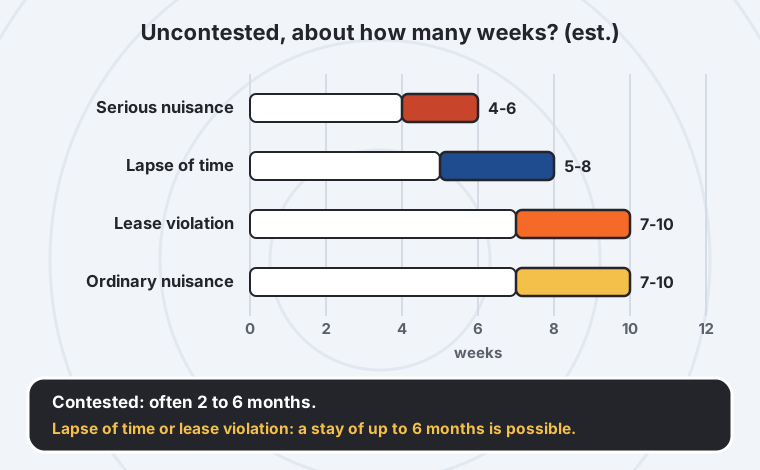
Removing a problem tenant in Connecticut often takes about 6 to 10 weeks when the tenant does not contest, and 3 to 6 months or more when they do (est.), depending on the ground. A lease violation adds the 15-day notice up front, a serious nuisance skips it, and lapse-of-time and lease-violation cases can add a stay of up to six months after judgment. Legal costs often run about $1,500 to $5,000 (est.).
| Ground | First notice | Uncontested (est.) | Contested (est.) | Stay after judgment |
|---|---|---|---|---|
| Serious nuisance | Notice to quit, at least 3 days | About 4 to 6 weeks | 2 to 4 months | 5-day automatic stay only; no stay application |
| Lapse of time / holdover | Notice to quit, at least 3 days | About 5 to 8 weeks | 3 to 5 months | Up to 6 months if granted |
| Lease violation | 15-day notice, then notice to quit | About 7 to 10 weeks | 3 to 6 months | Up to 6 months if granted |
| Ordinary nuisance | 15-day notice, then notice to quit | About 7 to 10 weeks | 3 to 6 months | 5-day automatic stay only; no stay application |
Example (illustrative): a holdover downstairs in Manchester
Built only from public numbers and labelled estimates. You own a two-family in Manchester. The downstairs tenant’s lease ended and they will not leave; they keep paying, and the upstairs tenant is threatening to move out because of noise. You decide on a lapse-of-time case and the tenant contests.
| Item | Input | Cost |
|---|---|---|
| Summary process entry fee | CGS 52-259 | $175 |
| State marshal: notice to quit, summons, execution | $300 to $1,200 (est.) | $300 to $1,200 |
| Attorney, contested case | $1,000 to $3,500 (est.) | $1,000 to $3,500 |
| Upstairs unit empty 2 months if that tenant leaves | $1,500 rent a month (est.) | $3,000 |
| Turnover downstairs: cleaning, paint, repairs | $1,000 to $4,000 (est.) | $1,000 to $4,000 |
| Total | $5,475 to $11,875 |
If the tenant keeps paying use and occupancy during the case (CGS 47a-26b), the rent loss is smaller. If they stop, the case becomes a nonpayment case too. Either way, your calendar fills with court dates, and the building sits in limbo.
Know where you stand,
on your own time.
Watch what homes around you sell for and how fast, so when you are ready, you already know your options.
Follow your numbers as the market moves, and decide when the timing is right.
What if the problem tenant is hoarding, damaging the unit or moving people in?
If the problem tenant is hoarding, damaging the unit or moving people in, each is a breach of the tenant’s duties or the lease that starts with a written 15-day notice to cure (CGS 47a-11, 47a-15), unless the damage is substantial and wilful, which is a serious nuisance. Hoarding can involve a disability, so answer any accommodation request; damage can also be claimed in money; and unauthorized occupants must be named on any notice to quit.
- Hoarding. Inspect with notice, document the safety issues (blocked exits, items near heat, pests), and give the 15-day notice. Hoarding disorder can be a disability under the federal Fair Housing Act, so a tenant may ask for a reasonable accommodation such as extra time with a cleanup plan (HUD/DOJ joint statement). Our guide to selling a hoarder house in Connecticut covers the health and safety side.
- Damage. Wilful or negligent damage breaches CGS 47a-11(f); substantial wilful destruction is a serious nuisance. Photograph it and keep repair invoices. After the tenant leaves, the deposit rules and small claims steps are in what to do when a tenant trashed your Connecticut house.
- Extra occupants. If the lease limits occupants, a 15-day notice is the start. If the occupants make the unit overcrowded under your town’s housing code, that is also a 47a-11(a) code issue, and you have your own duty to keep the unit code-compliant (CGS 47a-7).
- Refusing access. Give reasonable written notice of entry at reasonable times. If the tenant still refuses, the court can order access (CGS 47a-18), and repeated refusal can be a lease violation.
- Criminal activity. Call the police. Drug sales on the premises are a serious nuisance (CGS 47a-15(D)).
Should you keep fighting or sell the building with the problem tenant inside?
You should keep fighting if the building makes money in a normal year, you want to stay a landlord, and the case is clean: a documented violation, no retaliation risk, no protected tenant. You should consider selling with the tenant inside if you are done being a landlord, the case is messy or slow, or the problem is costing you good tenants, because a buyer takes over the lease and the tenant along with the building.
In Connecticut, a sale does not end a lease. The buyer steps into your shoes, takes over the tenancies and the security deposits, and can continue or start any eviction themselves. That is why a problem tenant does not stop a sale; it changes who buys and the price. A tenant must not unreasonably refuse entry to show the unit to buyers, with reasonable notice (CGS 47a-16), and a cash buyer often needs only one visit, or none for an occupied unit. The full rules for leases, deposits and showings are in our landlord’s guide to selling a rental property with tenants in Connecticut.
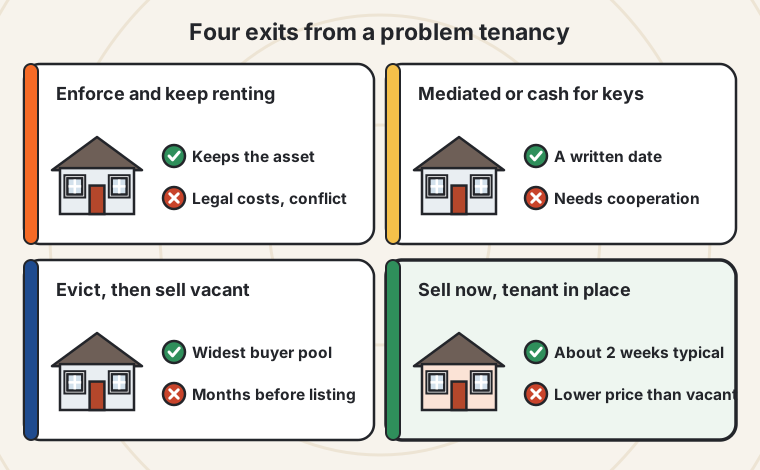
Enforce and keep renting
Keeps the assetBest when the building cash-flows and the case is clean.
- Future rent and appreciation stay yours
- Legal costs and weeks to months of conflict
- A new tenant brings new risk
Mediated or cash-for-keys move-out
Often the fastest real dateBest when the tenant is not dangerous and wants a way out.
- A written date, no trial
- You may pay the tenant to leave
- Needs the tenant to cooperate
Evict, then sell vacant
Widest buyer poolBest when you can wait out the case and want top price.
- Owner-occupant buyers can buy
- Months of court before listing
- Turnover repairs before showings
Sell now, tenant in place
About 2 weeks typicalBest when you are done, or the case is slow or messy.
- No eviction, no turnover, no showings to manage
- The buyer takes the lease, the deposit and the problem
- Trade-off: an occupied problem unit sells for less than a vacant, renovated one
When you should not sell to us
If the building is in good shape, the problem tenant is one unit out of three, and your case is documented and clean, an eviction followed by a normal listing may well net you more. If the tenant’s lease ends in a few weeks and they have said they are leaving, wait. And if you like owning rentals, one bad tenant is not a reason to sell. We will say that on the phone. Our comparison of a cash buyer versus a realtor in Connecticut lays out the trade-offs.

The landlords who struggle most are not the ones with the worst tenants. They are the ones with no paper: no written lease rules, no dated notices, no log. Start the log today, even if you plan to sell. If you keep the building, it wins your case. If you sell, it tells the buyer exactly what they are taking on, which makes for a cleaner offer and a cleaner closing.
How does selling a rental with a problem tenant work?
Selling a rental with a problem tenant in Connecticut works like this: you share the leases, the rent ledger and your notes, the buyer walks through the units you can show, you get a written offer for the building as it is, with the tenant in place, and you close with Connecticut attorneys, typically in about two weeks with us. The leases and security deposits, with interest, transfer to the buyer at closing.
Gather the paper
The leases or a note on any oral tenancy, the rent ledger, the security deposits and interest owed, and your log of the problem. Any open notices or court case too.
One visit, on the tenants’ terms
We walk through what you can show with reasonable notice to the tenants (CGS 47a-16). If a unit cannot be shown, we price it from the outside and the other units, and say so.
A written offer, tenant in place
You get a written number for the building exactly as it is, with the problem tenant inside. No eviction first, no turnover, no repairs. Take your time and have your attorney review it.
Close on your date
A Connecticut attorney conducts the closing (CGS 51-88a). The security deposits and interest are credited to the buyer, the conveyance tax comes out of your proceeds (0.75% state plus 0.50% town in Hartford, New Britain and East Hartford on a sale up to $800,000), and the buyer takes over every lease and any pending case.
For the situation page and our offer form, see how to sell a rental property with tenants in Connecticut.
See the house together.
Pick a time that works.
Choose a time for us to walk through the property with you, or ask for a quick call first. We confirm every request personally.
Tuesday, January 13
No open times in the next few weeks. Please call us.
We will confirm by email. Nothing is booked until we do.
View my requestQuestions Connecticut landlords ask about problem tenants
How do I get rid of a bad tenant in Connecticut?
To get rid of a bad tenant in Connecticut, use the legal path for the problem: a written 15-day notice to cure for a lease violation (CGS 47a-15), a notice to quit served by a state marshal for a serious nuisance or after the lease ends (CGS 47a-23), then summary process in housing court if they stay. You can also negotiate a move-out or sell with the tenant in place.
What is a Kapa notice in Connecticut?
A Kapa notice in Connecticut is the written pre-termination notice required by CGS 47a-15 before evicting for most lease violations. It describes the breach and says the lease ends on a date at least 15 days after the tenant receives it, unless a fixable breach is fixed. It is not needed for nonpayment or a serious nuisance.
Can a landlord evict for no reason in Connecticut?
A Connecticut landlord can end a month-to-month tenancy, or a lease that has expired, for “lapse of time” without another reason, using a notice to quit and housing court (CGS 47a-23). That is not allowed for tenants protected under CGS 47a-23c, or within six months of a good-faith tenant complaint unless an exception applies (CGS 47a-20, 47a-20a).
How much notice does a landlord have to give a tenant to move out in Connecticut?
A Connecticut notice to quit must give at least three days before the quit date (CGS 47a-23). For lease violations, a 15-day notice to cure comes first (CGS 47a-15). Leases, subsidy contracts and federally backed mortgages can require longer notice, and attorneys usually time a lapse-of-time quit date to the end of a rental month.
What is a serious nuisance in Connecticut?
A serious nuisance in Connecticut is inflicting or credibly threatening bodily harm on another tenant or the landlord, substantial wilful destruction of the premises, conduct that is an immediate and serious danger to others’ safety, or using the premises for prostitution or illegal drug sales (CGS 47a-15). It allows a notice to quit without a 15-day notice.
Can I evict a tenant for noise in Connecticut?
You can evict a tenant for noise in Connecticut if it is a material breach of the lease or interferes substantially with other tenants’ comfort, which is a nuisance (CGS 47a-11(g), 47a-32). Document dates and complaints, give a written 15-day notice to cure, and serve a notice to quit if it continues or recurs within six months.
What is retaliatory eviction in Connecticut?
Retaliatory eviction in Connecticut is starting an eviction, raising rent or cutting services within six months after a tenant in good faith asked for repairs, complained to an agency or fair rent commission, or joined a tenants’ union (CGS 47a-20). Exceptions include lease violations, nonpayment and tenant-caused conditions (CGS 47a-20a).
Can a landlord change the locks on a tenant in Connecticut?
No, a landlord cannot change the locks on a tenant in Connecticut without a court judgment and a state marshal’s execution. A lockout, utility shut-off or removing belongings can lead to double damages and costs (CGS 47a-43, 47a-46) and a criminal lockout charge (CGS 53a-214).
How do I remove someone who is not on the lease in Connecticut?
To remove someone who is not on the lease in Connecticut, serve them a notice to quit as an occupant who never had a right to be there, or whose right has ended (CGS 47a-23(a)(2)-(3)), naming them, or “John Doe” if you do not know the name. If the tenant allowed them in against the lease, that can also be a lease violation.
Can a tenant refuse showings when I sell in Connecticut?
A Connecticut tenant may not unreasonably refuse entry to show the unit to prospective buyers, but you must give reasonable written or oral notice and come at reasonable times (CGS 47a-16). If a tenant still refuses, the court can order access (CGS 47a-18).
Can I sell my house with a problem tenant in it in Connecticut?
Yes, you can sell a house with a problem tenant in it in Connecticut. The lease survives the sale, the buyer takes over the tenancy and the security deposit with interest, and the buyer can continue or start any eviction. Investors and cash buyers commonly buy occupied buildings.
How long does an eviction for a lease violation take in Connecticut?
An eviction for a lease violation in Connecticut often takes about 7 to 10 weeks if the tenant does not contest and 3 to 6 months or more if they do (est.), counting the 15-day notice, the notice to quit and the court case. After judgment, the tenant can ask for a stay of up to six months (CGS 47a-39).
Can a tenant over 62 be evicted in Connecticut?
A tenant over 62 can be evicted in Connecticut for good cause such as nonpayment, a material lease violation or a serious code breach. In buildings or complexes of five or more units, such tenants cannot be evicted for lapse of time alone (CGS 47a-23c). In smaller buildings, the ordinary rules apply.
Related Connecticut guides for landlords
Tenants and the law
Selling a rental
Money and the decision
We buy occupied rentals across Connecticut, including Hartford, New Britain, Manchester, East Hartford, Enfield and Windsor. For the whole process from start to finish, see how to sell a house in Connecticut and our complete guide to selling a house in Connecticut.
Plain-English information, not legal advice. Landlord-tenant law changes often and cases turn on details; talk to a Connecticut landlord-tenant attorney before serving any notice.
Sources
- CGS §§ 47a-3b, 47a-3d, 47a-7, 47a-11, 47a-15, 47a-16, 47a-17, 47a-18, 47a-20 and 47a-20a (tenancy terms, duties, 15-day notice and serious nuisance, entry, retaliation).
- CGS § 47a-23, 2026 Supplement (notice to quit: grounds, form, service by a proper officer, use-and-occupancy disclaimer).
- CGS §§ 47a-23a, 47a-23c, 47a-26, 47a-26b, 47a-26h, 47a-32, 47a-33, 47a-35, 47a-37 and 47a-39 (summary process, protected tenants, nuisance, retaliation defense, stays).
- CGS §§ 47a-43 and 47a-46 (forcible entry and detainer, double damages).
- CGS §§ 47a-69 and 47a-75 (housing mediators, right to counsel).
- CGS § 53a-214 (criminal lockout).
- CGS § 52-259 (court fees, including the summary process entry fee).
- CGS § 51-88a (closings conducted by attorneys); CGS § 12-494 (conveyance tax).
- Connecticut Judicial Branch housing forms (JD-HM-7 notice to quit, JD-HM-32 summons, JD-HM-20 lapse-of-time complaint) and housing matters.
- HUD and DOJ joint statement: reasonable accommodations under the Fair Housing Act.
- Town median and mill rate: Connecticut OPM fiscal 2027 mill rates and Oct 2024 to Sep 2025 sales, as published on our town pages.

Who wrote this
Jerryll Noorden
Jerryll has bought and sold Connecticut houses since 2016 and has sat at more closing tables than he can count, on both sides. Before real estate he was a robotics scientist at NASA, IHMC and IIT. He wrote this guide because the national sites that rank for it skip the Connecticut rules that cost sellers money. When listing or selling it yourself would get you more than a cash offer, he says so.
This guide explains Connecticut rules in plain English. It is not legal or tax advice. Laws change; for your sale, talk to a Connecticut real estate attorney and a tax professional.
