
- Part of our guide to how to sell a house in Connecticut, for landlords. Document everything before you touch anything: dated photos and video of every room, the move-in record, receipts and estimates. That file decides your deposit deductions, your court case and your insurance claim.
- You have 21 days after the tenancy ends, or 15 days after receiving a written forwarding address if later, to return the deposit with interest or send an itemized list of deductions. Miss it and you can owe twice the deposit (CGS 47a-21(d)(2)).
- Normal wear and tear is not deductible; damage is. Tenants must not “wilfully or negligently destroy, deface, damage, impair or remove” any part of the premises (CGS 47a-11(f)).
- For damage beyond the deposit, small claims court handles up to $5,000 for a $95 entry fee (jud.ct.gov). Winning is one step; collecting with wage or bank executions is another.
- Deliberate destruction can be a crime: criminal mischief is a felony above $1,500 of damage (CGS 53a-115). A police report also helps an insurance claim.
- Repair or sell is a math question. In our Waterbury example, repairs plus three months of carrying costs come to about $16,730 to $44,230 (est.). Selling as-is skips the cleanout, the contractors and the wait.
What can you do if a tenant trashed your house in Connecticut?
If a tenant trashed your house in Connecticut, document the damage with dated photos, make sure the tenant has really left, stop any ongoing damage, and send the deposit balance with an itemized list of deductions within 21 days. Then decide whether to sue for the rest in small claims (up to $5,000), file an insurance claim or police report, and repair the house or sell it as-is.
This page is part of our guide to how to sell a house in Connecticut, written for landlords who just opened the door on a mess. It covers what to do first, what Connecticut’s security deposit law lets you keep, how to sue for the rest and collect, what insurance and the police can and cannot do, and how to decide between fixing the house and selling it as it is.
I am Jerryll Noorden. I have bought Connecticut houses since 2016, many of them rentals that tenants left in rough shape: walls punched through, floors ruined by pets, kitchens stripped, rooms full of trash. Nothing you are looking at will surprise us. I am not a lawyer, so every legal rule here links to the statute or Judicial Branch page it comes from.
Why does finding your rental trashed hit so hard, and is this page for you?
Finding your rental trashed hits hard because it feels like a personal violation as well as a financial loss: someone you trusted damaged a home you paid for and maintained. It is normal to feel angry, ashamed, overwhelmed and done with being a landlord. This page is for Connecticut owners who want to know what they can recover and whether to repair or sell.
Maybe it is a cape in Waterbury’s Town Plot you rented out after you moved, or the second floor of your New Britain two-family. You walk in and the smell hits first. Holes in the drywall. Carpet you will never get clean. Doors off their hinges, a broken toilet, bags of garbage in the basement. Maybe they owe you two months of rent too.
The first feeling is anger. The second, for a lot of landlords, is embarrassment: “How did I not see this coming? Who would even look at this house now?” Then come the numbers, which keep growing every time you walk into another room.
Take a breath. This happens to careful landlords with good leases. You did not cause it. Connecticut law gives you real tools: the security deposit, small claims court, executions to collect, and the criminal law when it was deliberate. And if you have had enough, a house in this condition can still be sold, today, as it sits. If you are standing in that house right now, this page is for you.
What should you do in the first 48 hours after you find the damage?
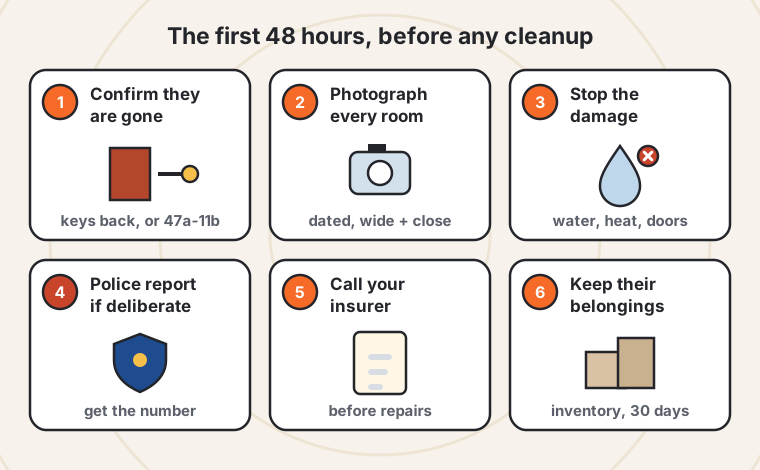
In the first 48 hours after you find tenant damage in Connecticut, confirm the tenant has surrendered or abandoned the unit, photograph and video every room with dates, stop active damage such as leaks or open windows, call the police if the damage looks deliberate, notify your insurer, and start a file of receipts and estimates. Do not throw away the tenant’s belongings yet.
Make sure the tenant has really left
If the tenant returned the keys or signed a move-out, the unit is surrendered. If they simply vanished, Connecticut has an abandonment procedure: notice by regular and certified mail to each occupant’s last address saying you believe they abandoned and will retake the unit unless they contact you within ten days (CGS 47a-11b). If you know or should know they have not abandoned, you need a notice to quit and summary process instead; see our guide to tenants who do not pay rent. Entering and clearing out a unit someone still occupies is a lockout (CGS 53a-214, 47a-43).
Photograph and video every room
Before any cleanup: wide shots of each room, close-ups of each damaged item with something for scale, the inside of appliances, the yard and the basement. Turn on the date stamp, or email the files to yourself the same day. Pull out your move-in photos or checklist for comparison.
Stop the damage from growing
Shut off water to a broken fixture, close windows, check the heat in winter so pipes do not freeze, and secure doors. Connecticut expects a landlord to mitigate damages (CGS 47a-11c), and insurers expect the same.
Call the police if it was deliberate
Smashed fixtures, graffiti, cut wires or stolen appliances are different from neglect. A report creates a dated official record (more on this below).
Notify your insurer
Most policies require prompt notice. Ask what your landlord policy covers before you hire anyone.
Keep belongings and start a file
Under the abandonment procedure, you inventory the tenant’s things and keep them at least 30 days before disposing of them (CGS 47a-11b(d)). Start a folder for photos, the lease, the ledger, the move-out date, any forwarding address and every estimate and receipt.
What are Connecticut’s security deposit rules after a tenant moves out?
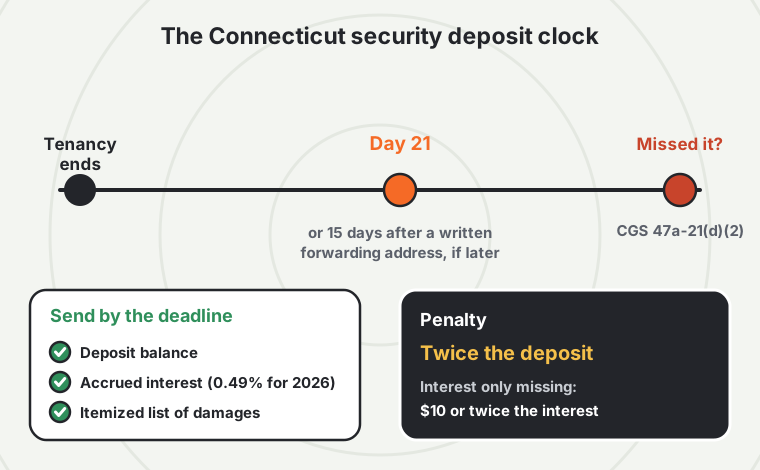
Connecticut’s security deposit rules after a tenant moves out require you to return the deposit plus accrued interest, or the balance with a written itemized list of damages, within 21 days after the tenancy ends or 15 days after receiving the tenant’s written forwarding address, whichever is later. You may deduct unpaid rent and damage beyond normal wear. Missing the deadline can cost twice the deposit (CGS 47a-21).
| Rule | What it means for you | Statute or source |
|---|---|---|
| Maximum deposit | Two months’ rent; one month for a tenant aged 62 or older | CGS 47a-21(b) |
| Escrow | The deposit goes into an escrow account at a Connecticut financial institution right away | CGS 47a-21(h)(1) |
| Bank notice | Within 30 days you tell the tenant the amount held and the bank’s name and address | CGS 47a-21(h)(4)(A) |
| What you may deduct | Unpaid rent and utilities owed to you, the tenant’s breaches of their duties under 47a-11 (damage), and unpaid lock-change costs | CGS 47a-21(a)(14) |
| Return deadline | 21 days after the tenancy ends, or 15 days after a written forwarding address, whichever is later | CGS 47a-21(d)(2) |
| Itemized statement | A written statement itemizing the nature and amount of each deduction, with the balance and interest | CGS 47a-21(d)(2) |
| Penalty | Twice the deposit for violating the return rules; if only the interest is missing, $10 or twice the interest, whichever is greater | CGS 47a-21(d)(2) |
| Interest | At least the Banking Commissioner’s deposit index: 0.49% for 2026 (0.52% for 2025); none for a month rent was more than 10 days late, unless you charged a late fee | CGS 47a-21(i); CT Department of Banking |
| Who checks | The Department of Banking investigates deposit complaints, but not good-faith disputes about the amount of damage | CGS 47a-21(j) |
| Tenant duty | A tenant must not wilfully or negligently destroy, deface, damage, impair or remove any part of the premises | CGS 47a-11(f) |
| Other damages | The deposit rules do not stop you from recovering other damages you are owed | CGS 47a-21(g) |
Landlords who are angry about damage often hold the whole deposit and send nothing, planning to “deal with it later.” That is the one move that can flip the case: if you miss the 21-day (or 15-day) deadline, the tenant can claim twice the deposit, and a small claims judge can award it against your damage claim (CGS 47a-21(d)(2), 51-15(d)). Send the itemized statement on time, even if the balance is zero and the tenant owes you more.
What counts as normal wear and tear versus tenant damage in Connecticut?
In Connecticut, normal wear and tear is the gradual decline that comes from ordinary living, such as faded paint, light scuffs and carpet worn in walkways, and you cannot charge the tenant for it. Tenant damage is harm from abuse, neglect or accidents beyond ordinary use, such as holes in walls, pet-ruined floors, broken doors and missing fixtures, and you can deduct its reasonable repair cost.
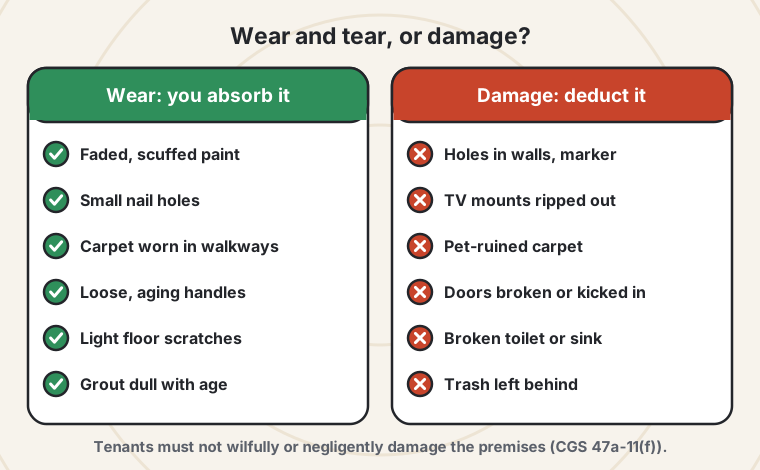
The statute does not list examples, so the line is drawn case by case. The question a judge asks is simple: would a reasonable tenant living normally for this long have left it this way? These are common examples, not legal rules.
| Normal wear and tear (not deductible) | Tenant damage (deductible) |
|---|---|
| Paint faded or lightly scuffed after a few years | Holes in walls, crayon or marker, unapproved paint colors |
| Small nail holes from hanging pictures | Large anchors, TV mounts ripped out, doors punched through |
| Carpet worn in walkways after years of use | Pet urine, burns, tears, carpet soaked and ruined |
| Loose door handles, sticky locks from age | Broken doors, frames split, locks changed without permission |
| Minor scratches on floors | Deep gouges, water damage from neglect, missing floorboards |
| Grout and caulk discolored with age | Broken toilet, cracked sink, missing faucets or fixtures |
| Appliances aging normally | Appliances broken by misuse or removed from the unit |
| A little dust at move-out | Garbage, abandoned furniture, infestations caused by filth |
Age matters. If a carpet with a ten-year life was already five years old, charging the tenant for a brand-new carpet is hard to defend; charging about half its replacement cost is easier to defend. Judges look for fairness, and an itemized list that clearly accounts for age makes your whole claim more believable.
How do you write the itemized list of deductions?
To write the itemized list of deductions in Connecticut, list each damaged item, what was wrong, and the actual or estimated repair cost, adjusted for age, then add any unpaid rent, subtract the total from the deposit plus interest, and mail the balance or a statement of what the tenant still owes to the forwarding address within the deadline. Attach photos and receipts or written estimates where you can.
Example (illustrative). A tenant paid a $3,000 deposit (two months at $1,500) and left owing the last month’s rent. The amounts below are labelled estimates, not quotes.
| Item | What was wrong | Amount |
|---|---|---|
| Deposit held | Two months at $1,500 | $3,000.00 |
| Interest, one year at 0.49% | 2026 rate (CT Department of Banking) | $14.70 |
| Total held for the tenant | $3,014.70 | |
| Patch and paint 3 rooms | Holes and marker beyond normal wear; 3 rooms at about $600 each (est.) | $1,800.00 |
| Bedroom carpet | Pet urine; $1,200 replacement, carpet half its useful life (est.) | $600.00 |
| Two interior doors | Punched through; 2 at about $250 installed (est.) | $500.00 |
| Trash and furniture removal | Left after move-out (est.) | $800.00 |
| Unpaid rent | Last month | $1,500.00 |
| Total deductions | $5,200.00 | |
| Balance the tenant still owes | $5,200.00 minus $3,014.70 | $2,185.30 |
Send it by a method you can prove (certified mail plus regular mail, or email if the tenant gave you an email address), keep a copy, and keep the photos that match each line. If the tenant gave no forwarding address, send it to the last known address and keep proof. That letter is also the first exhibit if you go to small claims.
Can you sue a tenant for damage beyond the security deposit in Connecticut?
Yes, you can sue a tenant for damage beyond the security deposit in Connecticut. Claims up to $5,000 go to small claims court for a $95 entry fee using form JD-CV-40, filed in the housing session where the property is if there is one; larger claims go to the regular Superior Court docket. The deposit law does not limit your right to recover other damages (CGS 47a-21(g)).
Send a demand letter
Use the itemized statement, ask for the balance by a date, and say you will file in small claims if it is not paid. Some former tenants pay or offer a plan at this point.
Fill out the writ
Complete the Small Claims Writ and Notice of Suit (JD-CV-40) with the tenant’s name and address, the amount and a short description. You sign it under oath before the clerk, a notary or a commissioner of the Superior Court.
Serve and file
Deliver the writ to each defendant as the court’s instructions require, complete the Statement of Service (JD-CV-123) and return everything to court with the $95 fee. For landlord-tenant matters, file in the housing session where the property is located, if one exists (jud.ct.gov). Waterbury, New Britain and Hartford have housing sessions (CGS 47a-70).
Prepare your evidence
The lease, move-in and move-out photos, the itemized letter with proof of mailing, receipts and estimates, and the ledger. Organize them in the same order as your list.
The decision
If the tenant does not answer, the court may enter judgment without a hearing; otherwise a magistrate or judge hears both sides. Small claims decisions cannot be appealed (jud.ct.gov), so bring everything the first time. Expect the tenant to argue wear and tear, or to counterclaim for twice the deposit if your statement was late or missing.
If the damage is well above $5,000, you can sue on the regular Superior Court docket instead, where an attorney is usually worth it. Ask your attorney which route fits the size of your claim.
How do you collect a judgment from a former tenant in Connecticut?
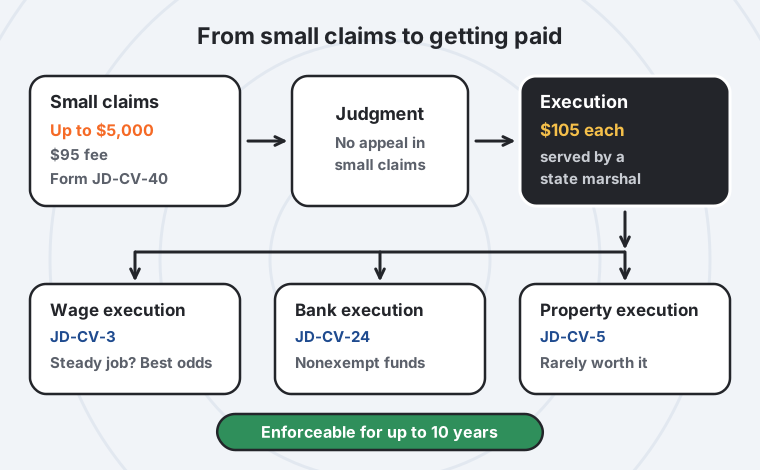
To collect a judgment from a former tenant in Connecticut, ask the court clerk for an execution: a wage execution (JD-CV-3), a bank execution (JD-CV-24) or a property execution (JD-CV-5), each for a $105 application fee, which a state marshal then enforces. A small claims judgment can be enforced for up to 10 years. The court does not collect for you, and some former tenants have nothing to collect.
- Find them. You need a current address and, for a wage execution, an employer. Your rental application often has the employer from the time they moved in.
- Wage execution. The marshal serves the employer, who withholds part of each paycheck within legal limits. It works best against a tenant with a steady job.
- Bank execution. The marshal serves the bank, which freezes nonexempt funds; certain benefits and a protected amount are exempt.
- Property execution. Reaches nonexempt personal property; rarely worth it against a former tenant.
- Real estate. Executions do not reach real estate; a separate judgment lien does (jud.ct.gov).
The honest math: if the balance is $2,185.30, you will spend $95 to file, marshal fees to serve, $105 per execution, and hours of your own time, against a person who may be unemployed or out of state. Some landlords collect the whole thing over a year of wage withholding; others never see a dollar. Decide with clear eyes, and do not let the case keep you from fixing or selling the house.
Will landlord insurance cover the damage a tenant did?
Landlord insurance may cover damage a tenant did if the policy covers vandalism or malicious mischief and the house was not vacant longer than the policy allows. It usually does not cover wear and tear, neglect, pet damage, gradual leaks or the tenant’s belongings. A regular homeowner’s policy often does not cover a rented house at all. Read the exact policy and call your agent before you start repairs.
- Check the policy type. A rented house should be on a landlord (dwelling) policy. If it is still on a homeowner’s policy written for an owner-occupied home, coverage may be denied.
- Look for vandalism and malicious mischief. Many dwelling policies cover it; some restrict it, and many limit coverage after the house has been vacant for a set number of days. Ask yours.
- Expect exclusions. Wear and tear, neglect, mold from long-term leaks, insects and rodents, and pet damage are commonly excluded.
- Loss of rent. Some landlord policies pay lost rent while a covered loss is repaired.
- Paperwork. A police report, dated photos, the lease and contractor estimates. Your deductible comes off the top; compare it with the size of the claim.
If the insurer pays for damage you also deducted from the deposit or won in court, you cannot collect twice. Tell your attorney and your insurer what you recovered elsewhere.
Should you file a police report when a tenant destroys your property?
You should file a police report when a tenant deliberately destroys your property in Connecticut, such as smashing fixtures, punching holes, spray-painting or stealing appliances. Intentional damage over $1,500 is criminal mischief in the first degree, a class D felony, and over $250 is second degree, a class A misdemeanor (CGS 53a-115, 53a-116). Ordinary neglect is a civil matter, not a crime.
Call your town’s non-emergency line, not 911, unless something is happening right now. Give the officer the lease, the tenant’s name and last known address, the photos and a rough damage estimate. Ask for the report number; your insurer will want it.
Be realistic about what follows. The police and the prosecutor decide whether to charge, and many cases are never charged. If there is a conviction, the court may order restitution, but that is the criminal court’s decision and timeline. Your own claim for money still runs through the deposit, small claims or insurance. Theft of appliances, fixtures or copper pipe is reported the same way.
Should you repair the trashed house or sell it as-is?
Whether to repair the trashed house or sell it as-is depends on the repair bill, the months it takes, your carrying costs and whether you still want to be a landlord. Repair if the work is mostly cosmetic, you have cash and time, and you plan to rent or list it. Sell as-is if the bill is large, your money is tight, the house has bigger problems, or you are finished with tenants.
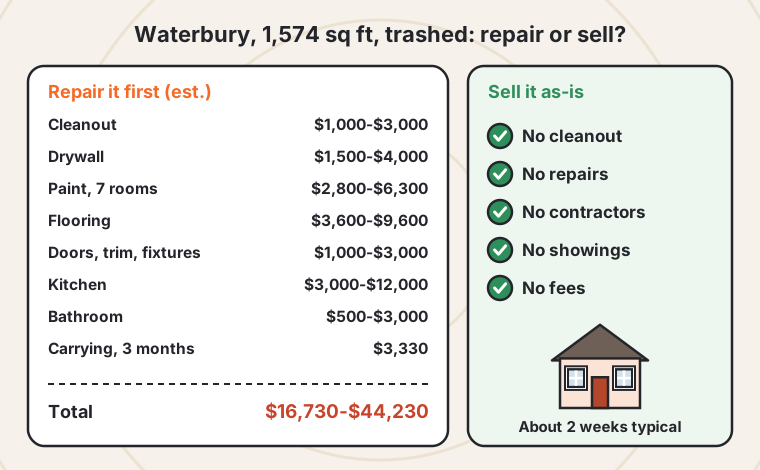
Example (illustrative). A Waterbury single-family of 1,574 square feet (the town’s average size for single-family homes) left trashed by a tenant: holes in most rooms, ruined floors, a damaged kitchen and bath, trash everywhere. Waterbury’s mill rate for fiscal 2027 is 43.34; on a $280,000 home that is about $8,490 a year in property tax, roughly $710 a month. Costs are estimates; get written quotes.
| Item | Low (est.) | High (est.) | Assumption |
|---|---|---|---|
| Cleanout, dumpster, haul-away | $1,000 | $3,000 | One to two dumpsters plus labor |
| Drywall repair, whole house | $1,500 | $4,000 | Patches and some new sheets |
| Paint, 7 rooms hired | $2,800 | $6,300 | $400 to $900 per room |
| Flooring, about 1,200 sq ft | $3,600 | $9,600 | $3 to $8 per sq ft installed |
| Doors, trim, blinds, light fixtures | $1,000 | $3,000 | Several interior doors and hardware |
| Kitchen: cabinet repairs, counter, appliances | $3,000 | $12,000 | Repair or replace what was broken |
| Bathroom fixtures | $500 | $3,000 | Toilet, vanity, faucets |
| Repairs subtotal | $13,400 | $40,900 | |
| Property tax, 3 months | $2,130 | $2,130 | $710 a month (Waterbury, fiscal 2027) |
| Insurance, utilities, upkeep, 3 months | $1,200 | $1,200 | About $400 a month (est.) |
| Total before the house earns again | $16,730 | $44,230 | Plus any mortgage payments |
Three months is optimistic for a house in this condition; contractor schedules, permits for electrical or plumbing work and surprises behind the drywall stretch it. And the repair bill is only the start if you plan to re-rent: you would screen a new tenant, take a new deposit and accept the risk again. If you plan to list, add the agent’s commission, the town and state conveyance tax and your attorney. Our guide to what to fix before selling a house in Connecticut separates the repairs that pay back from the ones that do not, and the cost to sell a house in Connecticut covers every selling cost.
Plug in your own price, payoff and costs here to see what you would walk away with:
How much would you walk away with?
Slide the numbers to match your house. It works in your browser; nothing is saved or sent.
Estimates for planning. Conveyance tax per CGS 12-494 (state 0.75% up to $800,000, 1.25% to $2.5M, 2.25% above, plus the town rate). Seller attorney about $1,200 to $1,500; flat-fee MLS about $400; listings include three months of taxes, insurance and utilities, a cash sale about two weeks. Your attorney gives you the final numbers.
What are your options for a trashed rental house in Connecticut?
Your options for a trashed rental house in Connecticut are to repair it and rent it again, repair it and list it with an agent, list it as-is for a lower price, or sell it as-is to a cash buyer who handles the cleanout and repairs. Each trades money for time and work differently; the right choice depends on your cash, your patience and whether you want to stay a landlord.
Repair and re-rent
2 to 4+ months to incomeBest if you want to stay a landlord and can fund the work.
- Keeps the asset and future rent
- You pay for every repair up front
- A new tenant brings new risk
Repair and list
Highest likely priceBest if the work is mostly cosmetic and you have cash and time.
- Buyers with mortgages can buy it
- Repairs, commissions and months of carrying costs
- Inspections can turn up more work
List as-is
Price reflects the conditionBest when some cash buyers and investors are active in your town.
- No repairs
- Many financed buyers cannot buy a house in this condition
- Showings, commissions, a longer sale
Sell as-is to a cash buyer
About 2 weeks typicalBest when the bill is big, money is tight, or you are done.
- No cleanout, no repairs, leave the trash and the broken stuff
- No showings, no inspection contingency
- Trade-off: the price is below what a repaired house would bring
Selling a house as it is in Connecticut still involves the property condition report and the other required papers; our guide to selling a house as-is in Connecticut explains what “as-is” does and does not change. If the house has other problems, such as an old oil tank, a failing septic or a roof near its end, our page on how to sell a house that needs repairs in Connecticut shows how buyers price them.
When you should not sell to us
If the damage is mostly paint, cleaning and a few doors, and you have the cash and a few weeks, fix it: a clean, freshly painted house will sell or rent for noticeably more than the work costs. If insurance is likely to pay for most of the repairs, wait for the claim before you decide. And if you still like being a landlord and the house cash-flows in a normal year, one bad tenant is not a reason to sell. We will tell you that on the phone, and our comparison of a cash buyer versus a realtor in Connecticut shows the trade-offs plainly.

Before you rent a dumpster, take your photos and get one or two contractor walk-throughs. Many landlords spend a weekend and a few thousand dollars cleaning out a trashed house and only then find out the floors, the kitchen and the wiring all need work. Once you know the whole number, decide. And keep your deposit letter on its deadline no matter what you decide about the house; it is the cheapest protection you have.
How does selling a trashed rental house as-is work?
Selling a trashed rental house as-is works like this: you send the address and a few photos, get a written offer for the house in its current condition, sign a contract with no repair requests or inspection contingency, and close through Connecticut attorneys. With us, closing typically takes about two weeks, and you leave the trash, the broken fixtures and anything else behind.
Get your cash offer
without anyone coming over.
Want your offer faster, or rather not talk to anyone yet? Send a few phone photos of each room. We price the repairs from them, line by line, and send your cash offer back, so you see a real number before you ever meet us or pick up the phone.
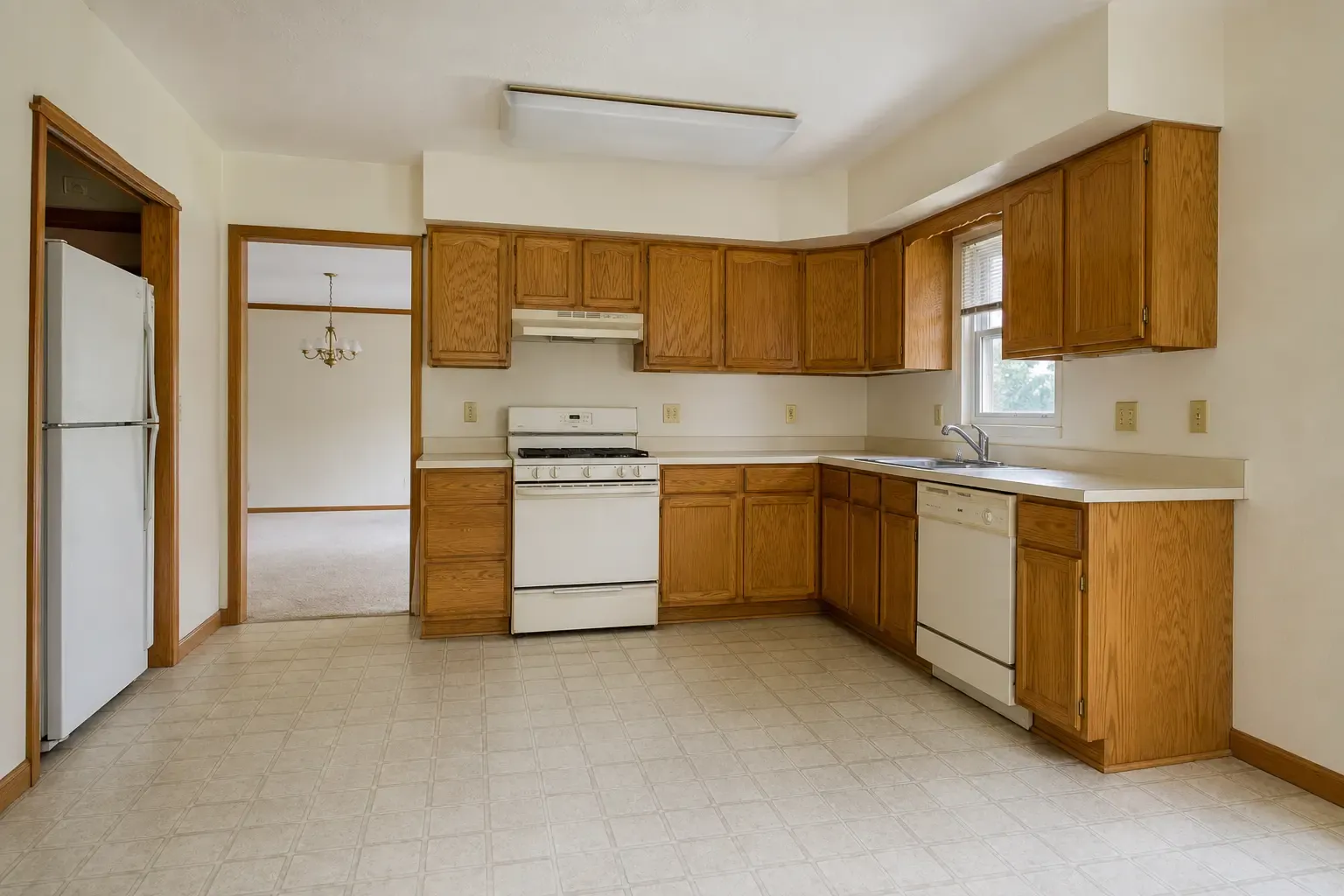 CabinetsFlooring
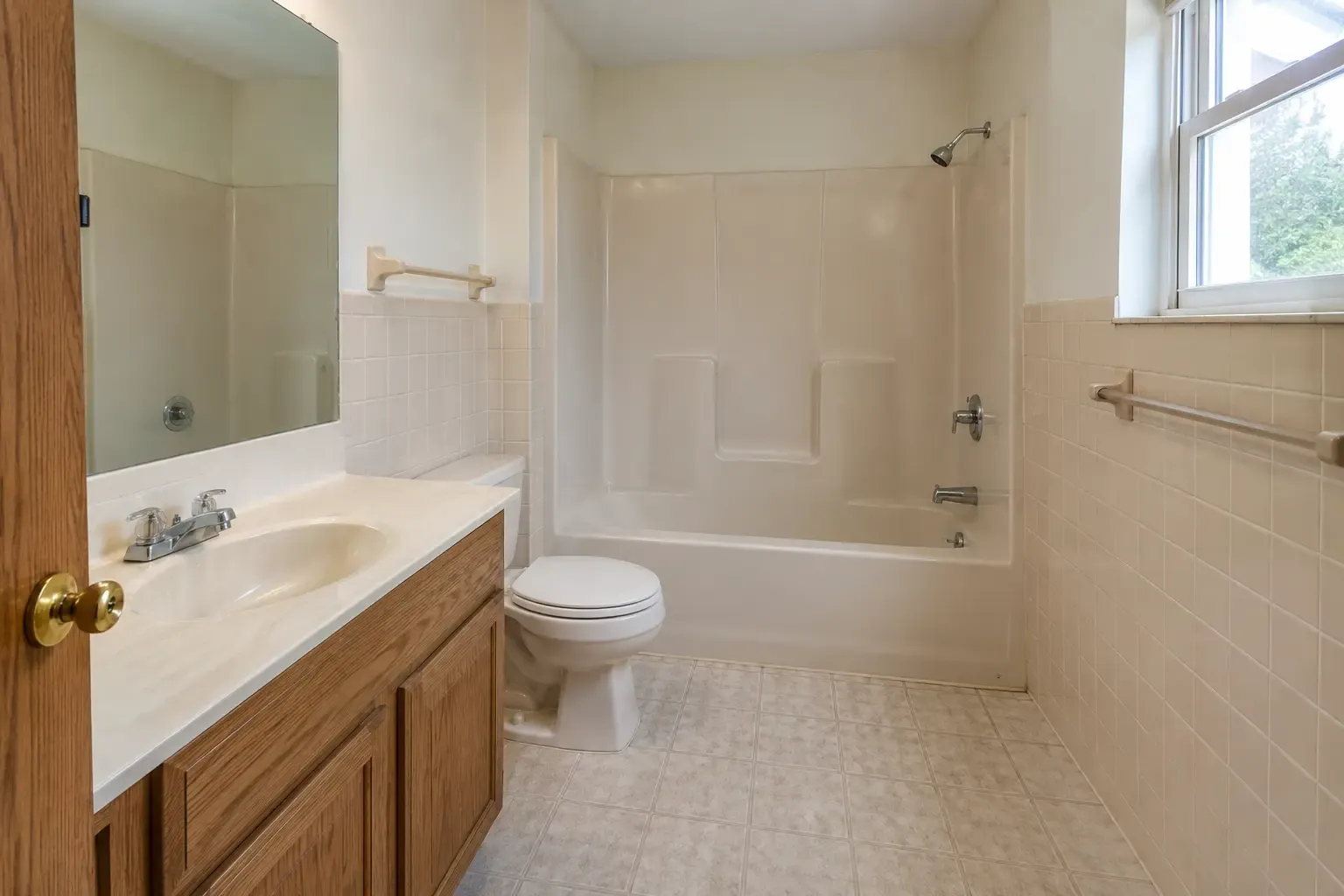 Tub & tile
 Floors
 Roof
We may bring in a partner buyer to close. Your price and terms don't change.
Send the address and photos
The photos you took for your deposit letter and insurer are enough to start. No cleanup first.
Get a written offer
We give you a written number for the house exactly as it is. It does not expire while you wait for your insurer, talk to your attorney or think it over.
Walk through once
Usually a short visit to confirm what the photos show. You do not clean, patch or haul anything first.
Sign and set the date
You pick the closing date. Your attorney reviews the contract. We never charge you a fee.
Close in about two weeks
A Connecticut attorney conducts the closing (CGS 51-88a). The conveyance tax comes out of your proceeds (0.75% state plus 0.50% town in Waterbury, New Britain and Hartford on a sale up to $800,000). Take what you want from the house; leave the rest.
No cleanout. No repairs. No contractors. No showings. No fees. You can still pursue the former tenant in small claims after you sell; the claim is yours, not the house’s. If the house is part of a two- or three-family with other tenants still in place, read how to sell a rental property with tenants in Connecticut; if it is now empty, our page on selling a vacant house in Connecticut covers insurance and upkeep while it sits.
See the house together.
Pick a time that works.
Choose a time for us to walk through the property with you, or ask for a quick call first. We confirm every request personally.
Tuesday, January 13
No open times in the next few weeks. Please call us.
We will confirm by email. Nothing is booked until we do.
View my requestHow can you protect yourself if you keep renting?
If you keep renting in Connecticut, protect yourself with a dated move-in inspection signed by the tenant, photos of every room, the full deposit the law allows (two months, or one month for tenants 62 and older), periodic inspections with reasonable notice, and a landlord policy that covers vandalism. A written lease that spells out the tenant’s duties also helps a judge see what was agreed.
- Move-in record. A room-by-room checklist and photos, signed and dated by both of you. This is the document that wins deposit disputes.
- Deposit and escrow. Take the deposit the law allows, put it in escrow and send the bank notice within 30 days (CGS 47a-21(b), (h)).
- Inspections. A tenant may not unreasonably refuse entry for inspections or repairs; give reasonable notice and come at reasonable times (CGS 47a-16).
- Screening. Verify income and call prior landlords, not just the current one, who may want the tenant gone.
- Act early. If rent stops or a neighbor reports trouble, follow the legal steps in our guide to tenants who do not pay rent in Connecticut right away.
Questions Connecticut landlords ask when a tenant trashed the house
How long does a Connecticut landlord have to return a security deposit?
A Connecticut landlord has 21 days after the tenancy ends, or 15 days after receiving the tenant’s written forwarding address, whichever is later, to return the deposit with interest or send the balance and an itemized list of damages (CGS 47a-21(d)(2)).
What happens if I miss the security deposit deadline in Connecticut?
If you miss the security deposit deadline in Connecticut, you can be liable for twice the amount of the deposit. If the only problem is unpaid interest, the penalty is $10 or twice the interest, whichever is greater (CGS 47a-21(d)(2)). You can still claim actual damages, but the penalty may offset them.
Can I keep the security deposit for unpaid rent in Connecticut?
Yes, you can deduct unpaid rent and unpaid utilities owed to you from the security deposit in Connecticut, along with damage the tenant caused beyond normal wear. List each deduction in the written statement you send within the deadline (CGS 47a-21(a)(14), (d)(2)).
What is considered normal wear and tear in Connecticut?
Normal wear and tear in Connecticut is the decline that comes from ordinary living, such as faded paint, small nail holes and carpet worn in walkways. Damage is harm from abuse or neglect, such as holes in walls, pet-ruined floors or broken fixtures. Tenants must not wilfully or negligently damage the premises (CGS 47a-11(f)).
Can I sue my tenant for damages beyond the security deposit?
Yes, you can sue a tenant in Connecticut for damages beyond the security deposit. Claims up to $5,000 go to small claims (form JD-CV-40, $95 fee), filed in the housing session where there is one; larger claims go to Superior Court. The deposit law preserves your right to other damages (CGS 47a-21(g)).
What is the small claims limit in Connecticut?
The small claims limit in Connecticut is $5,000 in money damages, or $15,000 for certain home improvement and new home construction claims (CGS 51-15(d)). The entry fee is $95, and small claims decisions cannot be appealed (jud.ct.gov).
How do I collect a small claims judgment from a former tenant?
You collect a small claims judgment in Connecticut by applying to the clerk for an execution: a wage execution, a bank execution or a property execution, each with a $105 application fee, served by a state marshal. A small claims judgment can be enforced for up to 10 years (jud.ct.gov).
Does landlord insurance cover damage by a tenant?
Landlord insurance may cover damage by a tenant if the policy includes vandalism or malicious mischief and the house was not vacant beyond the policy’s limit. Wear and tear, neglect and pet damage are commonly excluded. A homeowner’s policy written for an owner-occupied home often does not cover a rental. Check your exact policy.
Is it a crime for a tenant to damage my property in Connecticut?
Intentionally damaging another person’s property is criminal mischief in Connecticut: first degree, a class D felony, above $1,500 of damage; second degree, a class A misdemeanor, above $250; and third degree, a class B misdemeanor, below that (CGS 53a-115 to 53a-117). Ordinary carelessness is usually a civil matter.
Can I throw away what my tenant left behind?
Not right away. If the tenant abandoned the unit, Connecticut’s procedure requires notice by regular and certified mail, a ten-day window to respond, and keeping an inventory of the belongings for at least 30 days before you dispose of them (CGS 47a-11b). If the tenant was evicted, the state marshal handles belongings under the execution (CGS 47a-42).
Do I have to pay interest on a security deposit in Connecticut?
Yes. Connecticut landlords pay interest on security deposits at least at the Banking Commissioner’s deposit index, 0.49% for 2026, on each anniversary and at move-out. No interest is owed for a month in which rent was more than 10 days late, unless you charged a late fee (CGS 47a-21(i)).
Can I sell a house a tenant trashed without fixing it?
Yes, you can sell a house a tenant trashed in Connecticut without fixing it. Cash buyers and investors buy houses as they are; many buyers using a mortgage cannot. You still give the property condition report or the $500 credit and disclose what you know (CGS 20-327b, 20-327c).
Can I still sue the tenant after I sell the house?
Yes. Your claim against a former tenant for damage and unpaid rent is your personal claim, so selling the house does not end it. Keep your photos, the lease, the itemized deposit letter and any estimates or the repair figures the buyer relied on.
How much does it cost to repair a trashed rental house?
Repairing a trashed rental house in Connecticut often costs from about $13,000 to more than $40,000 for a typical single-family (est.), depending on floors, kitchen and bath damage, plus months of taxes and insurance while the work is done. Get written quotes before you decide.
Related Connecticut guides
Landlord guides
Repairs and condition
We buy damaged rentals across Connecticut, including Waterbury, New Britain, Hartford, Bristol, Meriden and East Hartford. For the full process, see how to sell a house in Connecticut.
Plain-English information, not legal advice. Talk to a Connecticut attorney about your deposit statement, a lawsuit or an abandoned unit. Reviewed by Jerryll Noorden, October 2026.
Sources
- CGS § 47a-21, 2026 Supplement (security deposits: maximum, escrow, deductions, 21-day return, itemized statement, double damages, interest).
- CT Department of Banking, deposit index and interest rates (0.49% for 2026; 0.52% for 2025).
- CGS §§ 47a-11, 47a-11b, 47a-11c and 47a-16 (tenant duties, abandonment and belongings, mitigation, landlord entry).
- CGS § 47a-42 (belongings after an eviction) and CGS § 47a-70 (housing dockets).
- CGS § 47a-43 (entry and detainer) and CGS §§ 53a-115, 53a-116, 53a-117 and 53a-214 (criminal mischief; criminal lockout).
- CGS § 51-15(d) (small claims limit and security deposit damages in small claims).
- Connecticut Judicial Branch small claims FAQ ($5,000 limit, $95 fee, JD-CV-40, housing session filing, no appeal, executions $105, 10-year enforcement).
- CGS §§ 20-327b and 20-327c (property condition report; $500 credit).
- CGS § 12-494 (conveyance tax) and CGS § 51-88a (attorney closings).

Who wrote this
Jerryll Noorden
Jerryll has bought and sold Connecticut houses since 2016 and has sat at more closing tables than he can count, on both sides. Before real estate he was a robotics scientist at NASA, IHMC and IIT. He wrote this guide because the national sites that rank for it skip the Connecticut rules that cost sellers money. When listing or selling it yourself would get you more than a cash offer, he says so.
This guide explains Connecticut rules in plain English. It is not legal or tax advice. Laws change; for your sale, talk to a Connecticut real estate attorney and a tax professional.
