
Key facts at a glance
| Fact | Number | Source |
|---|---|---|
| Homes sold in Windsor, Oct 2024 to Sep 2025 | 393 (median $340,000) | CT OPM real estate sales, data.ct.gov |
| Two-family market sales in Windsor, same period | 8 (median $408,250) | Our query of data.ct.gov 5mzw-sjtu (sales with no non-use code) |
| Windsor mill rate, fiscal 2027 | 28.88 mills on 70% of value | CT OPM mill rates; CGS 12-62a |
| Conveyance tax the seller pays in Windsor | 1.00% (0.75% state + 0.25% town) up to $800,000 | CGS 12-494 |
| Security deposits you hand the buyer at closing | 100% of every deposit, plus accrued interest | CGS 47a-21(h)(3) |
| Interest rate on security deposits, 2026 | 0.49% a year | CT Department of Banking deposit index; CGS 47a-21(i) |
| Time the buyer has to tell each tenant where the deposit is held | 30 days | CGS 47a-21(h)(4) |
Selling a rented house is mostly a normal Connecticut closing with five extra hand-offs: the leases, the security deposits and their interest, the current month’s rent, the tenant’s confirmation of the facts (the estoppel certificate), and the notice that tells each tenant who their new landlord is. This guide walks through those hand-offs with Windsor numbers. It is one chapter of our guide to how to sell a house in Connecticut. Whether to sell a rental at all, and how to end a tenancy first, is covered in our landlord guide, selling a rental with tenants in Connecticut; this page starts where that one stops, at the closing table.
Why does closing on a rented house feel riskier than selling an empty one?
Closing on a rented house feels riskier than selling an empty one because other people’s money and homes are part of the deal. You are handing over deposits you may have collected years ago, rent that is already in your account, and a relationship with tenants you know. One wrong number on the settlement statement can come back as a claim later, so the worry is reasonable, and it is fixable with a short checklist.
Maybe you bought a two-family in Windsor years ago and lived upstairs before you moved out, or inherited a parent’s Cape and kept the tenant who was already there. Either way, the closing feels like a test you never studied for.
You may feel exposed (is every deposit still in a separate account?), guilty toward a tenant who has treated you well, disorganized because the leases are in a drawer, suspicious that the buyer will chip the price over paperwork, and plain tired. Underneath, most landlords are cautiously hopeful that it is simpler than it looks.
This page is for you. Below is every hand-off in the order it happens, the Connecticut rule behind it, a worked Windsor example, and what can go wrong.
What happens at closing when you sell a Windsor rental with tenants?
When you sell a Windsor rental with tenants, the leases stay in force and pass to the buyer with the deed. At closing you hand over every security deposit plus interest (CGS 47a-21(h)(3)), credit the buyer for rent you already collected for days after closing, deliver signed estoppel certificates if the contract asks for them, and give the buyer keys, leases and records. The buyer then notifies each tenant (CGS 47a-6 and 47a-21(h)(4)).

A Connecticut sale does not cancel a lease. The buyer steps into your shoes as landlord, a “successor” in the words of the security deposit statute, and takes the building subject to the tenants’ rights. Your Connecticut attorney and the buyer’s attorney handle the paperwork (CGS 51-88a requires attorneys for closings), but the information has to come from you.
What is a tenant estoppel certificate, and do Windsor tenants have to sign one?
A tenant estoppel certificate is a one-page statement, signed by the tenant, confirming the monthly rent, the security deposit, the lease start and end dates, the date rent is paid through, and that the tenant has no claims against the landlord. Connecticut has no statute that forces a residential tenant to sign one; a tenant signs because the lease requires it or because you ask politely and explain why.
The word “estoppel” means the tenant is later stopped from claiming different facts. If a tenant signs that the deposit is $1,650 and later says it was $3,300, the buyer can point to the signed page. That protects the buyer, and it protects you too: it turns your records into facts both sides agreed to before money changed hands.
A practical estoppel for a Windsor two-family confirms the tenant and unit, the rent and paid-through date, the deposit (and any prepaid last month’s rent), the lease dates or “month to month”, who pays heat and utilities, and any side deal, open repair request or option to buy.
If a tenant will not sign, the buyer’s attorney usually accepts a landlord’s certificate instead: the same facts, signed by you, backed by the lease and your ledger. Small residential buyers often do. Lenders on bigger buildings are stricter, which is one reason estoppels come up more on three- and four-families. Our multi-family selling guide covers what financed buyers of two- to four-unit buildings ask for.
Send the form with a short note: the house is being sold, the lease stays in place, the deposit moves with it, and the form only confirms what is already true. Tenants sign far more readily when they see nothing changes for them.
How are rent and security deposits handled at closing in Connecticut?
At a Connecticut closing, the seller delivers every tenant’s security deposit plus accrued interest to the buyer (CGS 47a-21(h)(3)), and credits the buyer for any rent already collected for days after the closing date. From then on the buyer, as successor, is liable to return the deposits when each tenancy ends (CGS 47a-21(e)). Rent that is past due usually stays with the seller unless the contract says otherwise.
Three Connecticut details trip landlords up:
- The deposit is the tenant’s money, held in escrow. Connecticut requires deposits to sit in an escrow account at a Connecticut financial institution (CGS 47a-21(h)(1)). At the sale you withdraw them and deliver them to the buyer. If the account is short because deposits were mixed with other money, the law still expects the full amount; your attorney will usually take it from your proceeds.
- Interest is owed, even if it is small. Deposits earn interest at no less than the deposit index set by the Banking Commissioner, 0.49% for 2026 (CGS 47a-21(i)). Interest is paid on each tenancy anniversary; at the sale, the interest accrued since the last anniversary goes to the buyer with the deposit. A tenant who was more than ten days late with rent earns no interest for that month, unless you charged a late fee.
- Prepaid “last month’s rent” counts as a deposit. Connecticut defines a security deposit as any advance rental payment except the first month’s rent (CGS 47a-21(a)(11)). If you collected last month’s rent up front, it transfers like a deposit, and the deposit cap applies to the total: two months’ rent, or one month for a tenant aged 62 or older (CGS 47a-21(b)).
Rent proration is simpler. If the tenants paid June rent on June 1 and you close on June 20, the buyer owns the building for the last 10 days of June. You keep 20 days of rent and credit the buyer with 10. Contracts differ on who owns the closing day; your attorneys will follow the contract.
Unpaid rent is a contract question. A buyer rarely pays you for rent a tenant owes, because it may never be collected. The usual result is that you keep the right to pursue past-due rent yourself, and the buyer collects from the closing date on. If a tenant is far behind, read our guide on a tenant not paying rent in Connecticut before you sign anything.
What does the closing math look like on a Windsor two-family?
On a Windsor two-family selling for $410,000 with both units rented, the tenant-related credits to the buyer in our illustrative example come to $6,416.57: $5,250 in security deposits, $16.57 of interest at the 2026 rate of 0.49%, and $1,150 of June rent for the 10 days after a June 20 closing. The seller also pays $4,100 of conveyance tax at Windsor’s 1.00% rate.
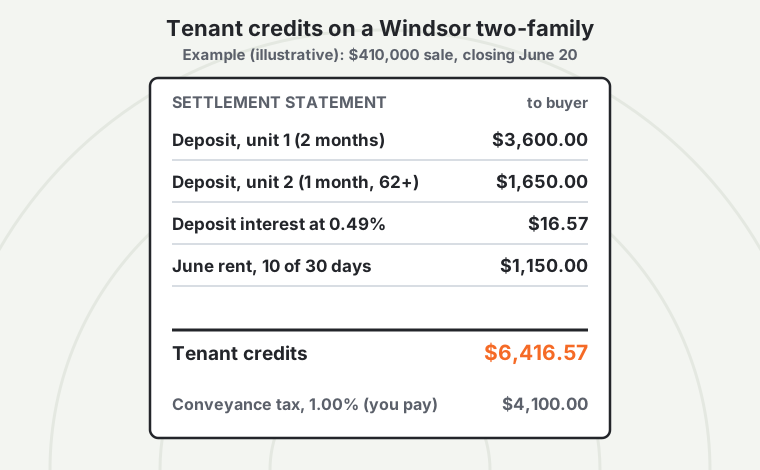
Example (illustrative). The price is set near the $408,250 median of Windsor’s eight market two-family sales from October 2024 to September 2025. The rents and lease dates are assumptions for the example, not market data.
| Line | Unit 1 | Unit 2 | Total |
|---|---|---|---|
| Monthly rent (example) | $1,800 | $1,650 | $3,450 |
| Security deposit held | $3,600 (2 months) | $1,650 (1 month, tenant aged 62+) | $5,250 |
| Interest at 0.49% since last anniversary | $14.11 (Sep 1 to Jun 20, 292 days) | $2.46 (Mar 1 to Jun 20, 111 days) | $16.57 |
| June rent credited to buyer (10 of 30 days) | $600 | $550 | $1,150 |
| Tenant credits to the buyer | $6,416.57 | ||
| Conveyance tax, 0.75% state + 0.25% Windsor | $4,100 | ||
| Property tax at 28.88 mills on $287,000 (70% of $410,000, est.) | $8,288.56 a year, about $22.71 a day |
Connecticut property tax is paid in arrears, so your attorneys will also credit the buyer for tax owed for your days of ownership that the buyer will pay later. How much depends on where Windsor’s billing cycle stands on your closing date; the daily figure above shows the scale. Oil works the other way: if you supply heat and leave oil in the tank, Connecticut custom is for the buyer to reimburse you for it.
Run your own numbers with the calculator below. Put the deposits and rent credit in the “other credits” line so the net reflects money that was never yours.
How much would you walk away with?
Slide the numbers to match your house. It works in your browser; nothing is saved or sent.
Estimates for planning. Conveyance tax per CGS 12-494 (state 0.75% up to $800,000, 1.25% to $2.5M, 2.25% above, plus the town rate). Seller attorney about $1,200 to $1,500; flat-fee MLS about $400; listings include three months of taxes, insurance and utilities, a cash sale about two weeks. Your attorney gives you the final numbers.
How do tenants learn about the new owner, and what changes for them?
Tenants learn about the new owner through a written notice. Connecticut requires a successor landlord, at the time it takes over, to tell each tenant in writing the name and address of the person managing the property and the person authorized to receive notices and court papers (CGS 47a-6). Within 30 days of receiving the deposits, the buyer must also tell each tenant how much deposit it holds and at which bank (CGS 47a-21(h)(4)).
Many sellers send a short joint letter with the buyer on closing day: the date of the sale and the new owner’s name, that the lease stays in force, where to pay rent from next month on, that the deposit and interest moved to the new owner, and who to call for repairs. It does more to calm tenants than anything else you can do.
Until the tenants have that letter, some will keep paying you. Agree in the contract that you will forward any rent you receive after closing, and do it promptly. What does not change for the tenant: the rent, the lease end date, their right to proper notice before any eviction, and their deposit. A new owner who wants the unit empty still has to use Connecticut’s legal process; the problem tenant guide explains notices to quit and summary process.
What do you do about keys, utilities, oil and the water bill?
On closing day you hand over every key, fob, garage remote, mailbox key and lock code, and you switch any utility in your name to the buyer. In Windsor, water and sewer come from the MDC, so order a final meter reading for the closing date; 56% of Windsor homes heat with oil, so if you supply heat, measure the tank so the buyer can reimburse you.
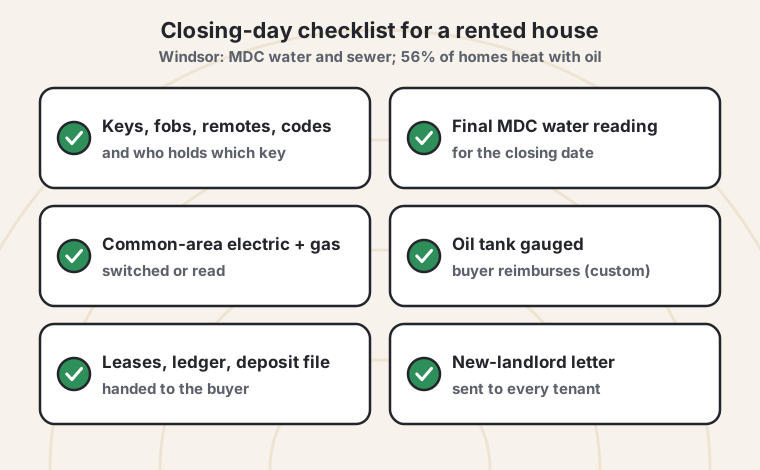
- Keys and codes: unit, common-area, mailbox and laundry keys, garage remotes, lock codes, and a note of which tenant holds which key.
- Water and sewer: Windsor is one of the MDC’s eight member towns; ask for a final reading for the closing date.
- Owner-paid electric and gas: common-area lights, hall heat, a shared water heater; transfer or read on the closing date.
- Heating oil: if you supply heat, have the tank gauged a day or two before closing.
- Records: leases, the rent ledger, deposit records, warranties and open work orders.
- Smoke and CO affidavit: for a one- or two-family you sign it at closing (CGS 29-453); there is no longer a credit option instead.
Windsor’s housing is older than many buyers expect: the median house was built in 1965 and 44% were built before 1960 (2025 CT parcel data). For any home built before 1978, federal law requires a lead paint disclosure to the buyer, and you will also give the Connecticut property condition report or pay a $500 credit (CGS 20-327b and 20-327c). Our seller document checklist lists the rest.
What can go wrong at an occupied closing, and how do you prevent it?
What goes wrong at an occupied closing is almost always a records problem: a deposit amount nobody can prove, a lease that expired and was never renewed, a side deal the buyer did not know about, a tenant who is behind, or a tenant who will not sign the estoppel. Each one is preventable if you pull your records together before you sign the contract, not the week of closing.
| Problem | Why it matters | Prevention |
|---|---|---|
| No record of the deposit amount | The buyer becomes liable for it (CGS 47a-21(e)) and will want proof or a holdback | Find the original lease or receipt; get the tenant to confirm in an estoppel |
| Expired lease, tenant still there | The tenancy is likely month to month (CGS 47a-3b, 47a-3d); the buyer may want a new lease | Tell the buyer up front; the estoppel should say “month to month” |
| Tenant behind on rent | Lowers what investors pay and may need an eviction | Decide in the contract who keeps arrears and who handles the case |
| Tenant refuses access or the estoppel | Delays inspections and financing | Use proper notice for showings (CGS 47a-16); offer a landlord’s certificate instead |

Before you sign a contract on a rented house, put one sheet of paper together: each unit, the rent, the deposit, the lease end date, who pays heat, and anything you promised the tenant. That one page answers most of what the buyer’s attorney will ask, and it is the fastest way I know to keep an occupied closing on schedule.
Should you sell occupied, and when should you not sell to a cash buyer?
You should sell occupied when the tenants pay, the leases are reasonable and you would rather not spend months emptying the building; investors price on the rents and the closing mechanics above are routine. You should not sell to a cash buyer if the house is in good shape, a vacant sale to an owner-occupant would net clearly more, and you have the time to end the tenancy lawfully first.
The full comparison of keeping, listing occupied, listing vacant and selling as-is is in the landlord guide linked above. In short: listing vacant usually brings the top price for a clean single-family or condo but needs a lawful end to the tenancy and months of carrying costs; listing occupied draws investor buyers and needs showings on notice (CGS 47a-16); a cash sale is the lower-price, faster route for a tired building, a tenant behind on rent, or an owner who is done.
If a cash sale is the route that fits, see how we buy rental properties with tenants in place. We are a small Connecticut company that has bought about 10 houses a year since 2016, and we buy the building as it stands, leases and all. If listing would clearly put more in your pocket, we will tell you so.
How do you close on an occupied Windsor rental, step by step?
To close on an occupied Windsor rental, build a one-page rent roll, gather leases and deposit records, choose your route and sign a contract that names the leases and deposits, collect estoppels, have your attorney prepare the deposit and rent credits, close, and send the new-landlord letter. With a cash buyer, that typically takes about two weeks; with a financed buyer, longer.
Build the rent roll
One line per unit: tenant, rent, deposit, prepaid rent, lease end date, who pays which utilities, arrears and side deals.
Gather the paper
Leases and renewals, deposit receipts and the escrow statement, the rent ledger, the property condition report (CGS 20-327b) and, for pre-1978 homes, the lead disclosure.
Sign a contract that names the tenants
It should list each lease and deposit, say the buyer takes the property subject to them, set the rent and deposit credits, and say whether estoppels are required; then send the estoppels with a plain-English note.
Review the settlement statement
Check the deposit total, the interest, the rent credit, the tax adjustment, the oil reimbursement and the conveyance tax at Windsor’s 1.00%.
Close and notify
Hand over keys and records, transfer utilities, and send the joint new-landlord letter so tenants know where to pay from the next month on (CGS 47a-6).
Want a number with the tenants in place? Ask on our Windsor page, or book a call below.
Questions Windsor landlords ask about closing with tenants
Does a lease end when a Connecticut rental is sold?
No, a lease does not end when a Connecticut rental is sold. The buyer takes the property subject to the lease and becomes the landlord, a “successor” under CGS 47a-21. A tenant with a lease through next August stays through next August on the same terms unless the tenant agrees otherwise.
Who gets the security deposit when a house with tenants is sold in Connecticut?
When a house with tenants is sold in Connecticut, the buyer gets the security deposit. The seller must withdraw every deposit from escrow and deliver it, plus accrued interest, to the buyer at the transfer (CGS 47a-21(h)(3)). The buyer is then liable to return it when the tenancy ends (CGS 47a-21(e)).
Do I owe interest on a tenant’s security deposit when I sell?
Yes, you owe interest on a tenant’s security deposit when you sell, for the time since the last tenancy anniversary. The 2026 rate is 0.49% a year (Connecticut Department of Banking). On a $3,600 deposit held for 292 days, that is $14.11, which goes to the buyer with the deposit.
Does a tenant have to sign an estoppel certificate in Connecticut?
A tenant does not have to sign an estoppel certificate in Connecticut unless the lease requires it; no statute forces a residential tenant to sign one. Most tenants sign when you explain that nothing changes for them. If one will not, buyers often accept a landlord’s certificate instead.
How is rent prorated at a Connecticut closing?
Rent is prorated at a Connecticut closing by the day: the seller keeps rent for the days it owned the building and credits the buyer for the rest of the month. With $3,450 of June rent collected and a June 20 closing, the buyer is credited 10 of 30 days, or $1,150.
Who keeps the rent a tenant owes from before the closing?
The rent a tenant owes from before the closing usually stays with the seller, because buyers rarely pay for rent that may never be collected. The contract should say so, and say who handles any eviction case already filed.
Is prepaid last month’s rent a security deposit in Connecticut?
Yes, prepaid last month’s rent is a security deposit in Connecticut, because the statute counts any advance rental payment except the first month’s rent (CGS 47a-21(a)(11)). It transfers to the buyer like the rest of the deposit and counts toward the two-month cap (one month for tenants 62 and older).
Can you sell a Windsor two-family to a cash buyer with both tenants staying?
Yes, you can sell a Windsor two-family to a cash buyer with both tenants staying. Investors usually prefer paying tenants in place. The closing works the same way as any occupied sale: deposits and interest transfer, rent is prorated, and the buyer sends the new-landlord notice.
Related guides
Landlord guides
Same cluster
For the whole process, see how to sell a house in Connecticut. If you would rather hand over the keys with the tenants in place, here is how we buy rentals with tenants.
Plain-English information, not legal advice. Talk to a Connecticut attorney about your own lease, deposits and closing.
Sources (checked on October 27, 2026)
- CGS 47a-21 (security deposits: definition, cap, escrow, transfer to a successor, notice, interest).
- CGS 47a-3b, 47a-3d, 47a-6 and 47a-16 (term of tenancy, holding over, identification of landlord, entry to show the unit).
- CT Department of Banking, 2026 deposit index (0.49%).
- CGS 12-494 (conveyance tax).
- CGS 29-453 (smoke and carbon monoxide affidavit).
- CGS 20-327b and 20-327c (property condition report and $500 credit).
- Connecticut OPM Real Estate Sales (Windsor, recorded Oct 2024 to Sep 2025), data.ct.gov.
- OPM mill rates, fiscal 2027, data.ct.gov.
- 2025 Connecticut parcel (CAMA) data for Windsor (year built, heating fuel), data.ct.gov.
- The MDC, member towns.
- EPA lead-based paint disclosure rule.
See the house together.
Pick a time that works.
Choose a time for us to walk through the property with you, or ask for a quick call first. We confirm every request personally.
Tuesday, January 13
No open times in the next few weeks. Please call us.
We will confirm by email. Nothing is booked until we do.
View my request
Who wrote this
Jerryll Noorden
Jerryll has bought and sold Connecticut houses since 2016 and has sat at more closing tables than he can count, on both sides. Before real estate he was a robotics scientist at NASA, IHMC and IIT. He wrote this guide because the national sites that rank for it skip the Connecticut rules that cost sellers money. When listing or selling it yourself would get you more than a cash offer, he says so.
This guide explains Connecticut rules in plain English. It is not legal or tax advice. Laws change; for your sale, talk to a Connecticut real estate attorney and a tax professional.
