
- Seven documents every Connecticut seller needs: your deed, your mortgage payoff, the Residential Property Condition Report, the purchase contract, the new deed, the conveyance tax return (Form OP-236) and the smoke and carbon monoxide affidavit.
- Two of them carry a price if you skip them: $500 for the condition report (CGS 20-327c) and $250 for the smoke and CO affidavit (CGS 29-453).
- Some houses need more: the lead paint disclosure (built before 1978), the foundation report (bank- or town-sold homes in crumbling-foundation towns), a condo resale certificate, and records for oil tanks, septic systems and wells.
- Some sellers need more: probate papers for an estate, a decree for a divorce, a recorded power of attorney, trust or LLC authority, or a lender’s short sale approval.
- Your attorney prepares most of the closing papers. Your job is to find what only you have and to fill in the disclosures honestly.
- Start early. Old records from the town, the probate court or a past lender can take weeks.
What documents do you need to sell a house in Connecticut?
To sell a house in Connecticut you need your current deed, a mortgage payoff statement, the Residential Property Condition Report, a purchase and sale agreement, a new deed for the buyer, the conveyance tax return (Form OP-236), and the smoke and carbon monoxide affidavit, plus the federal lead paint disclosure for homes built before 1978. Depending on the house and the owners, you may also need foundation, condo, probate, divorce or trust documents.
This guide is the paperwork part of our guide to how to sell a house in Connecticut. The title says seven, and seven is the core. But most Connecticut sales need a few more papers, and the ones people forget (probate certificates, oil tank records, an old mortgage release) are what delay closings. So below is the full list, what each is for, where to get it and who prepares it.
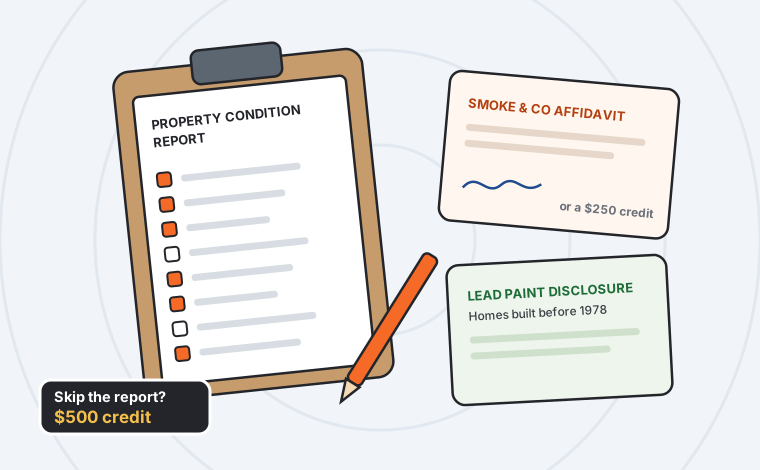
The seven every Connecticut seller needs
| # | Document | When | Where it comes from | Connecticut rule |
|---|---|---|---|---|
| 1 | Your current deed | Before listing | Your records, or the land records at your town clerk | Shows exactly who owns the house and must sign |
| 2 | Mortgage statement and payoff statement | Statement now; payoff a week or two before closing | Your lender(s); your attorney requests the payoff | Paid from your proceeds; the lender must release the mortgage within 60 days of a written request (CGS 49-8) |
| 3 | Residential Property Condition Report | Before the buyer signs a contract | You complete the Department of Consumer Protection form | CGS 20-327b; if not delivered, you credit the buyer $500 at closing (CGS 20-327c) |
| 4 | Purchase and sale agreement | After you accept an offer | Drafted or reviewed by the attorneys | Sets price, deposit, contingencies, closing date and the tax and oil adjustments |
| 5 | The new deed to the buyer (usually a warranty deed) | Closing | Your attorney | Recorded at the town clerk; an unrecorded deed does not protect the buyer against others (CGS 47-10) |
| 6 | Conveyance tax return, Form OP-236 | Closing | Your attorney (DRS form, usually filed through myCTREC) | Must be filed and the tax paid before the deed is recorded (CGS 12-497); the seller pays (CGS 12-495) |
| 7 | Smoke and carbon monoxide detector affidavit | Closing | You sign it; your attorney prepares it | One- and two-family homes and condo units; if not provided, you credit the buyer $250 (CGS 29-453) |
On top of those seven, nearly every sale also produces a settlement statement (the closing statement showing every dollar), seller affidavits for the buyer’s title insurer, and federal tax paperwork: the information for Form 1099-S and a non-foreign (FIRPTA) certification. Your attorney prepares these; you review and sign.
Which disclosure forms does a Connecticut seller have to give?
A Connecticut seller has to give the buyer the Residential Property Condition Report before the contract (or credit $500), and the federal lead-based paint disclosure and EPA pamphlet for homes built before 1978. The separate Residential Foundation Condition Report applies only to homes in crumbling-foundation towns sold after a foreclosure or deed in lieu, or by a town. Condo sellers must also deliver the association’s resale certificate and documents.
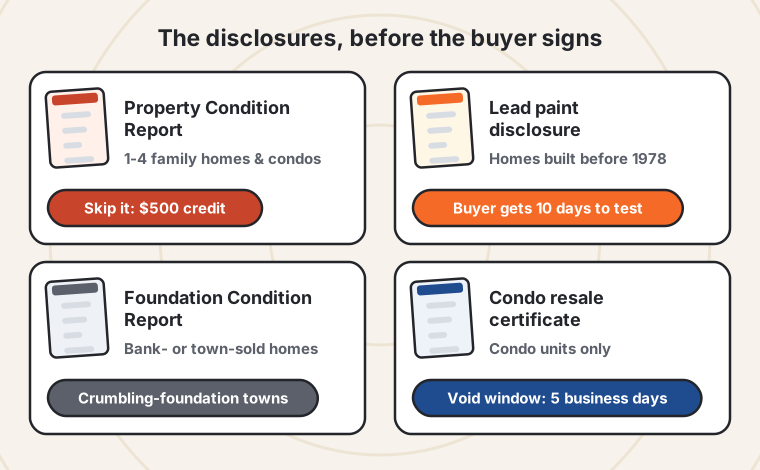
| Disclosure | Who needs it | When | If you skip it |
|---|---|---|---|
| Residential Property Condition Report (DCP) | Sellers of one- to four-family homes and condos, with or without an agent; some transfers are exempt | Before the buyer signs a binder or contract | $500 credit to the buyer at closing (CGS 20-327c) |
| Residential Foundation Condition Report (DCP, revised 07/2025) | Only for homes in crumbling-foundation towns sold after a foreclosure or deed in lieu, or by a town (CGS 20-327b(g)-(h)); other owners there answer the main report’s foundation questions | Before the contract | Ask your attorney |
| Lead-based paint disclosure and EPA pamphlet | Homes built before 1978 | Before the contract | Federal penalties and liability; the buyer also gets a 10-day window to test |
| Condo resale certificate and documents | Condo and common-interest community units | Before conveyance or possession | The buyer can void the contract until 5 business days after receiving it (CGS 47-270) |
The condition report is “to the best of your knowledge”, not a warranty, and you can legally give the $500 credit instead. But a missing report makes buyers and their attorneys suspicious, and the credit does not protect you from claims about defects you knew about and hid. If you do not know the answer to a question, say so. Our guide to the Connecticut property condition disclosure goes through the form question by question.
The condo resale certificate
If you are selling a condo, ask the association for its resale certificate as soon as you list. The association has ten business days after your written request and payment to deliver it, and the statutory fee is $185, adjusted for inflation, plus copy charges (CGS 47-270). The certificate shows your common charges, any unpaid assessments, approved capital spending, reserves, the budget, insurance and pending lawsuits. The buyer is not liable for unpaid charges larger than the certificate shows, so get it right.
What should you gather before you list your Connecticut house?
Before you list your Connecticut house, gather your deed, your mortgage and home equity statements, your latest property tax bill, your town’s field card, any survey, permits and receipts for major work, warranties and manuals, and records for the oil tank, septic system, well and radon. These answer most buyer questions and help your attorney spot title problems early.
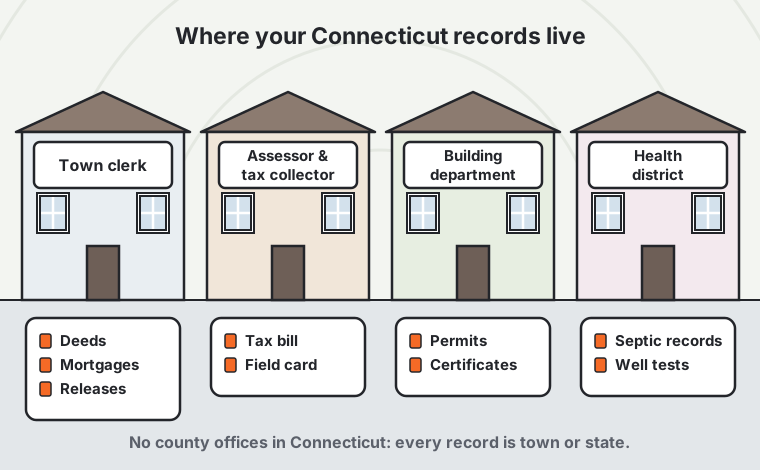
| Document | Why buyers or attorneys want it | Where to get it in Connecticut |
|---|---|---|
| Deed and any earlier deeds | Who owns it; how title is held | Town clerk’s land records |
| Mortgage, home equity line, any other liens | Payoffs; old releases that were never recorded | Your lenders; land records |
| Property tax bill and field card | Taxes, assessment, mill rate, recorded square footage | Tax collector and assessor (many towns post them online) |
| Water and sewer bills | Unpaid municipal charges can become liens | Your water and sewer authority |
| Survey or mortgage plot plan | Boundaries, encroachments; some lenders or title insurers ask | Your closing file from when you bought, or the town |
| Building permits and certificates for work done | Proves additions, decks, finished basements, roofs were permitted | Your town’s building department |
| Receipts for improvements | Adds to your tax basis; shows buyers the age of systems | Your files |
| Oil tank records (removal permit or closure, tank age, fill receipts) | Buried tanks worry buyers, lenders and insurers | Your oil company; town fire marshal or building department for removal permits |
| Septic records (permit, design, pumping) | Buyers usually inspect septic systems | Your local health district or department; your pumper |
| Well water test results | Lenders and buyers often require a water test | A state-certified lab; your local health department |
| Radon test results and any mitigation system details | Buyers often test; earlier results help | Your records |
| Foundation testing (core test or engineer’s report), if any | Relevant in towns on the crumbling-foundation list | Your engineer or testing lab |
| Warranties, manuals, alarm and appliance info | Transfers with the house | Your files |
Records for the systems buyers ask about most are covered in oil tanks, septic, wells and radon when selling a Connecticut house. If you are in a north-central or eastern Connecticut town, read about selling a house with a crumbling foundation too.
What documents do you sign at a Connecticut closing?
At a Connecticut closing you sign the deed to the buyer, the conveyance tax return (Form OP-236), the smoke and carbon monoxide affidavit, the seller’s title affidavits, the settlement statement, and the federal tax forms: the 1099-S information or certification and a FIRPTA non-foreign certification. Your attorney prepares them and explains each one.

- Deed. Usually a warranty deed. Executors, administrators and trustees sign a fiduciary deed.
- Form OP-236. Lists the sellers with Social Security or federal ID numbers and a mailing address after the sale, the type of property and the price by rate tier. Sellers that are LLCs, partnerships, estates or trusts attach Schedule A listing members or beneficiaries. Details in our Connecticut conveyance tax guide.
- Smoke and CO affidavit (or the $250 credit).
- Seller’s affidavits for the title insurer, for example that no unpaid contractors worked on the house recently and that there are no unrecorded agreements affecting it.
- Settlement statement showing the price, credits, conveyance tax, prorated property tax, oil adjustment, payoffs and your net.
- 1099-S. The person responsible for closing reports the sale to the IRS. A main-home sale of $250,000 or less ($500,000 if married) can be left off if you sign a written certification that the whole gain is excluded under the home-sale exclusion (IRS 1099-S instructions).
- FIRPTA certification. A statement that you are not a foreign person. If you are, the buyer generally must withhold 15% of the amount realized for the IRS unless an exception applies.
Step by step, from contract to wire, see the Connecticut closing process for sellers.
What extra documents do you need for an estate, a divorce, a trust or a short sale?
The extra documents you need are about proving who can sign. For an estate: the Probate Court’s certificate of the executor’s or administrator’s appointment, court authority to sell where required, and a release of the Connecticut estate tax lien. For a divorce: the decree or agreement. For a trust or LLC: proof of authority. For an agent: a recorded power of attorney. For a short sale: the lender’s written approval.
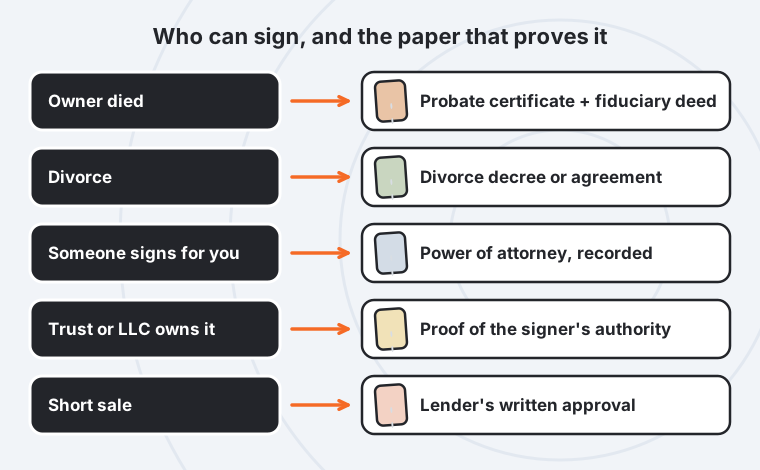
| Situation | Documents | Where from |
|---|---|---|
| Owner died; house in their name alone | Death certificate; fiduciary’s certificate of appointment; Probate Court authority to sell where required (CGS 45a-164); certificate releasing the Connecticut estate tax lien; fiduciary deed | Probate Court for the district where the owner lived; town vital records |
| Joint owner died (survivorship) | Death certificate; a probate certificate releasing the estate tax lien on the deceased owner’s interest | Town vital records; Probate Court |
| Divorce | Divorce decree or separation agreement covering the house; signatures of both spouses on title unless the court orders otherwise | Superior Court; your divorce attorney |
| Someone signs for an owner | Power of attorney, recorded with the deed unless already recorded (CGS 47-10) | Your attorney |
| House owned by a trust | Trust documents or a certification showing the trustee’s authority | Your trust or estate attorney |
| House owned by an LLC or company | Operating agreement or resolution authorizing the sale; good standing; OP-236 Schedule A | Your company records; Secretary of the State |
| Short sale | Lender’s written short sale approval letter; hardship documents the lender requested | Your lender; exempt from conveyance tax for a principal residence (CGS 12-498(a)(20)) |
| Foreclosure started | Current payoff or reinstatement figures; your Law Day if judgment entered | Your lender’s attorney; the court file at jud.ct.gov |
If a parent’s house is involved, read selling an inherited house in Connecticut and can a house be sold while in probate. If you are behind on payments, see selling a house in foreclosure in Connecticut.
How do you gather your documents without delaying the sale?
To gather your documents without delaying the sale, hire your attorney first, pull your deed and mortgage statements the week you decide to sell, complete the condition report before listing, order the condo certificate and any probate papers immediately, and collect records for the oil tank, septic, well and permits before buyers ask.
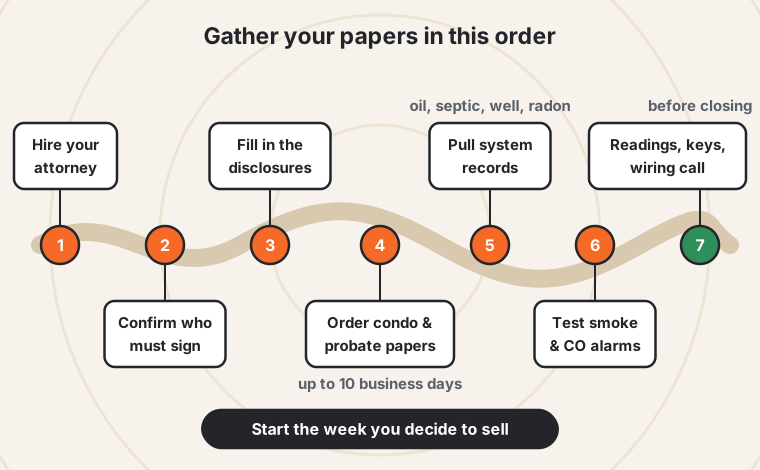
Hire your Connecticut attorney
Send them your deed and mortgage statements and ask them to run a preliminary title check. Unreleased old mortgages and name problems are easiest to fix before you have a buyer.
Confirm who must sign
Every owner on the deed signs, or someone with legal authority signs for them. If an owner has died, divorced or moved away, start that paperwork now.
Complete the disclosures
The condition report, the lead paint form for a pre-1978 house, and the foundation report if your town is on the list. Keep copies with the date you gave them to the buyer.
Order outside documents early
The condo resale certificate (up to 10 business days), probate certificates (court schedules vary), copies of permits from the building department.
Pull the system records
Oil tank, septic, well and radon records, plus receipts for big work. Scan them into one folder you can share with your agent and attorney.
Test your smoke and CO detectors
Replace dead units now so you can sign the affidavit at closing.
Before closing
Final water and sewer readings, an oil reading, keys and codes, and wiring instructions confirmed by phone with your attorney.
Your Connecticut seller document checklist
Tick items off as you gather them; your progress is saved on this device.
- Current deed (town clerk land records)
- Mortgage and home equity statements, with account numbers
- Latest property tax bill and assessor field card
- Water and sewer bills
- Residential Property Condition Report, completed and signed
- Lead paint disclosure and EPA pamphlet (built before 1978)
- Residential Foundation Condition Report (only if your home was acquired by foreclosure or deed in lieu in a crumbling-foundation town)
- Condo resale certificate and association documents
- Survey or plot plan, if you have one
- Building permits for additions, decks, roofs, finished basements
- Oil tank records (age, location, removal or closure paperwork)
- Septic permit, design and pumping records
- Well water test results
- Radon test results; mitigation system details
- Receipts for major improvements (for your taxes)
- Death certificate, probate certificate, divorce decree, power of attorney, trust or LLC papers, if they apply
- Working smoke and CO detectors (for the closing affidavit)
- Photo ID for closing
- Keys, garage openers, alarm codes
- Wiring instructions confirmed by phone with your attorney
Which documents should you keep after you sell?
After you sell a house in Connecticut, keep your settlement statement, a copy of the deed, the Form 1099-S if you receive one, your records of what you paid for the house and for improvements, and your payoff and release confirmations. You need them for your tax return and to prove the mortgage was released.
- Settlement statement. Shows your selling price and selling expenses (commissions, the conveyance tax, legal fees), which the IRS lets you subtract from the price when you figure your gain (IRS Publication 523).
- Purchase records and improvement receipts. Your basis. They matter if your gain is larger than the home-sale exclusion, or for a rental or second home.
- 1099-S. If you get one, the IRS gets a copy too, so report the sale.
- Mortgage release. Check the land records a couple of months after closing. If the release is missing, Connecticut law gives remedies (CGS 49-8 and 49-8a); call your attorney.
How the sale is taxed, including for out-of-state owners and inherited houses, is covered in taxes when selling a house in Connecticut.
What if you cannot find some of your documents?
If you cannot find some of your documents, most can be replaced in Connecticut: deeds and recorded mortgages from the town clerk’s land records, tax records from the assessor and tax collector, permits from the building department, septic records from the local health department, and probate records from the Probate Court. What cannot be replaced, such as old test results, can usually be redone.
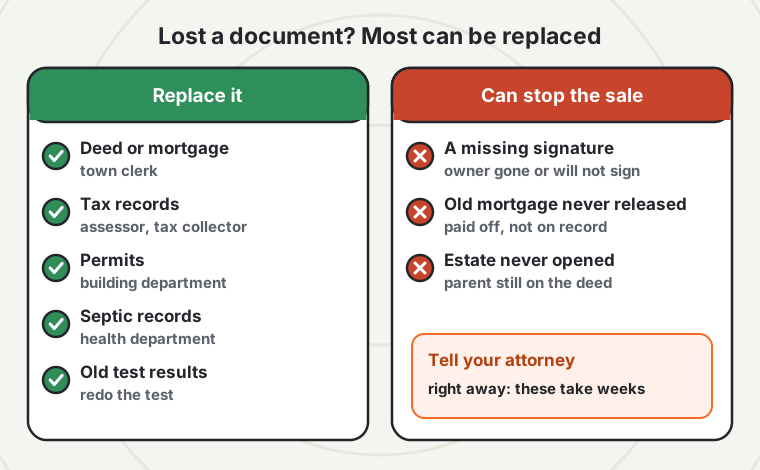
A missing survey, warranty or receipt does not stop a sale. A missing signature does. If an owner cannot be found or will not sign, or a lender from twenty years ago never released a paid-off mortgage, tell your attorney right away; those are the problems that take weeks.

The paperwork that slows Connecticut closings is almost never the disclosure form. It is a deed with a parent’s name still on it, a probate estate that was never opened, or a refinance from years ago whose old mortgage was never released. Pull your deed from the town clerk the day you decide to sell and read who is on it. If it is anyone besides you, call an attorney that week.
Do you need fewer documents if you sell for cash?
You need slightly fewer documents if you sell for cash in Connecticut, because there is no buyer’s lender asking for an appraisal, survey or repair proof. The legal documents stay the same: the condition report (or the $500 credit), the deed, the conveyance tax return, the smoke and CO affidavit, your payoff, and any probate, divorce or trust papers. A Connecticut attorney still conducts the closing.
We buy houses for cash, so here is the honest version. A cash buyer cannot make probate, a missing signature or a lien disappear; your attorney still has to fix those. What a cash buyer can do is wait for that work without a lender’s deadline, buy the house as it is, and close on the date that suits you. If your house is in good shape and you have time, listing it usually brings more money, and we will tell you if that is your situation. Compare both in our cash buyer vs. realtor guide.
If you want a number to compare, call me, Jerryll Noorden, at (203) 529-4712. I have bought Connecticut houses since 2016. We never charge fees, we close through Connecticut attorneys, you can have your own attorney review everything, and our offers do not expire while you decide. Start with just the address and a few photos.
Know where you stand,
on your own time.
Watch what homes around you sell for and how fast, so when you are ready, you already know your options.
Follow your numbers as the market moves, and decide when the timing is right.
Questions Connecticut sellers ask about documents
What paperwork do I need to sell my house in Connecticut?
To sell your house in Connecticut you need your deed, a mortgage payoff, the Residential Property Condition Report, a purchase contract, the new deed, the conveyance tax return (Form OP-236) and the smoke and CO affidavit, plus the lead paint disclosure for pre-1978 homes. Estates, divorces, trusts and condos need extra documents.
Where do I get a copy of my deed in Connecticut?
You get a copy of your deed in Connecticut from the town clerk in the town where the house is, which keeps the land records. Many town clerks have online land record searches; certified copies cost a small fee.
Is the property condition disclosure required in Connecticut?
The property condition disclosure is required in Connecticut for most sales of one- to four-family homes and condos, unless an exemption applies. If you do not deliver it before the buyer signs, you must credit the buyer $500 at closing (CGS 20-327b and 20-327c).
What is the smoke and carbon monoxide affidavit?
The smoke and carbon monoxide affidavit is a sworn statement the seller signs at a Connecticut closing about the home’s smoke and carbon monoxide detectors, required for one- and two-family homes and condo units. If you do not provide it, you credit the buyer $250 (CGS 29-453).
Who prepares the deed when I sell my house in Connecticut?
Your attorney prepares the deed when you sell your house in Connecticut. It is usually a warranty deed; executors and trustees sign a fiduciary deed. The buyer’s attorney records it with the town clerk after the conveyance tax is paid.
What is Form OP-236?
Form OP-236 is the Connecticut Real Estate Conveyance Tax Return. Your attorney prepares and files it, usually electronically, and the conveyance tax is paid with it before the deed can be recorded (CGS 12-497).
Do I need a survey to sell my house in Connecticut?
Usually you do not need a survey to sell a house in Connecticut. A buyer’s lender or title insurer may ask for one, especially for boundary or encroachment questions. If you have one from your purchase, give your attorney a copy.
Do I need a certificate of occupancy to sell a house in Connecticut?
For a typical resale you usually do not need a new certificate of occupancy in Connecticut, but open or missing permits for past work can come up in the buyer’s search or inspection. Check with your town’s building department before you list.
What documents do I need to sell an inherited house in Connecticut?
To sell an inherited house in Connecticut you usually need the death certificate, the Probate Court’s certificate of the executor’s or administrator’s appointment, court authority to sell where required, a certificate releasing the Connecticut estate tax lien, and a fiduciary deed signed by the executor or administrator.
What if my spouse is on the deed and we are divorcing?
If your spouse is on the deed and you are divorcing, both of you generally must sign the deed unless a court order says otherwise. Bring the divorce decree or agreement to your attorney. A deed between spouses or under a divorce decree is exempt from conveyance tax.
Can someone sign the closing documents for me?
Yes, someone can sign the closing documents for you with a valid power of attorney. In Connecticut the power of attorney is recorded with the deed unless it is already on record (CGS 47-10). Your attorney will check that it covers a real estate sale.
What does a condo seller need in Connecticut?
A Connecticut condo seller needs the association’s resale certificate and copies of the declaration, bylaws and rules, delivered to the buyer before closing. The association has ten business days to provide them for a fee of $185, adjusted for inflation, plus copies (CGS 47-270).
Do I need to disclose an oil tank when selling in Connecticut?
The Residential Property Condition Report asks about fuel tanks, so you answer what you know, including a buried or abandoned tank. Keep removal or closure paperwork; buyers, their lenders and insurers often ask for it.
What is a 1099-S and will I get one?
Form 1099-S reports a real estate sale to the IRS. You will get one unless your sale qualifies for the exception for a main home sold for $250,000 or less ($500,000 if married) and you sign the written certification that the whole gain is excluded.
How long should I keep documents after selling my house?
Keep your settlement statement, purchase and improvement records and any 1099-S for as long as you might need them for your tax return, which the IRS generally says is at least until the period to amend or audit that return has passed. Many owners simply keep them permanently.
Related Connecticut guides
Paperwork and disclosures
Money
We buy in towns across the state, including New Britain, Manchester, Vernon, Enfield, Hamden and Norwalk. For the full process, see how to sell a house in Connecticut.
Plain-English information, not legal advice. Your Connecticut attorney decides exactly which documents your sale needs.
Sources
- CGS § 20-327b and § 20-327c (property condition report; $500 credit) and the Residential Property Condition Report (Department of Consumer Protection).
- Residential Foundation Condition Report (DCP, revised 07/2025).
- CGS § 29-453 (smoke and carbon monoxide affidavit; $250 credit).
- EPA and HUD lead-based paint disclosure rule.
- CGS §§ 12-495, 12-497, 12-498 (conveyance tax payment, return, exemptions) and DRS Form OP-236 instructions.
- CGS § 47-10 (recording conveyances and powers of attorney).
- CGS § 47-270 (condo resale certificate; timing and fee).
- CGS § 49-8 and § 49-8a (mortgage releases).
- Connecticut Probate Courts (fiduciary certificates, sale of real property, estate tax lien releases); CGS § 45a-164 (court-authorized sale by a fiduciary).
- IRS Instructions for Form 1099-S, IRS FIRPTA withholding and IRS Publication 523 (selling expenses and records).
See the house together.
Pick a time that works.
Choose a time for us to walk through the property with you, or ask for a quick call first. We confirm every request personally.
Tuesday, January 13
No open times in the next few weeks. Please call us.
We will confirm by email. Nothing is booked until we do.
View my request
Who wrote this
Jerryll Noorden
Jerryll has bought and sold Connecticut houses since 2016 and has sat at more closing tables than he can count, on both sides. Before real estate he was a robotics scientist at NASA, IHMC and IIT. He wrote this guide because the national sites that rank for it skip the Connecticut rules that cost sellers money. When listing or selling it yourself would get you more than a cash offer, he says so.
This guide explains Connecticut rules in plain English. It is not legal or tax advice. Laws change; for your sale, talk to a Connecticut real estate attorney and a tax professional.
