
Key facts at a glance
This Newington guide is part of our guide to how to sell a house in Connecticut. It answers one question: in a Newington divorce, is it better for one spouse to buy out the other, or to sell the house? The math below uses Newington’s own numbers.
| Fact | Number | Source |
|---|---|---|
| Newington residential sales, Oct 2024 to Sep 2025 | 433 | CT OPM Real Estate Sales, data.ct.gov |
| Newington median single-family sale price | $360,000 | CT OPM Real Estate Sales |
| Newington mill rate, fiscal 2027 | 29.41 mills | CT OPM mill rates |
| Property tax on a $360,000 Newington house | About $7,410 a year ($620 a month) | Mill rate × 70% assessment (CGS 12-62a) |
| 30-year fixed mortgage rate, week of Oct 22, 2026 | 7.32% | Freddie Mac PMMS via FRED |
| Conveyance tax on a sale to a buyer | 1%: 0.75% state + 0.25% town | CGS 12-494 |
| Conveyance tax on a quitclaim between spouses | $0 (exempt) | CGS 12-498(a) |
| Superior Court judicial district for Newington | New Britain (Hartford also allowed for venue) | CGS 51-344, 51-345 |
Why is deciding between a buyout and a sale so hard in a Newington divorce?
Deciding between a buyout and a sale is so hard in a Newington divorce because it mixes a money question with a home question. One spouse often wants to keep the ranch the children grew up in; the other wants their share now. People at this point feel torn, protective of the children, afraid of losing the house, unsure they can afford it alone, and suspicious that the other side’s number is unfair.
Newington is a town of ranches, capes and colonials on modest lots, many built in the 1950s and 1960s, close to work in Hartford, New Britain and West Hartford. A lot of these houses were bought on two incomes at a lower mortgage rate than today’s. That is the core of the problem: keeping the house usually means taking on a new loan, alone, at a 2026 rate.
I am Jerryll Noorden. I have bought houses across Connecticut since 2016, about ten a year. I am a cash buyer, but this page is not a pitch for selling. If a buyout works for your family, it is often the better answer, and I will show you how to test that honestly, on a Newington house.
If you are trying to decide whether to keep the Newington house or sell it, this page is for you.
Is a buyout or a sale better in a Newington divorce?
A buyout is better in a Newington divorce when the spouse who keeps the house can refinance alone at today’s rate (about 7.32%), afford the new payment plus taxes, and still pay the other spouse their share. A sale is better when nobody can qualify alone, when the house needs work, or when both of you need cash to start over. On the $360,000 median, the gap between the two often comes down to about $11,000.
How a buyout works in general (agreeing on value, the quitclaim and the refinance) is explained in our main guide to selling a house during a divorce in Connecticut. This page goes further on the decision itself: the qualification test, the timing of the deed, and the cost of each route on Newington’s numbers.
What does each route look like on a $360,000 Newington house?
On a $360,000 Newington house with a $170,000 mortgage, a buyout pays the leaving spouse $95,000 and leaves the keeping spouse with a new loan of about $270,000. A sale through an agent nets about $167,150 after costs, or $83,575 each. The keeping spouse pays about $5,000 in refinance costs; the selling couple pays about $22,850 in commission, conveyance tax and attorney fees.
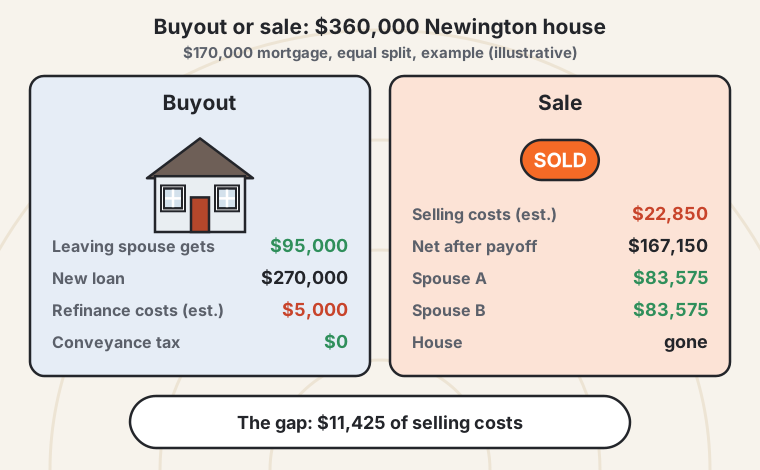
Example (illustrative). A Newington ranch worth the town’s single-family median of $360,000, with $170,000 left on a mortgage taken out years ago at a low rate. The couple agrees on an equal split of the equity. All loan and cost figures are examples.
| Line | Buyout | Sale through an agent |
|---|---|---|
| Agreed value or sale price | $360,000 | $360,000 |
| Mortgage balance | $170,000 | $170,000 (paid off at closing) |
| Equity | $190,000 | $190,000 |
| Commission at 5% (est.) | None | -$18,000 |
| Conveyance tax | $0 on the quitclaim (CGS 12-498) | -$3,600 (1%) |
| Attorney or refinance closing costs (est.) | About $5,000, paid by the keeping spouse | -$1,250 |
| Leaving spouse receives | $95,000 | $83,575 |
| Keeping spouse ends with | The house and a $270,000 loan | $83,575 and no house |
Notice the gap: $95,000 versus $83,575, a difference of $11,425. That is the selling cost the couple avoids by not selling. Some couples deduct “notional” selling costs from the buyout, because the keeping spouse will pay them one day; others do not, because no sale is happening. It is a negotiating point for your attorneys, not a rule.
Can you qualify to refinance a Newington house on one income?
You can qualify to refinance a Newington house on one income if the new monthly payment, plus your other debts, stays within the lender’s debt-to-income limit. In our example the new payment is about $2,625 a month, so you would need roughly $70,000 a year with no other debts at a 45% limit, or about $87,500 at a stricter 36% limit. Support counts only if it is documented and will last.
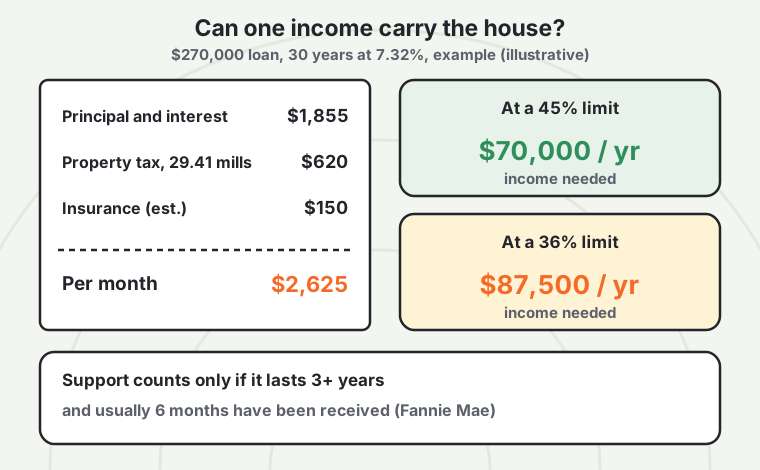
| Monthly cost after the buyout | Amount |
|---|---|
| Principal and interest on $270,000, 30 years at 7.32% | $1,855 |
| Newington property tax at 29.41 mills | $620 |
| Homeowners insurance (est.) | $150 |
| Total housing payment | $2,625 |
| Income needed at a 45% debt-to-income limit, no other debts | About $70,000 a year |
| Income needed at a 36% limit | About $87,500 a year |
Three lender rules matter most for divorcing borrowers (from Fannie Mae’s Selling Guide, which most conventional lenders follow):
- A buyout can be a limited cash-out refinance. When one owner buys out another “as a result of a divorce settlement,” Fannie Mae treats it as a limited cash-out refinance if the house was jointly owned for at least 12 months, all parties sign a written agreement on the transfer and the proceeds, and the keeping spouse takes no cash from the loan (Selling Guide B2-1.3-02). That usually allows a higher loan amount than a regular cash-out refinance.
- Alimony and child support count only with history and future. The lender must document that support will continue for at least three years from the application date, and usually needs proof of six months of full, regular, timely payments (Selling Guide B3-3.4-02). A child who turns 18 in two years, or a short alimony term, may not count.
- The old loan counts against the leaving spouse. Until the refinance pays it off, the old mortgage stays on the leaving spouse’s credit and in their debt ratio, which can stop them from buying their own place.
Talk to a lender before you sign the settlement, not after. A pre-approval letter based on your own income is the best evidence that a buyout will actually close.
When should the quitclaim deed be signed in a buyout?
The quitclaim deed in a buyout should be signed at the refinance closing, not before. At that closing the new loan pays off the old mortgage, the leaving spouse receives the buyout money, and the quitclaim is recorded the same day. Signing it earlier leaves the leaving spouse off the title but still on the old loan, with no money and no say.
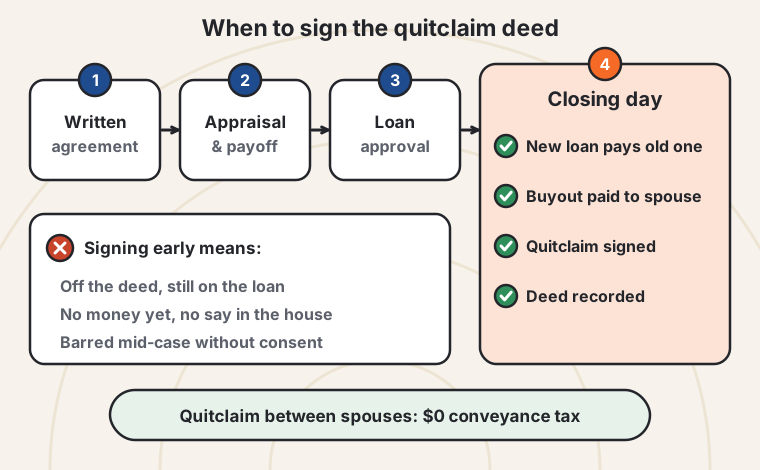
Three reasons to hold the deed until closing:
- The automatic orders. During the case, neither spouse may move a jointly held asset into one name without written consent or a court order (Practice Book § 25-5(b)(4)).
- The loan is separate from the deed. A quitclaim moves ownership; it does not remove anyone from the mortgage. Only a refinance, a payoff or a formal lender release does that. If you sign first and the refinance falls through, you own nothing and still owe the loan.
- The money. Your buyout should be paid by the closing attorney at the same table where you sign. No one should sign a deed on a promise of later payment.
The quitclaim between spouses owes no Connecticut conveyance tax: CGS 12-498(a) exempts “deeds between spouses” and deeds made under a divorce decree. If the decree itself transfers the house, it can be recorded on the Newington land records and acts as the deed (CGS 46b-81(b)). Settlements commonly add a fallback: if the refinance is not done by a set date, the house is listed for sale.
What does each route cost, beyond the numbers on the closing statement?
Beyond the closing statement, a buyout costs the keeping spouse a higher interest rate on a bigger loan, the full burden of repairs and upkeep, and possibly a larger built-in tax gain later. A sale costs both spouses the selling expenses, moving, and the price of a new place to live. Each spouse should compare their life one year after each route, not just the day of closing.
| Hidden cost | Buyout | Sale |
|---|---|---|
| Interest rate | The old low-rate loan is replaced at about 7.32% | Both spouses buy or rent at today’s prices |
| Repairs and upkeep | All on the keeping spouse, on one income | Ends at closing; condition affects the price |
| Taxes later | The keeping spouse takes over the whole tax basis (IRC 1041) | Each spouse uses their own exclusion now |
| Children | Same home, same school | A move; ask your attorney about timing |
| Ongoing ties | Ends once the refinance closes | Ends at closing |
The tax row matters more than it looks. A transfer between spouses incident to divorce is tax-free, but the keeping spouse inherits the original tax basis (IRC 1041). $95,000 of cash and $95,000 of house equity are not always worth the same after tax. On most Newington houses the gain stays under the $250,000 single exclusion, but check it. Our guide to taxes when selling a house in Connecticut explains the rules.
What if neither spouse can afford a buyout and the house needs work?
If neither spouse can afford a buyout and the house needs work, the realistic choices are to list it as-is at a lower price, fix only what buyers will discount most and list it, or sell directly to a cash buyer. Many Newington houses from the 1950s and 1960s have original baths, older roofs or oil tanks, and spending repair money neither of you has rarely makes sense mid-divorce.
A direct sale replaces the listing’s months of joint decisions with one written offer, sent to both spouses and both attorneys. No repairs, no showings, no cleaning out, and a closing in about two weeks or on the date your agreement sets. The price is lower than a good listing would bring; our guide to why cash offers are lower shows how buyers like us price a house. You can compare both nets here:
How much would you walk away with?
Slide the numbers to match your house. It works in your browser; nothing is saved or sent.
Estimates for planning. Conveyance tax per CGS 12-494 (state 0.75% up to $800,000, 1.25% to $2.5M, 2.25% above, plus the town rate). Seller attorney about $1,200 to $1,500; flat-fee MLS about $400; listings include three months of taxes, insurance and utilities, a cash sale about two weeks. Your attorney gives you the final numbers.
If you want a written number to compare, you can ask for one on our divorce house sale page. We stay neutral: we need both spouses’ signatures, or a court order, before we can buy.
When should you NOT sell your Newington house to a cash buyer?
You should not sell your Newington house to a cash buyer when one spouse can qualify for the buyout, or when the house is in good shape and both of you can cooperate through a listing. A buyout avoids selling costs entirely, and a well-priced Newington listing usually nets more than a direct sale. A cash sale makes sense only when time, condition or conflict costs more.
Also wait if your attorneys have not agreed on the split, or if a lender has not yet told the keeping spouse whether they qualify. Get the pre-approval first; it may make the decision for you. If anyone pressures you to sign quickly, read our guide to checking a cash home buyer in Connecticut.

The buyouts that fall apart are the ones agreed before anyone called a lender. Get the keeping spouse pre-approved on their own income first, then negotiate the number. It is much easier to agree on a buyout you know will close.
How do you decide between a buyout and a sale in Newington, step by step?
To decide between a buyout and a sale in Newington, agree on one value, get a mortgage payoff, ask a lender whether the keeping spouse qualifies alone, compare the buyout payment with the sale net, check the taxes, and write the decision into the settlement with a refinance deadline and a sale fallback.
Agree on one value
One appraisal you both accept, or the average of two.
Get the payoff
From the lender, plus any equity line or lien.
Test the refinance
A pre-approval for the keeping spouse, on their own income and documented support.
Compare both routes
Buyout payment versus each spouse’s sale net, using the table above.
Check the taxes
Basis, exclusion and timing with a tax adviser.
Write it down
Buyout amount, refinance deadline, quitclaim at closing, and a sale if the deadline passes.
Know where you stand,
on your own time.
Watch what homes around you sell for and how fast, so when you are ready, you already know your options.
Follow your numbers as the market moves, and decide when the timing is right.
Questions about a divorce buyout vs selling the house in Newington, CT
Is it better to buy out my spouse or sell the house in Connecticut?
It is better to buy out your spouse in Connecticut when you can refinance alone and afford the new payment; it is better to sell when neither of you can, or when the house needs work you cannot fund. On a $360,000 Newington house the leaving spouse gets about $95,000 in a buyout or $83,575 in a sale in our example.
How much income do I need to keep a Newington house after divorce?
To keep a $360,000 Newington house with a $270,000 refinance at 7.32%, you need roughly $70,000 a year with no other debts at a 45% debt-to-income limit, or about $87,500 at 36%, in our example. Lenders set their own limits.
Does alimony count as income for a refinance?
Alimony counts as income for a conventional refinance only if it will continue at least three years from the application and you can usually show six months of full, regular payments, under Fannie Mae’s Selling Guide (B3-3.4-02).
When do I sign the quitclaim deed in a Connecticut divorce?
Sign the quitclaim deed at the refinance closing, when the old loan is paid off and you receive your buyout. Signing earlier removes you from title while leaving you on the mortgage.
Is there conveyance tax on a quitclaim between divorcing spouses?
No. Connecticut exempts deeds between spouses and deeds made under a divorce decree from the conveyance tax (CGS 12-498(a)). A sale to an outside buyer pays 1% in Newington.
Can I keep the old mortgage and just take my spouse off the deed?
Removing your spouse from the deed does not remove them from the mortgage; only the lender can release a borrower. Some loans can be assumed with the lender’s approval, so ask your lender, but most buyouts use a refinance.
Should selling costs be deducted from a buyout?
Whether selling costs are deducted from a buyout is a negotiating point, not a rule. In our Newington example it is worth $11,425 to the leaving spouse: $95,000 without the deduction, $83,575 with it.
Which court handles a Newington divorce?
A Newington divorce is normally filed in the Superior Court for the Judicial District of New Britain, 20 Franklin Square (CGS 51-344). The venue statute also lets a plaintiff where a party lives in Newington choose Hartford (CGS 51-345).
What if the refinance falls through after we sign the agreement?
If the refinance falls through, the agreement’s fallback applies, usually a listing or sale by a set date. Make sure your settlement has one; without it, you may need to go back to court.
Is this page legal or tax advice?
No. It is plain-English information about Connecticut rules and Newington numbers, not legal, tax or lending advice. Your attorney, tax adviser and lender should review your own situation.
Related guides
Divorce and the house
Numbers and value
Near Newington
If selling turns out to be the answer, our Newington page is where to ask for a direct offer, and our divorce sale page explains how we handle both spouses. For every step from first decision to closing, see how to sell a house in Connecticut.
Plain-English information, not legal, tax or lending advice. We need both spouses’ signatures or a court order to buy a house during a divorce. The Newington example uses public data and labelled estimates.
Sources (checked on October 27, 2026)
- CGS § 46b-81 (division of property; decree recorded as a deed).
- Connecticut Judicial Branch, JD-FM-158 Notice of Automatic Court Orders (Practice Book § 25-5).
- CGS §§ 12-494 and 12-498 (conveyance tax; exemptions for deeds between spouses and under a divorce decree).
- Fannie Mae Selling Guide B2-1.3-02 (buyout of a co-owner as a limited cash-out refinance).
- Fannie Mae Selling Guide B3-3.4-02 (alimony and child support as income).
- Freddie Mac 30-year fixed rate (PMMS) via FRED.
- IRS Publication 504, Divorced or Separated Individuals (transfers between spouses, IRC 1041).
- CGS §§ 51-344 and 51-345, 2026 supplement (Newington: New Britain judicial district; Hartford venue option).
- Connecticut OPM, Real Estate Sales (data.ct.gov dataset 5mzw-sjtu): Newington sales recorded October 2024 to September 2025.
- Connecticut OPM mill rates (Newington, fiscal 2027: 29.41).

Who wrote this
Jerryll Noorden
Jerryll has bought and sold Connecticut houses since 2016 and has sat at more closing tables than he can count, on both sides. Before real estate he was a robotics scientist at NASA, IHMC and IIT. He wrote this guide because the national sites that rank for it skip the Connecticut rules that cost sellers money. When listing or selling it yourself would get you more than a cash offer, he says so.
This guide explains Connecticut rules in plain English. It is not legal or tax advice. Laws change; for your sale, talk to a Connecticut real estate attorney and a tax professional.
