
Key facts at a glance
| Fact | Number | Source |
|---|---|---|
| Federal home-sale exclusion (main home, 2 of 5 years) | $250,000; $500,000 married filing jointly | IRS Publication 523 |
| Where Connecticut income tax starts | Your federal adjusted gross income | CGS 12-701 |
| Connecticut income tax rates on a taxable gain | 2% to 6.99% | CGS 12-700 |
| Conveyance tax the seller pays (a selling expense) | 1.00% in most towns; 1.25% in 16 cities such as Hamden | CGS 12-494 |
| How long to keep your home-sale records | At least 3 years after the due date of the return for the year you sell | IRS Publication 523 |
| Connecticut estimated tax threshold | Payments due if you expect to owe $1,000 or more after withholding | DRS Form CT-1040ES |
| Glastonbury single-family median, Oct 2024 to Sep 2025 (used in the worked example) | $615,000 | CT OPM real estate sales, data.ct.gov |
This guide answers one narrow question: which costs lower the tax on a Connecticut house sale, and what proof you need to claim them. It is part of our guide to how to sell a house in Connecticut. Which taxes apply to a sale at all (conveyance tax, property tax proration, federal and Connecticut income tax, nonresident rules) is covered in our main guide to taxes when selling a house in Connecticut; read that first if you are not sure you owe anything. Here we go one level deeper: selling expenses, basis, improvements versus repairs, the few true deductions in the year of sale, and the records that hold it all together.
This is general education, not tax advice. Your numbers and your situation decide the answer, so take this page to a CPA or enrolled agent, and to your Connecticut closing attorney, before you sign anything.
Why does figuring out home-sale tax deductions feel so hard?
Figuring out home-sale tax deductions feels hard because the rules use words that mean something different from everyday speech. Most selling costs are not “deductions” at all; they lower your gain. Repairs and improvements look alike but count differently, and the proof often sits in a shoebox from 20 years ago. Once you sort costs into the right bucket, the picture gets simple.
Maybe you bought your house in the late 1990s, raised a family there, replaced the roof and the boiler, redid the kitchen, and now the house is worth more than twice what you paid. You hear “capital gains” and feel a knot in your stomach. Maybe you are anxious that the IRS will take a big bite, overwhelmed by receipts you never organized, embarrassed that you do not remember what the kitchen cost, suspicious of advice that sounds too good (“deduct everything!”), and worried about making a mistake you cannot undo after closing.
Those feelings make sense. The old version of this page told readers they could “deduct any reasonable cost” of selling. That was never quite right, and it is the kind of line that gets sellers in trouble. This page is for you if you want the real rules, in plain English, with a Connecticut example you can copy with your own numbers. Most owners selling their main home end up owing nothing. The work below is how you prove it, or how you shrink the bill if you do owe.
Which costs of selling a house can you deduct in Connecticut?
The costs of selling a house in Connecticut mostly cannot be deducted on your tax return as such; instead, they reduce your taxable gain. Commissions, the conveyance tax and attorney fees lower your “amount realized.” Improvements raise your “basis.” Only a few items, such as your share of property tax and mortgage interest up to closing, are true itemized deductions in the year you sell (IRS Publication 523).
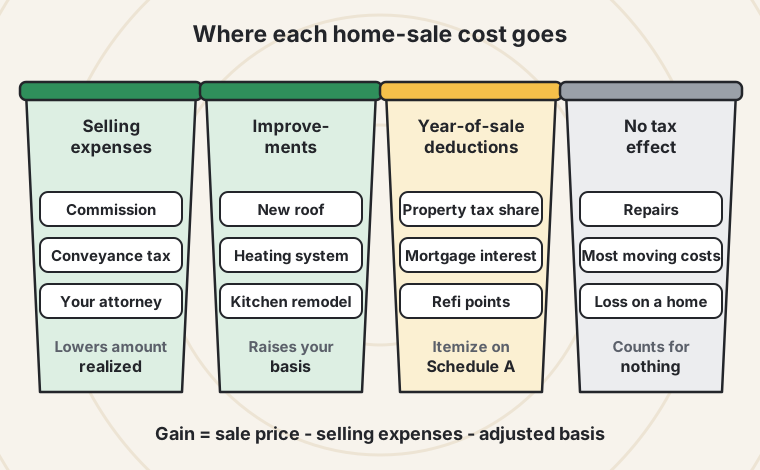
Think of four buckets. Every dollar you spent on the house, or on selling it, lands in one of them.
| Bucket | Examples | What it does | Rule |
|---|---|---|---|
| Selling expenses | Commission, Connecticut conveyance tax, your closing attorney, advertising, title charges you pay as seller | Subtracted from the sale price to get the amount realized | IRS Publication 523, Worksheet 2 |
| Basis additions | Purchase price, certain purchase closing costs, improvements (roof, addition, new heating system) | Raise your adjusted basis, so the gain shrinks | IRS Publication 523 |
| True deductions in the year of sale | Your share of the year’s property tax, mortgage interest through closing, leftover refinance points | Itemized deductions on Schedule A, if you itemize | IRS Publication 523 and 936 |
| Nothing | Ordinary repairs and upkeep, moving costs (for most people), a loss on a personal home | No tax effect | IRS Publication 523 |
The gain formula ties the buckets together: sale price minus selling expenses = amount realized; amount realized minus adjusted basis = gain. The home-sale exclusion then removes up to $250,000 of that gain ($500,000 married filing jointly) if you meet the tests. Our Connecticut home-sale tax guide explains the exclusion tests; this page is about making the gain as small as the law allows.
What counts as a selling expense on a Connecticut house sale?
A selling expense on a Connecticut house sale is a cost directly tied to selling the house, paid by you as seller: the agent’s commission, the state and town conveyance tax, your attorney’s fee, advertising, and other seller charges on the settlement statement. IRS Publication 523 subtracts them from the sale price, which lowers your gain dollar for dollar.
IRS Publication 523 calls these “the costs directly associated with selling your home.” In Connecticut, the common ones are:
- Commission. If you list, this is usually the biggest one. See what it typically runs in our guide to real estate commission in Connecticut.
- Conveyance tax. The seller pays it when the deed is recorded: 0.75% state plus 0.25% town in most towns, 0.50% town in 16 cities (CGS 12-494). In Hamden, a 1.25% city, a $355,000 sale (the Hamden single-family median, Oct 2024 to Sep 2025) carries $4,437.50 of conveyance tax. The IRS says there is no deduction for transfer taxes as a tax, but “you can treat these taxes and fees as selling expenses” (Publication 523). Every town’s rate is in our Connecticut conveyance tax guide.
- Your closing attorney. Connecticut closings are handled by attorneys; your attorney’s fee for the sale is a selling expense.
- Advertising and marketing you paid yourself, such as listing photos if you sold by owner.
- Other seller charges on your settlement statement tied to the sale, such as a release-recording fee or a courier charge.
What is not a selling expense: your mortgage payoff (that is your own debt, not a cost of selling), the property tax proration (it is tax for days you owned the house, handled separately below), and fix-up repairs you made to get the house ready. Before 1997, pre-sale “fixing-up expenses” had their own rule; that rule is gone, so painting and patching before listing do not reduce the gain unless they are part of a larger improvement project.
Your closing attorney gives you a settlement statement (often called the closing statement or ALTA statement). The seller column lists the commission, conveyance tax, attorney fee and every other charge. Keep a signed copy with your tax records; it is your proof for this whole bucket.
To see these costs next to each other before you sell, use the calculator in our guide to the cost to sell a house in Connecticut, or try it here:
How much would you walk away with?
Slide the numbers to match your house. It works in your browser; nothing is saved or sent.
Estimates for planning. Conveyance tax per CGS 12-494 (state 0.75% up to $800,000, 1.25% to $2.5M, 2.25% above, plus the town rate). Seller attorney about $1,200 to $1,500; flat-fee MLS about $400; listings include three months of taxes, insurance and utilities, a cash sale about two weeks. Your attorney gives you the final numbers.
What is your basis, and which purchase costs raise it?
Your basis is, in general, what the house cost you: the purchase price plus certain closing costs you paid when you bought it, plus the cost of improvements, minus a few items such as depreciation and insurance payouts for casualty losses. The higher your basis, the smaller your gain. Most Connecticut sellers who bought decades ago understate their basis because they forget the purchase costs and the improvements.
Start with your purchase closing statement (the one from when you bought). IRS Publication 523 lets you add these purchase costs to basis:
- Legal fees, including the title search and preparing the contract and deed
- Recording fees and survey fees
- Transfer or stamp taxes you paid as buyer
- Owner’s title insurance
- Amounts the seller owed that you agreed to pay, such as back taxes
You cannot add loan costs such as points and origination fees, mortgage insurance, appraisal fees required by the lender, or fire and casualty insurance premiums. Those relate to the loan or to insurance, not to buying the house.
Some events lower basis. Publication 523 lists depreciation you took or could have taken for a home office or rental use, casualty losses you claimed, insurance payments for casualty losses, and energy credits or subsidies that paid you back for improvements you counted in basis. For a Connecticut owner that might mean a storm-damage claim after a nor’easter, or a federal energy credit you claimed for solar panels or a heat pump.
Inherited the house? Your basis is generally the value at the date of death, not what your parents paid. That is covered in our guide to taxes on selling an inherited house in Connecticut.
What is the difference between an improvement and a repair for taxes?
The difference between an improvement and a repair for taxes is what the work does. An improvement adds value, prolongs the home’s useful life, or adapts it to new uses, and its cost is added to your basis. A repair keeps the house in normal working order and is not added. The exception: repair-type work done as part of an extensive remodeling or restoration job counts as part of the improvement (IRS Publication 523).
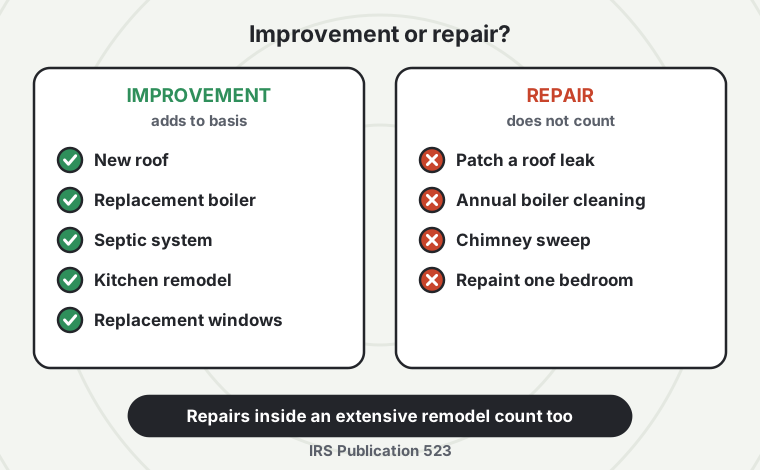
| Project on a Connecticut house | Usually | Why |
|---|---|---|
| New roof (full replacement) | Improvement | Prolongs the home’s life |
| Replacement boiler or furnace, or switching from oil to gas or a heat pump | Improvement | New heating system |
| New septic system or well pump replacement | Improvement | New plumbing or system component |
| Kitchen or bath remodel, addition, deck, garage | Improvement | Adds value or space |
| Replacement windows, new siding, insulation | Improvement | Adds value and life |
| Driveway, fence, retaining wall, landscaping | Improvement | Lawn and grounds category |
| Patching a roof leak, replacing a few shingles | Repair | Keeps the roof working |
| Annual boiler cleaning, chimney sweep | Repair | Maintenance |
| Repainting a bedroom on its own | Repair | Upkeep |
| Repainting the kitchen as part of the remodel | Improvement | Part of an extensive remodel |
Two traps catch Connecticut sellers who have owned for a long time:
- Improvements that are gone. If you put on a roof in 2002 and replaced it in 2020, only the 2020 roof counts. The cost of an improvement that is no longer part of the home comes out of basis.
- Your own labor. You can add what you paid for materials and contractors, not the value of your own weekend work.
For crumbling-foundation owners: a foundation replacement is an improvement, but if you received money from the Connecticut Foundation Solutions Indemnity Company or an insurer toward it, ask your preparer how that payment affects your basis before you count the full cost.
How does a worked basis example look on a Connecticut house?
A worked basis example on a Connecticut house shows why records matter. A single owner who bought a Glastonbury house for $250,000 in 1998 and sells it for $615,000 has a $193,600 gain once selling expenses, purchase costs and $130,000 of improvements are counted, so the $250,000 exclusion covers it. Without the improvement receipts, $73,600 would be taxable. (Example, illustrative.)
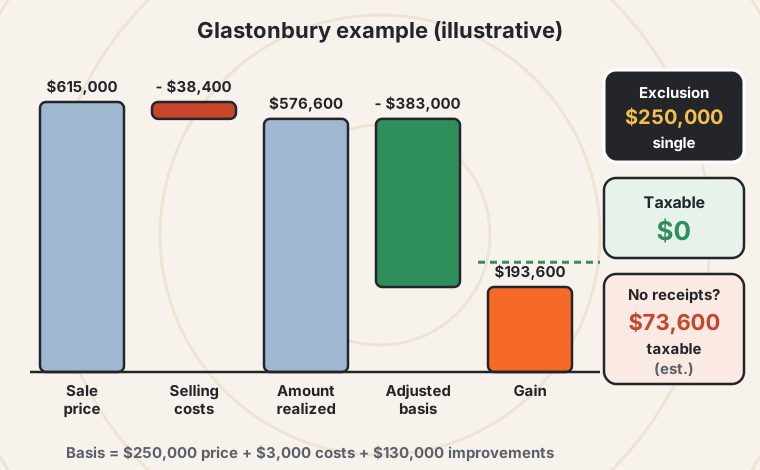
Example (illustrative). The sale price is the Glastonbury single-family median for October 2024 to September 2025. The purchase price, improvements, commission and attorney fee are invented inputs, marked (est.). The seller is single, owned and lived in the house for more than 2 of the last 5 years, and has never used the exclusion.
| Line | Amount | Note |
|---|---|---|
| Sale price | $615,000 | Glastonbury single-family median |
| Commission, 5% (est.) | − $30,750 | Selling expense |
| Conveyance tax, 1.00% (0.75% state + 0.25% town) | − $6,150 | Selling expense, CGS 12-494 |
| Seller’s attorney (est.) | − $1,500 | Selling expense |
| Amount realized | $576,600 | Sale price minus $38,400 of selling expenses |
| Purchase price, 1998 (est.) | $250,000 | From the purchase closing statement |
| Purchase closing costs added to basis (est.) | + $3,000 | Legal, title search, recording, owner’s title insurance |
| Improvements (est.): roof $18,000, kitchen $45,000, central air $12,000, bath addition $40,000, windows $15,000 | + $130,000 | Receipts kept |
| Adjusted basis | $383,000 | |
| Gain | $193,600 | $576,600 − $383,000 |
| Home-sale exclusion (single) | − $193,600 | Up to $250,000 |
| Taxable gain, federal and Connecticut | $0 |
Now take the improvement receipts away. The basis drops to $253,000, the gain rises to $323,600, and $73,600 is above the $250,000 exclusion. At a 15% federal long-term rate that is about $11,040, and at Connecticut’s top 6.99% rate up to about $5,145 more, roughly $16,185 in all (est.; your actual rates depend on your income for the year). If the seller had also ignored the selling expenses and simply subtracted the purchase price from the sale price, the “gain” would look like $365,000, with $115,000 seemingly taxable.
The lesson is not that every long-time owner owes tax. It is that the folder of receipts in your basement can be worth thousands of dollars, and that you should rebuild your basis before you choose a price or an offer, not in April.
What can you actually deduct in the year you sell your house?
In the year you sell your house you can deduct, if you itemize, your share of that year’s property tax, the mortgage interest you paid up to closing, and any refinance points you had not yet fully deducted. You cannot deduct a loss on the sale of your personal home, and ordinary repairs and most moving costs are not deductible (IRS Publications 523 and 936).
Property tax. Connecticut towns bill in arrears, so at closing your attorney prorates the year by the day and you usually credit the buyer. For federal purposes, the tax for the days you owned the house is treated as tax you paid, even though it shows up as a credit on the closing statement. Publication 523 explains the math: if you got a Form 1099-S, subtract the buyer’s share shown in box 6; if not, multiply the year’s tax by the days you owned the house divided by 365. Whether it helps depends on whether you itemize and on the federal cap on state and local tax deductions, which Congress changed in 2025; check the current Schedule A instructions. How the proration itself works is explained in our main tax guide.
Mortgage interest through the payoff date is deductible on the usual rules; the lender’s final Form 1098 shows it. Points from a refinance that you were deducting over the loan’s life can generally be deducted in full when the loan is paid off (IRS Publication 936).
A loss. If you sell your main home for less than your adjusted basis, “You can’t deduct this loss” (Publication 523). The upside: you owe no income tax on the sale.
Moving costs. For most people, moving expenses are not deductible. Active-duty military members moving under orders have their own rules; see IRS Publication 3. Our Waterford guide covers the military exclusion rules: home sale profit taxes in Connecticut.
Does Connecticut allow any extra deductions on a home sale?
Connecticut does not allow a separate set of home-sale deductions. Its income tax starts from your federal adjusted gross income (CGS 12-701), so every selling expense, basis adjustment and exclusion that lowers your federal gain lowers your Connecticut gain the same way. A taxable gain is then taxed with your other income at 2% to 6.99% (CGS 12-700). There is no lower Connecticut capital gains rate.
Three Connecticut points are worth knowing:
- No senior exclusion in current law. Old Department of Revenue Services pages that describe a special rule for older sellers are marked “not current.” A 2026 bill (SB 41) proposed a Connecticut deduction for home-sale gains of taxpayers 65 and older; when we checked, it had been referred to the Finance, Revenue and Bonding Committee and we found no public act. Ask your preparer whether anything has changed for the year you sell.
- High-price credit. A resident who paid the 2.25% state conveyance rate on the part of a price above $2.5 million can claim a partial income tax credit later (CGS 12-704c). Details are in the main tax guide.
- Estimated payments. No income tax is withheld at a Connecticut closing for a resident seller. If you will have a taxable gain, Connecticut expects estimated payments when you will owe $1,000 or more after withholding (Form CT-1040ES). The IRS has its own estimated-tax rules (Form 1040-ES).
Which records should you keep, and for how long?
You should keep the records that prove your basis and your selling expenses: both closing statements, the deed, receipts and contracts for every improvement, any casualty-loss and insurance papers, and depreciation records if you ever rented the house or had a home office. IRS Publication 523 says to keep them, in general, until 3 years after the due date of your return for the year you sold.
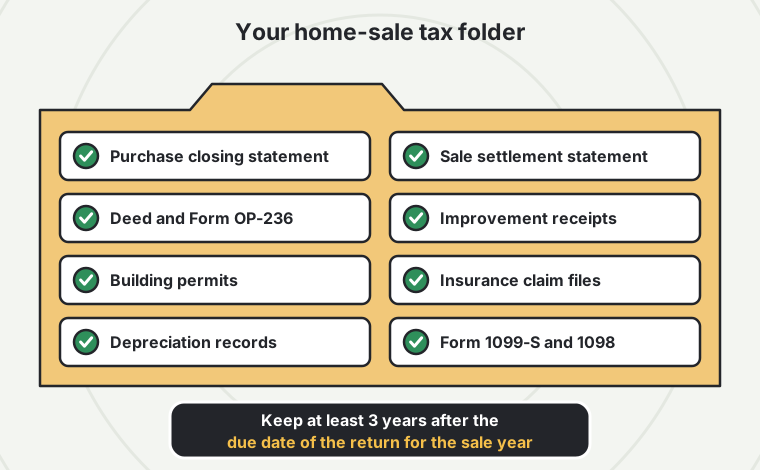
- Purchase closing statement (or HUD-1) from when you bought
- Sale settlement statement from your Connecticut closing attorney
- Deed, and your attorney’s copy of the conveyance tax return (Form OP-236)
- Contracts, invoices and proof of payment for every improvement
- Building permits from your town; they date the work and help when invoices are lost
- Insurance claim files and any casualty-loss paperwork
- Depreciation schedules if any part of the house was rented or used as a home office
- Form 1099-S, if your attorney issued one, and your final mortgage Form 1098
Lost receipts? Rebuild what you can. Your town building department keeps permit records, contractors often keep old invoices, and bank and credit card statements show payments. Write a dated summary of each project with whatever proof you can find. Ask your preparer how much reconstruction your situation needs; a reasonable, documented estimate is better than nothing, and nothing is what most people start with.
Does selling to a cash buyer or selling as-is change your tax deductions?
Selling to a cash buyer or selling as-is does not change the tax rules, but it changes the numbers that go into them. With no commission, your selling expenses are smaller, and a lower price means a smaller gain and a little less conveyance tax. Repairs you skip were never deductible anyway. Taxes alone are rarely a reason to pick one route over another.
We buy Connecticut houses for cash, so here is the honest version. Compare routes by what lands in your account after everything: price, commission, repairs, months of carrying costs, and tax. Our cash buyer vs. realtor comparison walks through that math.
List the house
Often nets moreBest when the house is in good shape and you have time.
- Higher price, bigger selling expenses
- Pre-listing repairs are not deductible
- Usually several months to close
Sell as-is to a direct buyer
Faster, simplerFits a house that needs work, an estate, tenants or a deadline.
- Lower price, no commission
- No repair spending at all
- Typically about 2 weeks to close
When you should NOT sell to a cash buyer: if the house is in good condition, you have time, and especially if your gain is close to or above the exclusion, list it and let the market pay you. A cash sale can make sense when repairs, vacancy, an estate or a deadline would eat more than the price difference. If you want a second number to compare, the cash vs. realtor guide shows how to line the two up.

The sellers who worry most about tax are usually long-time owners, and most of them end up owing nothing once their tax preparer counts the selling costs and the old improvements. My practical advice: before you accept any offer, from me or anyone else, pull the old closing statement and make a list of the big projects with years and rough costs. It takes an evening, and it tells you whether tax should even be part of the decision.
What steps should you take before and after closing?
The steps to take before and after closing are simple: rebuild your basis before you set a price, confirm the exclusion tests, collect the settlement statement at closing, decide with your preparer whether you need an estimated payment, and file the sale correctly the next spring. Each step takes less time than you fear.
Find the purchase closing statement
Check your files, your closing attorney from back then, or the town land records for the deed. Note the purchase costs that add to basis.
List every improvement
Year, project, cost, proof. Use permits and bank statements to fill gaps. Leave out repairs and anything since replaced.
Estimate the gain
Sale price minus selling expenses minus adjusted basis. Compare it with the $250,000 or $500,000 exclusion. Our tax guide explains the tests.
Talk to a CPA or enrolled agent
Especially if the gain is near the limit, the house was ever rented, you had a home office, or you are not sure you meet the 2-of-5-year test.
Keep the closing file
Ask your attorney for the final signed settlement statement and the 1099-S if one is issued. Store it with your basis folder.
Pay and file on time
Make any federal and Connecticut estimated payments your preparer recommends, and report the sale on Form 8949 and Schedule D if required.
See the house together.
Pick a time that works.
Choose a time for us to walk through the property with you, or ask for a quick call first. We confirm every request personally.
Tuesday, January 13
No open times in the next few weeks. Please call us.
We will confirm by email. Nothing is booked until we do.
View my requestFrequently asked questions
Can I deduct closing costs when I sell my house in Connecticut?
You cannot deduct most closing costs when you sell your house in Connecticut as a separate deduction, but the seller’s closing costs, such as the commission, conveyance tax and attorney fee, are selling expenses that reduce your gain (IRS Publication 523).
Is the Connecticut conveyance tax deductible?
The Connecticut conveyance tax is not deductible as a tax, but the IRS lets the seller treat it as a selling expense, which lowers the gain. On a $355,000 Hamden sale at 1.25%, that is $4,437.50 subtracted from the sale price.
Can I deduct repairs I made before selling my house?
You cannot deduct ordinary repairs made before selling your house, and they do not add to basis. Repair-type work done as part of an extensive remodel counts as part of that improvement (IRS Publication 523).
What home improvements add to basis?
Home improvements that add to basis are projects that add value, prolong the home’s life or adapt it to new uses, such as a new roof, a replacement heating system, a septic system, an addition, a kitchen remodel, new windows or a driveway.
Do I need receipts for home improvements to claim them?
You need records to support home improvements you add to basis. Receipts and contracts are best; permits, bank statements and contractor records can help rebuild missing proof. Ask your tax preparer how much documentation your situation needs.
How long should I keep records after selling a house?
You should keep records after selling a house, in general, until 3 years after the due date of your return for the year of the sale (IRS Publication 523). Keep basis records for as long as you own the home.
Can I deduct a loss on the sale of my home?
You cannot deduct a loss on the sale of your personal home. You also owe no income tax on the sale (IRS Publication 523).
Is the property tax I pay at closing deductible?
The property tax for the days you owned the house in the year of sale is deductible if you itemize, subject to the federal cap on state and local tax deductions. The credit you give the buyer at closing is part of your own tax for those days.
Does Connecticut have its own deductions for selling a house?
Connecticut does not have its own deductions for selling a house. Its income tax starts from federal adjusted gross income (CGS 12-701), so the federal selling expenses, basis rules and exclusion carry over.
Is there a Connecticut tax break for seniors selling a home?
We found no Connecticut tax break in current law just for seniors selling a home. A 2026 bill, SB 41, proposed one but was referred to committee, and we found no public act. Old DRS pages describing a senior rule are marked not current.
Can I add my own labor to the basis of my house?
You cannot add the value of your own labor to the basis of your house. You can add what you paid for materials, contractors and permits for an improvement.
Do I report the sale if all my gain is excluded?
If you received a Form 1099-S, you must report the sale on Form 8949 even if all your gain is excluded. If you did not get one and the whole gain is excluded, you generally do not report it (IRS Publication 523).
Related guides
Taxes and costs
After the sale
Taxes are one part of the plan. For pricing, timing, paperwork and closing, start with how to sell a house in Connecticut. If you would like a cash number to compare with a listing, our Glastonbury page and Hamden page show how we buy in those towns.
General education, not tax, legal or financial advice. Tax rules change and depend on your facts; talk to a CPA or enrolled agent and your Connecticut attorney before you sell.
Sources (checked on October 27, 2026)
- IRS Publication 523, Selling Your Home (selling expenses, basis, improvements vs. repairs, transfer taxes, records, losses, reporting).
- IRS Publication 936, Home Mortgage Interest Deduction (points on payoff).
- IRS Publication 3, Armed Forces’ Tax Guide (military moving expenses).
- CGS chapter 229: § 12-700 (rates), § 12-701 (Connecticut AGI starts from federal AGI), § 12-704c (conveyance tax credit).
- CGS chapter 223: § 12-494 (conveyance tax rates).
- Connecticut Department of Revenue Services, Form CT-1040ES estimated tax instructions.
- 2026 SB 41 bill status (proposed senior home-sale deduction).
- CT OPM Real Estate Sales (Glastonbury and Hamden medians, Oct 2024 to Sep 2025), data.ct.gov.

Who wrote this
Jerryll Noorden
Jerryll has bought and sold Connecticut houses since 2016 and has sat at more closing tables than he can count, on both sides. Before real estate he was a robotics scientist at NASA, IHMC and IIT. He wrote this guide because the national sites that rank for it skip the Connecticut rules that cost sellers money. When listing or selling it yourself would get you more than a cash offer, he says so.
This guide explains Connecticut rules in plain English. It is not legal or tax advice. Laws change; for your sale, talk to a Connecticut real estate attorney and a tax professional.
