
Key facts at a glance
This Woodbridge guide is part of our guide to how to sell a house in Connecticut. It answers one question: what is different when the house in a Connecticut divorce is worth $1 million or more? The numbers below are Woodbridge’s own.
| Fact | Number | Source |
|---|---|---|
| Woodbridge median single-family sale price, Oct 2024 to Sep 2025 | $665,000 | CT OPM Real Estate Sales, data.ct.gov |
| Woodbridge single-family sales above $800,000 | 31 of 112 (about 28%) | CT OPM Real Estate Sales (our query) |
| Woodbridge single-family sales of $1 million or more | 19 of 112 (about 17%) | CT OPM Real Estate Sales (our query) |
| Woodbridge mill rate, fiscal 2027 | 33.99 mills | CT OPM mill rates |
| State conveyance tax, residential | 0.75% to $800,000; 1.25% from $800,000 to $2.5M; 2.25% above | CGS 12-494 |
| Woodbridge town conveyance tax | 0.25% | CGS 12-494 |
| Home-sale exclusion | $250,000 single; $500,000 married filing jointly | IRC 121; IRS Publication 523 |
| Superior Court judicial district for Woodbridge | New Haven (Ansonia-Milford also allowed for venue) | CGS 51-344, 51-345 |
Why does a high-value house make a Woodbridge divorce harder?
A high-value house makes a Woodbridge divorce harder because the stakes on every number are larger: a $140,000 gap between two appraisals, a six-figure tax bill if the timing is wrong, a conveyance tax that climbs above $800,000. Owners at this point often feel guarded, distrustful of the other side’s experts, overwhelmed by advisers, proud of the house, and worried about being outmaneuvered.
Woodbridge is a town of larger houses on wooded lots, from mid-century colonials to custom contemporaries off Route 63 and Route 114. About one in six single-family sales in the last year closed at $1 million or more. Many of these houses were bought decades ago, so they carry gains far above what the tax code shelters, and few close comparables, which makes them hard to value.
I am Jerryll Noorden. I have bought houses across Connecticut since 2016, about ten a year, and I will say plainly that most high-value Woodbridge houses in good condition should be sold on the open market, not to a cash buyer like me. This page is about the three money questions that set a high-value divorce apart, so you and your advisers can get them right.
If your divorce includes a Woodbridge house worth well above the town median, this page is for you.
What is different about a high-value home in a Connecticut divorce?
A high-value home in a Connecticut divorce differs in three ways: gain above the $250,000 or $500,000 exclusion becomes taxable, so the sale date and filing status can cost or save tens of thousands; Connecticut’s conveyance tax rises to 1.25% on the part of the price above $800,000 (CGS 12-494); and competing appraisals can be far apart, so how the value is set matters more.
The basic divorce rules (automatic orders, who gets the house, the buyout mechanics) are in our main guide to selling a house during a divorce in Connecticut, which also explains the tax rules in general. This page applies them to a Woodbridge house worth $1,150,000 in our example.
How much tax is owed on gain above the exclusion when a high-value house is sold in a divorce?
The tax owed on gain above the exclusion when a high-value house is sold in a divorce depends on the size of the gain and on whether both spouses still qualify. In our Woodbridge example a $627,750 gain leaves $127,750 taxable whether sold jointly or after the divorce with both qualifying, but $377,750 taxable if one spouse has lost the exclusion, roughly $28,000 versus $83,000 of tax (est.).
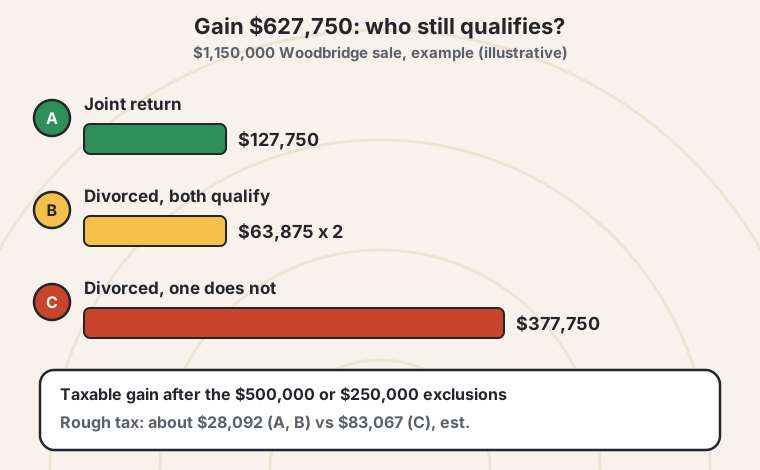
Example (illustrative). A Woodbridge couple bought their house in 1998 for $390,000 and spent $60,000 on improvements, a tax basis of $450,000. They sell for $1,150,000 with $72,250 of selling costs (5% commission of $57,500 (est.), $13,250 of conveyance tax, $1,500 attorney (est.)). The amount realized is $1,077,750, and the gain is $627,750.
| Scenario | Exclusion used | Taxable gain | Rough tax (est.) |
|---|---|---|---|
| A. Sold while still married on December 31, joint return | $500,000 | $127,750 | About $28,092 |
| B. Sold after the divorce, both spouses still qualify | $250,000 each | $63,875 each ($127,750 total) | About $14,046 each |
| C. Sold after the divorce, one spouse moved out more than 3 years earlier with no instrument granting the other use | $250,000 for one only | $63,875 + $313,875 = $377,750 | About $83,067 in total |
Three rules drive those differences. The $500,000 limit needs a joint return, and your filing status depends on whether you are married on the last day of the tax year (IRS Publication 504). Each spouse needs two years of use in the five before the sale, unless the other spouse was granted use of the house under a divorce or separation instrument, which counts for the spouse who moved out (IRC 121(d)(3)(B)). And Connecticut taxes the gain the federal return includes, at rates up to 6.99%.
The same math matters in a buyout. A transfer between spouses incident to divorce is tax-free, but the keeping spouse takes over the $450,000 basis (IRC 1041). If that spouse later sells at $1,150,000 alone, with one $250,000 exclusion, about $377,750 of gain would be taxable in our example. A buyout that ignores that built-in tax is not an equal split. Our guide to taxes when selling a house in Connecticut covers the rates and the net investment income tax.
How does Connecticut’s conveyance tax work on a house above $800,000?
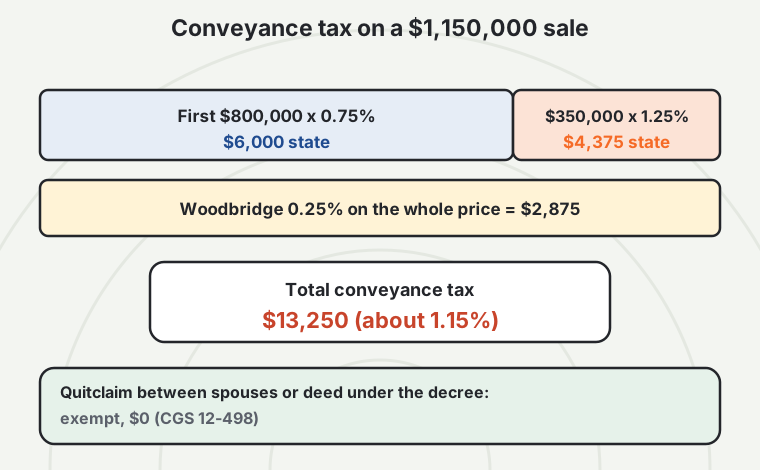
Connecticut’s conveyance tax on a house above $800,000 works in tiers: the seller pays the state 0.75% on the first $800,000 and 1.25% on the part from $800,000 to $2.5 million (2.25% above that), plus Woodbridge’s 0.25% on the whole price. On a $1,150,000 sale that is $6,000 plus $4,375 to the state and $2,875 to the town, $13,250 in all, about 1.15%.
| Sale price in Woodbridge | State tax | Town tax (0.25%) | Total |
|---|---|---|---|
| $665,000 (town median) | $4,987.50 | $1,662.50 | $6,650 (1%) |
| $1,150,000 (our example) | $10,375 | $2,875 | $13,250 (about 1.15%) |
Two divorce points. A quitclaim from one spouse to the other in a buyout, and a deed made to carry out a divorce decree, are exempt from the conveyance tax (CGS 12-498(a)). A sale to an outside buyer is not; the sellers pay the tax at closing, usually split as the proceeds are split. The Connecticut conveyance tax guide has every town’s rate.
How do Connecticut courts handle competing appraisals of a high-value house?
Connecticut courts handle competing appraisals of a high-value house by weighing the evidence: each spouse’s appraiser explains their comparables and adjustments, and the judge decides which is more credible or sets a value within the range the evidence supports. Courts generally value marital property as of the date of dissolution. On a $1.15 million house, a $140,000 (about 12%) gap between appraisals is a $70,000 swing in an equal-split buyout.
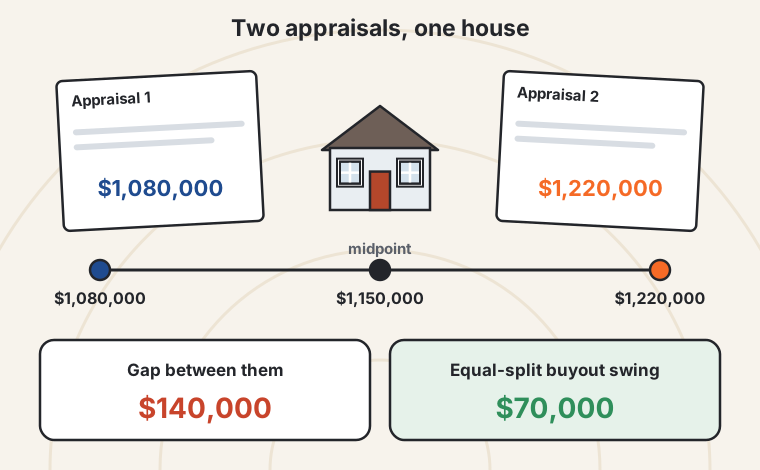
High-value Woodbridge houses are hard to appraise for an ordinary reason: there are few close comparables. In the year to September 2025, only 19 Woodbridge single-family houses sold for $1 million or more. A custom house on four acres may have no true match in town, so appraisers reach into Orange, Bethany or Hamden and adjust for differences. Two honest appraisers can land $140,000 apart.
Ways couples and courts narrow the gap:
- One neutral appraiser. Both spouses agree on one licensed appraiser and accept the number. Cheapest and fastest.
- Two appraisals, split the difference. Each hires one; the agreed value is the midpoint, $1,150,000 in our example. Common in settlements.
- A third appraisal. If two are far apart, both pick a third appraiser whose number governs.
- The court decides. At trial each appraiser testifies; the judge weighs credibility and the comparables. Appraiser fees and testimony time add cost (est. several thousand dollars per side).
- Let the market decide. If the house is being sold anyway, the sale price replaces the appraisals, and the net is split.
Timing matters too: Connecticut appellate courts have said marital property is generally valued as of the date of dissolution, not the date of separation, so an appraisal from a year ago may need updating. Our guide on appraisals and price in Connecticut explains what appraisers look at.
What does a high-value Woodbridge house cost to carry while the divorce is pending?
A high-value Woodbridge house costs a lot to carry while the divorce is pending: property tax alone on a $1,150,000 house is about $27,360 a year, or $2,280 a month, at 33.99 mills, before the mortgage, insurance, utilities and upkeep of a large house. Every month of disagreement is paid by the marital estate, which both spouses share.
Who pays meanwhile is set by agreement or a temporary court order; the general rules are in the main divorce guide linked above. On a high-value house, the cost of delay often exceeds the cost of a compromise on value. Six months of tax alone is about $13,680 on our example, more than the conveyance tax on the sale.
Know where you stand,
on your own time.
Watch what homes around you sell for and how fast, so when you are ready, you already know your options.
Follow your numbers as the market moves, and decide when the timing is right.
How should a high-value house be sold during a Connecticut divorce?
A high-value house should usually be sold during a Connecticut divorce through an experienced listing agent both spouses accept, with a written stipulation that sets the pricing method, a reduction schedule, who approves offers, and where the net goes. A direct cash sale fits only special cases: major condition problems, a hard deadline, or a conflict so deep that a listing cannot run.
At this price, the difference between a market sale and a cash sale is large in dollars, and buyers for $1 million Woodbridge houses exist, even if there are fewer of them. Expect a longer marketing period than at the median. A sale also settles the valuation fight: the market sets the price, and both spouses share the result. For the closing-table mechanics, our guide to splitting the proceeds at closing walks through escrow and credits, and our guide on a divorce house that won’t sell covers price-reduction schedules and court orders.
If your Woodbridge house needs major work, or a deadline makes a listing unrealistic, you can request a written cash offer through our divorce house sale page and compare it with your agent’s estimate. We send it to both spouses and need both signatures, or a court order, to buy.
When should you NOT sell your Woodbridge house to a cash buyer?
You should not sell your Woodbridge house to a cash buyer when it is in good condition, the two of you can run a listing together, and there is no hard deadline. That describes most high-value Woodbridge houses. On a $1 million house, the gap between a market price and a cash price can be far larger than any carrying cost a few more months would add.
Also wait until your tax adviser has checked the sale date against your filing status and the use test; on a gain this size, the calendar can matter more than the price. If anyone urges you to sign quickly, read our guide to checking a cash home buyer in Connecticut.

On expensive houses I see couples spend more fighting over the appraisal than the appraisal gap is worth after tax. Agree on the method first, one appraiser or the midpoint of two, before either of you sees a number. It is much easier to accept a value you did not choose when you chose the rule.
How do you handle a high-value house in a Woodbridge divorce, step by step?
To handle a high-value house in a Woodbridge divorce, gather the purchase and improvement records to fix the basis, get a tax projection for each sale date, agree on the valuation method before ordering appraisals, price the conveyance tax at the right tiers, decide sale or buyout with the built-in tax in view, and write the pricing, offer and escrow rules into the stipulation.
Rebuild the basis
Purchase closing statement plus receipts for improvements; this sets the gain.
Project the tax by date
Joint-year sale versus after the decree; check each spouse’s use test.
Agree on the valuation method
One neutral appraiser, the midpoint of two, or a third as tiebreaker.
Price the conveyance tax
0.75% to $800,000, 1.25% above, plus Woodbridge’s 0.25%.
Choose sale or buyout
Adjust any buyout for the built-in tax the keeping spouse takes on.
Write the rules down
Pricing, reductions, offer approval and escrow in the stipulation.
Questions about a high-value home in a Woodbridge, CT divorce
Do you pay capital gains tax when selling a house in a Connecticut divorce?
You pay capital gains tax when selling a house in a Connecticut divorce only on gain above your exclusion: $500,000 on a joint return if both of you qualify, $250,000 each otherwise. In our $1,150,000 Woodbridge example, $127,750 of a $627,750 gain is taxable when both qualify.
Is it better to sell the house before or after the divorce is final?
Selling before or after the divorce is final can give the same tax if both spouses still meet the use test. It matters when one spouse moved out long ago without a divorce instrument granting the other use, or when you want the $500,000 joint limit. Ask a tax adviser before choosing the date.
What is the conveyance tax on a $1 million house in Woodbridge?
The conveyance tax on a $1,000,000 house in Woodbridge is $11,000: $6,000 (0.75% of $800,000) plus $2,500 (1.25% of $200,000) to the state, and $2,500 (0.25%) to the town, under CGS 12-494.
Who pays for the appraisals in a Connecticut divorce?
Each spouse usually pays for the appraiser they hire, or the couple shares the cost of one neutral appraiser. The agreement or the court can allocate the cost differently.
What date is the house valued at in a Connecticut divorce?
Connecticut courts generally value marital property as of the date of dissolution, not the date of separation. Appraisals done long before trial may need updating.
What happens if two appraisals of our house are far apart?
If two appraisals are far apart, couples often take the midpoint or hire a third appraiser whose number governs. At trial, the judge weighs both appraisers’ evidence and sets a value the evidence supports.
Does a buyout of a high-value house have hidden tax costs?
Yes. The keeping spouse takes over the original tax basis (IRC 1041) and will have only one $250,000 exclusion when selling alone. In our example about $377,750 of gain would be taxable on a later sale at the same price.
Which court handles a Woodbridge divorce?
A Woodbridge divorce is normally in the Superior Court for the Judicial District of New Haven at 235 Church Street (CGS 51-344). The venue statute also allows Ansonia-Milford when a party lives in Woodbridge (CGS 51-345).
Is there a quitclaim conveyance tax between divorcing spouses?
No. Deeds between spouses and deeds made under a divorce decree are exempt from Connecticut’s conveyance tax (CGS 12-498(a)), however valuable the house.
Is this page legal or tax advice?
No. It is plain-English information about Connecticut and federal rules and Woodbridge numbers, not legal or tax advice. Your attorney and tax adviser should review your own situation.
Related guides
Divorce and the house
Tax and value
Near Woodbridge
If a direct offer would help you compare, our Woodbridge page is where to ask for one, and our divorce sale page explains how we handle both spouses. For every step from first decision to closing, see how to sell a house in Connecticut.
Plain-English information, not legal or tax advice. We need both spouses’ signatures or a court order to buy a house during a divorce. The Woodbridge example uses public data and labelled estimates.
Sources (checked on October 27, 2026)
- CGS §§ 12-494 and 12-498 (conveyance tax tiers; exemptions for deeds between spouses and under a divorce decree).
- CGS § 46b-81 (division of property in a dissolution).
- IRS Publication 523, Selling Your Home (exclusion limits, ownership and use tests).
- IRS Publication 504, Divorced or Separated Individuals (filing status on December 31; transfers between spouses).
- IRS, Net Investment Income Tax.
- Connecticut Department of Revenue Services (income tax rates up to 6.99%).
- CGS §§ 51-344 and 51-345, 2026 supplement (Woodbridge: New Haven judicial district; Ansonia-Milford venue option).
- Connecticut OPM, Real Estate Sales (data.ct.gov dataset 5mzw-sjtu): Woodbridge sales recorded October 2024 to September 2025.
- Connecticut OPM mill rates (Woodbridge, fiscal 2027: 33.99).

Who wrote this
Jerryll Noorden
Jerryll has bought and sold Connecticut houses since 2016 and has sat at more closing tables than he can count, on both sides. Before real estate he was a robotics scientist at NASA, IHMC and IIT. He wrote this guide because the national sites that rank for it skip the Connecticut rules that cost sellers money. When listing or selling it yourself would get you more than a cash offer, he says so.
This guide explains Connecticut rules in plain English. It is not legal or tax advice. Laws change; for your sale, talk to a Connecticut real estate attorney and a tax professional.
