
Key facts at a glance
| Fact | Number | Source |
|---|---|---|
| Interest on a late Connecticut property tax installment | 18% a year (1.5% a month) | CGS 12-146 |
| Most a town can charge for blight at a vacant 1-6 unit property | $250 a day after written notice; $1,000 a day for a third violation in 12 months | CGS 7-148(c)(7)(H)(xv) |
| Monthly property tax on Monroe’s median single-family house ($560,000) | $976 | OPM mill rate 29.88 (FY 2027), 70% assessment (CGS 12-62a) |
| One empty winter month in our Monroe example | $2,999 (est.) | Our Monroe carrying-cost worksheet |
| Connecticut heating oil price | $6.154 a gallon (week of Oct 19, 2026) | U.S. EIA weekly heating oil survey |
| Median days on market, Connecticut listings | 41 days (September 2026) | Realtor.com via FRED (MEDDAYONMARCT) |
| Active Connecticut listings with a price cut | 33.4% (1,984 of 5,934, September 2026) | Realtor.com via FRED (PRIREDCOUCT, ACTLISCOUCT) |
| Credit to the buyer if you skip the condition report | $500 at closing | CGS 20-327c |
This page is one part of our guide to how to sell a house in Connecticut. If you have not moved yet, start with our guide to selling when you relocate: it covers selling before or after you buy, bridge loans, remote closings and renting versus selling. This page is for the next stage: you already moved, and the house is still sitting there.
What should you do if you moved out but your Connecticut house has not sold?
If you moved out but your Connecticut house has not sold, protect it first and price it second. In the first week, tell your insurer the house is empty, keep the heat on or have it winterized, forward the mail, tell the town tax collector where to send bills, and line up a key holder. Then set a date to review the price, and decide now which exit you will take if it still has not sold.
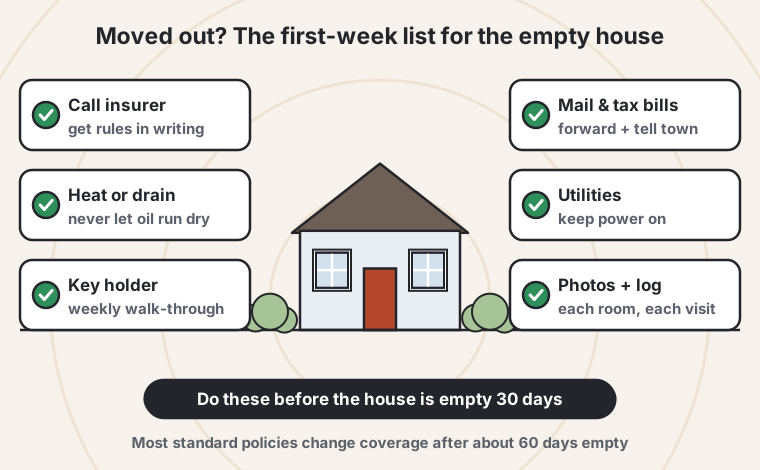
An empty house is not a paused house. It keeps costing money, getting mail and facing the weather. Treat it like a small job with a weekly routine and a deadline.
Why does a house you already left feel so heavy?
A house you already left feels heavy because you are paying for two homes and living in only one. You are also managing the old one from far away, through other people, while every call might be bad news. Most owners in this spot feel stuck, guilty about money, and a little embarrassed that the house did not sell fast.
People in your spot tell us they feel:
- Drained, because two housing payments leave every month and only one home is lived in.
- Anxious, every time it gets cold or the phone rings with a Connecticut number.
- Out of control, because they cannot see the house, the showings or the buyers.
- Second-guessing, wondering if they priced it wrong, picked the wrong agent or moved too soon.
That is normal, and fixable. This page is for you if you want a plan instead of worry. Where keeping the listing is the better choice, we say so.
What does your insurer need to know now that the house is empty?
Your insurer needs to know that the house is empty, the date you moved out, and how you will heat and check it. Many standard homeowners policies change coverage once a house has been vacant for about 60 days in a row, and freeze damage is often excluded unless heat was kept on or the water was drained. Ask for the rules in writing, and buy a vacancy endorsement or vacant-home policy if you need one.
Our relocation guide explains the usual vacancy clause in detail, so we will not repeat it here. What matters once you have already left is the paperwork that proves you did your part if something goes wrong:
- An email from your agent or insurer confirming the coverage rules and the start date of any vacancy endorsement.
- A thermostat setting your insurer accepts, written down, or a winterization receipt from a licensed plumber.
- Oil or propane delivery receipts showing the tank was kept filled.
- A short dated visit log: who walked through, what they checked, what they found.
Policies can treat “vacant” (empty) and “unoccupied” (furnished, nobody living there) differently. Read your own wording or ask your agent; do not guess.
If the pipes burst or someone breaks in after you have a buyer under contract, call your attorney the same day. The contract decides who carries the risk until closing. Your duty to disclose does not end because you moved.
Should you heat or winterize an empty Connecticut house?
You should heat an empty Connecticut house if it is still being shown, and winterize it if showings will stop for the season. Heating keeps it ready for buyers and inspectors but costs the most; with oil at $6.154 a gallon in October 2026 (EIA), a dry tank is the most common way an empty house freezes. Winterizing (water off, pipes and water heater drained) costs little to carry but must be undone for the buyer’s inspection.

| Question | Keep it heated | Drain and winterize |
|---|---|---|
| Can buyers see it any day? | Yes | Showings work, but no running water |
| Can the buyer’s inspector test plumbing and heat? | Yes | Only after a plumber re-opens it |
| Monthly cost | Highest: fuel, electricity, alarm | Lowest |
| Main risk | Fuel runs out, furnace fails, nobody notices | A missed pipe or trap freezes anyway |
| Best for | An active listing in fall and winter | A house that will not be shown until spring |
If you keep it heated, put the house on automatic oil or propane delivery, add a low-temperature and water-leak alarm that texts you and your key holder, and give the dealer your key holder’s number.
If you winterize, use a licensed plumber, keep the receipt, and tell your agent so no one turns the water on for a showing.
Which utilities, mail and security should you keep running?
You should keep electricity, heat (or a winterized system), water service and some form of monitoring running until closing, and stop only what the house does not need. Power runs the sump pump, the furnace controls, the alarm and the lights for showings. Mail should be forwarded with the Postal Service, and every bill tied to the house should go to your new address.
In practice: keep electricity, heating fuel on automatic delivery, the water and sewer account, and the internet plan your alarm or smart thermostat needs. Stop cable and streaming. Set up Postal Service forwarding, which sends first-class mail on for 12 months after a permanent change of address. Keep a paid lawn and snow service; it shapes first impressions, keeps the town happy and limits your liability.
Lights on timers, flyers cleared from the steps and a short note to the local police that the house is empty all help, and cost little.
What can a Connecticut town send you about an empty house?
A Connecticut town can send you property tax bills, a blight notice, and snow and ice reminders about an empty house, and each one keeps coming whether or not you live there. Late property tax carries 18% yearly interest (CGS 12-146). Towns with a blight ordinance must give written notice and a chance to fix it, then may charge up to $250 a day at a vacant property (CGS 7-148).
The real problem is the mail: town notices go to the address on file, often the empty house. Give the tax collector and the assessor your new mailing address in writing.
| Town notice | What it means | Connecticut rule |
|---|---|---|
| Property tax bill | Keep paying every installment until closing; the rest is settled at closing | 18% a year interest on late installments (CGS 12-146) |
| Blight notice | Overgrown lot, broken windows, junk outside, a house that looks abandoned | Written notice and a reasonable chance to fix it first; then up to $150 a day occupied, $250 a day vacant, $1,000 a day for a third violation in 12 months (1-6 units, CGS 7-148(c)(7)(H)(xv)) |
| Snow and ice on the sidewalk | In towns that adopted the rule, the owner next to the sidewalk can be liable for injuries | CGS 7-163a lets towns shift this duty to abutting owners by ordinance |
If a notice arrives, call the town office named on it, say the house is for sale, and ask what they need to close the file. A paid lawn service and a weekly visit prevent most of them.
How much does each month of an unsold empty house cost?
Each month of an unsold empty house in Connecticut costs property tax, mortgage interest, insurance, heat, electricity, lawn or snow care, checks and a repair reserve. In our Monroe example that adds up to about $2,999 in a winter month (est.), with $976 of it property tax alone. Three winter months is about $9,000 before you count the new home you are also paying for.
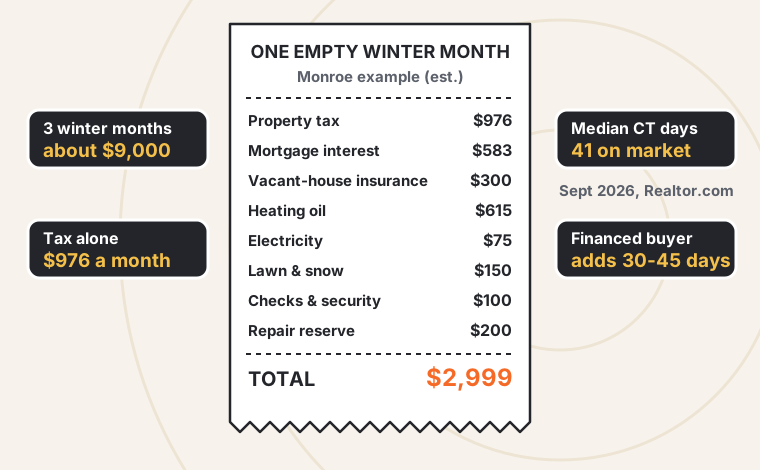
The full line-by-line worksheet, with the tax formula for any town, is in our guide to calculating the carrying costs of a vacant house. Every month the house sits is a bill, and the bill is bigger in winter.
Connecticut’s median listing spent 41 days on the market in September 2026 (Realtor.com via FRED), and a financed buyer then usually needs 30 to 45 days to close. So even a normal sale leaves the house empty for two to three months after listing.
Divide the price gain you hope for by your monthly cost. If you hope to get $10,000 more by waiting and the house costs $2,999 a month, waiting pays only if it sells within about three months. If you cannot say what you would gain, you are not waiting for a price; you are waiting for a feeling.
How much would you walk away with?
Slide the numbers to match your house. It works in your browser; nothing is saved or sent.
Estimates for planning. Conveyance tax per CGS 12-494 (state 0.75% up to $800,000, 1.25% to $2.5M, 2.25% above, plus the town rate). Seller attorney about $1,200 to $1,500; flat-fee MLS about $400; listings include three months of taxes, insurance and utilities, a cash sale about two weeks. Your attorney gives you the final numbers.
How do you manage showings and inspections from another state?
You manage showings and inspections from another state by giving your listing agent a lockbox and clear instructions, keeping a local key holder for everything else, and approving decisions by phone, email and video. Before buyers arrive, the house needs power, heat or a plan to re-open the water, working smoke and carbon monoxide detectors, and a signed property condition report your agent can hand out.
Empty houses show their flaws, so do a few things from afar:
- Ask your agent for a video walk-through after the move, and fix only what a buyer will notice in the first minute.
- Pay for one deep clean and one window cleaning; buyers smell a closed-up house.
- Leave the manuals, the oil company’s name, the last septic pump-out receipt and a list of recent repairs on the kitchen counter.
- Ask your agent to text you after every showing with the buyer’s agent’s feedback in one line.
The paperwork can all be done from where you live. Connecticut sellers give buyers the Residential Property Condition Report (CGS 20-327b); if a buyer does not get it before signing, the buyer gets a $500 credit at closing (CGS 20-327c). Our condition disclosure guide explains each question. At closing you also sign an affidavit about the smoke and carbon monoxide detectors (CGS 29-453), so make sure they are installed and working now, while you can still send someone to check.
Mail-away closings and powers of attorney are covered in the relocation guide linked above.
When should you cut the price on an empty house?
You should look hard at the price of an empty house at about three weeks on the market with showings and no offers, and make one clear cut if it passes Connecticut’s median of 41 days (September 2026) without a contract. A third of active Connecticut listings (33.4%) had already cut their price that month. One real cut usually works better than several small ones, because the house is costing you money every month it waits.
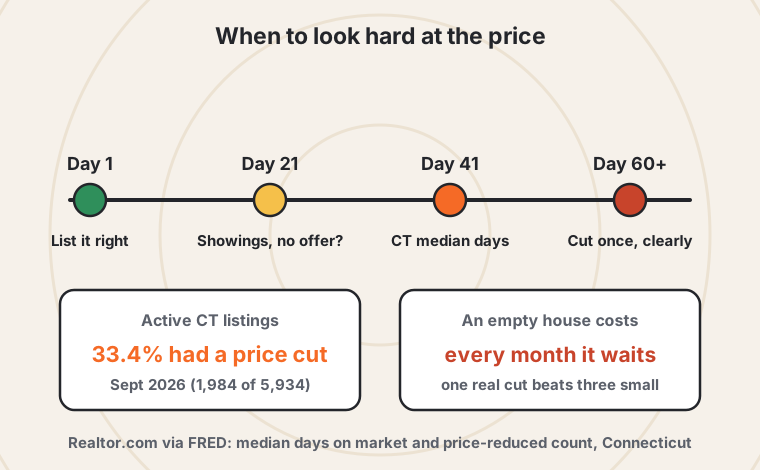
These day counts are our judgment, not a rule. What buyers do tells you more than the calendar:
| What you see | What it usually means | What to do |
|---|---|---|
| Few online views, few showings | The price or the photos are filtering buyers out | New photos first, then the price |
| Many showings, no offers | Buyers like the listing more than the house at that price | Price, or the one condition issue buyers keep mentioning |
| Offers that fall through after inspection | A condition problem the price does not reflect | Get your own quote for the repair and price it in, or offer a credit |
Season matters too. Connecticut’s median days on market was 61 in January 2026 and 28 in May 2026 (Realtor.com via FRED). A house that misses the fall market usually waits longer, empty, through the costliest months. Our guide to the best time to sell in Connecticut has the month-by-month numbers, and why a house won’t sell in Connecticut walks through every cause, one at a time.
What are your options if the empty house still will not sell?
If the empty house still will not sell, your options are a bigger price cut, fixing the one problem buyers keep naming, renting it out, a lease option, a relocation buyout if your employer offers one, a short sale if you owe more than it is worth, or a direct cash sale. Each one trades money against time and effort, so pick the one whose cost you can carry.
Cut the price and keep listing
Most moneyUsually the best net if the house is in decent shape and you can carry it a few more months.
- Needs heat, checks and showings to continue
- Agent commission and closing costs still apply
Rent it out
Monthly incomeCovers costs if the rent does, but makes you a long-distance landlord under Connecticut tenant law.
- The home-sale tax exclusion has a clock; see our relocation guide
- Selling later with a tenant inside is slower
Sell it as-is for cash
About 2 weeksLowest price, but the carrying stops fast, and you leave what you do not want.
- No repairs, showings or empty winter
- You pick the closing date
Also possible: a lease option, where the risks fall mostly on the owner, and, if you owe more than the house is worth, a lender-approved short sale (see short sale versus foreclosure).
A direct sale costs you price. Our page on why cash offers are lower explains the math, and cash buyer vs. realtor compares the net side by side. If you want a number to compare against the listing, we buy empty houses all over the state; see selling a Connecticut house after you relocate, or our page for selling a vacant house.

The owners who end up happiest with an empty house are the ones who wrote down a deadline the week they moved: “If there is no contract by the first of December, we do X.” It takes the guessing out of every phone call. Pick your X now, while you are calm, not in February with a frozen pipe.
When should you NOT sell an empty house to a cash buyer?
You should not sell an empty house to a cash buyer if it is in good condition, priced right, getting showings, and you can afford a few more months of carrying costs. In that case keeping the listing, or making one price cut, almost always leaves you more money. A cash sale earns its lower price only when time, repairs or the distance cost you more than the difference.
Keep the listing if:
- The house is updated or in good shape, and the feedback is about price, not condition.
- It is spring or early fall, when Connecticut buyers are most active.
- You have equity to protect and no deadline that forces a date.
A direct sale makes more sense when the house needs work you cannot manage from away, when winter is coming, or when two housing payments are draining savings you need. If listing will net you clearly more and you can wait, list it.
Is a cash sale right for you, or should you list?
Seven quick questions. There is no wrong answer, and we will tell you honestly if listing would leave you more.
- Does the house need repairs you would rather not pay for or manage?
- Do you need to close by a certain date, or within the next month or two?
- Would showings be hard: tenants, belongings, privacy, or you live out of state?
- Is there a complication: an estate or probate, a divorce, foreclosure, liens or back taxes?
- Could you comfortably cover the mortgage, taxes and utilities for three or more months?
- Is getting the highest possible price more important to you than speed and certainty?
- Would a buyer's bank lend on the house as it is (no major roof, foundation, oil tank or code issues)?
What are the steps to sell a house you already moved out of?
The steps to sell a house you already moved out of are: secure and insure the empty house, set a weekly check routine, review the listing at three and six weeks, pick your exit by a fixed date, and close through a Connecticut attorney by mail-away signing or power of attorney. Each step can be done from another state.
Secure it in week one
Insurer, heat or winterizing, mail, the town’s mailing address, lawn or snow service, photos.
Set the weekly routine
A key holder walks through, logs the visit, checks the thermostat, the basement and the doors, and clears the steps.
Review the listing on a schedule
At about day 21 and day 41, read the showing feedback with your agent and decide on photos, one repair or one price cut.
Pick your exit by a date
If there is no contract by your deadline, take the route you chose in advance: a bigger cut, renting, or a written cash offer to compare.
Close from where you live
Your Connecticut attorney prepares the deed and payoff; you sign before a notary and two witnesses or use a power of attorney, and the proceeds are wired to you. A direct sale usually closes in about two weeks.
See the house together.
Pick a time that works.
Choose a time for us to walk through the property with you, or ask for a quick call first. We confirm every request personally.
Tuesday, January 13
No open times in the next few weeks. Please call us.
We will confirm by email. Nothing is booked until we do.
View my requestQuestions owners ask when they moved out and the house has not sold
Is it bad to move out before your house sells?
Moving out before your house sells is not bad, but it costs money and needs a plan. An empty house often shows cleaner, yet it must be insured, heated or winterized, and checked weekly. In our Monroe example one empty winter month costs about $2,999 (est.), so set a price review and a deadline.
Does homeowners insurance cover a vacant house in Connecticut?
Homeowners insurance may not fully cover a vacant house in Connecticut. Many standard policies limit vandalism and some other coverage after about 60 days of vacancy and exclude freeze damage unless heat was kept on or the water drained. Ask your insurer in writing and add a vacancy endorsement if needed.
Should I winterize my house if it is for sale?
Winterize a house that is for sale only if it will not be shown or inspected for a while. Winterizing drains the water so pipes cannot freeze, but a plumber must re-open the system before a buyer’s inspection. An active winter listing is usually better kept heated with automatic fuel delivery.
Do I still pay property tax on a house I moved out of?
Yes, you still pay property tax on a house you moved out of, until the closing. Connecticut towns charge 18% a year interest on late installments (CGS 12-146). Give the tax collector your new mailing address in writing so bills do not sit in an empty mailbox.
Can a Connecticut town fine me for an empty house?
A Connecticut town with a blight ordinance can fine the owner of an empty house that looks neglected, after written notice and a chance to fix it. For homes with one to six units, the limit is $250 a day at a vacant property and $1,000 a day for a third violation within 12 months (CGS 7-148).
How long does a house usually take to sell in Connecticut?
Connecticut listings spent a median of 41 days on the market in September 2026 (Realtor.com via FRED), and a financed buyer then usually needs 30 to 45 days to close. In winter the median was longer: 61 days in January 2026.
When should I lower the price on my empty house?
Lower the price on an empty house when it has had showings but no offers for about three weeks, or passes the state median of 41 days without a contract. Make one clear cut rather than several small ones, because each month empty adds to your costs.
Do I need to come back to Connecticut to close?
You do not need to come back to Connecticut to close. Your Connecticut attorney can send a closing package that you sign before a notary and two witnesses where you live, or someone can sign with a power of attorney. Connecticut does not allow video notarization for real estate closings (CGS 3-95b).
Should I rent my house out instead of selling it?
Renting your house out instead of selling it makes sense if the rent covers the costs and you are ready to be a long-distance landlord. It can affect the home-sale tax exclusion if you rent too long. Our relocation guide compares renting and selling in detail.
Can I sell an empty house with furniture and junk still inside?
You can sell an empty house with furniture and leftover items inside. A listing buyer will usually want it cleared before closing, so plan a cleanout. A direct cash buyer usually lets you leave what you do not want, which saves a trip back to Connecticut.
Related Connecticut guides
Moving and relocating
We buy houses all over the state, including empty ones in Monroe; see where we buy houses in Connecticut. For every route, step and cost in one place, go back to how to sell a house in Connecticut.
Plain-English information, not legal, tax or insurance advice. Estimates are labelled (est.). Check your own policy with your insurer and your sale with a Connecticut attorney.
Sources (checked on October 27, 2026)
- CGS 7-148(c)(7)(H)(xv) and 7-163a (blight regulations and penalties, sidewalk snow and ice).
- CGS 12-146 (interest on delinquent property tax).
- CGS 12-62a (assessment at 70% of value).
- CGS 20-327b and 20-327c (residential property condition report; $500 credit).
- CGS 29-453 (smoke and carbon monoxide detector affidavit at transfer).
- CGS 3-95b (no remote notarization for real estate closings).
- Realtor.com median days on market, Connecticut (FRED MEDDAYONMARCT).
- Realtor.com price-reduced count, Connecticut (FRED PRIREDCOUCT) and active listing count (ACTLISCOUCT).
- U.S. EIA, weekly Connecticut No. 2 heating oil residential price (week of October 19, 2026).
- Connecticut OPM, mill rates (fiscal year 2027).
- USPS, Mail forwarding options (12 months for first-class mail on a permanent change).
- Connecticut Insurance Department, homeowners insurance consumer information.

Who wrote this
Jerryll Noorden
Jerryll has bought and sold Connecticut houses since 2016 and has sat at more closing tables than he can count, on both sides. Before real estate he was a robotics scientist at NASA, IHMC and IIT. He wrote this guide because the national sites that rank for it skip the Connecticut rules that cost sellers money. When listing or selling it yourself would get you more than a cash offer, he says so.
This guide explains Connecticut rules in plain English. It is not legal or tax advice. Laws change; for your sale, talk to a Connecticut real estate attorney and a tax professional.
