
Key facts at a glance
This Southington guide is part of our guide to how to sell a house in Connecticut. It answers one question: when a divorcing couple sells, what happens to the money at the closing table, and how is the split put on paper? The numbers below are Southington’s own.
| Fact | Number | Source |
|---|---|---|
| Southington residential sales, Oct 2024 to Sep 2025 | 631 | CT OPM Real Estate Sales, data.ct.gov |
| Southington median single-family sale price | $400,250 | CT OPM Real Estate Sales |
| Southington mill rate, fiscal 2027 | 23.29 mills | CT OPM mill rates |
| Property tax on a $400,250 Southington house | About $6,530 a year ($540 a month) | Mill rate × 70% assessment (CGS 12-62a) |
| Conveyance tax in Southington (seller pays) | 1.25%: 0.75% state + 0.50% town | CGS 12-494 |
| Conveyance tax on $400,250 | $5,003 | CGS 12-494 |
| Superior Court judicial district for Southington | New Britain (20 Franklin Square) | CGS 51-344; Judicial Branch directory |
Why is the money from the house the hardest part of a Southington divorce sale?
The money from the house is the hardest part of a Southington divorce sale because it is often the largest sum either spouse has ever seen in one place, and it arrives while you still do not trust each other. Sellers at this stage often feel suspicious, anxious about being shortchanged, impatient to get their share, guilty about the children’s home, and quietly afraid of what life costs on one income.
Maybe your spouse has handled the bills for years and you are not sure what the mortgage balance even is. Maybe you paid the mortgage alone since the separation and want that counted. Maybe there is a home equity line nobody mentions. These are the questions that turn a signed purchase contract into another fight.
I am Jerryll Noorden. I have bought houses across Connecticut since 2016, about ten a year, and I have sat at many closing tables where the sellers were divorcing. The money part is mechanical once you know the order things happen in. This page shows that order, on a Southington house, so nothing at the closing surprises you.
If you are selling a Southington or Plantsville house during a divorce and want to know exactly where every dollar goes, this page is for you.
How are the proceeds from a house sale split in a Connecticut divorce?
The proceeds from a house sale in a Connecticut divorce are split after the closing attorney pays off the mortgage, any home equity line and liens, the commission, the conveyance tax (1.25% in Southington) and closing costs. What is left is either divided on the spot as your written agreement says, or held in an attorney’s trust account until you agree or the court divides it under CGS 46b-81.
Connecticut does not split the house 50/50 by default; the split is part of your whole settlement under the factors in CGS 46b-81. Who gets the house, buyouts and the tax rules are covered in our main guide to selling a house during a divorce in Connecticut. This page stays on the money at closing.
In what order is the money paid out at a Connecticut closing?
At a Connecticut closing, the money is paid out in a fixed order: the buyer’s funds go to the closing attorney, who first pays the mortgage payoff and every other lien on the title, then the commission, the conveyance tax and the closing costs, then any debts your agreement says to pay from the sale, and only then disburses the net to the sellers or into escrow.
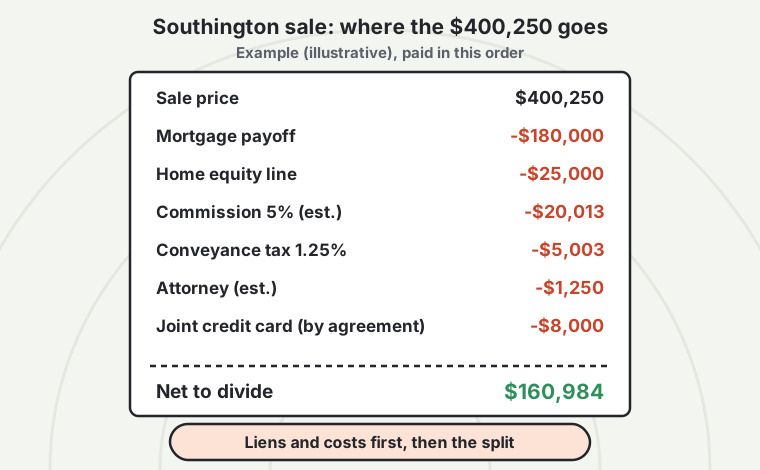
Connecticut closings are run by attorneys (CGS 51-88a). Usually the sellers share one closing attorney for the sale, and each spouse also has a divorce attorney. Here is the order on a Southington house.
Example (illustrative). A Southington raised ranch sells at the town’s single-family median of $400,250. The couple owes $180,000 on the mortgage and $25,000 on a home equity line, and agreed to pay off an $8,000 joint credit card from the sale. All debt figures are examples.
| Line on the settlement statement | Amount | Note |
|---|---|---|
| Sale price | $400,250 | Southington single-family median |
| Mortgage payoff | -$180,000 | Example; the lender’s payoff letter sets the exact figure |
| Home equity line payoff and release | -$25,000 | Example; the line must be closed, not just paid |
| Commission at 5% | -$20,013 | Estimate; negotiable |
| Conveyance tax at 1.25% | -$5,003 | 0.75% state + 0.50% Southington (CGS 12-494) |
| Seller’s attorney | -$1,250 | Estimate |
| Joint credit card, paid by agreement | -$8,000 | Only if your agreement says so |
| Net to divide | $160,984 |
Two smaller lines also appear. The property tax adjustment: Connecticut taxes are paid in arrears, so the sellers usually credit the buyer for the days of tax owed; in Southington that is about $540 a month on this house. And if the house heats with oil, the buyer usually reimburses you for oil left in the tank. Our guide to seller closing costs in Connecticut covers every line.
Mortgage and lien payoffs are not optional. The closing attorney has to deliver clear title to the buyer, so every mortgage, equity line, tax lien or judgment lien on the land records is paid from the sale before anyone sees a dollar. If the liens add up to more than the price, our guide to selling a house with a lien in Connecticut covers the options.
Can the sale money be held in escrow until the divorce is settled?
Yes, the sale money can be held in escrow until the divorce is settled. In Connecticut it is common for the net proceeds to go into an attorney’s client trust account, released only on a signed agreement of both spouses or a court order. This lets the house sell now without forcing a final decision on the split, and the automatic orders keep the money protected meanwhile.
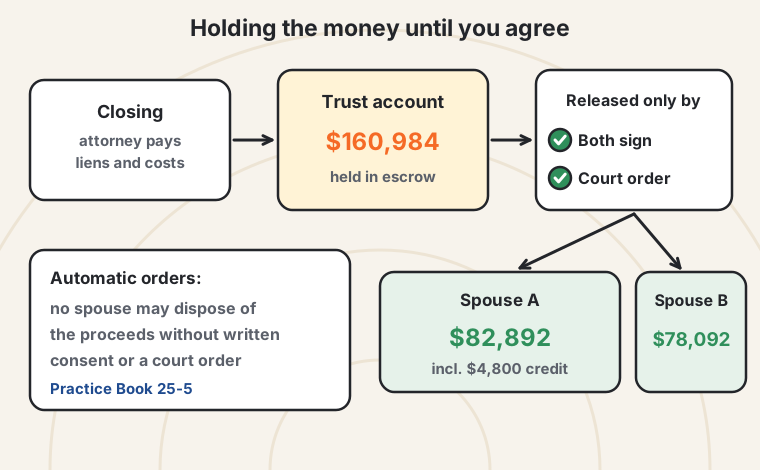
The automatic orders that apply in every Connecticut divorce (Practice Book § 25-5) say neither spouse may “sell, transfer, exchange, assign, remove, or in any way dispose of” property without the other’s written consent or a court order. The sale proceeds are still marital property. That is why many stipulations to sell say exactly where the net goes:
- Held in escrow. Into the trust account of one attorney, or jointly controlled, until a signed release by both spouses or a court order. Connecticut attorneys must keep client funds in a separate trust account (Rules of Professional Conduct 1.15).
- Partly released. A fixed sum to each spouse now (for a deposit on a rental, for example), with the rest held.
- Split at closing. If the settlement is already agreed, the closing attorney can pay each spouse their share directly, with separate checks or wires.
Ask both divorce attorneys to send the closing attorney written instructions well before the closing date. A closing attorney who receives conflicting instructions will usually hold the money until they get one set signed by both of you.
What credits and debts change each spouse’s share of the proceeds?
The credits and debts that change each spouse’s share of the proceeds are the ones your agreement or the court decides to count: mortgage payments one spouse made alone after separating, repairs one spouse paid to get the house sold, joint debts paid from the sale, money one spouse already received, and any premarital or inherited money put into the house. None of these apply automatically; each must be written down.
In our Southington example, one spouse paid the full mortgage for a year after moving out, and the couple agreed to credit $4,800 of principal paid down. The rest is split equally.
| Step | Spouse A | Spouse B |
|---|---|---|
| Net to divide | $160,984 | |
| Credit for principal A paid alone | $4,800 | $0 |
| Remaining $156,184 split equally | $78,092 | $78,092 |
| Each spouse receives | $82,892 | $78,092 |
Whether to count principal only, or the whole payment, or nothing because the spouse also lived there rent-free, is a negotiating point for your attorneys, not a rule. The same goes for a buyer’s repair credit after the inspection: decide in advance whose share it comes from. If you used the house to secure debts during the marriage, list them all before the closing so the payoff letters are ordered in time.
How is the split of the house proceeds documented in a Connecticut divorce?
The split of the house proceeds in a Connecticut divorce is documented in five papers: the signed stipulation or agreement to sell, the settlement statement from the closing, the escrow letter or disbursement instructions signed by both attorneys, the release or court order that frees escrowed money, and the final decree or separation agreement. Keep copies of all five.
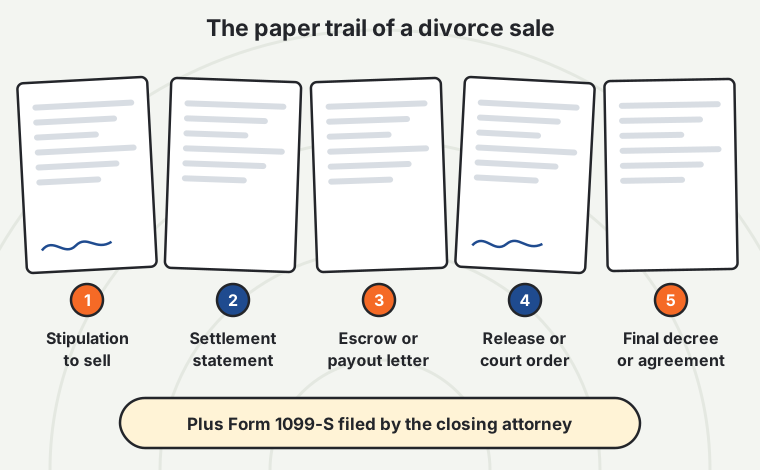
- The stipulation to sell. Price or how it is set, the agent or buyer, who pays costs meanwhile, and where the net goes. Many attorneys file it with the court for approval.
- The settlement statement. The closing attorney’s line-by-line record of the price, every payoff and cost, and the net. Both spouses should read it before signing.
- The disbursement or escrow letter. Who receives what, or which account holds it and what releases it.
- The release or court order. The signed agreement of both spouses, or the judge’s order, that frees escrowed money.
- The decree or separation agreement. The court must find the agreement “fair and equitable” before it becomes part of the decree (CGS 46b-66). It should state that the house proceeds were divided as described.
The closing attorney also reports the sale to the IRS on Form 1099-S. Ask how the gross proceeds will be shown between the two of you, because each spouse reports their own share on their tax return. The home-sale exclusion and the rules for divorcing spouses are explained in the main divorce guide linked above; get your tax adviser’s view before you pick the closing date.
How does the split change if you list the house or sell it for cash?
The split itself does not change if you list the house or sell it for cash; only the net being split changes. A listing usually brings a higher price but adds commission, months of carrying costs and repair credits. A cash sale brings a lower price with no commission, no repairs and a closing in about two weeks. Compare the two nets, then apply the same split.
In our Southington example, the listing net of $160,984 assumes the house sells at the median after the usual time on the market. Every month it does not sell costs the couple about $540 of tax plus the mortgage, insurance and utilities. If the house needs work, or every joint decision becomes a fight, a direct sale can leave you with a smaller but faster and more certain number. Run your own figures:
How much would you walk away with?
Slide the numbers to match your house. It works in your browser; nothing is saved or sent.
Estimates for planning. Conveyance tax per CGS 12-494 (state 0.75% up to $800,000, 1.25% to $2.5M, 2.25% above, plus the town rate). Seller attorney about $1,200 to $1,500; flat-fee MLS about $400; listings include three months of taxes, insurance and utilities, a cash sale about two weeks. Your attorney gives you the final numbers.
Our cash buyer vs realtor guide compares the two routes in detail. If you want a written cash number to put next to the listing net, you can request one through our divorce house sale page. We send it to both spouses.
When should you NOT sell your Southington house to a cash buyer?
You should not sell your Southington house to a cash buyer when it is in good shape, you and your spouse can cooperate through a listing, and nobody needs the money or the closing date soon. With a $400,250 median and steady demand, a well-priced Southington listing usually nets more. Also wait until both attorneys agree on where the proceeds go.
A cash sale earns its place when speed, condition or conflict is costing more than the price difference. If none of those applies, list it. And do not sign any purchase contract, with anyone, until the escrow instructions are written and both of you have agreed in writing or the court has ordered the sale. If someone urges you to sign before your attorney sees the paper, read our guide to checking a cash home buyer in Connecticut first.

Order the payoff letters early, for the mortgage and for any equity line, even one you think is at zero. An open line with a zero balance still sits on the title, and closing it takes the lender’s paperwork. It is the most common reason a divorce closing slips a week.
How do you plan the money side of a Southington divorce sale, step by step?
To plan the money side of a Southington divorce sale, list every debt on the house, order payoff letters, agree in writing which joint debts the sale pays, agree on credits, decide escrow or split at closing, send one set of instructions to the closing attorney, read the settlement statement before you sign, and keep every document.
List every lien
Mortgage, equity line, tax or judgment liens. Your attorney can order a title search.
Order payoff letters
From each lender, dated for the expected closing.
Agree on joint debts and credits
Which debts the sale pays and which credits each spouse gets, in writing.
Choose escrow or split
Hold the net until settlement, or pay each share at closing.
Send one set of instructions
Signed by both attorneys to the closing attorney, a week or more before closing.
Read the settlement statement
Check every line against your agreement before you sign the deed.
Questions about splitting house proceeds in a Southington divorce
How are house sale proceeds split in a Connecticut divorce?
House sale proceeds in a Connecticut divorce are split after the mortgage, liens, commission, conveyance tax and closing costs are paid, according to your written agreement or the court’s orders under CGS 46b-81. Connecticut uses equitable distribution, so the split is not automatically 50/50.
Who holds the money from a house sale during a divorce in Connecticut?
The money from a house sale during a Connecticut divorce is usually held in an attorney’s client trust account until both spouses sign a release or the court orders the split, unless the agreement says to pay each share at closing.
Can my spouse take all the money from our house sale?
No. During the case, the automatic orders bar either spouse from disposing of property, including sale proceeds, without written consent or a court order (Practice Book § 25-5). The closing attorney pays out only as the agreement or the court directs.
What is the conveyance tax on a Southington house sale?
The conveyance tax on a Southington house sale is 1.25% of the price: 0.75% to the state and 0.50% to Southington, about $5,003 on the $400,250 median (CGS 12-494). A deed between spouses is exempt; a sale to an outside buyer is not.
Do I get credit for paying the mortgage after we separated?
You get credit for paying the mortgage after separating only if your agreement or the court gives it. Many couples credit the principal paid down; others offset it against living in the house. Keep records of every payment and raise it with your attorney before closing.
Can joint credit card debt be paid from the house sale?
Yes, joint credit card debt can be paid from the house sale if both spouses agree in writing or the court orders it. The closing attorney then pays it from the proceeds before the net is divided.
Which court decides a Southington divorce?
A Southington divorce is decided by the Superior Court for the Judicial District of New Britain, at 20 Franklin Square in New Britain (CGS 51-344). Plantsville is a village of Southington and is in the same district.
Who gets the Form 1099-S after a divorce sale?
The closing attorney files Form 1099-S with the IRS to report the sale. Ask how the gross proceeds will be allocated between the two of you, since each spouse reports their own share of any gain.
What if we can’t agree on the split before closing?
If you can’t agree on the split before closing, sell anyway and put the net in escrow, released only by a signed agreement of both spouses or a court order. The house stops costing you money while the attorneys finish the settlement.
Is this page legal or tax advice?
No. This page is plain-English information about Connecticut closings and Southington numbers, not legal or tax advice. Your divorce attorney and tax adviser should review your own agreement.
Related guides
Divorce and the house
The closing
Near Southington
If a direct offer would help you compare, our Southington page is where to ask for one, and our divorce sale page explains how we handle both spouses. For every step from first decision to closing, see how to sell a house in Connecticut.
Plain-English information, not legal or tax advice. We need both spouses’ signatures or a court order to buy a house during a divorce. The Southington example uses public data and labelled estimates.
Sources (checked on October 27, 2026)
- CGS §§ 46b-66 and 46b-81 (agreements must be fair and equitable; division of property and sale orders).
- Connecticut Judicial Branch, JD-FM-158 Notice of Automatic Court Orders (Practice Book § 25-5).
- Connecticut Practice Book, including the Rules of Professional Conduct (Rule 1.15, safekeeping client funds).
- CGS § 12-494 (conveyance tax; Southington municipal rate 0.50%).
- CGS § 51-88a (attorneys conduct real estate closings).
- CGS § 51-344, 2026 supplement (Southington in the New Britain judicial district).
- Connecticut OPM, Real Estate Sales (data.ct.gov dataset 5mzw-sjtu): Southington sales recorded October 2024 to September 2025.
- Connecticut OPM mill rates (Southington, fiscal 2027: 23.29).
- IRS, Instructions for Form 1099-S.

Who wrote this
Jerryll Noorden
Jerryll has bought and sold Connecticut houses since 2016 and has sat at more closing tables than he can count, on both sides. Before real estate he was a robotics scientist at NASA, IHMC and IIT. He wrote this guide because the national sites that rank for it skip the Connecticut rules that cost sellers money. When listing or selling it yourself would get you more than a cash offer, he says so.
This guide explains Connecticut rules in plain English. It is not legal or tax advice. Laws change; for your sale, talk to a Connecticut real estate attorney and a tax professional.
