
Connecticut seller’s guide · Facts checked October 26, 2026
What Is Real Estate Wholesaling? The Complete Guide for Homeowners
How wholesaling works, who pays the fee, the honest benefits and risks, the red flags, how to back out, and what the law says in all 21 states that regulate it, written for the homeowner, not the investor.

Real estate wholesaling is when an investor signs a contract to buy your house and then assigns that contract to another buyer, who closes with you at the same price and pays the wholesaler a fee. It is legal, and done honestly it can mean a fast, as-is sale. But at least 21 states now regulate it, with licenses, written disclosures, cancellation rights and bans on clouding your title, because too many sellers were never told the buyer wasn’t really buying.
- Wholesaling means an investor puts your house under contract and then assigns that contract to another investor, who closes with you and pays the wholesaler a fee for bringing the deal.
- Wholesaling is a tool, not a scam. Like any tool, it depends on whose hands it is in. A lot of “we buy houses” companies are wholesalers, and the ones who hide it are why at least 21 states now regulate the practice.
- It exists because not every house fits every investor. A good wholesaler doesn’t tell you “no, we won’t buy it”. They find you a vetted buyer who will.
- What you get: speed, no repairs, no commission, no showings, and one person handling it start to finish.
- What it costs you: an investor price, below what a fixed-up house would sell for on the open market. Some operators also cut corners: they lock up houses they can’t sell, or hide that they are not the buyer.
- Your rights depend on your state. Depending on where you live, they can include a written disclosure, a right to cancel, a licensed or registered wholesaler, and limits on what can be recorded against your title. Connecticut has had registration, a disclosure report, a three-business-day cancellation right and a 90-day closing limit since July 1, 2026.
- If your house is updated and you have time, listing with an agent will usually net you more. This guide tells you when.
What is real estate wholesaling, in plain English?
Real estate wholesaling is when an investor signs a contract to buy your house and then, instead of buying it themselves, assigns that contract to another investor who buys it from you on the same terms. The first investor, the wholesaler, earns a fee from the second investor for finding the house and putting the deal together.
Think of it as matchmaking with a contract attached. You agree on a price with one person. Someone else brings the money to the closing table. Your price, your closing date and your terms stay the same. The only thing that changes is whose name ends up on the deed.
If you have ever had a “we buy houses” company call you, there is a good chance some of them were wholesalers. Many say so up front, and some don’t. That second group is a big reason at least 21 states have passed laws about wholesaling since 2017, and the reason this page exists. You deserve to know exactly how this works before you sign anything, with us or anyone else.
This guide is part of our series on how to sell a house in Connecticut. If you are weighing a cash sale against a listing in general, start with cash buyer vs. realtor in Connecticut.
Is wholesaling bad, or is it just a tool?
Wholesaling is not bad in itself. It is a tool, and like any tool it can help or harm depending on who uses it and how. Done honestly, it gets homeowners a fast, as-is sale to a buyer they could never have found alone. Done dishonestly, it ties up a house with a contract that was never meant to close.
Think about what the strategy actually does. A homeowner needs to sell. An investor finds them, agrees on a price, and brings in a buyer who wants exactly that kind of house. The homeowner gets the agreed price, the buyer gets a property that fits, and the person in the middle is paid for bringing them together. Nothing in that is a trick. Real estate agents, mortgage brokers and business brokers all get paid for matching people.
The problems come from how some people do it: hiding that they aren’t the buyer, signing contracts they have no way to close, making a price they plan to cut later, or pressuring people who are grieving, behind on payments or elderly. That behavior is what the new state laws target, not the idea of matching a seller with a buyer.

A gun isn’t evil. In the right hands it protects people; in the wrong hands it hurts them. Wholesaling is the same. The strategy itself does a lot of good for sellers, as long as they understand what it is, what can go wrong and what to expect. That’s what this guide is for.
Are many “we buy houses” companies actually wholesalers?
Yes. A lot of companies that advertise “we buy houses” are wholesalers: they put homes under contract and assign the contract to another investor instead of buying it themselves. That is legal when it is disclosed. The problem is the ones who never intend to buy and don’t say so, which is why more and more states now require wholesalers to disclose, register or be licensed.
You usually can’t tell from the ad, the yard sign or the postcard. The same words, “cash offer”, “close fast”, “any condition”, are used by companies that buy with their own money and by people who don’t have the money at all. The difference only shows in the contract and in the answers to a few direct questions (see how to check).
That isn’t a reason to avoid every cash buyer. It’s a reason to ask, every time: “Are you buying my house, or are you assigning the contract?” An honest buyer or an honest wholesaler answers that in one sentence.
How do investors buy so many houses?
Investors buy so many houses because they don’t rely on one way of paying for them. They buy with their own cash, with other people’s money, with creative financing like seller financing, with novation agreements, and through wholesaling. Each method fits a different house and a different seller, which is why one investor can say yes to far more homeowners than a single cash budget would allow.
Ever wonder how the same investor can buy a house in Hartford this week, another in Norwich next week and a third in Waterbury the week after? Most homeowners picture one person with a giant bank account. It rarely works that way. Here are the five main tools, and what each one means for you as the seller:
Their own cash
The simplest one. The investor buys your house with money they already have, fixes it and sells or rents it. For you, this is the cleanest deal: one buyer, one closing, no lender. The limit is that every investor’s cash runs out eventually, and each one buys only certain kinds of houses.
Other people’s money
Private lenders and hard-money lenders fund the purchase, and the investor pays them back when the house sells or refinances. You still get a cash closing, because the lender wires the money to the closing attorney. It just isn’t the investor’s own money. That is normal. What matters is that the funds are real and committed in writing before you sign.
Creative financing
Instead of paying you everything at closing, the investor pays you over time (seller financing), or takes over your existing mortgage payments (“subject to” the loan). Some lease the house with an option to buy it later (a lease option, or rent-to-own). These can get you a higher price, but you take on more risk and you wait for your money. Never do one without your own Connecticut attorney. Read is owner financing a good idea for the seller in Connecticut first.
Novation
The investor agrees with you to fix up and sell the house on the open market, and you split the result in a way you agree on in writing. It can net you more than a straight cash offer on a house that just needs cosmetic work. It also takes months, the outcome depends on the market, and it involves listing the house. Ask who holds the money for repairs and what happens if the house doesn’t sell. See how a novation works, step by step.
Wholesaling
The investor puts your house under contract and assigns the contract to another investor from their buyer network, who closes with you. This is how an investor can help a homeowner even when the house is not one they would buy themselves. The rest of this guide is about this method.
Honest investors use all five, and they tell you which one they are offering. Trouble starts when someone offers one thing and does another: they call it a “cash offer” but plan to assign it, or they say “we’re the buyer” when they don’t have the money.
Why would an investor wholesale your house instead of buying it?
An investor wholesales your house when it doesn’t fit what they buy themselves, but it does fit someone in their buyer network. Instead of turning you away, they put the house under contract and pass it to a vetted buyer who wants exactly that kind of property. You still get a firm offer, a closing date and someone to manage the sale.
Every investor has a “box”. One flips three-bedroom capes in central Connecticut and won’t touch a multi-family. Another only buys rentals in New Haven County. A third only takes on houses that need a full gut job, because that’s what their crew does. A fourth wants anything near the shoreline and nothing else.
So when a homeowner calls about a two-family in Bridgeport with tenants, a house with a crumbling foundation in Tolland County, or a ranch that needs $90,000 of work, an investor whose box doesn’t include that house has two choices:
- Say no. The homeowner goes back to square one, often with a deadline still ticking: a Law Day, a probate court, a move, tenants who stopped paying.
- Say “we can still help”. “This one isn’t for us, but we work with cash buyers who buy exactly this kind of house. Let us put it under contract and bring you one of them.”
The second answer is wholesaling done right. You don’t have to find a buyer, check whether they are real, or hope they show up at closing. The wholesaler already knows the buyers on their list: who has the money, who closes, and who walks away at the last minute.
I started in Connecticut real estate in 2016 as a wholesaler, so I have seen this business from the inside. Done right, it is a service: a homeowner who needs to sell gets a real buyer quickly, and nobody gets surprised at closing. Done wrong, it is someone tying up your house with a contract they can’t close. Everything below is what I’d want my own family to know before they signed with anyone, me included.
How does wholesaling work, step by step?
Wholesaling works in six steps. You get an offer. You sign a purchase contract that allows assignment, with a disclosure in states that require one. The wholesaler matches the contract with an end buyer, who signs an assignment and puts down a deposit. An attorney or title company then closes the sale, and you get the contract price.
Here is what that looks like for you, the homeowner. Connecticut’s rules are shown as an example:
You ask for an offer
You call, fill in a form, or send photos. The investor looks at the house, the repairs, the neighborhood and what similar houses sold for. A good one asks about your situation and your deadline first, because that decides which route fits.
You get a written offer, and you’re told whether they will buy it or assign it
This is the moment honesty matters most. An honest wholesaler tells you plainly: “We will be assigning this contract to one of our buyers.” A growing number of states require this in writing. In Connecticut, for example, the wholesaler must hand you the state’s disclosure report before you sign (CGS 20-329eee).
You sign a purchase contract that allows assignment
The contract names a price and a closing date, and usually says the buyer is “We Buy Houses In Connecticut and/or assigns”. Some states give you a right to cancel. In Connecticut it is three business days, for any reason (CGS 20-329ccc), and the closing date can be no more than 90 days out. See the state laws for yours.
The wholesaler matches your house with an end buyer
They send the deal to investors on their list who buy that kind of house. Some buyers walk through. The contract should spell out how many visits and how much notice you get. The wholesaler must tell the end buyer in writing that they are a wholesaler who does not hold title, and pass on your condition report (CGS 20-329ccc(c)).
The end buyer signs an assignment and puts down a deposit
The end buyer steps into the contract on the same terms you signed. Your price does not change. The end buyer usually puts down their own deposit, and agrees to pay the wholesaler’s fee at closing.
An attorney or title company closes the sale
Depending on your state, a closing attorney or a title or escrow company pays off your mortgage and any liens, collects any transfer tax, records the deed to the end buyer and sends you your money. In Connecticut, closings are handled by attorneys. The assignment fee usually appears on the closing paperwork, so you can see it.
What is an assignment fee, and who pays it?
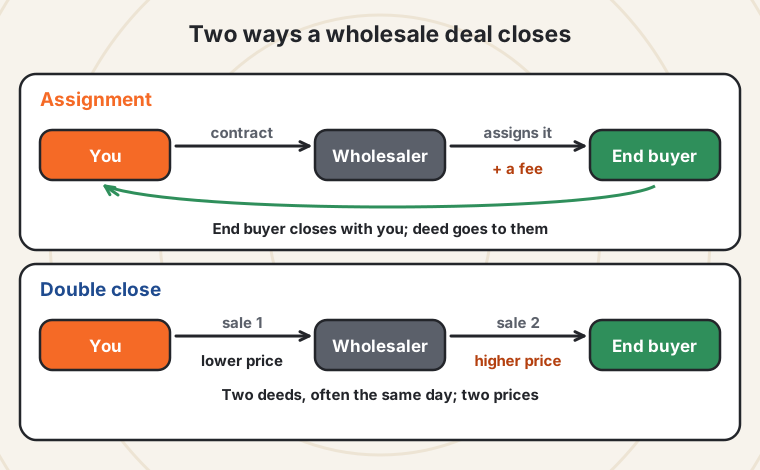
An assignment fee is what the end buyer pays the wholesaler for the right to step into your purchase contract. The end buyer pays it on top of your contract price, usually at closing, so it is not deducted from the price you signed for. Fees vary from deal to deal and should show on the closing paperwork.
Here is a simple way to picture it. You sign a contract to sell your house for $200,000. The wholesaler finds an investor who agrees to take over that contract and pay a $15,000 finder’s fee for the deal. At closing:
- You receive $200,000, less your normal Connecticut seller costs (mortgage payoff, conveyance tax, your attorney).
- The end buyer pays $200,000 to you plus $15,000 to the wholesaler.
- The wholesaler gets paid only if the deal actually closes. A good wholesaler is therefore just as motivated as you are to get it done.
Illustration only, not a typical or promised fee.
Now the honest part, because you will think of it anyway: “If the end buyer was willing to spend $215,000 in total, could I have gotten $215,000?” Maybe some of it. To get it, though, you would have to find that investor yourself, check that their money is real, negotiate with them, and carry the risk that they back out. The fee pays for the network, the vetting, the matchmaking and the hand-holding until closing. Plenty of homeowners decide that’s worth it. Some don’t, and they should list, or call several direct buyers. What you should never accept is a fee that’s hidden from you.
What is a double close?
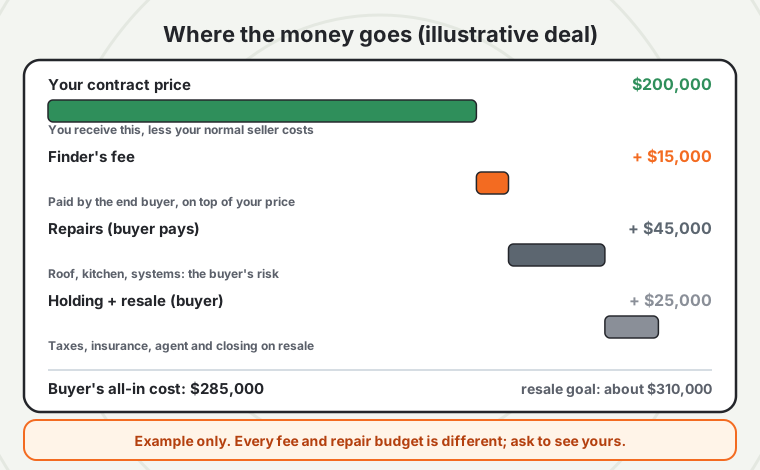
A double close is when the wholesaler actually buys your house and resells it to the end buyer, usually the same day, using two separate closings. You sell to the wholesaler at your contract price, and the wholesaler sells to the end buyer at a higher price. You don’t see the second price, and the wholesaler’s profit doesn’t show on your paperwork.
Some wholesalers prefer a double close because it keeps their buyer and their margin private. For you, the result can look the same: you get your contract price on your closing day. But there are differences worth knowing:
- Two sets of closing costs. Each closing has its own attorney work and conveyance tax. The end buyer usually absorbs these, but they shrink the room in the deal.
- Funding. The wholesaler needs money to close the first purchase, even for a few hours. Some use short-term “transactional” funding. Ask how they will fund it.
- Less transparency. With an assignment, you can see the fee. With a double close, you see only your own price.
- The law may treat it differently. Connecticut’s wholesaler law covers people who sell your house “without assuming title”. A wholesaler who briefly takes title may argue the law doesn’t apply to them. If someone offers you a double close, ask your attorney how your contract protects you.
What are the benefits of selling your house through a wholesaler?
The benefits of selling your house through a wholesaler are speed, selling as-is, no agent commission, no showings to the public, and one contact who manages the sale. You also get access to a network of cash buyers you could not reach on your own. For a house that needs work, is tenant-occupied or has a deadline attached, that can matter more than squeezing out the top price.
- Speed. A wholesaler with a real buyer list can often line up a buyer within days. Closing then depends on the attorneys, the title search and any payoffs. A listing typically takes months from first showing to closing.
- As-is. No repairs, no cleaning, no painting. Investors expect to do the work. Take what you want and leave the rest.
- No commission. You don’t pay an agent’s commission. The wholesaler’s fee is paid by the end buyer. You still pay the normal Connecticut seller costs, such as the conveyance tax and your attorney.
- Privacy. No sign in the yard, no listing photos online, no open houses. Investors on the wholesaler’s list may walk through, but the public doesn’t.
- A buyer you would never have found. The end buyer may be a landlord who buys only multi-families in Waterbury, or a contractor who loves foundation jobs. They don’t browse listings, and they won’t knock on your door. A wholesaler brings them to you.
- Certainty, when the wholesaler is good. Cash buyers don’t need a bank appraisal or a mortgage approval, so the usual reasons a listed sale falls apart mostly disappear. That certainty depends on the wholesaler matching you with buyers who really close, which is why vetting them matters (see below).
- Someone in your corner. A good wholesaler stays with you from contract to closing. They coordinate the attorneys, the walkthroughs, the payoff letters and the date. You talk to one person, not five.
What are the disadvantages of selling to a wholesaler?
The disadvantages of selling to a wholesaler are a price below full retail value, a fee that is part of what the end buyer was willing to spend, and the risk that a careless or dishonest wholesaler ties up your house with a contract they can’t close. Connecticut’s 2026 law limits that risk, but it doesn’t remove it. You still have to check who you’re dealing with.
I won’t pretend these don’t exist. Here they are, straight:
1. You’ll get an investor price, not a retail price
Any cash investor, whether they buy directly or through a wholesaler, pays less than a fixed-up house would bring on the open market. They are taking on the repairs, the holding costs, the resale costs and the risk. If your house is updated and you can wait a few months, listing will usually get you more money. That’s simply true.
2. The fee is money in the deal
The end buyer pays the fee, not you, and it doesn’t come out of your contract price. But it is part of what the end buyer decided they could pay for your house. On a house where buyers are lining up, you may be able to capture more of that by negotiating directly. On a hard-to-sell house, the network is often what gets it sold at all.
3. Some wholesalers can’t close
This is the big one. A wholesaler with no real buyers can sign your contract, shop it around, find no takers, and then either walk away or come back weeks later asking for a lower price. Meanwhile you have lost time you may not have had. Connecticut now caps this at 90 days, after which the contract ends automatically. But 90 days can still be the difference between selling and a Law Day passing.
4. Some aren’t honest about what they are
The national industry has a real reputation problem. Common complaints include people who say “we are the buyer” when they are not, a hidden “and/or assigns” in the contract, offers designed to be renegotiated after the inspection, and pressure to sign on the spot. Complaints like these are why Connecticut’s lawmakers made registration and the disclosure report mandatory.
- They say they are the buyer, but the contract says “and/or assigns” or lets them assign without telling you.
- They can’t or won’t show proof of funds for the buyer who will close.
- The earnest money deposit is tiny, or the buyer holds it instead of an attorney.
- There is a long “inspection period” during which they can walk away for any reason, and a closing date far in the future.
- They pressure you to sign today, or tell you the offer expires in hours.
- They want to record the contract or a “memorandum” on the land records. That is now illegal in Connecticut (CGS 20-329fff).
- They ask you for any upfront fee or “application” charge.
- They won’t give you a DCP registration number, or the disclosure report, before you sign.
- The price drops after “their contractor took a look”, once you have already turned other buyers away.
Why are states cracking down on wholesaling?
States are cracking down on wholesaling because of a pattern of complaints: buyers who never intended to buy, sellers who didn’t know their contract could be sold, contracts that let the buyer walk away at no cost, and documents recorded on homeowners’ titles that blocked later sales. The new laws mostly require disclosure, registration or licensing, and give sellers ways to cancel. None of them bans the strategy itself.
Regulators have been unusually consistent about what goes wrong. Here is what they have said in their own testimony and announcements:
- Kansas (2024). The state Real Estate Commission told legislators that a wholesaler “often has no intention of purchasing” and will back out if no buyer turns up, and that “often none of this is made known to the seller”. It also said contracts are structured so the wholesaler puts down little or no earnest money.
- Oklahoma (2021) and Arizona (2022). Both real estate regulators reported numerous calls and complaints about misleading tactics, predatory contracts and clouded titles before their states passed wholesaling laws.
- Philadelphia (2020). After neighborhood groups described aggressive “we buy houses” solicitation, the city began licensing residential property wholesalers and created a do-not-solicit list for homeowners.
- Connecticut (2026). The Department of Consumer Protection warned that sellers often may not know they are dealing with a wholesaler, and that this can cost them time or money.
Enforcement has followed. In 2026, the Kansas Attorney General sued a “we buy houses” wholesaling company, alleging unlicensed brokerage, mailers designed to look like personal checks, offers cut after sellers responded, and “affidavits of equitable interest” recorded against homeowners’ titles. Those are allegations, not findings. Elsewhere, several attorneys general have pursued related schemes: equity stripping aimed at owners facing foreclosure, and companies that recorded memorandums against homeowners’ titles.
The pattern behind every one of these is the same: hidden intent, hidden fees and paperwork the seller didn’t understand. The fix the states chose was sunlight (disclosure, registration, a chance to cancel), not prohibition. That is the right fix, and it is the standard every honest wholesaler should meet whether or not their state requires it.
Can a wholesaler put a lien or a memorandum on your house?
A wholesaler can sometimes record a “memorandum of contract” or an “affidavit of equitable interest” in your town or county land records, which tells the world your house is under contract. It isn’t a mortgage, but it can cloud your title and stop you from selling to anyone else until it is released. Some states now ban or limit these filings for wholesale contracts. Connecticut bans them and strips them of legal effect.
This is the single most damaging thing that can happen in a bad wholesale deal, and almost nobody warns sellers about it. Here’s how it usually goes. You sign a contract. The wholesaler records a short notice of it. The deal falls apart, or you cancel. Months or years later, you try to sell or refinance, and your buyer’s title search finds the notice. Until it’s released, your sale is stuck. News reports have described homeowners who were asked to pay thousands of dollars to have such a notice removed.
What the law says depends on where you are:
- Connecticut bans recording a wholesale contract, a notice of it or a purchaser’s lien. Anything recorded anyway gives no legal notice, and you can clear it by recording an affidavit of facts (CGS 20-329fff).
- Texas, since September 1, 2025, requires anyone who records a one-sided memorandum of contract (one the owner didn’t sign) on a home to mail the owner notice. The owner can record an affidavit that works as a release unless the filer contests it within 45 days (Tex. Prop. Code § 12.020).
- Elsewhere, your general state law applies. A recorded document without a valid basis can often be removed with a written release from the person who filed it or, if they refuse, through a court action to clear title (quiet title). Some states also allow damages for “slander of title”.
How to protect yourself before you sign:
- Add a clause: “Buyer shall not record this agreement or any memorandum, affidavit or notice of it.” More in how to remove a memorandum of contract.
- Ask: “Will you record anything against my property?” The only acceptable answer is no.
- If you cancel, ask for a signed release anyway, and check your land records a few weeks later.
Is wholesaling legal? What the state laws say
Wholesaling is legal in every state we have checked, but at least 21 states now have rules written specifically for it. Some require a real estate license or a state registration. Others require a written disclosure that the buyer may assign the contract, and many give the seller a right to cancel, especially when the disclosure is missing. No state we found bans the strategy outright.
The rules fall into four groups. A state can belong to more than one:
- License or registration required. Delaware, Illinois, Iowa, Kentucky, Nebraska, North Dakota, Oklahoma, Pennsylvania and Virginia treat wholesaling, or marketing a contract, as work that needs a real estate license (in Iowa, a license or broker representation). Connecticut and Oregon run separate wholesaler registrations.
- Written disclosure to you. Alabama, Arizona, Connecticut, Delaware, Iowa, Louisiana, Maryland, Missouri, North Dakota, Ohio, Oklahoma, Oregon, Pennsylvania, Tennessee, Texas and Wisconsin require the wholesaler to tell you in writing what they are doing.
- A right to cancel. Connecticut (3 business days), Oklahoma (2 business days), Louisiana (at least 5 days), Delaware (21 days) and Pennsylvania (30 days) let you cancel for any reason. Several other states let you cancel before closing if the required disclosure wasn’t given.
- Limits on clouding your title. Connecticut, Louisiana and Oklahoma bar wholesalers from recording liens or clouding title. Texas regulates one-sided memorandums of contract on all residential property.
| State | What the law requires | Your cancel right | Law |
|---|---|---|---|
| Alabama | Single-family homes. Written notice to you before the wholesaler markets your contract, and at least 3 business days before it is assigned. Penalties include 3x the fee. | — | Ala. Code §§ 8-42-1 to -3 |
| Arizona | Written disclosure, before you sign, that the buyer is a wholesale buyer. | Before closing, if not disclosed. You keep the earnest money. | A.R.S. § 44-5101 |
| Connecticut | State registration with DCP, a state disclosure report before signing, closing within 90 days, and no recorded liens. Violations are unfair trade practices. | 3 business days, any reason | CGS §§ 20-329aaa to hhh |
| Delaware | Contract must say it is a wholesale transaction and explain your rights. A license requirement phases in (signed June 2026). | 21 days, or any time before conveyance if disclosures are missing | SB 201 (2026) |
| Illinois | Dealing in contracts, including assignable contracts, 2 or more times in 12 months requires a broker license. | — | 225 ILCS 454/1-10 |
| Iowa | License or broker representation. Written disclosure to all parties that the wholesaler holds only an equitable interest and may not be able to convey title. | Before closing, if not disclosed. You keep the earnest money. | Iowa Code § 543B.6A |
| Kentucky | Only licensees may advertise an equitable interest in a purchase contract for sale. | — | KRS 324.010 (2023 HB 62) |
| Louisiana | Written disclosure before signing, a deposit of at least 1% held in escrow, no clouding title, and no posing as your representative. Effective Aug 1, 2026. | At least 5 calendar days, any reason | Act 807 (2026) |
| Maryland | Owner-occupied homes. Written notice before the contract that the buyer may assign it. | Before closing, if not disclosed and then assigned | Real Prop. § 10-715 (2025) |
| Missouri | Signed disclosure at least 14 days before the contract. Effective Aug 28, 2026. | Before closing, if not disclosed | SB 973 (2026) |
| Nebraska | Publicly marketing an equitable interest requires a license, and owners must sign an assignable-contract addendum. | — | Neb. Rev. Stat. § 81-885.02 |
| North Dakota | License to publicly market an equitable interest. Written disclosure that the wholesaler may not be able to convey title and intends to profit. | Before closing, if not disclosed | N.D.C.C. § 43-23-24 |
| Ohio | Separate signed disclosure before the contract. Applies to assignments and novations. Effective Mar 2, 2026. | Before closing, if not disclosed. The earnest money goes to you. | R.C. 5301.95 |
| Oklahoma | License to publicly market an equitable interest. Written disclosure of the intent to resell for more, a required notice beside your signature, no clouding title, and in-state escrow. | 2 business days, any reason | 59 O.S. § 858-301 and SB 1075 (2025) |
| Oregon | Registration as a residential property wholesaler (or a license), with written disclosure to sellers, buyers and in ads. | Any time, if not disclosed. You keep the earnest money. | Or. Laws 2024, ch. 3 |
| Pennsylvania | Real estate license required. The contract must say it is a wholesale transaction and explain your rights. | 30 days, or any time before conveyance if disclosures are missing | Act 52 of 2024 |
| South Carolina | Licensed agents may not engage in or assist wholesaling (marketing a property before taking title). Assigning a contract is excluded from the definition. | — | S.C. Code § 40-57-350 (2024) |
| Tennessee | Written notice to you of the intent to market, and of the assignment date at least 3 business days ahead, in bold, large print. | — | Pub. Ch. 72 (2025) |
| Texas | Written disclosure of the equitable interest to you and to buyers. Without it, it is unlicensed brokerage. Separate rules cover one-sided memorandums. | — | Tex. Occ. Code § 1101.0045 |
| Virginia | Dealing in contracts, including assignable contracts, 2 or more times in 12 months requires a broker license. | — | Va. Code § 54.1-2100 |
| Wisconsin | Written notice, no later than signing, that the buyer is a wholesaler. | Before closing, if not disclosed. You keep the deposits. | Wis. Stat. § 710.13 |
In other states, including Florida, New York, New Jersey, Georgia and North Carolina, we found no law written specifically for wholesaling as of October 2026, though bills are pending in several. That doesn’t mean anything goes. General real estate licensing, consumer protection and contract law still apply. North Carolina’s Real Estate Commission, for example, has warned that marketing yourself to sellers as a cash buyer while really planning to find an end buyer can be unlicensed brokerage. Georgia requires unsolicited offers to buy a home to carry a notice that the offer may or may not be fair market value.
Some cities add their own rules. Philadelphia licenses residential property wholesalers and keeps a do-not-solicit list for homeowners.
Can you back out of a contract with a wholesaler?
You can often back out of a contract with a wholesaler, depending on your state and your contract. Several states give you a set number of days to cancel for any reason, and many let you cancel before closing if the wholesaler didn’t give you the required written disclosure. Outside those rules, your contract’s own terms decide, so read the cancellation and inspection clauses before you sign.
- A no-reason cooling-off period: Connecticut 3 business days, Oklahoma 2 business days, Louisiana at least 5 days, Delaware 21 days, Pennsylvania 30 days.
- Cancel if they didn’t disclose: Arizona, Iowa, Maryland, Missouri, North Dakota, Ohio, Oregon and Wisconsin, generally until closing. Several of them let you keep the earnest money.
- Everywhere else: look for the buyer’s inspection or due-diligence period. If the buyer can walk away for any reason during it, ask for the same right, or a short period, for yourself.
And the other way around: can a wholesaler back out? Often yes, which is the real risk for you. Many wholesale contracts include a long inspection period that lets the buyer cancel for any reason and get their deposit back. If no end buyer turns up, that’s usually how the deal ends. Ask for a short inspection period, a meaningful deposit held by an attorney or escrow agent, and a firm closing date.
What happens if the wholesaler can’t find a buyer? Usually the contract is cancelled under its inspection clause, or it simply expires on its closing date. In Connecticut it ends automatically 90 days after signing unless you both agree in writing to extend it. Make sure nothing was recorded against your title (see liens and memorandums).
Is wholesaling legal in Connecticut, and what does the law require?
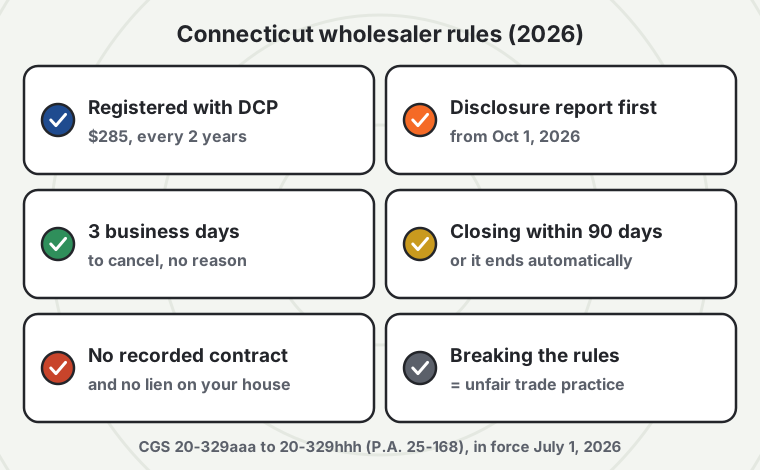
Wholesaling is legal in Connecticut, but since July 1, 2026, it is regulated. Every wholesaler must be registered with the Department of Consumer Protection. They must give you the state’s disclosure report before you sign, let you cancel within three business days, and close within 90 days unless you agree in writing to extend. Breaking these rules is an unfair trade practice.
The rules come from Public Act 25-168, now Connecticut General Statutes sections 20-329aaa to 20-329hhh. Here is what each one means for you:
| Rule | What it means for you | Statute |
|---|---|---|
| Registration with DCP | No one may act as a wholesaler in Connecticut without a Department of Consumer Protection registration ($285, valid up to two years). DCP says there are no exceptions, and real estate agents who wholesale need it too. | CGS 20-329bbb |
| Written disclosure report | Since October 1, 2026, the wholesaler must give you the state’s disclosure report before you sign. It tells you, in plain words, that they may not be the buyer and may profit from an assignment fee. You both sign it. | CGS 20-329eee |
| Three business days to cancel | Every wholesale contract must let you review it with an attorney and cancel within three business days, for any reason, with no penalty, other than returning any deposit they paid you. | CGS 20-329ccc(a) |
| 90-day closing limit | The closing date can’t be more than 90 days after everyone signs. Extensions must be in writing and signed by all parties. Otherwise the contract ends automatically. | CGS 20-329ccc(b) |
| Honesty to the end buyer | Before assigning, the wholesaler must tell the end buyer in writing that they are a wholesaler without title, and pass on your property condition report. | CGS 20-329ccc(c) |
| Your condition report | You give the wholesaler a written Residential Property Condition Report before signing, plus any federal disclosures (such as lead paint for pre-1978 homes). | CGS 20-329ddd, 20-327b |
| No liens on your house | No one may record a wholesale contract, a memo of it, or a purchaser’s lien against your property. If one is recorded, you can clear it with an affidavit of facts. | CGS 20-329fff |
| Teeth | Any violation is an unfair or deceptive trade practice under the Connecticut Unfair Trade Practices Act (CUTPA). You can file a complaint with DCP. | CGS 20-329hhh |
The report’s notice to sellers warns that the wholesaler may not be the buyer and may market your house. It says they may profit from an assignment fee, and that the assessed value is not the same as market value. It also tells you that the price is negotiable and that you may have an attorney or an appraiser look first. We agree with every word. If someone hands you a contract without it, that tells you a lot about them.
Every regulated state is covered one by one in wholesaling laws by state. For a deeper look at Connecticut’s law, including what to do if you already signed, read selling a house to a wholesaler in Connecticut: what to expect.
How does a wholesale sale close in Connecticut?
A wholesale sale in Connecticut closes like any other sale: through Connecticut attorneys, who run the title search, pay off your mortgage and liens, collect the conveyance tax and record the deed. The difference is that the deed goes to the end buyer, and the assignment paperwork and fee appear in the closing file.
- Attorneys, not title companies. In Connecticut, real estate closings are handled by attorneys. You can, and should, have your own. Their job is to protect you, not the buyer. The Connecticut Bar Association can refer you to one.
- Conveyance tax. As the seller, you pay Connecticut’s real estate conveyance tax at closing. The state portion is 0.75% of the price up to $800,000, plus a town portion of 0.25%, or 0.50% in Hartford, New Haven, Bridgeport, Waterbury and a dozen other towns (CGS 12-494). On a $200,000 sale in a 0.25% town, that is about $2,000. See the Connecticut conveyance tax by town.
- Disclosures. In a normal sale you can skip the property condition report and give the buyer a $500 credit instead. In a wholesale deal, the law requires you to hand the report over before signing. See the Connecticut property condition disclosure.
- Taxes in arrears. Connecticut property taxes are paid behind, so you usually credit the buyer for your share at closing. Oil left in the tank is usually reimbursed to you.
Step by step: the Connecticut closing process for sellers.
How do you check whether a wholesaler or cash buyer is legit?
To check whether a wholesaler or cash buyer is legit, ask plainly whether they will buy or assign, check their license or registration if your state requires one, ask for proof of funds, and make sure an attorney or title company holds the deposit and runs the closing. Also check real reviews with names and towns, and never pay an upfront fee. A legit company is glad to answer every question.
Ask these questions out loud, and listen to how they are answered as much as what is said:
- “Are you buying my house, or assigning the contract?” There’s nothing wrong with either answer. There is everything wrong with a vague one.
- “Are you licensed or registered to do this?” Many states now require a real estate license or a wholesaler registration. In Connecticut, ask for the DCP wholesaler registration and check it on DCP’s verify-a-license page. Elsewhere, check your state real estate commission’s license lookup.
- “Can I see your written disclosure before I sign?” Many states require one, including Connecticut since October 1, 2026. An honest wholesaler gives you one even where it isn’t required.
- “Who will the end buyer be, and how many deals has that buyer closed with you?” A good wholesaler knows their buyers personally.
- “Who holds the deposit, and how much is it?” The money should sit with an attorney, title company or escrow agent, never with the buyer.
- “What happens if you don’t find a buyer?” The honest answer: the contract ends, by the date in it, and you’re free.
- “Can you show me houses you have bought or sold nearby?” Deeds are public. Your town or county land records will show them.
- “Will you record anything against my property?” The only acceptable answer is no.
- “Will the price change after an inspection?” If the answer is “it might”, ask what exactly would change it, and get that in writing.
Then check the company itself. Look it up on your Secretary of State’s business registry, read reviews that name real people and towns, and search the company name plus “complaint”. We cover the full checklist in how to check a cash home buyer in Connecticut, and you can run every one of these checks on us on our company page.
If something goes wrong, complain to your state attorney general’s consumer protection office and your state real estate commission. In Connecticut, file with the Department of Consumer Protection.
How do we handle a Connecticut house we don’t buy ourselves?
When a house doesn’t fit what we buy ourselves, we tell you so, plainly. Then, if you want, we offer to match you with a buyer from the network of cash investors we work with. We put the house under a Connecticut-compliant contract, assign it to that buyer, and stay with you until the money is in your account.
Here’s the promise in practice:
- You hear up front, in writing, whether we’re buying it or assigning it. No surprises at closing.
- Any assignment in Connecticut is handled by a registered wholesaler, so you get the state disclosure report before you sign and the full three business days to think, call your attorney or change your mind.
- The buyer pays our fee, on top of your contract price. The price you sign for is the price you get, less your normal seller costs.
- We only bring buyers we know close, people we have done business with before, with their funds checked.
- One person handles your sale from first call to closing: the walkthroughs, the attorneys, the payoff, the date.
- If the house would do better listed with an agent, we tell you that too.
Don’t take our word for any of it. Ask us every question in the list above.
Send a few photos, get a written offer, and we'll tell you how we'd buy it
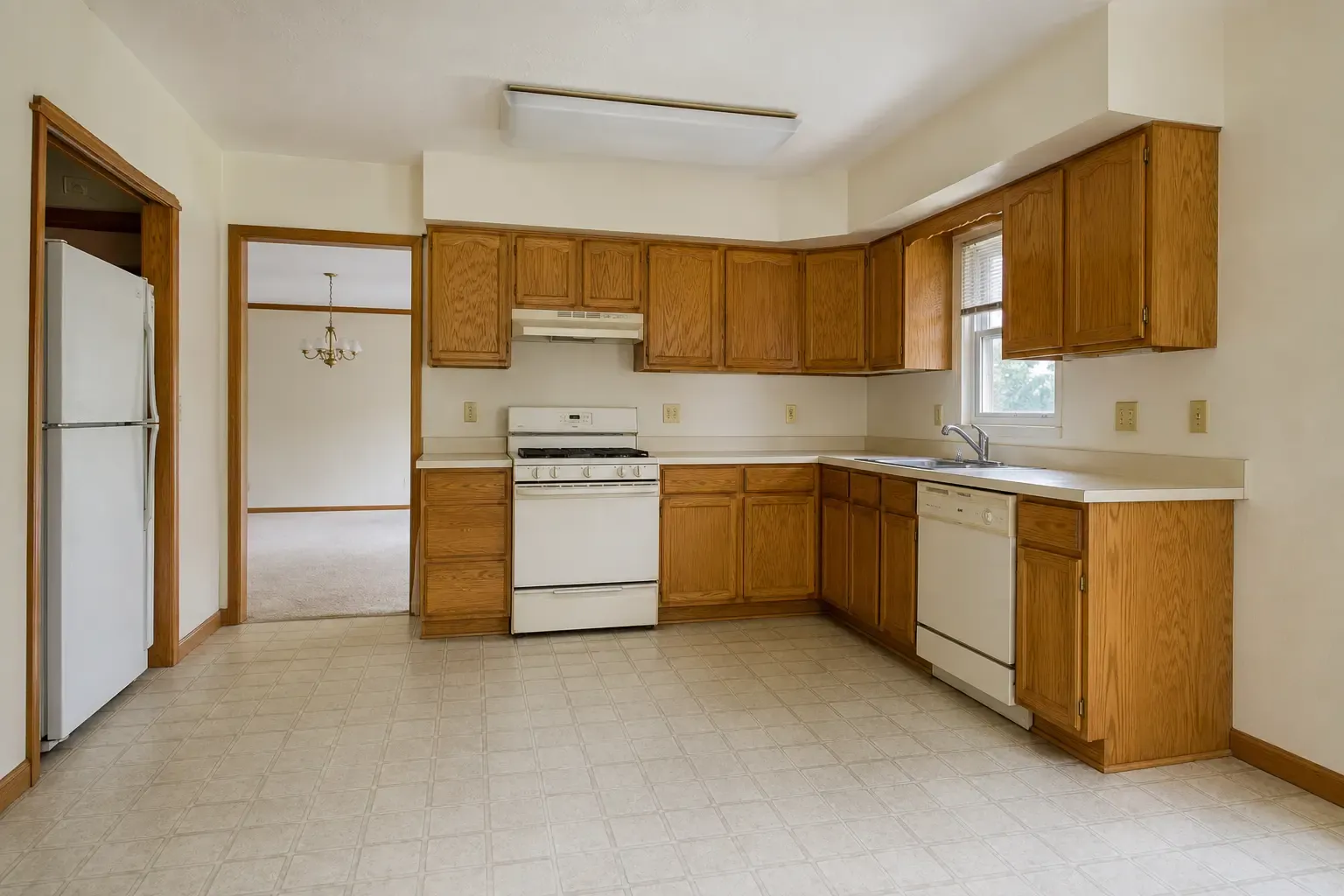
Want your offer faster, or rather not talk to anyone yet? Snap the rooms on your phone. We price the repairs we see and send back a written cash offer that says plainly whether we would buy the house ourselves or bring you one of our buyers. No obligation.
 CabinetsFlooring
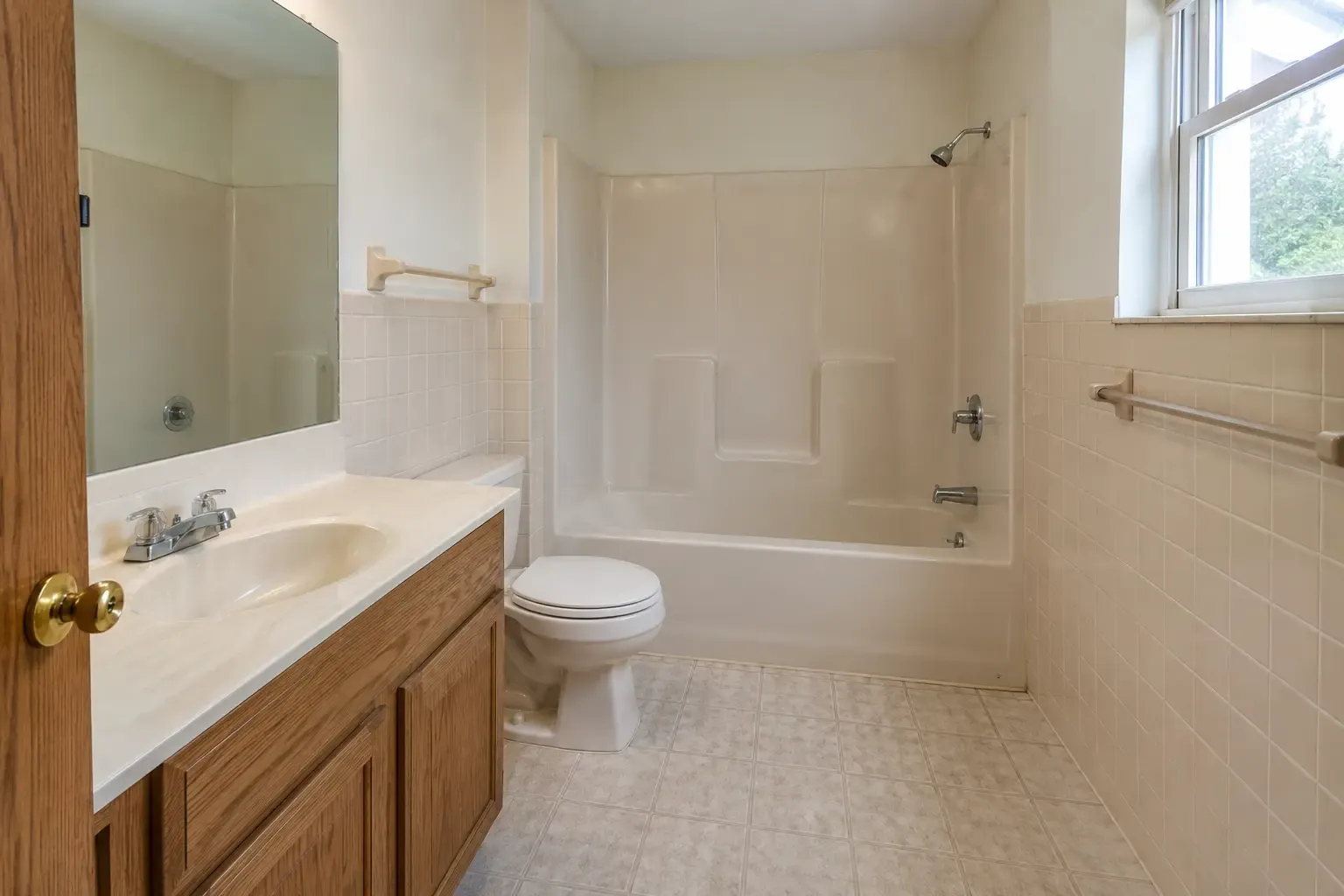 Tub & tile
 Floors
 Roof
We may bring in a partner buyer to close. Your price and terms don't change.
What does this look like for a real Connecticut homeowner?
Composite example. The situation below combines cases we see often. It is not one specific customer, and the numbers are illustrative, not a promise.
Picture a three-family in Waterbury. The owner inherited it from her father two years ago. One unit is empty, one tenant pays, and one has not paid since spring. The porches need rebuilding, the boiler is original, and she lives in Massachusetts. She called two “we buy houses” companies. The first never called back. The second said it doesn’t buy multi-families.
A third investor looked at it and said the same thing: “This isn’t a house we’d renovate ourselves. But we have two buyers who own three-families in Waterbury and buy them with tenants in place.” She got a written offer that said it would be assigned, the disclosure report and three days to think. She showed it to her attorney. One of those buyers walked through on a Saturday, signed the assignment, and the house closed through Connecticut attorneys a few weeks later at her contract price, tenants and all.
Could she have gotten more by fixing the porches, emptying a unit and listing it? Possibly, after months of work managed from out of state and an eviction. For her, a firm price and a closing date were worth more. For an owner with a renovated duplex in a hot neighborhood, the answer would be different.
When is listing with an agent the better choice?
Listing with an agent is the better choice when your house is in good condition, you have several months, you can handle showings, and getting the highest price matters most. In that situation the open market will usually beat any investor offer, wholesale or direct, even after the commission. A cash or wholesale sale wins when repairs, deadlines, tenants or distance make a listing hard.
A cash or wholesale sale fits if…
- The house needs repairs you can’t or don’t want to pay for
- You have a deadline: a Law Day, probate, a move, a divorce
- There are tenants, especially ones who don’t pay
- You live out of state or can’t manage the sale
- The house won’t pass a lender’s appraisal or inspection (crumbling foundation, old oil tank, code issues)
- Privacy and a sure closing date matter more than top price
List with an agent if…
- The house is updated and in good shape
- You have three to six months and no deadline
- You can keep it clean and ready for showings
- Buyers with mortgages can buy it as it is
- Getting the highest possible price matters most
- Your area has more buyers than houses for sale
Not sure which side you’re on? Run your numbers both ways. Use your price, your repairs and your town’s conveyance tax:
What would you keep each way?
The calculator uses your town’s conveyance tax and shows your net selling it yourself, with an agent, or to a cash buyer.
How much would you walk away with?
Slide the numbers to match your house. It works in your browser; nothing is saved or sent.
Estimates for planning. Conveyance tax per CGS 12-494 (state 0.75% up to $800,000, 1.25% to $2.5M, 2.25% above, plus the town rate). Seller attorney about $1,200 to $1,500; flat-fee MLS about $400; listings include three months of taxes, insurance and utilities, a cash sale about two weeks. Your attorney gives you the final numbers.
The full comparison is in cash buyer vs. realtor in Connecticut, and the agent costs are in the costs of listing with an agent in Connecticut.
How does wholesaling fit your situation?
Wholesaling fits best when a house is hard to sell the usual way: it needs major repairs, it’s in foreclosure or probate, it has tenants, or the owner has to move or split the proceeds fast. Each of these comes with its own Connecticut rules, so read the guide for your situation before you choose a route.
- Behind on payments or facing foreclosure? Your deadline is Law Day. A 90-day wholesale contract can be too long, so ask for a closing date well before it. See selling your house before foreclosure in Connecticut.
- Inherited a house? The executor or administrator signs, and the Probate Court may need to approve the sale. See selling an inherited or probate house in Connecticut.
- Going through a divorce? Both spouses sign, or the court orders the sale. See selling your house during a divorce in Connecticut.
- A rental with tenants? Many investors on a wholesaler’s list buy with tenants in place. See selling a rental property with tenants in Connecticut.
- Needs repairs, or vacant? See selling a house that needs repairs and selling a vacant house in Connecticut.
- Tax liens or moving away? See selling a house with tax liens and selling when relocating from Connecticut.
We buy, and match buyers for, houses all over Connecticut, including Hartford, New Haven, Bridgeport, Waterbury, New Britain, Norwich, Meriden, Manchester, Bristol and Stamford.
What do the wholesaling terms mean?
The wholesaling terms you’ll see most often are assignment, assignment fee, double close, end buyer, earnest money, equitable interest, inspection period and memorandum of contract. Knowing what each one means makes it much easier to read a wholesale contract and to spot when something isn’t right.
- Wholesaler: a person or company that puts a property under contract and sells that contract, or the property, to another buyer, usually without fixing it.
- End buyer: the investor who actually pays for and takes title to your house.
- Assignment: the wholesaler transfers their rights under your purchase contract to the end buyer, who then closes with you.
- Assignment fee: what the end buyer pays the wholesaler for the contract, on top of your price.
- “And/or assigns”: wording after the buyer’s name that allows the contract to be assigned.
- Double close (double closing): two back-to-back sales. You sell to the wholesaler, who immediately resells to the end buyer.
- Transactional funding: very short-term money a wholesaler borrows to fund the first half of a double close.
- Earnest money deposit (EMD): the buyer’s good-faith deposit, which should be held by an attorney or escrow agent, not the buyer.
- Inspection period (due-diligence period): a window in which the buyer can cancel, often for any reason. Long windows are where many wholesale deals fall apart.
- Equitable interest: the buyer’s legal interest in your property created by the signed contract. This is what a wholesaler is really selling.
- Memorandum of contract: a short document recorded in the land records to show the property is under contract. It can cloud your title. Connecticut bans recording one for a wholesale contract, and other states limit them (see memorandums and liens).
- Disclosure report: a written notice some states require a wholesaler to give you before you sign, explaining that they may not be the buyer and may profit from an assignment.
Where can you go deeper on each part of wholesaling?
You can go deeper on each part of wholesaling in the twelve guides below. Each one takes a single question, such as the assignment fee, double closings, the “and/or assigns” clause, the state laws or how to back out, and answers it completely, with sources, for homeowners rather than investors.
- Real estate wholesaling laws by state: all 21 regulated states, one by one
- What an assignment fee is, who pays it and where it shows
- Double closing in real estate, from the seller’s side
- What “and/or assigns” means in your purchase contract
- What an equitable interest is, and what a wholesaler is really selling
- Memorandum of contract: when a buyer clouds your title, and how to remove it
- How to back out of a wholesale contract
- Should you sell your house to a wholesaler? Honest pros and cons
- Wholesaler vs. realtor vs. cash buyer (plus novation)
- “We buy houses” scams: red flags and what regulators found
- Why you keep getting texts and letters to buy your house, and how to stop them
- Why cash offers are so low: the investor math, line by line
- Selling your house subject-to: how it works and how to protect your credit
- Lease option and rent-to-own: selling your house without selling it today
- What a novation is: the fix-and-list sale, explained
Wholesaling questions homeowners ask
What is real estate wholesaling?
Real estate wholesaling is when an investor signs a contract to buy your house and then assigns that contract to another investor, who buys it from you on the same terms. The wholesaler is paid a fee by the end buyer for finding and arranging the deal.
Is wholesaling legal in all 50 states?
Wholesaling is legal in every state we have checked. No state we found bans it outright. But at least 21 states regulate it, with license or registration requirements, written disclosures, cancellation rights or limits on recording against your title. The rules depend on where the house is.
Do real estate wholesalers need a license?
Real estate wholesalers need a license in some states, including Delaware, Illinois, Iowa, Kentucky, Nebraska, North Dakota, Oklahoma, Pennsylvania and Virginia. Connecticut and Oregon require a separate wholesaler registration instead. Other states require only written disclosure, or have no specific rule.
Can a wholesaler put a lien on my house?
A wholesaler may try to record a memorandum of contract or an affidavit of equitable interest, which can cloud your title. Connecticut, Louisiana and Oklahoma bar this for wholesale contracts, and Texas regulates one-sided memorandums. Add a no-recording clause to your contract and never accept a buyer who wants to record one.
What is an equitable interest in real estate?
An equitable interest is the buyer’s legal right in your property created by a signed purchase contract, before they own it. It is what a wholesaler sells or assigns to an end buyer. Several states require wholesalers to tell you they hold only an equitable interest and may not be able to deliver title.
Why do I keep getting “we buy houses” letters and texts?
You keep getting “we buy houses” letters and texts because investors and wholesalers buy marketing lists built from public records, often of owners with equity, older homes, inherited property or tax problems. Some mailers are designed to look like checks. Replying commits you to nothing. Ask the questions on this page before you sign anything.
Is wholesaling a scam?
Wholesaling is not a scam in itself. It is a legal way of matching a seller with a buyer for a fee. It becomes a problem when someone hides that they won’t be the buyer, signs contracts they can’t close, cuts the price later, or records documents against your title. Those practices are what the new state laws target.
What does a wholesaler do in real estate?
A wholesaler in real estate finds houses that need a buyer, puts them under contract, and matches them with cash investors from their network. A good one also manages the sale through closing: walkthroughs, attorneys, payoffs and the closing date.
Is wholesaling legal in Connecticut?
Yes, wholesaling is legal in Connecticut, but since July 1, 2026, it is regulated. Wholesalers must register with the Department of Consumer Protection. They must give you a disclosure report, let you cancel within three business days, and close within 90 days (CGS 20-329aaa to 20-329hhh).
Is a real estate wholesaler legit?
A real estate wholesaler can be completely legit, or not. Check that they are registered with DCP, that they say up front they will assign the contract, that a Connecticut attorney holds the deposit, and that they never ask you for a fee. A legit wholesaler welcomes these questions.
Does the wholesaler’s fee come out of my price?
No. With an assignment, the wholesaler’s fee is paid by the end buyer, on top of the price in your contract. You receive your contract price, less your normal seller costs such as the conveyance tax and your attorney. The fee is part of what the end buyer decided they could pay for the house.
How much do wholesalers make on a house?
How much a wholesaler makes varies by deal, the house and the market. There is no standard fee. With an assignment, the fee usually shows on the closing paperwork. With a double close, you will only see your own price.
What does “and/or assigns” mean in a contract?
“And/or assigns” after the buyer’s name means the buyer can transfer the contract to someone else, who would then close with you. It is normal in wholesale deals. Just make sure the buyer has told you plainly that they plan to assign it.
Can I back out of a wholesale contract in Connecticut?
Yes. In Connecticut you can cancel a wholesale contract within three business days for any reason, without penalty, other than returning any deposit the wholesaler paid you. After that, your contract’s own terms apply. If it doesn’t close within 90 days and nobody extended it in writing, it ends automatically.
What happens if the wholesaler can’t find a buyer?
If the wholesaler can’t find a buyer, the contract ends on the terms in it, and in Connecticut no later than 90 days after signing unless you agreed in writing to extend. A good wholesaler tells you early if a deal isn’t coming together, so you don’t lose time.
Is a wholesaler the same as a cash buyer?
No. A cash buyer closes with their own funds or their lender’s money and takes title. A wholesaler puts the house under contract and assigns it to a cash buyer. Some companies do both, depending on the house. Ask which one you are getting.
Is it bad to sell your house to a wholesaler?
No, not if the wholesaler is honest and registered and your situation fits. It can be a fast, as-is way to sell a house that’s hard to sell otherwise. It is a bad idea if your house is updated and you have time to list, or if the wholesaler hides what they are.
Do I need an attorney to sell to a wholesaler in Connecticut?
You should have one. Connecticut closings are handled by attorneys, and the wholesaler law gives you three business days to have an attorney review the contract. Your own attorney protects your interests, not the buyer’s.
What is the difference between assignment and double closing?
In an assignment, the end buyer steps into your contract and closes directly with you. In a double close, the wholesaler buys your house and resells it, usually the same day, in two closings. With an assignment you can see the fee. With a double close, you see only your own price.
Do I pay a commission when I sell to a wholesaler?
No. There is no agent commission when you sell to a wholesaler or a cash buyer. You still pay normal Connecticut seller costs, mainly the conveyance tax and your attorney’s fee.
How fast can a wholesale sale close in Connecticut?
A wholesale sale in Connecticut can close as soon as the end buyer is lined up and the attorneys finish the title work and payoffs, often within a few weeks. The law caps the contract at 90 days unless you agree in writing to extend it.
Related Connecticut guides
- All the ways we buy houses in Connecticut
- How to sell a house in Connecticut: every route, start to finish
- Cash buyer vs. realtor in Connecticut: the same house sold both ways
- Selling a house to a wholesaler in Connecticut: the 2026 law in depth, and what to do if you already signed
- How to check a cash home buyer in Connecticut
- Cash house buyers in Connecticut: how offers are worked out
- Selling a house as-is in Connecticut
- Is owner financing a good idea for the seller?
Ready to see a real number? Get your written cash offer, or call Jerryll at (203) 529-4712.
Sources
- Connecticut General Statutes chapter 392a, §§ 20-329aaa to 20-329hhh (real estate wholesalers; P.A. 25-168, effective July 1, 2026).
- Connecticut Department of Consumer Protection: Real Estate Wholesaling (registration, seller rights, FAQ).
- DCP news release: real estate wholesalers required to register with DCP (2026).
- DCP: verify a license or registration.
- DCP: file a complaint.
- CGS § 12-494 (real estate conveyance tax).
- CGS § 20-327b (residential property condition report).
- EPA: lead-based paint disclosure for pre-1978 homes.
- Kansas Real Estate Commission testimony on HB 2598 (January 31, 2024).
- Kansas Real Estate Commission bulletin on the Attorney General’s wholesaling lawsuit (April 2026).
- North Carolina Real Estate Commission: beware of unlicensed activity (December 2023).
- Oklahoma Real Estate Commission: wholesaling law.
- Tex. Prop. Code § 12.020 (unilateral memorandum of contract).
- City of Philadelphia: residential property wholesaler license.
- Georgia Department of Law: unsolicited real estate solicitations.
- State statutes and bills: each one is linked in the state law table above.
Who wrote this
Jerryll Noorden
Jerryll has bought and sold Connecticut houses since 2016 and has sat at more closing tables than he can count, on both sides. Before real estate he was a robotics scientist at NASA, IHMC and IIT. He wrote this guide because the national sites that rank for it skip the Connecticut rules that cost sellers money. When listing or selling it yourself would get you more than a cash offer, he says so.
This guide explains Connecticut rules in plain English. It is not legal or tax advice. Laws change; for your sale, talk to a Connecticut real estate attorney and a tax professional.
