
Connecticut seller’s guide · Facts checked October 26, 2026
Memorandum of Contract: When a Buyer Clouds Your Title and How to Remove It
Why a recorded memorandum or affidavit can block your sale years later, how to find one, and the step-by-step ways to remove it in Connecticut, Texas and other states.

A memorandum of contract is a short document recorded on your land records announcing that your house is under contract. It isn’t a lien, but it clouds your title until released. Connecticut bans recording wholesale contracts and lets owners void one with an affidavit of facts (CGS 20-329fff, CGS 47-12a). In Texas, since September 1, 2025, an owner’s affidavit releases a one-sided memorandum unless the filer contests it within 45 days (Tex. Prop. Code § 12.020).
- A memorandum of contract is a short document recorded on your land records that says your house is under contract. It isn’t a mortgage, but title companies and lenders treat it as a claim until it is released. It often comes up in real estate wholesaling deals.
- That makes it a “cloud on title”. A buyer or lender who finds it will usually refuse to close until it is cleared, even years after the deal died.
- It is one of the most damaging things a bad wholesale deal can leave behind. State regulators in Oklahoma and Arizona reported complaints about clouded titles, and a 2026 Kansas lawsuit alleges recorded “affidavits of equitable interest” acted as false liens. Those are allegations.
- Connecticut bans recording a wholesale contract or notice of it, strips anything recorded of legal effect, and lets you clear it by recording an affidavit of facts (CGS 20-329fff, CGS 47-12a).
- Texas, since September 1, 2025, requires anyone who records a one-sided memorandum on a home to mail the owner notice. The owner’s affidavit works as a release unless the filer contests it within 45 days (Tex. Prop. Code § 12.020).
- Everywhere else: ask for a recorded release first. If the filer refuses, a quiet-title action in court removes it.
- Prevention is one sentence: a contract clause saying the buyer will not record the agreement or any memorandum, affidavit or notice of it.
What is a memorandum of contract in real estate?
A memorandum of contract in real estate is a short document, filed in the town or county land records, that announces a property is under contract to be sold. It usually names the seller and buyer and describes the property, but leaves out the price and terms. Its purpose is to warn anyone searching the title that someone else claims a right to buy the house.
It goes by several names. You may see “memorandum of agreement”, “memorandum of purchase and sale agreement”, “notice of contract”, “memorandum of option” or “affidavit of equitable interest”. The labels differ, but they do the same thing: they put the buyer’s claim on the public record, where every future title search will find it.
In some deals that is legitimate. A buyer with a long-term option on land, or a developer waiting on permits, may record a memorandum so the owner can’t quietly sell to someone else. The trouble starts when one is recorded on a quick, as-is sale of a family home, especially by a wholesaler who may never close.
This page is part of our seller’s guide to how real estate wholesaling works. It explains why a memorandum clouds your title, how to find one, and how to get it removed in Connecticut, in Texas and in other states. As of October 2026. This is general information, not legal advice.
Why would a buyer record a memorandum of contract on your house?
A buyer records a memorandum of contract on your house to protect their claim to buy it. Once it is on the record, any later buyer or lender is on notice of the contract, so you can’t easily sell or refinance to someone else. In a long, legitimate deal that protects the buyer. In a bad wholesale deal it also traps you.
The general rule in many states is that a recorded contract is notice to everyone. Connecticut’s version says a recorded contract for the conveyance of land is “notice to all the world of the equitable interest thus created” (CGS 47-17). That is exactly why it works as leverage: a title company won’t insure a sale to someone else while that notice sits there.
Here is how a wholesaler might use that leverage:
- To stop you from walking away. If you get a better offer or change your mind, the recorded memorandum makes the other sale hard to close.
- To market the contract with “proof”. A recorded document can make the wholesaler’s claim look stronger to the investors they’re pitching.
- To get paid to leave. News reports have described homeowners who were asked to pay thousands of dollars to have such a notice released after the deal fell through.
Not every buyer who records a memorandum is acting in bad faith. But on a fast, as-is sale of a home that’s supposed to close in a few weeks, there is rarely a good reason to record one. And for a wholesale contract in Connecticut, there is no legal way to.
What is a cloud on title, and why does a memorandum cause one?
A cloud on title is any recorded document or claim that casts doubt on who owns a property or what rights others have in it. A memorandum of contract causes one because it says someone else may have a right to buy your house. Until it is released or ruled invalid, a title company may refuse to insure a sale, and a lender may refuse to lend.
Your title is your ownership as it appears on the land records. When you sell or refinance, the buyer’s or lender’s attorney or title company searches those records back through the years. They are looking for anything that could let someone else claim the property later: unpaid mortgages, liens, judgments, missing signatures and recorded contracts.
A recorded memorandum shows up in that search. The searcher can’t know from the paper alone whether the contract is still in force, was cancelled, or expired years ago. So they treat it as live until someone proves otherwise. That’s the cloud. Common results:
- Your sale is delayed while attorneys track down the filer for a release.
- Your buyer walks away because they can’t wait.
- Your refinance or home-equity loan is put on hold.
- You pay an attorney to clear it, sometimes through a court case.
Composite example. This combines a pattern described in news reports and regulator complaints. It is not one specific case. A homeowner signs a quick cash contract, gets cold feet, and cancels in writing within days. She hears nothing more. Three years later she accepts an offer from a family buying with a mortgage. Their title search turns up a “memorandum of agreement” recorded the week she signed. The lender won’t fund. The filer doesn’t return calls at first, then asks for money to sign a release. Her sale is stuck until it’s cleared.
Is a memorandum of contract a lien?
A memorandum of contract is generally not a lien. A lien secures a debt, like a mortgage or a tax lien, and can be foreclosed. A memorandum only gives notice that someone claims a contract right to buy. In practice it can block a sale just like a lien, because a title company won’t ignore it until it is released.
The distinction matters more to lawyers than to you. To you, both stop a closing. But it’s worth knowing the difference, because people sometimes say “they put a lien on my house” when what was recorded is a memorandum, an affidavit or a notice.
A few states do let a buyer create an actual lien for their deposit. Connecticut’s “purchaser’s lien” (CGS 49-92a) secures the amount of the deposit stated in a recorded contract, but only if the contract or notice is signed by the owner as well as the buyer, and witnessed and acknowledged like a deed. It lapses after two years unless the buyer sues to foreclose it (CGS 49-92c). Connecticut’s 2026 wholesaler law forbids a wholesaler from filing one at all (CGS 20-329fff(a)).
What is an “affidavit of equitable interest”?
An “affidavit of equitable interest” is a sworn statement, recorded on the land records, in which a buyer claims a contract right in your property. It works like a memorandum of contract, but the buyer signs it alone, so you may never see it. It can cloud your title the same way, and it is one of the documents regulators have flagged in wholesaling cases.
The word “equitable interest” means the buyer’s right to buy your house under a signed contract (see what an equitable interest is). The affidavit is the buyer swearing to the world that they hold one.
The one-sided nature is the problem. A memorandum is sometimes signed by both parties. An affidavit is typically signed only by the buyer, so it can be recorded without your knowledge and without any proof the contract is still in force. In its March 2026 lawsuit, the Kansas Attorney General alleged that a “we buy houses” wholesaling company recorded “Affidavits of Equitable Interest” that functioned as false liens on homeowners’ titles, including after some owners changed their minds. Those are allegations; the company denies them, and the case was at the pleading stage as of the Kansas Real Estate Commission’s April 2026 bulletin.
Texas’s 2025 law is aimed at exactly this kind of one-sided filing. It covers any “unilateral memorandum of contract”, which it defines as a document signed only by someone who is not an owner and that asserts a contract to buy, an option, or a right of first refusal (Tex. Prop. Code § 12.020(a)).
What have regulators found about recorded memorandums?
Regulators have found that recorded memorandums and affidavits are a recurring source of harm in wholesaling and related schemes. State real estate commissions reported complaints about clouded titles before passing wholesaling laws. Attorneys general have alleged false liens, and in a related scheme, several attorneys general pursued a company that recorded memorandums against homeowners’ titles.
- Oklahoma (2021) and Arizona (2022). Both states’ real estate regulators reported numerous calls and complaints about misleading tactics, predatory contracts and clouded titles before their wholesaling laws took effect.
- Kansas (2026). The Attorney General’s lawsuit alleges recorded “Affidavits of Equitable Interest” acted as false liens. Allegations, not findings.
- Several states (2023–2026), a related practice. Attorneys general in a number of states pursued a “homeowner benefit” program that paid owners small sums for the right to list their homes and recorded memorandums or mortgages against their titles. This wasn’t wholesaling, but it shows how recorded documents can trap owners, and how much work it takes to clear them once they’re on the record.
- Connecticut, Louisiana and Oklahoma now bar wholesalers from recording liens or clouding title, and Texas regulates one-sided memorandums on all homes.
The lesson is the same in every case: a document recorded in a minute can take months to remove. More on the enforcement record is in our guide to “we buy houses” red flags and what regulators found.
How do you find out if a memorandum is recorded against your house?
You find out if a memorandum is recorded against your house by searching your property’s land records. In Connecticut that means the town clerk’s office in your town. In most other states it is the county recorder or register of deeds. Search by your name as owner, and look for any memorandum, notice, affidavit or agreement filed by someone you don’t recognize.
- Online. Many town clerks and county recorders let you search the index online by owner name. Some charge a small fee for copies.
- In person. Clerks can show you the index and print copies. Bring your address and the year you bought the house.
- Through an attorney or title company. If you’re selling, the buyer’s title search will find it anyway. If you want to know before you list, a title search on your own house costs far less than a failed closing.
Search under every name the filer might have used: the company name on your contract, the name of the person you dealt with, and any “and/or assigns” buyer you were told about. If you signed with someone and the deal fell through, check again a few weeks after it ended. In Connecticut, an affidavit recorded under CGS 47-12a must be indexed under the record owner’s name (CGS 47-12a(c)), so your own name is the right place to look.
How do you remove a memorandum of contract from your title?
You remove a memorandum of contract from your title by getting a recorded release from the person who filed it, using a state shortcut such as Connecticut’s affidavit of facts or Texas’s owner affidavit, or, if the filer refuses, filing a quiet-title action in court. Start by confirming the contract has actually ended, in writing.
Get a copy of what was recorded
Pull the document from the land records: who filed it, when, which contract it refers to, and what it claims. Note the book and page or instrument number. You’ll need them for any release.
Gather proof that the contract is over
Find your contract, any cancellation notice you sent and proof of delivery, emails or texts about the deal ending, and the closing date in the contract. If you cancelled under a state cooling-off right, such as Connecticut’s three business days, keep the proof of the date. In Connecticut, a wholesale contract also ends automatically after 90 days unless both sides extended it in writing (CGS 20-329ccc(b)).
Ask the filer, in writing, to record a release
Send a short letter by certified mail, plus email if you have it. Identify the recorded document, say the contract has ended, and ask them to sign and record a release or termination within a set number of days. Keep it factual. Don’t pay a “release fee” without talking to an attorney first.
Use your state’s shortcut if there is one
In Connecticut, if the document relates to a wholesale contract, you can record an affidavit of facts under CGS 47-12a, and the filing then becomes “void and unenforceable” (CGS 20-329fff(c)). In Texas, for a one-sided memorandum on a home, you can record an owner’s affidavit and certificate of mailing, and mail the filer a copy. Unless they record a contradicting affidavit within 45 days, buyers and lenders can rely on your affidavit (Tex. Prop. Code § 12.020).
If they refuse and there’s no shortcut, go to court
A quiet-title action asks a judge to declare that the recorded claim is invalid or has expired. Connecticut’s version is an action to “quiet and settle the title” under CGS 47-31. Other states have their own. An attorney can also tell you whether your state allows damages or attorney’s fees for a bad-faith filing, sometimes called slander of title.
Record the result and check again
Make sure the release, affidavit or court judgment is actually recorded in the same land records as the memorandum. A few weeks later, search your name again and get a copy for your files. Give a copy to your closing attorney when you sell.
If a memorandum turns up during a sale you’re trying to close, tell your closing attorney right away. Depending on your state, they may be able to clear it with a release or affidavit before the closing date, or arrange for the buyer’s title insurer to accept a specific fix. Speed matters, because the filer has the most leverage when you’re about to close.
What does Connecticut law say about recording a wholesale contract?
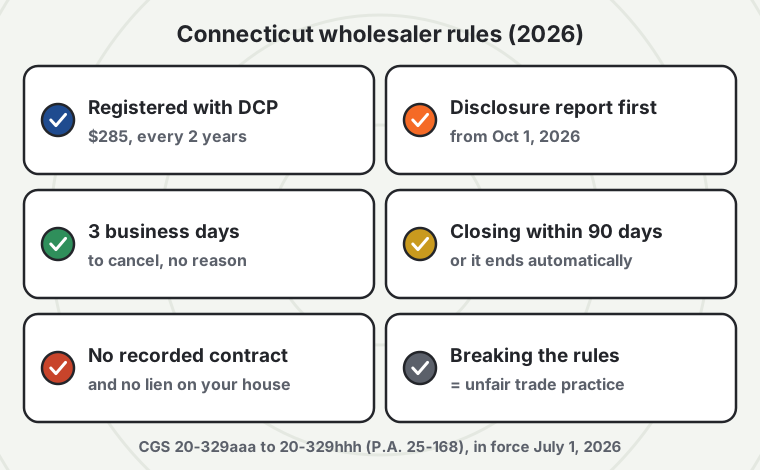
Connecticut law says no one may record a wholesale contract, a notice of it, or any document claiming a lien on the seller’s home, and a wholesaler may not file a purchaser’s lien. Anything recorded anyway gives no legal notice to a good-faith buyer or lender, the town clerk may refuse it, and the owner can void it by recording an affidavit of facts (CGS 20-329fff).
The rule took effect July 1, 2026, as part of Connecticut’s real estate wholesaler law. Here is what each piece does:
| Rule | What it means for you | Statute |
|---|---|---|
| Recording is banned | No one may record a wholesale contract, any notice or record of it, or anything that claims a lien, encumbrance or security interest on your home. | CGS 20-329fff(a) |
| No purchaser’s lien | A wholesaler may not file a purchaser’s lien under CGS 49-92a for a wholesale contract. | CGS 20-329fff(a) |
| No legal effect | If one is recorded anyway, it does not give actual or constructive notice to an otherwise good-faith buyer or lender. | CGS 20-329fff(a) |
| Clerk may refuse it | A town clerk may refuse to record such a document, even though clerks normally must record what is presented. | CGS 20-329fff(b) |
| Your affidavit voids it | The owner, or anyone with knowledge of the facts, may record an affidavit of facts under CGS 47-12a. Once it’s recorded, the filing is void and unenforceable. | CGS 20-329fff(c) |
| Violations are unfair trade practices | Breaking these rules is a violation of the Connecticut Unfair Trade Practices Act. You can complain to the Department of Consumer Protection. | CGS 20-329hhh |
The affidavit of facts. CGS 47-12a has long allowed anyone with knowledge of facts affecting title to record a sworn affidavit on the town land records. It must describe the land and name the record owner, and the clerk indexes it under that owner’s name. For wholesale filings, CGS 20-329fff(c) gives that affidavit real force: it voids the filing. The affidavit should identify the recorded document and state the facts, for example that it relates to a real estate wholesale contract, and when and how the contract ended. Have a Connecticut attorney draft it. It is sworn, and it goes on your permanent record.
Older Connecticut tools still apply. For a recording that isn’t a wholesale contract, or if anyone disputes that it is, three general statutes help:
- Time limit on contract claims. An interest under an executory contract to buy real estate can’t survive more than one year after the contract’s performance date (or 18 months after signing, if no date is given), unless the buyer sues within that time and files a notice of lis pendens. After that, the expired interest can’t make your title unmarketable (CGS 47-33a).
- Quiet title. You can sue anyone whose recorded claim conflicts with your title “to quiet and settle the title” (CGS 47-31).
- Falsely filed records. A person named in a land-record filing can petition the Superior Court, with no filing fee, to invalidate a filing that was falsely filed (CGS 47-31a). Ask your attorney whether it fits your case; it is designed for false filings.
For the rest of Connecticut’s wholesaler law, including registration and the disclosure report, see selling your house to a wholesaler in Connecticut: what to expect. To file a complaint, use DCP’s complaint page.
What does Texas law say about a memorandum of contract?
Texas law, since September 1, 2025, says anyone who records a one-sided memorandum of contract on a home must give the county clerk a certificate of mailing and send the owner a copy by certified or registered mail. The owner can record an affidavit that serves as a release. Unless the filer records a contradicting affidavit within 45 days, buyers and lenders can rely on the owner’s affidavit (Tex. Prop. Code § 12.020).
| Step | What the law requires | Subsection |
|---|---|---|
| What’s covered | A “unilateral memorandum of contract”: signed only by a non-owner, claiming a contract to buy, an option, a right of first refusal or first offer, or a right to match offers. Covers single-family homes, duplexes, triplexes, fourplexes and condo units. | § 12.020(a) |
| Filer must notify you | When recording, the filer gives the clerk their mailing address and a certificate of mailing, and by the filing date sends you a copy and a letter by registered or certified mail, return receipt requested, to the property and your other addresses of record. | § 12.020(b) |
| If the filer skips that | A memorandum recorded on or after September 1, 2025 without complying gives no notice, creates no duty to inquire, and doesn’t affect a sale or mortgage to someone for value. | § 12.020(k) |
| Your affidavit | You may record an affidavit for release, in the form set out in the statute, plus a certificate of mailing, and send the filer a copy by registered or certified mail. | § 12.020(c), (d), (i), (j) |
| The 45-day window | From the 45th day after your certificate of mailing is recorded, good-faith buyers and lenders may rely conclusively on your affidavit, and the filer’s only remedy is money damages. | § 12.020(f) |
| The filer can contest | Within those 45 days, the filer may record a contradicting affidavit saying yours is untrue or giving another reason the memorandum is valid. Then the release doesn’t take effect, and the dispute usually goes to court. | § 12.020(g) |
Texas also requires anyone assigning a contract without a real estate license to disclose the nature of their equitable interest in writing to the seller and to potential buyers (Tex. Occ. Code § 1101.0045). If you’re a Texas homeowner and you received a certified letter about a memorandum on your house, talk to a Texas real estate attorney about the affidavit before the timeline runs.
How do you remove a memorandum in other states?
In states without a specific rule, you remove a memorandum the traditional way: get the filer to sign and record a release, or ask a court to clear it in a quiet-title action. Louisiana and Oklahoma also bar wholesalers from clouding a seller’s title, which can strengthen your hand. Many states also recognize claims for damages when a filing was made in bad faith.
- Louisiana. Since August 1, 2026, a wholesaler may not place liens on or cloud the title of the seller’s property. Violations make the contract voidable and count as an unfair trade practice. See Act 807 (2026).
- Oklahoma. Since November 1, 2025, a wholesaler may not record a lien or cloud the seller’s title. See the Oklahoma Real Estate Commission’s wholesaling page.
- Everywhere else. General rules apply. A written release from the filer is fastest. If they won’t sign, an attorney can file a quiet-title action. Some states also allow damages or attorney’s fees for slander of title, which is a false recording that harms your ability to sell.
Our state-by-state table of seller protections, including which states limit recordings, is in real estate wholesaling laws by state.
How do you stop a buyer from recording anything in the first place?
You stop a buyer from recording anything by putting a no-recording clause in the contract, asking the question directly before you sign, and walking away from anyone who insists on recording. Keep the deal short, keep the deposit with an attorney or escrow agent, and get every cancellation in writing.
- Add a clause. For example: “Buyer shall not record this agreement or any memorandum, affidavit or notice of it. Any such recording is a default by Buyer.” Your attorney can add language making the buyer pay to remove anything recorded.
- Ask out loud: “Will you record anything against my property?” The only acceptable answer on a quick as-is sale is no.
- Read for one-sided affidavits. Watch for any page you are asked to sign that says “memorandum”, “affidavit” or “notice”. If you don’t know what it is, don’t sign it until your attorney does.
- Keep it short. A short closing date and a short inspection period mean less time for a deal to go wrong. In Connecticut a wholesale contract can’t run more than 90 days without a written extension.
- Cancel cleanly. If you or the buyer end the contract, ask for a signed release anyway, and check your land records a few weeks later. Our guide to backing out of a wholesale contract walks through it.

On a normal as-is sale that closes in a couple of weeks, there is no reason for the buyer to record anything. If someone tells you they need to “protect their interest” on the land records, ask them why your contract and a deposit with an attorney aren’t enough. If they can’t answer that, they’re not the buyer for your house.
Should you pay someone to remove a memorandum from your house?
You should not pay someone to remove a memorandum from your house until you’ve talked to a real estate attorney. In Connecticut, a wholesale filing can be voided by your own affidavit, and in Texas a one-sided memorandum can be released by yours. Elsewhere, an expired or cancelled contract usually gives the filer no right to be paid, and a court can clear it.
That said, the honest answer has a second half. If you’re days from closing and the filer will sign a release today for a small sum, paying can sometimes cost less than a court case and a lost buyer. That’s a business decision to make with your attorney, with the release drafted by them, not the filer, and recorded before any money changes hands.
Whatever you decide, document it. If a wholesaler recorded something they shouldn’t have, report it to your state attorney general’s consumer protection office and your state real estate commission. In Connecticut, report it to the Department of Consumer Protection. Regulators use these reports to build cases.
Can you still sell your house if a memorandum is recorded on it?
You can still sell your house if a memorandum is recorded on it, but usually only after it is released, voided or ruled invalid, because most buyers’ lenders and title insurers won’t close over it. Some cash buyers will sign a contract while the cloud is being cleared, as long as the closing waits for a clean title.
If you’re in this spot, you have two realistic paths. You can clear the title first and then sell any way you like, including listing with an agent, which will usually net more for a house in good shape. Or you can sign with a buyer who understands the issue and will wait while the attorneys clear it. Either way, the cloud has to be gone by closing.
If a deadline is pressing, such as a foreclosure, a probate timeline or tenants, see selling before foreclosure in Connecticut or selling an inherited house in Connecticut. To compare a cash sale with a listing, read cash buyer vs. realtor. Every route we offer is laid out on all the ways we buy houses in Connecticut.
Send a few photos and get a written offer that says plainly who is buying
Want your offer faster, or rather not talk to anyone yet? Snap the rooms on your phone. Jerryll's team prices the repairs and sends back a written cash offer. If your title has a cloud on it, tell us. We'll explain what has to be cleared before closing. No obligation.
 CabinetsFlooring
 Tub & tile
 Floors
 Roof
We may bring in a partner buyer to close. Your price and terms don't change.
We Buy Houses In Connecticut, LLC has bought Connecticut houses since 2016, about 10 a year, and a typical close takes about two weeks. Get your written cash offer or call Jerryll at (203) 529-4712. For the full picture, read our guide to wholesaling for homeowners.
Memorandum of contract questions homeowners ask
What is a memorandum of contract in real estate?
A memorandum of contract in real estate is a short document recorded in the land records that announces a property is under contract. It names the parties and describes the property, usually without the price. It warns anyone searching the title that someone claims a right to buy.
Can a buyer record a memorandum on my house without my signature?
In many states, yes, a buyer can record a one-sided memorandum or affidavit without the owner’s signature. Connecticut bans recording any wholesale contract or notice of it. Texas requires the filer of a one-sided memorandum on a home to mail the owner notice by certified or registered mail.
Is a memorandum of contract a lien?
No. A memorandum of contract is generally not a lien, because it doesn’t secure a debt. It gives notice of a claimed right to buy. In practice it can block a sale like a lien does, because title companies won’t insure over it until it is released.
What is a cloud on title?
A cloud on title is a recorded document or claim that casts doubt on who owns a property or what rights others hold in it. Recorded memorandums, old mortgages, liens and judgments are common examples. A cloud usually has to be cleared before a sale or refinance can close.
How do I remove a memorandum of contract?
You remove a memorandum of contract by getting the filer to record a release, by using a state procedure such as Connecticut’s affidavit of facts (CGS 20-329fff) or Texas’s owner affidavit (Tex. Prop. Code § 12.020), or by a quiet-title action in court.
How do I remove a wholesaler’s memorandum in Connecticut?
In Connecticut, you remove a wholesaler’s recorded contract or notice by recording an affidavit of facts under CGS 47-12a in the town land records. Under CGS 20-329fff(c), the filing then becomes void and unenforceable. Have a Connecticut attorney draft the affidavit.
How does the Texas memorandum of contract law work?
Under Tex. Prop. Code § 12.020, effective September 1, 2025, a person recording a one-sided memorandum on a home must mail the owner a copy by certified or registered mail. The owner can record an affidavit that acts as a release unless the filer records a contradicting affidavit within 45 days.
What is an affidavit of equitable interest?
An affidavit of equitable interest is a buyer’s sworn statement, recorded on the land records, claiming a contract right to buy a property. It is usually signed only by the buyer. The Kansas Attorney General’s 2026 lawsuit alleges such affidavits were used as false liens; those are allegations.
How long does a memorandum of contract stay on my title?
A memorandum of contract stays on your title until a release, affidavit or court order is recorded. It doesn’t vanish by itself, even if the contract expired. Some states limit how long the underlying claim survives; in Connecticut, CGS 47-33a sets an outer limit for contracts to buy real estate.
Can I sue someone for recording a memorandum on my house?
Possibly. Depending on your state and the facts, you may have a claim for slander of title, breach of contract or an unfair trade practice. In Connecticut, recording a wholesale contract violates CGS 20-329fff, which counts as a CUTPA violation. Ask a real estate attorney.
Should I pay a wholesaler to release a memorandum?
Don’t pay a wholesaler to release a memorandum until you’ve spoken with a real estate attorney. In Connecticut and Texas, you may be able to clear it with your own affidavit. Elsewhere, a court can clear an expired or invalid filing.
Will a title search find a memorandum of contract?
Yes. A title search will normally find a recorded memorandum of contract, because it is indexed in the land records under the owner’s name. That’s why it so often surfaces years later, when the owner tries to sell or refinance.
Sources
- Connecticut General Statutes chapter 392a, § 20-329fff (recording prohibited; remedies), and §§ 20-329aaa to 20-329hhh (P.A. 25-168, effective July 1, 2026).
- Connecticut General Statutes chapter 821 (§ 47-12a affidavit of facts; § 47-17 recorded contracts as notice; § 47-31 action to quiet title; § 47-31a falsely filed land records; § 47-33a time limit on executory agreements).
- Connecticut General Statutes chapter 847 (§§ 49-92a to 49-92c purchaser’s lien).
- Connecticut Department of Consumer Protection: Real Estate Wholesaling.
- Connecticut DCP: file a complaint.
- Texas HB 4063 (2025), enrolled text adding Tex. Prop. Code § 12.020 (effective September 1, 2025).
- Tex. Prop. Code § 12.020 (codified text).
- Texas SB 1577 (2023), Tex. Occ. Code § 1101.0045.
- Louisiana HB 468, Act 807 (2026).
- Oklahoma Real Estate Commission: wholesaling law.
- Kansas Real Estate Commission bulletin on the Attorney General’s wholesaling lawsuit (April 2026).
Who wrote this
Jerryll Noorden
Jerryll has bought and sold Connecticut houses since 2016 and has sat at more closing tables than he can count, on both sides. Before real estate he was a robotics scientist at NASA, IHMC and IIT. He wrote this guide because the national sites that rank for it skip the Connecticut rules that cost sellers money. When listing or selling it yourself would get you more than a cash offer, he says so.
This guide explains Connecticut rules in plain English. It is not legal or tax advice. Laws change; for your sale, talk to a Connecticut real estate attorney and a tax professional.
