
Connecticut seller’s guide · Facts checked October 26, 2026
Selling Your House to a Wholesaler: Honest Pros, Cons and Red Flags
A balanced decision guide: when a wholesale sale helps, when listing with an agent wins, how to tell if your buyer is a wholesaler, and how to do it safely.

Selling your house to a wholesaler makes sense when speed and selling as-is matter more than top price, and the wholesaler discloses the assignment, follows state law and has buyers who close. At least 21 states now regulate wholesaling. Connecticut requires DCP registration, a disclosure report, a three-business-day cancel right and closing within 90 days (CGS 20-329aaa to 20-329hhh). If your house is updated and you have time, listing usually nets more.
- Selling your house to a wholesaler can be a good decision, or a costly one. It depends on your house, your deadline and, above all, the wholesaler. Here is how wholesaling works, if you need the basics first.
- The pros: a fast, as-is sale, no agent commission, no public showings, a buyer you couldn’t have found yourself, and one person managing it to closing.
- The cons: an investor price, below what a fixed-up house sells for; a fee that comes out of what the end buyer was willing to pay; and the risk that a weak wholesaler ties up your house and never closes.
- It fits best when repairs, tenants, distance or a deadline make listing hard. Listing usually wins when the house is updated and you have a few months.
- Your protections depend on your state. At least 21 states now regulate wholesaling. Connecticut requires registration, a disclosure report, a three-business-day cancel right and a 90-day closing limit.
- The single most useful question: “Are you buying my house, or assigning the contract?” An honest answer takes one sentence.
Should you sell your house to a wholesaler?
You should consider selling your house to a wholesaler when speed, certainty and selling as-is matter more to you than the highest possible price, and only if the wholesaler is honest about assigning the contract, follows your state’s rules and has buyers who actually close. If your house is updated and you have time to list, an agent will usually get you more.
That answer has a lot of “ifs” in it, on purpose. A wholesaler is an investor who puts your house under contract and then assigns that contract to another investor, who closes with you. Wholesaling is a strategy, not a scam. Like any tool, it depends on whose hands it’s in. A lot of companies that say “we buy houses” are wholesalers, and some of them never intended to buy. That behavior is why so many states have passed laws. Done honestly, though, it gives homeowners real benefits, as long as they understand what they’re signing.
If you haven’t read it yet, our plain-English guide to real estate wholesaling explains the mechanics. This page is the decision guide: the real pros and cons, who it fits, when to walk away, and how to do it safely if you go ahead. It’s written for homeowners in any state. If your house is in Connecticut, read the Connecticut version too: what to expect when selling your house to a wholesaler in Connecticut.

A gun isn’t evil. In the right hands it protects people; in the wrong hands it hurts them. Wholesaling is the same. I started in Connecticut real estate in 2016 as a wholesaler, so I’ve seen both kinds up close. My advice below is what I’d tell my own family before they signed with anyone, including me.
What actually happens when you sell to a wholesaler?
When you sell to a wholesaler, you sign a purchase contract with them, usually naming the buyer as “We Buy Houses In Connecticut and/or assigns”. The wholesaler then finds an end buyer, often a landlord or renovator, and assigns the contract to them for a fee. The end buyer closes with you at your contract price, and the deed goes to them, not the wholesaler.
- You sign with one company. Your price, closing date and terms are set in that contract.
- Someone else may close. The end buyer steps into your contract on the same terms. Your price doesn’t change.
- The wholesaler is paid by the end buyer. The assignment fee is paid on top of your contract price, usually at closing, and often shows on the closing paperwork.
- Sometimes it’s two closings. Some wholesalers buy your house and resell it the same day instead. That’s a double closing, and you won’t see their resale price.
What the wholesaler actually holds between signing and closing is a contract right called an equitable interest. It’s not ownership. That is why several state laws require wholesalers to tell people in writing that they may not be able to deliver title.
What are the pros of selling your house to a wholesaler?
The pros of selling your house to a wholesaler are speed, selling as-is, no agent commission, privacy, access to cash investors you couldn’t reach on your own, and a single contact who manages the sale. For a house with heavy repairs, tenants, an estate or a deadline, a good wholesaler can turn a “no” from other buyers into a firm closing date.
- Speed. A wholesaler with a real buyer list can often line up an end buyer within days. Closing then depends on the title work and payoffs. A listing typically takes months from first showing to closing.
- As-is. No repairs, no cleaning out, no painting. Investors expect to do the work.
- No commission. You don’t pay an agent. The wholesaler’s fee is paid by the end buyer. You still pay your normal seller costs, such as transfer or conveyance tax and your attorney.
- Privacy. No sign in the yard, no listing photos online, no open houses. A few investors may walk through, but the public doesn’t.
- A buyer who fits your house. The landlord who only buys multi-families with tenants, the contractor who wants foundation jobs: they don’t browse listings. A wholesaler’s network brings them to you.
- Fewer reasons for the deal to fall apart. Cash investors don’t need a mortgage approval or a bank appraisal. That certainty is real only if the wholesaler’s buyers really close.
- One person in your corner. A good wholesaler coordinates the walkthroughs, the attorneys, the payoff letters and the date. You talk to one person.
What are the cons of selling your house to a wholesaler?
The cons of selling your house to a wholesaler are a price below full retail value, a fee that is part of what the end buyer was willing to spend, and the risk that a careless or dishonest wholesaler ties up your house with a contract they can’t close, cuts the price later, or records a document that clouds your title.
1. You get an investor price
Any investor, buying directly or through a wholesaler, pays less than a fixed-up house would bring on the open market. They take on the repairs, holding costs, resale costs and risk. If your house is updated and you can wait, listing will usually get you more. That’s simply true.
2. The fee is money in the deal
The end buyer pays the wholesaler, not you, and it doesn’t come out of your contract price. But it is part of what the end buyer decided they could pay. On a house investors are competing for, you might capture some of that by selling to the end buyer directly. On a hard-to-sell house, the network is often what gets it sold at all.
3. Some wholesalers can’t close
This is the big one. A wholesaler with no real buyers can sign your contract, shop it around, find no takers, then walk away during a long inspection period, or come back asking for a lower price. Regulators have described this exact pattern. The Kansas Real Estate Commission told legislators in 2024 that a wholesaler “often has no intention of purchasing” and will back out if no buyer turns up.
4. Some aren’t honest about what they are
Common complaints include claiming to be the buyer, hiding “and/or assigns” in the contract, pressure to sign on the spot, mailers designed to look like checks, and price cuts after the seller has turned other buyers away. In March 2026, the Kansas Attorney General sued a “we buy houses” wholesaling company over allegations like these. They are allegations, and the company denies them.
5. Your title can be clouded
Some wholesalers record a memorandum of contract or an “affidavit of equitable interest” on your land records. If the deal dies, it can block your next sale until it’s released. Connecticut bans this for wholesale contracts (CGS 20-329fff). See how to remove a memorandum of contract.
Will you get less money selling to a wholesaler?
You will usually get less money selling to a wholesaler than you would by listing an updated house with an agent, because any investor pays below retail to cover repairs, holding costs, resale costs and profit, and the wholesaler’s fee comes out of that same budget. Compared with a direct cash investor, the difference depends on the deal. Sometimes a wholesaler’s buyer pays more, sometimes less.
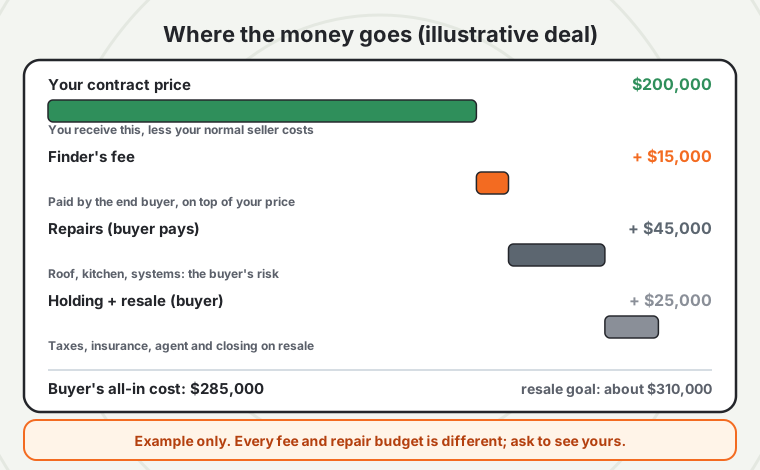
Here’s how the money works, in a simple illustration. Say the end buyer is willing to spend $215,000 in total on your house. If you sign with a wholesaler at $200,000, the end buyer pays you $200,000 and pays the wholesaler $15,000 for the deal.
Illustration only, not a typical or promised fee or price.
Could you have gotten $215,000? Maybe some of it, if you’d found that investor yourself, checked their money, negotiated and carried the risk they’d back out. That’s what the fee pays for. Many homeowners decide it’s worth it. Some don’t, and they should list or call several direct buyers. What you should never accept is a fee that’s hidden from you.
Investors also use rules of thumb to set their maximum price, such as the “70% rule”: about 70% of the expected after-repair value, minus repairs. It’s a rule of thumb, not a law, and it explains why cash offers on houses that need work look low. We explain it in why cash offers on houses are so low.
Before deciding, run your own numbers both ways. Our Connecticut fair offer guide shows how to sanity-check a cash offer, and cash buyer vs. realtor compares the net from each route.
Which homeowners does a wholesale sale fit, and which doesn’t it?
A wholesale sale fits homeowners whose house is hard to sell the usual way: it needs major repairs, has tenants, is inherited or vacant, is far away, or comes with a deadline like a foreclosure or probate. It doesn’t fit an updated house in a strong market when the owner has time, because listing will usually net more.
A wholesale or cash sale fits if…
- The house needs repairs you can’t or won’t pay for
- You have a deadline: foreclosure, probate, a move, a divorce
- There are tenants, especially non-paying ones
- You inherited it, or live out of state
- A lender’s appraisal or inspection would kill a normal sale
- Privacy and a sure date matter more than top price
List with an agent if…
- The house is updated and in good shape
- You have three to six months and no deadline
- You can keep it ready for showings
- Buyers with mortgages can buy it as it is
- Getting the highest price matters most
- Your area has more buyers than houses for sale
Situation guides for Connecticut sellers: facing foreclosure, an inherited or probate house, a rental with tenants and a house that needs repairs.
When is listing with an agent better than selling to a wholesaler?
Listing with an agent is better than selling to a wholesaler when your house is in good condition, buyers with mortgages can purchase it, you have several months, and getting the highest price matters most. In that case the open market usually beats any investor offer, even after the commission. A wholesaler makes more sense when repairs, deadlines or tenants make listing hard.
We say this on a page owned by a company that buys houses, because it’s true and because you’d figure it out anyway. When a seller who calls us would be better off listing, we tell them so. A wholesaler, or any cash buyer, is solving a problem: the house that won’t pass a lender’s inspection, the deadline that won’t wait, the tenant situation that scares off retail buyers. If you don’t have that problem, you probably don’t need that solution.
A middle path exists too. Some investors offer a novation, sometimes called fix-and-list: they agree with you to repair and sell the house on the open market and you split the result as agreed in writing. It can net more than a cash offer on a house that just needs cosmetic work, but it takes longer and depends on the market. Our comparison of a wholesaler vs. a realtor vs. a cash buyer lays out all four models.
How do you know if your “cash buyer” is really a wholesaler?
You know if your “cash buyer” is really a wholesaler by asking directly whether they will buy or assign, reading the contract for “and/or assigns” or an assignment clause, asking for proof of funds in the buyer’s name, and noticing whether strangers ask to walk through. In states that require it, a wholesaler must also give you a written disclosure before you sign.
- Ask: “Are you buying my house, or assigning the contract?” There’s nothing wrong with either answer. There is everything wrong with a vague one.
- Read the buyer’s name: “ABC Homes LLC and/or assigns” means they can transfer the contract. See what “and/or assigns” means.
- Ask for proof of funds: in the name on the contract, dated recently.
- Watch the walkthroughs: several different “partners” or “contractors” touring the house usually means it’s being marketed to buyers.
- Look for the disclosure: Connecticut, Arizona, Iowa, Ohio, Oklahoma, Texas, Wisconsin and other states require written disclosure. If it’s required where you live and you didn’t get it, that tells you a lot.
- Check a license or registration: some states require one. In Connecticut, ask for the DCP wholesaler registration and check it on DCP’s verify-a-license page.
What should you check before you sign with a wholesaler?
Before you sign with a wholesaler, check that they disclose the assignment in writing, hold any license or registration your state requires, can show who the end buyer will be or how their buyers prove funds, will put a real deposit with an attorney or escrow agent, set a firm, short closing date, and won’t record anything against your house.
| Check | Good sign | Red flag |
|---|---|---|
| Buy or assign? | A one-sentence answer, in writing | “Don’t worry about that” or “we’re the buyer” with “and/or assigns” in the contract |
| License or registration | Number given up front, checkable online | Can’t or won’t give it in a state that requires it |
| Written disclosure | Given before you sign, even where not required | Missing, or handed over after signing |
| Deposit | Meaningful, held by an attorney, title or escrow company | Tiny, due later, or held by the buyer |
| Inspection period | Days, with a clear end | Weeks, “for any reason”, with closing far away |
| Recording | “We won’t record anything”, and the contract says so | Wants to record a memorandum or affidavit |
| Pressure | Take your time, show it to your attorney | “This offer expires today” |
| Fees | No upfront fees, ever | Any “application”, “processing” or “listing” fee from you |
| Track record | Deeds you can look up, reviews naming real towns | No closed deals they can point to |
The full verification checklist is in how to check a cash home buyer, and the patterns regulators have flagged are in “we buy houses” scams and red flags.
How do you sell your house to a wholesaler safely, step by step?
To sell your house to a wholesaler safely, get at least one other offer or a listing opinion first, ask whether they will buy or assign, check their license or registration, have your own attorney read the contract, negotiate a short timeline, a real deposit and a no-recording clause, and stay in touch until closing. Know your exit if they can’t close.
Get a baseline number
Before you talk to any wholesaler, know roughly what your house is worth as-is and fixed up. Ask an agent for a free opinion, look at recent sales of similar houses, or get two or three cash offers. Your town’s assessed value is not market value; Connecticut’s disclosure report warns sellers it “may be significantly less”.
Ask the key question and get it in writing
“Are you buying my house, or assigning the contract?” If they’ll assign, ask how many deals they have closed with the buyers they have in mind, and how those buyers prove their funds.
Check their license or registration
If your state requires a license or a wholesaler registration, check it on the state’s lookup page before you sign. In Connecticut, every wholesaler must be registered with the Department of Consumer Protection (CGS 20-329bbb).
Get the required disclosure before signing
Many states require a written disclosure that the buyer may assign the contract. In Connecticut it’s the state’s wholesale disclosure report, which you both sign before the contract (CGS 20-329eee). Read it. It tells you your rights in plain words.
Have your own attorney read the contract
Ask them to check the closing date, inspection period, deposit, assignment clause, access for showings, what happens if the buyer doesn’t close, and a no-recording clause. In Connecticut, closings are handled by attorneys anyway; the Connecticut Bar Association can refer you.
Know your exit before you sign
Write down any cancellation window you have (in Connecticut, three business days) and the latest closing date (in Connecticut, no more than 90 days unless extended in writing). See how to back out of a wholesale contract.
Stay involved until closing
Ask for the end buyer’s name once they’re assigned, confirm the closing date with your attorney, and don’t move out or turn off utilities until closing is set. After closing, check the land records show the deed and nothing else.
How do you compare a wholesaler’s offer with other offers?
You compare a wholesaler’s offer with other offers by looking at your net after costs, how likely each buyer is to close, how fast, what you must do before closing, and how easily each buyer can walk away. The highest number on paper isn’t the best offer if the buyer can cancel for weeks with no deposit at stake.
| Compare | Why it matters |
|---|---|
| Net to you | Price minus your payoffs, transfer or conveyance tax, attorney fees and any commission. A higher price with a commission can net less than a lower price without one, or more. |
| Who is buying | A buyer closing with their own funds is more certain than a contract that still needs an end buyer. |
| Deposit and who holds it | A meaningful deposit with an attorney or escrow agent means the buyer has something to lose. |
| Inspection period | How long the buyer can walk away for any reason. |
| Closing date | When you get paid, and whether it beats your deadline. |
| Condition and clean-out | As-is, or repairs and clean-out first? |
| Price-change risk | Can the price change after inspection? On what grounds? |
Connecticut sellers can run the numbers with our calculator, using their own town’s conveyance tax:
How much would you walk away with?
Slide the numbers to match your house. It works in your browser; nothing is saved or sent.
Estimates for planning. Conveyance tax per CGS 12-494 (state 0.75% up to $800,000, 1.25% to $2.5M, 2.25% above, plus the town rate). Seller attorney about $1,200 to $1,500; flat-fee MLS about $400; listings include three months of taxes, insurance and utilities, a cash sale about two weeks. Your attorney gives you the final numbers.
What’s different if your house is in Connecticut?
If your house is in Connecticut, the wholesaler must be registered with the Department of Consumer Protection, give you the state’s disclosure report before you sign, let you cancel within three business days for any reason, and close within 90 days unless you both extend in writing. Recording the contract or a lien is banned, and violations are unfair trade practices.
These rules come from Connecticut General Statutes sections 20-329aaa to 20-329hhh, in force since July 1, 2026 (the disclosure report since October 1, 2026). A Connecticut wholesale sale also closes like any other: through attorneys, with you paying the state and town conveyance tax (CGS 12-494) and giving the buyer the Residential Property Condition Report before signing (CGS 20-329ddd).
The Connecticut version of this guide, with what to do if you’ve already signed, is what to expect when selling your house to a wholesaler in Connecticut. For the state’s own explanation, see DCP’s real estate wholesaling page. If you’re comparing companies, our company page shows the checks you can run on us.
How does We Buy Houses In Connecticut, LLC handle a house it won’t buy itself?
When a house doesn’t fit what We Buy Houses In Connecticut, LLC buys itself, we say so plainly. Then, if you want, we offer to match you with a cash buyer we know closes, and we tell you in writing that the contract will be assigned. Any assignment in Connecticut is handled by a registered wholesaler, and we stay with you until closing.
We’ve been buying Connecticut houses since 2016, about 10 a year, with a typical close in about two weeks. Buyer matching is only one of the ways we work. We also buy with our own and partners’ cash, and offer seller financing, subject-to, lease options and novation (fix-and-list) where they fit. Every route is laid out on all the ways we buy houses in Connecticut.
- You hear up front, in writing, whether we’re buying it or assigning it.
- You get the state disclosure report before you sign, and the full three business days to think, call your attorney or change your mind.
- The end buyer pays the fee, on top of your contract price.
- If the house would do better listed with an agent, we tell you that too.
Send a few photos and get a written offer that says who is buying
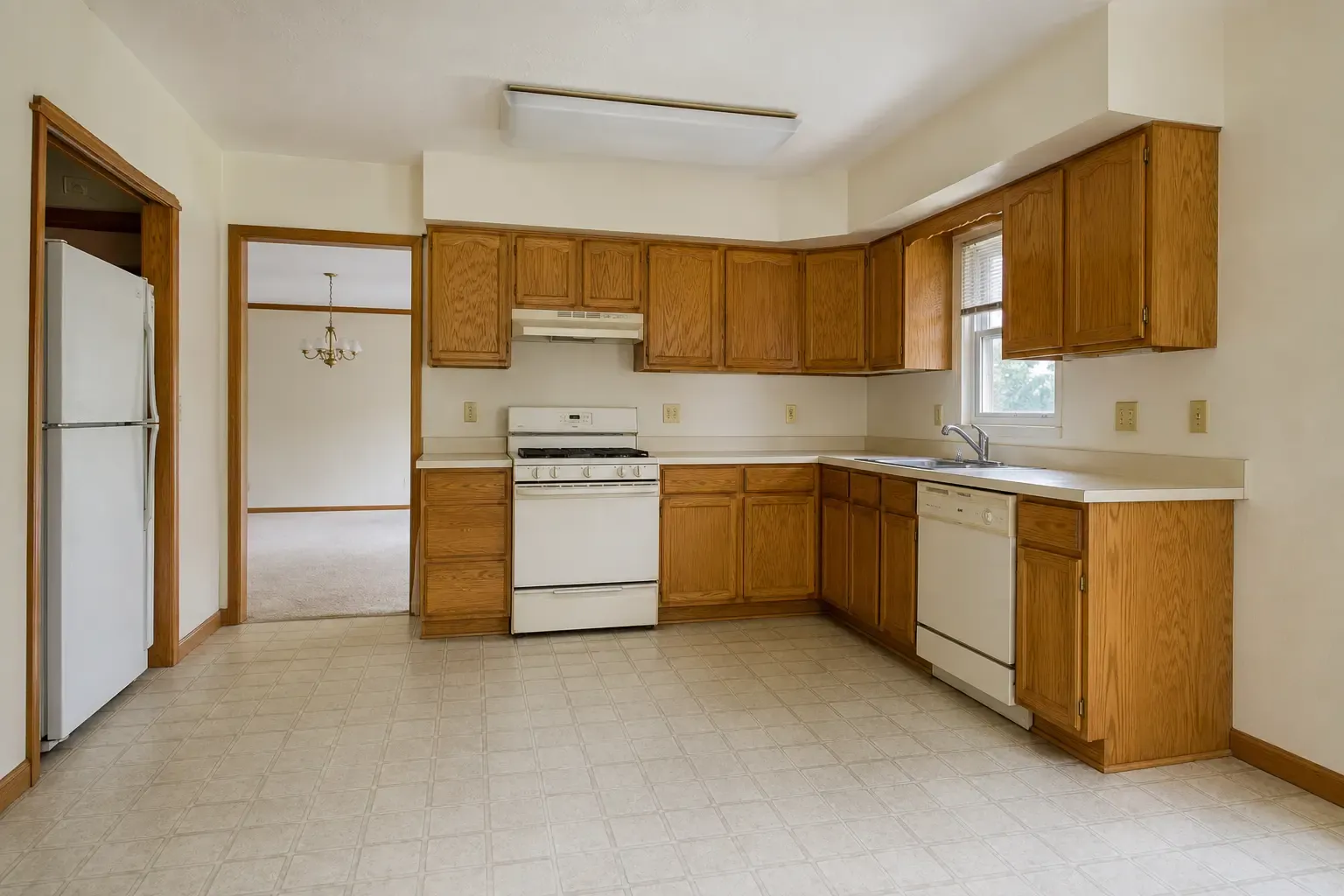
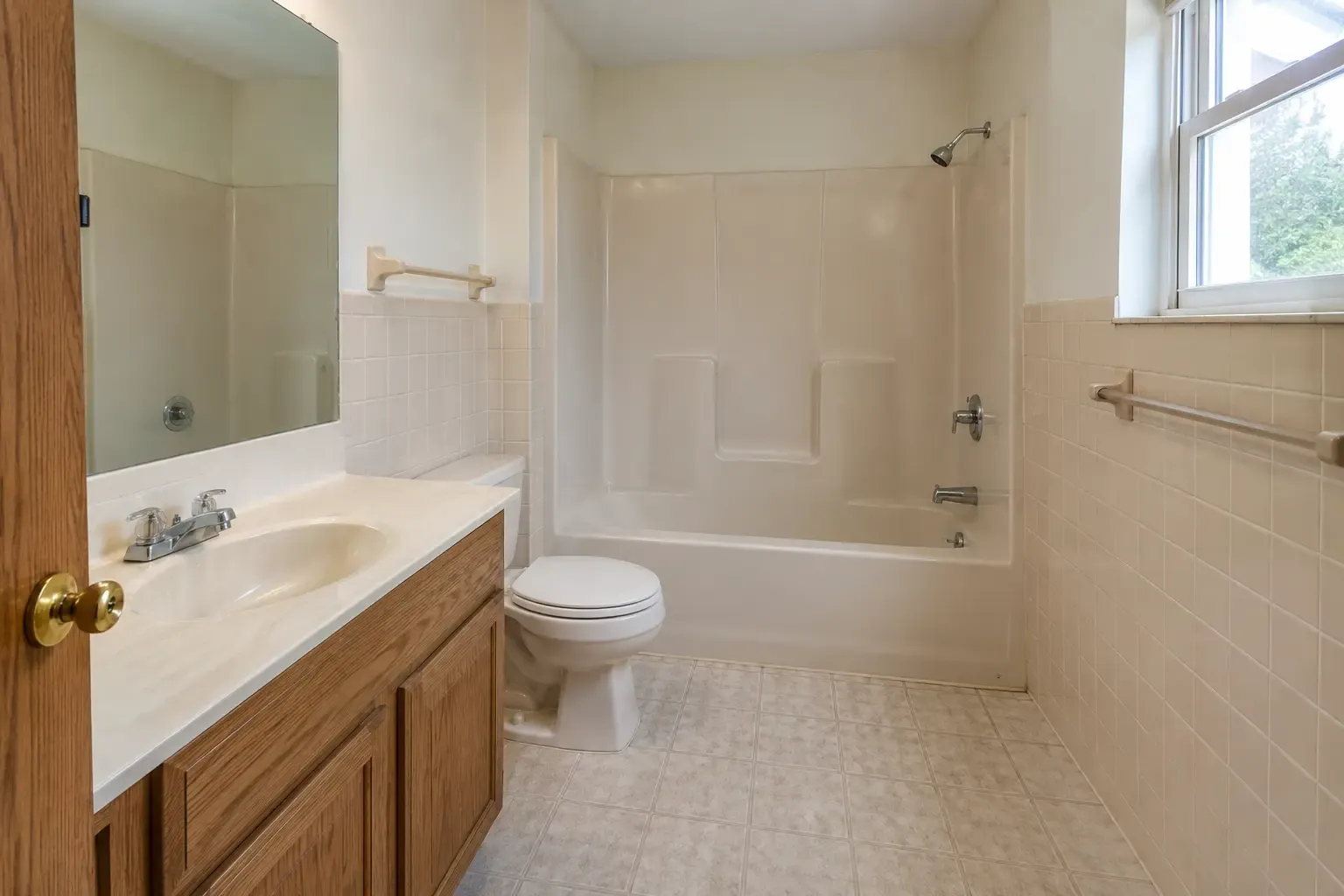
Want your offer faster, or rather not talk to anyone yet? Snap the rooms on your phone. Jerryll's team prices the repairs and sends back a written cash offer that says plainly whether we would buy the house ourselves or bring you one of our buyers. No obligation, no expiry pressure.
 CabinetsFlooring
 Tub & tile
 Floors
 Roof
We may bring in a partner buyer to close. Your price and terms don't change.
Ready to compare? Get your written cash offer, or call Jerryll at (203) 529-4712. For the background on how this all works, go back to our homeowner’s guide to wholesaling.
Questions about selling your house to a wholesaler
Should I sell my house to a wholesaler?
You should consider selling your house to a wholesaler if speed and selling as-is matter more than top price, and the wholesaler discloses the assignment, follows your state’s rules and has buyers who close. If your house is updated and you have time, listing with an agent usually nets more.
Is it bad to sell your house to a wholesaler?
No, it isn’t bad in itself. An honest wholesaler can deliver a fast, as-is sale for a house that’s hard to sell otherwise. It’s a bad idea when the house would sell well on the market, or when the wholesaler hides what they are or can’t close.
Will I get less money selling to a wholesaler?
Usually less than listing an updated house, because investors pay below retail to cover repairs, costs and profit, and the wholesaler’s fee comes from the end buyer’s budget. Compared with a direct cash buyer, it depends on the deal; get more than one offer.
Is selling to a wholesaler faster than listing?
Often, yes. A wholesaler with real buyers can line one up within days, and closing then depends on title work and payoffs. A listing usually takes months. But a wholesaler without buyers can be slower, because you lose time while they search.
Does the wholesaler’s fee come out of my price?
No. With an assignment, the end buyer pays the wholesaler’s fee on top of the price in your contract. You receive your contract price, less your normal seller costs. The fee is part of what the end buyer decided they could pay for your house.
Do I pay a commission when I sell to a wholesaler?
No, you don’t pay an agent commission when you sell to a wholesaler. You still pay normal seller costs, such as transfer or conveyance tax, your attorney and any mortgage payoff. Never pay a wholesaler an upfront fee.
How do I know if my buyer is a wholesaler?
Ask directly whether they’ll buy or assign, look for “and/or assigns” after the buyer’s name, ask for proof of funds in the contract buyer’s name, and watch for multiple investors touring the house. In many states, a wholesaler must also give you a written disclosure.
Can I back out after signing with a wholesaler?
Often, depending on your state and contract. Connecticut gives three business days, Oklahoma two business days, Louisiana at least five days, Delaware 21 days and Pennsylvania 30 days. Several other states allow cancellation before closing if the required disclosure was missing.
Is wholesaling legal?
Wholesaling is legal in every state we’ve checked, but at least 21 states regulate it with licensing or registration, written disclosures, cancellation rights or recording limits. No state we found bans it outright. The rules depend on where your house is.
What happens if the wholesaler can’t find a buyer?
If the wholesaler can’t find a buyer, the contract usually ends through an inspection-period cancellation or on its closing date. In Connecticut it ends automatically after 90 days unless extended in writing. Make sure nothing was recorded against your house.
Do I need an attorney to sell to a wholesaler?
It is wise to have one, and in Connecticut closings are handled by attorneys anyway. Your own attorney can check the assignment clause, deposit, inspection period, closing date and recording language, and protect your interests rather than the buyer’s.
Can a wholesaler put a lien on my house?
A wholesaler may try to record a memorandum or an affidavit of equitable interest, which can cloud your title. Connecticut, Louisiana and Oklahoma bar this for wholesale contracts, and Texas regulates one-sided memorandums. Add a no-recording clause to your contract.
Sources
- Connecticut General Statutes chapter 392a, §§ 20-329aaa to 20-329hhh (real estate wholesalers; P.A. 25-168, effective July 1, 2026).
- Connecticut Department of Consumer Protection: Real Estate Wholesaling.
- Connecticut DCP: verify a license or registration.
- CGS § 12-494 (real estate conveyance tax).
- Kansas Real Estate Commission testimony on HB 2598 (January 31, 2024).
- Kansas Real Estate Commission bulletin on the Attorney General’s wholesaling lawsuit (April 2026).
- Oklahoma Real Estate Commission: wholesaling law.
- Pennsylvania Act 52 of 2024 (SB 1173).
- Delaware SB 201 (2026).
- Louisiana HB 468, Act 807 (2026).
- Texas HB 4063 (2025), Tex. Prop. Code § 12.020.
- Other state laws are linked in wholesaling laws by state.
Who wrote this
Jerryll Noorden
Jerryll has bought and sold Connecticut houses since 2016 and has sat at more closing tables than he can count, on both sides. Before real estate he was a robotics scientist at NASA, IHMC and IIT. He wrote this guide because the national sites that rank for it skip the Connecticut rules that cost sellers money. When listing or selling it yourself would get you more than a cash offer, he says so.
This guide explains Connecticut rules in plain English. It is not legal or tax advice. Laws change; for your sale, talk to a Connecticut real estate attorney and a tax professional.
