
Connecticut seller’s guide · Facts checked October 26, 2026
Real Estate Wholesaling Laws by State (2026): A Seller’s Guide
Every state that regulates real estate wholesaling, what each law requires, and the rights it gives you as the seller, checked against the statutes in October 2026.

Real estate wholesaling is legal in every state we checked, but as of October 2026 at least 21 states regulate it. Some require a license or registration, many require a written disclosure, and five give sellers a no-reason cancel period: Oklahoma 2 business days, Connecticut 3 business days (CGS 20-329ccc), Louisiana 5 days, Delaware 21 days and Pennsylvania 30 days.
- Wholesaling is legal in every state we checked. As of October 2026, no state we found bans it outright, but at least 21 states have rules written for it. (New to the term? Start with what real estate wholesaling is.)
- The rules come in four kinds: a real estate license or a state registration, a written disclosure to you, a right to cancel, and limits on recording anything against your title. Many states use more than one.
- Five states give you a no-reason cooling-off period: Oklahoma (2 business days), Connecticut (3 business days), Louisiana (at least 5 days), Delaware (21 days) and Pennsylvania (30 days).
- In many others, a missing disclosure is your exit. Arizona, Iowa, Maryland, Missouri, North Dakota, Ohio, Oregon and Wisconsin let you cancel before closing if the wholesaler didn’t tell you in writing what they are.
- No law doesn’t mean no rules. In states without a wholesaling statute, the general real estate license law, consumer protection law and your contract still apply.
- Laws here change every year. Five of the laws below took effect in 2026. Every row links to the statute or the agency page, so you can check it yourself.
Is real estate wholesaling legal in every state?
Real estate wholesaling is legal in every state we checked, as of October 2026. No state we found bans it. But at least 21 states now regulate it with laws written specifically for wholesaling: some require a real estate license or a state registration, some require a written disclosure to the seller, many give the seller a right to cancel, and a few forbid recording anything against the seller’s title.
If you are a homeowner, the question that matters isn’t whether wholesaling is legal. It’s what rights you have if someone who calls themselves a cash buyer turns out to be a wholesaler. That depends entirely on the state your house is in, not the state the wholesaler is in.
This page is the state-by-state companion to our main guide, what real estate wholesaling is and how it works. If you are new to the idea, start there. In short: a wholesaler signs a contract to buy your house and then assigns that contract to another investor, who closes with you and pays the wholesaler a fee. Done honestly, it is a useful way to sell a house that doesn’t fit the usual buyer. Done dishonestly, it ties up your house with a contract nobody intended to close. The state laws below exist because of the second kind.
We researched every law on this page from the statute, the enacted bill or the state agency’s own page, in October 2026. This is general information, not legal advice. Before you rely on any of it for your own sale, read the linked law or ask a real estate attorney in your state.
Which states have wholesaling laws, and what do they require?
The states with wholesaling laws, as of October 2026, are Alabama, Arizona, Connecticut, Delaware, Illinois, Iowa, Kentucky, Louisiana, Maryland, Missouri, Nebraska, North Dakota, Ohio, Oklahoma, Oregon, Pennsylvania, South Carolina, Tennessee, Texas, Virginia and Wisconsin. What they require varies: a license or registration, a written disclosure, a right to cancel, or a ban on clouding your title.
Here is the whole picture in one table. Each state has its own section further down, with what the law means for you as the seller.
| State | License or registration | Written disclosure to you | Your right to cancel | Title protection |
|---|---|---|---|---|
| Alabama | No | Yes, before marketing, and 3 business days before assignment | None in the law | Bans recording long-term listing agreements |
| Arizona | No | Yes, before you sign | Before closing, if not disclosed | — |
| Connecticut | State registration (DCP) | Yes, the state’s disclosure report | 3 business days, any reason | Recording banned; no legal effect |
| Delaware | License (phasing in) | Yes, in the contract | 21 days, any reason | — |
| Illinois | Broker license at 2+ deals in 12 months | No specific rule | None in the law | — |
| Iowa | License, or broker representation | Yes, to all parties | Before closing, if not disclosed | — |
| Kentucky | License to advertise a contract | No specific rule | None in the law | — |
| Louisiana | Not in this law | Yes, before you sign | At least 5 days, any reason | No liens or clouding title |
| Maryland | No | Yes, before the contract (owner-occupied homes) | Before closing, if not disclosed and assigned | — |
| Missouri | No | Yes, 14 days before the contract | Before closing, if not disclosed | — |
| Nebraska | License to publicly market a contract | Signed addendum when a licensee markets it | None in the law | — |
| North Dakota | License to publicly market a contract | Yes, to all parties | Before closing, if not disclosed | — |
| Ohio | No | Yes, a separate signed form | Before closing, if not disclosed | — |
| Oklahoma | License to publicly market a contract | Yes, including intent to resell for more | 2 business days, any reason | No liens or clouding title |
| Oregon | State registration, or a license | Yes, on the agency form | Any time, if not disclosed | — |
| Pennsylvania | License | Yes, in the contract | 30 days, any reason | — |
| South Carolina | Licensees barred from wholesaling | No specific rule | None in the law | — |
| Tennessee | No | Yes, in bold, large print | None in the law | — |
| Texas | No, if disclosed | Yes, in writing | None in the law | Rules for one-sided memorandums |
| Virginia | Broker license at 2+ deals in 12 months | No specific rule | None in the law | — |
| Wisconsin | No | Yes, no later than signing | Before closing, if not disclosed | — |
A few patterns stand out. The license states (Illinois, Kentucky, Nebraska, North Dakota, Oklahoma, Pennsylvania, Virginia, and soon Delaware) treat marketing someone else’s house as brokerage, which already needs a license. The disclosure states focus on one thing: making sure you know, in writing, that the person signing may not be the person buying. And the newest laws, from 2025 and 2026, go further, with cooling-off periods, closing deadlines and bans on clouding your title.
Is wholesaling legal in Alabama?
Yes, wholesaling is legal in Alabama, with written disclosure. Under the 2023 law (SB 228, Ala. Code §§ 8-42-1 to 8-42-3), a buyer wholesaling a single-family home must tell the seller in writing that they intend to market the contract before marketing it, and give at least three business days’ written notice before assigning it. A violation is a misdemeanor, and the wholesaler can owe three times the fee.
- Who it covers: single-family residential property only. Duplexes and other property are outside it.
- What you must be told: the buyer’s intent to market their equitable interest (their contract right to buy your house), before any marketing, and the date of any assignment at least three business days ahead. Later buyers must be told the nature of the interest.
- How it can be transferred: the law applies to assignment, novation or any similar way of transferring the interest.
- Teeth: a Class C misdemeanor, plus civil liability to you of three times the fee the wholesaler received.
- Your title: the same act makes long-term “right to list” service agreements unenforceable and bans recording them or a memorandum of them.
What it doesn’t do: give you a cooling-off period or require a license. The law also says it doesn’t stop the parties from agreeing otherwise by contract, so read yours. Source: SB 228, enrolled (2023).
Is wholesaling legal in Arizona?
Yes, wholesaling is legal in Arizona, but a wholesale buyer of a home with fewer than five units must tell the seller in writing that they are a wholesale buyer before any binding agreement (A.R.S. § 44-5101). If they don’t, the seller may cancel the contract at any time before close of escrow, without penalty, and keep the earnest money.
Arizona’s law is short and clear. A “wholesale buyer” is someone who signs a purchase contract as the buyer and assigns that same contract to someone else. They must disclose that status in writing first. A wholesale seller, meaning the wholesaler passing the contract on, must tell the end buyer in writing that they hold only an equitable interest and may not be able to convey title.
For you, the key line is the remedy: no disclosure, and you can walk away until escrow closes, and keep their deposit. There is no license requirement and no no-reason cooling-off period in this section. Source: A.R.S. § 44-5101.
Is wholesaling legal in Connecticut?
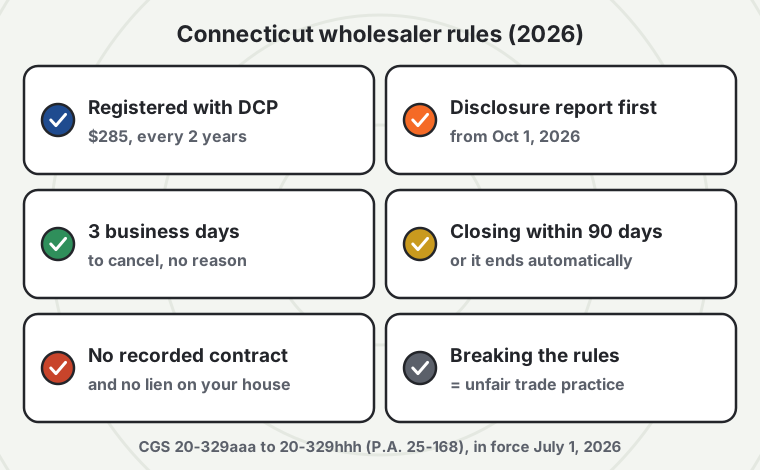
Yes, wholesaling is legal in Connecticut, and since July 1, 2026, it is one of the most tightly regulated states. Wholesalers must register with the Department of Consumer Protection, give you the state’s disclosure report before you sign, let you cancel within three business days for any reason, and set a closing no more than 90 days out (CGS §§ 20-329aaa to 20-329hhh).
| Rule | What it means for you | Statute |
|---|---|---|
| Registration | No one may act as a wholesaler in Connecticut without a DCP registration ($285, valid up to two years). A real estate license doesn’t replace it. DCP says there are no exceptions. | CGS 20-329bbb |
| Disclosure report | Since October 1, 2026, the wholesaler must give you the state’s written disclosure report before you sign. It says they may not be the buyer, may market your house and may profit from an assignment fee. You both sign it. | CGS 20-329eee |
| 3 business days to cancel | You can review the contract with an attorney and cancel within three business days, for any reason, with no penalty other than returning any deposit they paid you. | CGS 20-329ccc(a) |
| 90-day closing limit | The closing date can’t be more than 90 days after everyone signs. An extension must be in writing and signed by all parties; otherwise the contract ends automatically. | CGS 20-329ccc(b) |
| No recording | No one may record the contract, a notice of it, a lien or a purchaser’s lien. Anything recorded anyway gives no legal notice, and you can clear it with an affidavit of facts. | CGS 20-329fff |
| Teeth | Violations are unfair or deceptive trade practices under CUTPA. | CGS 20-329hhh |
Two details worth knowing. First, you have a duty too: before signing, you give the wholesaler a written property condition report (CGS 20-329ddd). Second, the law defines a wholesaler as someone who arranges the sale “without assuming title”, so a wholesaler who uses a double close may argue it doesn’t apply. Ask your attorney. For the full Connecticut picture, including what to do if you already signed, read selling a house to a wholesaler in Connecticut. You can check any registration on DCP’s verify-a-license page.
Is wholesaling legal in Delaware?
Yes, wholesaling is legal in Delaware, but a 2026 law (SB 201, signed June 1, 2026) makes it licensed real estate activity. The wholesale contract must say it is a wholesale transaction and explain your rights, and you can cancel until midnight of the 21st day after signing, or until conveyance. The disclosure and cancellation rules took effect in late August 2026; the license requirement follows in February 2027.
Delaware modeled its law on Pennsylvania’s. The bill’s own synopsis says assignment fees can be used as “equity stripping” of money that should go to the seller, which is why it treats marketing a contract as brokerage.
- Who it covers: one-to-four-family homes and single residential lots.
- What the contract must say: that it is a wholesale transaction; that you may get an appraisal, an unaffiliated real estate licensee or a lawyer; how to cancel; and that refunds are due within 10 business days.
- Your cancel right: until midnight of the 21st calendar day after you sign, or until conveyance, whichever is first. If the disclosures are missing, any time before conveyance. You can’t waive it.
- License: wholesaling as a business requires a real estate license, starting 270 days after signing (about February 26, 2027).
Source: Delaware SB 201 (153rd General Assembly), 85 Del. Laws c. 274.
Is wholesaling legal in Illinois?
Yes, wholesaling is legal in Illinois, but doing it as a business requires a real estate broker license. Since 2019, Illinois law has counted “dealing in contracts, including assignable contracts” on two or more occasions in any 12 months as brokerage (225 ILCS 454/1-10). The state regulator says this covers what is “commonly referred to as wholesaling.”
So in Illinois, someone who wholesales houses regularly should hold a broker license, which means they answer to the Illinois Department of Financial and Professional Regulation, carry a license number you can look up, and follow the license law’s rules on conduct and disclosure.
The Illinois law doesn’t add a specific disclosure form or a cooling-off period for sellers. Your protection is the license itself: ask for the number and check it on IDFPR’s license lookup before you sign. Sources: 225 ILCS 454/1-10 and IDFPR’s summary of the Real Estate License Act.
Is wholesaling legal in Iowa?
Yes, wholesaling is legal in Iowa, but only for a licensed real estate broker or someone represented by one (Iowa Code § 543B.6A). Before contracting, the wholesaler must tell every party in writing who is involved, how wholesaling works, and that they hold only an equitable interest and may not be able to convey title. If they don’t, you can cancel before closing and keep the earnest money.
- Who it covers: homes with one to four units.
- License: the wholesaler must be a licensed broker, or represented by one, and must give you a copy of the signed agency agreement.
- Disclosure: the legal identities of all parties, an explanation of wholesaling, and the warning that they may not be able to deliver title.
- Your remedy: cancel any time before closing, without penalty, and keep any earnest money the wholesaler paid.
- Penalty: a civil penalty of up to the greater of $10,000 or 10% of the sale price, for each property.
Source: Iowa Code § 543B.6A (2024 Acts ch. 1040).
Is wholesaling legal in Kentucky?
Yes, wholesaling is legal in Kentucky, but since 2023 only a licensed real estate professional may advertise for sale an equitable interest in a purchase contract (KRS 324.010 and 324.020, 2023 HB 62). In practice, that means a wholesaler who markets your contract to buyers needs a Kentucky real estate license.
Kentucky’s law works through the definition of brokerage. “Real estate brokerage” now includes advertising for sale an equitable interest in a contract between an owner and a buyer, and it is unlawful for someone without a license to do it.
The law doesn’t add a seller disclosure form or a cancellation period. If someone puts your house under contract and you then see it advertised by them, ask for their Kentucky license and check it with the Kentucky Real Estate Commission. Source: 2023 Ky. Acts ch. 84 (HB 62).
Is wholesaling legal in Louisiana?
Yes, wholesaling is legal in Louisiana, but since August 1, 2026 (Act 807 of 2026, HB 468), a wholesaler must disclose in writing before you sign that they intend to assign or market the contract for profit, and advise you to get legal advice. You may cancel for any reason for at least five calendar days, and the wholesaler must put down a deposit of at least 1%.
- Who it covers: homes with one to four units, for contracts made on or after August 1, 2026.
- Cancel: at least five calendar days for any reason, using a required notice and the Louisiana Real Estate Commission’s cancellation form.
- Deposit: at least 1% of the price, held in your account or with an in-state, federally insured escrow holder.
- Your title: no liens and no clouding title.
- No pretending: the wholesaler may not pose as your representative or as a licensee.
- Teeth: violations make the contract voidable, count as unfair trade practices enforced by the Attorney General, and can bring commission penalties of up to $5,000 each.
Source: Louisiana HB 468 (2026), Act 807.
Is wholesaling legal in Maryland?
Yes, wholesaling is legal in Maryland, but since October 1, 2025, a wholesale buyer of an owner-occupied home must tell the owner in writing, before the contract, that they “may assign the contract” (Md. Code, Real Prop. § 10-715). If they didn’t and then assign it, the owner may rescind without penalty any time before closing.
Maryland’s law is narrower than most. It covers owner-occupied homes of four or fewer units, so a rental or a vacant inherited house may fall outside it. Note the two conditions on your remedy: the disclosure was missing and the contract was actually assigned.
The law also protects the end buyer: the wholesaler must tell them in writing that they hold only an equitable interest and may not be able to convey title, and an end buyer who wasn’t told can back out and get their deposit back. There is no license requirement or stated fine. Source: Md. Code, Real Prop. § 10-715 (2025 HB 124, Ch. 508).
Is wholesaling legal in Missouri?
Yes, wholesaling is legal in Missouri, but since August 28, 2026, a wholesaler must give the owner a written disclosure at least 14 calendar days before signing a contract, and both must sign and date it first (SB 973, § 407.3600 RSMo). If they don’t, the owner may cancel before closing, and the escrow agent returns the earnest money to the owner within 30 days.
Missouri’s 14-day head start is the longest in the country: it gives you two weeks with the disclosure in hand before you can sign. The rights can’t be waived in the contract.
Violations are unlawful practices under the Missouri Merchandising Practices Act. You can sue the wholesaler yourself if you signed without the disclosure, and the Attorney General can bring a civil action. Source: Missouri Senate, SB 973 (2026).
Is wholesaling legal in Nebraska?
Yes, wholesaling is legal in Nebraska, but publicly marketing an equitable interest in a purchase contract counts as acting as a broker, so it requires a real estate license (Neb. Rev. Stat. § 81-885.02, from LB 892 of 2022). When a licensee markets a wholesaler’s contract, the owner must sign an Assignable Contract Addendum.
The Nebraska Real Estate Commission’s Policy and Interpretation No. 42 spells out how this works. The addendum the owner signs acknowledges that the equitable interest is being marketed for a profit, and that the owner gets none of that profit unless the purchase agreement says otherwise. Ads must make clear that a contract, not the house itself, is being marketed. Marketing without the addendum is a disciplinary violation.
That acknowledgment is worth reading twice: whatever the end buyer pays above your price goes to the wholesaler, unless you negotiated otherwise up front. Sources: Neb. Rev. Stat. § 81-885.02 and NREC Policies and Interpretations.
Is wholesaling legal in North Dakota?
Yes, wholesaling is legal in North Dakota, but publicly marketing an equitable interest requires a real estate license, and every wholesaler must disclose in writing to all parties that they hold only an equitable interest, may not be able to convey title, and intend to profit (N.D.C.C. §§ 43-23-06.1 and 43-23-24). Without that disclosure, the seller may cancel before closing.
North Dakota is one of the few states that requires the wholesaler to say out loud that they intend to make money on your contract. That’s useful: it turns a vague “investor” into a clear statement you can weigh.
If the disclosure is missing, the seller may cancel any time before close of escrow and keep the earnest money; an end buyer may cancel and get a refund. The current code applies to “real property”, not only homes. Source: N.D.C.C. chapter 43-23.
Is wholesaling legal in Ohio?
Yes, wholesaling is legal in Ohio, but since March 2, 2026, anyone who assigns or novates a home purchase contract for a fee must give the owner a separate written disclosure, signed by both, before a binding contract (R.C. 5301.95, from SB 155). Without it, the owner may cancel before closing, and the earnest money goes to the owner.
- Who it covers: homes with one to four units. It applies to both assignments and novations, with exceptions for close relatives and affiliates.
- Disclosure: a separate signed form, not a line buried in the contract.
- Your remedy: cancel before close of escrow; earnest money released to you within 30 days. You can’t waive it.
- Teeth: violations are treated as unfair or deceptive acts under the Consumer Sales Practices Act, and you can sue.
Ohio is notable for covering novations, the “we’ll fix it up and sell it for you” agreements, not just assignments. Source: Ohio Rev. Code 5301.95.
Is wholesaling legal in Oklahoma?
Yes, wholesaling is legal in Oklahoma, but it is licensed and heavily regulated. Since 2021, only a licensee may publicly market an equitable interest (59 O.S. § 858-301). Since November 1, 2025 (SB 1075), a wholesaler must disclose in writing that they intend to resell for a higher price, and you may cancel within two business days for any reason.
Oklahoma’s 2025 law is one of the most detailed seller-protection laws in the country:
- Before any contract: written disclosure of the intent to assign or sell the interest “for a higher price than what is offered” to you, and a prominent note that you should get legal advice.
- A notice beside your signature: the contract must carry a “NOTICE REQUIRED BY OKLAHOMA LAW” in bold, with the date your cancel right ends, plus the state’s cancellation form.
- No deed until the clock runs out: the wholesaler can’t ask you to sign a deed or other documents until your two business days have passed.
- Title and money: no liens or clouding your title; earnest money held in an in-state, federally insured escrow account.
- No pretending: they may not pose as your advisor or as licensed.
- If they skip the rules: you are entitled to the earnest money and can end the contract at any time.
Oklahoma’s definition of wholesaler also expressly includes double closing. Sources: SB 1075, enrolled (2025) and Oklahoma Real Estate Commission.
Is wholesaling legal in Oregon?
Yes, wholesaling is legal in Oregon, but a wholesaler must be registered with the Oregon Real Estate Agency as a Residential Property Wholesaler, or hold a real estate license. They must give you the agency’s written disclosure form before you sign. If they don’t, you can cancel the contract at any time without penalty and keep the earnest money.
Oregon’s law (Oregon Laws 2024, ch. 3, from HB 4058) covers someone marketing a home while holding only a contract or option, for fewer than 90 days, with less than $10,000 put into the property.
The disclosure goes to sellers and buyers before any contract, to any broker involved, and into every ad for the property. Unregistered wholesaling can bring civil penalties and a cease-and-desist order. Source: Oregon Real Estate Agency: residential property wholesaling.
Is wholesaling legal in Pennsylvania?
Yes, wholesaling is legal in Pennsylvania, but since January 2025 it requires a real estate license (Act 52 of 2024). The contract must say it is a wholesale transaction and explain your rights, and you can cancel until midnight of the 30th day after signing, or until conveyance. If the required statements are missing, you can cancel any time before conveyance.
- Who it covers: one-to-four-unit homes in Pennsylvania. The usual exemption for owners doesn’t apply to wholesale deals.
- What the contract must say: that the licensee intends to transfer the interest for a fee without taking title; that you may get an appraisal, an unaffiliated licensee or a lawyer; and how and when you can cancel.
- Your cancel right: 30 days, the longest no-reason period in the country. It can’t be waived, and you owe no damages for using it.
- Refunds: everything you paid is refunded within 10 business days.
Philadelphia adds its own layer: a city wholesaler license, with insurance and a background check, and a do-not-solicit list for homeowners. Sources: Act 52 of 2024 (SB 1173) and City of Philadelphia.
Is wholesaling legal in South Carolina?
Wholesaling is not banned in South Carolina, but since 2024 licensed real estate brokerages and their agents may not engage in or assist with it (S.C. Code §§ 40-57-30(44) and 40-57-350). The law defines wholesaling as marketing a home to another buyer before taking ownership, and excludes simply assigning or offering to assign a contract.
South Carolina took a different route from every other state. Instead of licensing wholesalers, it keeps licensees out of wholesaling. The same definition also says that advertising or marketing real estate owned by someone else, with the expectation of pay, falls under the definition of broker and requires a license.
What that means for you: an assignment of your contract isn’t “wholesaling” under the statute, but someone advertising your house to the public without a license may be doing unlicensed brokerage. There is no seller disclosure form or cancel right in this law. Source: Act 204 of 2024 (H. 4754).
Is wholesaling legal in Tennessee?
Yes, wholesaling is legal in Tennessee if the buyer discloses it. Under a 2025 law (Public Chapter 72, Tenn. Code §§ 66-4-401 to 66-4-403), the buyer must tell the seller in writing of their intent to market the contract before it is signed, and give at least three business days’ written notice of any assignment. The disclosures must be in bold, large print in the agreement.
Tennessee defines wholesaling as assigning the equitable interest to a later buyer “for a higher price” than the wholesaler agreed to pay. Later buyers must also be told the nature of the interest.
There is no license requirement or cancel right in this law. A lawsuit for a violation must be filed within two years after the contract was signed, so if something went wrong, don’t wait. Source: Tennessee Public Chapter 72 (2025).
Is wholesaling legal in Texas?
Yes, wholesaling is legal in Texas without a license, as long as the wholesaler discloses the nature of their equitable interest in writing to the seller and to any potential buyer (Tex. Occ. Code § 1101.0045). Without that written disclosure, assigning the contract counts as unlicensed real estate brokerage. Texas also regulates one-sided memorandums of contract recorded against homes.
- Disclosure: since January 1, 2024 (SB 1577), written disclosure to the owner as well as buyers. Before 2024, only buyers had to be told. The Property Code (§ 5.0205) also requires telling the owner in writing that the person intends to assign the contract.
- Memorandums: since September 1, 2025, anyone who records a memorandum of contract that only they signed on a one-to-four-unit home must mail the owner a copy and notice (Tex. Prop. Code § 12.020). The owner can record an affidavit that works as a release unless the filer records a contradicting affidavit within 45 days.
That second rule matters: a recorded memorandum is the main way a stalled wholesale deal ends up blocking a later sale. More in our guide to memorandums of contract and clouded titles. Sources: SB 1577 (2023) and HB 4063 (2025).
Is wholesaling legal in Virginia?
Yes, wholesaling is legal in Virginia, but doing it regularly requires a real estate broker license. Since 2024, Virginia’s definition of a real estate broker includes anyone who, for pay, deals in real estate contracts, “including assignable contracts,” on two or more occasions in any 12-month period (Va. Code § 54.1-2100).
Virginia’s rule mirrors Illinois’s: one deal a year is allowed without a license, two or more is brokerage. A licensed wholesaler answers to the Virginia Real Estate Board.
The law doesn’t add a seller disclosure form or a cooling-off period. Ask any Virginia wholesaler for their license number, and check it with the Department of Professional and Occupational Regulation. Source: Va. Code § 54.1-2100.
Is wholesaling legal in Wisconsin?
Yes, wholesaling is legal in Wisconsin, but a real property wholesaler must give the seller written notice that the buyer is a wholesaler no later than when the contract is signed (Wis. Stat. § 710.13, from 2023 Wisconsin Act 208). If they don’t, the seller may rescind any time before closing and keep any deposits. The right can’t be waived.
A “real property wholesaler” in Wisconsin is someone who contracts as the buyer intending to assign the contract for payment. A 2025 amendment (2025 Wisconsin Act 60) added a matching disclosure to the end buyer, a rescission right for that buyer, and rules for releasing deposits.
No license is required. Source: 2023 Wisconsin Act 208 and 2025 Wisconsin Act 60.
What if my state has no specific wholesaling law?
If your state has no specific wholesaling law, wholesaling is still governed by general law: the real estate license law, consumer protection law and contract law. As of October 2026, we found no wholesaling-specific statute in states including Florida, New York, New Jersey, Georgia and North Carolina. Some regulators there have still warned that certain wholesaling conduct can be illegal.
“No law” never means “anything goes”. Three examples from official sources:
- North Carolina. The North Carolina Real Estate Commission says a bona fide buyer doesn’t need a license to assign their own contract. But it says that soliciting sellers as a cash buyer when the wholesaler “has no intention of personally purchasing” can be unlicensed brokerage, which is a Class 1 misdemeanor there (NCREC, December 2023).
- Georgia. Georgia has no wholesaling statute, but unsolicited written offers to buy a home must say, in capital letters, that the offer may or may not be fair market value, and must add a second warning if the offer is below the county’s assessed value (Georgia Department of Law).
- Kansas. Kansas has no wholesaling statute either. In 2026 the Kansas Attorney General sued a “we buy houses” wholesaling company under the state’s consumer protection act, alleging unlicensed brokerage, mailers styled as checks and recorded “affidavits of equitable interest” on homeowners’ titles. These are allegations, not findings (Kansas Real Estate Commission bulletin).
Bills are pending in several more states. If your state isn’t in the list above, it doesn’t mean you have no rights. It means the contract you sign carries more of the weight. That makes a few clauses worth asking for: a short inspection period, a deposit held by an attorney or title company, a firm closing date, a ban on recording anything against your title, and a statement of whether the buyer will assign the contract. See what “and/or assigns” means in your contract.
Some cities also add rules. Philadelphia licenses residential property wholesalers and runs a do-not-solicit list, separate from Pennsylvania’s state law.
Do real estate wholesalers need a license?
Real estate wholesalers need a real estate license in some states, as of October 2026: Illinois and Virginia (at two or more deals a year), Kentucky, Nebraska, North Dakota and Oklahoma (to market a contract publicly), Iowa (a license or broker representation), Pennsylvania, and Delaware from 2027. Connecticut and Oregon instead require a state wholesaler registration. Elsewhere, no license is required if the wholesaler only assigns their own contract.
A license or registration doesn’t make a wholesaler honest. It does give you three useful things: a name and number you can check, a regulator who takes complaints, and a set of conduct rules the wholesaler can lose their license over.
So ask, every time: “Are you licensed or registered to do this in this state?” Then check the number yourself on the state’s lookup, not on a link the wholesaler sends you. In Connecticut, that is DCP’s lookup. Elsewhere, it is the state real estate commission.
Which states let you cancel a contract with a wholesaler?
The states that let you cancel a wholesale contract for any reason, as of October 2026, are Oklahoma (2 business days), Connecticut (3 business days), Louisiana (at least 5 calendar days), Delaware (21 days) and Pennsylvania (30 days). Arizona, Iowa, Maryland, Missouri, North Dakota, Ohio, Oregon and Wisconsin let you cancel before closing if the wholesaler skipped the required disclosure, and several let you keep the earnest money.
| Type of right | States | What you do |
|---|---|---|
| No-reason cooling-off period | Oklahoma 2 business days; Connecticut 3 business days; Louisiana at least 5 days; Delaware 21 days; Pennsylvania 30 days | Send written notice inside the window, the way the contract or state form says |
| Cancel if not disclosed | Arizona, Iowa, Maryland (if also assigned), Missouri, North Dakota, Ohio, Oregon, Wisconsin; also Delaware and Pennsylvania until conveyance | Cancel before closing; ask your attorney about the earnest money |
| No cancel right in the wholesaling law | Alabama, Illinois, Kentucky, Nebraska, South Carolina, Tennessee, Texas, Virginia, and states with no law | Rely on the contract’s own terms |
Cancelling is a sibling topic with its own guide: can you back out of a contract with a wholesaler? It also covers the reverse question, what happens when the wholesaler can’t find a buyer.
How do you check the wholesaling law in your state?
To check the wholesaling law in your state, start with your state real estate commission’s website, then search the state legislature’s site for “wholesale” or “equitable interest”, and read the statute itself rather than a summary. Then ask the wholesaler which law they follow, and check their license or registration on the state’s own lookup.
Find your state’s real estate regulator
Every state has a real estate commission or licensing board. Most of the states that regulate wholesaling explain the rule on that regulator’s site, often in plain English. In Connecticut, wholesaling is handled by the Department of Consumer Protection.
Search the statute, not a blog
On your state legislature’s website, search for “wholesale”, “wholesaler”, “equitable interest” and “assignable contract”. Check the date at the top: several laws on this page are from 2025 and 2026, and investor blogs often lag behind.
Note the four things that matter to you
Does the law require a license or registration? A written disclosure, and when? A right to cancel, and for how long? Any limit on recording against your title? Write the answers down next to the statute number.
Ask the wholesaler which law they follow
An honest wholesaler can name it in one sentence and show you the disclosure form. If they say “there’s no law about this” in a state that has one, that tells you something.
Verify the license or registration yourself
Use the state’s own lookup page. Look the company up on your Secretary of State’s business registry too. Our checklist for checking a cash home buyer walks through the rest.
Have an attorney read the contract before the window closes
If your state gives you a cancel period, use it for exactly this. If it doesn’t, ask for a short review period in the contract.

I started in Connecticut real estate in 2016 as a wholesaler. Every one of these laws asks for the same thing: tell the homeowner the truth, in writing, before they sign. That was always the right way to do it. A good wholesaler shouldn’t need a statute to tell you they plan to assign your contract, and a bad one won’t be stopped by a statute alone. That’s why I’d read the law, and then still ask every question on this page.
Why are so many states passing wholesaling laws?
So many states are passing wholesaling laws because regulators kept hearing the same complaints: sellers who didn’t know their contract could be sold, buyers who never intended to buy, contracts the wholesaler could walk away from for free, and documents recorded on homeowners’ titles. The laws mostly respond with disclosure, licensing and cancel rights, not bans.
The regulators’ own words are consistent. Oklahoma’s Real Estate Commission said it received “numerous calls and complaints” about wholesaling before its 2021 law, including misleading tactics, predatory contracts and clouded titles. Kansas’s commission told legislators in 2024 that a wholesaler “often has no intention of purchasing”. Connecticut’s Department of Consumer Protection warned in 2026 that sellers often may not know they are dealing with a wholesaler.
The pattern of the newest laws (Connecticut, Delaware, Louisiana, Missouri, Ohio, Oklahoma) is more protection, not prohibition: cooling-off periods, minimum deposits, closing deadlines and bans on clouding title. The full record of what regulators found is in our guide to “we buy houses” scams and red flags.
When is it better to skip the wholesaler and list your house?
It is better to skip the wholesaler and list your house with an agent when the house is in good shape, you have a few months, and getting the highest price matters most. No state law changes that math: a wholesaler or cash buyer pays an investor price. Their real value is speed and certainty for a house that is hard to sell the usual way.
A cash or wholesale sale can fit if…
- The house needs repairs you can’t or won’t pay for
- You face a deadline: foreclosure, probate, a move
- There are tenants, especially ones who don’t pay
- You live far away and can’t manage a listing
- Buyers with mortgages can’t buy it as it is
List with an agent if…
- The house is updated and in good condition
- You have three to six months and no deadline
- You can handle showings
- The top price matters more than speed
- Your area has more buyers than houses
If you are in Connecticut, see cash buyer vs. realtor in Connecticut for the numbers both ways, and the costs of a listing in the costs of listing with an agent in Connecticut.
What does this mean if you’re selling in Connecticut?
If you are selling in Connecticut, you have some of the strongest wholesaling protections in the country: a registered wholesaler, the state disclosure report, three business days to cancel, a 90-day closing cap and a ban on recording anything against your title. Use them. Then compare more than one route before you choose.
We’re We Buy Houses In Connecticut, LLC. We’ve been buying Connecticut houses since 2016, about 10 a year, and a typical close takes about two weeks. We buy with our own money and with partner funds, and we also offer seller financing, subject-to, lease options, novation and, when a house doesn’t fit us, buyer matching. Any assignment in Connecticut is handled by a registered wholesaler. All of the options are on one page: the ways we buy houses in Connecticut.
If your sale has a deadline attached, read the guide for your situation first: selling before foreclosure, selling an inherited house, selling a rental with tenants or selling a house that needs repairs. And you can run every check on this page on us, on our company page.
Send a few photos and get a written offer that says exactly how we'd buy
Want your offer faster, or rather not talk to anyone yet? Snap the rooms on your phone. We price the repairs we see and send a written offer that says plainly whether we would buy the house ourselves or bring you a buyer. No obligation, and no deadline to decide.
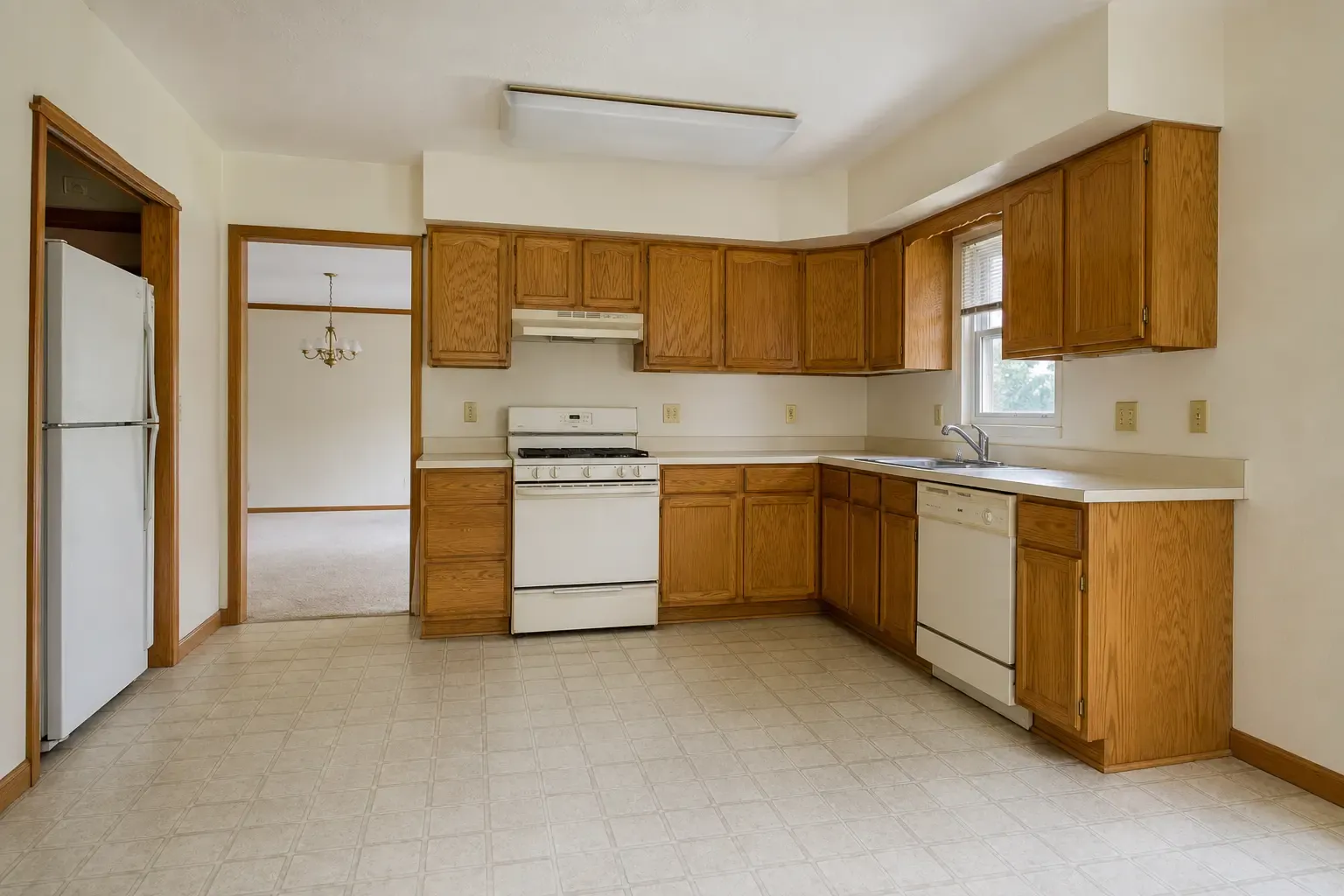 CabinetsFlooring
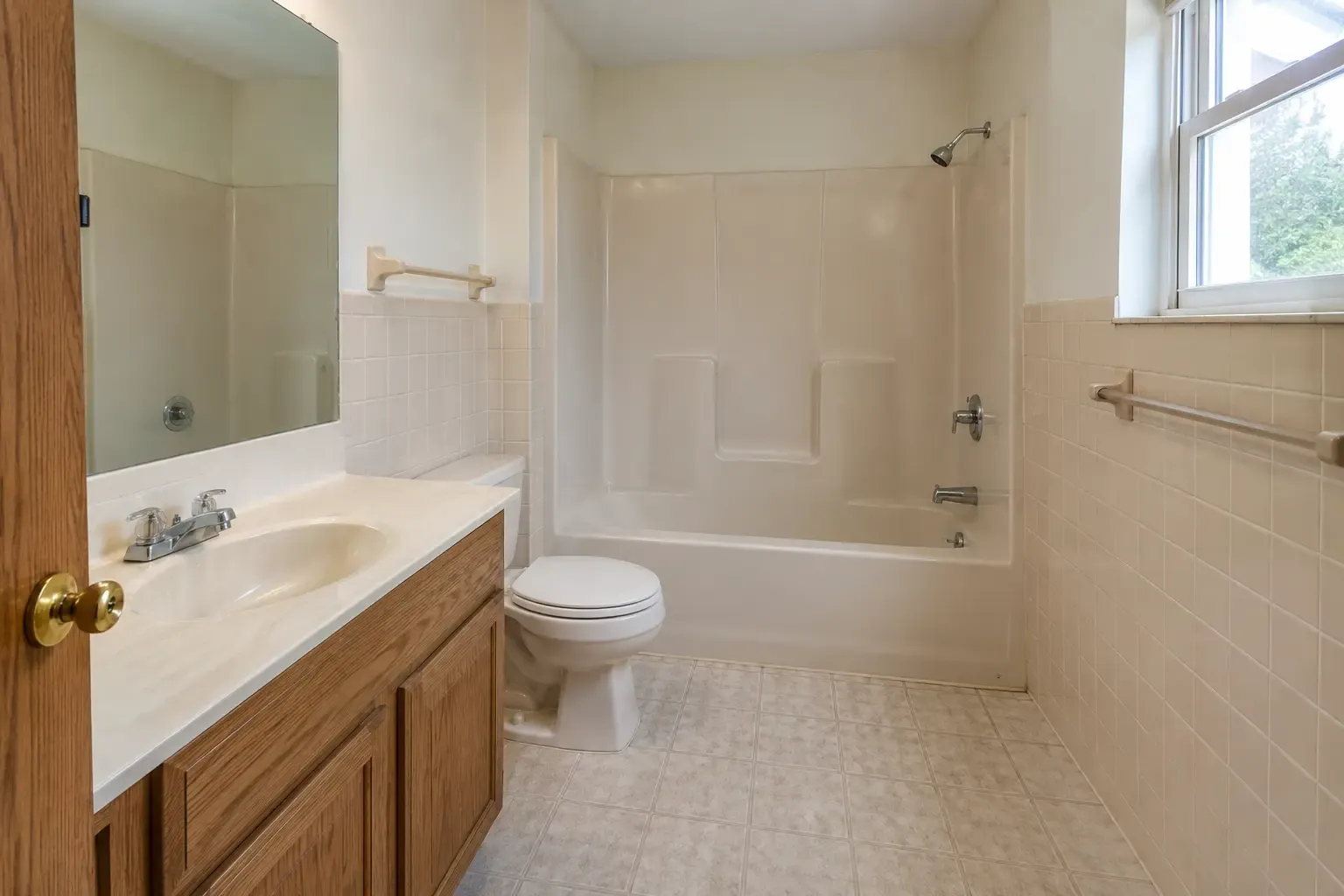 Tub & tile
 Floors
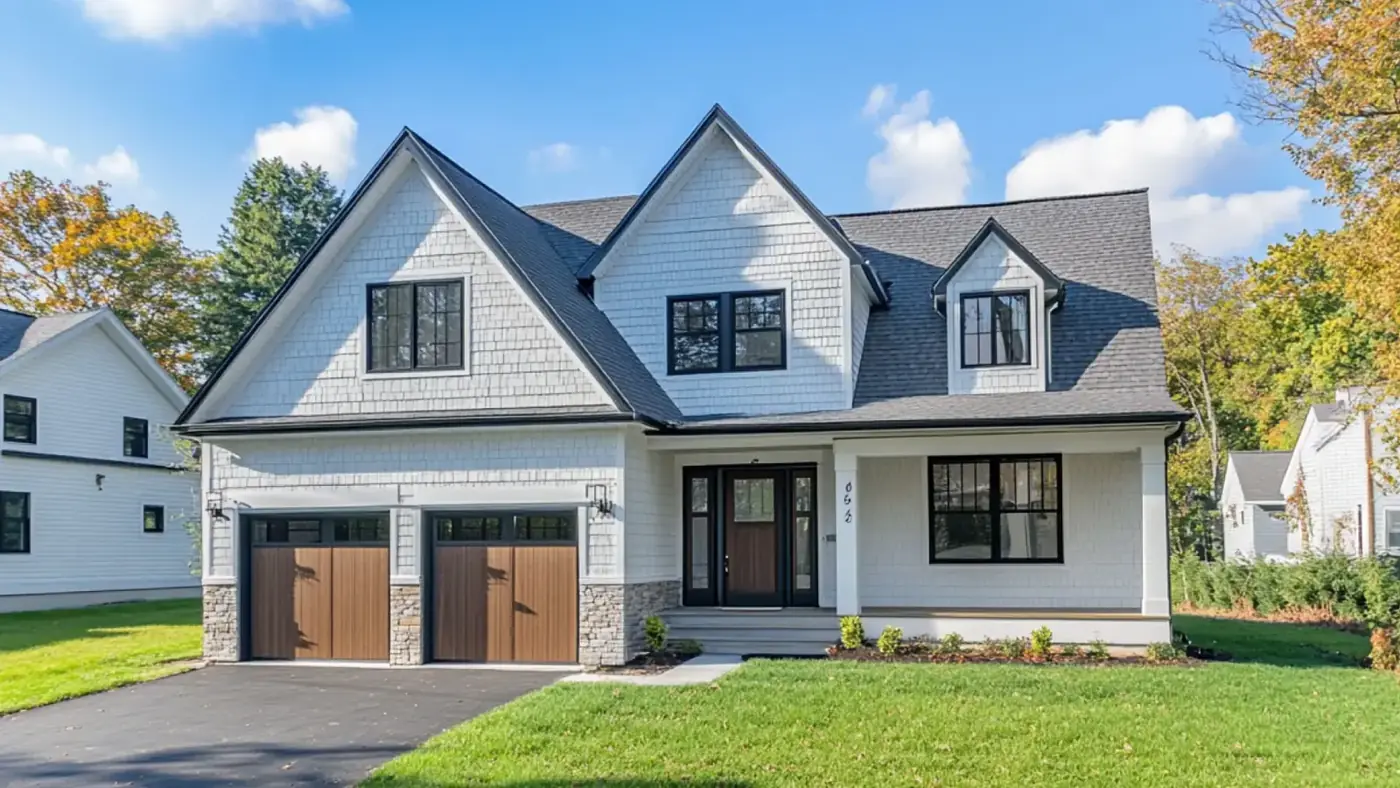 Roof
We may bring in a partner buyer to close. Your price and terms don't change.
Wholesaling law questions homeowners ask
Is wholesaling illegal in any state?
Wholesaling is not illegal in any state we found, as of October 2026. At least 21 states regulate it instead, with license or registration rules, written disclosures, cancellation rights or limits on recording against your title. South Carolina bars licensed agents from wholesaling but doesn’t ban the practice itself.
Which states require a license to wholesale real estate?
The states that require a real estate license to wholesale, as of October 2026, include Illinois, Iowa, Kentucky, Nebraska, North Dakota, Oklahoma, Pennsylvania and Virginia, with Delaware’s license rule starting in 2027. Connecticut and Oregon require a separate wholesaler registration. Check the details for your state above.
Which state has the strictest wholesaling law?
No single state is strictest on every point. Pennsylvania gives sellers the longest cancel period (30 days), Missouri requires the disclosure the earliest (14 days before the contract), Oklahoma has the most detailed contract rules, and Connecticut combines registration, a 90-day closing cap and a recording ban.
Is wholesaling legal in Florida?
Wholesaling is legal in Florida. As of October 2026, we found no Florida statute written specifically for wholesaling. Florida’s general real estate license law, consumer protection law and your contract still apply, so ask any wholesaler what they will do with your contract and get it in writing.
Is wholesaling legal in New York or New Jersey?
Wholesaling is legal in New York and New Jersey. As of October 2026, neither state had a wholesaling-specific statute that we found, though bills have been proposed in New Jersey. General license, consumer protection and contract law apply in both.
Is wholesaling legal in Georgia?
Wholesaling is legal in Georgia, and we found no wholesaling-specific statute as of October 2026. Georgia does require unsolicited written offers to buy a home to state, in capital letters, that the offer may or may not be fair market value.
Is wholesaling legal in North Carolina?
Wholesaling is legal in North Carolina, and assigning your own purchase contract needs no license. But the state Real Estate Commission warns that marketing yourself as a cash buyer while planning to find an end buyer can be unlicensed brokerage, a Class 1 misdemeanor there.
Does the law of my state or the wholesaler’s state apply?
The law of the state where your house is located is the one that generally governs the sale of the house. A wholesaler based in another state still has to follow your state’s wholesaling, licensing and recording rules for your property.
What happens if a wholesaler breaks the law in my state?
If a wholesaler breaks the law in your state, the remedy depends on the law: in many states you can cancel the contract and keep the earnest money, some add fines or license discipline, and several treat it as an unfair trade practice you can sue over. File a complaint with your state real estate regulator and attorney general.
Can a wholesaler put a lien on my house?
A wholesaler may try to record a memorandum of contract or an affidavit of equitable interest. Connecticut, Louisiana and Oklahoma bar this for wholesale contracts, and Texas regulates one-sided memorandums. Elsewhere, add a no-recording clause to your contract. See our guide to memorandums of contract.
Do these laws apply to double closings?
Not always. Many wholesaling laws are written around assignments by someone who never takes title, so a wholesaler who briefly buys and resells may fall outside them. Oklahoma’s law expressly includes double closing. Ask your attorney how your state treats it.
Are more states going to pass wholesaling laws?
Very likely. Five of the laws on this page took effect in 2026, and bills were pending in several more states as of October 2026. Always check the date of any source you read, including this one.
Related wholesaling guides
- The complete seller’s guide to real estate wholesaling
- Can you back out of a contract with a wholesaler?
- What “and/or assigns” means in a real estate contract
- Memorandum of contract: when a buyer clouds your title
- “We buy houses” scams: red flags and what regulators found
- Selling a house to a wholesaler in Connecticut: the 2026 law in depth
Ready to see a real number? Get your written offer, or call Jerryll at (203) 529-4712.
Sources
- Alabama SB 228 (2023), enrolled.
- Arizona Revised Statutes § 44-5101.
- Connecticut General Statutes chapter 392a, §§ 20-329aaa to 20-329hhh (P.A. 25-168, effective July 1, 2026).
- Connecticut DCP: real estate wholesaling.
- Connecticut DCP: verify a license or registration.
- Delaware SB 201 (153rd General Assembly).
- 225 ILCS 454/1-10 and IDFPR summary of the Real Estate License Act.
- Iowa Code § 543B.6A.
- Kentucky 2023 Acts ch. 84 (HB 62).
- Louisiana HB 468 (2026), Act 807.
- Maryland Real Property § 10-715.
- Missouri SB 973 (2026).
- Neb. Rev. Stat. § 81-885.02 and Nebraska Real Estate Commission Policies and Interpretations.
- North Dakota Century Code chapter 43-23.
- Ohio Revised Code 5301.95.
- Oklahoma SB 1075 (2025), enrolled and Oklahoma Real Estate Commission on the 2021 wholesaling law.
- Oregon Real Estate Agency: residential property wholesaling.
- Pennsylvania Act 52 of 2024 (SB 1173).
- City of Philadelphia: residential property wholesaler license.
- South Carolina Act 204 of 2024 (H. 4754).
- Tennessee Public Chapter 72 (2025).
- Texas SB 1577 (2023), enrolled (Occ. Code § 1101.0045; Prop. Code § 5.0205).
- Texas HB 4063 (2025), enrolled (Prop. Code § 12.020).
- Virginia Code § 54.1-2100.
- 2023 Wisconsin Act 208 and 2025 Wisconsin Act 60 (Wis. Stat. § 710.13).
- North Carolina Real Estate Commission: beware of unlicensed activity (December 2023).
- Georgia Department of Law: unsolicited real estate solicitations.
- Kansas Real Estate Commission bulletin on the Attorney General’s wholesaling lawsuit (April 2026).
- Kansas Real Estate Commission testimony on HB 2598 (January 31, 2024).
Who wrote this
Jerryll Noorden
Jerryll has bought and sold Connecticut houses since 2016 and has sat at more closing tables than he can count, on both sides. Before real estate he was a robotics scientist at NASA, IHMC and IIT. He wrote this guide because the national sites that rank for it skip the Connecticut rules that cost sellers money. When listing or selling it yourself would get you more than a cash offer, he says so.
This guide explains Connecticut rules in plain English. It is not legal or tax advice. Laws change; for your sale, talk to a Connecticut real estate attorney and a tax professional.
