
- There is no set real estate commission in Connecticut. Every Connecticut listing agreement has to say, in bold, that the rate “is not fixed by law” and “may be negotiable” (CGS 20-325b).
- Since August 17, 2024, the buyer’s agent fee is a separate negotiation. It can no longer be offered on the MLS, buyers sign a written agreement with their own agent before touring, and you decide whether to cover all, part or none of it.
- There is no official Connecticut average. Published “averages” come from companies that sell agent services. Do the math on your own price instead: each 1% of a $315,000 Manchester sale is $3,150.
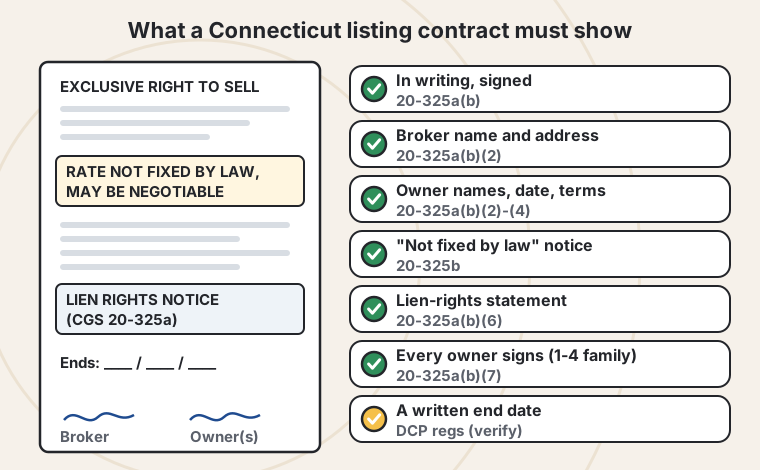
- A Connecticut listing contract must be in writing and signed, name the broker and the owners, show the date and the terms, and carry a broker lien-rights notice (CGS 20-325a). Ask for a short term and a clear end date.
- Commission is not the only cost of listing. On a $315,000 Manchester house, commissions, conveyance tax, attorney, prep and three months of carrying costs come to about $26,210 (est.).
- A cash sale has no commission, but listing often nets more. In our Manchester example a cash offer would have to reach about $293,500 to match the listing net, which is why we tell move-in-ready sellers to list.
How much is the real estate commission in Connecticut?
The real estate commission in Connecticut is whatever you and the broker agree to in writing; state law sets no rate and requires every listing agreement to say so. Sellers who also cover the buyer’s agent commonly pay a combined amount in the 4% to 6% range (est.), but there is no official Connecticut statistic. Since August 17, 2024, the listing fee and the buyer’s agent fee are negotiated separately.
This guide is the commission chapter of our guide to how to sell a house in Connecticut. The full list of selling costs, from conveyance tax to the oil adjustment, lives in our pillar guide to closing costs in Connecticut. Here we go deeper on the single biggest line: what agents charge, what the law says about it, what changed in 2024, and how to negotiate it without hurting your sale.
A commission has two parts, and you should think about them separately:
- The listing side. What you pay your own broker for pricing, photos, marketing, showings, negotiation and managing the deal to closing. You set this in the listing agreement.
- The buyer’s side. What the buyer’s agent is paid. Since August 17, 2024 this is agreed between the buyer and their agent in a written buyer agreement. The buyer can pay it, or ask you in the offer to pay all or part of it.
The rate is usually a percentage of the final sale price, paid at closing out of your proceeds. It can also be a flat fee, a reduced percentage, a tiered rate (one percentage up to a price, another above it), or a mix. All of these are legal in Connecticut. What matters is that it is written down and that you understand it before you sign.
Search for Connecticut commission rates and you will find precise-looking averages such as “5.56%”. These come from surveys run by companies that earn money referring sellers to agents or selling discount listings. They are not official statistics, and neither the state nor the Department of Consumer Protection publishes an average. Use them as gossip, not as a benchmark. The only number that matters is the one in your contract.
Why does the commission feel so hard to talk about?
The commission feels hard to talk about because it is the largest single check most Connecticut sellers ever write, it comes out of equity they spent years building, and the rules changed in 2024 in ways nobody explained to sellers. Many people also worry that asking for a lower rate is rude or will make the agent try less. Both feelings are normal, and neither should stop you from asking.
If you are reading this, you have probably done the math on a napkin. Six percent of $300,000 is $18,000. That is a year of property taxes in a lot of Connecticut towns, or the down payment on the condo you were hoping to move into. It is fair to feel suspicious that “six percent is standard” when no one can tell you who decided that.
You may also feel embarrassed to ask. Many sellers, especially older owners who sold their last house in the 1990s, were raised to think a commission is like a doctor’s fee: you do not haggle. Others feel confused by the new words in the paperwork, such as “offer of compensation”, “concession” and “buyer representation agreement”. And underneath it, there is often a squeeze: you need a certain number out of this sale to make the next step work, and every point matters.
Some sellers feel trapped before they have even signed, afraid of a six-month listing with an agent who disappears. And some feel cautiously hopeful, because they suspect that if they understood the rules they could keep thousands of dollars more. This page is for you. It lays out the Connecticut law, the 2024 changes, the math for your town and the honest trade-offs, so you can walk into an agent interview knowing exactly what you want.
What Connecticut laws apply to real estate commissions and listing agreements?
The Connecticut laws that apply to real estate commissions are in Chapter 392 of the General Statutes. A broker can only sue for a commission under a written, signed contract that names the parties, shows the date and terms, and includes a lien-rights notice (CGS 20-325a). Every agreement that fixes broker pay must say the rate is not fixed by law and may be negotiable (CGS 20-325b). Licensees must explain agency options at the first meeting (CGS 20-325d).
| Rule | What it says, in plain English | Why it matters to you | Source |
|---|---|---|---|
| Written contract | A licensed broker cannot sue to collect a commission unless the work was done under a written contract or authorization | No handshake deals; read everything before you sign | CGS 20-325a(b)(1) |
| Required contents | Names and addresses of the broker, names of the owners, the date, the conditions of the agreement, signature of the broker or authorized agent | Check each item is filled in; blanks are a red flag | CGS 20-325a(b)(2)-(5) |
| Owner signature (1-4 family) | A listing contract for a house of up to four units must be signed by the owner, or by an agent authorized in a document executed like a deed | Every owner on the deed should sign; a relative cannot sign for you casually | CGS 20-325a(b)(7) |
| Lien-rights notice | The contract must state: “THE REAL ESTATE BROKER MAY BE ENTITLED TO CERTAIN LIEN RIGHTS PURSUANT TO SECTION 20-325a” | A broker who has earned a fee can record a lien on the land records before the sale closes | CGS 20-325a(b)(6), (e), (f) |
| “Not fixed by law” notice | Any agreement that sets broker pay must say, in bold or otherwise conspicuous type, that the amount or rate “is not fixed by law” and “may be negotiable” | The law itself tells you to negotiate | CGS 20-325b |
| First-meeting disclosure | By the first personal meeting, a licensee must explain in writing the types of agency relationships and tell you not to share confidential information until you sign a written representation agreement | Do not tell an agent your bottom line before you have signed with them | CGS 20-325d(b) |
| Dual agency | One brokerage can represent both buyer and seller only with informed written consent on a statutory form | You can say no to dual agency, or negotiate a lower total fee if you say yes | CGS 20-325g |
| Designated agents | A brokerage can appoint one agent for you and another for the buyer within the same firm | Ask how your agent’s firm handles in-house buyers | CGS 20-325i |
| End date | Department of Consumer Protection regulations are understood to require a listing to state when it expires | Insist on a written end date and a term you are comfortable with | Regs. Conn. State Agencies 20-328-6a (verify current text) |
| Licensing | Only licensed brokers and salespersons can be paid to sell your house; licenses can be checked online | Look up your agent before signing | CGS 20-325a(a); DCP license lookup |
Connecticut gives a licensed broker who has a written contract a lien on the property for the agreed fee (CGS 20-325a(e)). It attaches only once the broker is entitled to the fee with no contingencies except closing, and only if the broker records the claim with your town clerk before the property is conveyed (CGS 20-325a(f)). In practice this comes up when a seller tries to skip paying an agent who produced the buyer, or sells to someone the agent introduced during a protection period. Read the “protection” or “extender” clause in your listing before you sign.
Notice what is not in the law: a rate, a minimum term, or a rule about who pays the buyer’s agent. Those are all contract terms. That is good news, because contract terms are negotiable.
What changed about commissions on August 17, 2024?
On August 17, 2024, practice changes from the National Association of Realtors settlement took effect: offers of compensation to buyer’s agents were removed from the MLS, and agents working with buyers must have a written agreement before touring a home, with pay that is clearly defined and not open-ended. Sellers can still agree to pay a buyer’s agent, but it is now negotiated off the MLS, usually as part of the offer.
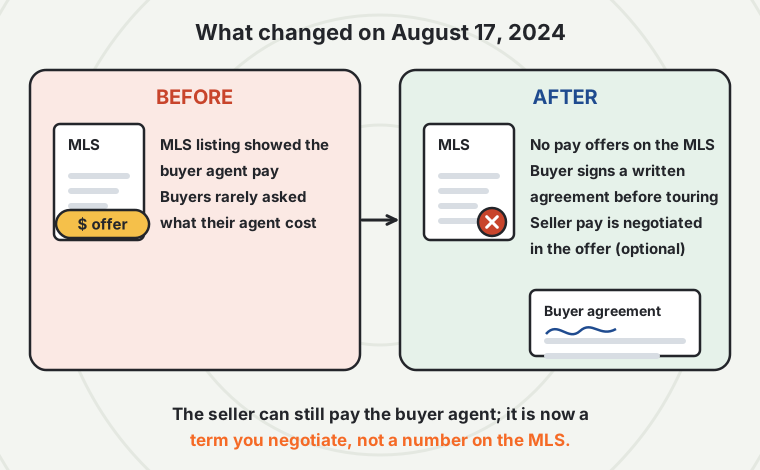
Before the change, most listings on the MLS showed a “cooperative commission”: a promise to pay whichever agent brought the buyer, often half of the total. Buyers rarely thought about what their agent cost. Now:
- No offers of compensation on the MLS. Your listing can no longer show what you will pay a buyer’s agent. Your agent can still tell a buyer’s agent directly, by phone or email, if you have authorized an offer.
- Written buyer agreements before touring. A buyer who tours with an agent, in person or virtually, signs an agreement first. It must state what the agent will be paid in a clear amount (a flat fee, a percentage or another defined figure), not an open-ended amount, and the agent cannot receive more than that from anyone.
- Buyers can still ask you to pay. The buyer’s offer can ask you to pay their agent’s fee, or give a credit toward it. You can accept, counter or refuse, just like any other term.
Connecticut already had a culture of written buyer agency, and the state’s first-meeting disclosure rule (CGS 20-325d) already told buyers not to share confidential information until they signed. What is new for sellers is that the buyer’s agent fee is now visible as its own negotiation, deal by deal.
So who pays the buyer’s agent in Connecticut now?
Whoever agrees to. In practice there are three patterns:
- You offer up front. You tell your agent to let buyer’s agents know you will pay a set amount (say 2% or a flat $6,000). Simple, predictable, and widens your pool of buyers.
- You decide offer by offer. You offer nothing up front and consider requests in each offer. More flexible, but you are comparing offers with different net amounts, so read every one as a net number.
- The buyer pays. Some buyers, especially those with cash or large down payments, pay their own agent. Many first-time buyers cannot, because a mortgage does not finance their agent’s fee and they are already stretched at closing.
Refusing to pay any buyer’s agent fee is legal and saves money on paper. The risk is a smaller pool of buyers for a house priced for buyers who need help with closing cash. Our guide to comparing offers on a house shows how to line up offers that ask for different concessions.
How much would the commission be on a house in my Connecticut town?
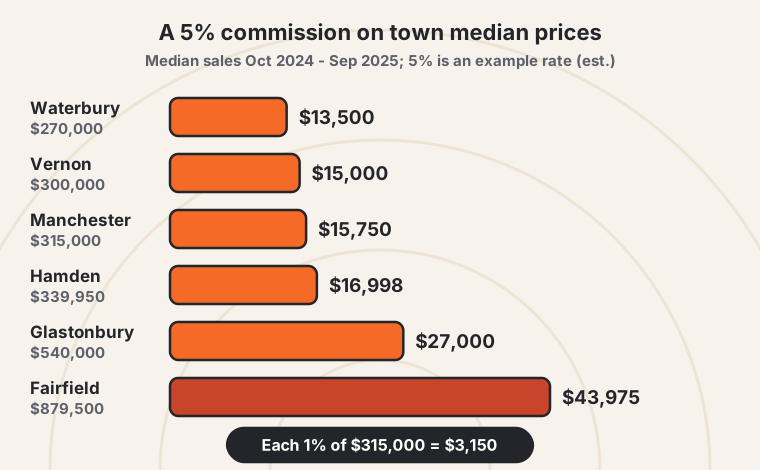
The commission on a Connecticut house is the rate times the final sale price. On a house at the Manchester median of $315,000, a 4% total is $12,600, 5% is $15,750, 5.5% is $17,325 and 6% is $18,900. Each half point you negotiate is worth $1,575 there. The rates below are examples, not quotes; the medians are town sales from October 2024 to September 2025.
| Town (median sale) | 4% total | 5% total | 5.5% total | 6% total | Listing side only at 2.5% |
|---|---|---|---|---|---|
| Waterbury ($270,000) | $10,800 | $13,500 | $14,850 | $16,200 | $6,750 |
| Vernon ($300,000) | $12,000 | $15,000 | $16,500 | $18,000 | $7,500 |
| Manchester ($315,000) | $12,600 | $15,750 | $17,325 | $18,900 | $7,875 |
| Hamden ($339,950) | $13,598 | $16,998 | $18,697 | $20,397 | $8,499 |
| Glastonbury ($540,000) | $21,600 | $27,000 | $29,700 | $32,400 | $13,500 |
| Fairfield ($879,500) | $35,180 | $43,975 | $48,372 | $52,770 | $21,988 |
Two things stand out. First, the dollar amount grows with the price, but the work does not grow at the same pace. Pricing, photographing and closing a $880,000 colonial in Fairfield is not three times the work of a $270,000 cape in Waterbury. That is why sellers of higher-priced homes have the most room to negotiate, and why tiered or flat fees are common at the top of the market.
Second, in lower-priced towns the commission is a larger share of what you walk away with. If you owe $200,000 on a $270,000 Waterbury house, a 5% commission of $13,500 is close to a fifth of your $70,000 equity before any other cost. That is the situation where every point, and every route, deserves a hard look.
Does the commission come out before or after the mortgage?
Neither: it all comes out of the same pot at closing. Your attorney’s settlement statement starts with the sale price, subtracts the commission, the conveyance tax, your attorney and any credits, pays off your mortgage, and sends you the rest. If your equity is thin, ask your agent for a net sheet before you sign, so you know the commission still leaves enough to pay off the loan. If it does not, the conversation becomes a short sale, which is covered in our guide to short sale vs. foreclosure.
What are all the costs of listing a house with an agent in Connecticut?
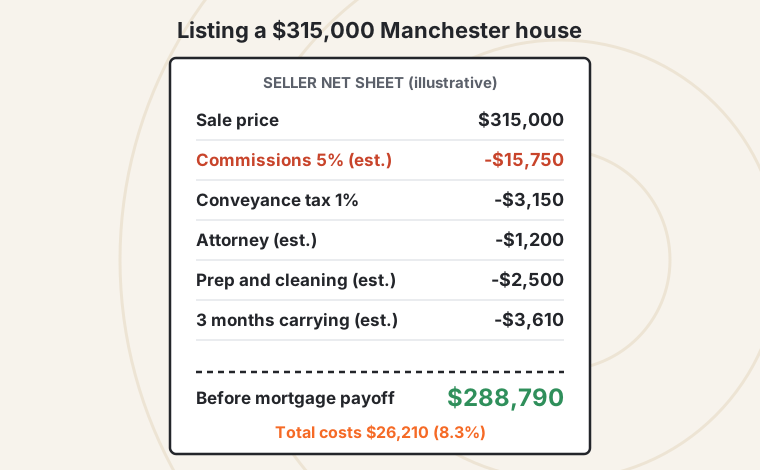
The costs of listing a house with an agent in Connecticut are the commissions, the state and town conveyance tax, your attorney, getting the house ready (repairs, cleaning, staging, photos are usually the agent’s) and the carrying costs while it is on the market. On a $315,000 Manchester house that adds up to about $26,210, or 8.3% of the price (est.), before your mortgage payoff.
| Line | Input | Amount |
|---|---|---|
| Sale price | Manchester median, Oct 2024 to Sep 2025 | $315,000 |
| Commissions | 5% total: 2.5% listing + 2.5% buyer’s agent (est.) | -$15,750 |
| Conveyance tax | 0.75% state + 0.25% Manchester (CGS 12-494) | -$3,150 |
| Seller’s attorney | Flat fee (est.) | -$1,200 |
| Prep and cleaning | Small repairs, paint touch-ups, deep clean (est.) | -$2,500 |
| Carrying costs, 3 months | Property tax $2,260 (41.0 mills on a 70% assessment) + insurance and utilities $1,350 (est.) | -$3,610 |
| Before mortgage payoff | Total costs $26,210 (8.3%) | $288,790 (est.) |
Run your own numbers with the calculator below. Put in your town, your price and your rate, and it shows the net for listing, selling yourself and a cash sale side by side.
How much would you walk away with?
Slide the numbers to match your house. It works in your browser; nothing is saved or sent.
Estimates for planning. Conveyance tax per CGS 12-494 (state 0.75% up to $800,000, 1.25% to $2.5M, 2.25% above, plus the town rate). Seller attorney about $1,200 to $1,500; flat-fee MLS about $400; listings include three months of taxes, insurance and utilities, a cash sale about two weeks. Your attorney gives you the final numbers.
The listing costs people forget
- Administrative or transaction fees. Some brokerages add a flat “admin” or “compliance” fee on top of the percentage. Ask whether there is one and whether it is negotiable.
- Repair credits after inspection. Most financed buyers inspect, and many ask for a credit. Older Connecticut houses (the median Manchester home was built in 1953) often turn up roof, heating, electrical or radon items. Our guide to what to fix before selling prices the usual ones.
- The $500 and $250 credits. If you do not deliver the property condition report you credit the buyer $500 (CGS 20-327c), and the smoke and carbon monoxide affidavit must be signed and given at closing (CGS 29-453; the old $250 credit option ended with Public Act 23-164). Easy to avoid; see the property condition disclosure guide.
- Staging. Many agents include basic staging advice; full staging of an empty house is extra and varies widely. Ask what is included in the commission.
- Time. Every month on the market costs Manchester owners about $753 in property tax at the median, plus insurance, utilities and mortgage interest. A vacant house adds risk: see selling a vacant house in Connecticut.
Commissions, the conveyance tax and legal fees are selling expenses that reduce your taxable gain under IRS rules (IRS Publication 523). For most owners who lived in the house two of the last five years, the $250,000 or $500,000 exclusion means no tax at all; the details are in taxes when selling a house in Connecticut.
How do you negotiate a realtor commission in Connecticut?
You negotiate a realtor commission in Connecticut by interviewing two or three licensed agents, asking each for their listing fee and what it buys, deciding separately what you will offer a buyer’s agent, and asking for a lower rate, a tiered rate or a shorter term in writing. The law requires the contract to say the rate is negotiable (CGS 20-325b), so asking is expected, not rude.
Get your own number first
Before any agent visits, look up recent sales on your street and in your town so you know roughly what the house is worth. Our guide on how to price your house to sell shows how to do it with public data. An agent who quotes a price far above everyone else may be “buying” the listing.
Interview two or three agents
Check each license on the Department of Consumer Protection lookup. Ask: What is your listing fee? What does it include (photos, video, staging, marketing, open houses)? How many houses like mine have you sold here in the last year? What do you recommend I offer a buyer’s agent, and why?
Separate the two fees
Negotiate your agent’s listing fee on its own. Then decide your buyer’s agent policy: a set amount up front, case by case, or nothing. Write both down. Bundling them into one “6%” hides which part you are actually negotiating.
Ask for a structure that fits your house
Options agents commonly accept: a lower rate for an easy, well-priced house; a tiered rate (for example a lower percentage on the part of the price above a target, which rewards a higher sale); a reduced rate if the agent also represents the buyer under dual or designated agency; or a flat fee.
Negotiate the term and the exits
Ask for a shorter listing (many sellers ask for 90 days rather than six months), a written end date, the right to cancel if the agent does not deliver agreed marketing, and a short protection period after expiry that names only buyers the agent actually introduced.
Read the whole agreement before signing
Check the CGS 20-325a items, the bold 20-325b notice, any admin fee, what happens if the buyer backs out, and what happens if you take the house off the market. If anything is unclear, have your Connecticut real estate attorney read it; it is a short, cheap review.
A good listing agent can earn their fee by pricing right, keeping a nervous buyer’s deal together, and getting a few thousand dollars more. A 1% discount that comes with weak photos and a wrong price can cost more than it saves. Negotiate, but compare agents on results and service, not rate alone.
What can you say no to?
You can say no to any rate, any term length, dual agency, an admin fee, and paying the buyer’s agent. You cannot change the law’s required contents, and once you sign, you are bound by what you signed. That is why the negotiation happens before the pen comes out.
What are the cheaper alternatives to a full-commission agent in Connecticut?
The cheaper alternatives to a full-commission agent in Connecticut are a discount or reduced-rate agent, a limited-service or flat-fee listing that puts your house on the MLS while you handle showings, selling by owner, and selling to a cash buyer with no commission. Each saves part or all of the commission but shifts work, risk or price onto you, so compare the net, not the fee.
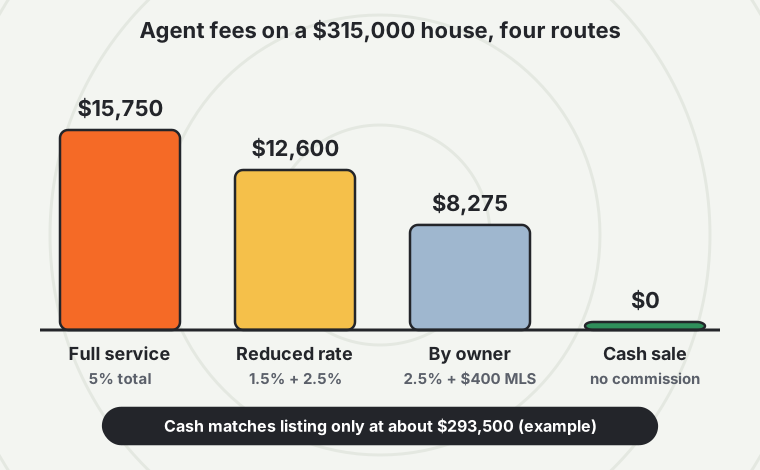
Full-service agent
$15,750at 5% total on $315,000 (est.)
- Pricing, marketing, showings, negotiation, deal management
- Best for houses that show well and buyers can finance
- Usually the highest sale price
Discount or limited service
$8,275 to $12,600depending on what you buy (est.)
- Reduced listing rate, or a flat fee for an MLS entry while you show the house
- You do more of the work; ask exactly which services are included
- You will usually still be asked about a buyer’s agent fee
Sell by owner
$7,875 savedon the listing side, less a flat-fee MLS (est.)
- You price, show, negotiate and coordinate with attorneys
- Most buyers still have an agent who may ask you to pay them
- Only about 5% of US sales are by owner (NAR 2025 profile)
Cash sale
$0commission; price is usually lower
- No showings, no repairs, no appraisal, close in about 2 weeks
- Makes sense for houses that need work or owners who need certainty
- Compare the net: in our example the offer must reach about $293,500 to match listing
Discount, flat-fee and limited-service listings
These come in many shapes, and the names are used loosely. Some are full-service agents who charge a lower percentage. Some are “flat-fee MLS” services, where for a fee (often a few hundred dollars, est.) a licensed broker puts your house on the MLS and you handle the showings, questions and negotiation. Others sit in between, with a menu of services you can add. In Connecticut the broker still needs a written agreement that meets CGS 20-325a and carries the 20-325b notice, so you will sign a contract either way. Read it for: what is included, who answers buyer calls, who holds the deposit, whether there is a cancellation fee, and whether you still owe a fee if you find the buyer yourself.
Selling by owner (FSBO)
Selling by owner saves the listing side, which is $7,875 on a $315,000 Manchester house at 2.5% (est.). You still pay the conveyance tax and your attorney, you will still likely be asked to pay part or all of the buyer’s agent fee, and you take on pricing, disclosures, showings and negotiation. Our complete guide to selling a house without an agent in Connecticut walks through the ten steps, the disclosures and the real savings math. It works best for owners with time, a house that shows well, and ideally a buyer already lined up, such as a neighbor or tenant.
Selling to a cash buyer
A cash sale has no commission on either side, no showings and no repairs, and in our case it usually closes in about two weeks. The trade-off is price: a cash buyer prices in repairs, holding costs, resale costs and profit, so the offer is below what a move-in-ready house would sell for on the MLS. The honest test is the break-even. In our Manchester example the listing route nets about $288,790 (est.). A cash offer nets the offer minus the conveyance tax, the attorney and two weeks of carrying costs (about $570, est.), so it would have to be about $293,500 to match. For a house in good shape, most cash offers will not reach that, and you should list. Our full comparison of a cash buyer vs. a realtor in Connecticut runs the numbers for houses that need work, where the gap closes fast.
Is a cash sale right for you, or should you list?
Seven quick questions. There is no wrong answer, and we will tell you honestly if listing would leave you more.
- Does the house need repairs you would rather not pay for or manage?
- Do you need to close by a certain date, or within the next month or two?
- Would showings be hard: tenants, belongings, privacy, or you live out of state?
- Is there a complication: an estate or probate, a divorce, foreclosure, liens or back taxes?
- Could you comfortably cover the mortgage, taxes and utilities for three or more months?
- Is getting the highest possible price more important to you than speed and certainty?
- Would a buyer's bank lend on the house as it is (no major roof, foundation, oil tank or code issues)?
When is paying a full commission worth it?
Paying a full commission is worth it in Connecticut when a good agent’s pricing, exposure and negotiation are likely to raise your sale price by more than the fee, when the house is in move-in condition for financed buyers, when you cannot handle showings or paperwork yourself, or when the deal is complex, such as an estate, a divorce or a house with a known defect that has to be disclosed and explained.
We buy houses for cash, so we want to be clear about this. If your house is clean, updated enough for an FHA or conventional buyer, and you have a few months, a good agent will usually put more money in your pocket than we can. Pay a fair commission, negotiate the terms in this guide, and list.
A full-service agent also earns their fee when the sale is likely to wobble: a buyer with a tight mortgage commitment, an inspection that turns up an oil tank, or an appraisal that comes in low (see low appraisals in Connecticut). Keeping a deal together is where experience shows.
When you should not pay a commission at all
- The house needs major work that lenders will not finance, such as a failed septic, a roof at the end of its life or a crumbling foundation. Most buyers who can pay full price cannot get a loan on it; see selling a house that needs repairs.
- You already have a buyer: a tenant, a neighbor or a relative. Hire an attorney, not a listing agent.
- You need a certain closing date, for example a probate deadline, a job move or a Law Day, and cannot risk a financed buyer falling through.
- The math after repairs, carrying costs and commission comes out close to a cash offer, and you value no showings and no repairs more than the difference.
What should you watch for in a Connecticut listing agreement?
In a Connecticut listing agreement, watch for a long term with no early exit, a protection or extender clause that covers any buyer rather than only buyers the agent introduced, a fee owed even if you withdraw the house, extra admin fees, automatic renewal, and a buyer’s agent amount you did not choose. Also confirm the CGS 20-325a items and the 20-325b negotiability notice are there.
- The commission is written as an exact rate or amount, and you know whether it includes the buyer’s agent
- The listing has a written start date and end date you agreed to
- There is a way to end it early if the agent does not perform
- The protection period is short and limited to buyers the agent actually introduced, in writing
- You know what you owe if you take the house off the market, and if a buyer backs out
- Any admin or transaction fee is listed and agreed
- Your buyer’s agent policy (amount, or case by case) is written down
- Dual agency is either declined or agreed on the statutory consent form, with a fee you accept
- The lien-rights statement and the bold “not fixed by law” notice are present
- Every owner on the deed has signed
Can you cancel a listing agreement in Connecticut?
You can end a listing agreement in Connecticut on the terms the agreement allows: at its end date, by mutual release, or under a cancellation clause. Many agents will release an unhappy seller rather than fight, sometimes with a fee or a protection period. What you cannot safely do is ignore the agreement and sell to a buyer the agent introduced, because the broker may be owed the fee and can record a lien before closing (CGS 20-325a(e)-(f)). If you are stuck in a listing that is not working, read our guide to why a house won’t sell and talk to your attorney before you sign anything else.
How do you choose the right route and keep the most money?
To choose the right route and keep the most money when selling in Connecticut, first estimate your house’s value and condition, then get a written net sheet from a listing agent at a rate you negotiated, a net from selling by owner, and, if the house needs work or time matters, a written cash offer. Compare the three nets after every cost and pick the highest one that fits your timeline.
Know your number
Pull recent sales in your town, adjust for condition, and note your mortgage payoff. Use the assessed vs. market value guide so you do not mistake your assessment for your price.
Get a listing net sheet
From your best agent interview, at the rate and buyer’s agent policy you negotiated, with the conveyance tax at your town’s rate (see the conveyance tax guide).
Price the by-owner route
Listing side saved, minus a flat-fee MLS, your time, and the buyer’s agent fee you will likely be asked to pay.
Get a cash offer if it fits
If the house needs work, sits empty, or you need certainty, ask for a written cash offer. With us that is a short call, a walkthrough, a written number with no fee and no obligation, and a closing date you pick, typically about two weeks after you say yes.
Compare nets, not prices
Put all three in the net calculator above, add carrying costs for the time each route takes, and choose. If listing wins, we will tell you so.

When sellers ask me whether they should list or sell to me, I ask two questions: could a buyer with a normal mortgage buy this house as it stands, and do you have three or four months? If both answers are yes, list it, negotiate the commission, and get your top price. If either answer is no, compare the nets honestly. A commission is only a bad deal when it buys you nothing you needed.
See the house together.
Pick a time that works.
Choose a time for us to walk through the property with you, or ask for a quick call first. We confirm every request personally.
Tuesday, January 13
No open times in the next few weeks. Please call us.
We will confirm by email. Nothing is booked until we do.
View my requestQuestions Connecticut sellers ask about real estate commissions
What is the average real estate commission in Connecticut?
There is no official average real estate commission in Connecticut. The state does not set or track rates, and the “averages” published online come from companies that sell agent services. Sellers who also pay the buyer’s agent commonly agree to a combined amount somewhere in the 4% to 6% range (est.), but your rate is whatever you negotiate in writing.
Is 6% commission still standard in Connecticut?
No, 6% commission is not standard in Connecticut, and it never was by law. CGS 20-325b requires every agreement that sets broker pay to state that the rate is not fixed by law and may be negotiable. Since August 2024 the listing and buyer’s agent fees are also negotiated separately, which makes a single “6%” even less meaningful.
Who pays the buyer’s agent in Connecticut now?
The buyer’s agent in Connecticut is paid under the buyer’s written agreement with that agent. The buyer can pay it, or ask the seller to pay all or part as a term of the offer. Since August 17, 2024 that offer can no longer appear on the MLS, but sellers can still agree to it in the contract.
Do I have to pay the buyer’s agent when I sell my house in CT?
No, you do not have to pay the buyer’s agent when you sell a house in Connecticut. It is a negotiable term. Many buyers ask, because their mortgage cannot finance their agent’s fee, so refusing can shrink your pool of buyers. Decide your policy before you list and read every offer as a net number.
How much do realtors charge to sell a house in Connecticut?
Realtors in Connecticut charge whatever is agreed in the listing contract, usually a percentage of the sale price paid at closing, sometimes a flat fee or tiered rate. On a $315,000 house, 2.5% for the listing side is $7,875 and a 5% total including the buyer’s agent is $15,750 (example rates, est.).
Can I negotiate my realtor’s commission?
Yes, you can negotiate your realtor’s commission in Connecticut, and the law expects it: the contract must say the rate may be negotiable (CGS 20-325b). Interview several agents, separate the listing fee from the buyer’s agent fee, and ask for a lower or tiered rate, a shorter term and clear exits in writing.
Does a Connecticut listing agreement have to be in writing?
Yes, in practice a Connecticut listing agreement has to be in writing. A broker cannot sue to collect a commission unless the work was done under a written, signed contract that names the broker and owners, shows the date and terms and includes a lien-rights notice (CGS 20-325a). For houses of up to four units, the owner must sign.
How long is a typical listing agreement in Connecticut?
There is no legal length for a listing agreement in Connecticut; the term is negotiated. Agents often propose several months, and sellers often ask for 90 days or less with a written end date. Department of Consumer Protection regulations are understood to require an expiration date, so make sure yours has one.
Can I cancel a listing agreement with my realtor?
You can cancel a listing agreement in Connecticut on the terms it allows, by mutual release, or when it expires. Many agents agree to a release. Selling to a buyer the agent introduced, during the listing or a protection period, can still leave you owing the fee, and the broker can record a lien before closing (CGS 20-325a).
Do I pay commission if the sale falls through?
Whether you pay commission if a Connecticut sale falls through depends on your listing agreement. Most agreements pay the broker only at closing, but some say the fee is earned when a ready, willing and able buyer is found. Read that clause before you sign and ask for payment to be tied to a completed closing.
What is a flat-fee MLS listing in Connecticut?
A flat-fee MLS listing in Connecticut is a limited-service arrangement where a licensed broker puts your house on the MLS for a set fee and you handle showings and negotiation. You still sign a written agreement, and buyer’s agents may still ask you to pay them. It saves most of the listing-side commission but adds work for you.
Is real estate commission tax-deductible when I sell my house?
Real estate commission is not a separate deduction, but the IRS treats it as a selling expense that reduces the amount realized, and so your gain, when you sell a house (IRS Publication 523). Most owners who lived in the home two of the last five years owe no federal tax on up to $250,000 of gain, or $500,000 for married couples.
Do cash home buyers charge a commission?
Cash home buyers who buy directly do not charge a commission; you pay only your own costs, such as the conveyance tax and your attorney. We charge no fees. Be careful with anyone who calls themselves a buyer but plans to resell your contract; our guide to checking a cash home buyer explains what to ask.
Is it worth paying a commission or should I sell to a cash buyer?
Paying a commission is usually worth it in Connecticut when the house is move-in ready and you have time, because a good agent typically gets a higher price than a cash buyer pays. A cash sale makes more sense when the house needs major work, sits empty, or you need a fixed date. Compare the net of each route after every cost.
Related Connecticut guides
Costs and paperwork
Choosing a route
Start with the big picture in how to sell a house in Connecticut. We buy houses in Manchester, Vernon, Waterbury, Hamden, Glastonbury and Fairfield, and across Connecticut.
Plain-English information, not legal advice. Commission rates and costs marked (est.) are examples, not quotes or market statistics. Have your Connecticut attorney review any listing agreement before you sign.
Sources
- CGS Chapter 392: § 20-325a (written contract, required contents, broker lien), § 20-325b (rate not fixed by law notice), § 20-325d (agency disclosure at first meeting), § 20-325g (dual agency consent), § 20-325i (designated agents), § 20-327b and 20-327c (condition report and $500 credit).
- CGS § 12-494 (state and town conveyance tax rates).
- CGS § 29-453 (smoke and carbon monoxide affidavit; as amended by PA 23-164).
- National Association of Realtors, settlement FAQs (practice changes effective August 17, 2024).
- National Association of Realtors, consumer guide to written buyer agreements.
- NAR Profile of Home Buyers and Sellers (share of sales by owner).
- Connecticut Department of Consumer Protection, look up and verify a license.
- Connecticut Department of Consumer Protection, real estate brokers.
- IRS Publication 523, Selling Your Home (selling expenses, home sale exclusion).
- Town median sale prices and mill rates: our town data compiled from public sales records (October 2024 to September 2025) and fiscal 2027 mill rates.

Who wrote this
Jerryll Noorden
Jerryll has bought and sold Connecticut houses since 2016 and has sat at more closing tables than he can count, on both sides. Before real estate he was a robotics scientist at NASA, IHMC and IIT. He wrote this guide because the national sites that rank for it skip the Connecticut rules that cost sellers money. When listing or selling it yourself would get you more than a cash offer, he says so.
This guide explains Connecticut rules in plain English. It is not legal or tax advice. Laws change; for your sale, talk to a Connecticut real estate attorney and a tax professional.
