
Connecticut seller’s guide · Facts checked October 26, 2026
Wholesaler vs. Realtor vs. Cash Buyer: Who Should Sell Your House?
Four ways to sell, side by side: who buys your house, who works for you, how each gets paid, and which one fits your house and deadline.

A realtor markets your house to the public, represents you and is paid a commission. A cash buyer buys it and takes title. A wholesaler signs a contract to buy it, then assigns that contract to a cash buyer for a fee, and does not represent you. Listing usually nets the most for a house in good shape. In Connecticut, wholesalers must register and let you cancel within three business days (CGS 20-329ccc).
- A realtor (listing agent) sells your house for you on the open market and is paid a commission you agree to. In most states the agent represents you.
- A cash buyer buys your house. They take title with their own money or a lender’s, usually as-is, at an investor price.
- A wholesaler puts your house under contract and assigns that contract to a cash buyer, who closes with you (how wholesaling works). The end buyer pays the wholesaler’s fee. A wholesaler does not represent you.
- Novation is a fourth model: an investor fixes up and lists your house, and you get an agreed price or share. It can net more than a cash offer, but it takes months.
- Listing usually gets the highest price for a house in good shape when you have time. Cash and wholesale sales trade some price for speed, no repairs and certainty.
- You can’t always tell them apart from the ad. Ask one question: “Will your name be on the deed, or are you assigning the contract?”
What is the difference between a wholesaler, a realtor and a cash buyer?
The difference between a wholesaler, a realtor and a cash buyer is who does what with your house. A realtor markets it to the public and is paid a commission. A cash buyer buys it and takes title. A wholesaler signs a contract to buy it, then assigns that contract to a cash buyer for a fee. Only the realtor works for you.
All three can show up on your phone in the same week, often using the same words: “fast”, “cash”, “any condition”. Underneath, they are three different jobs. A fourth model, novation, sits between them. This page compares all four side by side so you can pick the one that fits your house, your deadline and how much you need to walk away with.
This guide is part of our series that starts with what real estate wholesaling is and how it works. If you only want the Connecticut version of cash vs. listing, read cash buyer vs. realtor in Connecticut.
Here is each one in a sentence:
- Realtor or listing agent. A licensed real estate agent who puts your house on the market, finds a buyer (usually one with a mortgage), negotiates for you and is paid a commission when it sells. Strictly, “Realtor” means a member of the National Association of Realtors, but most people use it for any listing agent, and so do we here.
- Direct cash buyer. An investor, a landlord or a company that buys your house itself, with its own cash or with money from a private or hard-money lender. Their name goes on the deed.
- Wholesaler. Someone who signs a contract to buy your house and then sells their place in that contract to a cash buyer. The cash buyer closes with you and pays the wholesaler a fee. See what an assignment fee is.
- Novation (fix-and-list). An investor agrees with you in writing to fix up the house and sell it on the open market, usually through an agent, and you receive an agreed price or share of the result.
How do a realtor, a cash buyer, a wholesaler and a novation compare?
A realtor, a cash buyer, a wholesaler and a novation compare most clearly on six points: who ends up owning the house, who represents you, how the professional is paid, whether you can see that pay, how long it takes, and how likely the sale is to close. The table below lines them up so you can see the trade-offs at a glance.
| Listing agent (realtor) | Direct cash buyer | Wholesaler | Novation (fix-and-list) | |
|---|---|---|---|---|
| Who buys your house | A member of the public, usually with a mortgage | The cash buyer | An investor from the wholesaler’s buyer list | A member of the public, after the investor’s repairs |
| Who represents you | The agent, under your state’s agency law | No one on their side. They represent themselves. | No one on their side. They represent themselves. | The investor is your partner, not your agent. The listing agent may represent the sale. |
| How they are paid | A commission you agree to, paid from the sale | Their profit when they resell or rent the house | An assignment fee paid by the end buyer, or the spread in a double close | An agreed price or share, set in your written agreement |
| Can you see what they make? | Yes, it is in your listing agreement | No, it comes later, at resale | With an assignment, usually yes, on the closing paperwork. With a double close, no. | Yes, if the agreement spells out the split |
| Repairs and cleaning | Often expected, or reflected in the price | None, as-is | None, as-is | The investor pays for and manages them |
| Showings | Public showings and open houses | One or two walkthroughs | Walkthroughs by investors on the wholesaler’s list | Contractors, then public showings |
| Typical timeline | Months, from listing to closing | Weeks, depending on title work | Weeks, once an end buyer is found | Months |
| What can make it fall apart | Buyer’s financing, appraisal or inspection | Fewer risks: no lender appraisal | No end buyer found, or the end buyer backs out | Repairs run over, or the house doesn’t sell at the hoped-for price |
| Price | Usually the highest, for a house buyers can finance | Investor price, below retail | Investor price, below retail | Can be above a cash offer, depending on the market |
| Who regulates them | State real estate licensing board | General contract and consumer law | A growing number of states regulate wholesaling specifically | General contract law. Ohio’s wholesaling law also covers novations. |
Notice the row on representation. It is the one sellers most often get wrong, and it’s where most of the confusion about wholesalers comes from.
Does a wholesaler or cash buyer represent you like a realtor does?
No. A wholesaler or a cash buyer does not represent you the way a realtor does. A listing agent is your agent and, in most states, owes you legal duties such as loyalty and disclosure. A cash buyer and a wholesaler are on the other side of the deal: they are trying to buy your house, or your contract, at a price that works for them.
That’s not a criticism. A buyer is supposed to look after their own interests, the same way you look after yours. The problem starts when someone acts like your adviser while being your buyer. Several states now say this out loud:
- Connecticut. The Department of Consumer Protection’s wholesaling page tells sellers that the wholesaler does not represent them. The state’s disclosure report, which a wholesaler must hand you before you sign, warns that they may not be the buyer (CGS 20-329eee).
- Ohio. Since March 2, 2026, the wholesaler must give you a separate signed disclosure that they act for themselves and don’t represent you. The rule covers novations too (R.C. 5301.95).
- Oklahoma and Louisiana. Their wholesaling laws bar a wholesaler from posing as your adviser or representative.
So who looks out for you in a cash or wholesale sale? You do, with help. In Connecticut, every closing involves attorneys (CGS 51-88a), and you can have your own, whose only job is to protect you. In other states, a real estate attorney or an agent you hire by the hour can play the same role. Don’t let the buyer’s attorney, the buyer’s title company or the wholesaler be your only adviser.
Who actually takes title and pays for your house in each model?
In each model a different person takes title and pays. With a realtor, a buyer from the public pays, usually with a mortgage. With a direct cash buyer, that buyer pays and their name goes on the deed. With a wholesaler, an end buyer from their list pays and takes title. With novation, a retail buyer pays after the investor’s repairs.
This matters because the person who pays is the person whose money has to be real. Here’s what to check in each case:
- Listing: your agent should check the buyer’s mortgage pre-approval and proof of the down payment before you accept.
- Direct cash buyer: ask for proof of funds in the buyer’s own name, or a letter from their lender, before you sign.
- Wholesaler: the wholesaler’s own bank balance doesn’t matter much. The end buyer’s does. Ask who the end buyer will be and when you’ll see their proof of funds. See equitable interest in real estate for what a wholesaler actually holds.
- Novation: ask who pays for repairs if the house doesn’t sell, and whether that money is set aside in writing.
Some wholesalers close with a double close instead of an assignment: they buy your house and resell it the same day. You’d then sell to the wholesaler, but the end buyer’s money still funds it. Read double closing in real estate to see what that means for you.
How does each one get paid, and can you see it?
Each one gets paid differently. A realtor earns a commission written into your listing agreement, so you see it before you sign. A cash buyer earns their profit later, when they resell or rent the house. A wholesaler earns an assignment fee from the end buyer, which usually shows on the closing paperwork, or a hidden spread in a double close. In a novation, the split is in your agreement.
The realtor’s commission
Commissions have always been negotiable, and they are set by agreement, not by law. Practice changes that took effect on August 17, 2024, after the National Association of Realtors settlement, changed how buyer-agent pay is offered. The result for you is the same as before: your listing agreement says what you will pay, and you can negotiate it before you sign.
The cash buyer’s margin
A direct cash buyer doesn’t charge you a fee. They make money by paying less than the house will be worth after repairs, then reselling or renting it. You won’t see their profit, because it doesn’t exist yet when you close. What you can see is their offer, and you can compare it with others. Our guide to why cash offers are so low walks through the math investors use.
The wholesaler’s fee
With an assignment, the end buyer pays the fee on top of your contract price. It is not deducted from your price, but it is part of what the end buyer decided they could spend on your house. It usually appears on the closing paperwork. With a double close, you see only your own price.
The novation split
A novation should have one written agreement that says exactly what you receive, when, and who pays for what: the repairs, the holding costs, any agent commission on the final sale. If it isn’t written down, it isn’t part of the deal.
Which one gets you the most money for your house?
Listing with a realtor usually gets you the most money for a house that is in good condition, when you have a few months and buyers with mortgages can buy it as it is. A cash buyer or wholesaler will pay less than that, because they take on the repairs, the holding costs and the risk. Novation can land in between.
The fair comparison isn’t your sale price. It’s what you keep. A listing has costs a cash sale doesn’t: the commission, repairs and prep, months of mortgage payments, taxes, insurance and utilities while you wait, and the chance that a buyer’s inspection leads to a price cut. A cash sale has one big cost: the lower price.
For some houses, the listing price advantage is large and the costs are small. Sell that house on the market. For others, the house won’t pass a lender’s appraisal or inspection, the repairs are more than you can fund, or a deadline makes a few months impossible. For those, the listing price on paper may never turn into money in your hand.
Wholesalers and direct cash buyers usually land in the same price range, because the end buyer in a wholesale deal is the same kind of investor. The difference is who you deal with and whether a fee sits in the middle. On a house many investors want, you may get more by calling several direct buyers. On a house few investors want, a wholesaler who knows the one landlord or contractor who buys that kind of house may be the only way to get a firm offer at all.
Run your own numbers. Put in your price, your repairs and your town:
What would you keep each way?
The calculator uses Connecticut’s conveyance tax by town and shows your net selling it yourself, with an agent, or to a cash buyer.
How much would you walk away with?
Slide the numbers to match your house. It works in your browser; nothing is saved or sent.
Estimates for planning. Conveyance tax per CGS 12-494 (state 0.75% up to $800,000, 1.25% to $2.5M, 2.25% above, plus the town rate). Seller attorney about $1,200 to $1,500; flat-fee MLS about $400; listings include three months of taxes, insurance and utilities, a cash sale about two weeks. Your attorney gives you the final numbers.
For a full Connecticut example, read cash buyer vs. realtor in Connecticut. To test whether an offer you already have is reasonable, see is this a fair offer for my house.
Which option is fastest and most certain to close?
A direct cash buyer with proof of funds is usually the fastest and most certain option, because there is no lender, no mortgage appraisal and no financing contingency. A wholesaler can be just as fast once a real end buyer is lined up, but less certain before that. A listing takes months and can fall through over financing. Novation is the slowest.
What decides speed in practice:
- Listing. Time on the market, then the buyer’s mortgage process. Each step has its own way to fail: the appraisal comes in low, the inspection finds a problem, the loan isn’t approved.
- Direct cash buyer. Mostly the title search, payoff letters and the closing date you pick. We typically close in about two weeks, and we close on a later date when that suits the seller better.
- Wholesaler. The time it takes to find the end buyer, then the same title work as any cash sale. The risk is the gap before the end buyer signs. If none turns up, many wholesale contracts let the wholesaler cancel during an inspection period. Connecticut caps the closing date at 90 days after signing unless you both agree in writing to extend (CGS 20-329ccc(b)). See can you back out of a contract with a wholesaler.
- Novation. Repairs first, then a listing, then the buyer’s mortgage. Plan on months.
If you have a hard deadline, such as a foreclosure Law Day, a probate court order or a move, put the closing date in the contract and ask what happens if it is missed. A firm date that closes beats a higher number that doesn’t.
What is novation, and how is it different from wholesaling?
Novation is an agreement in which an investor pays for and manages repairs, and the house is then sold on the open market, with you receiving an agreed price or share. It differs from wholesaling because the house goes to a retail buyer after improvements, not to another investor as-is. It can net you more, but it takes longer and depends on the market.
The word comes from contract law, where a novation replaces one contract or party with another. In real estate investing it has come to mean a fix-and-list partnership. Structures vary a lot, which is exactly why you need to read the agreement closely.
Novation may suit you if:
- You have good equity, so there is room for repairs and still a meaningful result for you.
- The house needs updating, not rebuilding: paint, floors, a kitchen refresh.
- You can wait a few months, and you’re comfortable with the result depending on the market.
Ask these questions before you sign one:
- Who pays for the repairs, and what happens to that money if the house doesn’t sell?
- What exactly do I receive, and when: a fixed price or a share?
- Who sets the listing price, and who can lower it?
- Is there an agent commission on the final sale, and who pays it?
- Who carries the taxes, insurance and utilities while the work is done?
- What happens if either of us wants to end it?
Some states now treat certain novations like wholesaling. Ohio’s 2026 law, for example, requires the same signed disclosure for a novation as for an assignment (R.C. 5301.95). We describe how we use a fix-and-list partnership, alongside cash purchases, seller financing and buyer matching, on our page about all the ways we buy houses in Connecticut.
How can you tell whether you’re talking to a wholesaler or a cash buyer?
You can tell whether you’re talking to a wholesaler or a cash buyer by asking whose name will be on the deed, whose money will close, and whether the contract allows assignment. A cash buyer answers “mine” and shows proof of funds in their own name. A wholesaler, if they’re honest, says they will assign the contract and tells you how.
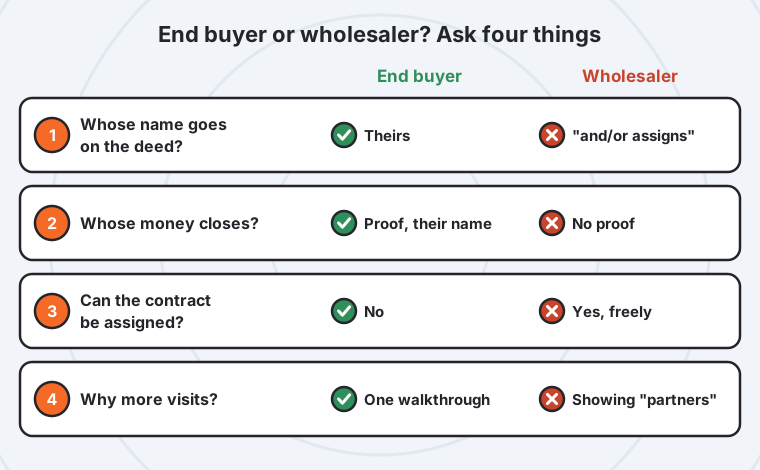
Then look at the contract itself. These are the signs a contract is built to be assigned:
- The buyer is named as “We Buy Houses In Connecticut and/or assigns”. See what “and/or assigns” means.
- A long inspection or due-diligence period, during which the buyer can cancel for any reason.
- A very small earnest money deposit.
- Permission for “the buyer’s partners” or “investors” to walk through.
- A closing date far in the future.
None of these is illegal on its own. Together, they usually mean the buyer is holding your house while looking for someone else to buy it. That’s fine if you were told so. It’s not fine if they said “we’re the buyer”. In states with a wholesaling law, the written disclosure answers this question for you: in Connecticut, ask for the state disclosure report and the wholesaler’s DCP registration before you sign. Our guide to checking a cash home buyer in Connecticut has the full checklist.
What legal protections do you have with each option?
Your legal protections differ by option. With a realtor, your state’s licensing law and agency rules apply, and the agent owes you duties. With a direct cash buyer, you rely mainly on your contract and your own attorney. With a wholesaler, a growing number of states add specific rights: written disclosure, registration or licensing, and in some states a right to cancel.
- Realtors are licensed by every state. You can check a license and complain to your state’s real estate commission. In Connecticut, agents are licensed by the Department of Consumer Protection.
- Direct cash buyers are mostly governed by contract law and general consumer protection law. Your strongest protection is a clear contract your own attorney has read: a firm price, a firm date, a deposit held by an attorney or title company, and a short inspection period or none.
- Wholesalers are now regulated in at least 21 states. Connecticut requires DCP registration, the state disclosure report before you sign, a three-business-day right to cancel for any reason, a 90-day closing limit and a ban on recording the contract against your title (CGS 20-329aaa to 20-329hhh). Other states require a license, a disclosure, or both. See wholesaling laws by state for yours.
- Novations are governed by your agreement. If the investor will list the house, make sure the agreement says who the listing agent is and whose interests that agent represents.
The laws summarized on this page were checked against state statutes and agency pages in October 2026. They change often. This is general information, not legal advice. Read the linked law, or ask a real estate attorney in your state, before you rely on it.
When is listing with a realtor the better choice?
Listing with a realtor is the better choice when your house is in good condition, buyers with mortgages can buy it as it is, you have three to six months, and getting the highest price matters more than speed or certainty. In that situation the open market will usually beat any investor offer, direct or wholesale, even after the commission.
We buy houses for a living, and we will still tell you this plainly: if your house fits the column on the right, list it.
A cash buyer or wholesaler fits if…
- The house needs repairs you can’t or don’t want to pay for
- It won’t pass a lender’s appraisal or inspection
- You have a deadline: a Law Day, probate, a move, a divorce
- There are tenants, especially ones who don’t pay
- You live far away and can’t manage a listing
- Privacy and a sure closing date matter more than top price
List with a realtor if…
- The house is updated and in good shape
- You have a few months and no deadline
- You can keep it ready for showings
- A buyer with a mortgage can buy it as it is
- Getting the highest price matters most
- Your area has more buyers than houses for sale
Somewhere in the middle? That’s where novation, or a light repair before listing, can make sense. And it’s worth getting both a cash offer and an agent’s pricing opinion before you decide. Nothing stops you from comparing.
Can you talk to a realtor, a cash buyer and a wholesaler at the same time?
Yes, you can talk to a realtor, a cash buyer and a wholesaler at the same time, and comparing them is smart. What you can’t safely do is sign more than one contract. A listing agreement may give the agent a commission even if you sell to a cash buyer, and a purchase contract with one buyer usually stops you from selling to another.
A sensible order:
- Get an agent’s opinion of price first, with comparable sales. It costs nothing and gives you a yardstick.
- Get two or three written cash offers. Ask each one: buy or assign?
- Compare what you’d keep, not just the headline numbers, and include time.
- Before you sign a listing agreement, read what it says about selling to a buyer you found yourself. Some agreements exclude named buyers if you ask.
- Before you sign a purchase contract, check the inspection period, the deposit, the closing date and whether it can be assigned.
How does this work in Connecticut?
In Connecticut, all four ways to sell close the same way: through attorneys, who search title, pay off your mortgage, collect the conveyance tax and record the deed. As the seller you pay the conveyance tax whichever route you choose. Wholesalers must also follow the state’s 2026 wholesaler law, including registration, a disclosure report and three business days to cancel.
- Attorneys run closings (CGS 51-88a). Have your own.
- Conveyance tax is 0.75% of the price up to $800,000 for the state, plus 0.25% for most towns, or 0.50% in 16 towns including Hartford, New Haven, Bridgeport and Waterbury (CGS 12-494). See Connecticut conveyance tax by town.
- Wholesale contracts must come with the state disclosure report and can be cancelled within three business days. For the full law, read selling a house to a wholesaler in Connecticut.
- Situations change the answer. Foreclosure, probate, tenants and heavy repairs each have their own Connecticut rules: see selling before foreclosure, selling an inherited house, selling a rental with tenants and selling a house that needs repairs.

The first thing I ask isn’t about the house, it’s about the deadline. A seller with time and an updated house should list, and I tell them so. A seller with a Law Day in five weeks needs a buyer who closes, not the highest number on paper. And whoever you talk to, me included, ask straight out: “Are you buying it, or assigning it?” You deserve a one-sentence answer.
We are We Buy Houses In Connecticut, LLC, and we have been buying Connecticut houses since 2016, about 10 a year. When we buy, we buy with our own money or with partners’ funds. When a house doesn’t fit what we buy, we say so in writing, and any assignment in Connecticut is handled by a registered wholesaler.
Get a written cash offer to set beside your agent's price
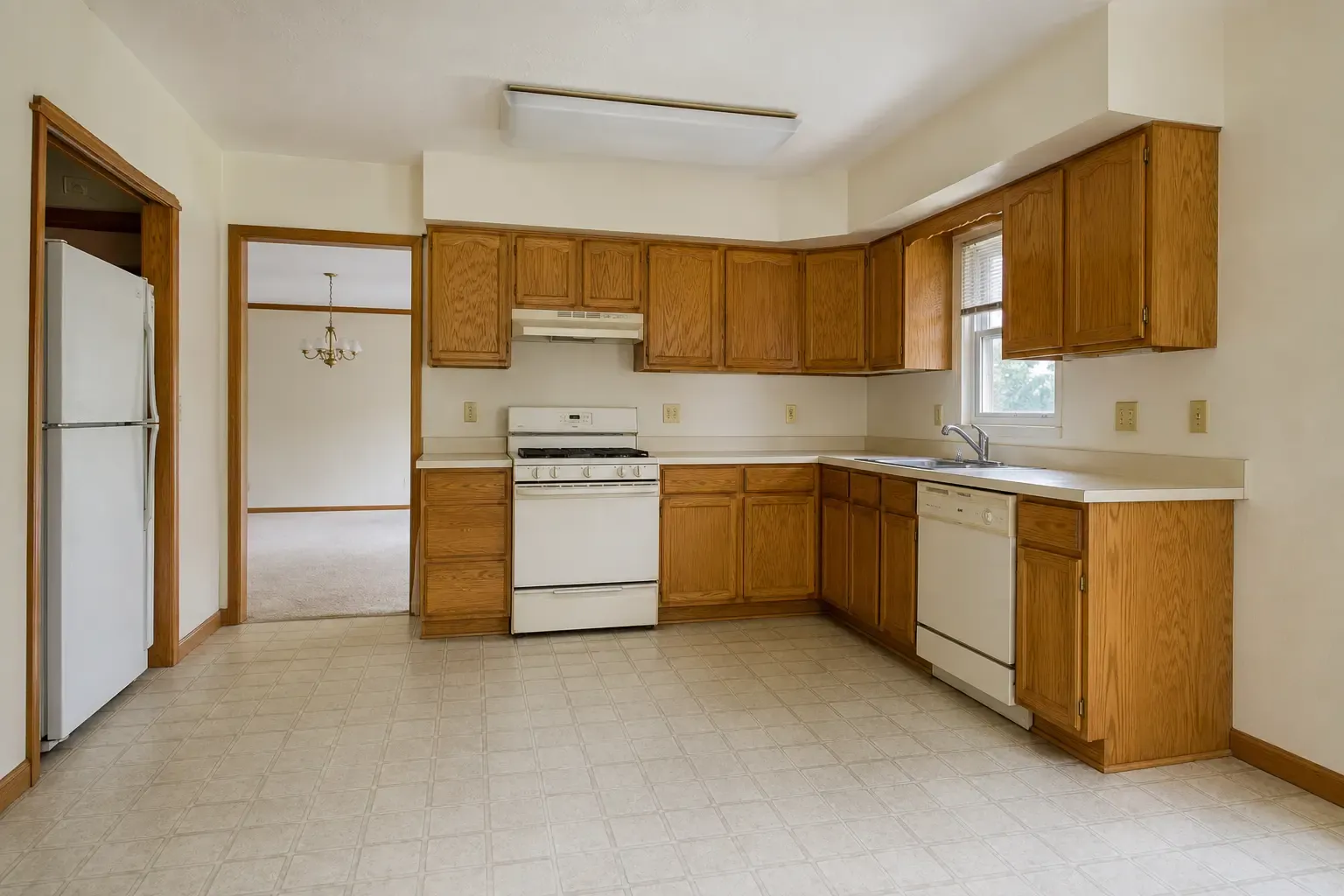
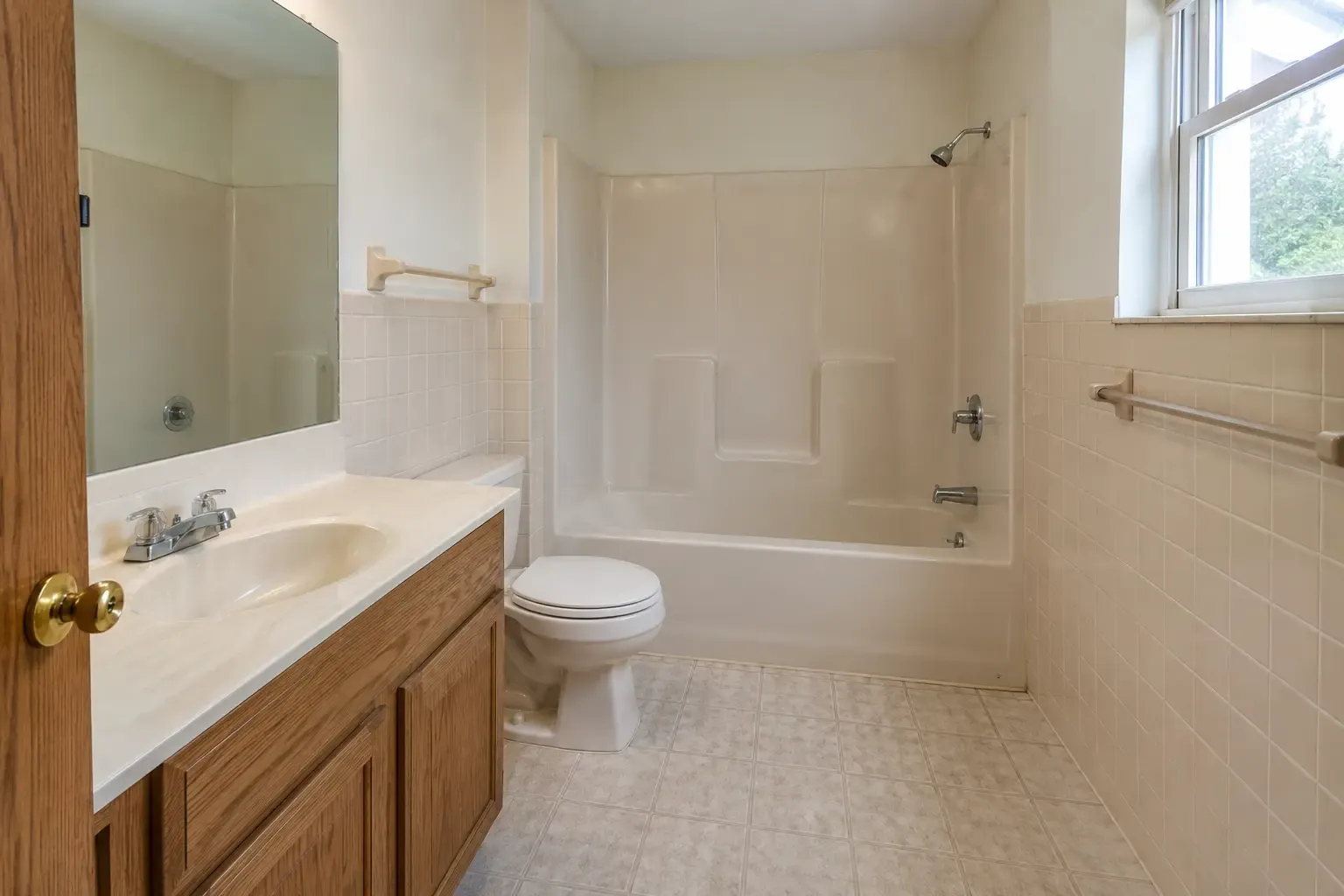
Want your offer faster, or rather not talk to anyone yet? Send a few phone photos of the rooms. We price the repairs we see and send back a written offer that says plainly whether we would buy the house ourselves or bring you a buyer. Then compare it with a listing. No obligation.
 CabinetsFlooring
 Tub & tile
 Floors
 Roof
We may bring in a partner buyer to close. Your price and terms don't change.
Wholesaler vs. realtor vs. cash buyer: common questions
What is the difference between a wholesaler and a realtor?
The difference between a wholesaler and a realtor is who they work for and what they sell. A realtor is a licensed agent who represents you and markets your house to the public for a commission. A wholesaler is a buyer who puts your house under contract and assigns that contract to an investor for a fee. A wholesaler does not represent you.
What is the difference between a wholesaler and a cash buyer?
A cash buyer buys your house with their own money or a lender’s and takes title. A wholesaler signs a contract to buy it and then assigns the contract to a cash buyer, who closes with you. Some companies do both, depending on the house. Ask which one you are getting.
Does a wholesaler need a real estate license?
Whether a wholesaler needs a real estate license depends on the state. Several states, including Illinois, Pennsylvania, Oklahoma and Virginia, require a license for wholesaling or for marketing a contract. Connecticut and Oregon require a separate wholesaler registration instead. Other states require only a written disclosure.
Who gets me the most money: a realtor, a cash buyer or a wholesaler?
A realtor usually gets the most money for a house in good condition when you have time to sell. A cash buyer or wholesaler pays an investor price, below retail, in exchange for speed, no repairs and certainty. Compare what you would keep after costs and time, not only the sale price.
Do I pay a commission to a cash buyer or a wholesaler?
No. You do not pay an agent commission to a direct cash buyer or a wholesaler. With an assignment, the end buyer pays the wholesaler’s fee on top of your contract price. You still pay your normal seller costs, such as transfer tax and your own attorney.
Is a wholesaler a type of real estate agent?
No. A wholesaler is not a real estate agent, even if some states require wholesalers to hold a license. An agent represents you. A wholesaler is a buyer under your contract who intends to transfer it, and represents themselves.
What is novation in real estate?
Novation in real estate is a fix-and-list arrangement: an investor pays for and manages repairs, the house is sold on the open market, and you receive an agreed price or share. It can net more than a cash offer for a house that needs cosmetic work, but it takes months and depends on the market.
Is it better to sell to a wholesaler or a direct cash buyer?
It depends on the house. A direct cash buyer avoids a fee in the middle and the risk that no end buyer turns up. A wholesaler can help when few investors want your house, because they know the specific buyers who do. Either way, ask for proof of funds and a firm closing date.
Can I list my house with an agent and still take a cash offer?
You can list your house and still take a cash offer, but check your listing agreement first. Many listing agreements pay the agent a commission whoever the buyer is. If you already have a cash buyer in mind, ask the agent to exclude that buyer in writing before you sign.
Can a realtor wholesale my house?
Rules on agents who wholesale differ by state. South Carolina bars licensed agents from engaging in or assisting wholesaling as its law defines it. Connecticut requires anyone who wholesales, including licensed agents, to hold a separate DCP wholesaler registration. An agent who is also the buyer must tell you so.
How do I know if a cash buyer is really a wholesaler?
You know a cash buyer is really a wholesaler if the contract says “and/or assigns”, the deposit is small, the inspection period is long, or “partners” need to see the house. Ask directly whose name will be on the deed, and ask for proof of funds in that name.
Which option is fastest?
A direct cash buyer with proof of funds is usually fastest, often within a few weeks, because there is no lender. A wholesaler can be as fast once an end buyer has signed. A listing usually takes months from listing to closing, and a novation takes longest.
Related guides
- Real estate wholesaling, explained for homeowners: the full guide
- Should you sell your house to a wholesaler? Honest pros and cons
- What is an assignment fee in real estate?
- Why cash offers are lower than list prices: the investor math
- “We buy houses” scams and red flags
- Who we are, and how to check us
Ready to compare? Get your written cash offer, or call Jerryll at (203) 529-4712.
Sources
- Connecticut General Statutes chapter 392a, §§ 20-329aaa to 20-329hhh (real estate wholesalers, effective July 1, 2026).
- Connecticut Department of Consumer Protection: Real Estate Wholesaling.
- CGS § 12-494 (real estate conveyance tax).
- CGS § 51-88a (real estate closings by attorneys).
- Ohio Rev. Code § 5301.95 (wholesaling and novation disclosure, effective March 2, 2026).
- Oklahoma SB 1075 (2025), enrolled text.
- Louisiana HB 468, Act 807 (2026).
- South Carolina H. 4754, Act 204 of 2024 (licensees and wholesaling).
- 225 ILCS 454/1-10 (Illinois broker definition, assignable contracts).
- Va. Code § 54.1-2100.
- Pennsylvania Act 52 of 2024 (SB 1173).
- Oregon Real Estate Agency: residential property wholesaling.
- National Association of Realtors, 2025 Profile of Home Buyers and Sellers, and the NAR settlement practice changes effective August 17, 2024.
Who wrote this
Jerryll Noorden
Jerryll has bought and sold Connecticut houses since 2016 and has sat at more closing tables than he can count, on both sides. Before real estate he was a robotics scientist at NASA, IHMC and IIT. He wrote this guide because the national sites that rank for it skip the Connecticut rules that cost sellers money. When listing or selling it yourself would get you more than a cash offer, he says so.
This guide explains Connecticut rules in plain English. It is not legal or tax advice. Laws change; for your sale, talk to a Connecticut real estate attorney and a tax professional.
