
- Owner financing can be a good idea for a Connecticut seller who owns the house free and clear, gets a real down payment, has an attorney draft and record a proper note and mortgage, and can live without the lump sum for years.
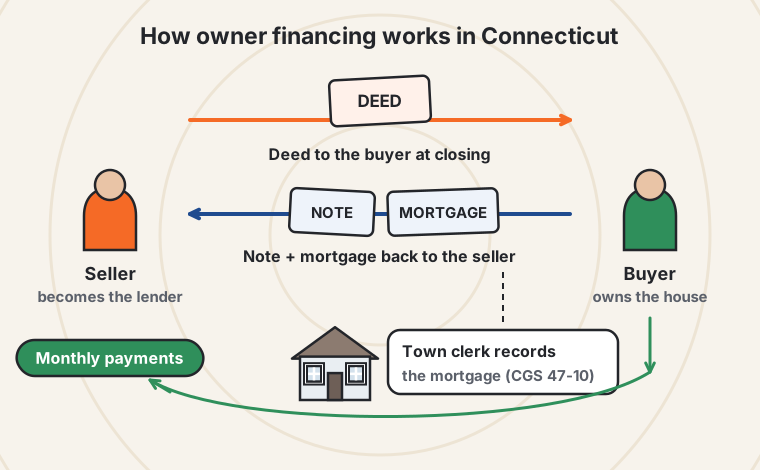
- The buyer gets the deed at closing. You hold a promissory note and a mortgage recorded in the town land records. You are a lender, not an owner.
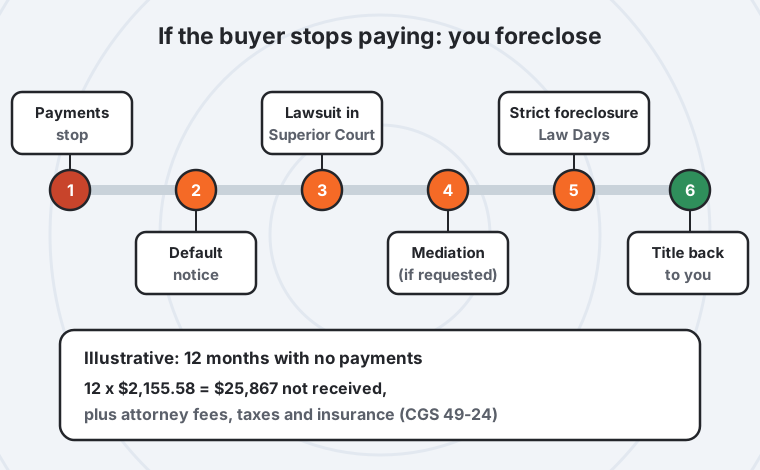
- If the buyer stops paying, you foreclose in Superior Court, usually by strict foreclosure (CGS 49-24). That takes months and costs money.
- Federal rules allow small sellers to finance one property a year (or up to three, with stricter terms) without being treated as a loan originator (12 CFR 1026.36(a)(4)-(5)). Connecticut licensing rules (CGS 36a-486) still need a check by your attorney.
- Still have a mortgage? Your lender can usually demand full payment if you sell (12 USC 1701j-3). Plan to pay it off at closing.
- Taxes: you may spread the gain over the years you are paid (IRS Pub 537, Form 6252), but the interest is taxable income every year.
- When you need the money now, or cannot stomach a default, a listing or a cash sale is simpler.
Is owner financing a good idea for the seller in Connecticut?
Owner financing is a good idea for a Connecticut seller only in a narrow set of cases: you own the house outright or will pay your mortgage off at closing, the buyer puts down a meaningful amount, an attorney prepares a note and a mortgage that are recorded in the town land records, and you do not need the full price now. It is a poor idea if you need cash soon, still owe a lender, or cannot afford a foreclosure if the buyer stops paying.
This guide is part of our guide to how to sell a house in Connecticut, and it answers one narrow question in depth: should you, the seller, act as the bank? Owner financing (also called seller financing) is legal in Connecticut, and for some owners it works well. But many explanations online leave out the parts that hurt sellers: the buyer owns the house from closing day, a default means a court case, and your own lender may not allow it.
Here is the short version in plain numbers. On an illustrative $360,000 house with 10% down, you would collect $36,000 at closing (before costs) and then a monthly payment of about $2,155.58 for years, with the rest of your money arriving only when the buyer refinances or sells. If you list the same house, you would net roughly $336,900 at closing (est.). One gives you income and risk; the other gives you cash and certainty. The rest of this page helps you choose.
Is this page for you if someone suggested owner financing?
This page is for you if a buyer, a relative, a tenant or an investor suggested owner financing for your Connecticut house and you are not sure whether it is generous, smart or a trap. You may feel tempted by the monthly checks, suspicious of the person suggesting it, and worried about what happens if payments stop. Those are the right questions to ask.
Most sellers who ask about owner financing are not real estate people. You might be a long-time owner in Trumbull or Wolcott whose house is paid off. You might be a landlord who is tired of tenants but likes the rent check. You might have inherited a house free and clear, or have a house that sat on the market and a buyer who “just can’t get a mortgage yet.” Someone said: be the bank, get your price, collect interest.
It is normal to feel two things at once. Tempted, because a monthly check sounds like a pension. Suspicious, because if it is such a good deal for you, why is the other side pushing it? Many sellers also feel out of their depth with words like note, balloon and Dodd-Frank, afraid of being stuck in court with a house that comes back damaged, and sometimes loyal to a buyer they know and want to help.
None of that is foolish. In Connecticut, the moment you close, the buyer owns the house and you hold paper. If the paper is good, owner financing can be a quiet, profitable arrangement. If it is not, you can spend a year and real money getting the house back. We will walk through exactly where the risks are, what the law says, and how to protect yourself, and we will be honest about when a regular listing or a cash sale is the better call.
How does owner financing work in Connecticut?
Owner financing in Connecticut works like a bank loan with you as the bank. You and the buyer sign a purchase contract, and at closing you sign a deed to the buyer, the buyer signs a promissory note promising to repay you, and a mortgage deed that pledges the house as security. The mortgage is recorded in the town land records. The buyer then pays you monthly until the loan is paid off, usually by a refinance or sale.
The live version of this page used to say the seller “still owns the property” until the end. That is not how a standard Connecticut seller-financed sale works, and it matters. In a note-and-mortgage sale:
Agree the price and the loan terms
Price, down payment, interest rate, length, monthly payment, any balloon date, late fees, and who pays taxes and insurance. These go into the purchase and sale agreement, drafted or reviewed by your attorney.
Check the buyer like a lender would
Credit report, income, debts, employment, and references, with the buyer’s written permission. If you finance under the federal three-property exclusion you must determine in good faith that the buyer can reasonably repay (12 CFR 1026.36(a)(4)).
Close with an attorney
Connecticut closings are handled by attorneys. You sign the deed to the buyer. The buyer signs a promissory note (the debt) and a mortgage deed (the security) in your favor. Your attorney should also get you a lender’s title insurance policy so your mortgage is protected.
Record the mortgage
The deed and your mortgage are recorded with the town clerk. Recording gives the world notice of your lien; an unrecorded interest does not protect you against later buyers or lenders (CGS 47-10). You pay the conveyance tax on the full price, not just the down payment (CGS 12-494).
Collect, service and release
The buyer pays you monthly, ideally through a loan servicing company that tracks payments, escrow and year-end tax forms. When the loan is paid off, you must release the mortgage on the land records (CGS 49-8).
In a land contract (also called a contract for deed or bond for deed) you keep the deed until the buyer finishes paying. In rent-to-own, a tenant rents with an option to buy later. Both are sometimes sold as “simpler” owner financing. They are not simpler for you: the buyer still gains rights in the house, a defaulting buyer may still have to be removed through the courts, and the federal rules treat many land contracts as credit too. Connecticut has no simple statute that makes these safe for sellers. Use them only with a Connecticut attorney, and see the section on them below.
What Connecticut and federal rules apply to owner financing?
The rules that apply to owner financing in Connecticut are federal mortgage rules (Regulation Z, including the seller-financer exclusions in 12 CFR 1026.36), Connecticut’s mortgage licensing law (CGS 36a-486 and 36a-487), Connecticut’s 12% usury law and its mortgage exemption (CGS 37-4 and 37-9), the federal due-on-sale law (12 USC 1701j-3), Connecticut foreclosure law (CGS 49-24) and the IRS installment-sale rules (Pub 537).

| Topic | What the rule says | What it means for you | Law |
|---|---|---|---|
| Federal “loan originator” rules: one property | A natural person, estate or trust that finances the sale of only one property it owns in any 12 months is not a loan originator, if the loan has no negative amortization and a fixed rate (or an adjustable rate fixed for 5+ years with reasonable caps) | Most individual owners selling one house fit here. A balloon payment is not ruled out by this exclusion | 12 CFR 1026.36(a)(5) |
| Federal “loan originator” rules: up to three properties | Any person (including an LLC) financing three or fewer properties it owns in 12 months is excluded only if the loan is fully amortizing, the seller determines in good faith the buyer can reasonably repay, and the rate is fixed (or adjustable after 5+ years with reasonable caps) | No balloon under this exclusion, and you must document the buyer’s ability to repay | 12 CFR 1026.36(a)(4) |
| Who counts as a “creditor” | A person regularly extends consumer credit if it extended credit more than 5 times for dwelling-secured transactions in the preceding calendar year | One or two seller-financed sales usually do not make you a TILA creditor; repeat financing can | 12 CFR 1026.2(a)(17)(v) |
| Connecticut mortgage licensing | No person may engage in the business of making residential mortgage loans without a license; advertising or soliciting to make loans counts as being in the business. Individuals offering terms on a dwelling that was their residence, or that they own, are exempt from the loan originator license unless done with “habitualness or repetition” | A one-time sale of your own house is generally treated differently from a business. Do not advertise financing as a service. Have your attorney confirm with the Department of Banking rules | CGS 36a-486(a), (b)(2)(C) and (G); CGS 36a-487 |
| Interest rate cap | Interest above 12% a year is generally prohibited, but the cap does not apply to “any bona fide mortgage of real property for a sum in excess of five thousand dollars” | A typical seller-financed house loan is above $5,000 and secured by a mortgage, so the 12% cap generally does not bite. A tiny unsecured note would be different | CGS 37-4; CGS 37-9(3) |
| Your own mortgage | A lender may enforce a due-on-sale clause; sale to a buyer is not one of the nine exempt transfers (those cover death, divorce, transfers to a spouse or children, living trusts, leases of 3 years or less without an option, and similar) | If you still owe on the house, your lender can call the loan when you sell. Plan to pay it off at closing | 12 USC 1701j-3(b), (d) |
| If the buyer defaults | Mortgages are foreclosed in Superior Court; the court usually orders strict foreclosure with Law Days, or a foreclosure by sale | You cannot simply change the locks. Expect months, attorney fees and possibly mediation | CGS 49-24; CGS 49-31l |
| Taxes on the sale | An installment sale is one where at least one payment arrives after the year of sale; you may report gain as you are paid, or elect to report it all in the year of sale | Spreads capital gain over years. Interest is ordinary income each year. The main-home exclusion still applies | IRS Pub 537; Form 6252; Pub 523 |
| Recording and release | Conveyances are recorded in the town land records; a mortgagee must release a paid mortgage | Record your mortgage at closing; release it when paid | CGS 47-10; CGS 49-8 |
Connecticut’s licensing law is written for businesses, and the Department of Banking says even exempt parties may still be subject to other Connecticut lending laws, including limits on loan terms. An individual financing the sale of their own home once is usually not in the “business” of making loans. An LLC that buys and resells several houses a year on terms is a different story. If you own several properties, or want to market “owner financing available,” get your attorney’s written opinion first.
What are the pros and cons of owner financing for the seller?
The pros of owner financing for a Connecticut seller are a larger pool of buyers, often a higher price, interest income, and capital gains spread over several years. The cons are that you do not get your full price now, the buyer owns the house while you carry the risk, a default means a foreclosure in court, and you take on paperwork, servicing and tax reporting for years.
Why sellers like it
- More buyers. Self-employed buyers, buyers rebuilding credit, and buyers of houses a bank will not lend on (for example, a house that needs work) can make an offer.
- Price and terms. Buyers often accept a higher price in exchange for flexible terms.
- Income. You earn interest instead of keeping cash in a low-yield account.
- Tax timing. Gain can be reported as you are paid (IRS Pub 537).
- A sellable note. A well-documented, well-paid note can later be sold, usually at a discount, if you need cash.
What can go wrong
- No lump sum. Most of your equity arrives only at the balloon or payoff.
- Default. If payments stop, you must foreclose (CGS 49-24). Months without income, plus legal fees.
- Condition risk. The buyer can neglect the house that secures your loan.
- Taxes and insurance. If the buyer lets the policy lapse or skips property tax, your collateral is at risk. Town taxes become a lien ahead of you.
- Your mortgage. If you still owe, the lender can call the loan (12 USC 1701j-3).
- Compliance. Federal and Connecticut lending rules, servicing, year-end reporting.
A plain way to think about it: owner financing turns a house sale into a house sale plus a loan. The sale part ends at closing. The loan part lasts as long as you let it. Before you agree, ask yourself whether you would lend this buyer this amount of money if there were no house involved. If the honest answer is no, the house is not much comfort, because getting it back takes a court case.
What does owner financing look like in real numbers?
In real numbers, an owner-financed sale of an illustrative $360,000 Wolcott house with 10% down gives the seller $36,000 at closing before costs, then about $2,155.58 a month on a $324,000 loan at 7% over 30 years, and a balloon of about $304,986 if the buyer refinances after five years. Listing the same house would net roughly $336,900 at closing (est.).
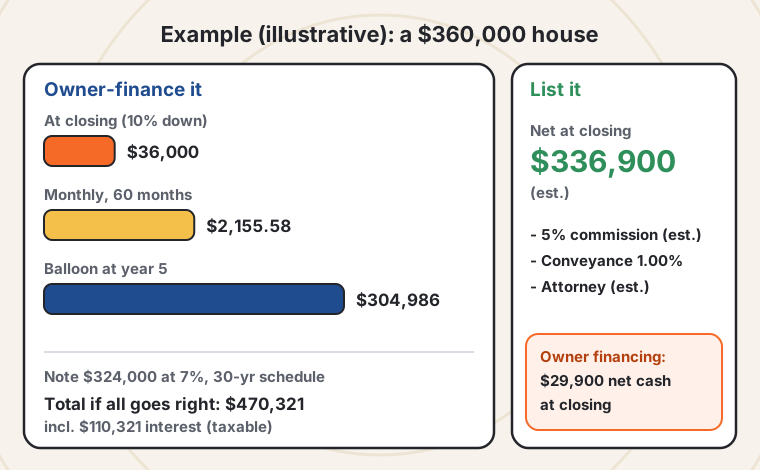
Example (illustrative). Inputs: price $360,000 (the single-family median in Wolcott, Oct 2024-Sep 2025, from our town data); Wolcott conveyance tax 1.00% (0.75% state plus 0.25% town, CGS 12-494); 10% down; 7.00% fixed rate (an assumption, not a recommendation); 30-year amortization with a 5-year balloon (allowed under the one-property exclusion, not under the three-property one). Commission 5% and attorney fees are estimates.
| Line | List it (buyer gets a bank loan) | Owner-finance it |
|---|---|---|
| Price | $360,000 | $360,000 |
| Cash to you at closing, before costs | $360,000 | $36,000 (10% down) |
| Commission (est. 5%) | -$18,000 | $0 if you found the buyer yourself |
| Conveyance tax, Wolcott 1.00% of full price | -$3,600 | -$3,600 (on the full price, even though you only got $36,000) |
| Attorney fees (est.) | -$1,500 | -$2,500 (note, mortgage, title policy; est.) |
| Net cash at closing | $336,900 | $29,900 |
| Monthly payment to you | none | $2,155.58 (principal and interest) |
| Received over 60 months | none | $129,335 |
| Interest earned in those 5 years (taxable income) | none | $110,321 |
| Balloon at month 60 (if the buyer refinances) | none | $304,986 |
| Total received if everything goes right | $336,900 now | $470,321 over 5 years, before costs and taxes |
The owner-financed column looks better in total. That is the interest. But compare where the money sits: in the listing you have $336,900 in your account the day you close. In the owner-financed sale, $304,986 of your money depends on the buyer qualifying for a bank refinance five years from now. If rates are higher or the buyer’s credit has not improved, the balloon may not happen on time, and your choices are to extend, renegotiate or foreclose.
You can model your own listing numbers with the calculator below, then compare them to your financing terms.
How much would you walk away with?
Slide the numbers to match your house. It works in your browser; nothing is saved or sent.
Estimates for planning. Conveyance tax per CGS 12-494 (state 0.75% up to $800,000, 1.25% to $2.5M, 2.25% above, plus the town rate). Seller attorney about $1,200 to $1,500; flat-fee MLS about $400; listings include three months of taxes, insurance and utilities, a cash sale about two weeks. Your attorney gives you the final numbers.
What if the buyer stops paying?
Same illustrative loan. Say the buyer pays 18 months, then stops. The balance is still about $318,975. If it takes 12 months to get the house back through court, that is $25,867 of payments you did not receive (12 × $2,155.58), plus your attorney fees, plus any property taxes or insurance you pay to protect the house, plus repairs if it comes back in poor shape. You keep the down payment and the payments already made, but the “passive income” has become a lawsuit. Plan for that possibility before you sign, not after.
What happens if an owner-financed buyer defaults in Connecticut?
If an owner-financed buyer defaults in Connecticut, you, as the mortgage holder, must foreclose through Superior Court. The court usually orders strict foreclosure, which sets Law Days; if the buyer does not pay what is owed by their Law Day, title passes to you (CGS 49-24). The buyer may be able to request foreclosure mediation, and the case typically takes months.
As the lender, you are in the bank’s shoes. The steps are the same ones homeowners face in our guide to foreclosure in Connecticut, just from the other side of the table:
- Default and notice. Your note and mortgage should spell out late fees, the cure period and what counts as default. Your attorney sends the formal notice.
- Lawsuit. A foreclosure is a civil case in Superior Court. You will need a Connecticut attorney.
- Mediation. Owner-occupants of residential property can usually ask for the state’s foreclosure mediation program, which pauses parts of the case for a time (CGS 49-31l). Expect to negotiate.
- Judgment and Law Day. In strict foreclosure the court sets Law Days. If the buyer does not redeem, title passes to you. If the house is worth much more than the debt, the court may order a foreclosure by sale instead (CGS 49-24).
- Getting possession. If the buyer will not leave after title passes, there is a further court step to remove occupants.
Two things reduce this risk more than anything else: a large down payment (the buyer has more to lose and you have more cushion), and choosing a buyer whose finances you have actually checked.
Can you do owner financing if you still have a mortgage in Connecticut?
You usually cannot safely do owner financing in Connecticut if you still have a mortgage, because nearly all modern mortgages have a due-on-sale clause and federal law lets your lender enforce it when you sell (12 USC 1701j-3). The safe structure is to pay off your loan at closing from the buyer’s down payment and your own funds, or to get your lender’s written consent.
Investors sometimes suggest a “wrap” (you keep paying your mortgage while the buyer pays you more) or a “subject-to” deal (the buyer takes over your payments without the lender’s approval). The federal due-on-sale law lists transfers a lender may not use to call the loan, such as a transfer to your spouse or children, a transfer on death to a relative, a divorce decree, a living trust where you stay a beneficiary, or a lease of three years or less with no option to buy. A sale to an outside buyer is not on that list.
- Your lender can demand the full balance once it learns of the sale. If you cannot pay, it can foreclose on a house you no longer own, while the buyer you financed is living in it.
- You stay liable on your original loan. If the buyer stops paying you, you still owe your lender.
- Taxes and insurance get messy. Your homeowner’s policy and escrow are in your name for a house you sold.
If you are thinking about owner financing because you are behind on payments, it is the wrong tool: a buyer’s down payment rarely covers the arrears, and the due-on-sale risk is highest exactly then. Read selling a house before foreclosure in Connecticut and the free help listed in the foreclosure guide first.
How is an owner-financed sale taxed?
An owner-financed sale is usually taxed as an installment sale: because at least one payment arrives after the year of sale, you can report part of your gain each year as principal comes in, using IRS Form 6252, or elect to report it all in the year of sale (IRS Pub 537). The interest the buyer pays you is ordinary income every year, and Connecticut taxes both gain and interest as income.
- Gain is spread, not erased. Each principal payment carries a share of your profit (the “gross profit percentage”). The down payment is a payment in the year of sale.
- Your main-home exclusion still works. If the house was your main home and you qualify, up to $250,000 of gain ($500,000 married filing jointly) can be excluded; gain you exclude is not counted in the installment calculation (IRS Pub 523 and 537).
- Rental property is different. Depreciation recapture is generally reported in the year of sale, even if you receive little cash that year. Ask your tax preparer before choosing terms.
- Charge real interest. If your rate is too low, the IRS can treat part of each payment as interest anyway (the “unstated interest” rules tied to the applicable federal rate in Pub 537).
- Exchange Social Security numbers. When the buyer uses the house as a residence, you report the buyer’s name, address and SSN with your interest income, and the buyer reports yours to deduct the interest (Pub 537).
For the conveyance tax, capital gains and the rest of the tax picture on any Connecticut sale, see taxes when selling a house in Connecticut.
How do you protect yourself if you offer owner financing?
To protect yourself when you offer owner financing in Connecticut, hire a Connecticut real estate attorney, require a substantial down payment, check the buyer’s credit and income, use a recorded first mortgage with a lender’s title policy, require insurance naming you, collect property taxes in escrow, and use a professional loan servicer.
- A Connecticut real estate attorney drafts the purchase contract, note and mortgage and handles the closing.
- A down payment large enough that the buyer will not walk away (many sellers aim for 10% to 20%; more is safer).
- The buyer’s written permission to pull credit, plus pay stubs, tax returns and bank statements. Keep a copy of how you judged ability to repay.
- A fixed interest rate, a written payment schedule, and no negative amortization (required for the federal exclusions).
- Your mortgage recorded with the town clerk at closing, in first position.
- A lender’s title insurance policy in your name.
- Homeowner’s insurance with you named as mortgagee; proof every year.
- Monthly escrow for property taxes, or proof of payment each tax bill, so a town tax lien does not jump ahead of you.
- A third-party servicing company to collect payments, track escrow and send year-end statements.
- Clear default, late fee and cure terms in the note.
- A balloon date realistic for a refinance, and a plan if the buyer cannot refinance on time.
- Your own mortgage paid off at closing, or the lender’s written consent.

The part people skip is the boring part: the servicer, the insurance certificate, the tax escrow. Those are what keep a note healthy for ten years. If someone pushes you to skip the attorney “to save money,” that is your sign to slow down. A few hundred dollars of legal work is cheap next to a foreclosure.
Are land contracts or rent-to-own safer for a Connecticut seller?
Land contracts and rent-to-own deals are not automatically safer for a Connecticut seller. Keeping the deed sounds protective, but the buyer still gains rights in the house, a buyer who stops paying may still have to be removed through court, and the arrangement can create title, tax and insurance problems. Use them only with a Connecticut attorney.
- Land contract (contract for deed, bond for deed). You keep title; the buyer moves in and pays you over time, and you deed the house when they finish. Courts in many states treat a long-paying buyer as having an equitable interest, which can mean a foreclosure-like process to end the contract. Federal rules can treat these as credit sales (Regulation Z covers credit sales). Get Connecticut-specific advice before signing.
- Rent-to-own (lease with option). The occupant is a tenant first. If they stop paying, you are likely in a Connecticut eviction case. A lease with an option to buy is also not one of the transfers protected from your lender’s due-on-sale clause (only a lease of three years or less with no option is, 12 USC 1701j-3(d)(4)).
- Your insurance and taxes. With either, you are often still the owner of record, which can affect your insurance, your liability if someone is hurt, and who receives tax bills.
If what you really want is to stop being a landlord, owner financing a tenant rarely ends the landlord feeling; it often just changes the paperwork. For landlord options, see the truth about being a landlord in Connecticut and selling a rental with tenants in place.
When is a listing or a cash sale simpler than owner financing?
A listing or a cash sale is simpler than owner financing when you need your equity within months, still owe on your mortgage, do not want to be a lender for years, or cannot afford a default. A listing usually brings the highest price when the house is in good shape; a cash sale trades some price for speed, no repairs and no financing risk.

List with an agent
$336,900 (est.)Net at closing in the illustrative example.
- Usually the highest price for a house in good shape
- Buyer brings a bank loan; you are paid in full
- Showings, repairs the buyer asks for, a few months
- Commission and conveyance tax
Owner-finance
$29,900 + $2,155.58/moAt closing, then monthly, then a balloon.
- Can bring a higher total price and interest
- You carry default, condition and refinance risk
- Attorney, servicer, taxes every year
- Best when the house is paid off and you do not need the cash
Sell for cash, as-is
About 2 weeksTypical time from first call to closing with us.
- No repairs, no showings; leave what you do not want
- Paid in full at closing; no monthly collection, no foreclosure risk
- Price is below a retail listing; that is the honest trade-off
- A Connecticut attorney handles the closing
Jerryll Noorden’s company, We Buy Houses In Connecticut, buys houses for cash, about 10 a year since 2016. A cash offer is lower than a full retail listing on a house in good shape, and we say so. Where it fits is when certainty and speed are worth more than the last dollar: a house that needs work, a tenant situation, an estate, or a seller who simply does not want to be a lender. For how cash offers are calculated, read cash home buyers in Connecticut, and for a side-by-side of the two main routes, see selling to a cash buyer vs. listing with a realtor.
Is a cash sale right for you, or should you list?
Seven quick questions. There is no wrong answer, and we will tell you honestly if listing would leave you more.
- Does the house need repairs you would rather not pay for or manage?
- Do you need to close by a certain date, or within the next month or two?
- Would showings be hard: tenants, belongings, privacy, or you live out of state?
- Is there a complication: an estate or probate, a divorce, foreclosure, liens or back taxes?
- Could you comfortably cover the mortgage, taxes and utilities for three or more months?
- Is getting the highest possible price more important to you than speed and certainty?
- Would a buyer's bank lend on the house as it is (no major roof, foundation, oil tank or code issues)?
When you should NOT owner-finance
- You need most of your equity within a year (for a new home, care costs, debts).
- You still owe on the house and cannot pay the loan off at closing.
- The buyer cannot make a real down payment or will not let you check credit and income.
- You would not be able to pay a foreclosure attorney and go months without payments.
- You own several properties and plan to do this repeatedly without licensing advice.
When you should NOT sell to a cash buyer
- Your house is in good condition in a strong town, and you have a few months: list it.
- You are behind on your mortgage and might qualify for a modification or mediation: get free help first.
- A buyer is offering you a fee-based “rescue” or asks you to sign over your deed before closing: walk away and check them with our guide on how to check a cash home buyer.
How do you decide between owner financing and a regular sale?
To decide between owner financing and a regular sale in Connecticut, write down when you need the money, confirm your mortgage payoff, get a realistic listing price and a cash offer, model the financing terms, and have a Connecticut attorney review the plan before you agree to anything. Compare the three paths by net cash, time and risk, not by the headline price.
Know your numbers
Get your mortgage payoff and estimate your selling costs, including conveyance tax at your town’s rate (see the Connecticut conveyance tax guide).
Get a listing estimate and a cash offer
Ask an agent for a pricing opinion and get at least one written cash offer. Both are free and neither commits you. Use how to compare offers to line them up.
Model the financing
Down payment, rate, term, balloon, and what happens if payments stop for a year. If the plan only works when everything goes right, it is not a plan.
Talk to a Connecticut attorney and a tax preparer
Ask about licensing, the federal exclusions, your mortgage, the installment-sale tax and your default remedies.
Choose and close
With a listing, plan for a few months (see how long it takes to sell in Connecticut). With a cash sale to us, about 2 weeks is typical, and you pick the date.
If you want a cash number to compare against your financing plan, you can book a short call or a walkthrough below. No repairs, leave what you do not want, and take whatever time you need to compare.
See the house together.
Pick a time that works.
Choose a time for us to walk through the property with you, or ask for a quick call first. We confirm every request personally.
Tuesday, January 13
No open times in the next few weeks. Please call us.
We will confirm by email. Nothing is booked until we do.
View my requestOwner financing questions Connecticut sellers ask
Is owner financing legal in Connecticut?
Yes, owner financing is legal in Connecticut. A seller can take a promissory note and a recorded mortgage from the buyer. Federal Regulation Z and Connecticut’s mortgage licensing law (CGS 36a-486) still apply, so an individual selling their own house once is treated very differently from a business that finances sales regularly.
Who holds the deed in owner financing?
In a standard owner-financed sale in Connecticut, the buyer holds the deed from closing day. The seller holds a promissory note and a mortgage recorded in the town land records. Only in a land contract does the seller keep the deed until the buyer finishes paying.
Do I need a license to offer seller financing in Connecticut?
You usually do not need a mortgage license to seller-finance the one-time sale of your own home in Connecticut, because the licensing law targets people in the business of making loans and exempts individuals offering terms on their own residence or dwelling unless they do it habitually (CGS 36a-486(b)(2)(C), (G)). Repeat financing or advertising financing can change that, so confirm with an attorney.
What is the Dodd-Frank seller financing exemption?
The Dodd-Frank seller financing exemption is a pair of exclusions in Regulation Z. A person, estate or trust financing one property it owns in 12 months is not a loan originator if the loan has no negative amortization and a fixed or 5-year-fixed rate. Anyone financing up to three properties is excluded only with fully amortizing loans and a good-faith ability-to-repay check (12 CFR 1026.36(a)(4)-(5)).
Can I do owner financing if I have a mortgage?
You can only do owner financing safely with a mortgage if you pay that mortgage off at closing or get your lender’s written consent. A sale triggers the due-on-sale clause, and federal law lets the lender demand the full balance (12 USC 1701j-3). You also stay personally liable on your loan.
What interest rate can I charge on owner financing in Connecticut?
Connecticut’s 12% usury cap (CGS 37-4) generally does not apply to a bona fide mortgage of real property for more than $5,000 (CGS 37-9(3)), so a typical owner-financed house loan is not capped at 12%. Federal rules require a fixed rate or one fixed for at least five years for the seller-financer exclusions, and the IRS may impute interest if your rate is too low.
What happens if the buyer stops paying?
If an owner-financed buyer stops paying in Connecticut, you foreclose your mortgage in Superior Court like a bank. The court usually orders strict foreclosure with Law Days (CGS 49-24), and the buyer may request mediation. It takes months and needs an attorney.
How long does a seller-financed loan usually last?
A seller-financed loan in Connecticut often runs on a 30-year payment schedule with a balloon after a few years, when the buyer is expected to refinance with a bank. Balloons fit the federal one-property exclusion but not the three-property exclusion, which requires full amortization.
How is owner financing taxed?
Owner financing is usually taxed as an installment sale: you report part of the gain each year as principal comes in (IRS Form 6252, Pub 537), or elect to report it all in the year of sale. Interest you receive is ordinary income each year, federally and in Connecticut.
Do I still pay Connecticut conveyance tax with owner financing?
Yes, you still pay Connecticut conveyance tax with owner financing, and it is figured on the full sale price, not only the down payment (CGS 12-494). In most towns that is 1.00% on a home up to $800,000; some towns charge more.
Can I sell the promissory note later?
Yes, you can usually sell a promissory note later to a note buyer, but expect a discount from the balance. Notes with a large down payment, a strong payment history, a recorded first mortgage and proper paperwork sell for more.
Is rent-to-own the same as owner financing?
No, rent-to-own is not the same as owner financing. In rent-to-own the occupant is a tenant with an option to buy later, and you remain the owner. If they stop paying, it is usually an eviction, not a foreclosure, and a lease with an option is not protected from your own lender’s due-on-sale clause.
Is owner financing a good idea for selling an inherited house?
Owner financing can work for an inherited house that is free and clear, but it keeps the estate or heirs tied to the property for years, and an estate or several heirs must agree on terms and on who collects payments. Many heirs prefer a clean sale; see selling an inherited house in Connecticut.
Will a cash buyer pay as much as an owner-financed buyer?
No, a cash buyer will usually pay less in total than an owner-financed buyer, because the owner-financed buyer is paying for the credit with a higher price and interest. The cash buyer pays all at once, takes the house as-is and carries no default risk for you. Compare net cash, time and risk.
Related Connecticut guides
Ways to sell
Money and timing
If the house is hard to sell
We buy houses across the state, including Trumbull, Wolcott, Shelton, Stratford, Monroe and Waterbury. For every step of a sale, see how to sell a house in Connecticut.
Plain-English information, not legal, tax or lending advice. Talk to a Connecticut real estate attorney and a tax professional before you agree to finance a sale.
Sources
- 12 CFR 1026.36(a)(4) and (a)(5) (Regulation Z seller-financer exclusions, CFPB) and 12 CFR 1026.2(a)(17) (definition of creditor).
- CFPB Regulation Z, section 1026.36 (official interpretations).
- CGS 36a-485 to 36a-487 (Connecticut mortgage lender and loan originator licensing and exemptions).
- Connecticut Department of Banking, mortgage lender licensing information.
- CGS 37-4 and 37-9 (12% interest limit and the mortgage exemption).
- 12 USC 1701j-3 (Garn-St Germain due-on-sale law and exempt transfers).
- CGS 49-8, 49-24 and 49-31l (mortgage release, strict foreclosure and foreclosure by sale, foreclosure mediation).
- CGS 47-10 (recording conveyances in the town land records).
- CGS 12-494 (real estate conveyance tax).
- IRS Publication 537, Installment Sales, Form 6252 and IRS Publication 523.

Who wrote this
Jerryll Noorden
Jerryll has bought and sold Connecticut houses since 2016 and has sat at more closing tables than he can count, on both sides. Before real estate he was a robotics scientist at NASA, IHMC and IIT. He wrote this guide because the national sites that rank for it skip the Connecticut rules that cost sellers money. When listing or selling it yourself would get you more than a cash offer, he says so.
This guide explains Connecticut rules in plain English. It is not legal or tax advice. Laws change; for your sale, talk to a Connecticut real estate attorney and a tax professional.
