
Key facts at a glance
| Fact | Number | Source |
|---|---|---|
| Homes sold in Seymour, Oct 2023 to Sep 2024 (latest full year in the state data for Seymour) | 186, median $350,000 (single-family $372,000) | CT OPM real estate sales, data.ct.gov |
| Median year built, Seymour houses (5,075 houses, condos excluded) | 1963 | 2025 CT parcel (CAMA) data, data.ct.gov, our count |
| Seymour houses built before 1978 / before 1940 | 67% / 22% | 2025 CT parcel (CAMA) data, our count |
| Seymour houses heated with oil | 84% (4,248 of 5,075) | 2025 CT parcel (CAMA) data, our count |
| Property tax on a $372,000 house, fiscal 2027 (28.64 mills) | About $7,460 a year, $620 a month (est.) | OPM mill rates; assessment at 70% |
| FHA appraisals on pre-1978 homes | Appraiser must inspect for defective paint; it must be treated | 24 CFR 200.810 |
| Conveyance tax the seller pays | 1.00% (0.75% state + 0.25% town): $3,720 on $372,000 | CGS 12-494 |
| Probate court and Superior Court | Probate district No. 41 (Ansonia, Derby, Seymour, Woodbridge); Ansonia-Milford Judicial District | CGS 45a-2; CGS 51-344 |
Every Seymour owner with a tired house asks the same thing: how much will these repairs knock off my price? This guide answers that one question with Seymour’s own housing data and worked examples. It shows how different buyers price different repairs, when fixing first pays, and when it does not. It is part of our guide to how to sell a house in Connecticut. If you want the full net-proceeds walk-through for a Seymour sale, our Seymour numbers guide covers it line by line.
Why does a repair list feel so heavy when you are about to sell?
A repair list feels heavy when you are about to sell because every item looks like money leaving your pocket twice: once if you fix it, and again if a buyer uses it to cut the price. Most owners are less worried about the work itself than about guessing wrong, spending on the wrong fix or giving away too much at the negotiating table.
Maybe it is your parents’ 1950s Cape near the Naugatuck River, with the original bathroom and an oil tank nobody has looked at in years. Maybe it is the raised ranch you have lived in for twenty years, with a roof that is “probably fine”. People in this spot often feel uncertain, because no one will give them a straight number, defensive about a house they cared for, afraid of being taken advantage of, stretched because there is no spare cash for a contractor, and impatient to just know where they stand.
This page is for you. The answer is not a single percentage, and anyone who quotes you one without seeing the house is guessing. But there is a clear logic to how buyers price repairs, and once you see it you can decide what to fix and what to leave.
How much do repairs lower a house price in Seymour, CT?
Repairs lower a house price in Seymour, CT by roughly the cost of the work for small, visible, cosmetic items, by more than the cost for system items such as a roof, boiler or oil tank, and by much more than the cost for unknowns such as water, structure or septic. The size of the discount depends on how certain the buyer can be about the cost and whether the repair stops a mortgage.

Think of three steps on a ladder:
- Cosmetic (paint, carpet, dated fixtures, a tired kitchen that works). Buyers can see it and price it. The discount is usually close to the cost, sometimes less, because many buyers want to choose their own finishes anyway.
- Systems (roof near the end of its life, an old boiler, a buried oil tank, an electrical panel or wiring that an insurer will question, windows). Buyers add a cushion on top of the cost, and some of these items can stop an FHA or conventional loan until they are fixed.
- Unknowns (water in the basement, a sagging floor, a failed septic, mold, a structural crack). Nobody knows the cost until walls are open, so buyers price the worst case or walk away.
That last step is where most of the money is lost, and it is also where a little information goes furthest. A $500 inspection that turns “unknown” into “known: $6,000” can move a price more than the repair itself.
What repairs do Seymour’s older houses usually need?
Seymour’s older houses usually need repairs tied to their age and heating: the median Seymour house was built in 1963, 67% were built before 1978 and 22% before 1940, and 84% heat with oil. That points to roofs and windows on a second or third cycle, original wiring and plumbing in the oldest homes, lead paint questions on pre-1978 houses, and oil tanks.
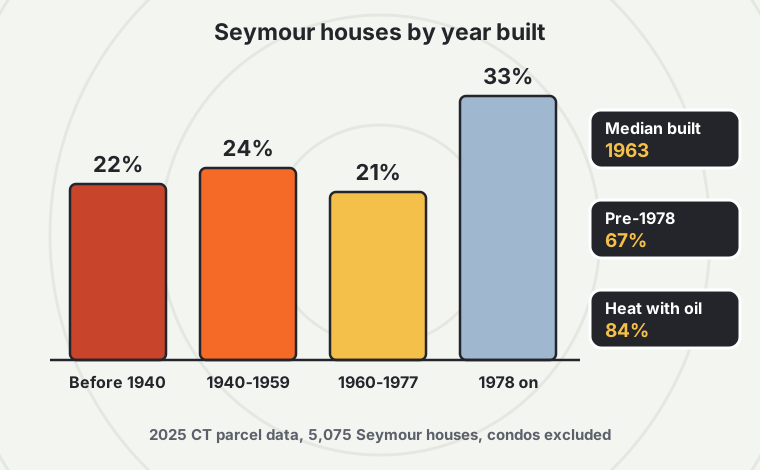
Seymour’s housing is mostly ranches, colonials, raised ranches and capes, plus a few hundred two-families. By age, the common repair items are:
| Seymour house age | Share of houses | Repairs buyers look for |
|---|---|---|
| Before 1940 | 22% | Old wiring (some knob-and-tube), galvanized or cast-iron pipes, stone or block foundations, peeling paint, porches and stairs. |
| 1940 to 1959 | 24% | Original electrical panels, steel oil tanks (some buried), basement water, single-pane windows, lead paint. |
| 1960 to 1977 | 21% | Boilers and oil tanks at end of life, second-cycle roofs, dated kitchens and baths, lead paint on original trim. |
| 1978 and later | 33% | Mostly cosmetic updates, roofs and water heaters on schedule. |
Two federal rules make age matter more than it seems. Every seller of a pre-1978 home must give the buyer the lead-based paint disclosure and pamphlet (EPA and HUD rule). And when a buyer uses an FHA loan on a pre-1978 house, the appraiser must inspect for defective paint and it must be treated before the loan closes (24 CFR 200.810). In a town where two in three houses predate 1978 and many buyers at this price use FHA loans, peeling paint is not cosmetic; it can be a loan condition.
The oil share matters too. If the house has, or once had, a buried oil tank, buyers will ask. Our guide to oil tanks, septic, wells and radon covers testing, removal and what to disclose.
Why do different buyers knock off different amounts for the same repair?
Different buyers knock off different amounts for the same repair because they pay for it in different ways. An owner-occupant with a mortgage pays for repairs out of savings after closing and may be blocked by the lender; a buyer with a renovation loan pays interest on it; and an investor pays for it, plus holding costs and resale costs, and needs a profit at the end.
An owner-occupant buying a $372,000 Seymour house with 3.5% down puts down about $13,000, and still has closing costs to pay. A $14,000 roof is a real problem for that buyer even if it is a fair price for the work. That is why system repairs get a cushion: the buyer is pricing their own cash squeeze, not just the roof.
An investor prices the whole house backwards from its value after repairs. A common version is the 70% formula: 70% of the after-repair value, minus the repair cost. On a Seymour house worth $372,000 fixed up, that is $260,400 before repairs. The 30% covers the investor’s selling costs, holding costs, financing, risk and profit. Our page on why cash offers are so low explains each slice, and it is the honest reason a cash offer on a house that needs work sits well under retail.
What do repairs do to the price of a typical Seymour house?
On a typical $372,000 Seymour house, repairs do very different things to the price depending on their type. In our illustrative examples, $9,000 of cosmetic work costs a seller about $9,000 to $15,000 in price, a $17,000 roof and oil tank problem costs about $20,000 to $30,000, and an $85,000 full update leaves an investor formula number of about $175,400.
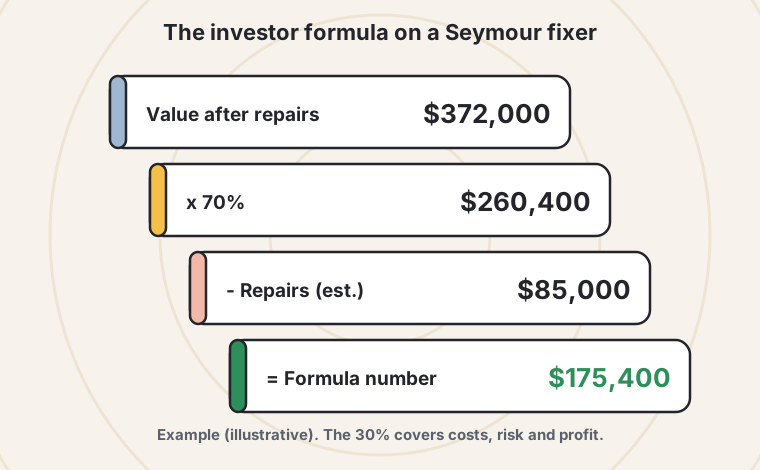
Example (illustrative). All three examples use a Seymour single-family house worth $372,000 in good condition (the town’s single-family median, Oct 2023 to Sep 2024). Repair costs are planning estimates (est.), and the discount ranges are illustrations of how buyers typically react, not measured data.
| Example | Repair cost (est.) | Likely price effect (illustrative) | Fix first? |
|---|---|---|---|
| 1. Cosmetic: paint inside, refinish floors, replace dated light fixtures | $9,000 | $9,000 to $15,000 off, or longer on the market | Usually yes, if you have the cash and a month |
| 2. Systems: roof at end of life ($14,000) plus a buried oil tank removed and soil tested ($3,000, if it did not leak) | $17,000 | $20,000 to $30,000 off, and some FHA buyers drop out | Often yes for the tank test; the roof depends on your cash |
| 3. Full update: kitchen, two baths, boiler, electrical panel, roof, paint and floors | $85,000 | Priced by investors: 70% of $372,000 minus $85,000 = $175,400 | Rarely; a full renovation is a business, not a prep job |
Example 1 is the classic case where fixing pays: the work is cheap, fast and certain. Example 2 is where a little information pays most. The tank test might cost a few hundred dollars and turns an open question into a known one; the roof is a judgment call about your own cash. Example 3 is where most owners should not start a renovation. The repairs would take months, need permits, and the profit from doing them is the same profit an investor is pricing into the formula; you would be taking the investor’s risk without the investor’s experience.
Carrying costs belong in the decision too. Every month you hold a vacant Seymour house during repairs costs about $620 in property tax alone at the fiscal 2027 mill rate (est.), before insurance, heat and utilities.
Should you fix the repairs or price them into the sale?
You should fix repairs before selling when they are cheap, visible, quick and certain, and when you have the cash and time; you should price them into the sale when they are expensive, uncertain, need permits, or would block a buyer’s loan anyway. The rule of thumb is simple: fix what removes doubt, and disclose and price in what does not.
Fix first
Small and certainPaint, minor plumbing leaks, missing railings, broken windows, smoke and CO detectors, an oil tank test, cleaning out.
- Cost is known
- Done in days or weeks
- Removes a loan condition or a buyer’s worry
Price it in
Big or uncertainRoof replacement when cash is short, structural or water problems, septic, full kitchen and bath updates.
- Get a written estimate to show buyers
- Disclose it on the condition report
- Expect more buyers to pay cash
Sell as-is
Many items at onceA long list, no cash, an estate or a deadline.
- One price, no repairs, no cleanout
- Lower number than a fixed-up sale
- Typically about two weeks to close
Our guide to what to fix before selling a house in Connecticut ranks individual repairs by payback, and our list of 13 low-cost fixes covers the cheap ones. Whatever you choose, you still owe the buyer Connecticut’s residential condition report or a $500 credit at closing (CGS 20-327b and 20-327c); the as-is route is explained in our guide to selling as-is in Connecticut.
Is a cash sale right for you, or should you list?
Seven quick questions. There is no wrong answer, and we will tell you honestly if listing would leave you more.
- Does the house need repairs you would rather not pay for or manage?
- Do you need to close by a certain date, or within the next month or two?
- Would showings be hard: tenants, belongings, privacy, or you live out of state?
- Is there a complication: an estate or probate, a divorce, foreclosure, liens or back taxes?
- Could you comfortably cover the mortgage, taxes and utilities for three or more months?
- Is getting the highest possible price more important to you than speed and certainty?
- Would a buyer's bank lend on the house as it is (no major roof, foundation, oil tank or code issues)?
When should you NOT sell a Seymour house that needs repairs to a cash buyer?
You should not sell a Seymour house that needs repairs to a cash buyer when the repairs are mostly cosmetic, when you can fund the few system repairs that block a loan, and when you have a couple of months. A house like Example 1 or Example 2 above usually nets more listed with an agent after the fixes, even after commission.
A direct sale is the better fit for Example 3 houses, for estates where heirs live far away, for houses with tenants or a hoarding situation, and for owners who cannot or should not take on a renovation. In those cases certainty and time are worth more than the gap. Our page on selling a house that needs repairs in Connecticut shows how that works from first call to closing.
How do you work out the right price for your Seymour house with repairs?
You work out the right price for your Seymour house with repairs by listing every repair and sorting it into cosmetic, systems and unknowns, turning unknowns into known costs with an inspection or a quote, getting an agent’s after-repair value, and comparing a fix-and-list net with at least two as-is offers.
Make the list
Walk the house with a notepad, or pay for a pre-listing inspection. Write every item down.
Sort it into three groups
Cosmetic, systems, unknowns. Be honest about the unknowns.
Turn unknowns into numbers
An oil tank test, a roofer’s estimate, an electrician’s look at the panel. Written quotes travel with the house and calm buyers.
Get two values
An agent’s after-repair value and an as-is value. Compare the nets with our calculator, below.
Choose and disclose
Fix the cheap, certain items, disclose the rest on the condition report, and choose the buyer whose net, timeline and certainty suit you. Check any cash buyer with our cash buyer checklist.
How much would you walk away with?
Slide the numbers to match your house. It works in your browser; nothing is saved or sent.
Estimates for planning. Conveyance tax per CGS 12-494 (state 0.75% up to $800,000, 1.25% to $2.5M, 2.25% above, plus the town rate). Seller attorney about $1,200 to $1,500; flat-fee MLS about $400; listings include three months of taxes, insurance and utilities, a cash sale about two weeks. Your attorney gives you the final numbers.
Questions Seymour owners ask about repairs and price
How much do repairs lower a house price?
Repairs lower a house price by about their cost for cosmetic items, by more than their cost for system items like roofs and oil tanks, and by much more for unknowns like water, structure or septic, because buyers price their own risk and cash needs.
Is it better to fix a house before selling in Seymour?
It is better to fix a Seymour house before selling when the repairs are cheap, quick and certain. For large or uncertain repairs, pricing them in or selling as-is often leaves you with as much money for far less risk.
How old are most houses in Seymour, CT?
Most houses in Seymour, CT are older: the median house was built in 1963, 67% were built before 1978 and 22% before 1940, based on 2025 state parcel data for 5,075 houses, condos excluded.
Will an FHA buyer require repairs on an older Seymour house?
An FHA buyer’s appraiser must inspect a pre-1978 house for defective paint, and it must be treated before the loan closes (24 CFR 200.810). Other safety items, such as missing railings or a failing roof, can also become loan conditions.
Do I have to disclose repairs when I sell in Connecticut?
Yes, you must disclose known problems on Connecticut’s residential condition report (CGS 20-327b), or credit the buyer $500 at closing. The credit does not excuse hiding a known defect that seriously affects value, health or safety (CGS 20-327c).
What is the 70% rule investors use?
The 70% rule is a formula investors use: 70% of a house’s value after repairs, minus the repair cost. On a $372,000 Seymour house needing $85,000 of work, that gives $175,400. Real offers vary with the house and the buyer.
Should I remove an oil tank before selling in Seymour?
You do not have to remove a residential oil tank before selling in Connecticut, but buyers and insurers often ask about buried tanks, and 84% of Seymour houses heat with oil. A tank test or removal with soil testing usually removes a large price objection.
How much is the conveyance tax on a Seymour sale?
The conveyance tax on a Seymour sale is 1.00% for most homes, 0.75% to the state and 0.25% to the town, paid by the seller: $3,720 on a $372,000 sale (CGS 12-494).
Which court handles a Seymour estate or foreclosure?
A Seymour estate is handled by probate district No. 41, which serves Ansonia, Derby, Seymour and Woodbridge (CGS 45a-2); foreclosures and other civil cases go to the Ansonia-Milford Judicial District (CGS 51-344).
Related guides
The house
Other problem houses
For the full process, see how to sell a house in Connecticut. If you want an as-is number to compare with your repair list, see how we buy houses that need repairs or start on our Seymour page.
Plain-English information, not legal or appraisal advice. Talk to a Connecticut attorney about your own sale.
Sources (checked on October 27, 2026)
- CT OPM Real Estate Sales (Seymour, recorded Oct 2023 to Sep 2024), data.ct.gov.
- 2025 CT Parcel and CAMA data (Seymour year built, heating fuel and style), data.ct.gov.
- OPM mill rates, fiscal 2027, data.ct.gov.
- 24 CFR 200.810 (FHA defective paint on pre-1978 homes).
- EPA and HUD lead-based paint disclosure rule.
- CGS 20-327b and 20-327c (residential condition report; $500 credit).
- CGS 12-494 (conveyance tax).
- CGS 45a-2 (probate districts) and CGS 51-344 (judicial districts).
- CT DEEP: residential home heating oil tanks FAQ.
See the house together.
Pick a time that works.
Choose a time for us to walk through the property with you, or ask for a quick call first. We confirm every request personally.
Tuesday, January 13
No open times in the next few weeks. Please call us.
We will confirm by email. Nothing is booked until we do.
View my request
Who wrote this
Jerryll Noorden
Jerryll has bought and sold Connecticut houses since 2016 and has sat at more closing tables than he can count, on both sides. Before real estate he was a robotics scientist at NASA, IHMC and IIT. He wrote this guide because the national sites that rank for it skip the Connecticut rules that cost sellers money. When listing or selling it yourself would get you more than a cash offer, he says so.
This guide explains Connecticut rules in plain English. It is not legal or tax advice. Laws change; for your sale, talk to a Connecticut real estate attorney and a tax professional.
