
- Yes, you can sell a house with code violations in Connecticut. No state law stops the sale. The violation changes who can buy, how they pay and what you must disclose. It is one situation inside our guide to how to sell a house in Connecticut.
- Know which kind you have. An open permit, unpermitted work, a housing or blight order, a zoning problem, a septic (health code) problem and a fire code problem are handled by different town offices and fixed in different ways.
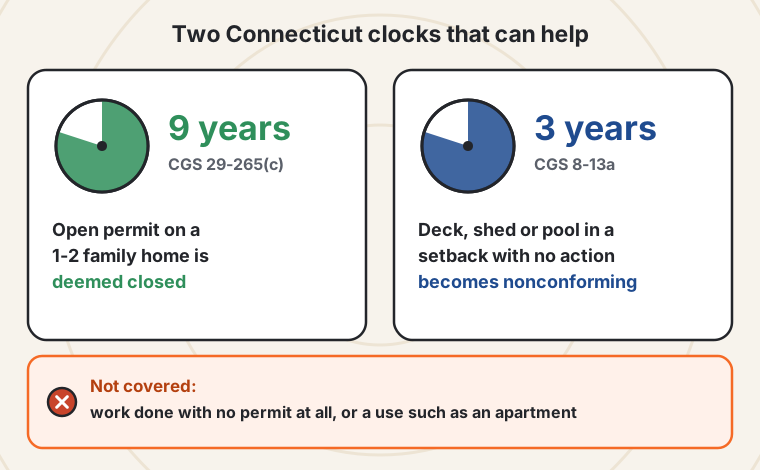
- Some problems age out. An open building permit on a one- or two-family home is deemed closed nine years after it was issued (CGS 29-265(c)). A building or deck that has sat in a setback for three years without enforcement becomes legally nonconforming (CGS 8-13a).
- Some problems grow. Blight penalties can run up to $150 a day on an occupied home and $250 a day on a vacant one, and unpaid penalties become a lien on the house (CGS 7-148(c)(7)(H)(xv), 7-148aa).
- Disclose what you know. The state condition report tells buyers to check permits with the building official, but its instructions also say to disclose any problems you know about. Hiding one is the real legal risk.
- You have four routes: close the permits, legalize the work, give the buyer a credit, or sell as-is to a cash buyer. Fixing usually nets more when the fix is small and you have time; selling as-is wins when the fix is big, uncertain or blocked.
Can you sell a house with code violations in Connecticut?
Yes, you can sell a house with code violations in Connecticut. There is no state law that blocks the sale of a house with open permits, unpermitted work or a town order. What the violation changes is the buyer pool: many mortgage lenders and appraisers balk at open violations, so you either fix or legalize the problem first, give the buyer a credit, or sell as-is to a buyer who pays cash. Either way you disclose what you know.
Here is the plain version. A code violation is a gap between your house and a rule the town enforces: the State Building Code, the town’s zoning regulations, the Public Health Code for septic systems, the fire code, or a local housing or blight ordinance. The gap does not freeze your title. You still own the house and you can still sign a deed. But the buyer’s attorney, the buyer’s lender and the buyer’s appraiser all look for those gaps, and each one can slow or stop a financed sale.
So the real question is not “can I sell?” It is “which route nets me the most, with the least risk, on the timeline I need?” That depends on what kind of violation you have, what it costs to clear, and whether the town is already involved. The rest of this guide walks through each piece, with the Connecticut statutes and real Westbrook numbers.
If your house has other problems besides paperwork, start with our page on how to sell a house that needs repairs in Connecticut. For the general rules on as-is sales (disclosure, buyer lawsuits, pricing), see selling a house as-is in Connecticut. This page goes deeper on one question: violations, permits and town orders.
Does a code violation make you feel stuck with the house?
A code violation makes a lot of Connecticut owners feel stuck with the house: embarrassed about work they did themselves, worried about fines or being “reported”, and convinced that nobody will buy until everything is perfect. That feeling is common and it is usually wrong. Most violations can be cleared, credited or sold around, and you get to choose which.
Maybe you finished the basement yourself fifteen years ago, a good job, but nobody ever came out to inspect it. Maybe your father built the deck and the sunroom and never pulled a permit in his life. Maybe a contractor took your money, pulled a permit and never called for the final inspection. Maybe a letter from the town arrived about the cars in the yard, or the roof, and you have not been able to open the second one. Or maybe a buyer’s attorney just emailed to say the town has no record of your addition, and the deal you were counting on is wobbling.
The feelings are real: ashamed that strangers will see it, afraid of fines or lawsuits, trapped because the fix costs money you do not have, confused about which town office is in charge, and skeptical of anyone who says “we buy any house”. Underneath that, most people are cautiously hopeful: if someone would just explain the rules, maybe it is fixable.
Here is one Connecticut detail that surprises almost everyone: if a permit on your one- or two-family house was issued more than nine years ago and simply never got its final sign-off, state law already treats it as closed, and the town cannot start enforcement based on that work (CGS 29-265(c)). That does not cover work done with no permit at all, but it shows how much depends on the details.
This page is for you if you own a Connecticut house, in Westbrook or anywhere else in the state, with open permits, unpermitted work, a blight or housing order, a zoning problem or a septic problem, and you want to know your real options before you spend a dollar. Nothing you read here obligates you to anything, and nothing about your house will surprise us.
What kinds of code violations show up on Connecticut houses?
The code violations that show up on Connecticut houses fall into six groups: building code problems such as open permits and unpermitted work (finished basements, decks, additions, bathrooms), housing code and blight problems, zoning problems such as setbacks or an illegal apartment, septic and health code problems, and fire code problems, which for one- and two-family homes are mostly about smoke and carbon monoxide detection. Each group belongs to a different town office.
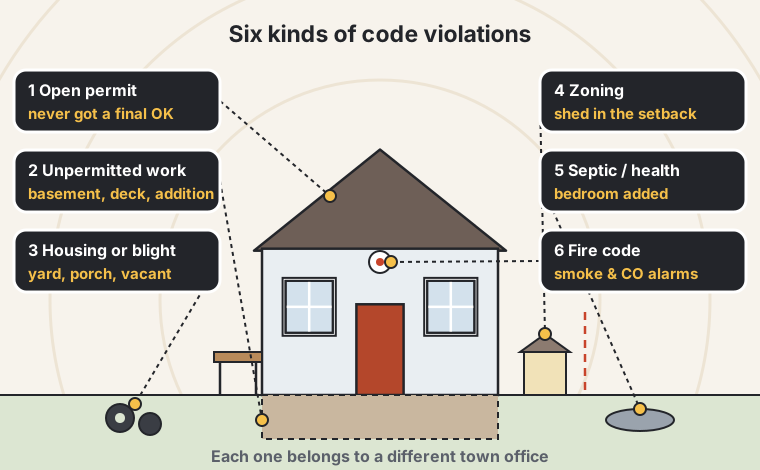
Knowing which group you are in tells you who to call, what the fix looks like and how much it matters to a buyer. Many houses have more than one.
| Type | Typical examples | Town office | Usual fix |
|---|---|---|---|
| Open building permit | Roof, deck, furnace, water heater or remodel permit that never got a final inspection | Building official | Call for the final inspection; repair anything that fails; get the certificate of approval or occupancy |
| Unpermitted work | Finished basement, deck, enclosed porch, addition, added bathroom, electrical or plumbing done without a permit | Building official | Apply for a permit after the fact; open walls for inspection if required; or remove the work; or price the space as if it were not there |
| Housing code or blight | Broken windows, collapsing porch, junk or vehicles in the yard, overgrowth, a vacant house falling apart | Blight enforcement officer, housing code office or health department (varies by town) | Remediate within the notice period; ask for more time in writing; pay or contest a citation |
| Zoning | Shed, garage, deck or pool inside a setback; in-law or basement apartment the zoning does not allow; commercial use at home | Zoning enforcement officer | Variance or special permit; remove or relocate; stop the use; check whether the three-year rule already protects it |
| Septic and health code | Failed septic system; bedrooms added beyond what the system was designed for; an addition, garage or pool built without health approval on a septic lot | Local health department or district | Repair or replace the system with a permit; get B100a approval for the addition; or market the house at its approved bedroom count |
| Fire code | Missing smoke or carbon monoxide detectors; in multi-family buildings, egress, fire separation and alarm problems | Local fire marshal | Install detectors (needed for the closing affidavit anyway); for 3+ units, follow the marshal’s order |
Why unpermitted finished basements and decks come up so often
Two problems come up again and again on Connecticut resales: a basement finished without a permit and a deck built or rebuilt without one. Both are popular do-it-yourself projects, both are easy to see in listing photos, and both matter to appraisers: an appraiser may not count unpermitted living space in a basement, and a deck with no permit raises questions about footings and ledger attachment. A deck can also be a zoning issue if it reaches into a setback.
Old work is not automatically a violation
Connecticut’s permit law applies to work done after October 1, 1970 (CGS 29-263 and 29-265). A house can be out of date (no ground-fault outlets, steep stairs, a low basement ceiling) without being in violation, because building codes generally apply to new work, not to everything that already existed. Do not let a home inspector’s list of “code items” convince you that the whole house is illegal. Ask which items are actual violations of a permit, an order or a rule, and which are simply older than today’s code.
How do code violations and open permits come to light when you sell?
Code violations and open permits come to light when you sell in three main ways: someone searches the town’s permit records for the address, the buyer’s attorney or title examiner finds an open permit, order or recorded lien, or the buyer’s lender and appraiser notice space or work the town records do not show. Increasingly they surface before a buyer ever sees the house, because permit histories are easy to pull.
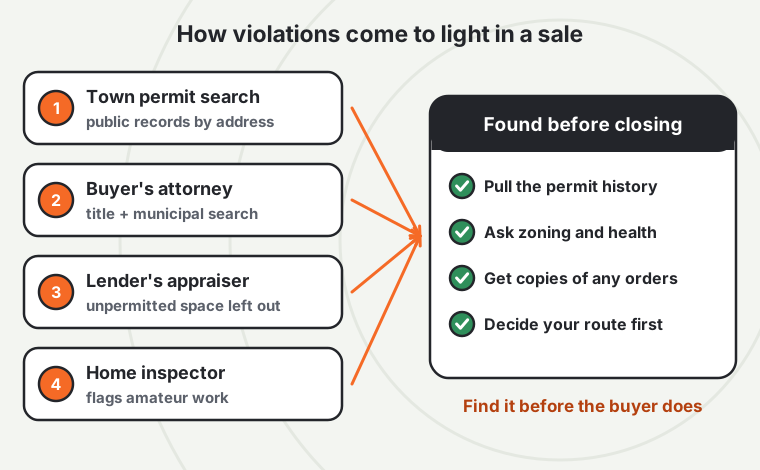
1. The town permit search
Every Connecticut building department keeps permit records by address, and they are public. Many towns now take permit applications online; Westbrook’s building department, for example, posts its applications online and links to the 2022 Connecticut State Building Code. A listing agent, a buyer’s agent, an appraiser or a curious neighbor can ask for the permit history. If the listing says “finished lower level with full bath” and the permit file is empty, someone will notice.
2. The buyer’s attorney and title search
Connecticut closings are run by attorneys (CGS 51-88a), and the buyer’s attorney orders a title search of the land records. That search finds recorded liens, including liens for unpaid blight or zoning penalties (CGS 7-148aa) and for money the town spent to repair, secure or demolish a building (CGS 49-73b). Many buyer’s attorneys also send a municipal inquiry to the building, zoning and health offices asking about open permits and orders. An open permit is not a lien, but it is a question the buyer’s attorney will want answered before closing.
3. The lender and the appraisal
A buyer who borrows needs the lender’s appraiser to agree with the price. Appraisers compare your house to sales of similar houses and look at public records. Unpermitted living space may be valued lower or left out, which can make the appraisal come in short. Some loan programs also have condition requirements, so obvious safety problems can hold up the loan until they are fixed. That is why a violation that a cash buyer shrugs off can kill a financed sale.
4. The home inspection
A buyer’s home inspector does not enforce codes, but will flag work that looks amateur or unpermitted: a basement bathroom with no vent, a deck with no footings, wiring spliced outside a box. That report often sends the buyer to the permit office.
Ask your town building department for the permit history of your address before you list. Ask the zoning and health offices whether there are open orders or complaints. It costs little or nothing, and it turns a surprise in week three of a contract into a decision you make on your own time.
Which Connecticut laws apply to code violations, permits and blight?
The Connecticut laws that apply to code violations are the State Building Code and the permit and certificate rules in CGS 29-263 and 29-265, the building code penalty in CGS 29-254a, the zoning enforcement rules in CGS 8-12, 8-12a and 8-13a, the blight power in CGS 7-148(c)(7)(H)(xv) with liens under 7-148aa, the Public Health Code under CGS 19a-36 (including the B100a septic rule), and the fire code rules in CGS 29-291a and 29-305.
| Rule | What it says, in plain English | Statute |
|---|---|---|
| Building permit | No building or structure may be built or altered (after October 1, 1970) until a permit is issued by the building official | CGS 29-263 |
| Certificate of occupancy | New or altered space may not be used until the building official issues a certificate that the work substantially conforms to the code | CGS 29-265(a) |
| Old open permits close | A permit for a one- or two-family home (or a structure on the same lot) with no certificate is deemed closed nine years after it was issued; no enforcement may start based on that work | CGS 29-265(c) |
| Single-family limit | The code may not require removal or alteration of a single-family home after six years of occupancy following the work, except as needed for safety of life or property | CGS 29-265(a) |
| Building code penalty | A fine of $200 to $1,000, or up to six months in jail, or both | CGS 29-254a |
| Zoning enforcement | The zoning officer can order a violation fixed; fines of $10 to $100 a day ($100 to $250 a day if wilful); a civil penalty of up to $2,500 for ignoring an order for 10 days | CGS 8-12 |
| Zoning citations | Towns may adopt citation fines for zoning violations of up to $150 a day | CGS 8-12a |
| Three-year setback rule | A building or structure (including a deck, shed, fence or pool) that violates a setback or minimum lot size for three years without an enforcement action becomes legally nonconforming; the owner must prove it | CGS 8-13a(a) |
| Blight ordinances | Towns may regulate blight, but must define it, give written notice and a reasonable chance to fix it first (except a third violation in 12 months); penalties for homes of six or fewer units: up to $150 a day occupied, $250 a day vacant, $1,000 a day for a third violation in 12 months | CGS 7-148(c)(7)(H)(xv) |
| Penalties become liens | Unpaid blight penalties (and zoning citation penalties) are a lien on the house, ahead of everything filed after July 1, 1997 except taxes | CGS 7-148aa |
| Town repair costs | If the town spends money to secure, repair or demolish a building under a building, health, housing or safety code, it can recover the cost and place a lien that ranks ahead of everything but municipal taxes | CGS 49-73b |
| Septic and additions | The Public Health Code (adopted under CGS 19a-36) requires local health approval before an addition, conversion, garage, pool or added bedroom on a lot served by septic (regulation 19-13-B100a) | CGS 19a-36; Reg. 19-13-B100a |
| Fire code | Local fire marshals inspect one- and two-family homes only on complaint or request, and only for smoke detection; larger buildings are inspected regularly | CGS 29-291a; 29-305(b) |
What the nine-year rule does and does not do
CGS 29-265(c) was added in 2017 (Public Act 17-176). It is a real relief for owners with an old roof, window, furnace or deck permit that never got its final inspection. Nine years after the permit was issued, the permit is deemed closed and no enforcement action may start based on the work done under it. Three limits: it covers one- and two-family homes and structures on the same lot, not larger buildings; it covers work done under a permit, not work done with no permit at all; and a buyer’s lender or attorney may still ask questions. Ask the building department to note the closure in the file.
What the three-year rule does and does not do
CGS 8-13a protects the location of a building or structure that has broken a setback or lot-size rule for three years without the town starting enforcement. It does not legalize a use the zoning does not allow, such as an unapproved apartment, and it does not fix building code or septic problems with the same structure. You carry the burden of proving the three years, so old photos, aerial images, permits or receipts help.
What do you have to disclose about code violations when you sell in Connecticut?
When you sell in Connecticut you must give the buyer the Residential Property Condition Report before they sign a contract, or credit them $500 at closing (CGS 20-327b and 20-327c). The report tells buyers to consult the town building official about permits and certificates of occupancy, and it instructs sellers to disclose any problems they know about. Known violations, orders and unpermitted work belong on the report.
The statute spells out what the report must contain. Its instructions to sellers say to answer every question to the best of your knowledge and to “Identify/Disclose any problems regarding the subject property.” It then asks specific questions that touch many violations: patio and deck problems, interior floor, wall and ceiling problems, plumbing and electrical problems, septic problems, unpaid water and sewer charges, whether the property is in a flood hazard area, and whether it is subject to land use restrictions.
On permits, the report puts the burden on the buyer with a notice: prospective buyers “should consult with the municipal building official” to confirm that permits and certificates of occupancy were issued (CGS 20-327b(d)). In the statutory text we reviewed there is no single yes-or-no question that asks “do you have open permits or code violations?” That is not a loophole. If you know about an unpermitted basement or a town order, the honest answer to the related questions, plus an attached explanation, protects you far more than silence does.
You can legally skip the report and credit the buyer $500 at closing. But the credit does not protect you from a claim that you hid a defect you knew about. Selling “as-is” does not either. If you know about it, write it down. Our guide to the Connecticut property condition disclosure walks through the form question by question.
Disclosure does not invite the town in
Many owners worry that writing “basement finished without a permit” on the report will bring an inspector to the door. The report goes to the buyer, not the town. The buyer may ask you to fix or legalize the work, ask for a credit, or accept it as it is. If the town is already involved because of an order or citation, the buyer’s attorney will find that in the municipal search anyway.
Exemptions
Some sellers do not have to provide the report at all: for example, executors, administrators, trustees and conservators selling in that role, and transfers between co-owners or to close family for no payment (CGS 20-327b(b)). Exempt or not, knowingly hiding a defect is still risky; ask your attorney.
Can a buyer get a mortgage on a house with code violations?
A buyer can sometimes get a mortgage on a house with code violations, but it depends on the violation and the loan. Paperwork problems such as an old open permit often get cleared before closing. Unpermitted living space may be left out of the appraisal, which lowers the value the lender will lend against. Safety problems and active town orders can stop the loan until they are fixed. A cash buyer has no lender to satisfy.
Each lender and loan program has its own rules, so treat this as a pattern rather than a promise:
- Usually fine with a little work: an old open permit for a roof or water heater, missing smoke detectors, a deck permit that just needs a final inspection.
- Often a price problem: an unpermitted finished basement or attic, an unpermitted bathroom, a bedroom count higher than the septic approval. The loan may go through, but the appraiser may not count the space, so the buyer has to bring more cash or ask you to lower the price.
- Often a deal problem: an active blight or housing order, a failed septic system, structural problems, an illegal apartment the buyer planned to rent, a recorded penalty lien. These usually have to be fixed, released or escrowed before a lender will close.
That is why Connecticut houses with serious violations tend to end up with one of two buyers: a buyer who pays cash and fixes it afterwards, or a buyer whose seller fixed it first. Our guide on how appraisals affect the selling price in Connecticut explains the appraisal side in more detail.
What does it cost to fix, legalize or sell around a code violation?
What it costs to fix, legalize or sell around a code violation depends on the problem: closing an old permit can cost little more than an inspection, while legalizing an unpermitted basement or addition can run into the tens of thousands once walls are opened and work is corrected (est.). Add carrying costs while you fix, then compare the net from each route, not just the price.
Here is a worked example using real Westbrook numbers. The house is not a real deal; it is built from public data so the arithmetic is honest.
A Westbrook single-family with a basement finished years ago without a permit, plus an open deck permit from 2021 (not yet nine years old, so still open). Fully permitted, it would sell around the town median.
| Input | Value | Source |
|---|---|---|
| Westbrook median sale price (Oct 2024-Sep 2025) | $544,500 | Town sales data, 108 sales |
| Westbrook single-family median | $585,000 | Town sales data |
| Mill rate, fiscal 2027 | 23.25 | OPM mill rates |
| Property tax on the single-family median | about $9,520 a year, $790 a month | $585,000 x 70% x 23.25 mills |
| Conveyance tax (state 0.75% + Westbrook 0.25%) | 1.0% of the price | CGS 12-494 |
| Share of Westbrook homes built before 1960 | 38% | Assessor data |
| Line | A. Legalize, then list | B. List as-is, price for the basement | C. Sell as-is for cash |
|---|---|---|---|
| Sale price | $544,500 | $515,000 (est.) | $470,000 (illustrative offer) |
| Legalizing the basement and closing the deck permit | -$18,000 (est.) | $0 | $0 |
| Carrying costs while you fix and sell (taxes $790 a month plus insurance and utilities) | -$3,570 (3 months, est.) | -$3,570 (3 months, est.) | -$595 (2 weeks, est.) |
| Agent commission | -$27,225 (5%, est.) | -$25,750 (5%, est.) | $0 |
| Your attorney | -$1,500 (est.) | -$1,500 (est.) | -$1,500 (est.) |
| Conveyance tax (1.0%) | -$5,445 | -$5,150 | -$4,700 |
| Net before your mortgage payoff | $488,760 | $479,030 | $463,205 |
| Risk | Fix may cost more once walls open; delay | Appraisal or buyer may still balk | Lowest price; fastest and most certain |
The honest reading: in this example, legalizing and listing nets about $25,000 more than the cash sale, if the fix really costs $18,000, if you have the $18,000 and three months, and if nothing else turns up when the walls are opened. If the fix grows to $40,000, or you do not have the cash, or you need to be done in two weeks, the gap closes or flips. Run your own numbers with the calculator below.
How much would you walk away with?
Slide the numbers to match your house. It works in your browser; nothing is saved or sent.
Estimates for planning. Conveyance tax per CGS 12-494 (state 0.75% up to $800,000, 1.25% to $2.5M, 2.25% above, plus the town rate). Seller attorney about $1,200 to $1,500; flat-fee MLS about $400; listings include three months of taxes, insurance and utilities, a cash sale about two weeks. Your attorney gives you the final numbers.
What drives the cost of legalizing work
- Whether walls have to be opened. An inspector cannot see wiring, plumbing, insulation or framing behind finished drywall. Some towns accept an engineer’s or electrician’s report; others require openings. Ask before you budget.
- Whether the work meets today’s code. After-the-fact permits are generally judged against the code in effect now, so a basement bedroom may need an egress window and a bathroom may need venting it never had.
- Whether other offices must sign off. An added bedroom on a septic lot needs health department review; an addition in a setback needs zoning relief; a shoreline house may face flood rules (see the Westbrook section below).
- Permit fees. Building permit fees are set by each town, often based on the value of the work; some towns charge more for work already done. Ask your building department.
Should you fix the violation, legalize it, give a credit or sell as-is?
Whether you should fix the violation, legalize it, give a credit or sell as-is depends on the size of the problem, your cash, your timeline and whether the town is involved. Close small open permits yourself. Legalize work when the cost is known and modest. Offer a credit when a financed buyer will still close. Sell as-is to a cash buyer when the fix is large, uncertain, blocked by septic or zoning, or when you need certainty and speed.

Close the permit
Days to weeksBest for old roof, window, furnace or deck permits that just never had a final inspection.
- Call the building official and schedule the final
- Fix anything that fails
- Permits over nine years old on a 1-2 family home are already deemed closed (CGS 29-265(c))
Legalize the work
1-3 months (est.)Best when the work was done well and the cost is predictable.
- After-the-fact permit, inspections, corrections
- May need health (B100a) or zoning sign-off
- Lets the appraiser count the space
Credit the buyer
No workBest when a financed buyer and their lender will close with the problem disclosed.
- Lower price or closing credit
- Buyer legalizes after closing
- Fails if the appraisal or lender will not accept it
Sell as-is for cash
About 2 weeksBest for big, uncertain or blocked problems, town orders, vacant or inherited houses, or a hard deadline.
- No repairs, no permits to close, no inspections to pass
- No lender, no appraisal contingency
- Lowest price of the four; you trade price for certainty
When you should NOT sell to a cash buyer
We buy houses for cash, so we say this plainly. Do not sell to us, or to any cash buyer, if:
- Your only problem is an old open permit or two. Close them and list. It is usually cheap.
- The fix is small and known (a few thousand dollars), you have the money, and you have a couple of months. Listing will almost always net more.
- The house is in good shape apart from one unpermitted feature, and a financed buyer is willing to take it with a credit.
- You are in a strong-demand town and price matters more to you than speed and certainty.
A cash sale makes sense when the problem is big or uncertain (an addition that may not pass, a septic system that cannot support the bedrooms, a blight order with daily penalties), when you cannot fund the fix, when the house is vacant or inherited and you live far away, or when a deadline (a move, a divorce agreement, a probate timeline) matters more than the last dollar. Our cash buyer vs. realtor guide goes through that trade-off in general.
Is a cash sale right for you, or should you list?
Seven quick questions. There is no wrong answer, and we will tell you honestly if listing would leave you more.
- Does the house need repairs you would rather not pay for or manage?
- Do you need to close by a certain date, or within the next month or two?
- Would showings be hard: tenants, belongings, privacy, or you live out of state?
- Is there a complication: an estate or probate, a divorce, foreclosure, liens or back taxes?
- Could you comfortably cover the mortgage, taxes and utilities for three or more months?
- Is getting the highest possible price more important to you than speed and certainty?
- Would a buyer's bank lend on the house as it is (no major roof, foundation, oil tank or code issues)?
What is different about selling a Westbrook or shoreline house with violations?
What is different about selling a Westbrook or shoreline house with violations is that two extra rule books often apply: flood-zone rules for homes in FEMA flood hazard areas, which can force a larger renovation to meet flood standards, and septic rules for homes without sewers, which limit additions and bedroom counts. Both can turn a simple “just permit it” fix into a much bigger project.

Flood zones
Much of Westbrook’s shoreline, like the rest of the Connecticut coast along Long Island Sound, sits in FEMA flood hazard areas. Under the National Flood Insurance Program rules that towns enforce, when the cost of improving a building in a flood hazard area reaches 50% of the building’s market value (a “substantial improvement”; some towns set a lower threshold), the whole building generally must be brought up to current flood standards, which can mean elevating it. Legalizing a large addition or renovating after damage can cross that line. The Connecticut condition report also asks whether the property is in a flood hazard area. Ask the Westbrook building or land use office whether your house is in a flood zone and how the town counts improvement costs before you price any legalization work.
Septic systems and added bedrooms
Many shoreline and inland houses in towns like Westbrook, Clinton, Old Saybrook, Essex and Killingworth rely on septic systems. Under the Public Health Code’s B100a rule, a local health department must approve an addition, a conversion, a garage, a pool or an added bedroom on a septic lot before it is built, and it can refuse if the lot cannot keep a code-complying area for the septic system. Westbrook’s Public Health Department handles B100a reviews and septic permits, and the town offers an online search of septic pump-out records.
That matters when you sell. If the house was approved as a three-bedroom and someone turned the den into a fourth bedroom, the house is a three-bedroom on paper. Market it that way, or apply for approval, which may require soil testing or a larger system.
Older housing stock
About 38% of Westbrook’s homes were built before 1960 and 18% before 1940. Older houses have had more owners, more renovations and more chances for unpermitted work. They also have features (stairs, ceiling heights, wiring) that are older than today’s code without being violations.
We buy houses across the shoreline and lower Connecticut River valley. See our pages for Westbrook, Old Saybrook, Essex, Madison, Guilford and Killingworth.
| Town | Median sale price | Mill rate (FY2027) | Built before 1960 |
|---|---|---|---|
| Westbrook | $544,500 | 23.25 | 38% |
| Old Saybrook | $670,000 | 15.77 | 43% |
| Madison | $660,000 | 23.06 | 23% |
| Guilford | $593,000 | 28.40 | 26% |
| Killingworth | $485,000 | 28.47 | 15% |
What if the town has already sent a violation notice or blight citation?
If the town has already sent a violation notice or blight citation, read it, note the deadline and respond in writing before the deadline. Connecticut towns must give written notice and a reasonable chance to fix blight before enforcing (except a third violation in 12 months), and unpaid penalties become a lien on the house. You can still sell, but the buyer’s attorney will find the order and the lien.

A town order is the one kind of violation that gets more expensive the longer you wait. Penalties for blight on a home with six or fewer units can reach $150 a day if occupied and $250 a day if vacant (CGS 7-148(c)(7)(H)(xv)). Zoning citation fines can reach $150 a day (CGS 8-12a), and ignoring a zoning order for ten days can bring a civil penalty of up to $2,500 (CGS 8-12). Unpaid blight and zoning citation penalties become a lien enforced like a property tax lien (CGS 7-148aa). If the town has to secure or repair the house itself, it can recover the cost with a lien ahead of almost everything else (CGS 49-73b).
- Get the order in writing and read exactly what it requires and by when.
- Call the officer who signed it. Ask what would satisfy the order and whether a sale with a buyer who will fix it is acceptable. Many officers mainly want the condition fixed.
- Ask for more time in writing if you are selling, and keep a copy.
- Use the hearing. Towns that impose blight penalties must have a citation hearing procedure (CGS 7-152c). If you think the citation is wrong, contest it.
- Tell your attorney and any buyer. Penalties and liens are usually paid from your proceeds at closing, the same way your mortgage is.
If unpaid penalties or other liens are piling up on the house, read our guide to selling a house with a lien in Connecticut, which explains how liens are paid at closing.
How do you sell a house with code violations, step by step?
To sell a house with code violations, pull the permit and order history for your address, sort each problem into close, legalize, credit or leave as-is, get a price for each route, fill in the condition report honestly, choose the route that nets the most for your timeline, and close through Connecticut attorneys. A cash sale as-is typically closes in about two weeks.
Pull the records
Ask the building department for the permit history of your address, and the zoning and health offices for any open orders or complaints. Get copies of any letters, citations or recorded liens. This usually takes a phone call or an email.
Sort each problem
For each item, write down: open permit or no permit? Which office? Does the nine-year rule (CGS 29-265(c)) or the three-year setback rule (CGS 8-13a) already cover it? Is the town actively enforcing?
Price the fixes
Get a written estimate for the work and a clear answer from the town on what it will require (openings, engineer letters, health review). Add carrying costs. Now you know route A.
Get an as-is number
Ask an agent what the house would sell for as-is to a financed buyer, and ask one or two cash buyers for a written offer. Check any buyer first with our 8 checks for a Connecticut cash buyer.
Fill in the condition report
Answer to the best of your knowledge and attach a page explaining the permit history and any orders. Honest disclosure protects you whichever route you choose.
Choose and close
Compare the nets side by side (our guide on how to compare offers in Connecticut helps). With us, there are no repairs, no permits to close and no inspections to pass; you pick the closing date, typically about two weeks, and leave whatever you do not want to take.

The violation that hurts sellers most is the one they find out about from the buyer’s attorney three weeks into a contract. By then the buyer has leverage and the clock is running. Spend one morning at town hall before you list: permit history, zoning, health. If the only thing open is an old roof permit, close it and list with confidence. If it is bigger, you will know before anyone else does, and you can choose your route calmly.
What happens if you sell a house with code violations to a cash buyer like us?
If you sell a house with code violations to a cash buyer like us, you sell it exactly as it is: no repairs, no after-the-fact permits, no inspections to pass, no lender and no appraisal. You still disclose what you know, a Connecticut attorney still runs the closing, and any penalty liens are paid from your proceeds. The trade-off is a lower price than a fully legal, repaired house would bring.
I am Jerryll Noorden. I have bought Connecticut houses since 2016, about ten a year, including houses with open permits, unpermitted basements, additions that never got approval and town orders. Here is how we work:
- We price the problem in, out loud. We tell you what we think the fix costs and how that shapes our number, so you can compare it with the other routes.
- We never charge fees or commissions. You pay your own attorney and the conveyance tax, as in any sale.
- Our offers do not expire while you decide. Take it to your attorney, your family or another buyer.
- If listing will net you more, we will say so. That is often true for a single old permit.
- No judgment. Do-it-yourself basements, a parent’s lifetime of projects, a yard the town does not like: none of it changes how we treat you.
To get a number, call me at (203) 529-4712 or send a few photos and the address. For the bigger picture of your options, go back to our guide on how to sell a house in Connecticut or our page on how to sell a house that needs repairs.
Get your cash offer
without anyone coming over.
Want your offer faster, or rather not talk to anyone yet? Send a few phone photos of each room. We price the repairs from them, line by line, and send your cash offer back, so you see a real number before you ever meet us or pick up the phone.
 CabinetsFlooring
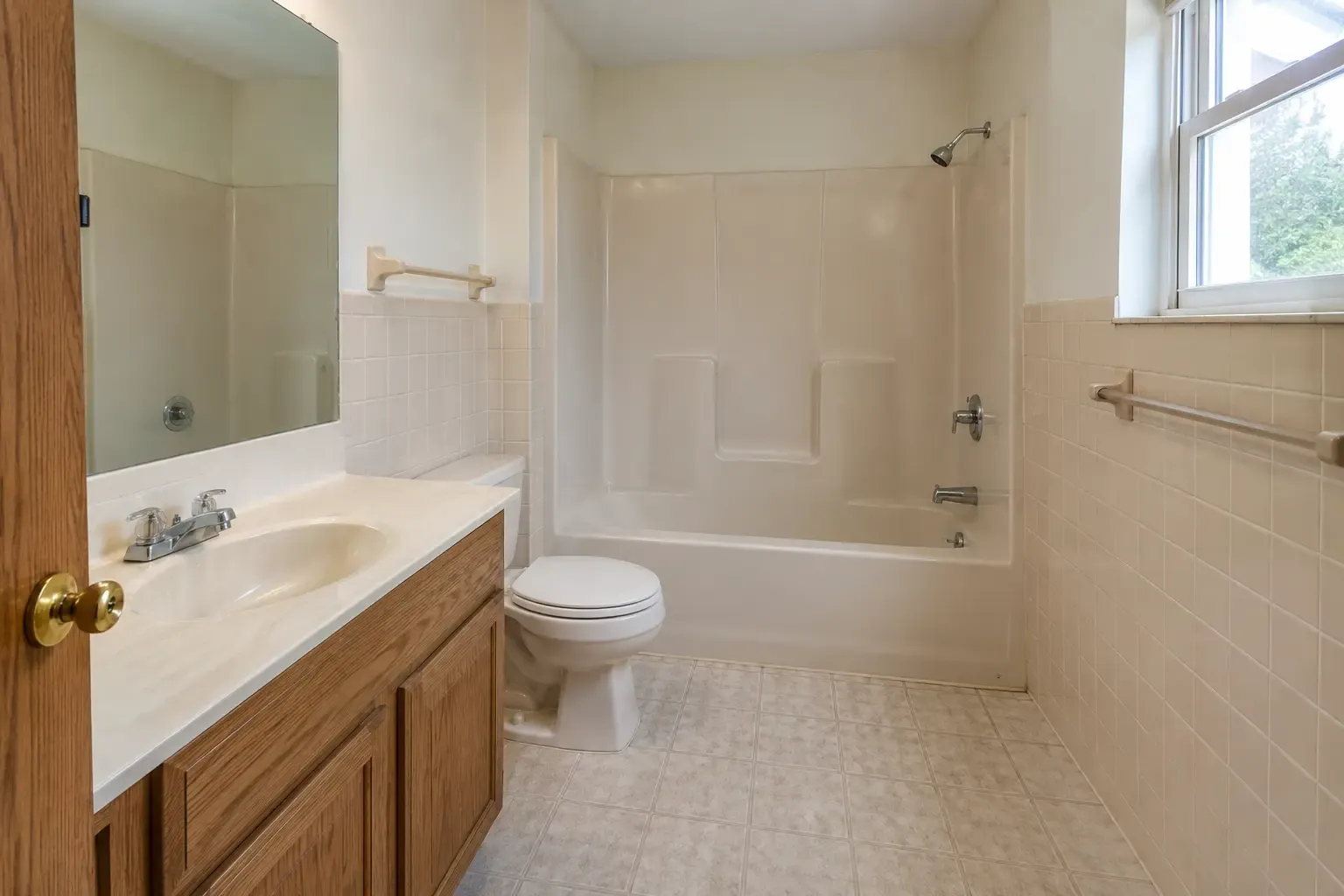 Tub & tile
 Floors
 Roof
We may bring in a partner buyer to close. Your price and terms don't change.
Questions Connecticut owners ask about selling with code violations
Can you sell a house with code violations in Connecticut?
Yes, you can sell a house with code violations in Connecticut. No state law blocks the sale. You disclose what you know, and then you either fix or legalize the problem, give the buyer a credit, or sell as-is, usually to a cash buyer when the problem is large.
Do I have to disclose unpermitted work when selling in Connecticut?
You have to disclose unpermitted work you know about in the sense that the Connecticut condition report tells sellers to disclose any problems they know of, and it asks about specific systems the work may affect (CGS 20-327b). The report also tells buyers to check permits with the building official. Hiding known work is the real legal risk.
How do I check for open permits on my house in Connecticut?
To check for open permits on your house in Connecticut, ask your town’s building department for the permit history of your address. The records are public. Also ask the zoning office and the health department or district whether there are open orders or complaints.
Do open building permits expire in Connecticut?
Open building permits on one- and two-family homes in Connecticut are deemed closed nine years after they were issued if no certificate of occupancy was issued, and no enforcement may start based on that work (CGS 29-265(c)). The rule does not cover work done without any permit.
Can you get a building permit after the fact in Connecticut?
Yes, you can usually apply for a building permit after the fact in Connecticut. The building official may require walls or ceilings to be opened, or reports from an engineer or licensed trade, and the work generally must meet the code in effect now. Fees and procedures vary by town.
What is the fine for a building code violation in Connecticut?
The fine for violating the Connecticut State Building Code is $200 to $1,000, or up to six months in jail, or both (CGS 29-254a). In practice most residential cases are resolved by getting the permit and inspections, but the penalty exists.
Can the town put a lien on my house for blight?
Yes, the town can put a lien on your house for unpaid blight penalties. Under CGS 7-148aa, unpaid penalties under a blight ordinance are a lien on the property, enforced like a property tax lien and paid from the proceeds when you sell.
How much can a Connecticut town fine for blight?
A Connecticut town can fine up to $150 a day for blight at an occupied home of six or fewer units, $250 a day at a vacant one, and up to $1,000 a day for a third violation at the same property within 12 months, after written notice and a chance to fix it (CGS 7-148(c)(7)(H)(xv)). Each town sets its own amounts within those limits.
Is my shed or deck in the setback still a zoning violation after years?
Your shed or deck in the setback is deemed a legally nonconforming structure in Connecticut once it has been there three years without the town starting enforcement (CGS 8-13a). You must prove the three years. The rule covers location and lot size, not uses such as an apartment.
Will a lender finance a house with code violations?
A lender may finance a house with minor code violations, but unpermitted living space may be left out of the appraisal, and active town orders, safety problems or a failed septic system often have to be fixed before the loan closes. Each loan program has its own rules.
Do I need a certificate of occupancy to sell a house in Connecticut?
For a typical resale you do not need a new certificate of occupancy to sell a house in Connecticut. A certificate is required before new or altered space is used (CGS 29-265), so missing certificates for past work can come up in the buyer’s permit search.
Who pays to fix code violations when selling a house?
Who pays to fix code violations when selling a house is negotiable in Connecticut. The seller may fix them before closing, give a credit, or sell as-is and let the buyer fix them. Unpaid penalties and town liens are paid from the seller’s proceeds at closing.
Can I add a bedroom on a septic system without approval?
You generally cannot add a bedroom on a septic system in Connecticut without local health department approval. The Public Health Code’s B100a rule requires review of additions, conversions and added bedrooms on septic lots. When you sell, market the house at its approved bedroom count unless you get approval.
Do cash buyers care about open permits?
Cash buyers care about open permits because they will have to deal with them later, so the cost of closing or legalizing the work is built into their offer. But a cash buyer does not need a lender’s approval or an appraisal, so open permits rarely stop a cash sale.
Related Connecticut guides
Problem houses
Paperwork and money
Plain-English information, not legal advice. Town rules and procedures vary; talk to your town’s building official and a Connecticut attorney about your house.
Sources
- CGS §§ 29-252, 29-254a, 29-263, 29-265, 29-291a, 29-305 (State Building Code, penalty, permits, certificates of occupancy and the nine-year closure, fire code and fire marshal inspections).
- CGS §§ 8-12, 8-12a, 8-13a (zoning enforcement, citation fines, nonconforming structures).
- CGS §§ 7-148(c)(7)(H)(xv), 7-148aa, 7-148ff (blight regulations, penalty liens, blight assessments).
- CGS § 49-73b (municipal liens for repair, securing and demolition costs).
- CGS §§ 20-327b, 20-327c (Residential Property Condition Report and $500 credit).
- CGS § 19a-36 (Public Health Code) and DPH: 19-13-B100a building conversions and additions.
- CGS § 12-494 (conveyance tax rates).
- FEMA: substantial damage and substantial improvement (FAQ).
- Town of Westbrook Building Department and Public Health Department.
- CT Office of Policy and Management (mill rates).

Who wrote this
Jerryll Noorden
Jerryll has bought and sold Connecticut houses since 2016 and has sat at more closing tables than he can count, on both sides. Before real estate he was a robotics scientist at NASA, IHMC and IIT. He wrote this guide because the national sites that rank for it skip the Connecticut rules that cost sellers money. When listing or selling it yourself would get you more than a cash offer, he says so.
This guide explains Connecticut rules in plain English. It is not legal or tax advice. Laws change; for your sale, talk to a Connecticut real estate attorney and a tax professional.
