
Key facts at a glance
This guide is part of our series on how to sell a house in Connecticut. It covers the rules that only apply to mobile and manufactured homes: the park, the paperwork on the town land records, the tax, and who can actually buy. We use Derby as the local example.
| Fact | Number | Source |
|---|---|---|
| Days a park owner has to approve your home’s condition for resale, or explain in writing why not | 20 days (silence counts as approval) | CGS 21-79(e) |
| Days a park owner has to approve or deny your buyer after a complete application | 10 days (silence counts as approval) | CGS 21-79(d) |
| Deadline to file a removal statement before a home is moved or conveyed | 72 hours; $500 fine if you don’t | CGS 21-67a(f)-(g) |
| Active licensed mobile home parks in Connecticut | 201 | DCP license records, data.ct.gov |
| Median price of recorded Connecticut sales described as mobile or manufactured homes, Oct 2024 to Sep 2025 | $105,500 (178 sales) | CT OPM Real Estate Sales, data.ct.gov (our query) |
| Same, in Shelton (next to Derby) | $144,000 (25 sales) | CT OPM Real Estate Sales (our query) |
| Derby mill rate, fiscal 2027 | 38.44 mills | CT OPM mill rates |
| Share of US manufactured home purchase loans that are chattel (home-only) loans | About 42% | CFPB, 2021 HMDA report |
Why does selling a mobile home in Connecticut feel harder than selling a house?
Selling a mobile home in Connecticut feels harder than selling a house because a second party, the park owner, has a say; most buyers can’t get a normal mortgage; and the paperwork lives in places you may never have looked, like the town land records and the tax collector’s office. Owners at this point often feel stuck, embarrassed by the home’s age, worried about the park, unsure what it’s worth, and afraid of being lowballed.
Maybe the lot rent went up again. Maybe a parent moved into assisted living and the home is sitting empty while the rent keeps coming due. Maybe the park sent a letter about the skirting or the deck, and now you’re wondering if they can stop you from selling at all.
Here is the first thing to know: in Connecticut, the park owner cannot make you remove a safe, sanitary home that meets the park’s written aesthetic standards when you sell it, and can only turn down your buyer for good cause, in writing (CGS 21-79). You have more rights than most sellers realize.
I am Jerryll Noorden. I have bought houses across Connecticut since 2016, about ten a year, and we buy mobile homes too. I’ll still lay out every route on this page, including the ones that don’t involve me, because a mobile home often sells best to someone already living in the park. If you own a mobile or manufactured home in Derby or anywhere in Connecticut and want to understand your options before you call anyone, this page is for you.
How do you sell a mobile home in Connecticut?
You sell a mobile home in Connecticut in five moves: find your ownership document and HUD label, check taxes and liens at town hall, ask the park in writing to approve the home’s condition (it has 20 days), find a buyer the park approves (it has 10 days), and have an attorney record a transfer document on the town land records after the taxes are paid (CGS 21-67a, 21-79). If you own the land too, it sells much like a house.
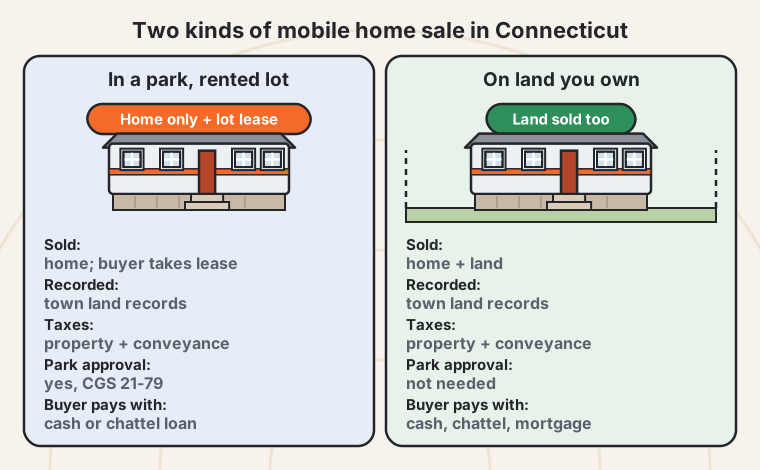
That last sentence matters. There are really two kinds of mobile home sales in Connecticut, and the rest of this guide keeps them apart:
- A home in a park on a rented lot. You sell the home only. The buyer takes over your lot rental agreement. The park’s rights under chapter 412 of the General Statutes apply.
- A home on land you own. You sell the home and the land together, much like a small house. The park rules don’t apply, and a wider pool of buyers can get a mortgage.
If you only want the quick version of the as-is route, our guide to selling a house as-is in Connecticut covers the general rules; this page covers what is different for a mobile home.
Is a mobile home real property or personal property in Connecticut?
A mobile home is treated much like real property in Connecticut for tax and transfer purposes, even on a rented park lot. Towns assess homes connected to utilities and used as a residence “in the same manner as residential real property” (CGS 12-63a), resales in licensed parks are taxed as conveyances of realty (CGS 12-412c), and the transfer is recorded on the town land records (CGS 21-67a). For lenders, though, a home without land is usually still a home-only loan.
Many national articles say a mobile home is “personal property with a DMV title” unless it sits on a permanent foundation on land you own. That is not how Connecticut works. Since 1986 Connecticut has run mobile home ownership through the town clerk:
- Proof of ownership. Every owner is supposed to have filed a certificate of title, bill of sale or other ownership document with the town clerk where the home sits (CGS 21-67a(b)).
- The transfer document. When a home in a licensed park, or on a lot owned by someone else, is sold, the document conveying title must name the manufacturer, model and serial number, list all encumbrances, name the park and lot number, and state any property taxes owed. It is recorded on the land records and has the same effect as a statutory deed (CGS 21-67a(c)-(d)).
- Liens. Mortgages, chattel mortgages, security interests and attachments on a mobile home are recorded on the same town land records (CGS 21-67a(e)).
Some older homes still carry a title document from before these rules. If your paperwork is a vehicle-style title, a bill of sale from decades ago, or nothing at all, don’t panic. Your attorney can search the land records and build the chain of ownership; that is a normal part of the job.
| Question | Home on a rented park lot | Home on land you own |
|---|---|---|
| What you sell | The home only; the buyer assumes the lot rental agreement | The home and the land together |
| Where the transfer is recorded | Town land records (CGS 21-67a(c)) | Town land records, by deed |
| Property tax | Assessed to the home’s owner; the park pays on the land (CGS 12-63a(c)) | Assessed like any dwelling (CGS 12-63a(c)) |
| Conveyance tax | Yes, as a conveyance of realty (CGS 12-412c(b), 12-494) | Yes (CGS 12-494) |
| Park approval needed | Yes, of the home’s condition and the buyer (CGS 21-79) | No |
| Typical buyer financing | Cash or a chattel (home-only) loan | Cash, chattel loan, or a mortgage if the lender accepts the home |
What can a Connecticut park owner do when you sell your mobile home?
When you sell your mobile home in Connecticut, the park owner can check that the home is safe, sanitary and meets the park’s filed aesthetic standards, and can approve or deny your buyer, but only for good cause and in writing. The owner cannot force you to move the home if it meets those standards, cannot charge an entrance fee, and cannot take a commission unless you hired them in writing as your agent (CGS 21-79, 21-83).
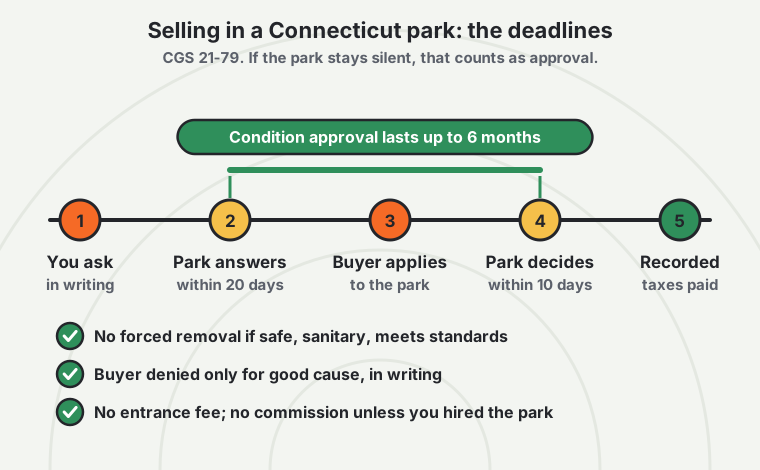
Here is what the statute actually says, step by step.
| Rule | What it means for you | Statute |
|---|---|---|
| No forced removal on sale | If the home is safe, sanitary and meets the park’s aesthetic standards, you can sell it in place. The buyer must assume your rental agreement and follow the park rules. | CGS 21-79(a) |
| Presumed safe and sanitary | A home built to a nationally recognized code (the HUD code, for homes since June 15, 1976) is presumed safe and sanitary. The park has the burden of proving otherwise. | CGS 21-79(b)-(c) |
| Limits on aesthetic rules | The park can’t hold your home’s size, original color or original materials against it if changing them would cause undue financial hardship. | CGS 21-79(c) |
| Condition statement in 20 days | You ask in writing; the park approves the condition or lists the reasons it doesn’t within 20 days. No answer counts as approval. An approval lasts up to six months. | CGS 21-79(e) |
| Disputes | If you disagree with the park’s list, you can fix the items and ask again, or ask the Department of Consumer Protection for a declaratory ruling. | CGS 21-79(e) |
| Buyer approval in 10 days | Your buyer must meet the park’s entry requirements, applied equally to everyone. The park can deny only for good cause (illegal or disruptive use, or inability to pay the lot rent), in writing, within 10 days of a complete application. No answer counts as approval. | CGS 21-79(d) |
| Same rent for your buyer | The park can’t charge your buyer more than the prevailing rent for other lots in the park. | CGS 21-79(e) |
| No commission or entrance fee | No commission on your sale price unless you signed a written agency contract with the park; no entrance fee for the new resident. | CGS 21-79(e), 21-83(a)(7) |
What about a right of first refusal? Some sellers are told the park gets “first dibs” on their home. We found no section in chapter 412 that gives a park owner a right of first refusal on a resident’s home. The purchase rights in the statute run the other way: residents get notice and a chance to buy the park itself when the owner plans to sell it or close it (CGS 21-70(f), 21-70b). If your rental agreement or park rules claim a right of first refusal, have a Connecticut attorney read them before you sign anything; a rental agreement provision that waives your rights under chapter 412 is unenforceable (CGS 21-83).
Ask the park for its disclosure statement, current rules and the aesthetic standards for resale. Parks must file their rental agreements, aesthetic standards and rules with the Department of Consumer Protection, and changes other than rent don’t take effect until filed (CGS 21-70(e)). DCP’s guide, Rights and Responsibilities of Residents of Mobile Home Communities, is a plain-English summary.
How do lot rent and a park eviction affect a mobile home sale?
Lot rent affects a mobile home sale in two ways: buyers price the home partly on the monthly rent they’ll take over, and unpaid rent can lead to an eviction that puts a deadline on your sale. Connecticut lets a park raise rent only when a rental agreement ends, with 30 days’ written notice, and lets an owner-resident who is sued for eviction ask the court for up to 12 months to sell the home in place (CGS 21-80).
The rules that matter most when you are selling:
- Rent increases. A park can raise the rent at the end of a rental agreement if it gives written notice at least 30 days before the new agreement starts, and the new rent is consistent with comparable lots in the same park (CGS 21-80(b)(5)). Rental agreements must run at least one year unless you ask in writing for a shorter term (CGS 21-70(b)).
- Behind on rent. For nonpayment, the park must give you 30 days’ written notice stating the total arrearage. If you pay the full arrearage within those 30 days, the park can’t proceed, once in any 12-month period (CGS 21-80(b)(3)(B)). Late fees can’t start until nine days after the due date (CGS 21-83(a)(3)).
- Selling during an eviction. If judgment enters against you as an owner-resident, you can ask the court, before the automatic stay runs out, for time to sell the home in place. The court can stay the eviction for up to 12 months in total, reviewing it every two months after the first six, as long as you keep paying use and occupancy and make a good-faith effort to sell (CGS 21-80(d)).
- If nothing happens. If the home is left on the lot with no rent paid for at least four months and other conditions are met, the park can petition the court to sell it at a public sale, which extinguishes your ownership (CGS 21-80(e)). Selling the home yourself first almost always leaves you with more.
Don’t rush to sell cheap if the park has announced a change in land use. Residents must get at least 545 days’ written notice (CGS 21-80(b)(1)(E)), owner-residents can be entitled to relocation payments of up to $10,000 (CGS 21-70a), and an association representing 25% of the units can try to buy the park (CGS 21-70(f), 21-70b). Talk to a lawyer or legal aid first.
What taxes apply when you sell a mobile home in Connecticut?
Two taxes apply when you sell a mobile home in Connecticut. First, the town’s property tax on the home must be paid before the transfer is recorded and before your buyer can take over the lot (CGS 21-67a(c)). Second, the resale is subject to the real estate conveyance tax, usually 1% of the price in Derby: 0.75% to the state and 0.25% to the town (CGS 12-412c, 12-494).
Property tax. Your town assessor values the home like residential real property, at 70% of its value, and bills it in your name, separately from the park’s land (CGS 12-63a(c), 12-62a). On a home worth $105,500 in Derby, at 38.44 mills, that is about $2,839 a year, or about $237 a month (est.; your actual assessment comes from the town’s last revaluation). Like other Connecticut property taxes, it is billed for the prior grand list year, so ask the tax collector exactly what is open on your account.
Back taxes block the sale. The transfer document has to state any taxes owed, and taxes due must be paid in full before the buyer can assume your tenancy (CGS 21-67a(c)). Park disclosure statements must also warn buyers to check with the town clerk, assessor and tax collector for taxes and liens (CGS 21-70(a)(10)-(11)). Back taxes can usually be paid out of the sale proceeds at closing.
Conveyance tax. Because a resale in a licensed park is taxed as a conveyance of realty (CGS 12-412c(b)), the normal rates apply: 0.75% state on residential sales up to $800,000 plus the town’s 0.25% in Derby, Ansonia and most towns, or 0.50% in a few cities such as New Britain (CGS 12-494). On $105,500 in Derby, that is $1,055. Our conveyance tax guide lists every town’s rate.
Why do the HUD label and the year built matter?
The HUD label and the year built matter because homes built on or after June 15, 1976 were built to the federal HUD code and carry a metal certification label on each section and a data plate inside. That label is what many lenders, insurers and park managers look for. A pre-1976 home has no label, so most buyers will have to pay cash, which lowers the price.
What to look for before you list:
- The certification label (“HUD tag”): an aluminum plate about 2 by 4 inches, riveted to the outside of each transportable section, normally at the end where the taillight was, about a foot up from the floor (24 CFR 3280.11).
- The data plate: a paper-like plate inside, usually near the main electrical panel, in a kitchen cabinet or in a bedroom closet. It lists the manufacturer, serial number, model, date of manufacture and the label numbers (24 CFR 3280.5).
- Missing labels. HUD does not reissue labels. Its contractor, IBTS, can issue a letter of label verification for homes it can find records for, which many lenders accept (HUD, manufactured home labels). You’ll need the serial number of each section, from the data plate.
Older homes still sell. A home built before September 1, 1971 is exempt from state building code provisions that would otherwise require a third-party inspection on resale, and on request of either party the local building official can inspect a home sold on site and issue a certificate of approval, for a fee of no more than $50 (CGS 21-68a). For a pre-1976 home in a park, the park’s acceptance of the home’s condition under CGS 21-79 is usually what decides whether a sale in place can happen.
Who buys mobile homes in Connecticut, and how do they pay?
Mobile homes in Connecticut are mostly bought by people who will live in them, often with cash or a chattel (home-only) loan, plus a smaller group of dealers and investors who buy for cash. Financing is the bottleneck: about 42% of US manufactured home purchase loans are chattel loans, which generally carry higher rates, and fewer than 30% of manufactured home loan applications were approved, against more than 70% for site-built homes (CFPB).
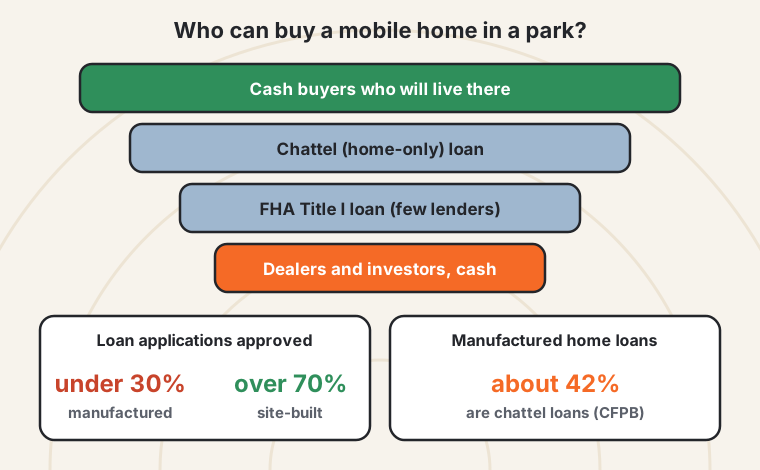
Each buyer group, honestly:
- Someone who wants to live in the park. Often a neighbor’s relative, a retiree downsizing, or someone who already rents nearby. They usually pay the most because they value the home as a home. Many pay cash.
- A buyer with a chattel loan. A chattel loan is secured by the home but not the land. The CFPB found these loans generally have higher interest rates and fewer consumer protections than mortgages (CFPB, 2021). Approval can take weeks.
- A buyer with an FHA Title I loan. HUD’s Title I program can finance a manufactured home on a leased lot if the lease has an initial term of three years and requires at least 180 days’ written notice before termination, and the buyer will live in it (HUD, Title I). Few lenders offer it; ask the buyer’s lender early.
- A buyer with a regular mortgage. Mostly only possible when the land comes with the home and the lender accepts the home. Ask any mortgage buyer for a pre-approval that names the property type.
- Dealers and investors. Connecticut licenses mobile manufactured home sellers through the Department of Consumer Protection; 18 were listed as active when we checked. Dealers and investors buy for cash, fast and as-is, and pay less because they take on repairs, holding costs and resale risk. Our company is one of these buyers: we buy mobile homes.
Also expect the park to require a credit and income check on any buyer who will live there. Under CGS 21-79(d), the park can deny a buyer who it reasonably believes can’t pay the lot rent. A buyer who can’t pass the park’s application can’t buy your home in place, no matter what they offer.
How do you price a mobile home in Connecticut?
You price a mobile home in Connecticut from recent sales of similar homes in the same park or nearby parks, then adjust for age, size, condition and the lot rent. Statewide, 178 recorded sales described as mobile or manufactured homes from October 2024 to September 2025 had a median of $105,500, with the middle half between $74,900 and $150,000; in Shelton, next to Derby, the median of 25 sales was $144,000 (CT OPM data).
Where to find real comparables:
- The town land records and assessor. Because park resales are recorded on the land records, the town clerk and assessor have actual sale prices. Many Connecticut assessors post sales online.
- The state’s sales data. The Office of Policy and Management’s Real Estate Sales dataset (data.ct.gov) includes these sales; some towns flag them as “mobile home” in the remarks. Our statewide figure above uses only those flagged sales with no non-market code, so it is a sample, not a census, and it includes some homes sold with land.
- New-home prices as a ceiling. The average new manufactured home sold in the Northeast went for $115,100 in May 2026, including dealer set-up (Census Manufactured Housing Survey via FRED). A used home with a dated interior rarely sells above a new one of the same size.
What moves the price, roughly in order: the park and its lot rent (a buyer compares your rent plus a loan payment with renting an apartment), the year built and HUD label, size (single-wide or double-wide), the roof and floors, the heating system, and whether the park has approved the home’s condition.
If you want to see how a cash buyer works backward from those numbers, our New Britain guide walks through how investors price a mobile home, and our general explainer covers why cash offers are lower.
What does selling a mobile home look like in Derby?
Selling a mobile home near Derby looks like a park sale in a neighboring town more often than a sale inside Derby itself. The state’s license list shows no active mobile home park with a Derby address, while license addresses in nearby Shelton, Naugatuck, Beacon Falls and Oxford list several. Derby’s own numbers still matter if your home sits in Derby: 38.44 mills of property tax and a 1% conveyance tax.
Derby is a small, dense river city where the Housatonic and Naugatuck rivers meet. Its housing is mostly older houses: 51% of Derby’s single-family homes were built before 1960, and the median single-family sale was $357,500 from October 2024 to September 2025 (CT OPM). A mobile home is one of the few ways to own a home in the area for a fraction of that, which is exactly why buyers look for them.
A few cautions on the local data:
- The DCP license list shows the address the licensee gave, which may be an office rather than the park itself. Check your own park’s license, which must be posted in a conspicuous place at the park (CGS 21-65a).
- No recorded sale in Derby, Ansonia or New Britain was flagged as a mobile home in the state data for October 2024 to September 2025. That doesn’t mean none exist, only that towns label sales differently.
When you’re ready to talk about a specific home, our Derby page is the place to ask for an offer, and you can compare it against everything below.
What are your real options for selling a mobile home fast?
Your real options for selling a mobile home fast in Connecticut are to sell it yourself to a buyer the park approves, list it with an agent or dealer who handles manufactured homes, sell it as-is to a cash buyer or investor, or, rarely, move it. On our $105,500 Derby example, selling it yourself nets about $98,534, an agent about $92,204 and a cash sale about $71,792, so the cash route costs about $26,742 in exchange for speed and certainty.
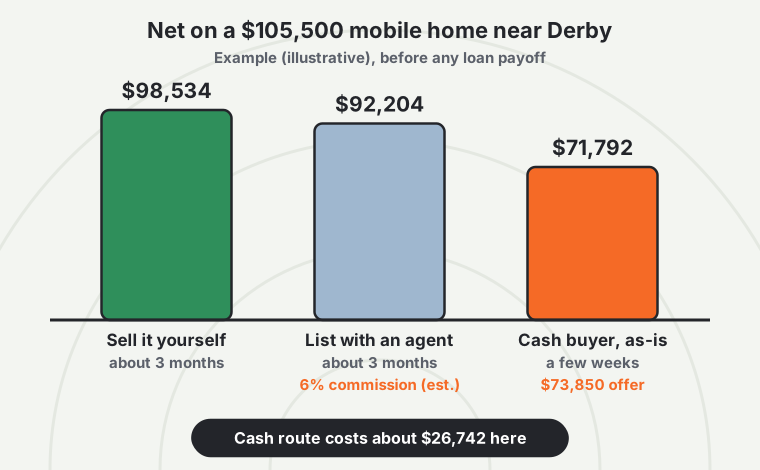
Example (illustrative). A home in a park near Derby, worth $105,500 to a buyer who will live in it. Carrying costs are $1,037 a month: lot rent of $650 (an assumption, not a Connecticut average), property tax of about $237 at Derby’s 38.44 mills, and $150 for insurance and utilities (est.). The cash offer of $73,850 (70% of value) is an example, not a quote.
| Line | Sell it yourself | List with an agent | Cash buyer, as-is |
|---|---|---|---|
| Sale price | $105,500 | $105,500 | $73,850 (example) |
| Commission, 6% (est.) | $0 | -$6,330 | $0 |
| Fixes to meet park standards (est.) | -$2,000 | -$2,000 | $0 |
| Attorney (est.) | -$800 | -$800 | -$800 |
| Conveyance tax, 1% | -$1,055 | -$1,055 | -$739 |
| Carrying costs at $1,037 a month | -$3,111 (3 months) | -$3,111 (3 months) | -$519 (half a month) |
| Net before any loan payoff or back taxes | $98,534 | $92,204 | $71,792 |
| Time (est.) | About 3 months | About 3 months | A few weeks, including park approval |
Moving the home is rarely the money-maker it sounds like. A home that is towed on a highway needs an oversize-load permit, you need a lot to put it on that the zoning allows, and you must file a removal statement with the town clerk at least 72 hours before it moves, signed off by the tax collector and any lienholder (CGS 21-67a(f)-(g)). Moving, re-setting and re-connecting a home can cost many thousands of dollars (est.), a big bite out of a home that sells for around $100,000.
Is a cash sale right for you, or should you list?
Seven quick questions. There is no wrong answer, and we will tell you honestly if listing would leave you more.
- Does the house need repairs you would rather not pay for or manage?
- Do you need to close by a certain date, or within the next month or two?
- Would showings be hard: tenants, belongings, privacy, or you live out of state?
- Is there a complication: an estate or probate, a divorce, foreclosure, liens or back taxes?
- Could you comfortably cover the mortgage, taxes and utilities for three or more months?
- Is getting the highest possible price more important to you than speed and certainty?
- Would a buyer's bank lend on the house as it is (no major roof, foundation, oil tank or code issues)?
When should you NOT sell your mobile home to a cash buyer?
You should not sell your mobile home to a cash buyer when the home is in good shape, the park has approved its condition, and you have a few months to find a buyer who will live in it. In that case selling it yourself usually nets much more, about $26,742 more in our Derby example. A cash sale makes sense when time, repairs, back rent or distance make the open market impractical.
Specifically, skip the cash route if:
- A neighbor, relative or park resident already wants it. Have an attorney do the paperwork and keep the difference.
- The park has announced a closure or land-use change. Learn your relocation and purchase rights first (CGS 21-70, 21-70a, 21-80).
- Someone is pressing you to sign today, asks for a fee, or wants you to sign over the home before the park approves the buyer. Those are red flags; see our guide to we-buy-houses scams.
And consider it seriously if the home has soft floors or a leaking roof the park has flagged, the lot rent is draining you every month on an empty home, you’re behind and facing a deadline, or you inherited it and live out of state. For homes that need work, our Ansonia guide covers which mobile home repairs pay before selling.
How do you sell a mobile home in Connecticut, step by step?
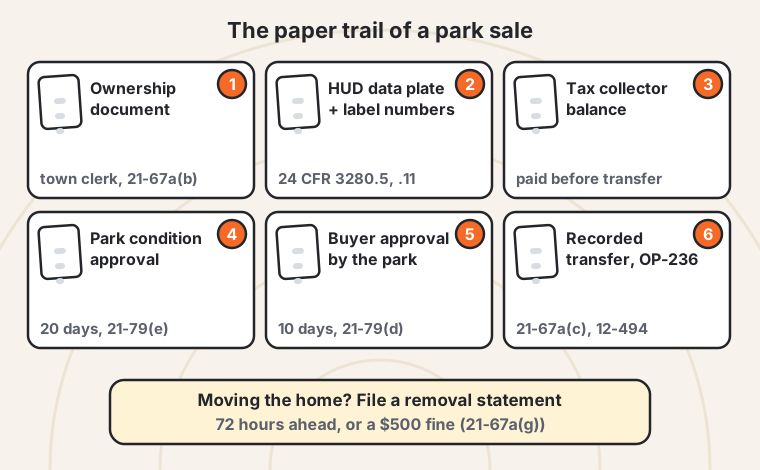
To sell a mobile home in Connecticut step by step: gather your ownership papers and HUD label numbers, check taxes and liens at town hall, request the park’s written condition approval, price and market the home, get the buyer approved by the park, and have an attorney record the transfer document and pay the conveyance tax. Each step below includes the deadline the law sets.
Find your papers
Your ownership document (title, bill of sale or the recorded transfer to you), the HUD data plate and label numbers, your rental agreement, the park’s disclosure statement and rules, and any loan statement. Your town clerk has the land records if anything is missing (CGS 21-67a).
Check taxes and liens
Ask the tax collector for the open balance on the home and the town clerk for any recorded lien or attachment. Taxes due must be paid before your buyer can take over the lot (CGS 21-67a(c)).
Ask the park, in writing, to approve the home’s condition
The park has 20 days to approve or give written reasons; silence is approval, and approval lasts up to six months (CGS 21-79(e)). Fix what’s reasonable or ask DCP for a ruling.
Price and market it
Use recent sales in your park and nearby, the HUD label year, and the lot rent. Our Derby guide covers mobile home listing tips: photos, paperwork and the buyer packet.
Sign a contract and send the buyer to the park
Make the contract subject to park approval. The park has 10 days from a complete application to approve or deny in writing (CGS 21-79(d)).
Close through an attorney
The transfer document must name the manufacturer, model, serial number, encumbrances, park and lot, and taxes owed, and it is recorded on the land records with the conveyance tax return (CGS 21-67a(c), 12-494). If the home is being moved, the removal statement is filed at least 72 hours ahead (CGS 21-67a(g)).
Hand over the keys
Your buyer assumes the lot rental agreement; give the park written notice that you’re leaving (at least 30 days for a resident terminating, CGS 21-80(b)(3)(A)).
See the house together.
Pick a time that works.
Choose a time for us to walk through the property with you, or ask for a quick call first. We confirm every request personally.
Tuesday, January 13
No open times in the next few weeks. Please call us.
We will confirm by email. Nothing is booked until we do.
View my requestQuestions about selling a mobile home in Connecticut
Can a Connecticut mobile home park stop me from selling my home?
A Connecticut mobile home park cannot stop you from selling your home if it is safe, sanitary and meets the park’s filed aesthetic standards. It can deny a specific buyer only for good cause, such as a reasonable belief the buyer can’t pay the lot rent, and must give the reason in writing within 10 days (CGS 21-79).
Does a park owner have a right of first refusal on my mobile home?
We found no section of Connecticut’s mobile home park law, chapter 412, that gives a park owner a right of first refusal on a resident’s home. If your rental agreement claims one, have a Connecticut attorney review it; provisions that waive your rights under the chapter are unenforceable (CGS 21-83).
Can the park charge me a fee or commission when I sell?
The park cannot take a commission on your sale price unless you hired it as your agent under a written contract, and it can’t charge your buyer an entrance fee or more than the prevailing lot rent (CGS 21-79(e), 21-83(a)(7)).
Do I need a title to sell a mobile home in Connecticut?
You need proof of ownership to sell a mobile home in Connecticut: a certificate of title, a bill of sale or another ownership document on file with the town clerk (CGS 21-67a(b)). The sale itself is done with a transfer document recorded on the town land records. If papers are missing, an attorney can trace ownership through the land records.
Do I pay conveyance tax when I sell a mobile home?
Yes, you pay conveyance tax when you sell a mobile home in a licensed Connecticut park, because the resale is taxed as a conveyance of realty (CGS 12-412c). In Derby that is 1% of the price: $1,055 on $105,500.
Who pays property tax on a mobile home in a park?
The home’s owner pays property tax on a mobile home in a park; the town assesses it in the owner’s name, separately from the park’s land (CGS 12-63a). Taxes due must be paid before your buyer can assume your lot (CGS 21-67a(c)).
Can I sell a mobile home built before 1976?
Yes, you can sell a mobile home built before 1976 in Connecticut, but it has no HUD label, so most buyers will need to pay cash, and the park’s condition approval becomes the key step. That usually lowers the price.
What if my HUD label is missing?
If your HUD label is missing, HUD won’t replace it, but IBTS can issue a letter of label verification for many homes built since June 15, 1976. You’ll need the serial number of each section from the data plate (HUD).
Can I sell my mobile home if I’m behind on lot rent?
Yes, you can sell your mobile home if you’re behind on lot rent, and the arrears are usually paid from the sale. If the park sues for eviction, an owner-resident can ask the court for up to 12 months to sell the home in place while paying use and occupancy (CGS 21-80(d)).
How long does it take to sell a mobile home in Connecticut?
Selling a mobile home in Connecticut takes as long as finding a buyer plus the park’s deadlines: up to 20 days for the condition statement and 10 days for buyer approval (CGS 21-79), then the recording. Asking for the condition statement before you advertise saves weeks.
Can I sell an inherited mobile home in a park?
Yes, an inherited mobile home in a Connecticut park can be sold, usually by the executor or administrator appointed by the probate court. Court annotations to CGS 21-79 indicate its resale protections apply to a deceased owner’s estate. In Derby the court is the Derby Probate District, which also serves Ansonia, Seymour and Woodbridge; ask it whether a sale needs court approval. Our inherited house page covers the estate side.
Do you buy mobile homes?
Yes, we buy mobile homes. Any sale to us still follows the same rules on this page: the park approves the buyer, taxes are paid, and an attorney records the transfer. Start on our Derby page or call (203) 529-4712.
Related guides
The mobile home series
Towns in this series
For selling a regular house, see how to sell a house in Connecticut and every route, step and cost.
Plain-English information, not legal or tax advice. Mobile home sales in parks raise legal questions that depend on your rental agreement; talk to a Connecticut attorney. The Derby example uses public data and labelled estimates.
Sources (checked on October 27, 2026)
- CGS chapter 412, Mobile Manufactured Home Parks: §§ 21-64, 21-65a, 21-67a, 21-68a, 21-70, 21-70a, 21-70b, 21-79, 21-80, 21-83.
- CGS §§ 12-62a, 12-63a (assessment at 70%; taxation of mobile manufactured homes).
- CGS § 12-412c (resale taxed as a conveyance of realty).
- CGS § 12-494 (conveyance tax).
- CT Department of Consumer Protection, Mobile Manufactured Homes.
- DCP, Rights and Responsibilities of Residents of Mobile Home Communities.
- State Licenses and Credentials (data.ct.gov): active mobile home park and mobile manufactured home seller licenses.
- CT OPM, Real Estate Sales (data.ct.gov dataset 5mzw-sjtu): sales recorded October 2024 to September 2025 whose remarks mention a mobile or manufactured home; Derby single-family data.
- CT OPM mill rates (Derby, fiscal 2027: 38.44).
- 24 CFR part 3280 (§ 3280.5 data plate; § 3280.11 certification label).
- HUD, Manufactured home labels (label verification through IBTS).
- HUD, Financing manufactured homes (Title I).
- CFPB, Manufactured Housing Finance: New Insights from HMDA (May 2021).
- Census Manufactured Housing Survey, average new home price, Northeast (FRED).
- City of Derby, Derby Probate Court District 41.

Who wrote this
Jerryll Noorden
Jerryll has bought and sold Connecticut houses since 2016 and has sat at more closing tables than he can count, on both sides. Before real estate he was a robotics scientist at NASA, IHMC and IIT. He wrote this guide because the national sites that rank for it skip the Connecticut rules that cost sellers money. When listing or selling it yourself would get you more than a cash offer, he says so.
This guide explains Connecticut rules in plain English. It is not legal or tax advice. Laws change; for your sale, talk to a Connecticut real estate attorney and a tax professional.
