
- Yes, you can sell a house with a lien in Connecticut. Liens do not block a sale; they get paid from your proceeds at the closing table, and the lienholder records a release. It is one situation inside our guide to how to sell a house in Connecticut.
- Every lien type has its own Connecticut rule. Property tax liens come first and grow at 18% a year (CGS 12-172, 12-146). Mechanic’s liens must be recorded within 90 days and die after one year unless the contractor sues (CGS 49-34, 49-39). Judgment liens are recorded at the town clerk (CGS 52-380a).
- Find them all first. In Connecticut, liens on a house are recorded in the land records at the town clerk of the town where it sits. There are no county offices.
- Many payoffs can be negotiated. Judgment creditors, contractors and some lenders often accept less to get paid now. Property tax interest is set by statute and is much harder to reduce.
- If the liens are bigger than the house is worth, you still have options: a short sale, negotiating junior liens, or an IRS discharge when the government’s lien has no equity behind it.
- Get free help first if you are in foreclosure or tax trouble. Then compare listing with a cash sale using real payoff numbers.
Can you sell a house with a lien in Connecticut?
Yes, you can sell a house with a lien in Connecticut. A lien is a claim against the house, not a ban on selling it. At closing, the attorneys pay each lien from the sale proceeds, in order of priority, and each lienholder releases its lien so the buyer gets clean title. The only real problem comes when the liens add up to more than the house will sell for, and even then there are options.
Think of a lien as a sticky note on your deed that says “pay me before the house changes hands.” A mortgage is a lien you agreed to. Others are put on the house without your agreement: back property taxes, a contractor who says you owe him, a creditor who won a court judgment, the IRS, the state, a condo association, the child support enforcement agency, a probate court collecting fees from a parent’s estate.
None of those stop you from signing a contract. What they do is stop the buyer’s attorney from closing until every one is either paid, released, or bonded off. That is the whole game: know every lien, know the payoff for each, and make sure the price covers them. This guide shows how each Connecticut lien works, how they are paid, how to negotiate them and what to do if the numbers do not work.
If your trouble is specifically back property taxes, read our page on how to sell a house with property tax liens in Connecticut; it covers tax sales, lien assignments and the town’s foreclosure process in detail. This page covers every kind of lien and how they fit together.
Does a lien on your house make you feel trapped?
A lien on your house makes many Connecticut owners feel trapped: you cannot pay the debts until you sell, and you think you cannot sell until you pay the debts. That loop is a myth. Liens are paid from the proceeds at closing, which is exactly how most Connecticut sales with liens work. The real work is finding every lien and getting accurate payoffs.
Maybe a contractor walked off the job and then recorded a mechanic’s lien for money you do not think you owe. Maybe an old credit card turned into a court judgment you never saw coming, and now it is in the land records. Maybe the taxes slipped during a bad year, and the tax collector’s letters keep arriving with a bigger number each time. Maybe you inherited a parent’s house and discovered a probate fee lien, an old home equity line and a sewer bill nobody paid.
The feelings are heavy: ashamed that your debts are now public record, trapped in the pay-to-sell loop, afraid of foreclosure or the IRS, angry at a contractor or an ex, confused about who gets paid first, and skeptical of anyone who promises to “take care of your liens”. Most people who read this far are also cautiously hopeful, because they suspect there is a way through.
Here is one Connecticut fact that helps: a mechanic’s lien is not permanent. Unless the contractor starts a foreclosure lawsuit and records a notice within one year, the lien is “invalid and discharged as a matter of law” (CGS 49-39). Plenty of owners carry a dead lien around in their heads for years.
This page is for you if you own a Connecticut house, in Killingworth or anywhere in the state, with one or more liens on it, and you want to know exactly where you stand before you decide anything. Nothing here obligates you, and nothing about your situation will surprise us.
What kinds of liens can be on a Connecticut house?
The liens that can be on a Connecticut house include mortgages and home equity lines, property tax liens, sewer and water liens, mechanic’s liens, judgment liens, federal tax liens, Connecticut Department of Revenue Services tax liens, probate fee liens, condominium and homeowner association liens, child support liens, and blight or zoning penalty liens. Each has its own statute, priority and release process.
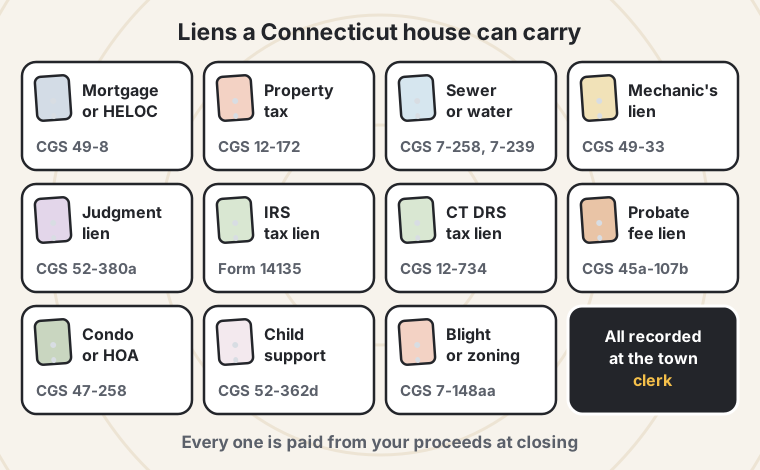
| Lien | How it attaches | Priority and key rule | How it is released | Statute |
|---|---|---|---|---|
| Mortgage / home equity line | You signed it | By recording date | Paid from proceeds; lender must release within 60 days of a written request, or owe damages | CGS 49-8 |
| Property tax lien | Automatic, from the assessment date; continued by a certificate the tax collector records within two years | Ahead of all other transfers and encumbrances; interest 18% a year (1.5% a month); collectible for 15 years | Tax collector’s certificate of discharge after payment | CGS 12-172, 12-173, 12-175, 12-146, 12-164 |
| Sewer use charge lien | Charge unpaid 30 days after the due date | Interest and lien handled like property taxes | Released like a tax lien | CGS 7-258 |
| Municipal water lien | Unpaid charges of a town waterworks system | Lien on the property served | Released after payment | CGS 7-239 |
| Mechanic’s lien | Contractor or supplier records a certificate within 90 days after last work and serves you within 30 days | Ahead of encumbrances that began after the work started; expires after 1 year unless a foreclosure suit and lis pendens are filed | Payment and release; court discharge or reduction hearing; substitute a bond | CGS 49-33, 49-34, 49-35, 49-35a, 49-37, 49-39 |
| Judgment lien | Creditor with a court judgment records a judgment lien certificate at the town clerk | From the recording date (or earlier attachment); can be foreclosed like a mortgage | Creditor must release on payment; 10 days after a written request, damages up to half the lien | CGS 52-380a, 52-380e, 52-380g |
| Federal tax lien (IRS) | Arises when tax is assessed and unpaid; Notice of Federal Tax Lien recorded | Federal law decides priority against buyers and lenders | Payment, or a certificate of discharge for the property (Form 14135) | 26 U.S.C. 6321, 6325; IRS Pub. 783 |
| Connecticut tax lien (DRS) | Unpaid state income, sales or other state tax; certificate recorded at the town clerk | Not effective against a good-faith buyer until recorded | Payoff request (Form TPG-198), then a DRS certificate discharging the lien | CGS 12-35, 12-35b, 12-734 |
| Probate fee lien | Probate fees owed by a decedent’s estate | Not valid against a good-faith buyer until recorded | Probate Court issues a release within 10 days after payment | CGS 45a-107b |
| Condo / HOA lien | Automatic for unpaid assessments and fines; recording the declaration perfects it | Up to 9 months of common charges plus collection costs come ahead of the first mortgage; ends if not enforced within 3 years | Paid from proceeds; shown on the resale certificate | CGS 47-258, 47-270 |
| Child support lien | Past-due support of $500 or more under a state IV-D order | Lien on any property of the obligor; can be foreclosed | Paid from proceeds; agency files a release | CGS 52-362d |
| Blight / zoning penalty lien | Unpaid town blight or zoning citation penalties | Ahead of liens filed after July 1, 1997, except taxes | Released like a tax lien | CGS 7-148aa |
Voluntary and involuntary liens
A mortgage and a home equity line are voluntary: you agreed to them, and their payoffs are routine. Everything else on that list is involuntary: someone put it on the house to collect a debt. Involuntary liens are what make sales feel stuck, because the amount may be disputed, the creditor may be hard to reach, and interest keeps running.
Liens that are not in the land records yet
Some claims exist before anyone records them. A property tax lien exists from the assessment date. A condo association’s lien is perfected by the recorded declaration, so no separate filing is needed (CGS 47-258(d)). A contractor has 90 days after finishing to record a mechanic’s lien. The condition report you give a buyer asks whether there are unpaid water or sewer charges (CGS 20-327b). Tell your attorney about every debt connected to the house, recorded or not.
How are liens paid when you sell a house in Connecticut?
When you sell a house in Connecticut, liens are paid at closing from the buyer’s money before you receive anything. Your attorney orders a written payoff from each lienholder, the settlement statement lists every payoff, the attorney sends each payment, and each lienholder records a release in the land records. What is left after liens, taxes and closing costs is yours.
Here is the order of events in a typical Connecticut closing with liens:
- Title search. The buyer’s attorney searches the land records at the town clerk and finds recorded mortgages, liens, judgments and lis pendens.
- Payoff letters. Your attorney requests a written payoff, good through the closing date, from each lienholder: the lender, the tax collector, the contractor’s attorney, the judgment creditor’s attorney, the IRS or DRS, the condo association.
- Settlement statement. Every payoff appears as a line item, along with the conveyance tax, the property tax adjustment and other costs.
- Disbursement. At closing the attorney pays each lienholder directly. You never have to find the money yourself.
- Releases. Each lienholder records a release or discharge. Connecticut law puts deadlines on many of them: a mortgage release within 60 days of a written request (CGS 49-8), a judgment lien release within 10 days of a request (CGS 52-380g), a probate fee lien release within 10 days of payment (CGS 45a-107b).
Priority matters only when there is not enough money for everyone. If the price covers all the liens, every lienholder is paid in full and the order is a formality. If it does not, the senior liens are paid first and the junior lienholders have to agree to take less, or the sale cannot close.
For a step-by-step view of the whole closing, see the Connecticut closing process for sellers.
How much will you walk away with after liens are paid?
How much you walk away with after liens are paid is the sale price minus every payoff, the conveyance tax, your attorney’s fee and any commission. Work it out before you list. The worked example below uses Killingworth’s median sale price and tax rate to show how back taxes, a mechanic’s lien and a judgment lien come out of the proceeds.

A Killingworth house that would sell around the town median. The owner owes a mortgage, one full year of property tax that is now a year late, a disputed contractor’s mechanic’s lien and a judgment lien from an old credit card. The lien amounts are made up for the example; the town figures and tax rules are real.
| Input | Value | Source |
|---|---|---|
| Killingworth median sale price (Oct 2024-Sep 2025) | $485,000 | Town sales data, 71 sales |
| Mill rate, fiscal 2027 | 28.47 | OPM mill rates |
| Annual property tax on the median | about $9,670 ($810 a month) | $485,000 x 70% x 28.47 mills |
| Interest on delinquent property tax | 18% a year (1.5% a month) | CGS 12-146 |
| Conveyance tax (state 0.75% + Killingworth 0.25%) | 1.0% of the price | CGS 12-494 |
| Line | Amount | Note |
|---|---|---|
| Sale price | $485,000 | Killingworth median |
| Conveyance tax (1.0%) | -$4,850 | Paid before the deed is recorded |
| Mortgage payoff | -$240,000 | Illustrative |
| Back property tax: one year plus 18% interest | -$11,411 | $9,670 + $1,741 (est., one full year late) |
| Mechanic’s lien | -$14,000 | Illustrative; could be negotiated or challenged |
| Judgment lien | -$8,500 | Illustrative; could be negotiated |
| Your attorney | -$1,500 | (est.) |
| You receive (before any commission) | $204,739 | |
| If listed with an agent at 5% (est.) | -$24,250 | Leaves $180,489 |
Two things stand out. First, the liens do not stop this sale: there is plenty of equity, so every creditor gets paid and the owner still walks away with about $180,000 to $205,000 depending on the route. Second, the disputed liens are worth working on. If the contractor accepts $9,000 and the judgment creditor accepts $5,500, the owner keeps another $8,000. Negotiation is covered below.
How much would you walk away with?
Slide the numbers to match your house. It works in your browser; nothing is saved or sent.
Estimates for planning. Conveyance tax per CGS 12-494 (state 0.75% up to $800,000, 1.25% to $2.5M, 2.25% above, plus the town rate). Seller attorney about $1,200 to $1,500; flat-fee MLS about $400; listings include three months of taxes, insurance and utilities, a cash sale about two weeks. Your attorney gives you the final numbers.
Every month costs money
Delinquent property tax grows at 1.5% a month. On one year of Killingworth tax ($9,670), that is about $145 more every month the bill sits unpaid, on top of the next year’s tax. Judgments also carry interest, and mortgage arrears grow late fees. Our guide on how to calculate the cost of holding a property shows how to add up the full monthly cost of waiting.
How do you run a lien search on a Connecticut house?
To run a lien search on a Connecticut house, search the land records at the town clerk of the town where the house sits for mortgages, liens, judgment lien certificates, tax lien certificates and lis pendens; then ask the tax collector for unpaid taxes and the sewer or water authority for unpaid charges; then check the Judicial Branch case lookup for pending lawsuits. For a sale, your attorney orders a full title search.
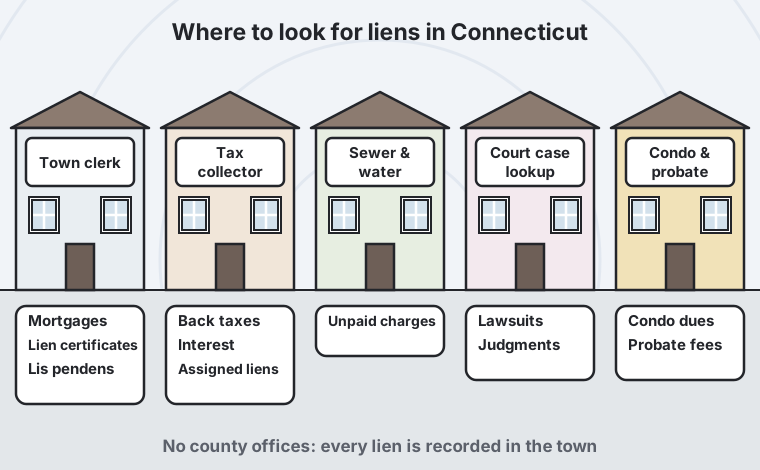
Connecticut has no county government, so there is no county recorder. Every recorded document affecting a house, including federal and state tax lien notices, lands in the land records of the town where the house is. Here is how to look yourself before you hire anyone:
- Town clerk land records. Search by owner name (every owner, including former names) and by address if the index allows. Look for mortgages without a recorded release, “certificate of lien”, “judgment lien”, “mechanic’s lien”, “lis pendens”, “notice of federal tax lien” and “continuation of tax lien”. In Killingworth, the town clerk’s office has land records on a public computer during business hours and offers online access by subscription; staff can explain the index but will not search or interpret for you.
- Tax collector. Ask for the balance on every grand list year, including interest and any liens assigned to a private company. Do not assume that a lien recorded years ago reflects today’s balance.
- Sewer and water. If the house is on public sewer or a town water system, ask for the balance. Many rural homes in towns like Killingworth use private wells and septic systems, in which case there is no sewer or water lien to worry about.
- Court cases. Search your name on the Connecticut Judicial Branch case lookup for pending civil, small claims and foreclosure cases. A judgment that has not yet been recorded as a lien may still become one.
- Condo association. Ask for a statement of unpaid charges; a buyer will get the resale certificate anyway (CGS 47-270).
- Probate. If an owner on the deed has died, ask the Probate Court whether fees are unpaid and whether a lien was recorded (CGS 45a-107b).
A do-it-yourself search tells you roughly what is there so you are not surprised. Before closing, the buyer’s attorney orders a professional title search and the title insurer decides what must be paid or released. If you find something you do not understand, bring a printout to your attorney.
How do property tax, IRS and state tax liens affect a Connecticut sale?
Property tax, IRS and state tax liens affect a Connecticut sale in different ways. A property tax lien comes ahead of everything, grows at 18% a year and is simply paid at closing. An IRS lien is paid at closing or removed from the house with a certificate of discharge, which the IRS asks you to apply for at least 45 days ahead. A Connecticut DRS lien is paid from proceeds using a DRS payoff and then discharged.
Property tax liens
Connecticut property taxes are a lien on the house from the assessment date, and that lien “shall take precedence of all transfers and encumbrances” (CGS 12-172). The tax collector keeps the lien alive by recording a certificate in the land records within two years after the tax was due (CGS 12-175). Delinquent tax carries interest at 18% a year (CGS 12-146), and the town can collect for 15 years (CGS 12-164). At closing, the tax collector gives a payoff and the attorney pays it first.
The bigger danger is what happens if you do not sell: towns can foreclose tax liens (CGS 12-181), hold tax sales (CGS 12-157), or sell the liens to private companies that then add their own fees and can foreclose (CGS 12-195h). Those processes, and how to stop them, are covered on our page about how to sell a house with property tax liens in Connecticut.
Federal tax liens (IRS)
If you owe the IRS, a federal tax lien attaches to everything you own, including the house. You have two ways to sell:
- Pay it at closing. Get the payoff from the IRS (the IRS lists 1-800-913-6050 for lien payoff questions in Publication 783), the attorney pays it from proceeds, and the IRS releases the lien.
- Get a certificate of discharge. File Form 14135 to remove the lien from this one property. Publication 783 says to submit the application “at least 45 days before the transaction date.” The IRS can discharge the property if you pay the value of its interest, if the government’s interest has no value because senior debts exceed the price, if other property still covers twice the debt, or if the proceeds are held in escrow while a dispute is resolved (26 U.S.C. 6325(b)).
Connecticut DRS tax liens
Unpaid state taxes, such as income tax, can become a lien on your Connecticut real estate when DRS records a certificate in the town land records (CGS 12-734 for income tax; CGS 12-35b lists the other state tax lien statutes). Your attorney requests a payoff with DRS Form TPG-198, pays it at closing, and DRS issues a certificate discharging the lien. A Connecticut estate tax lien on a parent’s house is a different process (Form CT-4422 UGE); see our guide on selling an inherited house in Connecticut.
How does a mechanic’s lien work in Connecticut, and can you sell with one?
A mechanic’s lien in Connecticut lets a contractor or supplier who worked on your house claim it as security for an unpaid bill of more than $10. It must be recorded within 90 days after the work stopped and served on you within 30 days after that, and it expires after one year unless the contractor files a foreclosure action and records a lis pendens. You can sell with one by paying it, settling it, bonding it off or getting a court to discharge it.
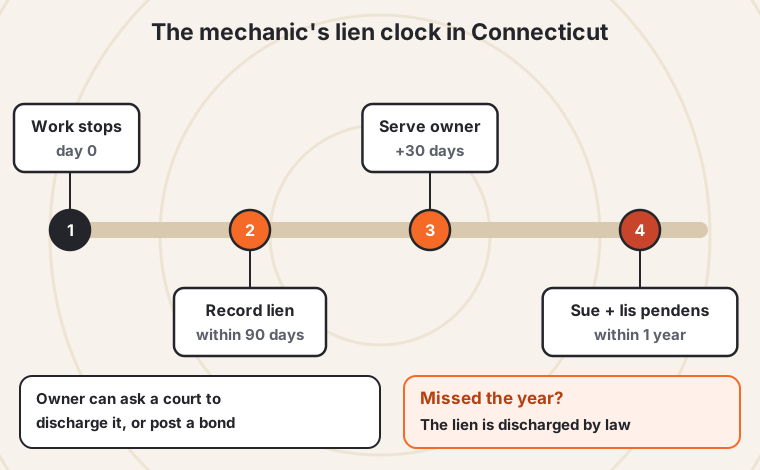
| Step | Deadline | Statute |
|---|---|---|
| Subcontractor or supplier gives you notice of intent | Within 90 days after the claimant stopped work; notice goes to you and to the original contractor | CGS 49-35 |
| Lien certificate recorded at the town clerk | Within 90 days after the claimant stopped work or deliveries | CGS 49-34(1) |
| Copy served on the owner | Within 30 days after recording | CGS 49-34(2) |
| Foreclosure suit plus lis pendens | Within 1 year after recording, or the lien is discharged by law | CGS 49-39 |
Four ways to clear a mechanic’s lien before closing
- Check whether it is still alive. If more than a year has passed since it was recorded and no foreclosure suit and lis pendens were filed, the lien is invalid (CGS 49-39). If it was recorded more than 90 days after the work stopped, it was never valid (CGS 49-34). Your attorney can ask the claimant to release it.
- Ask the court to discharge or reduce it. If no foreclosure is pending, you can apply to Superior Court for a hearing on whether the lien should be discharged or reduced (CGS 49-35a).
- Substitute a bond. A judge can dissolve the lien if you post a bond with surety, which moves the fight off the house so the sale can close (CGS 49-37).
- Settle and get a release. Many contractors prefer a check now to a lawsuit later. Get any agreement in writing and make the release part of the closing.
A related practical point: the buyer’s title insurer usually asks you to sign an affidavit that no one has worked on the house recently without being paid. If work was done in the last 90 days, tell your attorney; that is the window in which a lien could still appear.
What happens to a judgment lien when you sell a Connecticut house?
When you sell a Connecticut house with a judgment lien, the lien is paid from the proceeds at closing and the creditor must then release it. A judgment lien attaches when the creditor records a judgment lien certificate at the town clerk, it can be foreclosed like a mortgage, and once the judgment is paid the creditor must send a release within 10 days of a written request or owe damages.
A judgment lien starts with a lawsuit you lost or did not answer: a credit card, a medical bill, a car deficiency, a personal loan, a contractor. Once the creditor has a money judgment, it can record a judgment lien certificate on any real estate you own (CGS 52-380a(a)). From then on the judgment is a lien on your interest in the house (52-380a(b)), and the creditor can foreclose it like a mortgage (52-380a(c)). For consumer judgments, the creditor must give notice of the foreclosure mediation program before foreclosing (52-380a(d)).
- Get the exact payoff from the creditor’s attorney, including post-judgment interest and costs, good through your closing date.
- Negotiate. Judgment creditors and debt buyers often accept a lump-sum discount, especially on old consumer debt. Get the agreed amount in writing before closing.
- Insist on the release. After payment, the creditor must send a release; if it fails to do so within 10 days after a written request, it can owe damages of up to half the lien (CGS 52-380g).
- Bond it off if you dispute it. You can ask the court to discharge the lien if you substitute a bond or a lien on other property with equal equity (CGS 52-380e).
How do condo, probate fee, child support and town liens work in a sale?
Condo, probate fee, child support and town liens are paid from the proceeds like any other lien, but each has a twist. A condo association’s lien for up to nine months of common charges comes ahead of the first mortgage. A probate fee lien is released by the Probate Court within ten days of payment. A child support lien arises at $500 past due. Blight and sewer liens are handled like property tax liens.
Condo and HOA liens
Under the Common Interest Ownership Act, the association has a lien on your unit for unpaid assessments and fines, and recording the declaration is all it needs to perfect it (CGS 47-258(a) and (d)). Up to nine months of regular common charges, plus the association’s collection costs and attorney’s fees, come ahead of even the first mortgage (47-258(b)). The lien is extinguished if the association does not start enforcement within three years after the full amount came due (47-258(e)). The resale certificate a buyer receives shows the unpaid balance (CGS 47-270), so plan to pay it at closing.
Probate fee liens
The probate fees on a decedent’s estate are a lien in favor of the state on Connecticut real estate in the estate, though not against a good-faith buyer until notice is recorded (CGS 45a-107b(b)). The Probate Court must issue a certificate releasing the lien within ten days after the fees and interest are paid, and can release it earlier if payment is adequately assured (45a-107b(c)). That is why the fee is usually paid from the sale proceeds. Our inherited house guide covers the probate side.
Child support liens
When a person owes $500 or more in past-due child support under an order payable through the state’s IV-D agency, the state has a lien on any property in which that person has an interest (CGS 52-362d(a)). The lien can be foreclosed. The agency gives notice and an opportunity for a hearing. At a sale, the payoff comes from the obligor’s share of the proceeds and the agency records a release.
Sewer, water, blight and zoning liens
Unpaid sewer use charges become delinquent 30 days after the due date, carry interest like property taxes and become a lien (CGS 7-258). Town water systems have a similar lien (CGS 7-239). Unpaid blight and zoning citation penalties are a lien enforced like a property tax lien (CGS 7-148aa). If blight or permit problems are behind those liens, see our guide to selling a house with code violations in Connecticut.
Can you negotiate a lien payoff before you sell?
You can often negotiate a lien payoff before you sell in Connecticut, but not every lien is equally negotiable. Judgment creditors, debt buyers, contractors and junior lenders frequently accept less for a guaranteed payment at closing. Property tax interest is fixed by statute and rarely reduced. The IRS and state follow their own formal programs. Always get the reduced payoff in writing before closing.
| Lien | Room to negotiate | What works |
|---|---|---|
| Judgment lien (consumer debt) | Often good | A lump-sum offer paid at closing; written settlement and release |
| Mechanic’s lien | Often good | Check validity (90-day and 1-year rules), then settle; or apply for a discharge hearing or bond |
| Second mortgage or home equity line | Mainly when there is not enough equity | Short payoff request through the lender’s loss mitigation department |
| Condo / HOA lien | Some, on fines and fees | Ask the board to waive late fees and fines if the principal is paid at closing |
| Property tax lien | Very little | Interest is set at 18% by statute; ask about payment plans and any town relief programs |
| IRS lien | Formal process only | Discharge (Form 14135), installment agreement or offer in compromise through the IRS |
| DRS lien | Formal process only | DRS payoff and its own payment programs |
| Child support lien | Very little | Talk to the support enforcement agency and your attorney |
The best leverage is a signed purchase contract and a closing date. A creditor who has waited years for payment will often take a little less to be paid in two weeks. Have your attorney make the request, and never send money to a creditor directly based on a phone call.
What if the liens add up to more than the house is worth?
If the liens add up to more than the house is worth, the sale can only close if some lienholders agree to take less. That usually means a short sale approved by the mortgage lender, negotiated payoffs from junior lienholders, or an IRS certificate of discharge when the government’s lien has no equity behind it. A principal-residence sale where the price does not cover the mortgages and municipal liens is also exempt from Connecticut conveyance tax.
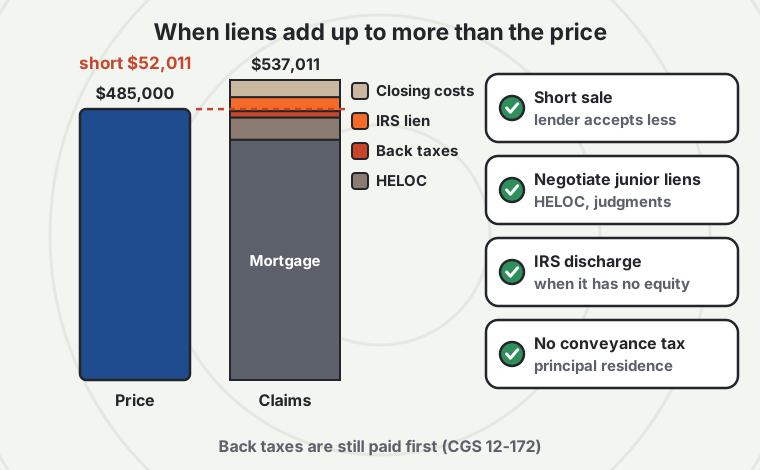
The same $485,000 Killingworth house, but the owner owes $430,000 on the first mortgage, $40,000 on a home equity line, $11,411 in back taxes and a $25,000 IRS lien. Add $4,850 in conveyance tax, $1,500 for the attorney and a 5% (est.) commission of $24,250, and the claims total $537,011: about $52,011 more than the price.
In that situation, something has to give:
- Short sale. The first-mortgage lender agrees to accept less than it is owed so the sale can close. Read short sale vs. foreclosure for how the two compare. Ask the lender in writing whether it will waive any remaining balance (a deficiency).
- Junior lien negotiation. The home equity lender and judgment creditors know they get nothing in a foreclosure, so they often accept a small payment to release.
- IRS discharge with no equity. If senior debts exceed the sale price, the IRS can discharge the property because its interest has no value (26 U.S.C. 6325(b)(2)(B); Publication 783). The tax debt itself remains.
- Conveyance tax relief. The conveyance tax does not apply to a transfer of your principal residence where the price is not enough to pay the mortgages and the municipal taxes and charges that can be liened (CGS 12-498(a)(20)).
- Property taxes still come first. Because property tax liens outrank everything (CGS 12-172), the back taxes are paid even in a short sale; for details see our page on how to sell a house with tax liens in Connecticut.
If foreclosure has started, the real deadline is your Law Day. Read our guide to foreclosure in Connecticut and the consequences of foreclosure for Connecticut sellers before you decide.
Before you sell anything, know your free options. A HUD-approved housing counselor can review a mortgage or tax problem at no cost (hud.gov/counseling). If a foreclosure case has been filed, Connecticut’s foreclosure mediation program may apply (jud.ct.gov/foreclosure). For IRS problems, the Taxpayer Advocate Service is free (taxpayeradvocate.irs.gov). Your town tax collector can tell you about payment plans. Never sign your deed over to anyone who promises to “save” the house, and never pay an upfront fee to stop a foreclosure.
Should you pay the liens off, list the house or sell it for cash?
Whether you should pay the liens off, list the house or sell it for cash depends on your equity, the condition of the house and your time. With good equity and a house in good shape, listing usually nets the most, and the liens are paid at closing. With thin equity, a house that needs work, a foreclosure or tax deadline, or liens that make buyers nervous, a cash sale trades some price for speed and certainty.
Pay first, then sell
Only if you have cashClears title before listing.
- Useful for a small lien that scares buyers
- Most people cannot, and do not need to
- Liens are normally paid from proceeds instead
List with an agent
2-4 months (est.)Best with good equity and a market-ready house.
- Highest price, minus commission
- Liens paid at closing
- Risk: a buyer’s lender, inspection or deadline falls through
Sell as-is for cash
About 2 weeksBest when time, condition or the liens themselves are the problem.
- No repairs, no showings, no lender
- We wait for payoffs, releases or a discharge
- Lower price than a retail sale; the honest trade-off
When you should NOT sell to a cash buyer
- You have solid equity, the house shows well, and you have a few months. List it; the liens get paid either way.
- Your only lien is a mortgage. That is a normal sale.
- Free help (mediation, a loan modification, a tax payment plan) could let you keep the house and you want to keep it.
- You are underwater and a short sale through an agent would get the lender a higher price. Lenders approve short sales based on the numbers.
A cash sale makes sense when the house needs work a financed buyer’s lender will not accept, when a tax sale or Law Day is close, when a lien is disputed and you need a buyer who will wait for it to be resolved, or when you simply want it done. For the general trade-offs of selling without repairs, see selling a house as-is in Connecticut.
Is a cash sale right for you, or should you list?
Seven quick questions. There is no wrong answer, and we will tell you honestly if listing would leave you more.
- Does the house need repairs you would rather not pay for or manage?
- Do you need to close by a certain date, or within the next month or two?
- Would showings be hard: tenants, belongings, privacy, or you live out of state?
- Is there a complication: an estate or probate, a divorce, foreclosure, liens or back taxes?
- Could you comfortably cover the mortgage, taxes and utilities for three or more months?
- Is getting the highest possible price more important to you than speed and certainty?
- Would a buyer's bank lend on the house as it is (no major roof, foundation, oil tank or code issues)?
How do you sell a house with liens, step by step?
To sell a house with liens, list every lien and debt tied to the house, get written payoffs, check which liens may be invalid or negotiable, compare your net from listing and from a cash sale, sign with the buyer who nets you the most for your timeline, and let the closing attorneys pay each lien and collect the releases. A cash sale with liens typically closes in about two weeks once payoffs are in hand.
List every lien
Search the town land records, ask the tax collector and any sewer, water or condo office, and check the court case lookup. Write down each lienholder, the amount claimed and the date recorded.
Hire your attorney and get payoffs
Your Connecticut attorney requests written payoffs good through a target closing date, including the IRS (Form 14135 timing if you need a discharge) and DRS (Form TPG-198).
Challenge and negotiate
Check mechanic’s liens against the 90-day and one-year rules, ask judgment creditors for a lump-sum discount, and ask the condo board to waive fines.
Run the numbers both ways
Price minus payoffs, conveyance tax, attorney and any commission. Use the calculator above, and compare offers line by line with our guide on how to compare offers in Connecticut.
Sign and close
At closing the attorney pays each lienholder directly and records the releases. With us there are no repairs and no showings, you pick the date (typically about two weeks), and you can leave what you do not want.

The lien that delays a Connecticut closing is rarely the big mortgage. It is the small one nobody knew about: a judgment from an old credit card, a home equity line that was paid off but never released, a sewer bill on an estate. Pull your land records the week you decide to sell, list every name you see, and let your attorney start chasing payoffs before you have a buyer. Weeks of waiting on a release letter become days.
What happens if you sell a house with liens to a cash buyer like us?
If you sell a house with liens to a cash buyer like us, the liens are paid from the price at closing exactly as in any other sale: your attorney gets the payoffs, the closing attorney pays them, and the releases are recorded. The difference is that there is no lender to approve the house or the timeline, so we can wait for a disputed lien to be resolved or a discharge to arrive and close when it does.
I am Jerryll Noorden. I have bought Connecticut houses since 2016, about ten a year, and many have had liens on them. What we do and do not do:
- We do not make liens disappear. Anyone who says that is either paying them from your price or misleading you. We show you the payoff math on paper.
- We never charge fees, and we never ask you to sign your deed to us before a closing run by Connecticut attorneys.
- Our offers do not expire while you decide. Show the number to your attorney, a housing counselor or your family.
- If listing or keeping the house is better for you, we will say so.
Call me at (203) 529-4712 with the address and a rough list of what is owed, and I will tell you honestly whether a cash sale makes sense. For the full picture of your options, see our guide on how to sell a house in Connecticut, and for property tax trouble in particular, our page on how to sell a house with property tax liens.
See the house together.
Pick a time that works.
Choose a time for us to walk through the property with you, or ask for a quick call first. We confirm every request personally.
Tuesday, January 13
No open times in the next few weeks. Please call us.
We will confirm by email. Nothing is booked until we do.
View my requestQuestions Connecticut owners ask about selling with liens
Can you sell a house with a lien on it in Connecticut?
Yes, you can sell a house with a lien on it in Connecticut. The lien is paid from the sale proceeds at closing and the lienholder records a release. If the liens total more than the price, some lienholders must agree to accept less for the sale to close.
How do I find out if there is a lien on my property in Connecticut?
To find out if there is a lien on your property in Connecticut, search the land records at the town clerk of the town where the property is, ask the tax collector for unpaid taxes, and check the Judicial Branch case lookup. For a sale, your attorney orders a full title search.
How long does a mechanic’s lien last in Connecticut?
A mechanic’s lien in Connecticut lasts one year after it is recorded unless the contractor starts a foreclosure action and records a lis pendens within that year; otherwise it is discharged by law (CGS 49-39). It must also have been recorded within 90 days after the work stopped (CGS 49-34).
What happens to a lien when a house is sold?
When a house is sold, the lien is paid from the seller’s proceeds at closing and the lienholder records a release in the town land records. The buyer takes the house free of the lien. Any amount the proceeds cannot cover must be negotiated before closing.
Can you sell a house with a judgment lien in Connecticut?
Yes, you can sell a house with a judgment lien in Connecticut. The judgment is paid at closing, and the creditor must then release the lien; if it fails to do so within 10 days after a written request, it can owe damages up to half the lien (CGS 52-380g).
Can you sell a house with an IRS tax lien?
Yes, you can sell a house with an IRS tax lien, either by paying the lien at closing or by getting a certificate of discharge for the property with IRS Form 14135. IRS Publication 783 says to apply at least 45 days before the closing.
Who pays the liens when a house is sold?
The seller pays the liens when a house is sold, out of the sale proceeds. The closing attorney sends each payment directly to the lienholder, and the payoffs appear on the settlement statement.
Can you sell a house with back property taxes in Connecticut?
Yes, you can sell a house with back property taxes in Connecticut. The taxes, with interest at 18% a year (CGS 12-146), are paid first at closing because the tax lien comes ahead of other liens (CGS 12-172). See our page on selling a house with property tax liens for tax sales and lien assignments.
What if the liens are more than the house is worth?
If the liens are more than the house is worth, the sale needs lienholders to accept less: a short sale with the mortgage lender, negotiated payoffs with junior creditors, or an IRS discharge when its lien has no equity. Talk to a HUD-approved housing counselor or an attorney first.
Can a lien be negotiated down before closing?
Many liens can be negotiated down before closing, especially judgment liens, mechanic’s liens and junior mortgages. Property tax interest is set by statute and is rarely reduced, and the IRS and DRS use formal programs. Get any reduced payoff in writing.
Does a condo lien come ahead of my mortgage in Connecticut?
Part of it does. In Connecticut, up to nine months of regular common charges plus the association’s collection costs and attorney’s fees come ahead of the first mortgage (CGS 47-258(b)). The rest ranks behind the mortgage.
Where are liens recorded in Connecticut?
Liens on Connecticut real estate are recorded in the land records of the town clerk in the town where the property is located. Connecticut has no county government, so there is no county recorder.
Can a contractor put a lien on my house without telling me?
A contractor cannot validly put a lien on your house in Connecticut without serving you. The lien certificate must be served on the owner within 30 days after it is recorded (CGS 49-34), and most subcontractors must give written notice of intent within 90 days (CGS 49-35).
Do I pay conveyance tax on a short sale in Connecticut?
Generally no. Connecticut exempts the transfer of your principal residence from conveyance tax when the price is not enough to pay the mortgages and municipal liens on it (CGS 12-498(a)(20)). Confirm with your attorney.
Related Connecticut guides
Money trouble
Closing and costs
We buy houses in Killingworth and nearby towns, including Killingworth, Haddam, Madison, Guilford, Essex and Westbrook.
Plain-English information, not legal or tax advice. Lien priority and payoff rules depend on your facts; talk to a Connecticut attorney.
Sources
- CGS §§ 12-172, 12-173, 12-175, 12-181, 12-195h and CGS §§ 12-146, 12-157, 12-164 (property tax liens, interest, tax sales, assignments).
- CGS §§ 49-33, 49-34, 49-35, 49-35a, 49-37, 49-39 (mechanic’s liens) and CGS § 49-8 (mortgage releases).
- CGS §§ 52-380a, 52-380e, 52-380g, 52-362d (judgment liens, releases, child support liens).
- CGS §§ 47-258, 47-270 (condominium liens and resale certificates).
- CGS § 45a-107b (probate fee liens).
- CGS §§ 12-35, 12-35b and CGS § 12-734 (state tax liens), and DRS Form TPG-198 (lien payoff request).
- CGS § 7-258, CGS § 7-239 and CGS § 7-148aa (sewer, water, blight and zoning penalty liens).
- CGS §§ 12-494, 12-498 (conveyance tax and the underwater principal-residence exemption).
- IRS Publication 783 (certificate of discharge from federal tax lien; Form 14135).
- Town of Killingworth Town Clerk (land records access).
- HUD-approved housing counseling, CT Judicial Branch foreclosure mediation and Taxpayer Advocate Service.

Who wrote this
Jerryll Noorden
Jerryll has bought and sold Connecticut houses since 2016 and has sat at more closing tables than he can count, on both sides. Before real estate he was a robotics scientist at NASA, IHMC and IIT. He wrote this guide because the national sites that rank for it skip the Connecticut rules that cost sellers money. When listing or selling it yourself would get you more than a cash offer, he says so.
This guide explains Connecticut rules in plain English. It is not legal or tax advice. Laws change; for your sale, talk to a Connecticut real estate attorney and a tax professional.
