
Key facts at a glance
This guide is part of how to sell a house in Connecticut. It assumes you have decided to sell and answers the next question: should you sell this house for cash, or list it? It goes situation by situation, including the ones where the honest answer is no.
| Fact | Number or rule | Source |
|---|---|---|
| Median days on market, Connecticut | 41 days in September 2026; 28 days in May 2026 | Realtor.com via FRED |
| Connecticut median residential sale price | $395,000 (Oct 2024 to Sep 2025) | CT OPM sales data, data.ct.gov |
| Foreclosure: deadline to sell or redeem | Before title becomes absolute after Law Day | CGS 49-15 |
| Executor or administrator selling estate real estate | Probate court may authorize the sale after notice and hearing | CGS 45a-164 |
| Divorce: house sale without both spouses’ consent | The court may order the sale | CGS 46b-81 |
| Condition report, cash sales included | Before the buyer signs, or a $500 credit at closing | CGS 20-327b, 20-327c |
| Who conducts every closing, cash or financed | A Connecticut attorney | CGS 51-88a |
Why is it so hard to decide whether to sell for cash?
It is hard to decide whether to sell for cash because the choice trades two things you care about against each other: the most money, and an end to the problem. Owners at this point usually feel pulled both ways: worn out, worried about being taken advantage of, guilty about “giving the house away,” afraid of a listing that drags on, and quietly relieved at the idea of being done.
You might be standing in a house that needs more than you can give it. Or the house is fine, but your life is not: a move date, an estate, a separation, a tenant who stopped paying. Everyone has an opinion. The agent says list. The postcard says cash. Your brother says hold on.
Here is the honest frame. For most Connecticut houses that are in good shape, listing nets more, even after commission. For a specific set of situations, a cash sale is the better trade, and sometimes the only realistic one. The work is figuring out which group your house is in, and this page does it one situation at a time.
I am Jerryll Noorden. I buy houses in Connecticut for cash, about ten a year since 2016. That means I gain when you say yes, so I will be plain about when you should say no. If you are trying to decide between a cash offer and a listing, this page is for you.
Should I sell my house for cash?
You should sell your house for cash if it has problems a buyer’s lender will not accept, if a deadline is only weeks away, or if tenants, an estate, a cleanout or a divorce make a listing hard to run. You should not if the house is move-in ready and you have two or three months, because individual buyers reached by listing will usually pay more than any investor.
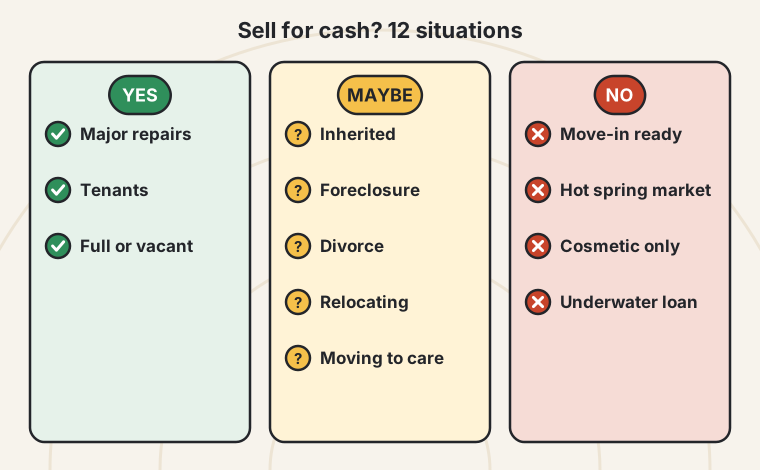
| Your situation | Sell for cash? | Why |
|---|---|---|
| Move-in ready, no deadline | No | Listing usually nets more; a cash offer would need about 93% of the price to match |
| Spring market, house shows well | No | Median 28 days on market in May 2026; competition works for you |
| Light cosmetic work only | Usually no | An as-is listing reaches financed buyers who will take paint and carpet |
| Owe more than it is worth | No | A cash sale cannot close below your payoff; you need your lender |
| Major repairs a lender will not finance | Yes | The buyer pool without cash is tiny; repairs cost you up front |
| Tenants, especially non-paying | Usually yes | Showings, inspections and evictions slow a listing; landlords buy with tenants in place |
| Full of contents, or vacant and costing money | Usually yes | Cleanout and monthly carrying costs can erase the listing premium |
| Inherited, estate in probate | Maybe | Yes if heirs are far away or the house needs work; list if it is clean and someone can manage it |
| Behind on payments, foreclosure filed | Maybe | Help first (mediation, servicer); cash protects equity when Law Day is close |
| Divorce | Maybe | Cash ends a deadlock fast; listing nets more if you can cooperate for months |
| Relocating on a fixed date | Maybe | Depends on how many weeks you have and whether you can carry two homes |
| Moving to assisted living or downsizing | Maybe | Depends on the house’s condition and who can manage a listing |
The rest of this page explains each row. If you want the money comparison in detail, our cash buyer vs. realtor guide runs it on a real Connecticut house. If you are still deciding whether to sell at all, start with should I sell my house in Connecticut.
What three questions decide whether a cash sale makes sense?
Three questions decide whether a cash sale makes sense: can a buyer’s lender finance the house as it is, how many weeks do you have before you must be out or paid, and do you have the money and energy to run a listing for about three months. Two “no” answers usually point to cash; three “yes” answers almost always point to listing.
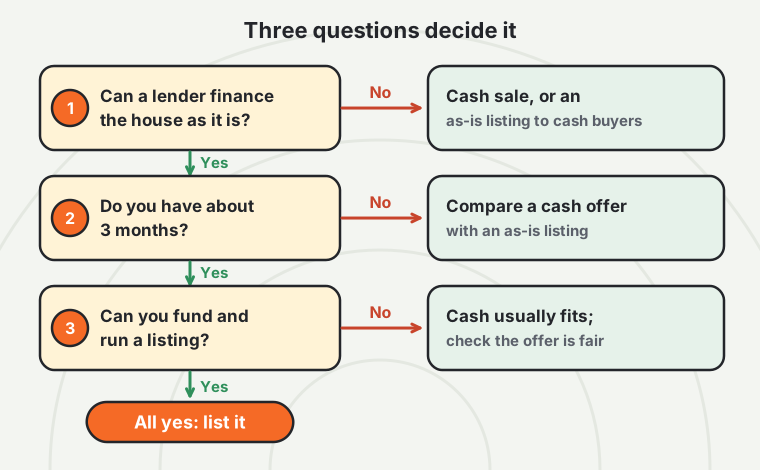
- Can a lender finance it? Most buyers use a mortgage, and the lender’s appraiser checks the house. A failing roof, missing kitchen, active leak, unsafe electrical, failed septic or a crumbling foundation can stop the loan. If lenders will not finance it, your buyers are mostly cash buyers either way.
- How many weeks do you have? A Connecticut listing typically means a few weeks of preparation, a median 41 days on market (September 2026) and 30 to 45 days from contract to closing (est.), about three months in all. A cash sale with us usually takes about two weeks, or a date you choose.
- Can you run a listing? That means paying the mortgage, taxes, insurance and utilities meanwhile, preparing and cleaning the house, keeping it ready for showings, and handling inspection requests. If you live out of state, are grieving, are ill or simply exhausted, that capacity is a real cost.
Everything a cash buyer offers, no repairs, no showings, no lender, a date you pick, is a substitute for one of those three. If you do not need the substitute, do not pay for it.
When does selling your house for cash make sense?
Selling your house for cash makes sense when the house needs repairs that block financing, when tenants make showings and inspections hard, or when the house is full of belongings or sitting vacant and costing money each month. In these situations the listing premium shrinks, and the work and risk of listing grow.
The house needs major repairs a lender will not finance
This is the clearest yes. If a buyer’s lender will not finance the house, your listing buyers are mostly cash investors anyway, but now with months of carrying costs and showings added. Fixing first can work if you have the cash and the time, but you pay contractors up front and carry the house while they work. Connecticut has its own version of this problem in north-central and eastern towns: pyrrhotite crumbling foundations, covered in our guide to selling a house with a crumbling foundation. Our page on selling a house that needs repairs explains how we buy these, and selling a house as-is in Connecticut covers the as-is listing alternative.
Tenants live there, especially ones who do not pay
Listing a rented house means coordinating showings around tenants, hoping they cooperate with the buyer’s inspector and appraiser, and often waiting for leases to end. With a non-paying tenant, you may face a summary process eviction before an owner-occupant buyer can move in. Landlord buyers buy with tenants in place and take over the leases and security deposits at closing. See selling a rental with tenants and the landlord’s guide to selling a rental with tenants in Connecticut.
The house is full, or empty and costing you
A house packed with decades of belongings needs a cleanout before it can be photographed, which takes weeks and thousands of dollars (est.). An empty house costs taxes, insurance, heat and utilities every month and needs checking in winter. A cash buyer takes the house with whatever you leave behind. Our guides to selling a hoarder house and selling a vacant house go into each.
When is selling for cash a “maybe”?
Selling for cash is a “maybe” when the situation is hard but the house itself is sellable: an inherited house in probate, a foreclosure with equity, a divorce, a relocation on a fixed date, or a move to assisted living. The answer turns on the house’s condition, how many weeks you have and who is able to manage a listing.
You inherited the house
An executor or administrator can sell estate real estate during probate with the court’s authority (CGS 45a-164), and fiduciaries are exempt from the condition report (CGS 20-327b). If the house is clean, sound and someone local can manage a listing, list it: heirs share more money. If heirs live out of state, the house needs work or is full of a parent’s belongings, or the family needs one written number to agree on, cash fits better. Our probate guide, selling an inherited house in Connecticut, covers the court steps; our inherited house page explains how we buy estate houses and wait for the court.
You are behind on payments or a foreclosure has been filed
Help comes first. Connecticut runs a foreclosure mediation program for owner-occupied homes (CGS 49-31l), and your servicer may offer a modification or repayment plan. If those fail and you have equity, selling before Law Day protects it: in a strict foreclosure, title passes to the lender once the redemption period runs out, and it is very hard to undo after that (CGS 49-15). A listing works if you have months; a cash sale works when Law Day is weeks away. See our Connecticut foreclosure guide first, and selling a house before foreclosure if you decide to sell.
Before you sell a house in foreclosure, talk to a HUD-approved housing counselor (free) and ask the court about the foreclosure mediation program (jud.ct.gov/foreclosure). A real buyer never charges you a fee, never asks you to sign your deed over before closing, and never asks you to stop talking to your lender.
You are divorcing
If you both agree and can cooperate through showings and an inspection for three months, list: more money for both of you. If you cannot agree, a written cash number can break the deadlock, and if one spouse refuses to sell, the court may order the sale (CGS 46b-81). A buyer needs both signatures or a court order either way. See selling a house during a divorce in Connecticut and our divorce sale page.
You are relocating on a fixed date
If your start date is four months or more away and the house shows well, list it before you go. If it is weeks away, or you cannot carry two housing payments, compare a cash offer with an as-is listing you manage from afar. Our relocation guide covers remote closings, and the relocation page explains how we close on your date.
You or a parent are moving to assisted living or downsizing
Often the house is sound but dated and full, and the person who owns it cannot manage a listing. If family can run it, list. If not, or if the move date is fixed by a facility, cash removes the cleanout and the waiting. Our guide to downsizing in Connecticut walks through both.
When should you not sell your house for cash?
You should not sell your house for cash when it is move-in ready and you have two or three months, when the market is busy and your house shows well, when it needs only light cosmetic work, or when you owe more than it is worth. In the first three, listing usually nets more; in the last, no cash buyer can solve the problem without your lender.
Your house is move-in ready and you have time
Individual buyers, whether they pay cash or use a mortgage, pay market value for a house in market condition. An investor cannot, because it must subtract its costs and margin. On a $395,000 move-in-ready house, our direct sale vs. agent guide works out that a cash offer would need to reach about $369,063 just to match the listing net. Investor offers on that house are rarely close.
The market is busy and your house shows well
Connecticut houses sold in a median 28 days on market in May 2026 and 41 in September 2026, according to Realtor.com data on FRED. When buyers compete, the listing premium grows. Our guide to the best time to sell a house in Connecticut shows the seasonal pattern.
The house only needs paint, carpet and fixtures
Cosmetic work does not stop a mortgage. An as-is listing reaches the large pool of financed buyers who are happy to paint. Our 13 low-cost fixes shows which small jobs are worth doing first.
You owe more than the house is worth
A cash sale has to pay off your mortgage at closing. If no buyer will pay enough, you need the lender’s agreement to a short sale, or another loss-mitigation option. Our guide to short sale vs. foreclosure in Connecticut explains how that works.
We will tell you when listing is the better route for your house. It often is.
How much does choosing cash cost you?
Choosing cash costs you the gap between a fair cash offer and your listing net, minus what listing would have cost you in repairs, carrying and risk. On a move-in-ready $395,000 house that gap is large; on a house needing $40,000 of work, a fair cash offer still netted about $67,552 less than an as-is listing in our example, but only if a lender would finance it.
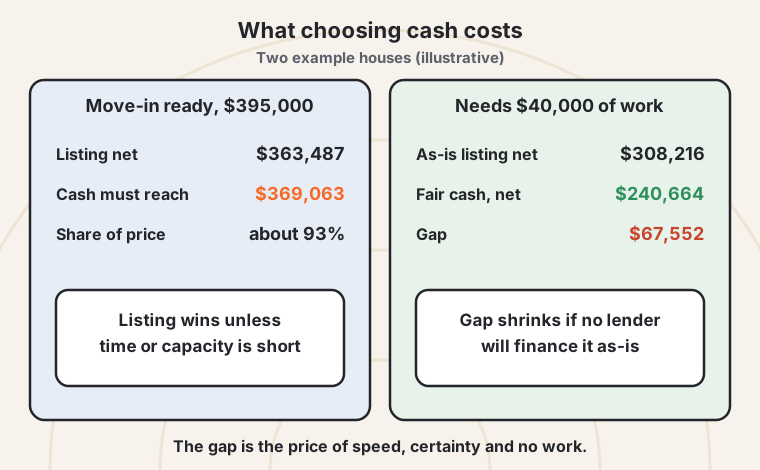
| Example house (illustrative) | Listing net | Cash | What decides it |
|---|---|---|---|
| Move-in ready, $395,000 | About $363,487 after about 3 months | Offer must reach about $369,063 to match | Listing wins unless time or capacity is the problem |
| Needs $40,000, worth $395,000 fixed | About $308,216 as-is, 4 months | About $240,664 from a fair $245,000 offer, 2 weeks | Whether a lender will finance it as-is, and whether you can wait |
Three costs of listing do not show up in a simple comparison, and they are why the gap can be smaller than it looks:
- Carrying. On the example house, property tax, insurance and utilities run about $1,371 a month (est.), plus your mortgage.
- Failed deals. A financed buyer’s appraisal or inspection can reopen the price or end the contract, and the clock restarts.
- Your time and stress. Not a dollar figure, but real if you are an executor three states away or living through a divorce.
Before you accept any cash offer, check it. Our step-by-step guide to whether your cash offer is fair rebuilds the buyer’s math from state sales data, and our guide to the types of cash home buyers explains why a landlord, a flipper and a wholesaler will offer different numbers on the same house. How each offer is built is laid out once in our Connecticut cash home buyers guide.
How much would you walk away with?
Slide the numbers to match your house. It works in your browser; nothing is saved or sent.
Estimates for planning. Conveyance tax per CGS 12-494 (state 0.75% up to $800,000, 1.25% to $2.5M, 2.25% above, plus the town rate). Seller attorney about $1,200 to $1,500; flat-fee MLS about $400; listings include three months of taxes, insurance and utilities, a cash sale about two weeks. Your attorney gives you the final numbers.
How does your deadline change the answer?
Your deadline changes the answer because a Connecticut listing takes about three months from preparation to closing, while a cash sale usually closes in about two weeks or on a date you choose. If you must be out or paid in under two months, listing becomes a gamble; with four months or more, the deadline alone is not a reason to sell for cash.
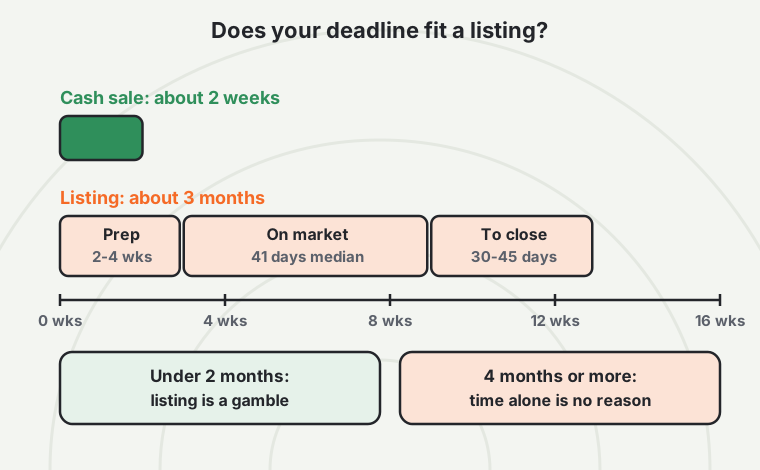
| Time until you must be out or paid | What usually fits |
|---|---|
| Under 1 month | Cash sale; a listing cannot realistically close |
| 1 to 2 months | Cash, or a listing priced to sell fast if the house is ready |
| 2 to 4 months | Listing if the house is ready; compare both if not |
| 4 months or more | Listing, unless condition, tenants or capacity point to cash |
Remember the deadline can be one you set, not only one set for you. “I cannot face another winter heating this empty house” is a deadline too.
How do you test both routes before deciding?
You test both routes before deciding by getting one listing opinion and one or two written cash offers in the same week, turning each into a net, and comparing those nets against your deadline and capacity. It costs nothing, commits you to nothing, and replaces a guess with two real numbers.
Answer the three questions
Lender, time, capacity. Write the answers down; they are your criteria.
Get a listing opinion
Ask one local agent what the house would sell for as-is and after obvious repairs, and how long it would take.
Get one or two written cash offers
From buyers who close in their own name. Ask each for its after-repair value and repair list.
Turn both into nets
Subtract commission, the conveyance tax (1% in most towns, CGS 12-494), attorney, repairs and carrying from each. Use the calculator above.
Decide with your attorney
Pick the route that fits your criteria, and have your own Connecticut attorney read any contract before you sign. Every closing is conducted by an attorney (CGS 51-88a).
If you want our number as one of the two, we can start from photos. A typical sale with us takes about two weeks, or the date you choose; there are no repairs, no showings and no fees, and you leave behind what you do not want.
Is a cash sale right for you, or should you list?
Seven quick questions. There is no wrong answer, and we will tell you honestly if listing would leave you more.
- Does the house need repairs you would rather not pay for or manage?
- Do you need to close by a certain date, or within the next month or two?
- Would showings be hard: tenants, belongings, privacy, or you live out of state?
- Is there a complication: an estate or probate, a divorce, foreclosure, liens or back taxes?
- Could you comfortably cover the mortgage, taxes and utilities for three or more months?
- Is getting the highest possible price more important to you than speed and certainty?
- Would a buyer's bank lend on the house as it is (no major roof, foundation, oil tank or code issues)?
Get your cash offer
without anyone coming over.
Want your offer faster, or rather not talk to anyone yet? Send a few phone photos of each room. We price the repairs from them, line by line, and send your cash offer back, so you see a real number before you ever meet us or pick up the phone.
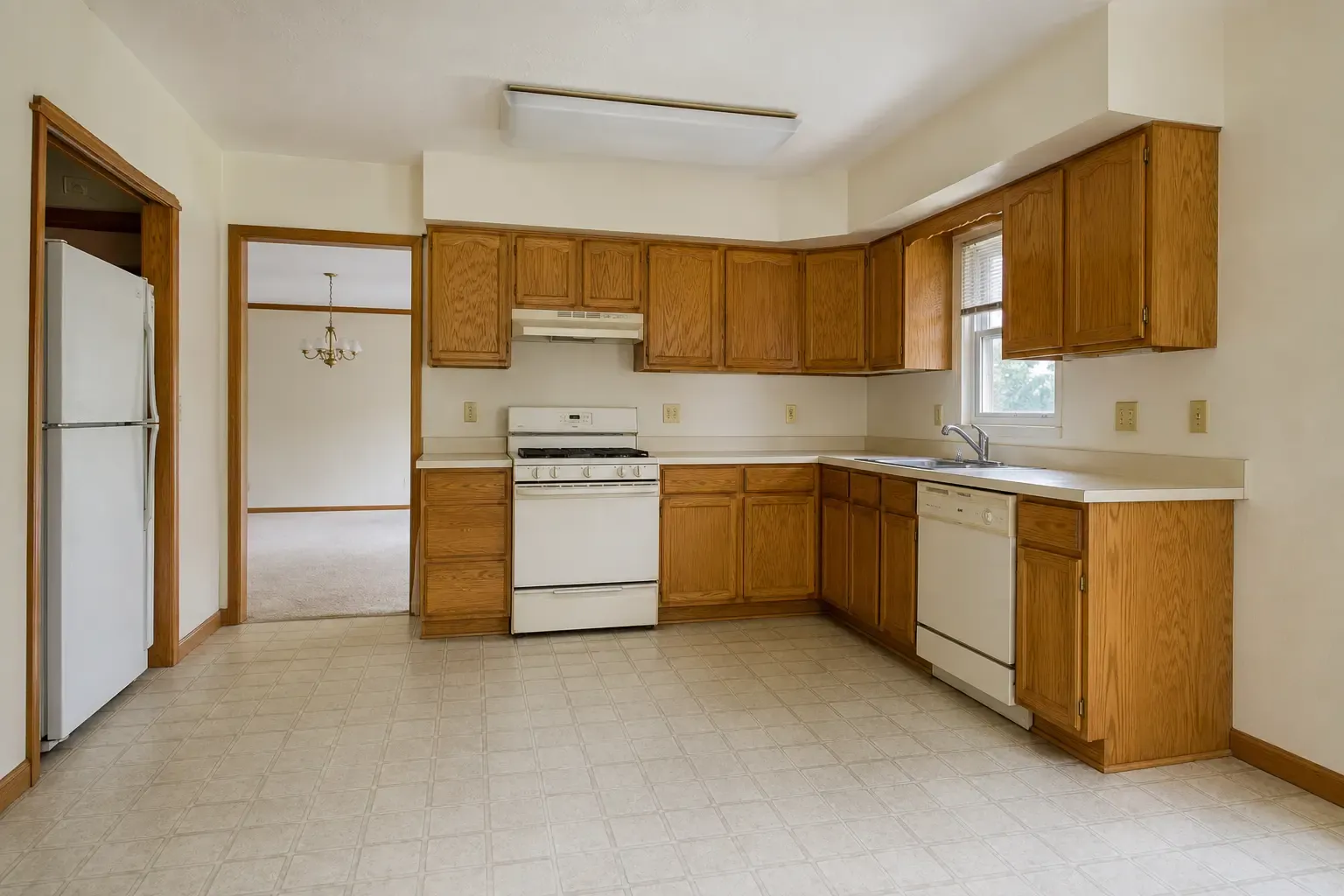 CabinetsFlooring
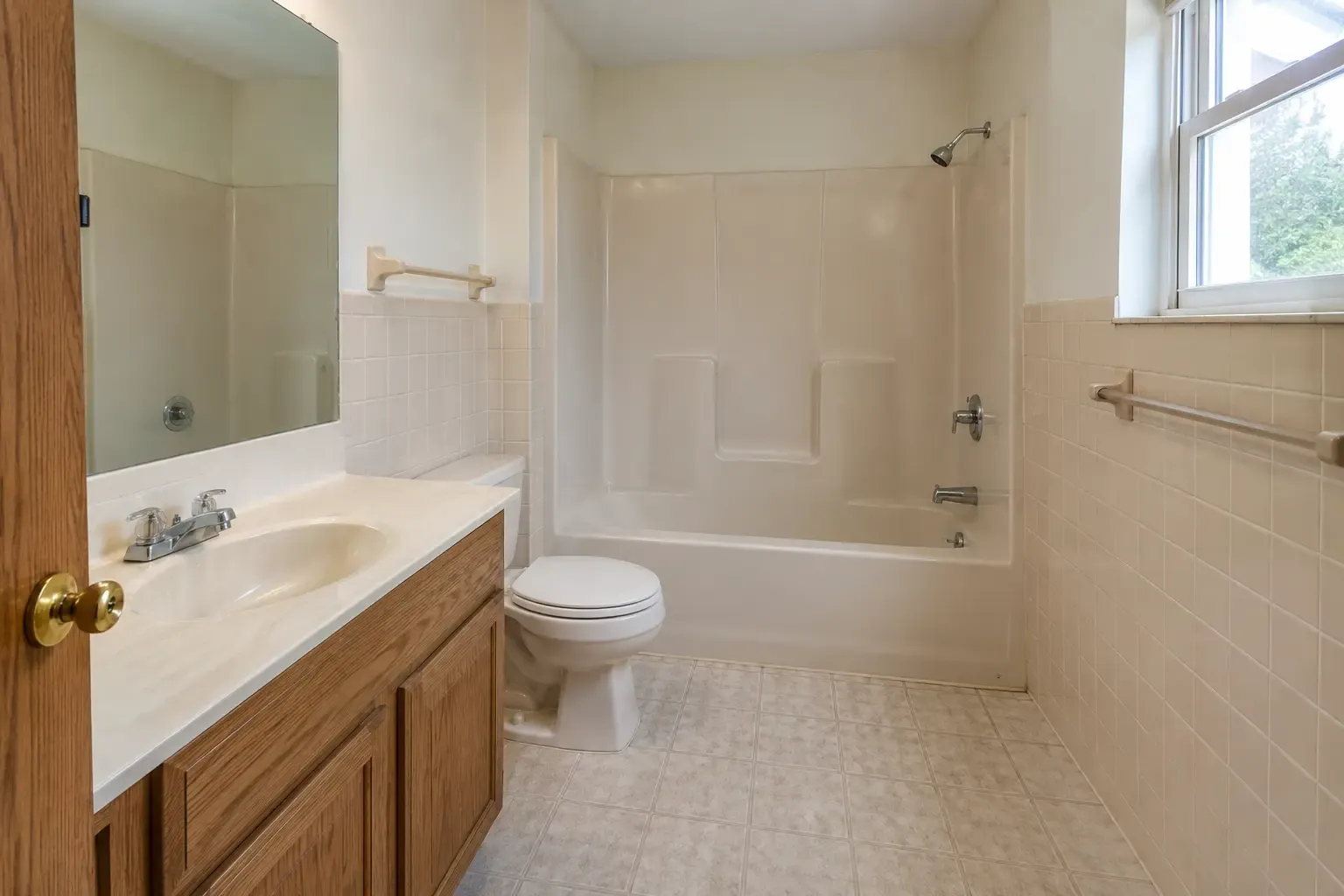 Tub & tile
 Floors
 Roof
We may bring in a partner buyer to close. Your price and terms don't change.
Questions about selling your house for cash in Connecticut
Should I sell my house for cash or list it?
You should sell your house for cash if a lender will not finance it, your deadline is weeks away, or tenants, an estate or a cleanout make listing hard. You should list it if it is move-in ready and you have two or three months, because listing usually nets more.
Is selling a house for cash a good idea?
Selling a house for cash is a good idea when speed, certainty and no repairs are worth more to you than the price difference, which is usually true for houses with serious problems or owners with hard deadlines. For a house in good condition with time to sell, it usually is not.
How much less will I get if I sell for cash?
How much less you get if you sell for cash depends on the house’s condition: little or nothing extra is lost on a house no lender will finance, and a lot on a move-in-ready house. On an illustrative $395,000 ready house, a cash offer would need about $369,063 to match the listing net.
Why would anyone sell their house for cash?
People sell their house for cash to avoid repairs they cannot fund, to close on a fixed date, to sell with tenants or belongings inside, to settle an estate or divorce, or to stop the monthly cost of an empty house. Each replaces a lender, time or work they do not have.
Can I sell my house for cash if I still have a mortgage?
Yes, you can sell your house for cash if you still have a mortgage; the closing attorney pays off the loan from the sale proceeds. If you owe more than the cash price, the sale needs your lender’s approval as a short sale.
Can I sell an inherited house for cash before probate is finished?
Yes, you can usually sell an inherited house for cash before probate is finished, because the probate court may authorize a fiduciary’s sale of real estate after notice and a hearing (CGS 45a-164). The buyer waits for that authority before closing.
Is it too late to sell for cash if my house is in foreclosure?
It is not too late to sell for cash if your house is in foreclosure until title becomes absolute after Law Day (CGS 49-15). Talk to a HUD-approved counselor and ask about Connecticut’s foreclosure mediation program first; if those fail, a sale before Law Day can protect your equity.
Do I need a real estate agent to sell for cash?
No, you do not need a real estate agent to sell for cash, but you do need a Connecticut attorney, because only an attorney may conduct the closing (CGS 51-88a). An agent’s free pricing opinion is still useful to compare against the cash offer.
Do I still need the condition report if I sell for cash?
Yes, you still need the property condition report if you sell for cash, or you credit the buyer $500 at closing (CGS 20-327b, 20-327c). Executors and other fiduciaries are exempt. You also sign the smoke and carbon monoxide affidavit at closing (CGS 29-453).
How fast can I sell my house for cash in Connecticut?
You can usually sell your house for cash in Connecticut in about two weeks with us, from first call to closing, mostly the time the attorneys need for title, payoff and the deed. You can also pick a later date if you need time to move.
Will a cash buyer tell me if listing is better?
A good cash buyer will tell you if listing is better, and you can test it yourself with one listing opinion and a net comparison. We say so when it is true, and on most move-in-ready houses it is.
Related Connecticut guides
Cash offers
We buy houses all over the state; see where we buy houses in Connecticut. For every route, step and cost, start with how to sell a house in Connecticut.
Plain-English information, not legal or financial advice. If you are facing foreclosure, divorce or probate, talk to a Connecticut attorney about your case.
See the house together.
Pick a time that works.
Choose a time for us to walk through the property with you, or ask for a quick call first. We confirm every request personally.
Tuesday, January 13
No open times in the next few weeks. Please call us.
We will confirm by email. Nothing is booked until we do.
View my requestSources (checked on October 27, 2026)
- Realtor.com median days on market in Connecticut (FRED): 28 days May 2026, 41 days September 2026.
- Connecticut OPM, Real Estate Sales (data.ct.gov): median residential sale price October 2024 to September 2025.
- CGS §§ 49-15, 49-31l (opening strict foreclosure judgments; foreclosure mediation program).
- CGS § 45a-164 (probate court authority for a fiduciary’s sale of real property).
- CGS § 46b-81 (assignment of property and court-ordered sale in divorce).
- CGS §§ 20-327b, 20-327c (residential condition report and exemptions; $500 credit).
- CGS § 29-453 (signed smoke and carbon monoxide affidavit at closing, as amended by P.A. 23-164).
- CGS § 12-494 (conveyance tax).
- CGS § 51-88a (closings conducted only by Connecticut attorneys).
- Connecticut Judicial Branch: foreclosure mediation.
- HUD: find a HUD-approved housing counselor.

Who wrote this
Jerryll Noorden
Jerryll has bought and sold Connecticut houses since 2016 and has sat at more closing tables than he can count, on both sides. Before real estate he was a robotics scientist at NASA, IHMC and IIT. He wrote this guide because the national sites that rank for it skip the Connecticut rules that cost sellers money. When listing or selling it yourself would get you more than a cash offer, he says so.
This guide explains Connecticut rules in plain English. It is not legal or tax advice. Laws change; for your sale, talk to a Connecticut real estate attorney and a tax professional.
