
- The best time to list a Connecticut house is March through May. That puts your closing in June, July or August, the three busiest closing months in the state’s own sales records (31% of single-family closings in three years).
- Summer closings carry the highest median prices ($455,000 in summer vs. $379,000 in winter, statewide, Oct 2022 to Sep 2025). Most of that gap is which houses sell in summer, not a bonus on the same house.
- The same house sells for only about 2% to 4% more in early summer than in January (est.), after we control for town, assessment and the year’s price growth.
- Houses sell fastest in April and May. Connecticut’s median days on market fell to 28 to 29 days in April and May 2026 and rose to about 60 days in January (Realtor.com).
- Winter is slower, not dead. October through December still account for about a quarter of all closings, with fewer competing listings.
- Timing does not matter much for a cash sale, an estate, a foreclosure deadline or a vacant house that costs you every month. Then the date you need beats the month the market likes.
This guide uses Connecticut’s own recorded sales, not national averages, to answer one planning question: when should you put your house on the market? It is part of our guide on how to sell a house in Connecticut, and it shows the data month by month, statewide and for 23 Connecticut towns, along with the cases where the calendar should not decide for you.
When is the best time to sell a house in Connecticut?
The best time to sell a house in Connecticut is to list in March, April or May and close in June, July or August. Those three summer months hold 31% of the state’s single-family closings and the highest median sale prices. Houses also sell fastest in April and May. The price edge for the same house is small, about 2% to 4% (est.), so a good house priced right sells in any month.
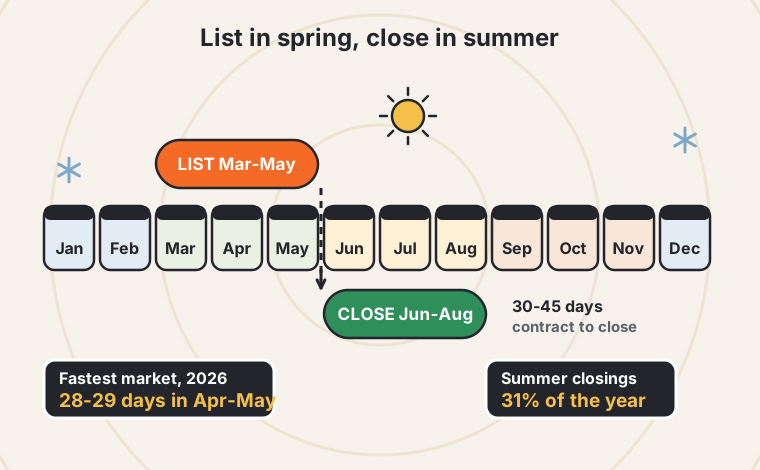
The question has two halves that most guides blur together: the month you list and the month you close. Connecticut’s public sales records show the date a deed was recorded, which is the closing. The deal behind it was usually signed 30 to 45 days earlier, and the house was usually listed a month or so before that. So “summer is the best time to sell” really means “spring is the best time to list”.
List March to May
Jun–Augclosing months
- Most buyers in the market
- Fastest days on market of the year
- Highest median prices
- Most competing listings too
List June to September
Sep–Novclosing months
- Still busy: fall is 27% of closings
- Families with school-age children mostly done
- Price cuts peak in late summer and fall
- Good for relocation buyers
List November to January
Jan–Marclosing months
- Fewest closings (February is the low point)
- Fewer competing listings
- Slowest days on market
- Snow, frozen ground, short days for photos
What does Connecticut’s sales data show, month by month?
Connecticut’s sales data shows a clear seasonal pattern, month by month. Single-family closings bottom out in February (5% of the year) and peak in July (10.8%). The median recorded price follows: $365,000 for January closings and $460,000 for June closings, statewide, across 64,175 arm’s-length single-family sales recorded from October 2022 through September 2025.
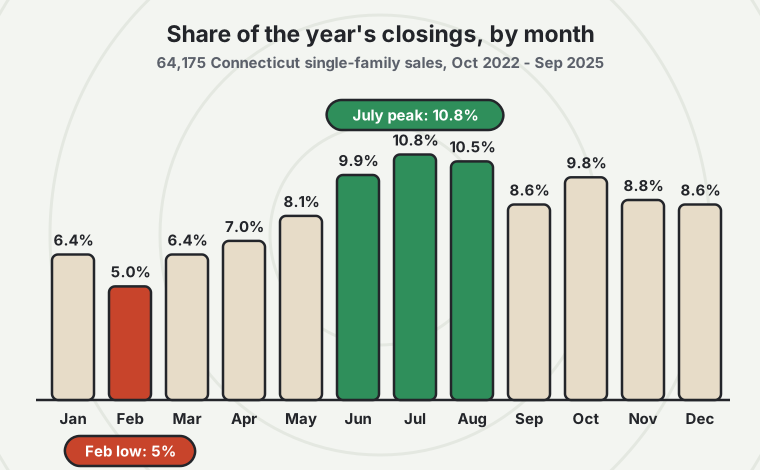
We pulled every single-family sale the state recorded in those three full sales years from the Office of Policy and Management’s real estate sales file on data.ct.gov, kept only arm’s-length sales (no family transfers, foreclosures, court orders or other “non-use” sales) of $30,000 or more, and counted them by the month the deed was recorded.
| Month recorded (closing) | Closings, 3 years | Share of the year | Median sale price | vs. 3-year median | Same-house index (est.) | Contract likely signed |
|---|---|---|---|---|---|---|
| January | 4,119 | 6.4% | $365,000 | −11.8% | −2.3% | Nov–Dec |
| February | 3,232 | 5.0% | $372,000 | −10.1% | −1.8% | Dec–Jan |
| March | 4,125 | 6.4% | $385,000 | −6.9% | −1.2% | Jan–Feb |
| April | 4,489 | 7.0% | $410,000 | −0.9% | +0.3% | Feb–Mar |
| May | 5,194 | 8.1% | $425,000 | +2.7% | +1.0% | Mar–Apr |
| June | 6,347 | 9.9% | $460,000 | +11.2% | +1.9% | Apr–May |
| July | 6,932 | 10.8% | $457,000 | +10.5% | +1.7% | May–Jun |
| August | 6,716 | 10.5% | $450,000 | +8.8% | +1.0% | Jun–Jul |
| September | 5,548 | 8.6% | $425,000 | +2.7% | −0.3% | Jul–Aug |
| October | 6,307 | 9.8% | $390,000 | −5.7% | +0.8% | Aug–Sep |
| November | 5,626 | 8.8% | $395,000 | −4.5% | 0.0% | Sep–Oct |
| December | 5,540 | 8.6% | $390,000 | −5.7% | −1.0% | Oct–Nov |
| All months | 64,175 | 100% | $413,700 |
How to read the table
- Closings tell you when buyers are active. More closings means more buyers competed for houses two months earlier.
- The median sale price is the middle price of the houses that closed that month. It rises in summer partly because bigger, pricier family homes close in summer.
- The same-house index strips most of that out. It is the better guide to what your house would gain or lose by waiting.
- The contract month is the month the deal was most likely signed. Back up one more month for the listing month.
Do Connecticut houses really sell for more in the summer?
Connecticut houses do sell for more in the summer, but by much less than the raw medians suggest. The median summer closing was $455,000 against $379,000 in winter, a 20% gap. After adjusting for the town, the house’s assessed value and the year’s price growth, the same house closing in June or July fetched only about 2% to 4% more than in January (est.). The rest is the mix of houses that sell in each season.
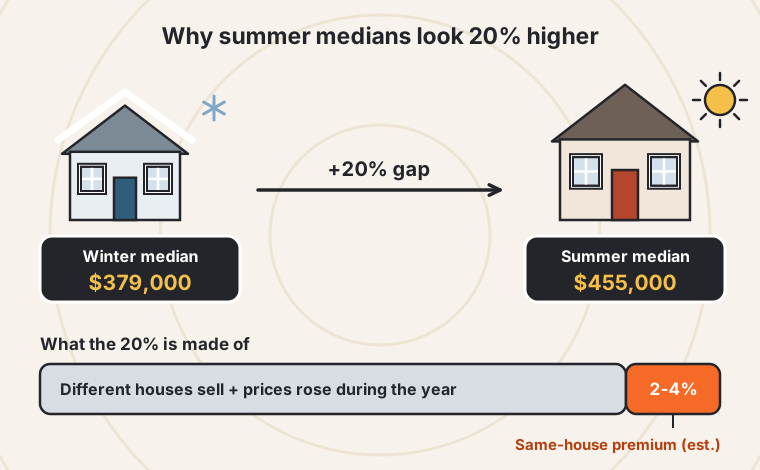
Three things push the summer median up, and only one of them is a real seasonal premium for your house:
- Mix. Families with school-age children buy in spring so they can move in summer. They buy bigger houses in pricier towns. West Hartford’s summer median is 27% above its winter median, and Fairfield’s is 30% higher. Those are not the same houses selling for more. They are different houses.
- Price growth during the year. Connecticut’s statewide median single-family price rose from $375,000 (Oct 2022 to Sep 2023) to $410,000 to $450,000 in the next two sales years, about 9% to 10% a year. A sale in July is several months “newer” than a sale in January.
- Competition among buyers. This is the real seasonal premium. More buyers in April and May means more multiple offers and fewer concessions. Our estimate puts it at about 2% to 4% between the weakest and strongest closing months.
On a $400,000 house, 2% to 4% is $8,000 to $16,000. That is real money, and it is worth planning for if you can. It is also smaller than the cost of several months of waiting for many owners, which we work out below.
Every Connecticut sale record includes the town’s assessed value, which is set for the same house before it sells. Comparing the sale price with the assessment, inside one town and one grand-list year, compares like with like: a $250,000 Cape and a $900,000 Colonial both show how far above or below “normal” they sold. Competitors’ “best month” figures usually compare raw averages, which mostly measures which houses sell when.
What is the best month to list a house in Connecticut?
The best month to list a house in Connecticut is usually April, with March and May close behind. A house listed in April meets the fastest market of the year: Connecticut’s median days on market was 29 days in April 2026 and 28 in May. With 30 to 45 days from contract to closing, an April listing typically closes in June or July, the strongest closing months in the state’s records.
Realtor.com publishes Connecticut’s median days on market every month (through the Federal Reserve Bank of St. Louis). It shows how long active listings have been on the market, so it is a good measure of how fast houses are moving in each season.
| Month | Median days on market, CT, 2025 | Median days on market, CT, 2026 | New listings, CT, 2026 | Listings with a price cut, CT, 2026 |
|---|---|---|---|---|
| January | 62 | 61 | 1,932 | 624 |
| February | 47 | 48 | 2,136 | 538 |
| March | 35 | 40 | 3,062 | 630 |
| April | 32 | 29 | 4,040 | 918 |
| May | 32 | 28 | 4,380 | 1,252 |
| June | 34 | 32 | 4,418 | 1,550 |
| July | 39 | 38 | 3,766 | 1,546 |
| August | 43 | 42 | 3,412 | 1,592 |
| September | 41 | 41 | 3,786 | 1,984 |
| October | 41 | n/a | n/a | n/a |
| November | 45 | n/a | n/a | n/a |
| December | 57 | n/a | n/a | n/a |
Two patterns stand out. First, houses move fastest in April and May, then slow steadily through the summer and fall, and stall around the holidays. Second, price cuts climb from about 600 a month in winter to nearly 2,000 in September 2026. Many of those are spring listings that were priced for a market that had already cooled. If you list in late summer, price for September’s buyers, not April’s.
A list-by calendar for Connecticut
| You want to close by | Sign a contract by (about) | List by (about) | Start prep by (about) |
|---|---|---|---|
| Late June | Mid-May | Mid-April | Early March |
| Mid-August (before school starts) | Early July | Early June | Late April |
| Late October | Mid-September | Mid-August | Early July |
| Before the holidays | Early November | Early October | Late August |
For a full step-by-step clock by route, see how long it takes to sell a house in Connecticut.
When is the worst time to sell a house in Connecticut?
The worst time to sell a house in Connecticut, on average, is to list between mid-November and early January. Those listings close in January through March, which hold the fewest closings (February is the low point at 5% of the year), the lowest recorded medians and, in 2025 and 2026, the slowest days on market (about 60 in January). Fewer competing listings partly make up for it.
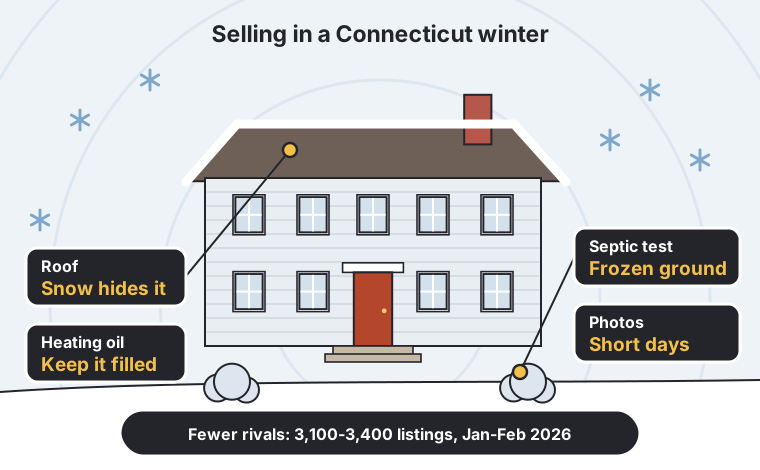
“Worst” is relative. Even the slowest quarter, January through March, still accounted for 11,476 single-family closings in the three years we studied. The buyers who look in winter tend to be serious: relocations, people whose leases end, investors and buyers who lost out in the fall. And they have less to choose from. Connecticut had about 3,100 to 3,400 active listings in January and February 2026, compared with 5,300 to 5,900 in late summer.
Selling in a Connecticut winter: what changes
- Inspections. Snow can hide a roof from the inspector, and septic inspections that need digging or a hydraulic load test are harder when the ground is frozen. Expect a buyer to ask for an escrow holdback or a re-inspection in spring.
- Heat and oil. A vacant house must stay heated. Keep the oil or propane tank filled; at closing the buyer reimburses you for the oil left in the tank, by Connecticut custom.
- Showings and photos. Days are short. Take photos on the brightest day you can, with every light on, and keep walks and the driveway clear for showings.
- Pipes. A burst pipe in a vacant house is the classic winter disaster. Keep the heat at a safe level and have someone check the house.
Is the best time to sell different in my Connecticut town?
The best time to sell is a little different in each Connecticut town. Summer is the busiest closing season in every one of the 23 larger towns below, but the size of the swing varies. Family suburbs such as West Hartford, Southington, Westport and Fairfield do 34% to 35% of their closings in summer; cities such as Bridgeport and Waterbury spread sales more evenly, at about 26%.
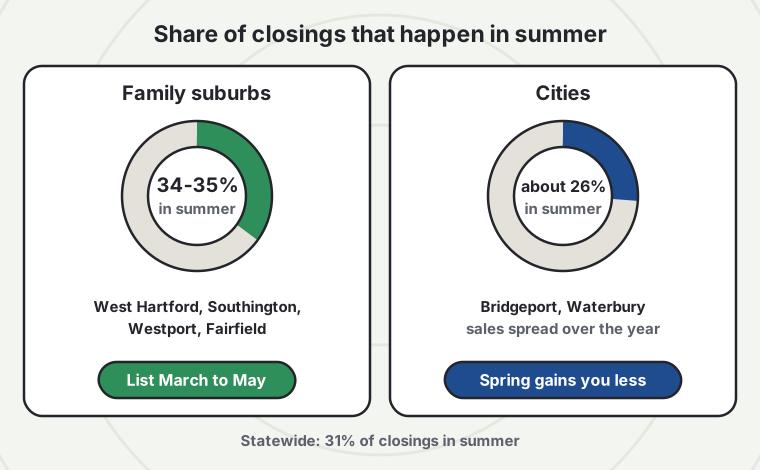
Monthly samples in a single town are too small to read reliably (a few dozen sales a month), so this table pools the same three years by season. The summer-vs-winter column compares raw medians, so it includes the mix effect explained above.
| Town | Single-family sales (3 yrs) | Winter share (Dec–Feb) | Spring share (Mar–May) | Summer share (Jun–Aug) | Fall share (Sep–Nov) | Median, all | Median, winter closings | Median, summer closings | Summer vs. winter |
|---|---|---|---|---|---|---|---|---|---|
| Bridgeport | 1,376 | 24% | 23% | 26% | 27% | $353,500 | $340,000 | $370,000 | +9% |
| Bristol | 992 | 20% | 23% | 29% | 28% | $325,000 | $310,000 | $351,500 | +13% |
| Danbury | 709 | 21% | 18% | 31% | 30% | $475,000 | $460,000 | $490,000 | +7% |
| East Hartford | 909 | 24% | 24% | 28% | 25% | $265,000 | $255,000 | $279,000 | +9% |
| Enfield | 1,133 | 23% | 21% | 29% | 27% | $295,000 | $280,000 | $310,000 | +11% |
| Fairfield | 1,342 | 19% | 23% | 34% | 24% | $910,300 | $810,000 | $1,050,000 | +30% |
| Hamden | 1,394 | 21% | 24% | 32% | 23% | $345,000 | $320,000 | $375,000 | +17% |
| Hartford | 542 | 22% | 25% | 29% | 24% | $255,000 | $245,900 | $275,000 | +12% |
| Manchester | 1,159 | 20% | 21% | 28% | 31% | $305,000 | $287,000 | $325,000 | +13% |
| Meriden | 1,215 | 24% | 21% | 29% | 26% | $300,000 | $275,000 | $320,000 | +16% |
| Milford | 1,301 | 21% | 23% | 31% | 26% | $490,000 | $450,000 | $512,500 | +14% |
| Naugatuck | 813 | 22% | 21% | 27% | 30% | $315,000 | $305,000 | $330,000 | +8% |
| New Haven | 902 | 21% | 22% | 32% | 25% | $320,000 | $295,000 | $350,000 | +19% |
| Norwalk | 1,560 | 18% | 24% | 31% | 27% | $700,000 | $667,500 | $737,450 | +10% |
| Norwich | 751 | 22% | 21% | 28% | 29% | $260,000 | $260,000 | $275,000 | +6% |
| Shelton | 883 | 21% | 23% | 29% | 27% | $505,000 | $470,000 | $535,000 | +14% |
| Southington | 1,137 | 19% | 19% | 35% | 26% | $390,000 | $375,000 | $410,000 | +9% |
| Stamford | 1,831 | 18% | 23% | 34% | 25% | $855,000 | $803,500 | $915,000 | +14% |
| Stratford | 1,284 | 21% | 22% | 29% | 29% | $415,000 | $400,000 | $455,000 | +14% |
| Trumbull | 682 | 22% | 22% | 30% | 26% | $575,000 | $526,500 | $625,000 | +19% |
| Waterbury | 1,613 | 24% | 23% | 26% | 27% | $269,000 | $255,000 | $282,600 | +11% |
| West Hartford | 1,662 | 18% | 21% | 34% | 27% | $480,000 | $425,000 | $540,000 | +27% |
| Westport | 944 | 18% | 21% | 35% | 25% | $1,850,000 | $1,674,500 | $1,920,960 | +15% |
| Connecticut (all towns) | 64,175 | 20% | 22% | 31% | 27% | $413,700 | $379,000 | $455,000 | +20% |
What the town pattern means for you
- Family suburbs (West Hartford, Fairfield, Westport, Southington, Stamford): the spring rush is strong. If your house is a family home near good schools, a March to May listing matters most.
- Cities with lots of investors and first-time buyers (Bridgeport, Waterbury, East Hartford, Norwich): sales are spread across the year. Waiting for spring gains you less.
- Fall-heavy towns (Manchester, Naugatuck, Norwich, Danbury, Stratford): fall closings match or beat summer. A June to August listing works well there.
What Connecticut-specific factors affect when you should sell?
The Connecticut-specific factors that affect when you should sell are the school calendar, winter weather and heating, inspections that are harder on frozen ground, the property tax calendar (towns assess property as of October 1 and tax it in arrears) and, for some sellers, deadlines from a probate court, a divorce or a foreclosure. National “best month” articles skip most of these.
- The school year. Families want to buy in spring and move in July or August. That is the main reason summer closings run high in towns like West Hartford and Fairfield.
- Heating fuel. Many Connecticut houses heat with oil (three-quarters or more of single-family homes in towns such as Bristol, Ledyard and Newtown, according to the assessor data behind our town pages). A winter sale means a full tank to manage and an oil adjustment at closing.
- Inspections. Septic, well, radon and roof inspections are easier in spring and summer. A frozen ground or a snow-covered roof can delay a winter deal or lead to a holdback.
- Property taxes. Connecticut towns value property as of October 1 and collect taxes in arrears; at closing the attorneys prorate the tax by day, and the seller usually credits the buyer. The proration does not change with the season you sell in; it simply follows the calendar. Ask your attorney for a projected closing statement early.
- Coastal and lake towns. Shoreline houses in towns like Old Saybrook, Madison and Westbrook draw summer buyers who want to see the water at its best.
Should I wait for spring or sell my Connecticut house now?
You should wait for spring to sell your Connecticut house only if the house is ready, you can afford the months in between, and the gain is bigger than the cost of waiting. The seasonal premium for the same house is about 2% to 4% (est.). On a $350,000 house that is $7,000 to $14,000, while four months of property tax, insurance, utilities and mortgage interest can run $6,000 to $12,000 or more.
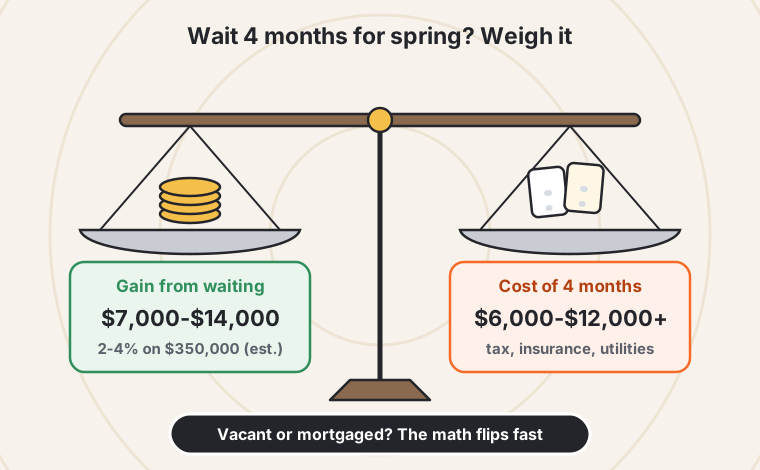
Here is the math for waiting four months, from November to March, on a few Connecticut houses. Property taxes are from each town’s fiscal 2027 mill rate and median single-family price; the rest are estimates.
| Town (median single-family price) | Property tax per month | Insurance, utilities, upkeep per month (est.) | Four months of waiting (est.) | 3% seasonal gain on the median (est.) |
|---|---|---|---|---|
| Hartford ($260,000; mill rate 69.95) | $1,060 | $500 | $6,240 | $7,800 |
| Hamden ($355,000; 53.67) | $1,110 | $550 | $6,640 | $10,650 |
| Waterbury ($280,000; 43.34) | $710 | $500 | $4,840 | $8,400 |
| West Hartford ($520,000; 46.77) | $1,420 | $650 | $8,280 | $15,600 |
| Bridgeport ($383,500; 27.95) | $620 | $550 | $4,680 | $11,500 |
For an owner who lives in the house and would pay those bills anyway, waiting for spring usually makes sense if the house is ready. For a vacant house, an inherited house, a second mortgage payment or a house you cannot keep up, the math flips quickly. Add a mortgage payment of $1,500 a month and four months of waiting costs $10,000 to $14,000 before you have gained anything.

The sellers who regret their timing rarely regret listing in the “wrong” month. They regret waiting for a perfect month while an empty house sat cold, the taxes kept coming and a small leak became a big one. If the house is ready and you can afford to wait for April, wait. If every month costs you real money or real worry, the calendar is the wrong thing to optimize.
See your own numbers, month by month
A free Home Forecast estimates your likely sale price from recent sales near you, how long each route would take, and what you would net if you listed now, in spring, or sold for cash. It follows your market, so you can choose your timing with real numbers.
Know where you stand,
on your own time.
Watch what homes around you sell for and how fast, so when you are ready, you already know your options.
Follow your numbers as the market moves, and decide when the timing is right.
When does the time of year not matter when selling a Connecticut house?
The time of year does not matter much when you sell a Connecticut house for cash, sell an estate on a probate timeline, face a foreclosure deadline, sell during a divorce under a court schedule, or own a vacant house that costs you every month. In those cases the date you need, and the certainty of closing, outweigh a 2% to 4% seasonal premium.
A cash sale
A cash buyer does not need a mortgage commitment or a bank appraisal, and buys the house as it is. The season changes almost nothing: a cash closing can happen in about two weeks in January or July, and on the date you choose. A cash offer is usually below what a ready house would bring on the open market, because the buyer takes on the repairs and the risk. Compare the two honestly with our cash buyer vs. realtor comparison.
An estate in probate
An executor’s timing is set by the Probate Court, the will and the heirs, not by the spring market. The house must be insured, heated and maintained while the estate is open, and vacant houses are harder and costlier to insure. If the house needs work, waiting for spring may only mean carrying it longer. See our guide to selling an inherited house in Connecticut.
A foreclosure deadline
Connecticut mostly uses strict foreclosure: if the court sets a Law Day and it passes without the debt being paid, the lender takes the title. You can still sell the house before that date, but the court’s calendar runs whatever the season. Do not wait for spring if your Law Day is in March. See selling a house in foreclosure in Connecticut and talk to an attorney or a HUD-approved housing counselor.
Divorce, relocation and health
A job start date, a court order in a divorce, or a move to care for a parent sets the date for you. In these cases, plan backwards from the date you need: list early enough to close on time, or line up a buyer who can close on your date.
A house that needs major work
A house with a failing roof, an underground oil tank, a septic problem or a crumbling foundation sells to a smaller pool of buyers in every season, because many lenders will not finance it. Waiting for spring does not grow that pool much. Read what to fix before selling a house in Connecticut before you decide.
Whatever the season, a legitimate buyer, agent or cash buyer gives you time to read an offer, have an attorney look at it and compare it with other options. If anyone pressures you with an exploding deadline or asks you for a fee up front, walk away.
How do you get ready to sell in the best season?
To get ready to sell in Connecticut’s best season, start six to ten weeks before you list: hire your attorney, pull recent sales near you, order any inspections you want (septic, radon, oil tank), fix what lenders and inspectors flag, fill in the state disclosure forms and book photos for a bright day. Then list in March to May, priced from current sales, not last year’s.
Ten weeks out: decide your route and your number
Decide whether you will list with an agent, sell by owner or sell for cash, and get a payoff estimate from your lender. Use the Connecticut closing cost guide to estimate what you will net.
Eight weeks out: hire a Connecticut real estate attorney
Connecticut closings are run by attorneys. Hiring yours early means title problems, estate paperwork or an old unreleased mortgage get fixed before they can delay a spring closing.
Six weeks out: inspect and fix what matters
Pump the septic and keep the receipt, test for radon, find out whether an old oil tank is buried in the yard and get a contractor’s letter if one was removed. Fix leaks, broken heat and safety items. Skip remodels.
Four weeks out: paperwork
Complete the Residential Property Condition Report (the version in effect since July 1, 2025, which added a flood section), and the lead paint disclosure for homes built before 1978. In crumbling-foundation towns, answer the report’s foundation questions carefully. See the first-time home seller checklist for Connecticut for every form.
Two weeks out: photos and price
Shoot photos on a bright day as soon as the snow is gone and the lawn has greened, if you can. Price from the newest closed sales near you; Connecticut prices rose by roughly 9% to 10% a year from 2022 to 2025, so a sale from a year ago can be far off.
List and respond fast
In April and May the median house goes under contract in about a month. Answer every inquiry the same day, make showings easy and review offers on net, not price (see how to compare offers on a house in Connecticut).
Questions Connecticut owners ask about the best time to sell
What is the best month to sell a house in Connecticut?
The best month to sell a house in Connecticut is June or July for the closing, which means listing in April or May. June and July closings had the highest median prices ($460,000 and $457,000 statewide, Oct 2022 to Sep 2025) and July had the most closings. April and May listings sold fastest in 2026.
What is the worst month to sell a house in Connecticut?
The worst month to sell a house in Connecticut, on average, is a listing in December that closes in February. February has the fewest closings (5% of the year) and among the lowest recorded medians. Fewer competing listings make winter better than its reputation for a well-priced house.
Do houses sell for more in the spring in Connecticut?
Houses listed in spring in Connecticut sell for a little more, because they close in summer when buyer competition peaks. For the same house, the gain is about 2% to 4% (est.) over a January closing. The much larger gap in raw medians mostly reflects the bigger, pricier homes that sell in summer.
Is fall a good time to sell a house in Connecticut?
Yes, fall is a good time to sell a house in Connecticut. September through November hold about 27% of the state’s single-family closings, second only to summer, and in towns such as Manchester, Naugatuck and Norwich fall closings match or beat summer. Price for the cooler market, since price cuts peak in September.
Is it bad to sell a house in winter in Connecticut?
It is not bad to sell a house in winter in Connecticut, only slower. January days on market ran about 60 in 2025 and 2026, versus about 30 in spring. You face fewer competing listings and serious buyers. Plan for snow-covered roofs, frozen-ground septic checks and heating a vacant house.
How long does it take to sell a house in Connecticut in the spring?
In the spring, a well-priced Connecticut house typically goes under contract in about a month (median days on market was 28 to 29 in April and May 2026), then takes 30 to 45 days to close with a mortgage buyer. Expect about two to three months from listing to closing.
When should I list my house to close before school starts?
To close before school starts in late August, list your Connecticut house by about early June and sign a contract by early July. Earlier is safer: an April or May listing gives you time for a second buyer if the first deal falls through.
Where does this Connecticut sales data come from?
This Connecticut sales data comes from the Office of Policy and Management’s real estate sales file on data.ct.gov (dataset 5mzw-sjtu), which lists every recorded sale of $2,000 or more by town. We used arm’s-length single-family sales of $30,000 or more recorded from October 2022 through September 2025.
Why are the recorded months later than the listing months?
The recorded months are later than the listing months because the state records a sale when the deed is recorded at closing. In Connecticut, closing usually comes 30 to 45 days after the contract with a mortgage buyer, and the house was typically on the market for about a month before that.
Should I wait until spring to sell my house?
You should wait until spring to sell your house only if it is ready to show and waiting costs you less than the expected 2% to 4% seasonal gain. For an owner-occupied house, that is often true. For a vacant, inherited or hard-to-carry house, monthly taxes, insurance and loan payments usually outweigh it.
Does the season matter if I sell my house for cash?
No, the season barely matters if you sell your Connecticut house for cash. A cash buyer needs no mortgage, appraisal or spring showings, so a closing can happen in about two weeks in any month. The trade-off is price: a cash offer is usually below the open-market price of a ready house.
Do property taxes affect the best time to sell in Connecticut?
Property taxes do not change much about the best time to sell in Connecticut. Taxes are paid in arrears and prorated by day at closing, so you pay your share up to the closing date whenever you sell. What matters is how many months you carry the house before you sell.
Is now a good time to sell a house in Connecticut?
Whether now is a good time to sell a house in Connecticut depends on your house and your costs more than the market. Prices rose about 9% to 10% a year from 2022 to 2025. If your house is ready, spring is best; if waiting costs you money each month, sooner is usually better.
Is the best time to sell different for condos or multi-family homes?
The best time to sell condos and multi-family homes in Connecticut may differ from single-family homes, which are the only type in our tables. Condo buyers include more singles and retirees, and multi-family buyers are often investors who buy year-round. Check recent sales of your property type in your town.
Timing is one decision in a longer process. For the full picture, from pricing to the closing table, read our guide on how to sell a house in Connecticut.
Related Connecticut guides
Plan the sale
Money and offers
Sources
- Connecticut Office of Policy and Management, Real Estate Sales 2001-2024 GL (data.ct.gov dataset 5mzw-sjtu; API: https://data.ct.gov/resource/5mzw-sjtu.json), queried October 2026.
- Realtor.com, Median Days on Market in Connecticut, plus New Listing Count, Active Listing Count and Price Reduced Count, via FRED, Federal Reserve Bank of St. Louis.
- CGS § 12-494 (real estate conveyance tax) and CGS chapter 203 (property tax; § 12-62a sets the October 1 assessment date and the 70% assessment ratio).
- Connecticut Department of Consumer Protection, Real Estate (Residential Property Condition Report and Residential Foundation Condition Report, effective July 1, 2025, under Public Act 25-33).
- Connecticut OPM, mill rates (fiscal 2027 rates used in the carrying-cost table).
- Connecticut Judicial Branch, foreclosure information (strict foreclosure and Law Day).
- Connecticut Probate Courts (estates and sales of real property).
See the house together.
Pick a time that works.
Choose a time for us to walk through the property with you, or ask for a quick call first. We confirm every request personally.
Tuesday, January 13
No open times in the next few weeks. Please call us.
We will confirm by email. Nothing is booked until we do.
View my request
Who wrote this
Jerryll Noorden
Jerryll has bought and sold Connecticut houses since 2016 and has sat at more closing tables than he can count, on both sides. Before real estate he was a robotics scientist at NASA, IHMC and IIT. He wrote this guide because the national sites that rank for it skip the Connecticut rules that cost sellers money. When listing or selling it yourself would get you more than a cash offer, he says so.
This guide explains Connecticut rules in plain English. It is not legal or tax advice. Laws change; for your sale, talk to a Connecticut real estate attorney and a tax professional.
