
- Sell when the house no longer fits your life or your budget, not because of a headline. The strongest signs are a life change, a house that is too big or too much work, repairs you cannot fund, and carrying costs that keep rising against your income. When you are ready, our guide to how to sell a house in Connecticut covers the steps.
- Put a number on staying. In our Wethersfield example, property tax, insurance, utilities and upkeep cost about $2,087 a month before any mortgage (est.). The tax alone is $11,614 a year on the town’s median house.
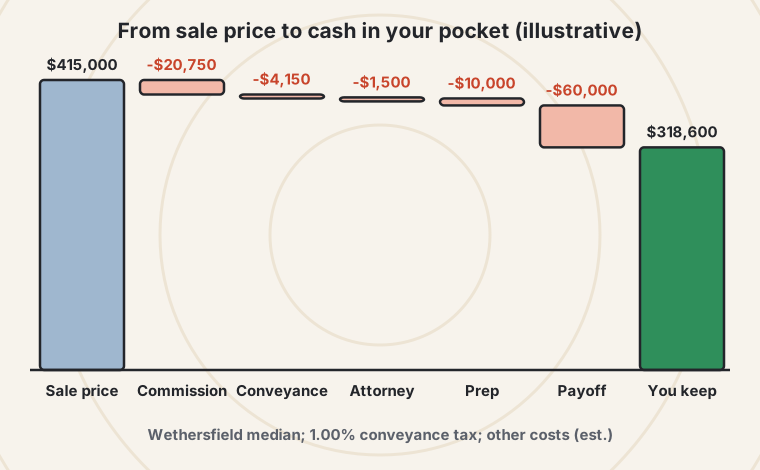
- Know your equity. Price minus commission, conveyance tax, attorney, repairs and the mortgage payoff is what you walk away with: about $318,600 in our example (illustrative).
- Most sellers owe no federal tax on the gain. The home-sale exclusion is $250,000, or $500,000 for a married couple, after 2 of the last 5 years living there (IRS Publication 523).
- There are good reasons to wait: no plan for where you will live, less than two years of ownership, a fresh loss, or a cost problem that tax relief or one repair would fix.
- Timing is a separate question. Once you decide to sell, see our guide to the best time to sell in Connecticut.
Should I sell my house in Connecticut?
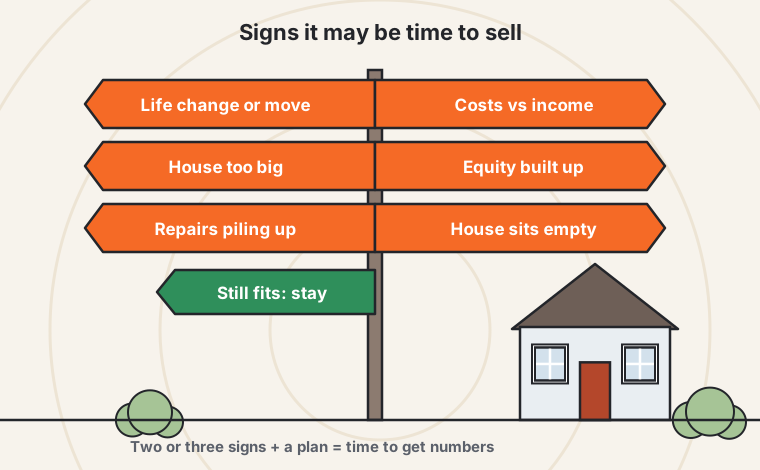
You should sell your house in Connecticut when keeping it costs you more, in money, work or peace of mind, than the life it gives you, and you have a realistic plan for where to go next. Clear signs include a move or life change, a house that is too big or too much upkeep, repairs piling up, property taxes rising against your income, and enough equity to start over. If none of those apply, staying is often the better choice.
This guide is about the decision itself: sell or stay. For the steps once you decide, see how to sell a house in Connecticut and our complete guide to selling a house in Connecticut. Below you will find the real signs, the honest reasons not to sell yet, a self-check, worked numbers from Connecticut town data, and every option, including staying.
Nobody can answer this question for you. What this page can do is turn a vague, heavy feeling into a few numbers and a short list of yes-or-no questions, so the decision becomes clearer either way.
Why is deciding to sell your house so hard?
Deciding to sell your house is hard because it mixes money, memory and fear. The house may hold decades of family life; selling can feel like admitting something has ended. At the same time the bills keep coming. Owners in this spot often feel torn, guilty, overwhelmed by everything that would need doing, afraid of choosing wrong, and unsure who to trust for advice.
Maybe the kids are long gone and you are heating four bedrooms in a Wethersfield colonial for two people. Maybe the stairs are getting harder, the roof is due, and the tax bill went up again after the town revalued. Maybe you have a job offer out of state, or your marriage has ended, or you inherited a parent’s house and you are paying for it while it sits empty.
It is normal to put the decision off. Most people do, for months or years, because every option looks like work and nobody wants to be told what to do with their home. It is also normal to be wary of anyone, including a home buyer like us, who might benefit from your answer.
This page is for you. It does not assume the answer is “sell”. It gives you the signs, the reasons to wait, and the math, and then the options, so you can decide on your own terms.
What are the real signs it is time to sell your house?
The real signs it is time to sell your house are practical, not emotional: your life has changed (a job, a marriage, a divorce, a death, health), the house is too big or too hard to keep up, repairs are piling up faster than you can pay for them, carrying costs are taking a growing share of your income, you have built enough equity to move on, or the house sits empty while you pay for it.
1. Your life has changed
A new job, a transfer, a military move, a new baby, a marriage or a divorce, a death in the family, a health change. When the reason you bought the house is gone, the house often stops fitting. If you are moving for work, our page on selling a house when relocating and the full relocation guide cover the timing. Divorce has its own rules; see selling a house during a divorce.
2. The house is too big, or too much work
Rooms you never enter but still heat, a lawn and a driveway you dread in February, stairs that worry you. Downsizing is one of the most common reasons Connecticut owners sell. Our guide to downsizing your home in Connecticut covers the move, the belongings and the money.
3. Repairs are piling up
A roof near the end of its life, a boiler on borrowed time, an old oil tank, windows, a wet basement. If the list is longer than your budget, every year makes it longer. Many Connecticut houses are old (in our town data, more than half the houses in Wethersfield, Manchester, Hamden and New Britain were built before 1960). Our page on selling a house that needs repairs explains the as-is route, and what to fix before selling covers the fix-first route.
4. The carrying costs keep rising against your income
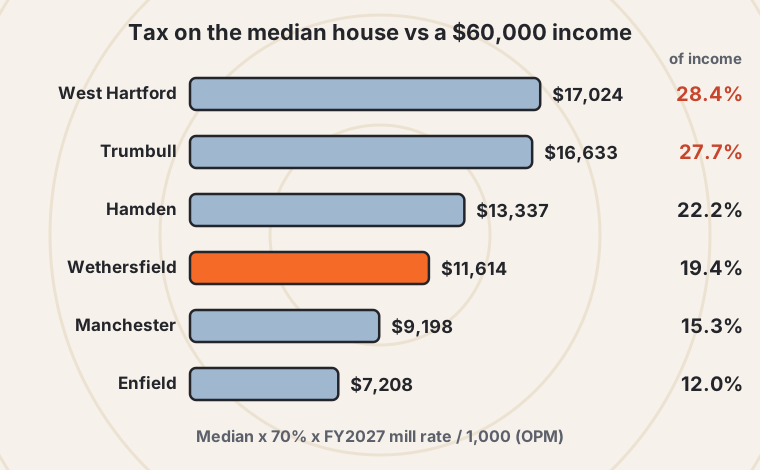
Property tax, insurance, heat and upkeep rise; a retirement income often does not. In some Connecticut towns the tax on a median house is more than a quarter of a $60,000 retirement income (see the town numbers below).
5. You have built real equity
If your mortgage is small or paid off and prices have risen, you may be able to buy something smaller outright, pay off debts, or fund the next chapter. Equity is only useful when you can reach it, and selling is one way.
6. The house sits empty
An inherited house, a house left behind after a move, a house you moved out of before it sold. Empty houses cost money every month and carry extra risk. See selling a vacant house in Connecticut and the monthly carrying costs of an empty house. If it was a parent’s house, start with selling an inherited house.
If the reason you are thinking of selling is missed mortgage payments, talk to a HUD-approved housing counselor and read our guide to stopping foreclosure in Connecticut before you decide anything. If a foreclosure has been filed, Connecticut’s court mediation program may be available (CGS 49-31l). Selling is one option among several; our page on selling before foreclosure explains when it makes sense. Never pay anyone an upfront fee to “save” your house.
What Connecticut rules and numbers should shape your decision?
The Connecticut rules and numbers that should shape your decision are the property tax formula (70% of value times the town mill rate, CGS 12-62a), the revaluation cycle that can raise it (CGS 12-62), tax relief that might make staying affordable (CGS 12-170aa), the conveyance tax you pay when you sell (CGS 12-494), the federal home-sale exclusion (IRS Publication 523) and the disclosure report every seller owes (CGS 20-327b).
| Rule or number | Why it matters for sell-or-stay | Source |
|---|---|---|
| Property tax = value × 70% × mill rate ÷ 1,000 | The biggest cost of staying that you cannot shop around | CGS 12-62a |
| Revaluation at least every five years | Your assessment, and often your tax, can jump in a revaluation year | CGS 12-62(b) |
| Elderly or disabled homeowner tax relief | Income-qualified owners can get a reduction; it may make staying affordable | CGS 12-170aa |
| Conveyance tax | Seller pays 0.75% state (up to $800,000) plus 0.25% town (0.50% in some towns) of the price | CGS 12-494 |
| Home-sale exclusion | Up to $250,000 of gain ($500,000 married) is federally tax-free after 2 of 5 years living there | IRS Publication 523 |
| Connecticut income tax on gains | Taxable gain is taxed as income in Connecticut (top rate 6.99%) | CT DRS |
| Property condition disclosure | Every seller answers the report, or credits the buyer $500 | CGS 20-327b, 20-327c |
| Attorney-run closings | Your attorney handles the closing whichever way you sell | CGS 51-88a |
| Foreclosure mediation | If a foreclosure is filed, mediation may give time to work out options | CGS 49-31l |
Two of these surprise people. First, the assessment is based on the last revaluation, not today’s price, so the tax can lag and then jump; our guide to assessed value vs. market value explains it. Second, the exclusion means most long-time owners pay no federal tax on their gain; see taxes when selling a house in Connecticut.
What does it cost to stay in your house compared with selling?
The cost of staying in your house is every bill you pay to keep it: property tax, insurance, heat and utilities, upkeep and any mortgage. In our Wethersfield example, a house at the town’s $415,000 median costs about $2,087 a month before a mortgage: $968 of property tax, plus insurance, utilities and upkeep (est.). Compare that with what your next home would cost each month; the difference is the price of staying.
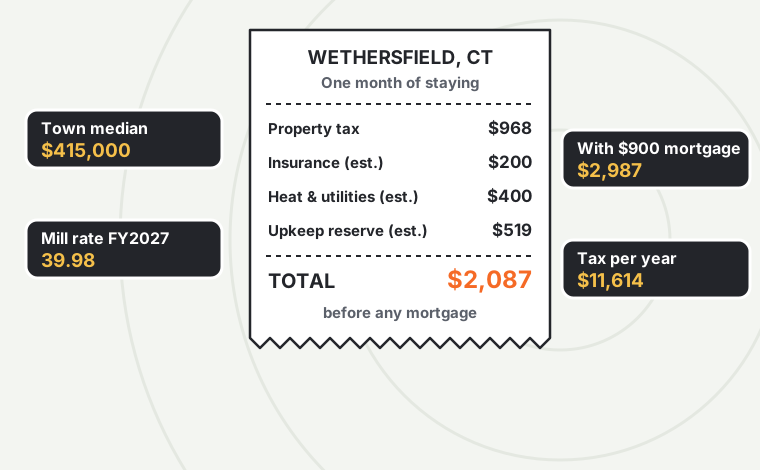
Example (illustrative), built from public numbers. A retired couple owns a colonial in Wethersfield. The town’s median single-family sale price was $415,000 (Oct 2024 to Sep 2025, OPM data) and its fiscal 2027 mill rate is 39.98.
| Monthly cost of staying | Amount | How we got it |
|---|---|---|
| Property tax | $968 | $415,000 × 70% × 39.98 ÷ 1,000 = $11,614 a year |
| Homeowners insurance | $200 | $2,400 a year (est.) |
| Heat, electricity, water | $400 | $4,800 a year (est.) |
| Upkeep reserve | $519 | 1.5% of value a year, a common planning rule (est.) |
| Total before mortgage | $2,087 | $25,039 a year (est.) |
| Mortgage payment, if any | $900 | Illustrative remaining loan payment |
| Total with mortgage | $2,987 | (est.) |
Now compare: what would a smaller house, a condo, a 55-and-over community or an apartment cost each month, all in? If it is much less, staying has a real price. If it is about the same, the decision is about space, work and life, not money.
Property tax against income, town by town
For many retired owners the property tax is the line that decides it. Here is the yearly tax on each town’s median single-family house, and what share of a $60,000 income it takes:
| Town | Median single-family price | Mill rate (FY 2027) | Yearly tax on the median (est.) | Share of a $60,000 income |
|---|---|---|---|---|
| West Hartford | $520,000 | 46.77 | $17,024 | 28.4% |
| Trumbull | $635,000 | 37.42 | $16,633 | 27.7% |
| Hamden | $355,000 | 53.67 | $13,337 | 22.2% |
| Wethersfield | $415,000 | 39.98 | $11,614 | 19.4% |
| Manchester | $320,500 | 41.00 | $9,198 | 15.3% |
| Enfield | $311,000 | 33.11 | $7,208 | 12.0% |
If your tax is a large share of a fixed income, ask your assessor about the elderly and disabled homeowner program (CGS 12-170aa) and any local relief before you decide. If relief solves it, staying may be the right answer.
How much equity would you walk away with if you sold?
The equity you would walk away with is the sale price minus the commission (if you list), the conveyance tax, your attorney, any repairs or prep, and your mortgage payoff. In our Wethersfield example, a $415,000 sale with a 5% commission (est.), the 1.00% conveyance tax, $1,500 for the attorney (est.), $10,000 of prep (est.) and a $60,000 payoff leaves about $318,600 (illustrative).
| Line | Amount |
|---|---|
| Sale price (Wethersfield median) | $415,000 |
| Commission, 5% (est.; negotiable) | −$20,750 |
| Conveyance tax, 1.00% (CGS 12-494) | −$4,150 |
| Seller’s attorney (est.) | −$1,500 |
| Prep and repairs (est.) | −$10,000 |
| Net before payoff | $378,600 |
| Mortgage payoff (illustrative) | −$60,000 |
| Cash at closing | $318,600 |
Will they owe tax on it? Say the couple bought for $160,000 and spent $40,000 on improvements, a basis of $200,000. Their gain is $378,600 − $200,000 = $178,600, well under the $500,000 exclusion for a married couple who lived there 2 of the last 5 years, so no federal tax (IRS Publication 523). Connecticut follows the federal gain, so no Connecticut tax on the excluded amount either. Check your own numbers with a tax professional.
Put your own price, payoff and town into the calculator. Try it both ways: listing with a commission and repairs, and selling as-is without them.
How much would you walk away with?
Slide the numbers to match your house. It works in your browser; nothing is saved or sent.
Estimates for planning. Conveyance tax per CGS 12-494 (state 0.75% up to $800,000, 1.25% to $2.5M, 2.25% above, plus the town rate). Seller attorney about $1,200 to $1,500; flat-fee MLS about $400; listings include three months of taxes, insurance and utilities, a cash sale about two weeks. Your attorney gives you the final numbers.
When should you NOT sell your house yet?
You should not sell your house yet if you have no realistic plan for where you will live, if you have owned and lived in it for less than two years (you may lose part of the tax exclusion), if you are within months of a major loss and still deciding under grief, or if the problem pushing you is fixable: a tax bill that relief would cut, a repair that costs less than moving, or a short-term cash squeeze.
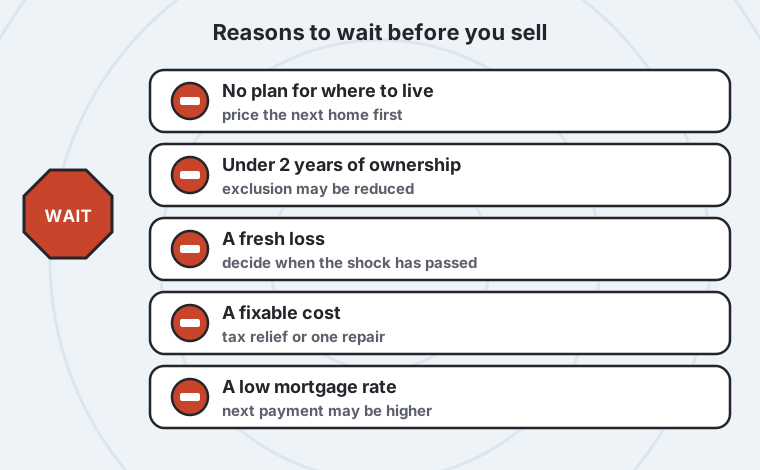
- You have nowhere to go yet. Selling without a next home in mind turns one decision into two rushed ones. Price the next home first: rent, a condo, a 55-and-over community, living with family.
- You have lived there under two years. The full exclusion needs 2 of the last 5 years of ownership and use; a reduced exclusion may apply for a job move, health or unforeseen circumstances (IRS Publication 523).
- You have just lost someone. Unless money forces it, many families wait until the first shock has passed before deciding about a home. A house can be secured and held for a while; see the carrying-cost guide for what that costs.
- The cost problem is fixable. Tax relief (CGS 12-170aa), a veterans exemption, energy assistance or a single repair may fix what feels like a reason to sell.
- Your mortgage rate is far below today’s. If you would replace a low-rate loan with a much higher one on your next home, the monthly cost can rise even in a smaller house. Do that math before you list.
- You are only reacting to the market. Selling because prices are “high” means buying in the same market. If you want the best season, read the best time to sell a house in Connecticut; this page is about whether, not when.
How do you know if you are ready to sell? A self-check
You know you are ready to sell when you can answer yes to most of a short list: you know where you will live next, you know roughly what the house is worth and what you would net, the monthly cost of staying is higher than the next home, the repairs ahead are more than you want to fund, and the people who share the decision agree. Tick the boxes below; three or more yeses usually means it is time to get real numbers.
- I know where I will live next and roughly what it will cost each month.
- The house is bigger, or more work, than I need or want.
- There are repairs coming in the next two years that I do not want to pay for or manage.
- Property tax, insurance and utilities take a bigger share of my income every year.
- I have owned and lived in the house for at least 2 of the last 5 years.
- I have a rough idea of my equity (price minus selling costs and mortgage).
- My spouse, co-owner or family agree, or at least are ready to talk numbers.
- A life change (job, health, family, divorce, a death) means the house no longer fits.
- The house is empty, or soon will be, and costs me money every month.
- I would feel relief, not only sadness, if the house were sold.
If you ticked three or more, the next step is a number, not a commitment: a comparative market analysis from a local agent, a net-proceeds estimate, and if you like, a written as-is offer to compare.
Is a cash sale right for you, or should you list?
Seven quick questions. There is no wrong answer, and we will tell you honestly if listing would leave you more.
- Does the house need repairs you would rather not pay for or manage?
- Do you need to close by a certain date, or within the next month or two?
- Would showings be hard: tenants, belongings, privacy, or you live out of state?
- Is there a complication: an estate or probate, a divorce, foreclosure, liens or back taxes?
- Could you comfortably cover the mortgage, taxes and utilities for three or more months?
- Is getting the highest possible price more important to you than speed and certainty?
- Would a buyer's bank lend on the house as it is (no major roof, foundation, oil tank or code issues)?
What are your options if you decide to sell, or to stay?
Your options if you decide to sell are to list with an agent, fix up and then list, sell it yourself, or sell as-is for cash. If you decide to stay, you can adapt the house, apply for tax relief, rent out part of it, or plan a sale date a year or two out. The best option depends on the house’s condition, your timeline and how much work you want to take on.
List with an agent
Usually the highest priceBest for a house in good shape when you have a few months.
- Reaches the most buyers
- Commission, prep and showings
- Buyer’s appraisal and inspection
Fix up, then list
More money, more workFits when a few repairs clearly add more than they cost.
- You fund the repairs
- Months of carrying costs
- Works best with time and energy
Sell as-is for cash
About 2 weeks, or your dateFits when repairs, an empty house or a fixed date make listing hard.
- No repairs, no showings, no fees
- Leave what you do not want
- Price below a fixed-up listing
Stay and adapt
No moveMakes sense if the house still works with changes and help.
- Tax relief, a first-floor bedroom, help with upkeep
- Costs and repairs stay with you
- Revisit the decision each year
Selling it yourself is also possible in Connecticut; our guide to selling without an agent covers the steps and paperwork. For a side-by-side of the two most common routes, see cash buyer vs. realtor in Connecticut.
When you should NOT sell to a cash buyer
If your house is in good condition, you have a few months and you are comfortable with showings, listing will very likely put more money in your pocket than a cash offer, even after the commission. We will tell you that if it is true for your house. A cash sale earns its place when the repairs, the cleanout, an empty house, a fixed move date or simple exhaustion make the listing route more than you want to take on.
What does selling your house look like, step by step?
Selling your house in Connecticut, once you decide, looks like this: get a realistic value and a net number, choose the route, sign a contract your attorney reviews, sign the disclosure documents, and close at an attorney’s office or by mail. A listed sale typically takes a few months from listing to closing; an as-is cash sale typically closes in about two weeks from a signed contract, or on the date you choose.
Get two numbers
A comparative market analysis from a local agent and, if you are considering it, a written as-is offer. Run both through the net calculator above.
Talk to the people involved
Spouse, co-owners, children, your attorney, a tax professional if your gain is large. Decide together what “enough” looks like.
Pick the route and the date
Listing: plan for prep, showings and the buyer’s financing. Cash: pick your closing date; we can close in about two weeks or wait until your next home is ready.
Your attorney reviews the contract
Connecticut closings are conducted by attorneys (CGS 51-88a). Yours checks the price, the dates and what you may leave behind. You complete the property condition report (CGS 20-327b).
Close and move on
Your mortgage is paid off from the proceeds and you receive the rest. With us there are no repairs, no showings and no fees, and you take what you want and leave the rest.

The owners who feel best after a sale are the ones who decided where they were going before they decided to sell. When the next place is chosen, the price, the date and what to take all fall into place. The owners who struggle are the ones who sold because one bill scared them. Write down your monthly cost of staying and your monthly cost of the next place. If the gap is big, you have your answer. If it is small, take your time.
I am Jerryll Noorden. I have bought Connecticut houses since 2016. If you want an honest second opinion, including “stay put”, call me at (203) 529-4712. There is no obligation and the offer, if you want one, does not expire while you decide.
See the house together.
Pick a time that works.
Choose a time for us to walk through the property with you, or ask for a quick call first. We confirm every request personally.
Tuesday, January 13
No open times in the next few weeks. Please call us.
We will confirm by email. Nothing is booked until we do.
View my requestQuestions Connecticut homeowners ask about whether to sell
How do I know if I should sell my house?
You know you should sell your house when it no longer fits your life or your budget and you have a plan for what comes next. Common signs: a life change, a house that is too big, repairs you cannot fund, and carrying costs rising against your income.
What are the signs it is time to sell your house?
The signs it is time to sell your house are a job or family change, too much space or upkeep, repairs piling up, property tax and insurance taking a growing share of income, strong equity, or a house sitting empty while you pay for it.
Is it better to sell or stay in my house?
It is better to sell than stay when the monthly cost of staying is clearly higher than your next home and the house no longer fits. It is better to stay when you have no plan for where to go, have owned under two years, or the problem is fixable.
When is the best time to sell a house in Connecticut?
The best time to sell a house in Connecticut is usually spring, when more buyers are looking, but your own timeline matters more. Our guide to the best time to sell covers Connecticut monthly sales and prices in detail.
How much will I make if I sell my house?
You will make the sale price minus the commission, the conveyance tax, your attorney, repairs and your mortgage payoff. On a $415,000 Wethersfield sale with a $60,000 payoff, that is about $318,600 in our illustrative example.
Do I pay tax when I sell my house in Connecticut?
You usually pay no federal tax when you sell your main home if the gain is under $250,000, or $500,000 for a married couple, and you lived there 2 of the last 5 years (IRS Publication 523). Connecticut taxes any taxable gain as income. The seller also pays the conveyance tax.
Should I sell my house before I retire?
You should sell your house before you retire if the costs of keeping it would take too large a share of your retirement income, or if you plan to move anyway. Compare the tax, insurance and upkeep with your expected income, and check Connecticut’s elderly homeowner tax relief first.
Is it worth selling a house that needs repairs?
It is worth selling a house that needs repairs when the repairs cost more than you want to spend or manage. You can fix and list, list as-is, or sell as-is for cash. Compare the net from each, including months of carrying costs.
Should I sell my house if property taxes are too high?
You should consider selling if property taxes are too high for your income and relief does not fix it. First ask your assessor about the elderly and disabled homeowner program (CGS 12-170aa), veterans exemptions and local relief, and check whether your assessment is correct.
What if I sell my house before two years?
If you sell your house before two years of ownership and use, you may owe tax on the gain, but a reduced exclusion may apply if you moved for work, health or unforeseen circumstances (IRS Publication 523). Ask a tax professional before you sign.
Can I sell my house and rent instead?
You can sell your house and rent instead, and many downsizers do. Renting frees your equity and removes repairs and property tax, but rent can rise. Compare your monthly cost of staying with the rent you would pay.
Should I fix my house before selling or sell as-is?
You should fix your house before selling only when the repairs clearly add more to the price than they cost, and you have the time and money. Otherwise selling as-is, listed or to a cash buyer, avoids the work and the months of carrying costs.
How long does it take to sell a house in Connecticut?
It takes a few months to sell a house in Connecticut with an agent, from prep and listing to closing, depending on the town and season. An as-is cash sale typically closes in about two weeks from a signed contract.
Will a cash buyer pay less than an agent can get?
A cash buyer usually pays less than an agent can get for a house in good condition, because the buyer takes on repairs, holding costs and resale risk. The gap narrows when the house needs significant work. Compare the net numbers, not the headline prices.
Related Connecticut guides
Deciding and timing
Your situation
We buy houses across Connecticut, including Wethersfield, West Hartford, Hamden, Manchester, Enfield and Trumbull. For the whole process, see how to sell your house in Connecticut step by step.
Plain-English information, not financial, tax or legal advice. Examples are illustrative and labelled; estimates are marked (est.). Use your own bills and talk to a tax professional or Connecticut attorney about your situation.
Sources
- CGS §§ 12-62 and 12-62a (revaluation; 70% assessment ratio).
- CGS § 12-170aa (tax relief for elderly or totally disabled homeowners).
- CGS § 12-494 (conveyance tax).
- CGS §§ 20-327b and 20-327c (property condition disclosure report).
- CGS § 51-88a (attorneys conduct closings).
- CGS § 49-31l (foreclosure mediation program).
- IRS Publication 523, Selling Your Home (exclusion, reduced exclusion, basis and gain).
- Connecticut Department of Revenue Services (income tax on gains).
- HUD-approved housing counselors.
- Connecticut OPM real estate sales data on data.ct.gov and fiscal 2027 town mill rates (OPM), as shown on our town pages.

Who wrote this
Jerryll Noorden
Jerryll has bought and sold Connecticut houses since 2016 and has sat at more closing tables than he can count, on both sides. Before real estate he was a robotics scientist at NASA, IHMC and IIT. He wrote this guide because the national sites that rank for it skip the Connecticut rules that cost sellers money. When listing or selling it yourself would get you more than a cash offer, he says so.
This guide explains Connecticut rules in plain English. It is not legal or tax advice. Laws change; for your sale, talk to a Connecticut real estate attorney and a tax professional.
